Studies on first language (L1) speech processing have demonstrated that presenting words in acoustically varied formats can negatively affect performance on L1 speech processing tasks such as vowel perception (Assmann, Nearey, & Hogan, 1982), word recognition, and word naming (Mullennix, Pisoni, & Martin, 1989; Sommers & Barcroft, 2006). These negative effects have been obtained using talker characteristics, speaking rate, and speaking style (e.g., whispered, conversational, excited) as sources of acoustic variability. Other research, however, has demonstrated that not all sources of variability have negative effects on L1 speech processing. Sommers, Nygaard, and Pisoni (1994), for example, found null effects for amplitude variability on L1 word identification, and Sommers and Barcroft (2006) found similar null effects for fundamental frequency (F0) variability.
In contrast to the negative effects of acoustic–phonetic variability on L1 processing, recent experiments (Barcroft & Sommers, 2005) have found positive effects for at least some sources of variability on L2 vocabulary learning. Of particular importance to the current study, Barcroft and Sommers reported that two sources of variability that have been shown to have negative effects on L1 speech perception—talker and voice-type variability—have positive effects on L2 vocabulary acquisition. Findings from these two different areas of research raise the following questions: (a) Do sources of variability that have no effect on L1 speech processing (overall amplitude, F0) also have no effect on L2 vocabulary learning? (b) Do other sources of variability that impede L1 speech processing (e.g., speaking rate) also produce improved L2 learning?
The present study examined the effects of these three sources of variability—overall amplitude, F0, and speaking rate—on L2 vocabulary learning. The broader goal of the study was to obtain additional empirical evidence regarding the processing of acoustic–phonetic variability in L1 and L2 and thereby begin to develop a comprehensive account of how the speech perception and language acquisition systems accommodate and use indexical (i.e., nonlinguistic) information.
REVIEW OF LITERATURE
Acoustic variability and L1 speech processing
To date, most research on acoustic variability has focused on L1 speech perception and spoken word recognition. A number of studies, for example, have demonstrated that when listeners are presented with speech signals that vary in certain source characteristics, the resultant acoustic–phonetic variability can impair identification performance (Mullennix et al., 1989; Sommers et al., 1994; Nygaard, Sommers, & Pisoni, 1995; Bradlow, Nygaard, & Pisoni, 1999; Sommers & Barcroft, 2006). In one of the earliest studies on stimulus variability and L1 speech perception, Mullennix et al. (1989) found that trial-to-trial changes in talkers resulted in poorer spoken word recognition compared to conditions in which the same talker spoke all the items. Sommers et al. (1994) extended these findings by demonstrating that a source of intraspeaker variability, trial-to-trial changes in speaking rate, also produced approximately a 15% decline in identification performance compared to conditions in which all words were spoken at the same rate. Finally, Sommers and Barcroft (2006) found that trial-to-trial variations in speaking style reduced overall word identification performance, compared to conditions containing no speaking-style variability. These combined findings suggest that talker characteristics, speaking style, and speaking rate are sources of variability that negatively affect performance in L1 speech processing.
Not all sources of variability, however, have been found to impair L1 speech processing. Sommers et al. (1994) reported that variations in overall amplitude had no significant effect on L1 spoken word identification. In their explanation of these findings, Sommers et al. suggested that acoustic variability will impair spoken word identification only if the source of variability in question alters phonetically relevant properties of the speech signal. According to this proposal, trial-to-trial variations in talker characteristics, speaking style, and speaking rate affect phonetic perception because each produces changes in acoustic features, including formant frequencies and transitions that are important cues for phonetic identification. Variations in overall amplitude, in contrast, do not affect acoustic properties that serve as the primary cues for identifying spoken words and, according to Sommers et al., therefore will not impede L1 speech perception. Further evidence for this hypothesis was provided by Sommers and Barcroft (2006), who found that variations in F0, without concomitant changes in formant frequencies or transitions, did not significantly affect performance on spoken word identification by native speakers of English. Taken together, the findings are consistent with what we will term the phonetic-relevance hypothesis for L1 speech processing. According to this hypothesis, accommodating for sources of variability that affect phonetically relevant properties of speech signals requires additional perceptual operations and therefore greater cognitive effort, with observable costs for L1 speech perception. In contrast, sources of variability that do not have direct effects on phonetically relevant acoustic properties are processed more automatically (e.g., by a mechanism analogous to an automatic gain control in the case of amplitude variability) so as not to incur the same type of perceptual costs associated with processing phonetically relevant features of speech.
Acoustic variability and L2 vocabulary learning
Interestingly, research on acoustic variability and L2 vocabulary learning has demonstrated that sources of variability associated with costs during L1 speech processing can produce positive effects on L2 vocabulary learning (Barcroft & Sommers, 2005). Barcroft and Sommers examined the effects of variability in speaking style1
The six speaking styles used in this experiment were conversational, nasal, whispered, elongated, excited, and pitch shifted.
In addition to these positive findings for L2 vocabulary learning, researchers also have found acoustically varied presentation formats to be effective for teaching L2 phonemic contrasts, such as when training native Japanese speakers on the English contrast between liquid consonants /r/ and /l/, compared to acoustically consistent presentation formats (Bradlow, Pisoni, Akahane-Yamada & Tokura, 1997; Lively et al., 1994; Lively, Logan, & Pisoni, 1993; Logan, Lively, & Pisoni, 1991; see also Hardison, 2003). These findings demonstrate that at least one source of acoustic variability (talker variability) can improve memory for novel phonetic forms and speak further to the positive role that variability can play in L2 speech processing.
An integrated explanation of the effects of acoustic variability
To summarize, research on L1 speech processing indicates that talker characteristics, speaking style, and speaking rate are sources of variability that negatively affect performance on a variety of tasks assessing L1 speech perception, whereas overall amplitude and F0 are sources of variability that have little or no effect on these same measures. Complementing these findings, research on L2 vocabulary learning indicates that talker characteristics, and speaking style are sources of variability that positively affect L2 vocabulary learning. Taken together, therefore, the extant literature suggests that two sources of variability that negatively affect performance on L1 speech processing (talker and speaking style) have positive effects on L2 vocabulary learning.
The purpose of the present study was to investigate further how L2 vocabulary learning is affected by sources of variability that either do (speaking rate) or do not (overall amplitude, F0) affect L1 speech perception. Recall that according to the phonetic-relevance hypothesis only phonetically relevant sources of variability have negative effects on L1 processing. We propose an extended version of this hypothesis based on the idea that only phonetically relevant sources of variability will positively affect L2 vocabulary learning.
Thus, in the first two experiments we examined the effects of variability in overall amplitude (Experiment 1) and F0 (Experiment 2) on L2 vocabulary learning. The phonetic relevance hypothesis would predict that neither of these sources of variability should affect L2 vocabulary learning because neither affects phonetically relevant properties of speech. Speaking-rate variability, in contrast, has been shown to impair L1 speech processing and the phonetic-relevance hypothesis would therefore predict beneficial effects of rate variability on L2 vocabulary learning. This prediction was tested in Experiment 3.
In each of the three experiments, L2 vocabulary learning was measured based on recall of target words in L2 when cued by a picture and recall of target words in L1 when cued by the L2 word. Both of these measures were included to increase the generalizability of the findings by examining the effects of variability on both a more productively oriented measure of L2 word knowledge (picture to L2 recall, in which production of the target word form is required) and a more receptively oriented measure of L2 word knowledge (L2 to L1 recall, in which production of the target word form is not required). To examine both the main effects and interactions with recall type both measures were included in the analyses. Latency (in addition to accuracy) was also measured in each experiment as a potentially more sensitive index of the effects of acoustic variability.
EXPERIMENT 1: AMPLITUDE VARIABILITY
Participants
The participants were 60 native speakers of English with no previous formal instruction in Spanish. All of the participants were undergraduate psychology students at a private midwestern university in the United States. None of the participants reported a history of speech or hearing difficulties. Participants received credit related to requirements of their psychology class for their participation.
Experimental words
The experimental words used were 24 Spanish concrete nouns divided into three groups. Each word group had either 20 or 21 syllables. Words 1 to 8 were hongos (mushrooms), oso (bear), reloj (clock), tijeras (scissors), sandía (watermelon), cuaderno (notebook), ardilla (squirrel), and cinta (tape). Words 9 to 16 were fresas (strawberries), tiza (chalk), caballo (horse), manzana (apple), cebolla (onion), elote ([ear of] corn), lechuga (lettuce), and grapadora (stapler). Words 17 to 24 were loro (parrot), pato (duck), lápiz (pencil), conejo (rabbit), gato (cat), naranja (orange), basurero (garbage can), and pez (fish). The experimental words were the same as those used by Barcroft and Sommers (2005). The words were grouped so that semantic categories (animals, fruits and vegetables, classroom items) would be mixed and so that the average number of syllables in each word group was approximately the same. The average number of syllables was 2.5 for Words 1 to 8, 2.63 for Words 9 to 16, and 2.63 for Words 17 to 24.
All of the target words had been previously recorded from a male native speaker of Mexican Spanish in a sound-attenuating booth. Stimuli were recorded using a sampling rate of 44.1 kHz and 16-bit resolution. The native speaker was instructed to read the list of the 24 target words in four different speaking styles: neutral or conversational voice, excited voice, whispered voice, and nasal voice. Only the stimuli produced in neutral voice were used for this study. The overall amplitude of the 24 words was adjusted so as to produce six variants of each word, with root mean squared amplitude values ranging from 65 to 90 dB SPL in 5-dB increments.2
A pilot experiment was conducted to ensure that the amplitude differences used in the main experiment were discriminable to young adult listeners. In the pilot study, 20 young adults (none of whom took part in the main experiment) were presented with pairs of words over headphones, with 500 ms of silence separating the two words in each pair. Participants were first asked to indicate whether the word pairs had the same or different amplitudes. For “different” responses, they were also asked to indicate whether the second member of the pair was “louder or softer than the first.” The participants were presented with a total of 120 trials (word pairs), of which 60 had the same amplitude and 60 had different amplitudes. The 60 pair with the same amplitude consisted of 10 presentations each of the six same-amplitude pairs (e.g., 65–65, 70–70, etc.). The 60 different-amplitude trials consisted of the five pair that had the smallest (5 dB SPL) overall amplitude difference (i.e., 65–70, 70–75, etc.). For half of the different trials the first word in the pair had the higher amplitude, and for half the second word in the pair had the higher amplitude. The specific word presented on a given trial was selected randomly from the 24 words that were going to be used in the main experiment and all pairs contained the same word. Overall accuracy was extremely high, with mean percent correct for same pairs at 98.5 (SD = 1.4) and mean percent correct for different pairs at 96.3 (SD = 2.1). Accuracy for decisions about the relative loudness of the two stimuli when participants indicated an amplitude difference between pairs was approximately 97.4%. These findings suggest that even the smallest amplitude differences were clearly perceptible to participants in this population.
Procedures
Participants were tested individually in a quiet room according to three procedures. In the learning phase, each participant sat in front of the computer screen and viewed six repetitions of 24 pictures while hearing the spoken form of the Spanish word for each picture. Each picture appeared on the screen for 5 s. In each case, the target Spanish word was spoken 750 ms after the picture appeared. Each participant attempted to learn eight words in each of the following three learning conditions: (a) no variability, or six repetitions at one amplitude level; (b) moderate variability, or two repetitions each at three amplitude levels; and (c) high variability, or one repetition each at six amplitude levels. In the no-variability condition, each of the six amplitude values served as the no-variability stimuli for 10 participants (i.e., for 10 participants all of the stimuli in the no variability were presented at the 65 dB SPL level, for a different set of 10 participants they were presented at the 70 dB SPL level, etc.). For the moderate variability condition, half of the participants heard the stimuli (two presentations of each word at each level) at levels of 65, 75, and 85 dB SPL and the other half heard the stimuli presented at 70, 80, and 90 dB SPL (again, two presentations of each word at each level). This counterbalancing kept the range of amplitude values at 20 dB for each group and allowed equal numbers of presentations at each amplitude.
Word groups and presentation orders were counterbalanced across learning conditions in the following manner. Twenty participants received Words 1 to 8 with no variability, Words 9 to 16 with moderate variability, and Words 17 to 24 with high variability. Twenty participants received Words 1 to 8 with high variability, Words 9 to 16 with no variability, and Words 17 to 24 with moderate variability. Twenty participants received Words 1 to 8 with moderate variability, Words 9 to 16 with high variability, and Words 17 to 24 with no variability. Within a word group, order of presentation was constant across the six repetitions (e.g., in the no-variability condition, participants heard all eight words repeated in the same order at the same amplitude, for each of the six repetitions). In the moderate- and high-variability conditions, the amplitude level associated with a particular presentation was selected pseudorandomly (i.e., participants always heard the words in the same order but the amplitude level associated with that item was selected randomly without replacement). We presented six repetitions of the eight words within each condition, given that prior research (Barcroft, 2001; Barcroft & Sommers, 2005) has reported that this method produced overall performance levels that did not approach either floor or ceiling.
The picture-to-L2 recall posttest was administered immediately after the learning phase. All participants performed the picture-to-L2 recall task prior to the L2-to-L1 recall task to avoid additional exposure to the spoken L2 word forms (cues for the L2-to-L1 recall task were the spoken L2 word forms). For the picture-to-L2 recall posttest, the participants attempted to produce the Spanish word for each picture. The picture for each target word appeared on the screen in a random order different from the order used during the learning phase. A voice key was used to measure response latencies, which extended from the onset of the picture cue to the participant's initial vocalization of the word. Each picture appeared on the screen for a maximum of 10 s or until the participant provided a spoken response.
The L2-to-L1 recall posttest was administered after the cued L2 recall. For this posttest, participants heard Spanish words and were asked to provide the English translation of each word. All of the L2 word cues were presented at 78 dB SPL, which was approximately the average of the six amplitude levels used in the learning phase but was also a novel level for all participants. The order of the Spanish words was a random order different from the orders used for the learning phase and for the picture to L2 recall task. Participants were given a maximum of 10 s to provide the appropriate English translation for each word they heard.
Scoring
The criteria used to score the picture-to-L2 recall and L2-to-L1 recall was 1 point for a completely correct production, 0.5 points for errors in a single syllable, and 0 for all other responses. In the case of L2-to-L1 recall, the 0.5 score was never used because participants did not make any phonetic errors in their L1.
Analyses
Latencies for trials receiving a score of 0 on the accuracy measure were excluded from the analyses. Latencies exceeding 2.5 SD of the mean of individual conditions were also excluded from the analyses as outliers. Scores were submitted to two repeated-measures analyses of variance (ANOVAs). In the first ANOVA, condition (no, moderate, high variability) and recall type (picture to L2, L2 to L1) were within-subjects independent variables, and accuracy was the dependent variable. In the second ANOVA, condition (no, moderate, high variability) and recall type (picture to L2, L2 to L1) was a within-subjects independent variable, and reaction time was the dependent variable. The α value was set at .05 for all statistical analyses.
Results and discussion
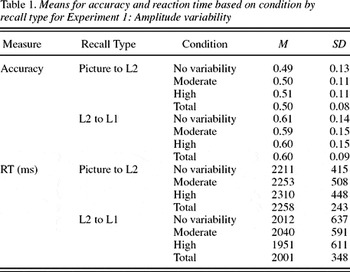
Means for accuracy and reaction time based on condition and recall type appear in Table 1. The ANOVA based on accuracy revealed that recall scores were higher for the L2-to-L1 recall task than for the picture to L2 task, F(1, 59)=51.82, p<.001, η2 = .468. Of particular importance to the phonetic-relevance hypothesis, however, there was no significant effect of condition, F(2, 118)=.39, p=.680, η2 = .007, nor did condition interact with recall type. The ANOVA based on reaction time also indicated that participants were faster for the L2-to-L1 recall task than for the picture-to-L2 task, F(1, 59)=21.36, p<.001, η2 = .266, but failed to reveal a significant effect for condition, F(2, 118)=.12, p=.887, η2 = .002, or a significant interaction between condition and recall type.

The findings of Experiment 1 are consistent with the predictions of the phonetic-relevance hypothesis, which predicts null effects for amplitude variability on both L1 speech processing and L2 vocabulary learning. Before considering explanations that attempt to integrate findings on acoustic variability from both L1 and L2, however, we wanted to investigate further the generality of the phonetic relevance hypothesis by examining at least one other factor that has been shown to have null effects on L1 speech perception, namely, variations in F0. The phonetic relevance hypothesis would predict that introducing variability in F0 without altering phonetically relevant speech parameters would not significantly affect L2 vocabulary learning among native speakers of English. Experiment 2 tested this hypothesis by examining whether F0 variability would have an effect on L2 vocabulary learning.
EXPERIMENT 2: F0 VARIABILITY
Participants
The participants were 60 native speakers of English with no previous formal instruction in Spanish from the same participant pool as Experiment 1. All of the participants were undergraduate psychology students at a private midwestern university in the United States. None of the participants reported a history of speech or hearing difficulties, and none had participated in Experiment 1. Participants received credit related to requirements of their psychology class for their participation.
Experimental words and F0 variations
The experimental words used were the same as those used in Experiment 1. They were the same spoken forms of the words produced by the same male native speaker. Six new instances of each word were created by changing the F0 of the stimuli produced in the neutral or conversational voice. The average F0 of the unmodified words was 127 Hz. The six new instances of each word were created by both increasing and decreasing the F0 of the neutral-voice stimuli by 10, 20, and 30%. Thus, mean F0 in the modified stimuli ranged from approximately 90 Hz (30% decrease in F0) to 140 Hz (30% increase in F0). These values are well within the range of previously measured F0 values for adult males (Baken, 1987). This type of change in F0 in which F0 is altered without concomitant changes in formant frequencies is not contrastive in English, and results of a recent study (Sommers & Barcroft, 2006) revealed no effects of this type of variability on L1 speech perception. The changes in F0 were implemented using digital signal processing so as to produce changes in overall voice pitch without varying formant frequencies or transitions. To ensure that the F0 changes did not significantly alter formant frequencies, formant tracks were generated for the original stimuli and the six variants of each word. The individual formant tracks were used to compute mean formant frequencies for the first four formants of the original version and the six F0-altered variants. In all cases, differences between the original and F0-altered formants were less than 1%.3
To determine if the differences in F0 were perceptually salient to listeners, we conducted a pilot study analogous to the one conducted for Experiment 1, with the following exceptions. First, on each trial participants were presented with two identical Spanish words and had to decide whether the two words “had the same overall voice pitch.” For “same” trials participants heard 18 presentations for each of the six different voice pitches (e.g., participants heard the 10% increase in F0 paired with the 10% increase in F0 18 times). On the remainder of the trials, participants again heard two repetitions of the same word but differing by 10% in F0. Participants received 27 trials for each of these pairs with counterbalancing and stimulus selection analogous to the pilot study for Experiment 1. Mean percent correct for same-F0 and different-F0 trials were 98.1 and 99.2, respectively. For correct “different” trials, mean percent correct for determining whether the second stimulus was higher or lower in pitch was approximately 96.4%. The results of the pilot study suggest that the 10% change in F0 was readily detectable by participants and that listeners were able to judge the relative voice pitch of two stimuli differing by 10% in F0.
Procedures
The procedures were the same as those as in Experiment 1 with the following exceptions. The no-variability condition consisted of six repetitions of the 24 L2 words at one F0, the moderate variability consisted of two repetitions each at three F0s, and the high-variability condition consisted of one repetition each at the six F0 values. Similar to Experiment 1, in the no variability condition 10 participants heard one of the six different F0 values (e.g., for 10 participants the no variability condition contained the 10% increase in F0, for another 10 it contained, the 10% decrease in F0, etc.). In the moderate-variability condition, half of the participants heard two repetitions each with the +10, −20, and +30 changes in F0 and half heard two repetitions each with −10, +20, and −30 changes in F0. In the moderate- and high-variability conditions, the F0 level associated with a particular presentation was selected pseudorandomly (i.e., participants always heard the words in the same order but the F0 level associated with that item was selected randomly without replacement).
The dependent measures for Experiment 2 were the same as those in Experiment 1: accuracy and latency of picture-to-L2 and L2-to-L1 recall. For the L2-to-L1 recall task, the L2 cue was always presented with the unmodified F0 (i.e., the one obtained during initial recording) so that the F0 of the cue was novel for all participants. Scoring and analyses paralleled those used in Experiment 1.
Results and discussion
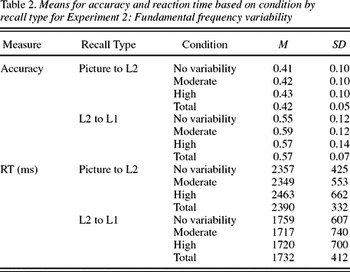
Means for accuracy and reaction time based on condition and recall type appear in Table 2. The ANOVA based on accuracy data revealed a significant main effect for recall type, F(1, 59)=192.60, p<.001, η2 = .766, with higher accuracy for the L2-to-L1 than for the picture-to-L2 task. Neither the effect of condition, F(2, 118)=1.80, p=.17, η2 = .030, nor the interaction between condition and recall type, reached statistical significance. The ANOVA based on reaction time also revealed significantly faster response latencies for the L2-to-L1 than for the picture-to-L2 task, F(1, 59)=106.32, p<.001, η2 = .643, but no significant effect for condition, F(2, 118)=.25, p=.781, η2 = .004, and no significant interaction between condition and recall type.

As with Experiment 1, the findings of Experiment 2 are consistent with the predictions of the phonetic-relevance hypothesis, which predicts null effects for F0 variability on both L1 speech processing and L2 vocabulary learning among native speakers of English. One obvious concern, however, is that support for the theory from Experiments 1 and 2 is based on null results. Therefore, in Experiment 3 we examined the effects of another source of variability, variations in speaking rate, on L2 vocabulary learning. Changes in speaking rate alter phonetically relevant properties of the speech signal, including formant center frequencies and formant transition durations. Consistent with the phonetic relevance hypothesis, Sommers et al. (1994) reported that trial-to-trial variations in speaking rate have negative effects on identification of L1 words compared with conditions in which speaking rate remained unchanged. Therefore, the phonetic relevance hypothesis would predict that variations in speaking rate would have positive effects on L2 vocabulary learning.
EXPERIMENT 3: SPEAKING-RATE VARIABILITY
Participants
The participants were 60 native speakers of English with no previous formal instruction in Spanish from the same participant pool as Experiments 1 and 2. All of the participants were undergraduate psychology students at a private midwestern university in the United States. None of the participants reported a history of speech or hearing difficulties and none had participated in either Experiment 1 or 2. Participants received credit related to requirements of their psychology class for their participation.
Stimuli
The experimental words used were the same as those used in Experiments 1 and 2. They were the same spoken forms of the words produced by the same male native speaker. Variations in speaking rate were introduced by digital compression and expansion of the neutral-voice utterances. Specifically, the neutral-voice recordings were compressed (producing faster speaking rates) and expanded (producing slower speaking rates) by 10, 20, and 30%. Compression and expansion of the signals were achieved by duplicating (expansion) or deleting (compression) the appropriate number (depending on desired compression/expansion rate) of 10-ms segments from the neutral (unaltered) stimuli. The duplication (or deletion) was restricted to steady-state portions of the signal (primarily vowels) that were identified by visual inspection of the waveform and spectrogram. The altered segments always started and ended at zero crossings in the waveform, and we specifically avoided altering transition or burst information. This method of altering speaking rate allows for compression and expansion of the signal without producing changes in F0. In addition, Sommers and Barcroft (2006) found that this method of varying speaking rate produced decrements in L1 identification performance that were equivalent to those produced by natural speaking-rate variations. The mean duration for the unmodified stimuli was 747 ms (SD = 113 ms), giving an overall range of 522 to 971 ms for the rate-altered stimuli.4
As in Experiments 1 and 2, a pilot study was conducted to ensure that the changes in speaking rate were clearly perceptible to participants. The design of the pilot experiment was similar to the one used in Experiment 2, except that speaking rate rather than F0 was manipulated. Twenty participants received a total of 216 trials, half having the same speaking rate and half having a 10% change in speaking rate. Mean percent correct for same-rate and different-rate trials was 98.1 and 99.2, respectively. Mean percent correct for the faster–slower judgment on correct different trials exceeded 99%. The results of the pilot study suggest that the 10% change in speaking rate was readily detectable by participants and that listeners were able to judge differences in the relative speaking rate of two successive stimuli.
Procedures
The procedures were the same as those as in Experiment 1 with the following exceptions. The no-variability condition consisted of six repetitions at one speaking rate; the moderate-variability condition consisted of two repetitions each at three speaking rates; and the high-variability condition consisted of one repetition each at six speaking rates. In the no-variability condition, 10 participants heard one of the six speaking rates (i.e., for 10 participants, the no-variability condition consisted of six repetitions of words with a 10% increase in speaking rate, for another 10 participants the no-variability condition contained words with a 20% increase in speaking rate, etc.). In the moderate-variability condition, half of the participants heard two repetitions each of the 10% increase, 20% decrease, and 30% increase and the other half heard two repetitions each of the 10% decrease, 20% increase, and 30% decrease. In the moderate- and high-variability conditions, the speaking rate associated with a particular presentation was selected pseudorandomly (i.e., participants always heard the words in the same order but the speaking rate associated with that item was selected randomly without replacement). Cues for the L2-to-L1 recall task were the unaltered stimuli presented at the speaking rate obtained in the original recordings. Scoring and analyses paralleled those of the first two experiments.
Results and discussion
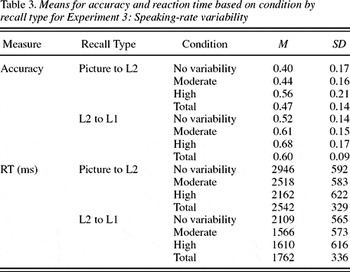
Means for accuracy and reaction time based on condition and recall type appear in Table 3. The ANOVA based on accuracy revealed significant main effects for condition, F(2, 118)=41.86, p<.001, η2 = .415, and for recall type, F(1, 59)=35.62, p<.001, η2 = .376, but no significant interaction between condition and recall type. After a Bonferroni adjustment for multiple comparisons, pairwise comparisons indicated that scores were significantly higher for moderate variability than no variability (p<.001); significantly higher for high variability than no variability (p<.001); and significantly higher for high variability than for moderate variability (p<.001).

The ANOVA based on reaction time also revealed significant main effects for condition, F(2, 118)=42.11, p<.001, η2 = .416, and for recall type, F(1, 59)=201.49, p<.001, η2 = .774, but no significant interaction. After a Bonferroni adjustment for multiple comparisons, pairwise comparisons indicated that latencies were significantly higher for moderate variability than no variability (p<.001); significantly higher for high variability than no variability (p<.001). Latencies were not significantly different between the high-variability and moderate-variability conditions.
Although not the main focus of the experiment, we used performance in the no-variability condition to examine the effects of absolute speaking rate (rather than speaking-rate variability) on recall accuracy. That is, in the no-variability condition, 10 participants heard each of the six speaking rates (10, 20, and 30% increase and 10, 20, and 30% decrease), making it possible to see how speaking rate affected our two accuracy measures of L2 vocabulary learning. Separate repeated-measures ANOVAs with direction (rate increase vs. rate decrease) and extent (10, 20, or 30% rate change) as within-participants variables were conducted on the picture-to-L2 and L2-to-L1 accuracy measures. Overall, the pattern of results was similar for the two measures and indicated that performance for the picture-to-L2 recall was lower for the faster speaking rate (M=0.34, SD = 0.12) than for the slower speaking rate (M=0.46, SD = 0.12), F(1, 9)=14.6, p<.01, η2 = .621. Differences in accuracy between the three levels of rate change did not reach significance, although there was a trend for greater increases in speaking rate to produce lower performance. Means for the 10, 20, and 30% increase were 0.39 (SD = 0.12), 0.32 (SD = 0.12), and 0.29 (SD = 0.10), respectively. For the L2-to-L1 recall measure, accuracy was greater for the slow (M=0.61, SD = 0.13) than for the fast (M=0.43, SD = 0.11) speaking rate, F(1, 9)=12.5, p<.01, η2 = .53. Again, there was a nonsignificant trend for faster speaking rates to produce poorer performance, with mean scores of 0.49 (SD = 0.11), 0.44 (SD = 0.11), and 0.35 (SD = 0.13) for the 10, 20, and 30% increases in speaking rate, respectively. We observed a general trend for slower speaking rates to produce better performance on both measures, but overall accuracy was similar for the three slower speaking rates. It is important to note, however, that these secondary findings should be viewed as preliminary, owing to the relatively small sample size (n=10) for each speaking rate.
GENERAL DISCUSSION
The combined findings from Experiments 1 to 3 provide evidence in support of extending the phonetic-relevance hypothesis to the domain of L2 vocabulary learning. Specifically, Experiments 1 and 2 demonstrated that two sources of variability, overall amplitude and F0, which do not affect identification of L1 English words, also do not affect L2 vocabulary learning among native speakers of English. In contrast, Experiment 3 demonstrated that a source of variability, speaking rate, which has been shown to have negative effects on L1 speech identification (Sommers et al., 1994), facilitates L2 vocabulary acquisition. According to the phonetic relevance hypothesis, amplitude and F0 variability do not affect either L1 speech processing in English or L2 vocabulary learning because neither source of variability alters phonetically relevant parameters of the speech signal. Variations in speaking rate, however, do affect properties of the speech signal that serve as cues for phonetic identification and therefore, according to the hypothesis, variability in this dimension produces negative effects on L1 speech perception and positive effects on L2 vocabulary learning.
Before discussing theoretical implications for the current set of findings, it is important to recognize that Experiments 1 and 2 produced null results and conclusions from these two experiments must therefore be interpreted cautiously. Specifically, it is possible that factors other than the source of acoustic variability contributed to the absence of significant differences in the first two experiments. Such concerns are somewhat mitigated in the current study by the use of identical participant populations, testing procedures, and dependent measures. In addition, the absence of variability effects in these two experiments was theoretically motivated and predicted by prior findings in L1 (Sommers & Barcroft, 2006; Sommers et al., 1994). Nevertheless, an important direction for future research will be to revise the methodology to enable existing findings on variability and L1 speech processing using a within-participants design. Altering the procedure such that sources of variability are manipulated within participants would provide an important extension of previous results with acoustic variability and both L1 and L2 speech processing, which have relied largely on between-subjects studies to compare the effects of different sources of acoustic variability.
In addition to considering possible mechanisms for the pattern of results that has been observed across L1 speech perception and L2 vocabulary acquisition, it is important to assess whether the results of the current experiments are specific to L2 vocabulary learning or whether they reflect the operation of a more generalized mechanism that may also apply to memory for L1 words. Bradlow et al. (1999) used a continuous recognition paradigm to investigate the effects of changes in talker characteristics, speaking rate, and overall amplitude on memory for familiar L1 words. Participants in the Bradlow et al. (1999) study were presented with a single spoken word on each trial and were asked to indicate whether the word had been presented previously or was a new item (half the words were new and half were repeated). The key manipulation in their study was that half of the repeated items were identical repetitions in that they were spoken in the same voice, speaking rate, or overall amplitude on both presentations, and half were repeated in a different voice, speaking rate, or overall amplitude. Memory for L1 words was better for same-voice and same-rate repetitions (compared with different-voice and different-rate presentations), but recognition was not affected by changes in overall amplitude (i.e., recognition memory did not differ for same- vs. different-amplitude repetitions). Although the Bradlow et al. (1999) study was not designed to examine acoustic variability specifically, the findings for the different stimulus dimensions (talker, rate, and amplitude) parallel the pattern that has been observed for L2 vocabulary learning: null effects for amplitude variability (present study) and significant effects for talker (Barcroft & Sommers, 2005) and rate variability (present study). An important future direction in assessing the generality of the phonetic-relevance hypothesis will be to determine if this same pattern is observed for learning novel L1 words.
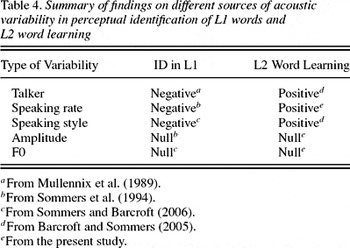
Table 4 summarizes the results of studies that have examined the effects of different sources of variability on perception of L1 words and acquisition of L2 vocabulary. The picture that is beginning to emerge is that sources of variability that have negative effects on L1 identification, including variations in talker characteristics, speaking style, and speaking rate, have positive effects on the acquisition of L2 vocabulary. In addition, sources of variability that do not affect L1 speech perception (overall amplitude and F0 in English) also do not influence (either positively or negatively) learning L2 vocabulary. Future research on the effects of different sources of variability on learning novel L1 words will help to determine whether the current pattern of results (negative effects of phonetically relevant variability on word identification and positive effects on recognition memory) are due to differences in the effects of variability on learning versus later processing or, alternatively, due to fundamental differences between learning and processing in L1 versus L2. Interpretations of the current pattern of results should therefore be viewed cautiously until future results on the effects of variability on L1 vocabulary learning are available.

Bradlow et al. (1999) suggested that one explanation for improved memory of L1 words as a result of increased stimulus variability is that certain types of paralinguistic or indexical information, including speaking style, speaking rate, and talker characteristics, are encoded and stored along with the linguistic content of spoken utterances. According to their proposal, there is an initial cost associated with encoding word lists varying along certain indexical features because listeners must expend more cognitive effort as they perceive and retain both indexical and linguistic information. Once stored, however, the indexical information can serve as an additional retrieval cue during subsequent recall, resulting in improved memory performance for lists of words spoken by multiple talkers, speaking rates, or speaking styles. As is the case with L1, variability along certain dimensions imposes a perceptual cost during initial encoding, as evidenced by negative effects of talker variability on L2 speech perception (Takayanagi, Dirks, & Moshfegh, 2002). The findings of the present study suggest that similar arguments might be applied to acquisition of L2 vocabulary, even though the initial encoding in question involves novel words as opposed to previously acquired words. If there is an initial cost of encoding indexical information during L2 vocabulary learning, this cost may provide a subsequent improvement in retention, as evidenced by the beneficial effects of talker, rate, and speaking-style variability in the current study and in the study of Barcroft and Sommers (2005). An attractive feature of this explanation is that it can account both for the negative effects of variability on measures of L1 and L2 speech processing and the beneficial effects on memory for L1 and L2 words.
Thus, one integrated account of the effects of stimulus variability on perception and retention of L1 and L2 words is that several sources of variability (e.g., talker characteristics, speaking rate, and speaking style) are associated with an initial perceptual cost, owing to the additional processing demands incurred as listeners encode and store both linguistic and indexical information. This initial cost, however, is associated with beneficial effects during subsequent recall because the stored indexical information provides an additional retrieval cue that is not available when source characteristics remain constant throughout a word list. One set of findings consistent with this proposal are from a study (Goldinger, Pisoni & Logan, 1991) examining the effects of stimulus variability on memory for L1 words as a function of presentation rate. In their study, Goldinger et al. (1991) presented listeners with lists of 10 highly familiar L1 words. For half of the lists, the same talker produced all of the words. For the other half, each word was spoken by a different talker. Of particular importance, Goldinger et al. (1999) varied presentation rate such that participants heard the words produced at interstimulus intervals of 250, 500, 1000, 2000, or 4000 ms. Goldinger et al. (1999) hypothesized that at faster presentation rates listeners would not have time to encode and store the indexical (talker) information in the multiple-talker condition but would incur the processing costs associated with trying to encode both lexical (word) and indexical information. Therefore, they predicted that at fast presentation rates, memory for lists spoken by multiple talkers would be poorer than memory for lists produced by a single talker. At slower presentation rates, however, Goldinger et al. suggested that listeners would have time to encode and store both lexical and indexical information and that the additional retrieval cue (talker information) would more than offset the cost of encoding multiple-talker lists. Consequently, they predicted that at slower presentation rates multiple-talker lists would produce better memory performance than single-talker lists. Consistent with this prediction, single-talker lists produced better serial recall at the two fastest presentation rates, but multiple-talker lists produced better performance at the two slowest presentation rates. These findings are consistent with the hypothesis that acoustic–phonetic variability increases the initial encoding demands but provides a retention benefit in the form of an additional retrieval cue from the indexical information.
To account for how participants may use certain sources of acoustic variability as an additional retrieval cue to benefit L2 vocabulary acquisition, Barcroft and Sommers (2005) proposed a model in which the retention of indexical information produces a more distributed lexical representation of new word forms. Specifically, in the absence of acoustic variability learners develop a strong, but minimally distributed representation of one variant of the word form (see Barcroft & Sommers' figure 5, p. 411). The strength of this representation is built upon exposure to multiple repetitions of a single word-form variant (e.g., produced at the same speaking rate). In the case of acoustically varied input, however, learners develop multiple, but weaker, representations of the word form. These variants, in turn, can provide more associative links between phonological word forms and the semantic-conceptual representations that are retrieved when the referent is activated. Thus, as a result of the more distributed representation following acoustically varied compared with acoustically consistent input, listeners have a greater probability of successfully linking semantic representations with appropriate phonological word forms. An important question for future work will be to establish the level (e.g., phonetic, segmental, syllabic or lexical) at which such linking might take place.
One issue that remains to be addressed regarding the effects of variability on L2 vocabulary learning is why variability in at least two dimensions, overall amplitude and F0, has no effect on L2 vocabulary learning. Within the framework of the phonetic-relevance hypothesis, variations in overall amplitude and F0 do not affect L1 speech processing in English because they do not alter properties of the speech signal that are important for phonetic identification in English.5
A source of variability that is not phonetically relevant in one language (e.g., F0 in English) may be phonetically relevant in another language. Although between-language differences in the phonetic relevance of individual acoustic features may limit the generalizability of the present findings to English, they also offer a potentially strong test of the phonetic-relevance hypothesis. Specifically, if phonetic relevance is a principal determinant of whether a given source of variability has negative consequences for language processing, then the phonetic-relevance hypothesis would predict opposing results for the same source of variability depending on its relevance for a specific language.
In summary, the current findings add to a growing body of work supporting the phonetic-relevance hypothesis of stimulus variability for both L1 and L2. The general framework of this hypothesis is that sources of variability such as speaking style, talker characteristics, and speaking rate, all of which affect acoustic features of the speech signal that are important for phonetic identification, may impose an initial processing cost because participants need to use greater cognitive effort to encode the variability. However, encoding the acoustically varied word forms may provide a benefit for subsequent recall of both familiar L1 and novel L2 words because the stored indexical information provides an additional cue for word retrieval. In contrast, sources of variability, such as overall amplitude and F0, which do not affect phonetically relevant parameters of the speech signal in languages such as English, are not retained in the same manner as phonetically relevant indexical information. Consequently, these sources of variability neither impose an initial perceptual cost nor provide a subsequent retention benefit.
The practical implications of the current research on acoustic variability and L2 vocabulary learning are substantial. Experiments 1 and 2 of the present study indicate that variability based on amplitude and F0 do not produce positive effects on L2 vocabulary learning, at least among native speakers of English. However, the findings of Experiment 3 and those of Barcroft and Sommers (2005) weigh strongly in favor of introducing variability in certain dimensions (speaker characteristics, speaking style, and speaking rate) as effective techniques for promoting L2 vocabulary learning. Developers of language instruction materials may help learners by incorporating multiple speakers, multiple voice types, and multiple speaking rates during the presentation of new vocabulary on audiotapes, videotapes, or computer-based presentation programs. Instructors also may consider incorporating these sources of acoustic variability in various types of classroom activities, such as when presenting new words while viewing pictures or during other types of input-oriented vocabulary instruction.