




No CrossRef data available.
Article contents
Mental adjustment after surgery for non-small cell lung cancer
Published online by Cambridge University Press: 29 April 2003
Abstract
Objective: Although surgery for early-stage non-small cell lung cancer (NSCLC) is generally considered curative, the outcome is still unsatisfactory, leaving patients faced with uncertainty and fear of recurrence for a long time after surgery. The purpose of this study was to clarify the course of patients' mental adjustment after surgery for NSCLC and to identify predictors of long-term outcome.
Methods: A total of 205 patients completed a baseline interview for patient characteristics at 1 month after curative resection of NSCLC and for social support at 3 months, and the Mental Adjustment to Cancer scale at 3 and 12 months. Univariate and multivariate analyses were used to identify predictors of their psychological outcome.
Results: The helplessness/hopelessness subscale score improved slightly after curative resection (p < .001), but the score on the fighting spirit subscale score was unchanged (p = .659). Significant predictors of helplessness/hopelessness at 12 months included helplessness/hopelessness at 3 months and advanced disease stage, and satisfaction with confidants. Significant predictors of fighting spirit at 12 months included fighting spirit at 3 months existence of confidants.
Significance of results: The results suggested that mental adjustment improved slightly after curative resection for NSCLC. They also suggested the need to maintain continuity of psychosocial care that provides social support, and that an approach that includes careful attention to patients with advanced stage disease may be a strategy for improving mental adjustment after surgery for NSCLC.
Keywords
Information
- Type
- Research Article
- Information
- Copyright
- © 2003 Cambridge University Press
INTRODUCTION
Lung cancer is the most common form of cancer and the most common cause of cancer-related deaths in the world (Parkin et al., 1999; Pisani et al., 1999). In contrast to nonsurgical treatment for advanced non-small cell lung cancer (NSCLC) and small cell lung cancer, surgical treatment for early-stage NSCLC is generally considered curative, and because of this, there have been few psychosocial studies of patients after surgery for early-stage NSCLC (Nou & Aberg, 1980; Hamelmann et al., 1983; Bernhard & Ganz, 1991; Dales et al., 1994; Montazeri et al., 1998; Uchitomi et al., 2000). However, since the outcome of NSCLC is still unsatisfactory, with a postoperative 5-year survival rate of only 65.0% in pathological stage I disease, 42.9% in stage II disease, and 22.2% in stage IIIA disease (Naruke et al., 1988), patients face uncertainty and fear of recurrence after curative resection for early-stage NSCLC.
Although patients' ways of coping with cancer have been classified into “negative” and “positive,” helplessness/hopelessness, and fighting spirit (Watson et al., 1988) are considered important cognitive and behavioral responses that might be associated with cancer patients' compliance with chemotherapy (Ayres et al., 1994), the quality of life (QOL) of cancer patients (Grassi et al., 1993; Cotton et al., 1999), and the psychological distress of lung cancer patients (Akechi et al., 1998a). Depressive ways of coping, including helplessness/hopelessness, have been shown to be significantly associated with shorter survival of both lung cancer patients (Faller et al., 1999) and breast cancer patients (Watson et al., 1999), independent of the influence of biomedical prognostic factors. Since previous studies have revealed that such coping styles of cancer patients can be improved by psychosocial interventions (Greer et al., 1992; Edmonds et al., 1999; Fukui et al., 2000), it is important to identify predictors of patients' long-term outcome after surgery for NSCLC.
Factors found to be associated with helplessness/hopelessness and fighting spirit in cancer patients have included physical variables, such as pain and poor performance status (PS), and demographic and psychosocial variables, such as younger age, psychiatric disorders, including depression, and social support (Watson et al., 1991; Grassi & Rosti, 1996; Akechi et al., 1998b; Nordin and Glimelius, 1998; Okano et al., 2001). Although there have been no long-term studies of coping in patients after surgery for NSCLC, one study did examine both the physical symptoms and global QOL before and 1, 3, 6, and 9 months after surgery in 117 consecutive subjects who underwent thoracotomy for a definite or presumptive diagnosis of lung cancer (Dales et al., 1994). The investigators in that study observed deterioration of QOL during the first 3 months postoperatively in those in whom the final diagnosis was cancer (n = 91) with subsequent improvement of their QOL back to its preoperative level, but not to the level of those whose final diagnosis was not cancer (n = 26). Previous studies have shown worsening of PS and dyspnea during the 3 months after surgery for lung cancer, and that both returned to their preoperative levels by 6 or 9 months after surgery (Nou & Aberg, 1980; Hamelmann et al., 1983; Dales et al., 1994). The finding of incomplete recovery of QOL after surgery and of the relatively good clinical course of PS and dyspnea led to speculation that the course of coping by NSCLC patients might not be markedly affected even after curative resection, and that demographic and psychosocial factors, rather than physical factors, might predict long-term coping after curative resection of NSCLC.
The purpose of this study was to clarify the course of patients' mental adjustment after surgery for NSCLC by using reliable, valid, self-administered instruments, and to identify predictors of long-term outcome.
METHODS
Participants
The study was conducted at the Thoracic Oncology Division, National Cancer Center Hospital East, Chiba, Japan, and consecutive, newly diagnosed patients who had undergone curative resection of NSCLC were invited to participate.
The eligibility criteria were: age 18 years or older; awareness of the diagnosis of cancer; ability to speak Japanese; standard surgical treatment (lobectomy or pneumonectomy with mediastinal lymph node dissection); no evidence of brain tumor on computerized tomography or magnetic resonance images of the head; no history of or current chemotherapy, immunotherapy, or radiation therapy; no active concomitant cancer; curative resection based on pathology reports of a UICC disease stage of pT1-3, pN0-1, pM0 (Mountain, 1986); and no severe medical or psychiatric conditions at 1 month after surgery. Patients who were currently undergoing psychiatric treatment or subsequently received such treatment were excluded.
Procedure
The study was approved by the Institutional Review Board and the Ethics Committee of the National Cancer Center, Japan. Written consent was obtained from each patient after being fully informed of the purpose of the study. Data for demographic and biomedical variables, including age, gender, education level, preoperative employment status, and preoperative smoking status (current smoker or ex-smoker/nonsmoker), history of nicotine dependence, type of surgery (lobectomy or pneumonectomy), preoperative percent vital capacity (%VC), preoperative percent forced expiratory volume in 1 s (FEV1.0%), preoperative PS, and pathological disease stage were obtained from the patients' medical chart or during a semistructured interview conducted by one of two psychiatrists (YU, IM) 1 month after surgery (median interval after surgery: 31 days). “Current smokers” were defined as those who smoked at the time of surgery or had quit smoking within the previous year, and “ex-smokers” as those who had quit smoking 1 or more years before surgery.
Data for other variables, including pain, dyspnea, performance status, and social support, were obtained at 3 months after surgery (median interval after surgery: 92 days). Pain and dyspnea were rated on a 4-point verbal scale: (0) “absent,” (1) “mild,” (2) “moderate,” (3) “severe.” Mental adjustment was measured by means of the Mental Adjustment to Cancer (MAC) scale (Watson et al., 1988) 3 and 12 months after surgery (median interval after surgery: 377 days) and the Structured Clinical Interview for DSM-III-R (SCID; Spitzer et al., 1990) 1 and 3 months after surgery. Most measurements at baseline, including the MAC, could not be made before surgery for NSCLC, mainly because we judged that the baseline interview before surgery would be too stressful for most patients. The hospital had only informed them of the day they would be admitted for surgical treatment of NSCLC 1 or 2 days in advance. Another reason was the practical problem of not being able to interview patients because of the brief interval between the time they were admitted and the operation (usually 2 or 3 days). Whenever a patient was diagnosed with depression, we recommended psychiatric consultation to the attending physician. If the patient agreed to consult the Psychiatry Division, National Cancer Center Hospital East, routine psychiatric consultation was provided.
Measures
The MAC scale (Watson et al., 1988) is a 40-item self-rating scale and was used to assess patients' ways of coping with cancer. It consists of five subscales: fighting spirit (16 items; range of possible scores: 16–64), anxious preoccupation (9 items), fatalism (8 items), helplessness/hopelessness (6 items; range of possible scores: 6–24), and avoidance (1 item). The participants were asked to read a number of statements that might describe their reactions to having cancer and to circle the number of the reply that represented the degree to which each statement applied to them. Each item was rated on a scale of 1 to 4, ranging from “definitely does not apply to me” to “definitely applies to me.” The validity and reliability of the Japanese version of the MAC have been confirmed (Akechi et al., 2000). Helplessness/hopelessness is characterized by a tendency to feel hopeless and helpless about oneself and the future because of having cancer and the adoption of a wholly pessimistic attitude, whereas fighting spirit is characterized by a tendency to confront and deal with the illness and by adoption of an optimistic attitude. In this study, we used only two subscales of the MAC scale, the helplessness/hopelessness subscale and the fighting spirit subscale, because the former has been suggested to be the most deleterious response and the latter to be the most beneficial response (Watson et al., 1988, 1991, 1999; Grassi et al., 1993; Ayres et al., 1994; Akechi et al., 1998a; Cotton et al., 1999).
The SCID (Spitzer et al., 1990) was performed at 1 and 3 months after surgery in regard to depression during the previous month, and history of depression before surgery and during the period at 2 months after surgery. The number of major depressive episode items according to the DSM-III-R (American Psychiatric Association, 1987) was obtained by summing the number of the following nine items that were present at the time: (1) depressive mood, (2) diminished interest or pleasure, (3) change in body weight or appetite, (4) insomnia or hypersomnia, (5) psychomotor agitation or retardation, (6) fatigue or loss of energy, (7) feelings of worthlessness or guilt, (8) loss of concentration or indecisiveness, and (9) suicidal thought. The diagnosis of depression was made according to the criteria for major and/or minor depression (American Psychiatric Association, 1987), with depression being diagnosed when two or more of the above nine items, at least one of which was depressive mood or diminished interest or pleasure, were present. The reliability of the interview ratings was determined by having a second rater attend a random sample consisting of 30 interviews (4.8%), and the interrater agreement (kappa) value for the diagnosis of depression was 0.78. Ratings for each of the nine individual items were also reliable, and the kappa values ranged from 0.65 to 1.00.
The Eysenck Personality Questionnaire–Revised (EPQR), a 48-item self-rating scale, was used to measure personality traits in a wide range of settings (Eysenck et al., 1985). It consists of four subscales: psychoticism, extraversion, neuroticism, and lie, each of which contains 12 items. The validity and reliability of the Japanese version of the EPQR have been confirmed (Hosokawa & Ohyama, 1993). Extraversion is a reflection of sociability and liveliness, whereas neuroticism reflects emotional instability and anxiousness.
Patients' utilization of confidants was used as an indicator of social support (Maunsell et al., 1995; Akechi et al., 1998b). The psychiatrists asked the patients whether they had confided in someone or discussed personal problems with someone during the period between being told of the diagnosis of lung cancer and 3 months after surgery. Utilization of confidants appears to be important during the initial period after diagnosis and surgery, since psychiatric morbidity has been found to occur less frequently in breast cancer patients who reported having a confidant (Maguire, 1982). Finally, patients were asked how satisfied they were with their interactions with their confidants as a whole. If they had not confided in anyone, they were asked about their degree of satisfaction with that situation, and their responses were rated on a scale from 1 to 7: (1) “very dissatisfied,” (2) “fairly dissatisfied,” (3) “slightly dissatisfied,” (4) “neither satisfied nor dissatisfied,” (5) “somewhat satisfied,” (6) “fairly satisfied,” and (7) “very satisfied.” The reliability of the interview ratings was determined by having a second rater attend a random sample consisting of 24 interviews. The interrater agreement (kappa) value for affirmation of use of confidants was 1.00. The interrater agreement value (intraclass correlation) for the degree of satisfaction with confidants was also 1.00.
Analysis
Standard descriptive statistics were used to characterize the distributions of the hopelessness/helplessness and fighting spirit scores at 3 and 12 months after surgery. Intergroup comparisons were performed using the nonparametric Mann–Whitney U test. Associations between continuous variables were assessed by Spearman correlation coefficients. The changes over time in the coping scores were tested by using the Wilcoxon test. Subgroup analyses of changes in coping scores over time were also performed.
The predictors examined were age, gender, education, marital status, living alone, preoperative employment status, type of surgery (lobectomy or pneumonectomy), preoperative %VC, FEV1.0%, PS, and smoking status, history of nicotine dependence, history of depression before being told of the diagnosis of NSCLC, history of depression between being told of the diagnosis and 2 months after surgery, PS, pain, dyspnea, depression, existence of confidants, and satisfaction with confidants at 3 months after surgery. After confirming low correlations (r < .400) between the biomedical and psychosocial variables related to the hopelessness/helplessness and fighting spirit scores at 12 months after surgery in the univariate comparisons (p < .05), they were entered into multivariate models to identify factors that predicted the hopelessness/helplessness and fighting spirit scores at 12 months after surgery. To control for possible confounding biomedical factors at 12 months, such as PS, dyspnea, and pain, the biomedical factors at 12 months that were significantly related to the dependent variables in the univariate comparison (p < .05) were entered into the multivariate models as controlled variables. Factors associated with the hopelessness/helplessness and fighting spirit scores at 3 months after surgery were also examined in other univariate and multivariate analyses. Since recommendations for psychiatric referral are given to the attending physicians after the interview whenever their patients are diagnosed with depression at 1 or 3 months after surgery, a reanalysis was performed after excluding these patients.
In all of the statistical evaluations, p values of .05 or less were considered to be indicative of significant differences. SPSS 10.0J for Windows statistical software was used for all data analyses.
RESULTS
The final pathological report of disease stage confirmed curative resection in 262 (86.5%) of the 303 NSCLC patients who underwent standard surgery between June 1996 and April 1999. Of the 262 eligible patients, 3 could not be contacted, 10 refused to participate because of the psychological burden, 3 because of the psychological and physical burden, 4 because of the physical burden, and 3 for unknown reasons, and the remaining 239 patients (91.2%) participated in the study. By 3 months after surgery, 2 patients had died, 4 patients diagnosed with depression at 1 month were referred to the Psychiatry Division by the attending physician, 2 had been lost to follow up, and 4 refused to participate because of the psychological burden, 1 because of the physical burden, 1 because of time constraints, and 1 for unknown reasons. By the time of the 12-month follow-up, 5 patients had been lost, 7 had died, 2 diagnosed with depression at 3 months had been referred to the Psychiatry Division, 3 were too ill to participate, 1 failed to complete the questionnaires, and 1 refused for unknown reasons. Thus, the final study group consisted of 205 patients, representing 78.2% of all eligible patients.
Data for the patients who had undergone successful curative resection but did not participate in the study (n = 57, 21.8%) were available in regard to age, gender, education, marital status, preoperative employment status, preoperative PS, and pathological disease stage. More nonparticipants were unmarried (31.8% of nonparticipants; 15.6% of participants, p = .012) and unemployed (70.2% of nonparticipants; 53.2% of participants, p = .022). A significantly higher proportion of nonparticipants had advanced pathological stage disease (pStage IIIA: 26.3% of nonparticipants; 6.3% of participants, p = .004).
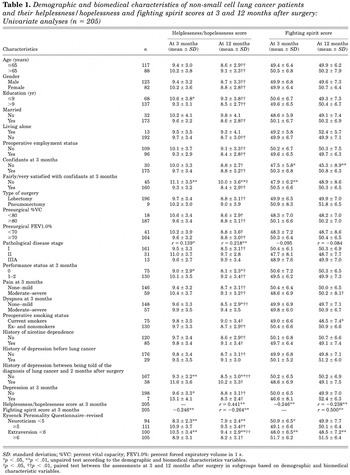
The age (mean ± SD) of the 205 cancer patients who participated in the study was 61.9 ± 10.9 years (range: 22 to 83; median: 63.0). Pathological stage I disease was the most common stage (n = 161; 78.5%), followed by pStage II (n = 31, 15.1%), and pStage IIIA (n = 13; 6.3%). Other demographic and biomedical characteristics are shown in Table 1.
Demographic and biomedical characteristics of non-small cell lung cancer patients and their helplessness/hopelessness and fighting spirit scores at 3 and 12 months after surgery: Univariate analyses (n = 205)

The mean helplessness/hopelessness subscale score decreased slightly but significantly, from 9.7 (SD = 3.4) to 8.8 (SD = 3.1), between the assessments at 3 and 12 months after surgery (p < .001), whereas the mean fighting spirit subscale score was unchanged [49.9 (SD = 6.6) vs. 50.0 (SD = 7.0), p = 0.534]. The results of the subgroup analyses by the paired Wilcoxon test between the assessments at 3 and 12 months after surgery showed that the helplessness/hopelessness scores did not decrease significantly in the following subgroups: unmarried, living alone, pneumonectomy, pathological disease stage II and III, moderate-severe dyspnea, history of depression before lung cancer, lower neuroticism, or higher extraversion (Table 1). The fighting spirit score increased significantly only in the moderate–severe subgroups.
The results for available biomedical data (n = 184) indicated a statistically significant reduction in %VC (−15%) at 12 months after surgery compared to the preoperative values, but no change in FEV1.0%. Neither %VC nor FEV1.0% at 12 months after surgery was significantly associated with helplessness/hopelessness or fighting spirit scores at 12 months. There was significant worsening of the PS scores at 3 months after surgery (0.64 ± 0.50) compared to the preoperative scores (0.31 ± 0.50, p < .001), but at 12 months (0.30 ± 0.47, p = .817) they had returned to their preoperative level. PS at 12 months after surgery was significantly associated with helplessness/hopelessness at 12 months (p = .040), but not with fighting spirit (p = .192). The change in PS between the two assessments was unassociated with either the helplessness/hopelessness or fighting spirit scores at 12 months.
Pain and dyspnea had significantly decreased between the assessments at 3 and 12 months after surgery (pain: 2.16 ± 0.63 and 1.83 ± 0.67, respectively, p < .001; dyspnea: 2.10 ± 0.68 and 1.81 ± 0.68, respectively, p < .001). Neither pain nor dyspnea at 12 months after surgery was significantly associated with helplessness/hopelessness or fighting spirit scores at 12 months, and neither change in pain nor change in dyspnea between the two assessments was significantly associated with helplessness/hopelessness or fighting spirit scores at 12 months. Accordingly, PS at 12 months was entered into the multivariate model of helplessness/hopelessness at 12 months as a controlled variable.
The results of the univariate analyses are shown in Table 1. Higher helplessness/hopelessness score at 12 months was significantly associated with advanced pathological disease stage, lower performance status, dyspnea, poor satisfaction with confidants, higher helplessness/hopelessness score at 3 months, history of depression between being told of the diagnosis of lung cancer and 2 months after surgery, higher neuroticism, and lower extraversion. Higher fighting spirit score at 12 months was significantly associated with ex- and nonsmoker, existence of confidants, higher fighting spirit score at 3 months, and higher extraversion.
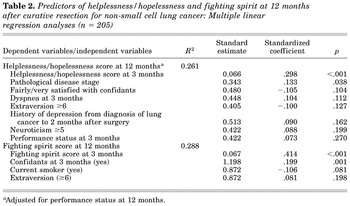
The results of the multivariate analysis are shown in Table 2. The proportion of variability in the helplessness/hopelessness and fighting spirit scores at 12 months explained by the predictor variables was 26.1% and 28.8%, respectively. In the multiple regression model, helplessness/hopelessness score at 3 months and pathological disease stage continued to be significant predictors for helplessness/hopelessness, while dyspnea, performance status, satisfaction with confidants, history of depression between being told of the diagnosis of lung cancer and 2 months after surgery, and extraversion and neuroticism did not. Fighting spirit score at 3 months and existence of confidants continued to be significant predictors for fighting spirit, while extraversion and current smoker did not.
Predictors of helplessness/hopelessness and fighting spirit at 12 months after curative resection for non-small cell lung cancer: Multiple linear regression analyses (n = 205)

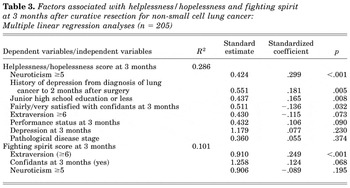
The results of additional univariate and multivariate analyses to identify factors associated with coping at 3 months (Tables 1 and 3) showed that less educated, poor satisfaction with confidants, history of depression between being told of the diagnosis of lung cancer and 2 months after surgery, and higher neuroticism were significant associated factors for helplessness/hopelessness at 3 months. Since the correlation between existence of confidants and satisfaction with confidants was not low (r = .447, p < .001), existence of confidants was entered into the models. The results also show that extraversion was a significant associated factor for fighting spirit at 3 months.
Factors associated with helplessness/hopelessness and fighting spirit at 3 months after curative resection for non-small cell lung cancer: Multiple linear regression analyses (n = 205)

Since 16 patients were diagnosed with depression at 1 or 3 months after surgery and their attending physicians were given recommendations for psychiatric referral after the interview, the data for the patients not recommended for psychiatric referral were reanalyzed (n = 189). The results showed that only one of the predictors in the former model, the helplessness/hopelessness score at 3 months, and not pathological disease stage (p = .132), continued to be a significant predictor in the present model of subjects not recommended for psychiatric referral, while fighting spirit at 3 months and existence of confidants continued to be significant predictors in the fighting spirit model of subjects not recommended for psychiatric referral (data not shown).
DISCUSSION
The present study is the first to prospectively assess patients' mental adjustment after curative resection for NSCLC and to identify predictors of long-term outcome. The helplessness/hopelessness scores showed a slight but significant decrease during the year after curative resection of NSCLC, but they did not change over time in the poor social support subgroups, including the “unmarried” subgroup and the “living alone” subgroup, the pneumonectomy subgroup, the advanced pathological disease stage subgroup, the moderate–severe dyspnea subgroup, the history of depression before lung cancer subgroup, the lower neuroticism subgroup, or the higher extraversion subgroup (Table 1). Although helplessness/hopelessness has been considered to possess both a “trait” and a “state” nature, the correlation between helplessness/hopelessness at 3 and 12 months in the present study was not high (r = .441). A study on the test-retest reliability of helplessness/hopelessness on the Japanese MAC scale showed a relatively high correlation (r = .73, test–retest interval: median 27 days; Akechi et al., 2000), and another study on 6-year cancer survivors showed no significant change (Grassi & Rosti, 1996). Thus, the results obtained in this study suggest that helplessness/hopelessness may be slightly affected during the year after curative resection for NSCLC.
The results of the multiple linear regression model showed that helplessness/hopelessness at 3 months was a very important predictor for helplessness/hopelessness at 12 months (standardized coefficient: .298). This finding was consistent with the results of a previous study showing that initial coping with cancer is significantly related to later coping (Grassi & Rosti, 1996). Factors associated with helplessness/hopelessness at 3 months included higher neuroticism, poor satisfaction with confidants, less educated, and history of depression between the time of diagnosis of lung cancer and 2 months after surgery. Therefore, careful attention to patients with higher neuroticism and who are less educated, providing opportunities to receive social support that would improve helplessness/hopelessness, for examples, a peer-support group (Edmonds et al., 1999), and screening and psychiatric intervention for perioperative depression may provide effective strategies for improving helplessness/hopelessness.
In the multivariate analyses, advanced disease stage was also a significant predictor for helplessness/hopelessness at 12 months, but not a significant associated factor for helplessness/hopelessness at 3 months. Helplessness/hopelessness did not decrease over time in patients with pStage II and IIIA disease. A previous study showed that actual diagnosis of advanced disease stage had less impact on psychological distress in small cell lung cancer patients before treatment, except those with poor PS (= 3; Cella et al., 1987). Most participants in the present study had good PS at 3 months (PS = 0, n = 75; PS = 1, n = 134; PS = 2, n = 2). Although surgical treatment for early-stage NSCLC is generally considered curative, patients must have been faced with uncertainty and fear of recurrence for a long period. These findings suggested that disease stage may not have been associated with helplessness/hopelessness immediately after treatment, and that its impact may have gradually developed later. Since previous studies have revealed that helplessness/hopelessness can be improved by psychotherapeutic interventions, such as cognitive psychotherapy (Greer et al., 1992), a strategy consisting of perioperative cognitive psychotherapeutic intervention, such as teaching coping strategies for uncertainty and fear of recurrence to enhance adjustment to the illness, and careful attention to providing information on the disease stage, might ameliorate the helplessness/hopelessness of patients with advanced disease.
Consistent with previous studies (Nou et al., 1980; Hamelmann et al., 1983; Dales et al., 1994), dyspnea, pain, and performance status had improved at 12 months after surgery. Unexpectedly, dyspnea, pain, and PS were not significant predictors for helplessness/hopelessness at 12 months in the multivariate models. This may be explained by the findings in the study showing that the severity of those factors after surgery was generally mild. If the subjects' physical status had been poorer, a clear association between physical symptoms and status and patients' hopelessness might have emerged. Helplessness/hopelessness, in fact, did not decrease over time in the subgroup of patients with moderate–severe dyspnea. Since the results we obtained do not rule out the need for appropriate lung rehabilitation in postoperative patients, more studies are needed to clarify the association between dyspnea and helplessness/hopelessness.
In contrast to the findings regarding helplessness/hopelessness, fighting spirit did not change during the year after surgery, and increased only when the patients were divided into the moderate–severe pain subgroup. Although the correlation between fighting spirit at 3 and 12 months in the present study (r = .500) was not as high as in a study on the test–retest reliability of fighting spirit on the Japanese MAC scale that showed a high correlation (r = .81; Akechi et al., 2000), the results of the present study suggested that fighting spirit might not be easily affected by biomedical or psychosocial factors.
The existence of confidants predicted fighting spirit at 12 months. This finding suggested the need to maintain psychosocial care, such as a peer-support group, to provide an opportunity for patients to receive social support that would enhance fighting spirit (Edmonds et al., 1999; Fukui et al., 2000). Fighting spirit at 3 months was also a significant predictor for fighting spirit at 12 months. One of the significant factors associated with fighting spirit at 3 months was higher extraversion, and thus careful attention to patients with lower extraversion may be an effective strategy for improving fighting spirit.
In conclusion, the results of the present study suggested that helplessness/hopelessness decreased slightly after curative resection for NSCLC and fighting spirit remained unchanged. They also suggested the need to maintain continuity of psychosocial care that provides social support, and that an approach that includes careful attention to patients with advanced stage disease may provide a strategy for improving mental adjustment after surgery for NSCLC. Further well-designed studies, such as randomized controlled trials for NSCLC after surgery, are needed to confirm these results.
There were several limitations to this study. First, there was sampling bias. Since the results were obtained from only one institution, a teaching cancer center hospital, the sample was not representative of Japanese NSCLC patients as a whole. Second, recommendations for psychiatric consultation were made to the attending physicians, and thus the patients' coping may have been altered. More nonparticipants had a more advanced disease stage, and this was abstracted as one of the predictors in the helplessness/hopelessness model. Moreover, there was a high attrition rate and many nonparticipants refused to participate for reasons that included psychological burden. Thus, coping in the present results may also have been underestimated. Third, most measurements at baseline, including measures of coping could not be obtained before surgery for NSCLC, thereby limiting the comparison of overall degree of change in relation to preoperative psychological functioning. Finally, potential predictors of coping, such as self-efficacy and other physical symptoms, such as fatigue, were not examined.
ACKNOWLEDGMENTS
We are grateful to the patients who gave their time so willingly as well as to the physicians of the Thoracic Oncology Division of the National Cancer Center Hospital East (Drs. M. Nishimura, J. Yoshida, K. Takahashi) for enrolling their patients into this study. We also thank K. Harada, RN, Y. Kojima, RN, and Ms. R. Katayama for their assistance in conducting this research. This work was supported in part by a Grant-in-Aid for Cancer Research, Second-Term Comprehensive 10-Year Strategy for Cancer Control and Medical Frontier Research, from the Japanese Ministry of Health, Labour and Welfare.
References
REFERENCES
Akechi, T.,
Fukue-Saeki, M.,
Kugaya, A.,
Okamura, H.,
Nishiwaki, Y.,
Yamawaki, S., &
Uchitomi, Y.
(2000).
Psychometric properties of the Japanese version of the Mental
Adjustment to Cancer (MAC) scale.
Psycho-Oncology,
9,
395–401.3.0.CO;2-O>CrossRefGoogle Scholar
Akechi, T.,
Kugaya, A.,
Okamura, H.,
Nishiwaki, Y.,
Yamawaki, S., &
Uchitomi, Y.
(1998a).
Predictive factors for psychological distress of ambulatory lung
cancer patients.
Supportive Care in Cancer,
6,
281–286.Google Scholar
Akechi, T.,
Okamura, H.,
Yamawaki, S., &
Uchitomi, Y.
(1998b).
Predictors of patients' mental adjustment to cancer: Patient
characteristics and social support.
British Journal of Cancer,
77,
2381–2385.Google Scholar
American Psychiatric Association.
(1987).
Diagnostic and Statistical Manual of Mental Disorders,
3rd ed., Revised.
Washington, DC:
American Psychiatric Press.
Ayres, A.,
Hoon, P.W.,
Franzoni, J.B.,
Matheny, K.B.,
Cotanch, P.H., &
Takayanagi, S.
(1994).
Influence of mood and adjustment to cancer on compliance with
chemotherapy among breast cancer patients.
Journal of Psychosomatic Research,
38,
393–402.CrossRefGoogle Scholar
Bernhard, J. &
Ganz, P.A.
(1991).
Psychosocial issues in lung cancer patients (Part 1).
Chest,
99,
216–223.CrossRefGoogle Scholar
Cella, D.F.,
Orofiamma, B.,
Holland, J.C.,
Silberfarb, P.M.,
Tross, S.,
Feldstein, M.,
Perry, M.,
Maurer, L.H.,
Comis, R., &
Orav, E.J.
(1987).
The relationship of psychological distress, extent of disease, and
performance status in patients with lung cancer.
Cancer,
60,
1661–1667.3.0.CO;2-4>CrossRefGoogle Scholar
Cotton, S.P.,
Levine, E.G.,
Fitzpatrick, C.M.,
Dold, K.H., &
Targ, E.
(1999).
Exploring the relationships among spiritual well-being, quality of
life, and psychological adjustment in women with breast cancer.
Psycho-Oncology,
8,
429–438.3.0.CO;2-P>CrossRefGoogle Scholar
Dales, R.E.,
Belanger, R.,
Shamji, F.M.,
Leech, J.,
Crepeau, A., &
Sachs, H.J.
(1994).
Quality-of-life following thoracotomy for lung cancer.
Journal of Clinical Epidemiology,
47,
1443–1449.CrossRefGoogle Scholar
Edmonds, C.V.,
Lockwood, G.A., &
Cunningham, A.J.
(1999).
Psychological response to long-term group therapy: A randomized
trial with metastatic breast cancer patients.
Psycho-Oncology,
8,
74–91.3.0.CO;2-K>CrossRefGoogle Scholar
Eysenck, S.B.G.,
Eysenck, H.J., &
Barret, P.
(1985).
A revised version of the psychoticism scale.
Personality and Individual Differences,
6,
21–29.CrossRefGoogle Scholar
Faller, H.,
Bulzebruck, H.,
Drings, P., &
Lung, H.
(1999).
Coping, distress, and survival among patients with lung cancer.
Archives of General Psychiatry,
56,
756–762.CrossRefGoogle Scholar
Fukui, S.,
Kugaya, A.,
Okamura, H.,
Kamiya, M.,
Koike, M.,
Nakanishi, T.,
Imoto, S.,
Kanagawa, K., &
Uchitomi, Y.
(2000).
A psychosocial group intervention for Japanese women with primary
breast carcinoma.
Cancer,
89,
1026–1036.3.0.CO;2-5>CrossRefGoogle Scholar
Grassi, L. &
Rosti, G.
(1996).
Psychosocial morbidity and adjustment to illness among long-term
cancer survivors. A six-year follow-up study.
Psychosomatics,
37,
523–532.Google Scholar
Grassi, L.,
Rosti, G.,
Lasalvia, A., &
Marangolo, M.
(1993).
Psychosocial variables associated with mental adjustment to cancer.
Psycho-Oncology,
2,
11–20.CrossRefGoogle Scholar
Greer, S.,
Moorey, S.,
Baruch, J.D.,
Watson, M.,
Robertson, B.M.,
Mason, A.,
Rowden, L.,
Law, M.G., &
Bliss, J.M.
(1992).
Adjuvant psychological therapy for patients with cancer:
A prospective randomised trial.
British Medical Journal,
304,
675–680.CrossRefGoogle Scholar
Hamelmann, H.,
Thermann, M.,
Muller-Schwefe, T.,
Schnurer, C., &
Troidl, H.
(1983).
Surgically treated bronchial carcinoma patients—results of
systematic follow-up.
Thoracic and Cardiovascular Surgery,
31,
41–44.CrossRefGoogle Scholar
Hosokawa, T. &
Ohyama, M.
(1993).
Reliability and validity of a Japanese version of the short-form
Eysenck personality questionnaire-revised.
Psychological Report,
72,
823–832.CrossRefGoogle Scholar
Maguire, P.
(1982).
Psychiatric morbidity associated with mastectomy.
Experientia,
41(Suppl. 1),
373–380.Google Scholar
Maunsell, E.,
Brisson, J., &
Deschenes, L.
(1995).
Social support and survival among women with breast cancer.
Cancer,
76,
631–637.3.0.CO;2-9>CrossRefGoogle Scholar
Montazeri, A.,
Gillis, C.R., &
McEwen, J.
(1998).
Quality of life in patients with lung cancer: A review of
literature from 1970 to 1995.
Chest,
113,
467–481.CrossRefGoogle Scholar
Mountain, C.F.
(1986).
A new international staging system for lung cancer.
Chest,
89(Suppl. 1),
225–233.CrossRefGoogle Scholar
Naruke, T.,
Goya, T.,
Tsuchiya, R., &
Suemasu, K.
(1988).
Prognosis and survival in resected lung carcinoma based on the new
international staging system.
Journal of Thoracic and Cardiovascular Surgery,
96,
440–447.Google Scholar
Nordin, K. &
Glimelius, B.
(1998).
Reactions to gastrointestinal cancer variation in mental adjustment
and emotional well-being over time in patients with different
prognoses.
Psycho-Oncology,
7,
413–423.3.0.CO;2-Q>CrossRefGoogle Scholar
Nou, E. &
Aberg, T.
(1980).
Quality of survival in patients with surgically treated bronchial
carcinoma.
Thorax,
35,
255–263.CrossRefGoogle Scholar
Okano, Y.,
Okamura, H.,
Watanabe, T.,
Narabayashi, M.,
Katsumata, N.,
Ando, M.,
Adachi, I.,
Kazuma, K.,
Akechi, T., &
Uchitomi, Y.
(2001).
Mental adjustment to first recurrence and correlated factors in
patients with breast cancer.
Breast Cancer Research and Treatment,
67,
255–262.CrossRefGoogle Scholar
Parkin, D.M.,
Pisani, P., &
Ferlay, J.
(1999).
Estimates of the worldwide incidence of 25 major cancers in 1990.
International Journal of Cancer,
80,
827–841.3.0.CO;2-P>CrossRefGoogle Scholar
Pisani, P.,
Parkin, D.M.,
Bray, F., &
Ferlay, J.
(1999).
Estimates of the worldwide mortality from 25 cancers in 1990.
International Journal of Cancer,
83,
18–29.3.0.CO;2-M>CrossRefGoogle Scholar
Spitzer, R.L.,
Williams, J.B.W.,
Gibbon, M., &
First, M.B.
(1990).
Structured Clinical Interview for DSM III-R.
Washington, DC:
American Psychiatric Press.
Uchitomi, Y.,
Mikami, I.,
Kugaya, A.,
Akizuki, N.,
Nagai, K.,
Nishiwaki, Y.,
Akechi, T., &
Okamura, H.
(2000).
Depression after successful treatment for nonsmall cell lung
carcinoma.
Cancer,
89,
1172–1179.3.0.CO;2-U>CrossRefGoogle Scholar
Watson, M.,
Greer, S.,
Rowden, L.,
Gorman, C.,
Robertson, B.,
Bliss, J.M., &
Tunmore, R.
(1991).
Relationships between emotional control, adjustment to cancer and
depression and anxiety in breast cancer patients.
Psychological Medicine,
21,
51–57.CrossRefGoogle Scholar
Watson, M.,
Greer, S.,
Young, J.,
Inayat, Q.,
Burgess, C., &
Robertson, B.
(1988).
Development of a questionnaire measure of adjustment to cancer:
The MAC scale.
Psychological Medicine,
18,
203–209.CrossRefGoogle Scholar
Watson, M.,
Haviland, J.S.,
Greer, S.,
Davidson, J., &
Bliss, J.M.
(1999).
Influence of psychological response on survival in breast cancer:
A population-based cohort study.
Lancet,
354,
1331–1336.CrossRefGoogle Scholar
Demographic and biomedical characteristics of non-small cell lung cancer patients and their helplessness/hopelessness and fighting spirit scores at 3 and 12 months after surgery: Univariate analyses (n = 205)
Predictors of helplessness/hopelessness and fighting spirit at 12 months after curative resection for non-small cell lung cancer: Multiple linear regression analyses (n = 205)
Factors associated with helplessness/hopelessness and fighting spirit at 3 months after curative resection for non-small cell lung cancer: Multiple linear regression analyses (n = 205)
 You have
Access
- 6
- Cited by