INTRODUCTION
Conjugated linoleic acids (CLA) are formed as an intermediate during the rumen biohydrogenation (BH) of linoleic acid (C18 : 2; LA) by Butyrivibrio fibrisolvens or from the endogenous conversion of vaccenic acid (t-11-18 : 1; VA) into rumenic acid (c9,t11-18 : 2; RA) by Δ9-desaturase in tissues (Rana et al. Reference Rana, Tyagi, Hossain and Tyagi2012). Thus, CLA content in ruminant-derived food products can be increased by nutritional and management practices that increase fore-stomach output of CLA and VA (Rana et al. Reference Rana, Tyagi, Hossain and Tyagi2012). In this sense, feeding ruminants with oils rich in polyunsaturated fatty acids (PUFAs) is an effective way to increase CLA content in food products such as milk or meat (Chilliard et al. Reference Chilliard, Glasser, Ferlay, Bernard, Rouel and Doreau2007; Wood et al. Reference Wood, Enser, Fisher, Nute, Sheard, Richardson, Hughes and Whittington2008). However, this approach may increase lipid oxidation in meat, so in recent years new feeding strategies to extend the shelf-life of these food products have been attempted. The combination of PUFAs with antioxidants, such as phenolic compounds, in the diet of animals pursues enhanced lipid stability of food with increased CLA content.
However, reports on the interaction of polyphenols and PUFAs when included simultaneously in diets, as far as BH is concerned, may be contradictory. Whereas some in vivo studies suggest no significant or even negative effects of polyphenols on VA or CLA contents (Benchaar & Chouinard Reference Benchaar and Chouinard2009; Cabiddu et al. Reference Cabiddu, Molle, Decandia, Spada, Fiori, Piredda and Addis2009; Vasta et al. Reference Vasta, Makkar, Mele and Priolo2009a ), other reports have demonstrated decreased total saturated fatty acids (SFA) and increased monounsaturated FA (MUFA) contents in both milk (Ferlay et al. Reference Ferlay, Martin, Lerch, Gobert, Pradel and Chilliard2010) and meat (Andrés et al. Reference Andrés, Morán, Aldai, Tejido, Prieto, Bodas and Giráldez2014), thus suggesting that polyphenols could alter rumen BH pathway to some extent (direct effect) by inhibition of the last step of BH (Khiaosa-Ard et al. Reference Khiaosa-Ard, Bryner, Scheeder, Wettstein, Leiber, Kreuzer and Soliva2009; Vasta et al. Reference Vasta, Makkar, Mele and Priolo2009a , Reference Vasta, Mele, Serra, Scerra, Luciano, Lanza and Priolo b ). Moreover, a fatty acid (FA) protector role of phenolic compounds against ruminal lipid metabolism (indirect effect by encapsulation) has also been described recently (Gadeyne et al. Reference Gadeyne, Van Ranst, Vlaeminck, Vossen, Van der Meeren and Fievez2015).
All these arguments support the need for a better understanding of the interaction of polyphenols and PUFAs when included simultaneously in ruminant diets and its effects on rumen fermentation. For this purpose, in vitro studies with ruminal contents from lambs being fed control and supplemented diets can be used. This procedure together with microbial genetics and molecular phylogenetic techniques for identifying and classifying microorganisms by their small-subunit rRNA gene sequences would allow clarification of the role and contribution of specific microbial species (Jenkins et al. Reference Jenkins, Wallace, Moate and Mosley2008) and to develop feeding strategies to improve the digesta FA profile (less saturated FA and more VA (t11-18 : 1) and RA (c9,t11-18 : 2) synthesized in the rumen) reaching the intestine of the animals.
Combinations of polyphenols and PUFAs that alter BH via different mechanisms may act in a synergistic manner when administered together in the diet. To test this hypothesis, the effect of two different PUFA sources (palm oil v. flaxseed (FS)) and quercetin (QCT) (a phenolic compound) added to the diet of fattening lambs (previously used to study meat quality parameters; Andrés et al. Reference Andrés, Morán, Aldai, Tejido, Prieto, Bodas and Giráldez2014) on in vitro ruminal parameters and rumen microbial community was tested.
MATERIALS AND METHODS
Animals
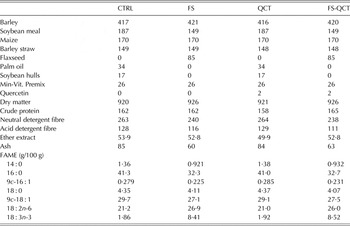
Thirty-two fattening lambs were fed their corresponding total mixed ration (TMR) during the experimental period (at least 5 weeks) as described below: eight control lambs (CTRL, 34 g palm oil/kg TMR), eight lambs fed ground FS, (85 g FS/kg of TMR), eight lambs fed control diet plus QCT (Shaanxi Sciphar Biotechnology Co., Ltd, Xi'an, China) (QCT, 34 g palm oil plus 2 g QCT/kg TMR), and eight lambs fed ground FS plus QCT (FS-QCT, 85 g FS plus 2 g QCT/kg TMR). The four TMRs were formulated to be isoenergetic and isoproteic. The ingredients and chemical composition of TMR are shown in Table 1. The TMR were weighed and supplied ad libitum at 09.00 h every day, and fresh drinking water was always available. All handling practises followed the recommendations of the European Council Directive 86/609/EEC (EC 1986) for the protection of animals used for experimental and other scientific purposes and all the animals were able to see and hear other animals. Further details can be found in Andrés et al. (Reference Andrés, Morán, Aldai, Tejido, Prieto, Bodas and Giráldez2014).
Ingredients (g/kg fresh matter) and chemical composition (g/kg dry matter) of the experimental total mixed rations (TMR)

CTRL, control group (34 g palm oil/kg TMR); FS, flaxseed group (85 g FS/kg TMR); QCT, quercetin group (CTRL plus 2 g QCT/kg TMR); FS-QCT, FS plus QCT group (85 g FS plus 2 g QCT/kg TMR); FAME, fatty acid methyl esters.
Animals were slaughtered on four different days (two animals per group each day), once they reached the intended body weight (c. 25 kg), just before morning feeding of the rest of the lambs. Total rumen contents of each lamb were sampled and immediately frozen at –80 °C for DNA extraction (32 samples in total). Another fraction of rumen contents of 24 lambs slaughtered in three different days was strained through four layers of cheesecloth into an Erlenmeyer flask with an O2-free headspace. The filtrated rumen fluid from the lambs being fed the same experimental diet (two animals from each group were slaughtered each day) was mixed (four inocula per day, three incubation series on three different days).
In vitro incubation
The control TMR (CTRL) was used as substrate in in vitro incubations. For this purpose, an aliquot of CTRL diet was ground through a 1 mm screen; then samples of 400 mg were accurately weighed into 120 ml serum bottles. Rumen fluid from each diet was mixed with the buffer solution of Goering & Van Soest (Reference Goering and Van Soest1970; no trypticase added) in a proportion of 1 : 4 (vol/vol) at 39 °C under continuous flushing with carbon dioxide (CO2). Serum bottles were pre-warmed (39 °C) prior to the addition of 40 ml of buffered rumen fluid under CO2 flushing. Then, bottles were sealed with rubber stoppers and aluminium caps and incubated at 39 °C.
Three incubation series were performed on different days (3 days of slaughter), so that each treatment was conducted in triplicate. On each incubation day a total of 16 bottles were incubated (4 inocula × 1 substrate × (2 repetitions + 2 blanks)), for each inoculum (a mix of rumen fluid from two lambs from the same group) two bottles with substrate (control diet) and two additional bottles without substrate (blanks), which were included to correct the gas production values and methane production for gas release from endogenous substrates. After 20 h of incubation the gas production of each bottle was measured using a pressure transducer (Delta Ohm DTP704-2BGI, Herter Instruments SL, Barcelona, Spain) and a sample of gas (about 15 ml) was removed and stored in a Haemoguard Vacutainer (BD Vacutainer®, Oxford, UK) for methane analysis. Immediately, bottles were opened, pH was measured with a pH-meter (model 507, CRISON, Alella, Barcelona, Spain), and fermentation was stopped by swirling the bottles in ice. A sample (1 ml) of the supernatant was added to 1 ml of a deproteinizing solution (100 g of metaphosphoric acid and 0·6 g of crotonic acid/l) for volatile fatty acid (VFA) determination, and 2 ml of content were added to 2 ml of hydrochloric acid (HCl), 0·5 m for ammonia-N analysis. The contents of the bottles were transferred to previously weighed filter crucibles (pore size 100–160 µm) and filtered under vacuum to determine dry matter (DM) disappearance.
DNA extraction and quantification of rumen contents (in vivo samples)
Frozen rumen samples were freeze-dried and thoroughly homogenized before DNA extraction by physical disruption (1 min) using a bead beater (Mini-bead Beater, BioSpec Products, Bartlesville, OK, USA) and subsequent DNA purification with the QIAamp DNA Stool Mini Kit (Qiagen Inc., Valencia, CA, USA), with the modification of a greater temperature (95 °C) to improve cell lysis. The DNA samples were used as templates for quantitative real-time polymerase chain reaction (qPCR) amplification and terminal restriction fragment length polymorphism (T-RFLP) analysis.
Cloning of gene fragments of universal bacteria, Butyrivibrio and ciliate protozoa
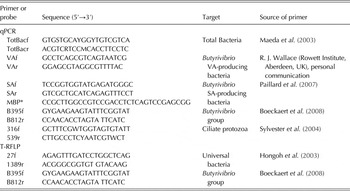
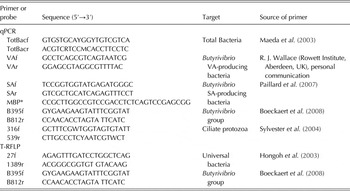
For qPCR quantification, plasmid DNA used as PCR standards were obtained by PCR cloning of partial 16S rRNA gene fragments of universal bacteria and Butyrivibrio species (Butyrivibrio vaccenic acid-producing bacteria, Butyrivibrio stearic acid-producing bacteria and Butyrivibrio spp.), whereas a partial 18S rRNA gene fragment was cloned for PCR standards of ciliate protozoa. These gene fragments were amplified (see primers in Table 2) using genomic DNA extracted from the rumen contents of a cannulated sheep fed a forage diet. Then PCR products were isolated using a gel extraction kit (QIaquick Gel Extraction Kit, Qiagen Inc., Valencia, CA, USA) after agarose gel electrophoresis, and finally cloned into pGEM-T Easy Vector System II (Promega, Madison, WI, USA) according to the manufacturer's instructions. Escherichia coli strains JM109 were transformed by heat shock at 42 °C. The transformed cells were initially plated onto Luria-Bertani (LB) agar plates supplemented with ampicillin (100 µg/ml) to which 25 µl of 50 mg/ml 5-bromo-4-chloro-3-indolyl-ß-D-galactoside (X-gal) and 40 µl of 100 mmol/l isopropyl-ß-D-thiolgalactopyranoside (IPTG) were applied. Then, the LB/ampicillin/IPTG/X-gal plates were held overnight at 37 °C. Clones were identified from selected white colonies (positive transformants) and plasmid DNA was purified with a Kit QUIagen: QIAprep Miniprep (Qiagen Inc., Valencia, CA, USA) according to the manufacturer's instructions. For preliminary characterization of the PCR products, the inserts were PCR amplified and then sequenced. Their sequence similarities were assessed by Basic Local Alignment Search Tool (BLAST; http://www.ncbi.nlm.nih.gov/BLAST/). Then, plasmids containing respective target DNA fragments were used as standards in qPCR.
Primers used in the current study for quantitative real time polymerase chain reaction (qPCR) and terminal restriction fragment length polymorphism (T-RFLP)
* Molecular beacon probe.
Quantitative real-time polymerase chain reaction analysis
Quantitative real-time PCR was carried out using the Applied Biosystems StepOne Plus™ real time PCR system (Applied Biosystems, Foster City, CA, USA) to investigate the abundance of ciliate protozoa and three bacterial groups potentially able to perform the rumen BH: Butyrivibrio VA-, Butyrivibrio SA- and Butyrivibrio spp. The gene-targeted primer sets used for qPCR analysis are presented in Table 2. All qPCR amplifications were performed in triplicate with SYBR Green Supermix (Takara Bio Inc., Otsu, Shiga, Japan) as previously described (Maeda et al. Reference Maeda, Fujimoto, Haruki, Maeda, Kokeguchi, Petelin, Arai, Tanimoto, Nishimura and Takashiba2003), using a 20 µl reaction mixture and 0·85 µl of each primer (10 µm) for total bacteria and 0·4 µl for Butyrivibrio VA-producing bacteria, Butyrivibrio spp. and ciliate protozoa. For the detection of the Butyrivibrio SA-producing bacteria (B. proteoclasticus group) using qPCR, the molecular beacon approach with the primers and probe designed by Paillard et al. (Reference Paillard, McKain, Rincon, Shingfield, Givens and Wallace2007) was employed.
Quantification of universal bacteria, Butyrivibrio SA-producing bacteria, Butyrivibrio spp. and ciliate protozoa was based on standard curves obtained from the amplification profile of known concentrations of the standard plasmid for the respective target. For this purpose the concentration of total DNA was measured by spectrophotometry (NanoDrop ND-1000 Spectrophotometer, Nanodrop Technologies, Wilmington, DE, USA) and the corresponding copy number was calculated according to Lee et al. (Reference Lee, Kim, Shin and Hwang2006). Then, a 10-fold dilution series of the standard plasmid for the respective target was run along with the samples. The qPCR efficiency ranged between 94 and 100% for the analysis of rumen samples for both biohydrogenating groups and universal bacteria. Negative controls without DNA template were run with every assay to assess the overall specificity.
Quantification of Butyrivibrio VA-producing bacteria was finally based on standard curves obtained from dilutions of purified genomic DNA from a control strain (B. fibrisolvens JW11), since standard plasmid failed to amplify.
Terminal restriction fragment length polymorphism analysis
Terminal RFLP is a technique used to rapidly distinguish bacterial communities based on the size of the terminal fragments of 16S rRNA genes following restriction endonuclease digestion (Liu et al. Reference Liu, Marsh, Cheng and Forney1997).
Two different T-RFLP analyses were performed, firstly using a universal bacteria-specific primer pair set (Hongoh et al. Reference Hongoh, Yuzawa, Ohkuma and Kudo2003) and secondly using Butyrivibrio group-specific primers (Boeckaert et al. Reference Boeckaert, Vlaeminck, Fievez, Maignien, Dijkstra and Boon2008; Table 2). Both forward primers were labelled with 6-carboxy-fluorescein. Fluorescence-labelled PCR products were purified using the GFX PCR DNA and Gel Band Purification kit (GE Healthcare, Roosendaal, Netherlands). Then, the DNA was quantified by spectrophotometry (NanoDrop ND-1000 Spectrophotometer, Nanodrop Technologies, Wilmington, DE, USA) and 100 ng of each sample was subjected to a restriction reaction with enzyme HaeIII for universal bacteria and HhaI for Butyrivibrio group for 12 h at 37 °C. Fluorescence-labelled terminal restriction fragments were analysed by capillary electrophoresis on an automatic sequence analyser Megabace 500 (GE Healthcare, Roosendaal, Netherlands) with internal Et-ROX-labelled DNA size standards (Amersham Biosciences, Fairfield, CT, USA).
Fatty acid analysis
All details regarding lipid extraction and FA determination (gas chromatography conditions, peak separation and identification: 100 m SP2560, fatty acid methyl esters –FAME– standards) have been previously described in Aldai et al. (Reference Aldai, Lavín, Kramer, Jaroso and Mantecón2012). The FAMEs were expressed as percentage (%) of total FAME.
Analytical procedures
Dry matter, ash and nitrogen (N) were determined according to the Association of Official Analytical Chemists (AOAC 1999). The procedure described by Van Soest et al. (Reference Van Soest, Roberston and Lewis1991) was used for the analysis of neutral detergent fibre (NDF), whereas acid detergent fibre (ADF) and acid detergent lignin (ADL) were determined according to the procedures proposed by AOAC (1999). Concentrations of VFA and NH3-N were determined according to Carro & Miller (Reference Carro and Miller1999).
Methane was analysed by injecting 0·3 ml of gas into a gas chromatograph (Shimadzu GC 14B; Shimadzu Europa GmbH, Duisburg, Germany), heated at 200 °C and equipped with a flame ionization detector and a column packed with Carboxen 1000 (Supelco, Madrid, Spain). Helium was used as the carrier gas and peaks were identified by comparison with a standard of known methane concentration.
Statistical analyses
The qPCR data were subjected to a two way analysis of variance (ANOVA), using the General Linear Model (GLM) procedure of Statistical Analysis Software (SAS) (SAS 2012) according to the following model:
 $${y_{ijk}} = \mu + {\rm F}{{\rm S}_i} + {\rm QC}{{\rm T}_j} + {\left( {{\rm FS} \times {\rm QCT}} \right)_{ij}} + {\varepsilon _{ijk}}$$
where y ijk is the dependent variable, μ is the overall mean, FS is the effect of FS addition, QCT is the effect of QCT addition, FS × QCT is the effect of the interaction between QCT and FS, and ε ijk is the residual error. Least square means were generated and separated using the PDIFF option of SAS for main or interactive effects, with significance declared at P < 0·05.
The model used to analyse the in vitro incubation data differed slightly. After averaging vial replicates, the 12 observations were subjected to ANOVA, with inocula (CTRL, QCT, FS and FS-QCT) as fixed factor and the batch as a blocking factor (B k ). Consequently, the model previously described also included B k for in vitro incubation data.
Finally, the T-RFLP data [matrix showing the presence (1) or absence (0) of the peaks, i.e., the presence of operational taxonomic units] obtained for each ruminal sample were analysed by principal components analysis (PCA), using the Unscrambler software version 8.0.5 (CAMO, Oslo, Norway).
RESULTS
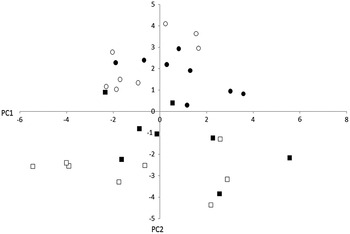
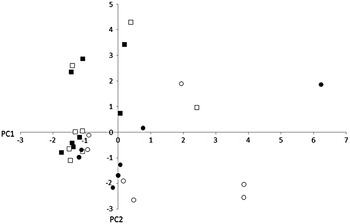
The T-RFLP analysis of 16S rRNA genes using universal primers for bacteria indicated complex communities in all samples. The samples derived from the FS -fed animals (FS and FS-QCT groups) were grouped in a separate cluster by the PCA (Fig. 1), suggesting that FS induced important shifts in bacterial communities. Specifically, qPCR results demonstrated that both Butyrivibrio VA- (P = 0·023) and Butyrivibrio SA-producing bacteria (P = 0·032) were decreased when FS was added to the diet of fattening lambs (Table 3). In fact, the T-RFLP analysis of 16S rRNA genes for members of the Butyrivibrio group showed different clusters for different dietary treatments (Fig. 2), thus confirming an effect of FS (but not QCT) on these bacterial species.
Discriminant analysis (principal component analysis (PCA)) of microbial diversity in ruminal content performed on matrix data showing the presence (1) or absence (0) of peaks detected in terminal restriction fragment length polymorphism (T-RFLP) profiles with HaeIII restriction enzyme. ○ control group (no antioxidants, 34 g palm oil/kg total mixed ration (TMR)); □ flaxseed group (85 g flaxseed/kg TMR); ● quercetine group (control group plus 2 g quercetin/kg TMR); ■ flaxseed plus quercetin group (85 g flaxseed plus 2 g quercetin/kg TMR).

Discriminant analysis (principal component analysis (PCA)) of Butyrivibrio group diversity in ruminal content performed on matrix data showing the presence (1) or absence (0) of peaks detected in terminal restriction fragment length polymorphism (T-RFLP) profiles with HhaI restriction enzyme. ○ control group (no antioxidants, 34 g palm oil/kg total mixed ration (TMR)); □ flaxseed group (85 g flaxseed/kg TMR); ● quercetine group (control group plus 2 g quercetin/kg TMR); ■ flaxseed plus quercetin group (85 g flaxseed plus 2 g quercetin/kg TMR).

Quantitative real time polymerase chain reaction (qPCR) of ruminal content samples (number of copies × 106/ng total DNA) of fattening lambs (n = 8 per treatment)

CTRL, control group (no antioxidants, 34 g palm oil/kg TMR); FS, flaxseed group (85 g FS/kg TMR); QCT, quercetin group (CTRL plus 2 g QCT/kg TMR); FS-QCT, FS plus QCT group (85 g FS plus 2 g QCT/kg TMR); s.e.d., standard error of the difference; P-values for FS, QCT, and their interaction (FS × QCT); BSA, Butyrivibrio stearic acid producing bacteria; BVA, Butyrivibrio vaccenic acid producing bacteria.
On the contrary, and in agreement with qPCR analysis (Table 3), no significant effects of QCT on ruminal bacterial populations were observed by T-RFLP (Fig. 1). However, ciliate protozoa proliferation seemed to be increased significantly (P = 0·028) by QCT (Table 3), which was in agreement with the numerically (but not significantly) higher values of methane production for QCT group (P = 0·451) during in vitro incubation (Table 4).
Effect of quercetin and flaxseed included in the diet of donor fattening lambs on in vitro fermentation of the control diet (CTRL; no flaxseed, no quercetin added) incubated with buffered rumen fluid for 20 h (n = 6 per treatment)
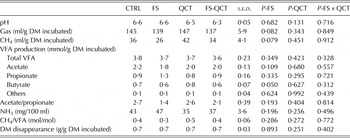
CTRL, control group (no antioxidants, 34 g palm oil/kg TMR); FS, flaxseed group (85 g FS/kg TMR); QCT, quercetin group (CTRL plus 2 g QCT/kg TMR); FS-QCT, FS plus QCT group (85 g FS plus 2 g QCT/kg TMR); s.e.d., standard error of the difference; P-values for FS, QCT, and their interaction (FS × QCT); VFA, volatile fatty acid; DM, dry matter.
As far as QCT is concerned, no significant differences were observed in the main in vitro ruminal fermentation parameters when QCT was included in the diet of donor liquid fattening lambs (Table 4). However, gas production, methane production, acetic acid and butyric acid observed during in vitro incubation were numerically reduced with FS (Table 4), which seemed to be in accordance with the toxic effects of PUFAs on cellulolytic bacteria like Butyrivibrio species (Table 3).
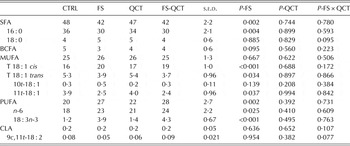
With regards to the FA profile of ruminal contents a trend towards significantly higher values of RA was observed when FS and QCT were included together in the diet of fattening lambs (P = 0·072, Table 5). Quercetin administered alone did not modify FA profile of ruminal contents. On the other hand FS promoted significant reduction of total SFA and total 18 : 1 trans (included VA), whereas total 18 : 1 cis and PUFAs were significantly increased.
Effect of dietary treatment on total fatty acid methyl ester (FAME) profile (g/100 g of total FAMEs) in the ruminal content of fattening lambs (n = 8 per treatment)
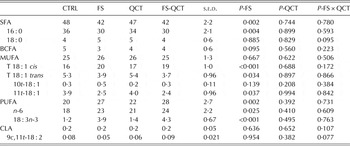
CTRL, control group (no antioxidants, 34 g palm oil/kg total mixed ration (TMR)); FS, flaxseed group (85 g FS/kg TMR); QCT, quercetin group (CTRL plus 2 g QCT/kg TMR); FS-QCT, FS plus QCT group (85 g FS plus 2 g QCT/kg TMR); SFA, total saturated fatty acids (sum of 6 : 0, 7 : 0, 8 : 0, 9 : 0, 10 : 0, 11 : 0, 12 : 0, 13 : 0, 14 : 0, 15 : 0, 16 : 0, 17 : 0, 18 : 0, 20 : 0, 22 : 0); BCFA, total branched chain fatty acids (sum of iso 15 : 0, anteiso 15 : 0, iso 16 : 0); MUFA, monounsaturated fatty acids (sum of cis- and trans-MUFA); T 18 : 1 cis (sum of c9-18 : 1, c11-18 : 1, c12-18 : 1): T 18 : 1 trans (sum of 4t-18 : 1, 5t-18 : 1, 6t/7t/8t-18 : 1, 9t-18 : 1, 10t-18 : 1, 11t-18 : 1, 12t-18 : 1, 13t/14t-18 : 1, 15t-18 : 1, and 16t-18 : 1); PUFA, polyunsaturated fatty acids (sum of 18 : 2n-6, 20 : 2n-6, 20 : 4n-6, 18 : 3n-3); n-6 (sum of 18 : 2n-6, 20 : 2n-6, 20 : 4n-6); CLA, conjugated linoleic acid (sum of 9c,11t-18 : 2, 7t,9c-18 : 2, 9t,11c-18 : 2, 11t,13c-18 : 2, t/t-CLA); s.e.d., standard error of the difference; P-value, probability of significant effects of FS, QCT and their interaction (FS × QCT).
DISCUSSION
The main purpose of the current study was to investigate the reasons why both VA (t11-18 : 1) and RA (c9,t11-18 : 2) contents were increased significantly in meat when FS and QCT were supplied together (but not separately) in the diet of fattening lambs (Andrés et al. Reference Andrés, Morán, Aldai, Tejido, Prieto, Bodas and Giráldez2014). This effect was observed in the meat of the same lambs used in the present study as ruminal content and liquid donors (Andrés et al. Reference Andrés, Morán, Aldai, Tejido, Prieto, Bodas and Giráldez2014).
Palmquist et al. (Reference Palmquist, St-Pierre and McClure2004) estimated that the conversion of VA to RA in lamb intramuscular fat by the action of ∆9-desaturase enzyme could take place at a similar extent to that reported for milk. Consequently, it has been suggested that the most efficient way to increase RA concentration in tissues is to enhance ruminant production of VA (Griinari et al. Reference Griinari, Corl, Lacy, Chouinard, Nurmela and Bauman2000; Santora et al. Reference Santora, Palmquist and Roehrig2000). Therefore, feeding strategies that increase VA absorption would be effective in enhancing RA in meat. In this sense, linolenic acid (LNA) has been demonstrated as a source of CLA isomers at ruminal level (Lee & Jenkins Reference Lee and Jenkins2011). However, in the present study VA content was significantly decreased at ruminal level when FS was included in the diet of fattening lambs, which might be explained as a consequence of the inhibition of bacteria involved in both steps (VA production and SA production) of the ruminal BH processes. In other words, even if FS inhibited the complete BH of C18 PUFA to SA (less Butyrivibrio SA-producing bacteria when feeding FS) resulting in an accumulation of VA which would have been available for endogenous conversion to RA via the action of ∆9-desaturase in the tissues, the concomitant reduction of Butyrivibrio VA-producing bacteria might have neutralized the previous effect resulting in a reduction of VA at ruminal level.
In any case, the current results are in consonance with those investigating the effect of lipid supplementation on the rumen microbiota in cattle (Boeckaert et al. Reference Boeckaert, Fievez, Van Hecke, Verstraete and Boon2007, Reference Boeckaert, Vlaeminck, Fievez, Maignien, Dijkstra and Boon2008) and would confirm the toxic effects of PUFAs on members of the Butyrivibrio/Pseudobutyrivibrio phylogenetic group which biohydrogenate PUFAs, particularly when LNA rich oils are fed (Jenkins Reference Jenkins1993; Kim et al. Reference Kim, Liu, Bond and Russell2000; Maia et al. Reference Maia, Chaudhary, Figueres and Wallace2007, Reference Maia, Chaudhary, Bestwick, Richardson, McKain, Larson, Graham and Wallace2010; Yang et al. Reference Yang, Bu, Wang, Hu, Li, Wei, Zhou and Loor2009). The toxic effects of FS on B. fibrisolvens (a butyric acid-producing bacteria during ruminant digestion) would also explain the shift towards a decline in butyrate when FS was included in the diet (Machmüller et al. Reference Machmüller, Ossowski and Kreuzer2000). Indeed, B. fibrisolvens, like many other bacteria sensible to PUFAs, is a cellulolytic bacteria involved in fibre degradation (Kamra Reference Kamra2005; Maia et al. Reference Maia, Chaudhary, Figueres and Wallace2007), which also might explain the numerically (but not significantly, P = 0·082) lower levels of gas produced after 20 h of incubation when FS was included in the diet.
Moreover, and in agreement with Oldick & Firkins (Reference Oldick and Firkins2000), the inhibitory effect of unsaturated oils, which appears to be associated with the degree of unsaturation of the FAs (e.g. two unsaturated double bonds (LNA) v. three double bonds (LNA)) and lipid peroxidation (Mihaliková et al. Reference Mihaliková, Gresáková, Boldizárová, Faix, Leng and Kisidayová2005), was also observed on ciliate protozoa. This effect might have promoted the numerically lower levels of in vitro methane production after 20 h of incubation with ruminal liquid obtained from FS diets. The current results are in agreement with those reported by Machmüller et al. (Reference Machmüller, Ossowski and Kreuzer2000) in lambs, where an effect of linseed oil (0·66 g/kg DM) on methane production (10% reduction) was described. In this sense, it is well-known that FS also decreases the archaeal population and activity of enzymes involved in methane production, being proposed as an alternative to reduce greenhouse gas emissions in dairy cattle (Li et al. Reference Li, Schoenhals, Brady, Estill, Perumbakkam and Craig2012).
As far as QCT is concerned, none of the main ruminal fermentation parameters was significantly modified in the present study by the addition of this flavonoid to the diet of fattening lambs, maybe as a consequence of the low levels of this compound (2 g/kg DM) added to the diet. Alternatively, all the bacterial species (including Butyrivibrio groups) might have been adapted to the QCT included in the diet (Benchaar et al. Reference Benchaar, McAllister and Chouinard2008) along the whole experimental period (at least 5 weeks), thus explaining the lack of significant effects of QCT on ruminal bacterial communities when supplied alone or together with FS. However, it must be stressed that numerically (though not significantly) higher values for methane production observed for the QCT group seemed to be in agreement with the enhancement of ciliate protozoa by this polyphenol. A previous study (Oskoueian et al. Reference Oskoueian, Abdullah and Oskoueian2013) described a suppression of protozoa and methane production when QCT was included at a rate of 45 g/kg DM, a concentration much higher than that used in the present experiment (2 g/kg DM). Consequently, opposite effects of this compound when included at low against high levels cannot be discarded.
Additionally, ruminal protozoa have been shown to be capable of converting LA into RA but not RA into VA (Or-Rashid et al. Reference Or-Rashid, Al Zahal and McBride2008). This fact, together with the concomitant inhibition of Butyrivibrio by PUFAs (taking part in both steps of the BH route, that is to say, from RA to VA and VA to SA) would allow an explanation for the trend towards significantly higher values of RA at ruminal and meat level (Andrés et al. Reference Andrés, Morán, Aldai, Tejido, Prieto, Bodas and Giráldez2014) when QCT and FS were included simultaneously (but not separately) in the diet of fattening lambs. It must be stated, however, that BH routes are very complex, so other effects of FS and QCT on ruminal microbial population cannot be discarded.
Few studies have investigated deeper into the effects of polyphenolic compounds or the interaction between polyphenolic compounds and PUFAs on those microorganisms involved in BH processes. However, in agreement with the current study, Vasta et al. (Reference Vasta, Yáñez-Ruiz, Mele, Serra, Luciano, Lanza, Biondi and Priolo2010) demonstrated that the incubation of ruminal fluid with tannins reduced the BH of LA and LNA. This effect was attributed to the inhibition of proliferation of rumen microorganisms participating in the second step (VA to SA) of BH (Vasta et al. Reference Vasta, Makkar, Mele and Priolo2009a ; Rana et al. Reference Rana, Tyagi, Hossain and Tyagi2012), thus leading to the accumulation of trans C18 : 1 isomers (VA). Nevertheless, these studies did not specifically investigate the effects of polyphenols on ciliate protozoa to explain this effect.
Benchaar & Chouinard (Reference Benchaar and Chouinard2009) described that the addition of plant extracts rich in polyphenols had no effect on dairy performance or milk composition but slightly altered milk FA composition (decrease in SFA and increase in MUFA). This is in agreement with those results previously described in meat samples (Rana et al. Reference Rana, Tyagi, Hossain and Tyagi2012; Andrés et al. Reference Andrés, Morán, Aldai, Tejido, Prieto, Bodas and Giráldez2014) where a significant decrease in saturation index was observed when either tannins (Rana et al. Reference Rana, Tyagi, Hossain and Tyagi2012) or QCT (Andrés et al. Reference Andrés, Morán, Aldai, Tejido, Prieto, Bodas and Giráldez2014) were added to the diet of lambs, suggesting that polyphenols could alter rumen BH to some extent (Ferlay et al. Reference Ferlay, Martin, Lerch, Gobert, Pradel and Chilliard2010). However the present study has highlighted no effects of QCT at ruminal level on SFA or MUFA, so meat FA profile (Andrés et al. Reference Andrés, Morán, Aldai, Tejido, Prieto, Bodas and Giráldez2014) cannot be completely explained as a consequence of ruminal microbiota and ruminal FA profile. Alternatively it has been suggested that polyphenols may result in modification of rumen metabolic pathways via modulation of the absorbed FAs and protein, thus altering indirectly the regulatory mechanism responsible for ∆9-desaturase expression (Rana et al. Reference Rana, Tyagi, Hossain and Tyagi2012). Moreover, a direct influence of QCT on ∆9-desaturase expression cannot be excluded. Accordingly, previous studies have observed that Δ9-desaturase expression was influenced by the presence of polyphenolic compounds (Palmquist et al. Reference Palmquist, Lock, Shingfield and Bauman2005; Vasta et al. Reference Vasta, Mele, Serra, Scerra, Luciano, Lanza and Priolo2009b ; Rana et al. Reference Rana, Tyagi, Hossain and Tyagi2012), which have been shown to be present in plasma (mainly as conjugated forms) even after extensive ruminal degradation by enzymes or rumen microbiota (Lowry & Kennedy Reference Lowry and Kennedy1996; Berger et al. Reference Berger, Wein, Blank, Metges and Wolffram2012).
In conclusion, supplementation of fattening lambs with FS promoted important quantitative changes in the total bacteria and reduced Butyrivibrio populations, whereas the ciliate protozoa population was increased by QCT. These changes may explain the increased RA concentration in ruminal contents (present study) and meat (a previous study) when FS and QCT were administered together in the diet of fattening lambs. To our knowledge, this is the first study using QCT as a feed additive in which effects of their addition to a LNA-rich diet has been examined in fattening lambs. However, further research investigating possible effects of QCT, mainly as far as methane production is concerned, is advisable before recommending this compound to modify ruminal BH and meat FA composition.
Financial support received from ‘Consejería de Educación de la Junta de Castilla y León’ (Project CSI185B11-2) and CSIC (Proyecto Intramural Especial; Project 201540E084) are gratefully acknowledged. R. Bodas and M.L. Tejido (JAE-Doc contracts) were supported by the program ‘Junta para la Ampliación de Estudios’ (CSIC-European Social Fund).