INTRODUCTION
In Finland, representing the northernmost regions in European agriculture, cereal yields have stagnated or even decreased despite continuous advances in the genetic yield potential (Peltonen-Sainio et al. Reference Peltonen-Sainio, Jauhiainen and Laurila2009, Reference Peltonen-Sainio, Salo, Jauhiainen, Lehtonen and Sieviläinen2015). Between 1995 and 2013, national winter rye (Secale cereal L.) yields decreased on average by 1·6%/year, while oat (Avena sativa L.) and wheat (Triticum aestivum L.) yields on average only increased by 0·2%/year. The highest yield increase was observed for barley, being 0·7%/year on average (Luke 2015).
By comparison, the genetic improvement of barley in Finland averaged 1·15%/year between 1995 and 2005 (Peltonen-Sainio et al. Reference Peltonen-Sainio, Jauhiainen and Laurila2009). This means an increasing yield gap, i.e. the difference between the potential yield attainable under optimum management and the average yield achieved by farmers. The reduction of yield gaps has received increasing attention due to rising grain prices and concerns over global and regional food security (van Ittersum & Cassman Reference van Ittersum and Cassman2013).
Regions with a favourable climate and soil quality, as well as possible access to irrigation have a greater potential to support higher yields in a sustainable manner (van Ittersum et al. Reference van Ittersum, Cassman, Grassini, Wolf, Tittonell and Hochman2013). However, even modest changes in cropping systems may have a significant contribution when aiming to sustainably intensify agricultural systems. The use of commercially certified seed (CCS) is an example of a means to reduce yield gaps and sustainably intensify crop management practices in countries such as Finland that are characterized by a high usage rate for farm-saved seed (FSS) (Peltonen-Sainio & Rajala Reference Peltonen-Sainio and Rajala2014).
The usage rate for CCS is low on Finnish farms, where it only accounts for some 0·20–0·30 of wheat and barley seed. In Europe, low levels of use (0·10–0·30) are also found in, for instance, Poland, Lithuania and Slovakia. In contrast, the use of commercially certified wheat and barley seeds is common in countries such as Denmark, France and Sweden, varying between 0·50 and 0·90. Despite the yield benefits from and the ease of use of CCS, farmers in Finland mostly prefer FSS and have long traditions in using it. From a total of 491 samples of barley FSS provided by Finnish farmers, the median number of FSS generations used was found to be 3 in 2008 and 4 in 2009, but higher generation numbers of up to 15 years were recorded (Peltonen-Sainio et al. Reference Peltonen-Sainio, Rajala and Jauhiainen2011).
For barley and oats, farmer interviews demonstrated that use of CCS decreased in 2014 compared with the previous year. The lowest level of CCS use was found for malting barley, with figures of only 0·19, 0·30, 0·22 and 0·15, respectively, for the years from 2011 to 2014. Malting barley requires the approval of varieties by malt houses and brewers and thereafter new varieties are taken into use. Despite the low rates of CCS use, farmers are interested in attempting to increase yields by some other means and there is an aim to raise barley yields from the current 4010 to 4460 kg/ha in the coming years (VYR 2014).
The policy reform resulting from Finland's entry into the EU in 1995 reduced agricultural output prices by 40–50%. To balance the effects of the price decrease, extensive policy measures were introduced with the objective of maintaining farm incomes through income support (per hectare and per animal payments). Furthermore, policy measures such as investment aid were expected to support productivity growth and structural development. Despite the new policy measures, the marginal value product of both short- and long-term investments in production decreased significantly. The policy reform described above is the main reason for the observed yield gap between potential and attained yields (Peltonen-Sainio et al. Reference Peltonen-Sainio, Salo, Jauhiainen, Lehtonen and Sieviläinen2015).
The motives of farmers for using or occasionally switching to CCS instead of FSS are mainly related to the benefits provided by new and better varieties with a higher yield potential (VYR 2012). Therefore, buying new CCS can be considered as an investment in new genetic material, providing higher yield and returns, and the price difference compared with FSS is an investment cost. Higher yields can be attained in two ways when switching to CCS without any other changes in input use: firstly, through genetic yield improvement averaging 1·15%/year as new cultivars are taken into use (Peltonen-Sainio et al. Reference Peltonen-Sainio, Jauhiainen and Laurila2009) and secondly, due to the higher yields attainable with better quality CCS than with FSS, even without the benefits from cultivar change (Rajala et al. Reference Rajala, Niskanen, Isolahti and Peltonen-Sainio2011). In a 3-year field experiment in Finland between 2007 and 2009, CCS produced the highest malting barley yields compared with upgraded or native FSS. The yield difference was highest, 654 kg/ha (0·12), when CCS was compared with FSS with no sieving or disinfectant treatment (Rajala et al. Reference Rajala, Niskanen, Isolahti and Peltonen-Sainio2011). Moreover, the mean barley yield in Finland could be increased from 3460 to 3920 kg/ha if only CCS was used, and farmers would therefore benefit from new cultivars with higher yield potential (Peltonen-Sainio & Rajala Reference Peltonen-Sainio and Rajala2014). However, costs related to the use of CCS limit the opportunities of farmers to increase yields through their use. Besides this, soil heterogeneity affects the possibility of choosing new cultivars, and may limit the choice of new CCS.
Farmer interviews in 2011 also revealed rough price thresholds for CCS. Most farmers considered CCS too expensive, as its price reached 380 €/t. A price level lower than 230 €/t was also considered too low in terms of the high-quality requirements of CCS. Hence, a price range of 230–380 €/t was considered acceptable by farmers (VYR 2012). A price relationship between CCS and unrestored FSS (malting barley) of <2 therefore implies a favourable relationship leading to a preference for CCS over unrestored FSS. Presently, this relationship has increased to 3 and is significantly hindering the use of CCS.
The objective of the present study was to evaluate the effect of price on the use of CCS in a country having long traditions in using primarily FSS, despite the unknown quality with high risks for crop emergence and concomitant yield failures. Improvements in yield potential were considered as a dynamic procedure with carry-over effects on upcoming years. Thus, the choice of seed type is a decision-making process considering several years at the same time. One-year gross-margin calculations are not able to cover all related variables. Decision making according to 1-year returns and costs neglects genetic improvements in new cultivars. By solving and characterizing the optimal decision rules, the present study identified the optimal interval to replace FSS with CCS. As a by-product, the solved model gives the part of the yield gap that could be associated with the seed choices made by farmers.
MATERIALS AND METHODS
The most important economic factor determining the use of CCS is the price difference between equal quality seeds of FSS and CCS. Sieving and disinfecting FSS increases seed costs, narrowing the price difference compared with CCS. The cost of sieving and disinfecting FSS varies between farms, and not all farms have the equipment needed to restore seed. On the other hand, there is an administration gain from using FSS since lower transportation costs increase the price difference compared with CCS. Only 0·33 of farmers calculate the total costs of FSS restoration, which was considered by the CCS industry as one of the main reasons for the widespread use of FSS (VYR 2012).
In Finland, the price of malting barley including transportation costs to malt house at the end of 2013 was 160 €/t, also representing the price for unrestored FSS. If FSS was sieved, farm-level calculations by authors showed the price level to reach 240 €/t at farm. The price for sieved and disinfected FSS reached 280 €/t, whereas the CCS price reached 480 €/t. Farm-saved seed prices included all the costs for different restoration measures, i.e. sieving and disinfecting, as well as analysis costs for thousand grain weight (TGW) and germination percentage, in order to be able to calculate the sowing rate per hectare. In the simplified model used, the actual behaviour of farms was not fully represented. New cultivar seed is often purchased for small areas, to produce seed for using in a larger area the next year. Since seed choice was formalized to 1 ha, a premium of 57 €/ha was used for CCS compared with FSS in the base scenario.
The economic dynamic optimization model was numerically solved by dynamic programming with known parameters for one-period returns and transition equations. The model parameters represented Finnish conditions and were based on farm-level cost data in 2012. The stock variable was defined as the genetic yield potential of seed used on a farm, and the initial value was set to 100. The level of the stock variable changes with time and is a result of the control variable CCS, which increases the stock variable due to plant breeding. Use of FSS was assumed to reduce the stock variable.
The yield increase through the use of CCS was assumed to be 1·15%, which was recorded as the pace of genetic yield improvement in Finland between 1995 and 2005. In the simulation, 1·15% yield increase was calculated as a percentage of first year yield (4009 kg/ha). Therefore, an absolute yield increase of 46 kg/ha/year was used, assuming steady genetic yield improvement during simulation period. If FSS is used for many years, then farmers are not able to benefit from this increase in the genetic yield potential. The influence of using FSS for many generations, in terms of possible seed degradation, is not straightforward and is more complex to measure. For barley, the number of FSS generations that can be used safely could not be determined based on Finnish seed lots. However, genotypic degradation caused by mixing with other cultivars and species during harvest, drying and storing was still an evident risk (Peltonen-Sainio et al. Reference Peltonen-Sainio, Rajala and Jauhiainen2011). In the dynamic optimization routine, degradation of the FSS yield potential equal to 1%/year was expected.
Malting barley represents a special branch of barley production, with a 0·20 share of the total barley area in Finland (Luke 2015). The challenge of the present study was to optimize the renewal interval for malting barley seed with certain carry-over effects. The parameters used were derived from farm-level cross-sectional cost data from 2012 for malting barley (Lohkotietopankki, Agricultural plot databank) collected by the Association of ProAgria Centres. The average yield was 4009 kg/ha, and this initial yield level was set to equal the initial genetic yield potential of 100. Variable costs comprised seed, fertilizer and crop protection costs, as well as other variable costs, including fuel, electricity and transport. Variable costs were connected to the yield level according to the farm data. Variable cost data were complemented by labour and fixed costs set to 100 €/t.
The optimization problem was formalized as a recursive finite horizon (T) dynamic programming problem that was solved numerically by iterating Bellman's equation (Bellman Reference Bellman1957):
 $$\eqalign{V_t (z_t) &= \max{_{u_t}} \left\{R_t (z_t, u_t) + \beta V_{t + 1} (z_{t + 1}) \right\}, \cr t & = 0, 1, \,\ldots,},T$$
subject to z t+1 = g (z t , u t )
z 0 given, T = 35,
where the optimal value function (V t ) is the function of the current state vector (z t ), u t is the control (the choice between FSS and CCS), R t (.) is the one-period net return function and β is the discount factor. The optimal value function is constrained by transition equations, in which g(.) is a function. It determines the connection between the current state and control and the next period state. The optimal solution is a function of the initial state z 0.
The one-period net return (R t ) is the difference between total returns and costs. The one-period return function is:
 $$R_t (z_t, u_t) = S_t + p_t ya_t - VC - FC - \;w_t u_t $$
where S t denotes subsidies per ha, p t is the price of malting barley, y is the malting barley yield, a t is the yield potential of the seed used, and VC and FC, respectively, are variable and fixed costs per ha of malting barley production. In the model, variable costs were the sum of seed, fertilizer and crop protection costs, as well as other variable costs, including fuel, electricity and transport. Fixed costs were the sum of labour, machinery, building, land and general costs. The last term, w t ut , is the extra cost of purchasing CCS compared with using FSS instead. The time horizon (T) was set to 35 years.
The state vector (z t ) consists of the yield potential of seed used (x t ) and the output price (p t ), as well as the price of the control variable CCS (w t ). Prices and subsidies were assumed deterministic such that they will remain the same in the future. Thus, the transition equations for prices are simply
 $$p_t = p_{t + 1} = \bar p,\quad w_t = w_{t + 1} = \bar w\quad {\rm and}\quad S_t = S_{t + 1} = {\overline S}$$
The transition equation, i.e. the carry-over effect, for the seed yield potential was defined as follows: CCS control (u t ) as %/ha and a t as the seed yield potential. The transition equation was assumed to be
 $$a_{t + 1} = 0{\cdot}0115\;u_t + (1 - 0{\cdot}01)a_t $$
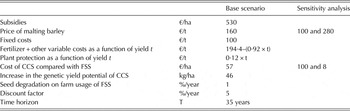
The initial state for the stock was set at 100, representing the average yield of 4009 kg/ha malting barley. The transition equation imposed an average annual decay rate of 1% in the stock of the seed yield potential, which can be seen when u t is set at zero. The optimization problem was solved by using GAUSS software (version 9.0; GAUSS 2009). The prices and the scope of the model are summarized in Table 1.
Prices and scope of the base scenario optimization problem

RESULTS
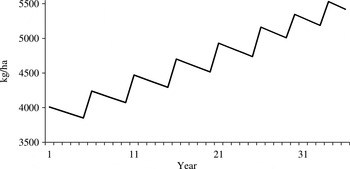
The long-term equilibrium for the seed renewal interval that maximized the farmer's value function was estimated to be 5 years, which is substantially below the interval needed for the maximum yield potential provided by genetic improvement resulting from plant breeding. On average, the result showed 0·20 use of CCS per year. Therefore, FSS was used for 4 years between seed renewal, which was a time period during which genetic improvement was not utilized and FSS degraded by 1% annually. In the base scenario, yield gap expanded to its maximum in the fourth year, being 342 kg/ha. Thereafter, marginal return of buying new CCS was larger or equal to marginal cost, which catches up with the plant breeding achievements and declaration in FSS.
The jumps in farm-level seed yield potential (Fig. 1) indicate the time points at which CCS was purchased, increasing the yield potential. The horizontal segments indicate years when FSS was used, with no improvement in the seed yield potential, and also representing the period when the most recent genetic yield improvements were unutilized. Plant breeding runs on the frontier, which is the line connecting all the ‘peaks’ in Fig. 1. The yield gap is represented by the distance to all points that deviate from this frontier.
Development of the farm-level seed yield potential (base scenario) in the case where FSS was used for 4 years and the cultivar was then renewed by using CCS to benefit not only from the genetic yield gains provided by plant breeding but also from higher yields attainable by using quality seed.

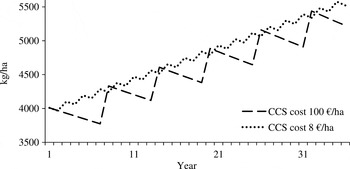
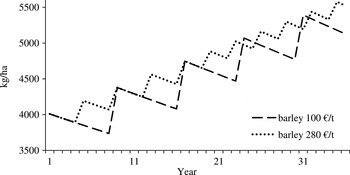
It is rational that if the price difference between CCS and FSS approaches zero, farmers will have strong incentives to utilize all the genetic gains available through the immediate use of CCS. However, when the price difference moves away from zero, farmers will take into consideration profit maximization. The optimal CCS usage with different CCS cost levels is highlighted in Fig. 2. In the case where the CCS cost was 100 €/ha, it was rational for farmers to optimize seed renewal at longer intervals, i.e. only every 6–7 years. A low barley price discourages farmers from using CCS. With a price level as low as 100 €/t, the seed renewal time increased to 8 years. Conversely, a high price level provided incentives to renew seed at shorter intervals, i.e. every 3 years (Fig. 3).
Effect of CCS price on the seed renewal interval and seed yield potential on a farm (corrections in figure: 100 €/ha, 8 €/ha).

Effect of barley price on the seed renewal interval and seed yield potential on a farm.

Sensitivity analysis regarding seed degradation due to the use of FSS on farms or discount factor <5% indicated that the results are robust. The optimal control path u t did not change, even if the degradation rate changed dramatically or discount factor was equal to 1·15% representing average genetic yield improvement in Finland, but also total average productivity increase per year in Finnish agriculture during 1992–2009 (Niemi & Ahlstedt Reference Niemi and Ahlstedt2010). However, when the rate of increase in the genetic yield potential of CCS was doubled, the optimal renewal time of seed was halved.
DISCUSSION
The results obtained with the dynamic optimization routine simulated the farmer profit maximization problem. As an economic decision maker, a farmer has to consider costs related to the use of all inputs, including the decision to use CCS instead of FSS. The present study indicated that because of the rational consideration of costs, not all the benefits provided by plant breeding could immediately be achieved at the farm level, but only at intervals depending on barley price and CCS price. At high northern European latitudes, fluctuating weather conditions may occasionally result in yield failures and quality deterioration, as for instance occurred on a large scale in 2012 (Peltonen-Sainio & Jauhiainen Reference Peltonen-Sainio and Jauhiainen2014), and this again compels farmers to renew seeds independent of their typical pace of renewal.
Despite the consistent genetic yield gains achieved by plant breeding exhibited in new cultivars, national yield trends in Finland indicate inadequate exploitation of the genetic yield potential (Peltonen-Sainio et al. Reference Peltonen-Sainio, Jauhiainen and Laurila2009, Reference Peltonen-Sainio, Salo, Jauhiainen, Lehtonen and Sieviläinen2015). Yield trends have in many cases stagnated, and in some crops even declined.
According to Cassman & Harwood (Reference Cassman and Harwood1995) and van Wart et al. (Reference van Wart, Kersebaum, Peng, Milner and Cassman2013), grain yields at the farm scale could in general approach 0·75–0·85 of the genetic yield potential, but in Finnish conditions only wheat was in that range (0·80), whilst other spring cereals including barley exhibited a utilization rate of only 0·60–0·70 (Peltonen-Sainio et al. Reference Peltonen-Sainio, Salo, Jauhiainen, Lehtonen and Sieviläinen2015). The closing or narrowing of this gap between the potential yield and yield attained at the farm scale is challenging in terms of optimizing management, as several factors have simultaneous effects and all of the management options require decision making by the farmer.
Firstly, if the price of malting barley is low, incentives to use more expensive CCS, as well as other inputs, decreases. Secondly, farmers have some inputs into stock, such as seed retained from earlier harvest(s), and this is often carelessly considered as readily available for sowing, even though it requires upgrading measures and quality verification to avoid failures. Inputs into stock often do not follow the latest development on the markets, and by using them the productive capacity decreases. Machinery and buildings are generally recognized examples of such inputs. The present study revealed that this phenomenon is also consistent with seed inputs.
During recent years, the use of CCS for malting barley in Finland has varied between 0·15 and 0·30 (VYR 2014). The results of the current estimations also suggested an optimal renewal interval of 5 years, or 0·20 annually on average. Also, an earlier study demonstrated that the median for the FSS generation number was four to five (Peltonen-Sainio et al. Reference Peltonen-Sainio, Rajala and Jauhiainen2011). Therefore, renewal-related decisions made by Finnish farmers appear to be rational in the current socio-economic situation. On the other hand, a high barley price might encourage farmers to switch towards higher rates of CCS use.
A higher pace of genetic yield improvements may shorten the CCS renewal interval. In fact, a recent study indicated that the pace of genetic yield gains increased in the 2000s compared with earlier decades, probably due to developments in breeding tools that facilitate breeding programmes (Peltonen-Sainio et al. Reference Peltonen-Sainio, Salo, Jauhiainen, Lehtonen and Sieviläinen2015). Sudden, temporary shifts in CCS use are, however, challenging for the CCS production chain, which is better prepared for constant rather than strongly fluctuating seed demand. This challenge of variable demand for CCS is again often evident after autumns with poor harvesting conditions. According to the results obtained in the present study, annual variation in use of CCS is associated with highly volatile barley prices. In decision making by farmers, CCS is an input that is easily substituted by FSS if the CCS price and expected output prices (yield and quality premiums) are not sufficient or convincing to encourage its use. In rational management procedure, new cultivar seed is often purchased for smaller areas to produce seed for a larger area in the next year. This implies lower use of more expensive CCS with higher yield potential but more frequent purchases. Therefore, full consideration of farmers' possibilities for reproduction of seed for own use needs further research.
The authors acknowledge funding received from the Ministry of Agriculture and Forestry in Finland.