INTRODUCTION
The Strait of Gibraltar is a biogeographical zone in which faunas of the Mediterranean and the Atlantic, along one axis, and of Europe and Africa along the other, overlap (Guerra-García et al., Reference Guerra-García, Cabezas, Baeza-Rojano, Espinosa and García-Gómez2009). It is a very important geographical–geological region formed in the final phases of the Pliocene period, being the boundary for the Mediterranean region (to the east), the Lusitanian region (to the north-west) and the Mauritanian region (to the south-west).
Europe and Africa are separated by 14.24 km at the Strait's narrowest point. The Strait depth ranges between 300 and 900 m. Around 5.9 million years ago, the connection between the Mediterranean Sea and the Atlantic Ocean was progressively restricted until its total closure (Messinian salinity crisis), which was one of the most dramatic events on Earth during the Cenozoic era (Hsü et al., Reference Hsü, Ryan and Cita1973). After a lengthy period of restricted intermittent or no water exchange between the Atlantic Ocean and Mediterranean basin, approximately 5.33 million years ago, the Atlantic–Mediterranean connection was completely re-established through the Strait of Gibraltar and again disconnected Africa from Europe. No evidence for a further closing of the Strait of Gibraltar exists (Blondel & Aronson, Reference Blondel and Aronson1999). All these geological events have determined the terrestrial and marine fauna across the Strait of Gibraltar. And thus, the Strait has attracted the attention of marine taxonomists and several biogeographical studies have been published (e.g. bryozoans: López de la Cuadra & García-Gómez, Reference López de la Cuadra and García-Gómez1994; sponges: Carballo et al., Reference Carballo, Naranjo and García-Gómez1997; ascidians: Naranjo et al., Reference Naranjo, Carballo and García-Gómez1998; molluscs: Gofás, Reference Gofás1998; crustaceans: Conradi & López González, Reference Conradi and López-González1999; Guerra-García & Takeuchi, Reference Guerra-García and Takeuchi2002; Guerra-García et al., Reference Guerra-García, Cabezas, Baeza-Rojano, Espinosa and García-Gómez2009). Most of the invertebrates from the Strait of Gibraltar include species with Atlantic–Mediterranean distribution, but peracarideans also include an important Indo-Pacific element (Guerra-García et al., Reference Guerra-García, Cabezas, Baeza-Rojano, Espinosa and García-Gómez2009).
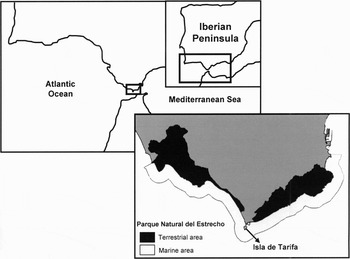
The Spanish side of the Strait is protected under the Straits Natural Park (Parque Natural del Estrecho) (Figure 1) which was declared a protected area in 2003. It is a maritime–terrestrial park along 54 km of coastline in southern Spain and includes highly diverse and structured marine communities (García-Gómez et al., Reference García-Gómez, Corzo, López-Fe, Sánchez-Moyano, Corzo, Rey, Guerra-García and García-Asencio2003). Inside the Park, Tarifa Island is considered a marine reserve, and constitutes the most interesting enclave of the park regarding the marine habitats. Tarifa Island is the southernmost point of Europe, just between the Mediterranean and Atlantic, with 21 hectares and 2 km of coastline. Its unique biogeographical position together with the substrate heterogeneity and the long-term military access restrictions, have contributed to maintain the richest rocky shore intertidal ecosystems of southern Spain (Guerra-García & García-Gómez, Reference Guerra-García and García-Gómez2000).
Location of Tarifa Island in the Strait of Gibraltar.

During a general monitoring study of the peracaridean community associated with intertidal algae in Tarifa Island, several interesting gammaridean species were registered, some of them previously collected only from the Atlantic. In the present paper these gammarids are illustrated, and ecological data and seasonal fluctuation patterns are also included for each species.
MATERIALS AND METHODS
All the samples were collected from the most southern point of Tarifa Island (Punta Marroquí, 36°00′00.7″N 5°36′37.5″W). The width of the intertidal range in this location is 2.5 m approximately and we considered 5 levels to establish the zonation of the intertidal algae (level 1: from zero tidal level to 0.5 m; level 2: 0.5–1 m; level 3: 1–1.5 m; level 4: 1.5–2 m and level 5: 2–2.5 m). A ruler, set square and rope were used to establish the different heights. The first height was the zero tidal level and the process was continued until the vertical height of 2.5 m had been achieved, coinciding with the upper limit of the intertidal community (see also Fa et al., Reference Fa, Finlayson, García-Adiego, Sánchez-Moyano and García-Gómez2002; Guerra-García et al., Reference Guerra-García, Maestre, González and García-Gómez2006). At each height, three replicates (quadrats 20 × 20 cm) were sampled. The surface was scraped and all specimens of algae and associated fauna were collected. Samples were taken every two months from the different intertidal levels (December 2005 to December 2007). The samples were fixed in ethanol 70–80% and brought to the laboratory for further identification and quantification after sieving using a mesh size of 0.5 mm. Biomass of algae was expressed in grams of dry weight per m2 and abundance of gammaridean species was expressed in number of individuals per m2. In each sampling, water temperature and salinity were measured using a conductivimeter WTW LF-323.
Selected specimens were dissected under a Reichert dissecting microscope. All dissected appendages were mounted in Faure's medium. The figures were drawn using a Wild compound microscope equipped with a camera lucida (drawing-tube).
All the examined material for the present study is deposited at the Museo Civico di Storia Naturale di Verona.
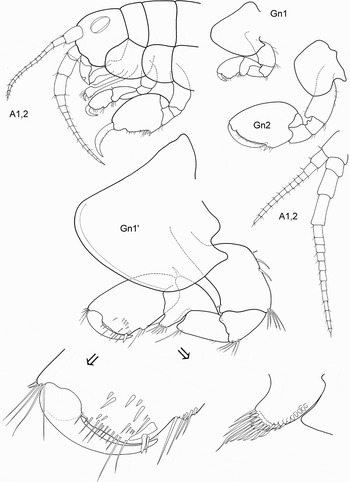
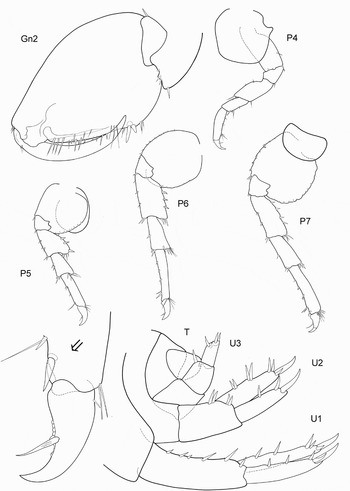
The symbols used in plates are: A1, 2 = antenna 1, 2; Gn1, 2 = gnathopods 1 & 2; P3-7 = pereopods 3–7; U1-3 = uropods 1–3; T = telson.
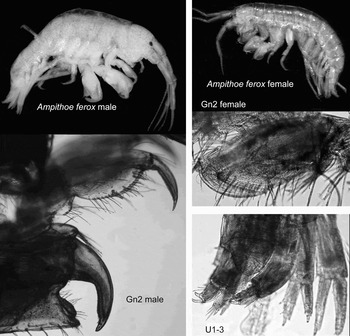
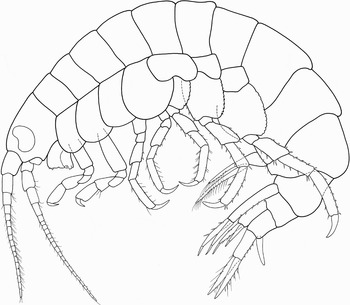
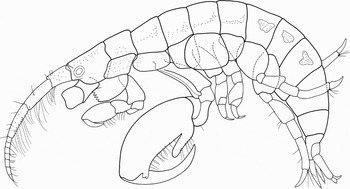
Ampithoe ferox Chevreux; habitus male, female; gnathopods male, female; urosome.

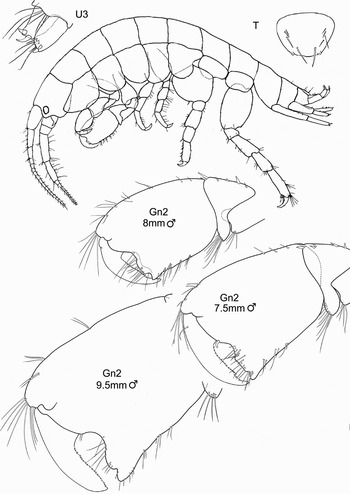
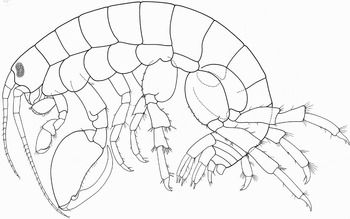
Ampithoe ferox Chevreux; habitus male, U3, T and Gn2 of three different males.

MATERIAL EXAMINED (ALL INTERTIDAL)
4 spec.; 4 December 2005: Corallina elongata, Jania rubens. 3 spec.; 1 May 2006: Corallina elongata, Jania rubens. 18 spec.; 29 July 2006: Corallina elongata, Jania rubens, Gelidium sp., Caulacanthus ustulatus, Laurencia pinnatifida. 4 spec.; 8 October 2006: Gelidium spp., Caulacanthus ustulatus, Laurencia pinnatifida. 6 spec.; 9 November 2006. Ulva rigida, Chaetomorpha sp. 4 spec.; 22 April 2007: Corallina elongata, Jania rubens. 1 spec.; 17 July 2007: Corallina elongata, Jania rubens.
REMARKS
This species has been only rarely collected in France, Sicily, Malta and the northern Adriatic Sea (Krapp-Schickel, Reference Krapp-Schickel and Ruffo1982b). It is the first time the allometric growth of Gn2 in male has been demonstrated.
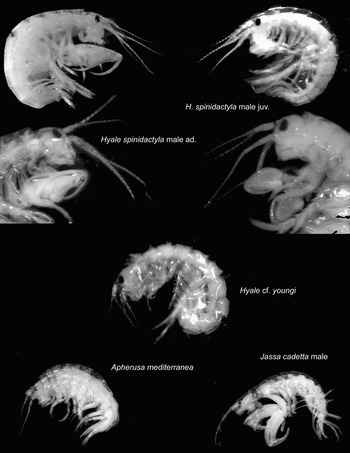
Habitus of Hyale spinidactylus adult and juvenile male, Hyale cf. youngi, Apherusa mediterranea and Jassa cadetta.

Apherusa mediterranea Chevreux; habitus.

MATERIAL EXAMINED (INTERTIDAL)
12 spec.; 1 May 2006: Gelidium sesquipedale.
REMARKS
This species is very sparsely cited from the Atlantic coast of Morocco, from Sicily and Algeria in the Mediterranean (Krapp-Schickel, 1982a).
Hyale spinidactyla Chevreux; habitus.

MATERIAL EXAMINED (ALL INTERTIDAL)
11 males, 23 females + juvenile; 17 July 2007: Corallina elongate, Jania rubens, Ulva rigida. 1 spec.; 1 October 2007: Corallina elongata, Jania rubens. 1 spec.; 15 December 2007: Ulva rigida, Chaetomorpha sp.
REMARKS
This species has been cited until now exclusively from the Atlantic. The type locality is Canary Islands (Chevreux, Reference Chevreux1925) but the species has been also reported from São Tomé Island, Cape Verde, Azores and coast of the Basque Country, northern Spain (Serejo, Reference Serejo2001).
Hyale cf. youngi Serejo; morphological details.

Hyale cf. youngi Serejo; morphological details.

MATERIAL EXAMINED (ALL INTERTIDAL)
1 juvenile male, 14 females + juvenile; 29 July 2006: Corallina elongata, Jania rubens. 1 juvenile male; 15 December 2007: Ulva rigida, Chaetomorpha sp.
REMARKS
As there are seemingly no adults collected, the identification cannot be certain; as above, also this species is only known from Brazil (States of Bahia, Rio de Janeiro and São Paulo).
Jassa cadetta Krapp, Rampin & Libertini; habitus.

MATERIAL EXAMINED
4 males, 3 females; 29 July 2006 intertidal: on Gelidium sesquipedale.
REMARKS
Only known from the northern Adriatic Sea until now. This study represents the first record of the species after its original description based on specimens collected from the Lagoon of Venice (Krapp et al., Reference Krapp, Rampin and Libertini2008).
SPATIO-TEMPORAL DISTRIBUTION
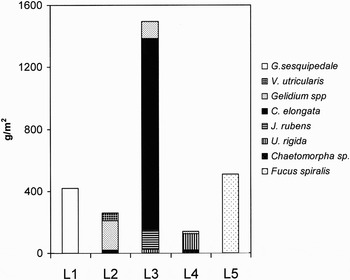
Salinity values remained similar throughout the year. Water temperature showed maximum values by the end of summer (August–October) and minimum values in February (Figure 10A). Biomass of seaweed was higher in level 3 than in the other levels (Figure 10B). Maximum values of biomass were reached by the end of spring and beginning of summer (April–June) and an important decrease was registered coinciding with the highest temperature of August, except for level 1 (0–0.5 m, closer to the subtidal) in which seaweed biomass did not decrease in August. Level 1 was dominated by Gelidium sesquipedale, level 2 (0.5–1 m) by Gelidium spp. (mainly G. latifolium and G. spinulosum) and Valonia utricularis (Figure 11). Level 3 (1–1.5 m) was composed mainly of Corallina elongata, but also Jania rubens and Gelidium spp. Level 4 (1.5–2 m) was dominated by green algae, such as Ulva rigida and Chaetomorpha sp., and level 5 (2–2.5 m) was exclusively represented by Fucus spiralis. In connection with the gammaridean species included in this study, Jassa cadetta and Apherusa mediterranea were dominant in level 1, Ampithoe ferox in levels 2 and 3, Hyale cf. youngi in level 3 and Hyale spinidactyla in levels 3 and 4 (Figure 12), demonstrating a spatial segregation of these species in the intertidal zone. All the species showed maximum peaks of abundance from April to October (late spring and summer) coinciding with the maximum seawater temperatures. The stability of the peracaridean composition assemblages through the year had been shown previously for soft bottom communities (Moreira et al., Reference Moreira, Gestoso and Troncoso2008) but little had been explored for rocky shores. Collecting data of abundance over the year is rare in ecological literature because it is time-consuming, costly and often not possible (Simkanin et al., Reference Simkanin, Power, Myers, McGrath, Southward, Mieskowska, Lepaer and O'Riordan2005). However, knowledge of seasonal fluctuations of seaweeds and associated macrofauna is essential for future monitoring, conservation and for making reliable management decisions, especially in protected areas such as Tarifa Island in the Strait of Gibraltar.
(A) Seawater temperature (°C) and salinity (psu) in the study area; (B) seaweed biomass in each intertidal level considered. Mean values ± standard deviation are included.

Main seaweed species in each intertidal level and their abundance.

Abundance (ind/m2) of the gammaridean species studied in the different levels in which each species were found. Mean values ± standard error of the mean are included.

ACKNOWLEDGEMENTS
Financial support of this work was provided by the Ministerio de Educación y Ciencia (Project CGL2007-60044/BOS) co-financed by FEDER funds, and by the Consejería de Innovación, Ciencia y Empresa, Junta de Andalucía (Project P07-RNM-02524). Special thanks to the directors of the Parque Natural del Estrecho (Jesús Cabello and Esther Gordo) and to the Comandancia General de la Guardia Civil for providing authorizations and facilitating access to the marine reserve Isla de Tarifa.