Introduction
Many reports suggest that electronic dance music (EDM) events and illicit drug use are tightly connected, with a high prevalence of 3,4-methylenedioxymethamphetamine (MDMA), cocaine, amphetamine, cannabis, gamma-hydroxybutyric acid (GHB), and ketamine ingestion.Reference Van Havere, Vanderplasschen, Lammertyn, Broekaert and Bellis 1 – 3 This phenomenon is worrisome as these substances, known as “party drugs,” “recreational drugs,” or “club drugs,” have been shown to cause serious health hazards and death. 3 – Reference Lund and Turris 8
The last few years, this important health care issue is further being complicated by a steadily increasing number of new psychoactive substances (NPS), also called “research chemicals” and “designer drugs.” Across the European Union, over 560 NPS are monitored, with 98 appearing for the first time in 2015. 9 For most NPS, little knowledge regarding pharmacology and toxicology is available to users and caregivers, thereby contributing to major health problems, including fatalities.Reference Hondebrink, Nugteren-van Lonkhuyzen and Van Der Gouwe 10 – Reference Walterscheid, Phillips, Lopez, Gonsoulin, Chen and Sanchez 13 Additionally, ethanol consumption remains a huge problem in Europe. A 31.2% prevalence of heavy episodic ethanol drinking is found among youngsters (15-19 years of age), and the proportion of deaths attributable to ethanol is around 20.0% in the 15-19 years old age group and around 25.0% in the 20-29 years old age group. 14
The main purpose of this prospective study was to describe the medical problems at the 2013 and 2014 editions of I LOVE TECHNO (ILT; Ghent, Belgium), one of Europe’s largest indoor EDM events. Focus was put on the impact of different types of recreational drugs: ethanol, “classical” illegal party drugs, and NPS. The results may assist medical caregivers and police forces in developing prevention strategies at large EDM events, and to optimize the on-site care.
Methods
Preventive Measures and On-Site Medical Support
The concept of the ILT event and the on-site medical care has been described previously.Reference Van Sassenbroeck, Calle and Rousseau 6 Briefly, first-aid Belgian Red Cross (Mechelen, Belgium) personnel, reinforced with five emergency physicians and six emergency nurses, treated less-serious illnesses and casualties in the medical station. If necessary, medical stabilization was started on-site, with subsequent transfer to one of the four nearby participating hospitals by one of the six stand-by ambulances.
Data Collection
As already described for the 2001 edition, all patients were registered by the Red Cross, and a standardized registration form with administrative and medical items was filled out by the caregivers.Reference Van Sassenbroeck, Calle and Rousseau 6 , Reference Gogaert, Vande Veegaete, Scholliers and Vandekerckhove 15 All apparently intoxicated patients judged by the attending physician to be in need of an intravenous line (for example, for the administration of benzodiazepines or fluids) were included in the toxicology study (irrespective of the patient’s age and the clinical presentation). For this sub-group, medical students prospectively recorded the clinical findings throughout the patient’s stay in the medical station. Information about the nature of the ingested substances was gathered from the patient, accompanying persons, and/or a body search. According to the protocol, blood samples for toxicological analysis were collected on the occasion of the vein cannulation. In case of micturition in the medical station, urine samples were also preserved. For patients transferred to a hospital, follow-up data were obtained retrospectively from the hospital charts. In these patients, urine samples were also collected. Patients for whom the drug assay proved to be negative were ultimately excluded from the toxicology study.
The study with an opting-out design was approved by the ethical committees of the four participating hospitals (University Hospital Ghent, General Hospital Jan Palfijn Ghent, General Hospital Saint Lucas Ghent, and General Hospital Maria Middelares Ghent; Belgium). The registration numbers are B670201318873 (for ILT 2013) and B670201422530 (for ILT 2014). The option-out design implied that blood and urine samples were obtained without consent. All included patients were given an information letter (eg, put in a plastic bag together with a cell phone and a wallet for a comatose patient transferred to a hospital). In this letter, the included attendants were invited to contact the principal investigator in order to obtain more information on the study and/or to express their will to be excluded from the study.
Drug Assay
For the toxicology study, all blood and urine samples were subjected to a standard systematic toxicological screening. Ethanol concentration was determined using headspace gas chromatographic-flame ionization detection. For urine and blood, the following were applied: gas chromatography-mass spectrometry (GC-MS) method, with commercially available libraries and high-performance liquid chromatographic (HPLC) method, combined with a diode-array detector (Agilent Technologies; Santa Clara, California USA) with an in-house developed library. Advanced toxicological analysis, such as LC-MS/MS, GC-MS, or GC-MS/MS, was performed for quantification of Δ9-tetrahydrocannabinol (THC) and its metabolites, cocaine, opioids, GHB, amphetamines, as well as benzodiazepines.Reference del Mar Ramirez Fernandez, De Boeck, Wood, Lopez-Rivadulla and Samyn 16 – Reference del Mar Ramirez Fernandez and Samyn 19 For NPS detection and confirmation, commercially available MS libraries and LC-high-resolution tandem MS with an in-house developed library were used. The in-house target list comprised NPS from the following groups: cannabinoids, cathinones, phenylethylamines, piperazines, and tryptamines.Reference Kinyua, Negreira and Ibáñez 20
Additional Toxicological Analyses for the NPS Sub-Study
The initial toxicological screening for ethanol, THC, GHB, cocaine, and amphetamines was performed by trained toxicologists who were blinded regarding clinical presentation and the drug(s) ingested. The results of the toxicology study were independently cross-referenced with all available clinical data by two emergency physicians with special interest in party drugs. Whenever these two experts agreed on a discrepancy between the clinical and toxicological data, further toxicological analysis was requested. At this stage of the additional NPS sub-study, toxicologists were informed about the presenting symptoms. Only when advanced analysis yielded negative results, blinding was removed and information pointing to a particular drug (eg, conviction of mescaline ingestion) was revealed.
Results
The EDM event was attended by 30,000 and 26,000 people in 2013 and 2014, respectively.
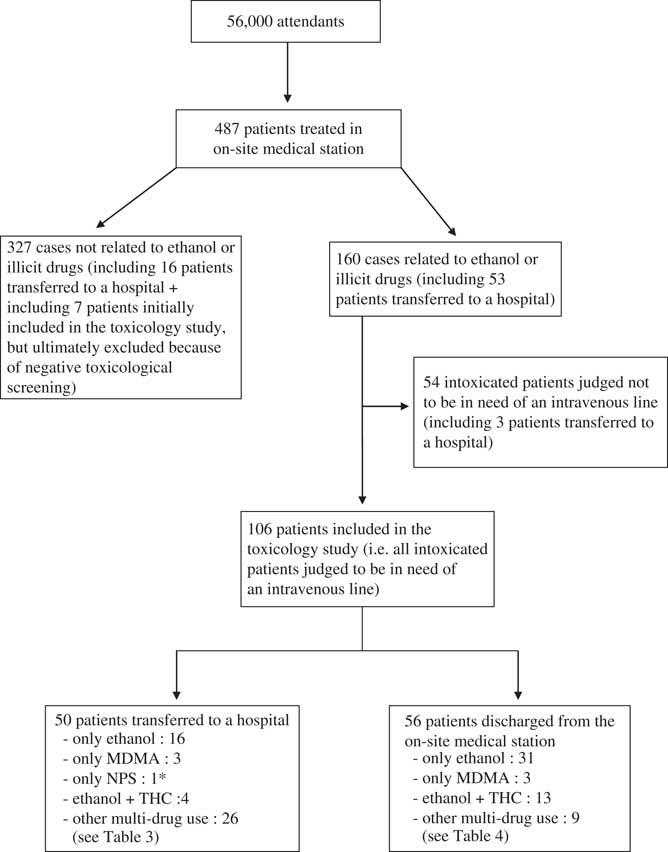
A diagram of the studied populations is given in Figure 1.
Diagram of Study Populations. Abbreviations: MDMA, 3,4-methylenedioxymethamphetamine; NPS, new psychoactive substances; THC, tetrahydrocannabinol. * The toxicological screening in a patient remaining comatose for more than one hour was negative; this case is described in more detail in the sub-study on new psychoactive substances (NPS).

The number of patients treated in the on-site medical station was 265 (88.3 per 10,000) in 2013 and 222 (85.4 per 10,000) in 2014. Among these patients, 38 were transferred to a hospital in 2013 (12.7 per 10,000) and 31 in 2014 (11.9 per 10,000).
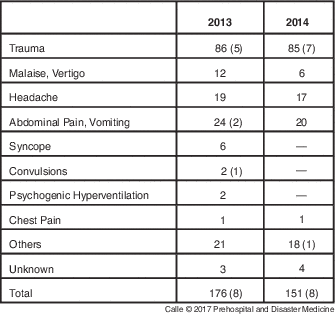
Details regarding medical problems not related to alcohol or illicit drugs are presented in Table 1. Of particular interest were multiple robbery attempts with tear gas in 2014 (leading to 23 victims, including four transferred to a hospital).
Presenting Symptoms Not Related to Ethanol or Illicit Drugs

Note: The number of patients transferred to a hospital is shown between brackets.
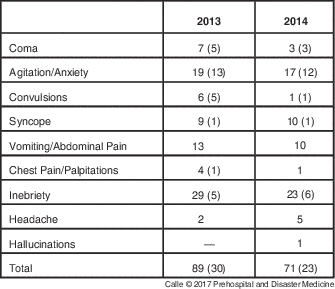
The number of patients with drug-related problems was 89 in 2013 (29.6/10,000) and 71 in 2014 (27.3/10,000). The presenting symptoms are shown in Table 2. Hypoglycemia was excluded in all these patients. Only one agitated patient was hyperthermic, and one bradypnoeic patient was intubated endotracheally (Table 3). All patients admitted to a hospital were discharged within 18 hours.
Presenting Symptoms Related to Ethanol or Illicit Drugs

Note: The number of patients transferred to a hospital is shown between brackets.
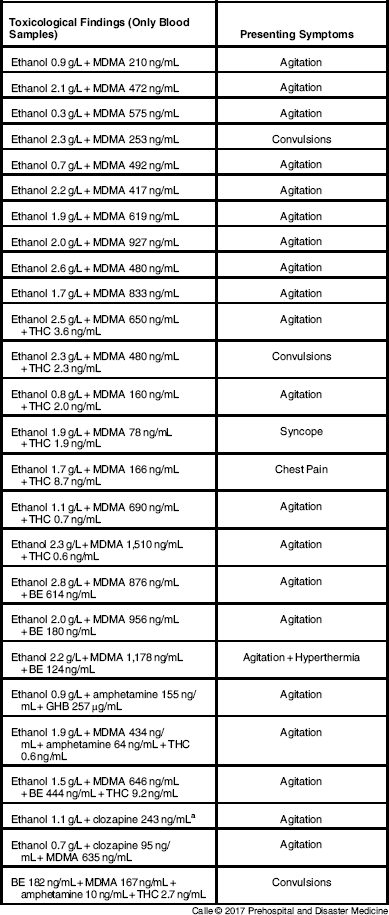
Clinical and Toxicological Findings in 26 Cases Transferred to a Hospital because of Multi-Drug Use (with the exception of the combination of ethanol and cannabis)

Abbreviations: MDMA, 3,4-methylenedioxymethamphetamine; THC, tetrahydrocannabinol; GHB, gamma-hydroxybutyric acid; BE, benzoylecgonine (ie, the main metabolite of cocaine).
a This case was intubated three hours after transfer to the hospital because of recurrent episodes of bradypnea.
According to the study protocol, blood samples were collected in 113 apparently intoxicated patients (67 in 2013 and 46 in 2014). None of these 113 patients asked to be excluded from the study. After review of the clinical data and based on negative toxicology, seven cases initially included in the toxicology study (six in 2013 and one in 2014) were excluded from the group with drug-related problems (and subsequently added to the cases not related to ethanol or illicit drugs). Fifty of the 106 cases included in the toxicology study (29/61 in 2013 and 21/45 in 2014) were transferred to a hospital.
For the 56 patients discharged from the on-site medical station after treatment, analytical toxicology revealed only ethanol in 31 patients (mean 2.0 g/L; range from 0.9 to 2.8 g/L). Three patients had consumed only MDMA (range: 464-609 ng/mL), and a further 13 patients had consumed both cannabis and ethanol (with ethanol concentrations between 0.3 and 2.4 g/L, and THC concentrations between 0.5 and 7.0 ng/mL). Among the 50 patients transferred to a hospital, only ethanol was found in 16 patients (mean 2.6 g/L; range from 1.9 to 4.0 g/L), only MDMA in three patients (range: 238-356 ng/mL), and a combination of ethanol and THC in four patients (with ethanol concentrations between 0.9 and 3.0 g/L and THC concentrations between 0.5 and 2.9 ng/mL).
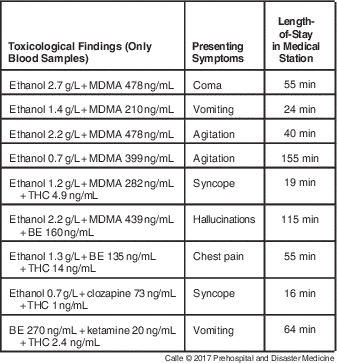
For the remaining 36 cases (ie, 27 transferred to a hospital and nine discharged from the on-site medical station), clinical and toxicological data (except the findings on NPS) are shown in Table 3 and Table 4. Intriguing was the patient transferred to a hospital with a presumed NPS intoxication. Also of particular interest were three patients where an intoxication with clozapine (a neuroleptic drug) was found; these intoxications most likely resulted from clozapine tablets sold as ecstasy during the event.Reference Calle, Patteet and Maudens 21
Clinical and Toxicological Findings in Nine Patients Who could be Discharged from the On-Site Medical Station (with the exception of the combination of ethanol and cannabis)

Abbreviations: MDMA, 3,4-methylenedioxymethamphetamine; THC, tetrahydrocannabinol; BE, benzoylecgonine (ie, the main metabolite of cocaine).
An alternative presentation of the above-mentioned data from the 106 cases in the toxicology study (but without the results of the additional NPS sub-study) revealed ethanol in 97 patients (91.5%), MDMA in 36 (34.0%), THC in 32 (30.2%), cocaine in eight (7.5%), amphetamine in three and clozapine in three (2.8%), and ketamine in one and GHB in one (0.9%).
In 20 cases (nine in 2013 and 11 in 2014), the two clinicians requested additional toxicological analysis. The reasons for the inclusion in this NPS sub-study (ie, a presumed discrepancy between clinical data and the first set of toxicological data) were: discrepancy between level of depressed consciousness and toxicology (n=8), discrepancy between level of agitation and toxicology (n=3), and information on the intake of a particular drug not detected (n=9; MDMA in three cases, lysergic acid diethylamide in two cases, and four individuals assumed having ingested respectively mescaline, ketamine, a spiced drink, and sugar cubes impregnated with a drug causing convulsions). This stepwise toxicological approach revealed the presence of hallucinogenic phenethylamine derivatives 25B-NBOMe and 25C-NBOMe, in combination with ethanol (0.9 g/L) and THC (0.8 ng/mL), in an agitated patient. Particularly intriguing in this NPS sub-study was one patient who remained comatose for more than one hour with negative toxicology. As no cause for the depressed level of consciousness was detected during a 6-hour hospital stay, this case remained in the group of intoxicated patients (under the assumption that an NPS was ingested that was not present in the toxicological spectral libraries used for NPS identification).
The toxicological analysis of the urine samples (available in only 27 of the 106 included cases) provided no additional information.
Discussion
The findings in this study on the total number of treated patients, the number of patients transferred to a hospital after first assessment and treatment in the on-site medical station, and the numbers of patients with potentially life-threatening conditions (such as coma or convulsions) confirm the need of on-site, well-organized medical coverage during EDM events, mainly for incidents related to ethanol and/or illicit drug consumption.Reference Krul, Blankers and Girbes 5 – Reference Lund and Turris 8 Indirectly, reports on dead party goers from other EDM events strongly suggest that Advanced Life Support providers in the field may save lives. Without any doubt, the deployment of medical teams at EDM events avoids many transfers to a hospital.Reference Krul, Blankers and Girbes 5 – Reference Lund and Turris 8 , Reference Ganguly and Friedman 22 – Reference Chapple 25
Main Findings in the Intoxicated Patients from this Study
The toxicology data in the present study revealed that the most prevalent substance used was ethanol: in up to 91.5% (97/106) ethanol was found, with ethanol being the only substance detected in 47.4% (46/97). Another figure underscoring the dominant role of ethanol was the 90.0% (45/50) prevalence of ethanol use in patients transferred to a hospital, with ethanol being the only substance in 35.6% (16/45).
Second, among the “classic” illicit party drugs, only MDMA (34.0%) and cannabis (30.2%) were frequently detected. Worrisome is the observed poly-drug use in MDMA-positive cases. In only six cases, MDMA was the sole substance found (with concentrations between 238 and 609 ng/mL). Among the other 30 MDMA users, ethanol was most prevalent (found in 29 patients), followed by THC (11 patients), cocaine (six patients), and amphetamine (two patients). Most perturbing were the six cases with MDMA concentrations above 800 ng/mL in combination with ethanol levels of at least 1.7 g/L (plus cocaine use in three).
Third, with regard to the use of GHB, ketamine, and all categories of NPS, the number of positive cases was low and the clinical presentations were rather mild.
A fourth point of interest was the discrepancy between toxicological data and the information provided concerning the ingested substance(s). There were seven cases where the presumed consumed drug was not found. Also, the three patients intoxicated with clozapine (assumed to be sold as ecstasy) were very remarkable. As this study was not designed to investigate this issue, these 10 cases were certainly an under-estimation. The dangers associated with this phenomenon were shown clearly by the clozapine case in need of intubation.Reference Hondebrink, Nugteren-van Lonkhuyzen and Van Der Gouwe 10 , Reference Helander, Bäckberg, Hultén, Al-Saffar and Beck 11 , Reference Calle, Patteet and Maudens 21
What are the Implications of the Above-Mentioned Toxicological Results?
In view of the time needed to perform all analyses, it is obvious that the patients and the treating physicians do not benefit from this laborious and costly research. Moreover, the therapy for all party drugs, including all known NPS, is symptom-driven (and not substance-specific or dose-dependent). Consequently, even point-of-care testing (if ever available) would rarely alter clinical decision making nor therapy. 3 , Reference Nelson, Bryant and Aks 4 Therefore, the surplus value of this type of toxicological research involves mainly epidemiology and case histories (eg, the high-risk behavior of many MDMA users and the clozapine trickery), with the remark that extrapolating data from one event to another is troublesome. Nevertheless, up-to-date information on locally available party drugs (including dosage, color and logo on pills, contaminants, forgeries, and unusual clinical presentation) is important for potential users, medical caregivers, police forces, and political decision makers. For that purpose, scrutinized data from research projects performed during a particular event are useful, but only when combined with repetitive and wide-ranging surveys on drug use, a continuous program for in-depth chemical analysis on seized materials, and a nation-wide network of Emergency Medical Services, hospitals, and coroners collecting clinical and toxicological data. 9 – Reference Blanckaert, van Amsterdam and Brunt 12 , Reference Heyerdahl, Hovda and Giraudon 26
The above-mentioned line of thought leads inevitably to the importance of all kinds of preventive measures: information and warnings to the attendants, close cooperation between the organizing committee and the law enforcement authorities to limit the on-site availability of illicit drugs, early detection and appropriate protective measures towards inebriated or intoxicated attendants, the on-site presence of properly trained and equipped medical care providers, and legal actions to classify NPS as illicit drugs. Whether or not pill testing/drug checking projects accessible for lay persons are valuable is a matter of (political/ethical) debate.Reference Ritter 27 To some extent, these preventive measures on a particular EDM may be tailored by the results of locally performed toxicological studies.
Limitations
Some limitations of this study should be stressed.
First, the cases described were subject to selection bias regarding at least five items. The decision to bring a patient to the on-site medical station depended on many non-medical factors such as the attitude of friends/bystanders and the vigilance of stewards. Furthermore, the classification as a drug-related event, the instruction to insert an intravenous line (ie, the starting point for the inclusion in the intoxication study), and the decision to hospital transfer may vary from one emergency physician to another, especially because most decisions were taken under pressure within a short period of time and/or without sufficient information. In addition, the request for an additional NPS toxicological analysis was impossible to standardize and therefore also bias-prone. Some examples of the (almost inevitable) risk of selection bias in this study are the seven cases initially included in the toxicology study (eg, because of syncope or convulsions) but subsequently excluded as toxicology was negative, the three cases that were included but could be discharged from the on-site medical station within 30 minutes (Table 4), and the intriguing case from the NPS sub-study remaining comatose for more than one hour with negative toxicology.
Second, important pieces of information were lacking or unreliable for many patients, despite the on-site presence of medical students having no other task than collecting and registering data.
Third, toxicologists can never be 100% sure about the absence of illicit drugs since many substances (especially NPS) are active at very low concentrations. Moreover, the number of NPS is seemingly unending. 9 – Reference Helander, Bäckberg, Hultén, Al-Saffar and Beck 11 This issue is perfectly illustrated by the 25B-NBOMe/25C-NBOMe case. These NPS were only detected during the third toxicological search, and necessitated the use of innovative equipment and techniques.Reference Walterscheid, Phillips, Lopez, Gonsoulin, Chen and Sanchez 13 , Reference Kinyua, Negreira and Ibáñez 20
It is important to mention that the above-mentioned methodological limitations are practically inescapable and that very few studies collected toxicological data as rigorously as in the present study. Indeed, other studies only analyzed data collected retrospectively (using chart review) or classified drug use with only a limited number of toxicological tests, or even without any toxicological analysis at all.Reference Krul, Blankers and Girbes 5 , Reference Ridpath, Driver and Nolan 7 , Reference Lund and Turris 8 , Reference Ganguly and Friedman 22 – Reference Chapple 25 , Reference Krul and Girbes 28 For all these reasons, any comparison between studies or extrapolation from one music event to another have to be done with great caution.
Conclusion
The results of the present study confirm the need for on-site, well-organized medical coverage during EDM events, mainly for incidents related to ethanol and/or illicit drugs. The most prevalent substance was ethanol. Most worrying was the high-risk, poly-drug use, especially among MDMA users where very high MDMA concentrations were observed. Regarding GHB, ketamine, and all categories of NPS, the numbers of cases were low and the clinical presentations rather mild. Extrapolating these findings to other events should be done with great caution as each event has its own particularities and considerable selection bias influences data gathering in this kind of study.