Significant outcomes
∙ While the exposure to noise bursts elicited unconditioned freezing in rat, exposure to the context where the noise bursts had been administered elicited merely a marginal response in non-treated animals.
∙ Acute administration of a selective serotonin reuptake inhibitor (SSRI) before testing enhanced the unconditioned response and unmasked a context-conditioned response.
∙ It is suggested that the augmentation of both the conditioned and unconditioned fear obtained by acute administration of an SSRI reflects the anxiogenic effects sometimes observed following acute administration of an SSRI to man.
Limitations
∙ The relevance of freezing (immobility) in rat as a model of human fear or anxiety remains unclear.
Introduction
While long-term administration of SSRIs is effective for the treatment of anxiety disorders (Reference Borsini, Podhorna and Marazziti1), acute administration of the same drugs may exert the opposite effect, that is, elicit or exacerbate anxiety (Reference Rammsayer and Netter2–Reference Naslund, Studer, Petterson, Hagsater, Nilsson, Nissbrandt and Eriksson5). Acute administration of SSRIs has been evaluated in different animal models tentatively reflecting human anxiety but with inconsistent results, some authors reporting enhanced anxiety and some having observed an acute anxiety-reducing effect of these drugs (Reference Borsini, Podhorna and Marazziti1).
Many animals react to an aversive stimulus with a response characterised by the absence of body movements, arched back, retraction of the ears and piloerection (Reference Riess6,Reference Blanchard and Blanchard7). This behaviour, so-called freezing, is a well-established measure of fear in animals and has been assessed in a great variety of paradigms tentatively reflecting various aspects of human anxiety (Reference Blanchard and Blanchard7–Reference Miyata, Shimoi, Hirano, Yamada, Hata, Yoshikawa, Ohsawa and Kamei13). Previous studies regarding the effect of acute administration of an SSRI on conditioned freezing are partly conflicting; for example, increased anxiety after acute SSRI administration has been reported in the auditory fear conditioning paradigm (Reference Burghardt, Sullivan, McEwen, Gorman and LeDoux14,Reference Burghardt, Bush, McEwen and LeDoux15), whereas other studies on fear conditioning report decreased anxiety after acute SSRI administration (Reference Hashimoto, Inoue and Koyama16,Reference Santos, Martinez and Brandao17). Studies on the possible acute effects of an SSRI on unconditioned freezing are sparse (Reference Miyata, Shimoi, Hirano, Yamada, Hata, Yoshikawa, Ohsawa and Kamei13,Reference Borelli, Nobre, Brandao and Coimbra18).
Brief acoustic stimuli of high intensity is often applied to elicit a startle reflex (Reference Brown, Kalish and Farber19–Reference Davis, Falls, Campeau and Kim21) but may also be used to elicit unconditioned freezing (Reference Plappert, Pilz and Schnitzler22). In addition, this stimulus can be utilised in Pavlovian fear conditioning, where the noise bursts function as unconditioned stimulus and the contextual cues of the testing apparatus constitutes the conditioned stimulus (Reference Cranney23–Reference Kiernan and Cranney25).
In the present study, noise bursts were used to provoke both unconditioned freezing, during a period of reoccurring burst presentations, and context-conditioned freezing, when the animals were re-introduced to the testing chamber where they had been exposed to noise bursts 7 days earlier, the aim of the study being to assess the effect of a serotonin reuptake inhibitor, escitalopram, on both the unconditioned and the conditioned response. Since previous studies have suggested marked inter-individual differences within a batch of outbred female Sprague Dawley rats, only about half displaying a freezing response to acoustic stimulation (Reference Plappert, Pilz and Schnitzler22), an additional purpose of this study was to assess whether male rats of the same strain exhibit stable inter-individual, test-retest differences in this regard.
Material and methods
Animals
Male Sprague Dawley rats (Taconic, Denmark) were housed with four (experiment I) or three (experiment II) individuals per cage. Food and water were supplied ad libitum. Rats were 9 weeks of age at arrival and were habituated to human handling at a regular basis during 2 weeks before testing.
Drugs
Escitalopram oxalate (Shodana Labs, Hyderabad, India) was dissolved in 0.9% saline and injected s.c. at a dose of 10 mg/kg (Reference Sanchez, Bergqvist, Brennum, Gupta, Hogg, Larsen and Wiborg26,Reference Lugenbiel, Sartorius, Vollmayr and Schloss27). The 5-HT2C receptor antagonist SB-242084 (Sigma-Aldrich, St Louis, MO, USA) was dissolved in pure water and injected s.c. at a dose, 0.5 mg/kg, previously reported to effectively block this receptor subtype in rat brain (Reference Bagdy, Graf, Anheuer, Modos and Kantor28,Reference Martin, Ballard and Higgins29). Drug concentrations were calculated so that the rats received an injection volume of ~1 ml. Rats in control groups were given s.c. injections of 1 ml of 0.9% saline.
Assessment of freezing
All testing was performed in darkness using a fear-conditioning system (MED-VFC-NIR-R, Med Associates, St Albans, Vermont) with two identical sound-attenuating cubicles. Within each cubicle, the rats were placed in a fear-conditioning chamber (VFC-008, Med Associates) measuring 305×241×210 mm. Individual rats were assigned to the same cubicle at test 1 and test 2, respectively. The rats were video-recorded throughout all procedures using a monochrome near infrared video camera; subsequently, the time spent freezing was assessed by automated scoring of video recordings and was computed as lack of motion for more than 1 s (Reference Anagnostaras, Wood, Shuman, Cai, Leduc, Zurn, Zurn, Sage and Herrera30). All animals displaying immobility were the subject of gross observation to ensure that they did display typical freezing behaviour.
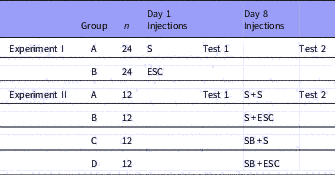
In both experiments I and II, the animals were first exposed to a 5-min adaptation period (without acoustic stimuli), followed by a 10-min period with 20 presentations of 0.2 s long acoustic stimuli (white noise) with an inter-stimuli interval of 30 s. The amplitude of the acoustic stimuli was 95 dB. Freezing was scored separately for the first 5-min period, without stimuli, and for the subsequent 10-min period, during which the acoustic stimuli were presented. In both experiments, a second test was performed 7 days after the first; whereas the first test was used both for assessing the acute unconditioned response to noise bursts and to induce fear conditioning to the context, the second one enabled us to assess both context-conditioned freezing before the onset of bursts and the acute response to a second exposure of noise bursts (Table 1).
Outline of experiments I and II

Injections (before test 1 or test 2): ESC, escitalopram; S, saline; SB, SB-242084.
Experiment I
To assess the possible effect of acute SSRI administration on unconditioned freezing, the animals received a single injection of escitalopram or 0.9% saline 1 h before the first test. At the second test, conducted 7 days later, no drugs were given, the aim of this test being to measure the predictability of the magnitude of the fear response for individual subjects as well as to test to what extent the SSRI administration at the previous test influenced any possible context-conditioned response, that is, whether presence of an SSRI may influence the acquisition of contextual fear.
Experiment II
At the first test of experiment II, no drugs were given. To assess the possible effect of acute SSRI administration on the expression of context-conditioned fear, the animals received a single injection of escitalopram or 0.9% saline 30 min before the second test, the freezing recorded in the 0–5 min interval being a measure of context-conditioned fear and the freezing recorded at the 5–15 min interval, when the animals were again exposed to noise bursts, being a measure of unconditioned fear. To evaluate the possible involvement of 5-HT2C receptors in any possible freezing-enhancing effect of escitalopram, half of the animals in each of the escitalopram/saline groups were administered a 5-HT2C receptor antagonist, SB-242084, 15 min before escitalopram (i.e. 45 min before test 2). Since experiment I had shown fear response for individual subjects during noise burst presentation to display stable test–retest inter-individual variation, the allocation of the animals to different treatment groups was based on their level of freezing during the 5–15 min interval in test 1 to avoid differences in baseline freezing between treatment groups.
Statistics
The data were analysed using SPSS statistics version 19. Comparisons of groups were undertaken using Mann–Whitney U tests in experiment I, and using Kruskal–Wallis test followed by Mann–Whitney U tests in experiment II. Correlation was assessed using Spearman’s test. One rat in the saline group in experiment I was disqualified from analysis due to temporary malfunction of the fear-conditioning system.
Results
Experiment I
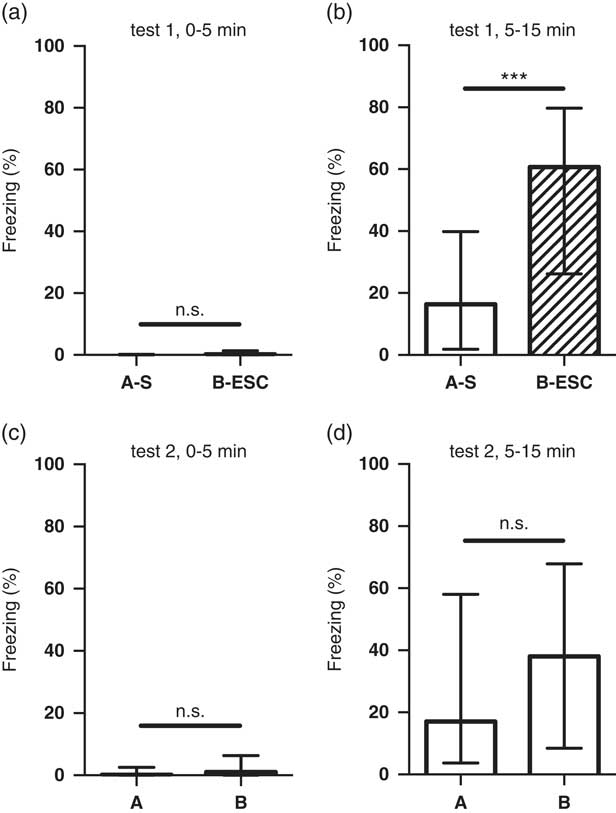
In test 1, the average amount of freezing differed substantially before (0–5 min) (controls: 0.2%, escitalopram 0.7%) as compared to after (5–15 min) (controls: 24.7%, escitalopram 52.7%) the onset of noise bursts (Figs 1a and b). A similar effect of noise bursts was observed also in test 2 (Figs 1c and d). In test 1, escitalopram pretreatment increased unconditioned freezing during the interval with noise burst presentation (5–15 min) (U=120, p<0.001) (Fig. 1b).
Experiment I: Average time (median±IQR) spent freezing at test 1 before the onset of noise bursts (0-5 min) (a) and during noise burst presentation (5-15 min) (b) and at test 2 before the onset of noise bursts (c) and after onset on noise bursts (d). Injections of saline (Group A) or escitalopram (Group B) were given one hour before placing the rats in the testing chamber in test 1. No drug treatment was given in test 2. n.s., non-significant. ∗∗∗p<0.001.

A comparison by inspection with the very low degree of freezing displayed by the animals at test 1 before the onset of noise bursts suggests that noise burst exposure had induced merely a marginal context-conditioning effect, reflected by freezing in the 0–5 min interval, which was not influenced by to what extent the animals had received escitalopram before acquisition (i.e. at test 1) or not (U=204, p=0.12) (Fig. 1c). Neither was there any difference in unconditioned freezing after the onset of noise bursts between these groups (U=233, p=0.36) (Fig. 1d).
Correlation analyses were performed with respect to the total time spent freezing before (0–5 min) and after the onset of noise bursts (5–15 min) on test 1 and test 2, respectively. In the latter interval (5–15 min), significant correlations between days were found for both escitalopram-treated animals [r treat,5–15 (24)=0.56, p<0.01] and controls [r control,5–15 (23)=0.73, p<0.001].
Gross observation of the animals revealed that those being immobile displayed characteristic freezing behaviour, including arched back, retraction of the ears and piloerection.
Experiment II
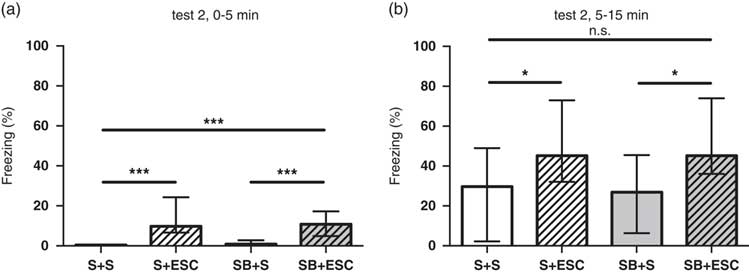
As in experiment I, the context-conditioning effect of noise bursts in saline-treated animals appeared marginal; however, animals administered escitalopram before test 2 displayed more freezing in the 0–5 min interval than those given saline (U=1, p<0.001). A corresponding effect of escitalopram in the 0–5 min interval was seen also in animals pretreated with the 5-HT2C receptor antagonist SB-242084 (U=9.5, p<0.001). There was no significant effect of SB-242084 either in animals that did (U=139, p=0.55) or in animals that did not (U=53.5, p=0.29) receive escitalopram.
The average amount of freezing for controls differed substantially before (0–5 min) as compared to after (5–15 min) the onset of noise bursts not only in test 1 (data not shown) but also in test 2 (Fig. 2); bursts hence exerted an unconditioned freezing-enhancing effect also in animals with prior experience of this stimulus. The influence of drug treatment during the 5–15 min interval was similar as during the 0–5 min interval (Fig. 2), escitalopram-treated animals displaying more freezing than controls regardless of if they were pretreated with SB-242084 or not.
Experiment II: Average time (median±IQR) spent freezing during test 2 (a) before onset of noise burst presentation (0-5 min) and (b) after onset of noise burst presentation (5-15 min). Rats were injected with saline (S) or the 5-HT2C receptor antagonist SB-242084 (SB) 45 minutes before testing and with saline or escitalopram (ESC) 30 minutes before testing. n.s., non-significant. ∗p<0.05 and ∗∗∗p<0.001.

As in experiment I, there was a significant inter-test correlation between freezing during the interval with noise burst presentation (5–15 min) at test 1 versus test 2 both for rats receiving saline [r(12)=0.78, p<0.01] and for those receiving escitalopram [r(12)=0.75, p<0.01] at test 2. There was however, regardless of treatment, no corresponding correlation between freezing before and after the onset of noise bursts.
Gross observation of the animals revealed that those being immobile displayed characteristic freezing behaviour.
Discussion
In the present study, intense noise bursts were found to elicit unconditioned freezing that was enhanced by prior administration of one injection of an SSRI, escitalopram. Likewise, treatment with escitalopram before exposure to context unmasked context-conditioned freezing in animals exposed to noise bursts as unconditioned stimulus one week earlier. The results suggest the freezing-enhancing effect of SSRIs not to be restricted to conditioned fear (Reference Inoue, Kitaichi and Koyama31) but to be a more generalised phenomenon.
Our observation that noise bursts, a stimulus more frequently used to elicit startle behaviour, elicit a moderate degree of freezing is in line with previous studies (Reference Plappert, Pilz and Schnitzler22,Reference Borszcz, Cranney and Leaton32,Reference Pettersson, Naslund, Nilsson, Eriksson and Hagsater33). We suggest this response, which displayed a considerable degree of test-retest inter-individual variation, to be a feasible paradigm for future investigations of the modulation of mild fear responses. In contrast, noise bursts induced merely a marginal context-conditioned freezing response in saline-treated animals tested seven days after fear acquisition; also this negligible response may however be utilised for the study of interventions potentially enhancing mild fear since it was markedly augmented by pretreatment with escitalopram.
In both experiments, escitalopram markedly increased freezing during presentation of the unconditioned stimulus. The possible effect of SSRIs on unconditioned freezing in response to noise bursts has to our knowledge not been reported by others but was noted in a previous study in our laboratory also including assessment of startle (Reference Pettersson, Naslund, Nilsson, Eriksson and Hagsater33). In contrast to these findings, acute administration of an SSRI has been shown to decrease freezing in the elevated open platform test (Reference Miyata, Shimoi, Hirano, Yamada, Hata, Yoshikawa, Ohsawa and Kamei13) and not to influence freezing induced by electric stimulation of the periaqueductal gray (Reference Borelli, Nobre, Brandao and Coimbra18).
The previous literature regarding the possible influence of SSRIs on conditioned freezing behaviour is partly contradictory; thus, while Burghardt et al. reported citalopram to enhance the expression of freezing in response to an auditory cue (Reference Burghardt, Bush, McEwen and LeDoux15), several authors have found the same drug to reduce freezing in rats displaying context-conditioned freezing one day after they had been exposed to foot shocks in the training chamber (Reference Hashimoto, Inoue and Koyama16,Reference Santos, Martinez and Brandao17). The present observation that administration of an SSRI prior to testing markedly enhanced context-conditioned freezing from a very low baseline level suggests that the discrepancy between the previous results from Burghardt et al., on the one hand, and those from several other groups, on the other, are not, as has been suggested (Reference Inoue, Kitaichi and Koyama31,Reference Burghardt and Bauer34), the use of cued fear conditioning versus context conditioning.
When interpreting these contradictory results, it should be kept in mind that acute administration of SSRIs exerts a complex influence on the serotonin output; on the one hand, the reuptake inhibition in terminal regions causes an increase in extracellular serotonin levels in at least some brain regions (Reference Fuller and Wong35); on the other hand, the corresponding increase in extracellular levels of serotonin in the brain structures where the serotonergic cell bodies reside, that is, the raphe, leads to reduced firing rate (Reference Gallager and Aghajanian36). Moreover, it should be considered that the expression of both unconditioned (Reference Macedo, Martinez, de Souza Silva and Brandao37,Reference Forster, Feng, Watt, Korzan, Mouw, Summers and Renner38) and conditioned (Reference Yokoyama, Suzuki, Sato, Maruta, Watanabe and Miyaoka39,Reference Zanoveli, Carvalho, Cunha and Brandao40) freezing in untreated rats per se is associated with enhanced release of serotonin. Tentatively, the net effect of SSRI in terms of enhanced or reduced serotonergic output in such situations may be dependent on factors such as the baseline serotonergic activity of the studied batch of animals (which may be related, e.g. to their stress level), the time between drug administration and testing and the magnitude of the fear response under study. When interpreting the observation that escitalopram in the present experiments exerted a consistent anxiogenic-like effect with respect to both unconditioned and conditioned fear, one factor that should be taken into consideration hence is that relatively mild fear-generating stimuli, causing merely modest degrees of freezing, were used.
In the report by Burghardt et al. (Reference Burghardt, Bush, McEwen and LeDoux15) mentioned above, reporting citalopram to augment tone-conditioned freezing, the authors found this effect of the SSRI to be effectively antagonised by pretreatment with a 5-HT2C receptor antagonist, SB-242084. Prompted by this finding, and by other reports suggesting the 5-HT2C receptor to exert an anxiogenic influence (Reference Bagdy, Graf, Anheuer, Modos and Kantor41–Reference Pelrine, Pasik, Bayat, Goldschmiedt and Bauer45), we explored to what extent the freezing-enhancing effect of escitalopram in the present paradigm could be prevented by pretreatment with a relevant dose of the same 5-HT2C receptor antagonist. We, however, observed no influence of SB-242084 on the effects of escitalopram on either context-conditioned or unconditioned freezing, and also no effect of the antagonist per se. Additional studies exploring the possible involvement of other 5-HT receptor subtypes for the observed effect of escitalopram are clearly warranted.
With respect to the possible effect of SSRI administration before acquisition of contextual conditioned freezing, the previous literature is similarly ambiguous, both decreased and increased freezing having been reported (Reference Inoue, Tsuchiya and Koyama46,Reference Montezinho, Miller, Plath, Jensen, Karlsson, Witten and Mork47). In the present study, no effect of escitalopram administered as one dose prior to acquisition was observed. Thus, while we obtained strong support for the notion that the studied SSRI enhances unconditioned freezing as well as the expression of context-conditioned fear, the results do not support any impact of escitalopram on acquisition of context-conditioned freezing.
One additional aim of the current study was to investigate to what extent male Sprague Dawley rats display consistent inter-individual differences in the freezing response to noise bursts, and if such differences, if at hand, are influenced by SSRI administration. Correlation analyses showed that freezing displayed during noise bursts at test 1 correlated with the same measure at test 2 regardless of possible drug exposure. On the other hand, we observed no correlation between the amount of freezing displayed before (0–5 min) and after (5–15 min) the onset of the conditioned stimulus in the second test of the second experiment. Inter-individual differences in unconditioned freezing hence appear to be stable over repeated testing, but do not predict the magnitude of context-conditioned freezing.
While a limitation of this study is that we applied an automatic measurement of immobility, as previously suggested by Anagnostaras et al. (Reference Anagnostaras, Wood, Shuman, Cai, Leduc, Zurn, Zurn, Sage and Herrera30), as a proxy for freezing, previous reports do support the feasibility of this technique to quantify freezing behaviour (Reference Anagnostaras, Wood, Shuman, Cai, Leduc, Zurn, Zurn, Sage and Herrera30,Reference Shoji, Takao, Hattori and Miyakawa48); moreover, gross observation of the animals confirmed that rats displaying immobility when exposed to the context in which they had received shocks did display characteristic freezing behaviour, including arched back, retraction of the ears and piloerection. Another limitation of the study is that only one dose of the SSRI and only one dose of the 5-HT2C receptor antagonist were tested; since the doses selected for both compounds were relatively high (according to previous studies), it is, however, not likely that any lack of effect may be explained by the doses used being too low. A limitation of a more general nature is that the possible relevance of conditioned and unconditioned freezing in rat for human fear and anxiety remains a matter of speculation.
In conclusion, the main findings of this study are that escitalopram when administered immediately before testing enhanced freezing in two situations characterised by low or relatively modest fear: when the rats were exposed to a relatively mild (as compared to foot shocks) unconditioned stimulus (i.e. noise bursts) and when they were tested for expression of context-conditioned fear where noise bursts had served as conditioning stimulus. It is suggested that this freezing-enhancing effect may be related to the acute anxiogenic response sometimes observed after administration of an SSRI to humans.
Acknowledgements
Gunilla Bourghardt and Ann-Christine Reinhold are acknowledged for excellent technical assistance. This study was supported by the Swedish Research Council (K2013-61×-14961-07-3), Söderberg’s Foundation (MT-30/09), Hållsten’s Foundation and the Swedish Brain Foundation (FO-20110293).
Conflicts of interest
There are no competing financial interests in relation to the work described.
Ethical standards
All procedures were approved by the Animal Ethics Committee at the University of Gothenburg. The authors assert that all procedures contributing to this work comply with the ethical standards of the relevant national and institutional guidelines on the care and use of laboratory animals.