1. Introduction
In response to climate change, country members of the United Nations Framework Convention on Climate Change (UNFCCC) proposed the Kyoto Protocol, an international agreement with legally binding measures (UNFCCC, 1997). The Kyoto Protocol set binding targets for 37 industrialized countries and the European Community to reduce greenhouse gas emissions to an average of 5 per cent below 1990 levels over the period 2008–2012. One of the mechanisms that countries could use to meet their targets was to plant trees (reforestation), since trees sequester carbon from the atmosphere, and hence reduce CO2 concentrations. The Kyoto Protocol has recently been extended to cover the period 2012–2020 (UNFCCC, 2012) and it is likely that other future international carbon control treaties will also provide financial mechanisms to favour the use of forestry for carbon sequestering.
The Government of Vietnam ratified the Kyoto Protocol on 25 September 2002. It has also implemented several trial projects to fund environmental services including carbon sequestration (Government of Vietnam, 2008; Ha et al., Reference Ha, Noordwijk and Thuy2008). In particular, it can provide direct payment for environmental services (after four years of planting) to either private or state organizations managing such forests (Phu, Reference Phu2008). The payment can also be made indirectly from individuals or organizations who benefit from the environmental services, such as clean water and fresh air, or whose activities negatively impact on forests, for example, electricity generation. The government takes responsibility for collecting this money and then pays it to the foresters whose forests provide the specific environmental services. These payment schemes have been implemented successfully in terms of reducing illegal logging and increasing income levels for foresters in trial provinces, and are widely utilized in Vietnam (Vietnam Ministry of Resources and Environment, 2012).
The Government of Vietnam also collects money from domestic and international organizations supporting environmental services and from the sale of carbon credits (Phu, Reference Phu2008). For instance, the funding for the Clean Development Mechanism (CDM) project, which is jointly operated by Vietnamese and Japanese organizations in Hoa Binh Province, comes from Honda Vietnam and the sale of carbon credits, timber and other non-timber forest products (Ha et al., Reference Ha, Noordwijk and Thuy2008). If the payment to foresters is less than the costs borne by foresters to provide the environmental services such as carbon sequestration and clean water, the government commits to subsidizing products of CDM projects (Government of Vietnam, 2007). This Hoa Binh CDM project is still in progress.
At a time of rapid global climate change, managing planted forests for multiple-use purposes which include carbon sequestration is increasingly important. In Vietnam, the area of productive planted forest constitutes approximately 13.1 per cent of the total forest area and increased by 11.9 per cent per annum during the period 2002–2006 (Vietnam Ministry of Agriculture and Rural Development, 2007). The rapid increase in the area of forest plantations was mainly due to government investment in this area to achieve the goal of five million ha of new plantings (Government of Vietnam, 1997). In addition, claims have been made that Vietnam could benefit from engaging in the international carbon market. Nevertheless, the benefits of carbon sequestration have not been adequately studied in the management of productive tropical planted forests (Bui and Hong, Reference Bui and Hong2006).
The purpose of this study was therefore to survey timber management practices and strategies by household owners in planted tropical forests in Yen Bai Province, Vietnam. The study also examined foresters' attitudes towards management of and payments for carbon sequestration. Furthermore, the study aimed to determine whether or not current timber harvesting practices are optimal, and how rotation ages might change when the benefits of carbon sequestration are taken into account.
2. A survey of household foresters in Yen Bai Province, Vietnam
2.1. The study area
Yen Bai is a major timber supply area with the area of productive planted forest being 116,400 ha, accounting for 30.9 per cent of the total forest area (including planted and native forests) and 6.9 per cent of the total productive planted forest area in Vietnam (Vietnam Ministry of Agriculture and Rural Development, 2007). Nine state enterprises (Yen Bai Forestry Department, 2008) and approximately 41,000 households are involved in plantation forestry (Nguyen et al., Reference Nguyen, Nguyen, Bui and Trinh2006). There are variations in forest investments and harvesting regimes under different types of ownership. Under the household category, households are financially responsible for their investments, and they do not have to seek harvesting permission from the government. State forest enterprises use government funds for their plantation investments and must seek harvesting permission. Planted forests in Yen Bai Province are dominated by fast-growing trees such as Eucalyptus urophylla, Acacia mangium, Styrax tonkinensis, Manglietia conifera and some native species (Yen Bai Forestry Department, 2008).
In Vietnam, all forest land is under state ownership and according to Government Decree No. 163/1999/ND-CP (Government of Vietnam, 1999), forest land is allocated and leased to individuals and organizations for long-term forestry purposes. Forest land allocated to households is limited, not exceeding 30 ha and for a 50-year time period. After 50 years the right to use the land can be extended at the request of the forester; otherwise it reverts back to the government.
According to Government Decree No. 23/2006/ND-CP (Government of Vietnam, 2006), foresters can exchange, transfer, rent, inherit or mortgage the right to use the land that they have been allocated. They can also use their land as capital for joint ventures. Thus, foresters could pool their land for carbon sequestration management; however, they cannot change the purpose of the land use unless approved by the government (Government of Vietnam 2003, 2010).
2.2. Survey implementation and analyses
A survey was conducted to obtain data on timber production and forest management strategies for two dominant plantation tree species, E. urophylla and A. mangium, in the planted forests of household foresters in Yen Bai Province. Preliminary fieldwork was conducted to establish if it were possible to obtain data for the variables specified in the questionnaires by sending these to local experts for comments and validation, and then by pre-testing using 10 household foresters in Yen Bai Province. The study sites included the Tran Yen, Van Yen and Yen Binh Districts. The sample population consisted of households who grew E. urophylla or A. mangium and who owned a productive forest of at least 0.5 ha in size. The survey was implemented in September 2008 by trained enumerators. A total of 271 usable questionnaires out of 291 distributed were collected (93 per cent).
Regarding survey analyses, since household characteristics were found to influence forest farmers' management activities and attitudes (Adhikari et al., Reference Adhikari, Di Falco and Lovett2004; Dolisca et al., Reference Dolisca, Carter, McDaniel, Shannon and Jolly2006; Valdivia and Poulos, Reference Valdivia and Poulos2009), this study first used descriptive statistics and cross-tabulations in Microsoft Excel 2007 to understand this relationship. Secondly, significance testing was employed to test whether the means of forest management related variables were statistically different depending on household characteristics, using non-parametric Wilcoxon–Mann–Whitney U-tests in SAS 9.3 (Roos and Nyrud, Reference Roos and Nyrud2008; Marey-Pérez and Rodríguez-Vicente, Reference Marey-Perez and Rodriguez-Vicente2009). Finally, regression analyses were performed to test the significance of these household characteristics coefficients in SAS 9.3.
In the regression analyses, categorical and continuous dependent variables were analyzed using a logistic regression and a simple linear regression, respectively – see a review of econometric studies in forest management (Beach et al., Reference Beach, Pattanayak, Yang, Murray and Abt2005) and further literature (Macmillan et al., Reference Macmillan, Duff and Elston2001; Gellrich et al., Reference Gellrich, Baur, Koch and Zimmermann2007; Kideghesho et al., Reference Kideghesho, Roskaft and Kaltenborn2007). Furthermore, a district fixed effects regression was then performed to reduce omitted variable bias in the model (Edmonds, Reference Edmonds2002; Wooldridge, Reference Wooldridge2002; Lantz and Feng, Reference Lantz and Feng2006). Omitted variables in this Vietnamese model could be different soil types, forest health and socio-economic conditions in these districts. These features were noticed during the survey via discussion with the respondents but were not included in the questionnaire.
2.3. Survey results and discussion
2.3.1. Descriptive data
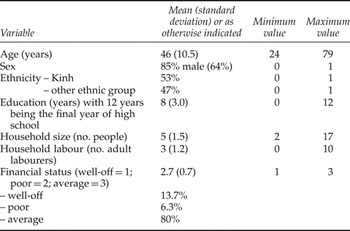
Table 1 provides descriptive information about the household foresters in Yen Bai Province, Vietnam (Nghiem, Reference Nghiem2013). The average age of respondents was 46 years, average level of education was 7.6 on a scale up to 12 (with 12 being final year of high school), and almost all respondents (85 per cent) were male. Nearly half (47 per cent) of these foresters belonged to minority groups, namely Tay, Cao Lan, Dao and Nung, with the rest being from the Kinh group. The average household size was 4.84 and over half of the adult family members were labourers. Eighty per cent of the respondents were classed as ‘middle-class income’ (including all sources of income) according to government standards. That is, the income level was higher than 2.4 million VND or US$141.18/person/year on average. About 6 per cent were classified as poor and the rest as relatively ‘well-off’ (Government of Vietnam, 2005).
Descriptive statistics about the sample of household foresters in Yen Bai Province, Vietnam (n = 271)

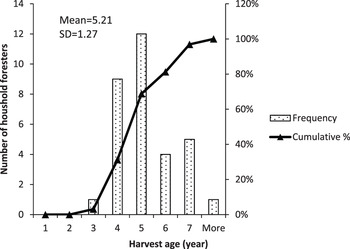
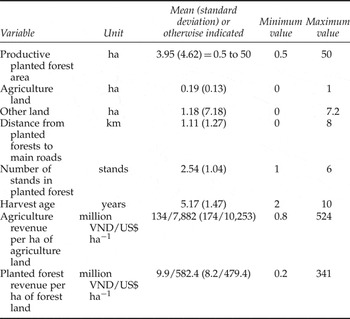
With regard to production information, table 2 shows that the actual harvesting age of household-planted forests was 5.18 years. The histogram results (figure 1) suggest a similar distribution for harvest age for the two species (at 5.21, S.D. = 1.27 and at 5.17, S.D. = 1.52 years for E. urophylla and A. mangium, respectively). Interestingly, revenue per ha from agricultural activities was 14 times higher than for forestry. These findings were consistent with the foresters' desire, noted during household interviews, to shift more of their land to non-forestry agricultural use. The data also suggested that almost all households (99 per cent; 267/271) effectively ‘own’ their forest land, which means they have a government lease. Ninety-one per cent of the owners applied a clear-cut practice to harvest their forests. Among the 271 respondents, 32 (12 per cent) grew E. urophylla only, 78 (29 per cent) grew A. mangium only, and 161 (59 per cent) grew both species.
Distribution of harvest age (years) for E. urophylla grown in household foresters' planted forests in Yen Bai Province, Vietnam

Production information for the household foresters in Yen Bai Province, Vietnam

The results of the Wilcoxon–Mann–Whitney U-tests suggested that there was a statistically significant difference in: the number of forest stands with regard to ethnicity; the number of forest stands with regard to financial status; planted forest revenue with regard to financial status; and planted forest area with regard to financial status. These results were as expected. For example, families belonging to the Kinh group normally migrate from other regions and tend to participate in activities outside the forestry sector, so it was not unexpected that they had fewer forest stands compared to those of people in other ethnic groups. It is also not surprising that wealthier families had more planted forest area and earn more compared to poorer families. The other forest-related variables were not significantly statistically different with regard to household size or other respondent characteristics.
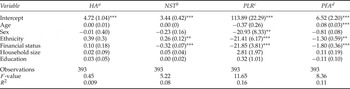
Further analysis of household characteristics with regard to forest management using a district fixed effects regression suggested that financial status, sex, ethnicity and age were statistically correlated with forest management variables (table 3). Moreover, financial status was negatively correlated with forest management variables at 1 per cent significance. That means that the more well-off families had larger planted forest area, more forest stands and higher income from forests. However, household size and education consistently showed no relationship with forest management dependent variables. Furthermore, the signs of coefficients and their magnitudes were reasonable. The standard error values suggested that the coefficients were quite stable. Results from the simple linear regression were quite similar in terms of coefficient signs and magnitudes compared to those from the district fixed effects analysis.
Relationships between forest management practices and household characteristics in Yen Bai Province, Vietnam, using a district fixed effects model

Notes: *Significant at 10% level; **significant at 5% level; ***significant at 1% level.
a Harvesting age; b no. forest stands; c revenue from planted forests; d planted forest area.
2.3.2. Planting costs and timber prices
To estimate the cost functions for the two species, planting costs obtained from the survey were adjusted by inflation rates (World Bank, 2008) to 2007 values. The average planting cost of E. urophylla per ha was 6.85 million Vietnamese dong (VND) (US$402.94) ha−1, and 0.07 million VND (US$4.12) higher than that of A. mangium. The majority of the foresters sold stumpage trees at an average stumpage timber price of 0.37 (21.76) and 0.33 (19.41) million VND (US$) cubic meter−1 for E. urophylla and A. mangium.
2.3.3. Forest management for timber production
The survey results suggested that about 73.4 per cent of households used their own capital to invest in their forests (see table A1 in the online appendix, available at http://journals.cambridge.org/EDE), so lower interest rates from bank loans, a policy currently used by the Government of Vietnam to encourage investment in planted forests, may not be relevant to the majority of household foresters (Government of Vietnam, 2009). The most likely reason is that risk aversion makes foresters avoid borrowing money from banks. Family financial status also played an important role in the decisions of household foresters regarding tree cutting, tree species and compensation levels for delaying harvest. A total of 93.4 per cent of foresters stated that they would delay their harvest if they were financially supported by the government with an average amount of 5.5 million VND (US$323.53) ha−1 year−1.
2.3.4. Participating in a carbon pooling project
In the survey, foresters were also asked about their willingness to participate in a carbon pooling arrangement. Under such an arrangement, the land of several households is bundled to form a larger project size. The households must act together regarding types of dominant tree species, harvest decisions and benefit sharing mechanisms. Besides the income from selling the timber, the participants would be paid for carbon sequestration. A pooling arrangement would help to reduce transactions costs and could take advantage of economies of scale (Grieg-Gran et al., Reference Grieg-Gran, Porras and Wunder2005; Gong et al., Reference Gong, Bull and Baylis2010).
The results suggested that the majority of households (89 per cent) would agree to participate in such a carbon pooling arrangement (see online appendix, table A2). Regarding the potential contractual arrangements involved, nearly half of the respondents (47.3 per cent) said that a contract between households and the investor would be necessary. When asked if they could foresee any obstacles to a carbon pooling agreement, nearly half (42.4 per cent) had no view about whether or not obstacles would occur. This response may have been because carbon sequestration and the CDM are relatively new concepts to household foresters in Vietnam.
The results of the Wilcoxon–Mann–Whitney U-tests suggested that there was a statistically significant difference in the mean of carbon pooling agreement with regard to age of the respondents, and in respect of the reasons for being involved in a carbon pooling project with regard to householder ethnicity, education and financial status. Other household characteristics showed no significant difference in the mean of these variables.
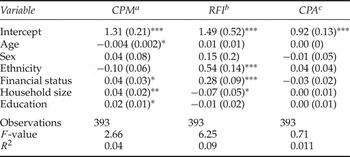
Further analysis of household characteristics with regard to carbon sequestration management using district fixed effects regression suggested that age, ethnicity and household size also significantly correlated with carbon payment method (table 4). Ethnicity was also correlated with ‘reason for being involved in a carbon pooling project’, but not financial status and education as suggested by the mean test as above. This suggests that these two variables had no impact on carbon sequestration management at the margin. In addition, education was correlated to the carbon payment method.
Relationships between carbon sequestration management and household characteristics in Yen Bai Province, Vietnam, using a district fixed effects model

Notes: *Significant at 10% level; **significant at 5% level; ***significant at 1% level.
a Carbon payment method; b reason for involving in a carbon pooling project; c carbon pooling project agreement.
2.3.5. Payments for carbon sequestration
For the annual payment scheme, it was proposed that foresters would be given annual carbon service payments from forest canopy closure or from year four onwards until forest harvesting. For the upfront payment scheme, foresters would be paid for carbon services in full at forest establishment and they would have to sign a pledge to keep their forests until they reached a certain age. The two proposed carbon payment schemes, annual vs. upfront payments, were favoured by the respondents, at 51.7 and 48.3 per cent respectively. The survey results indicated that foresters would want an average amount of 21.4 million VND (US$1,258.8) ha−1 rotation−1 from carbon sequestration benefits for them to keep their trees until age 11 years on average.
An analysis of the characteristics of household foresters in the annual and upfront payment groups suggested that households who chose the annual payment tended to belong to a low-income group, were more dependent on income from planted forests, were more concerned about money for their living and were less interested in a carbon pooling project. With regard to income levels, the data indicated that households favouring the annual payment were characterized by earning less income in total compared to those of the upfront payment group (by 3.7 million VND (US$246.7) per year). More than half of the respondents (56.1 per cent) who belonged to minority communities, who were recognized as poorer in comparison to the Kinh group, also favoured annual payments.
Furthermore, the annual payment group obtained more of their income from productive forests and less income from other sources, even though they provided more outside labour, such as work for other individuals or organizations. This is because the outside work performed by the annual payment group was low skilled, and thus they were paid less compared to the upfront group. This result followed from the fact that the level of education in the annual payment group, on average, was lower than that in the upfront payment group (7.34 and 7.95 over the scale of 12, respectively). The data implied that the annual payment households were more dependent on planted forests, and that this was probably the major reason why they favoured annual payments (i.e., to secure a constant source of income). The reasons given for harvesting decisions made by households also clearly support this hypothesis. Around one-third (31 per cent) of households who preferred payment annually stated that they cut their trees because of financial reasons, i.e., lack of money for their everyday basic needs, compared to 24 per cent in the other group.
The next characteristic of household foresters who favoured annual payments was that they seemed to be more worried about money for living than the other group. In particular, the majority of the respondents would agree to delay harvest if they were subsidized by the government, especially those in the annual payment group. When asked why, 47 per cent of the annual group related their answers to financial ability, living costs and debts, compared to 42 per cent of the upfront payment group. Again, in the expression of household foresters' opinions about the carbon pooling project, the respondents who preferred the annual payment were more concerned about capital and money (10 per cent) than those who chose the upfront payment (4.6 per cent).
Household foresters in the upfront payment group seemed to be more optimistic than those in the other group. This was also suggested by this group being more willing to engage in the carbon pooling project compared to the other group. Furthermore, when asked if they anticipated any difficulties in the implementation of the carbon pooling project, 30 per cent of the respondents in the upfront payment group believed there would be no obstacles while only 18 per cent of those in the other group had that belief.
In conclusion, household foresters who preferred the annual payment seemed to be poorer, more financially vulnerable (that is, more dependent on planted forest income) and less sure about the success of the carbon pooling project. It was likely that this group did not choose the upfront payment with a commitment because they were concerned that the commitment might bring inflexibility in times when they needed to sell their trees for everyday basic needs or living costs. However, these results may be influenced by bias, given that most respondents were male (85 per cent), reflecting the more dominant role played by men in the financial decisions of a family in this country. Even though the survey requested that the respondents answer on behalf of their families, it was not possible to ascertain to what extent their answers represented their personal view only (see Nghiem, Reference Nghiem2013 for more discussion about survey bias).
3. Determining optimal rotation ages for timber production and carbon sequestration in planted forests
The survey data indicated that the rotation age used by household foresters in Yen Bai Province, Vietnam was relatively short, at only five years on average. Therefore, a further analysis was performed to determine the optimized rotation age in this tropical country setting when: (1) only timber production has market values, and (2) when both timber production and carbon sequestration are marketable.
3.1. Optimization methods and data
The optimal management strategy for a single forest stand was developed by Faustmann (Reference Faustmann1849). The Faustmann model has been extended to include the benefits of carbon sequestration by van Kooten et al. (Reference van Kooten, Binkley and Delcourt1995); Diaz-Balteiro and Rodriguez (Reference Diaz-Balteiro and Rodriguez2006); Gutrich and Howarth (Reference Gutrich and Howarth2007); Englin and Callaway (Reference Englin and Callaway1993); Guthrie and Kumareswaran (Reference Guthrie and Kumareswaran2009), and Thompson et al. (Reference Thompson, Adams and Sessions2009), among others (see Nghiem, Reference Nghiem2011, for a detailed literature review).
The study reported here extended the Faustmann model to include the benefits of carbon sequestration and applied the model to E. urophylla and A. mangium, two major and fast-growing tree species planted in the province. The planning horizon of the model was 50 years, in contrast to an infinite planning horizon in the traditional Faustmann model, since the Government of Vietnam allocates forestry land to household owners for 50 years at most.
3.1.1. The single stand forest model
The objective of the single stand forest model was to maximize the net present value (NPV) from harvesting timber and sequestering carbon. At the end of the planning horizon, foresters were supposed to harvest the whole forests. In this study, the NPV did not include land rents since once the land is used in forestry, it cannot be rented. So renting is another investment option instead of growing trees for the land. Instead of being calculated over the infinite chain of cycles of planting on the given forest stand as in the Faustmann formulae, the NPV was calculated over 50 years with a one-year time step as in the mathematical model below.
Let v(.) be the discounted sum of the timber value (V t ) and the carbon sequestration value (A t ).
 $$\eqalign{& \quad x_{t}\colon \hbox{the age of the stand at period}\, \, t. \cr &t\colon \hbox{time period with a step of one year}.}$$
The model objective was to maximize the discounted revenue from timber and carbon sequestration (Nghiem, Reference Nghiem2011, Reference Nghiem2013, Reference Nghiem2014):
 $$v\lpar x_t\rpar = max\sum_{t=1}^{50} \lpar 1+r\rpar ^{-t} \lpar V_t + A_t\rpar$$
subject to:
 $$x_{t+1} = \lpar x_{t} + 1\rpar \comma \; \hbox{ age of the stand at period }t + 1$$
 $$x_{t} \ge 0\comma \; \hbox{non-negative age constraint}$$
where:
 $$r \quad \quad \quad \hbox{discount rate}$$
 $$V_t = q\lpar x_t\rpar . P-G \quad \hbox{timber value at the period}\, \, t $$
 $$q\lpar x_{t}\rpar \quad \quad \quad \hbox{timber volume ha}^{-1} \hbox{of stand in period}\, \, t $$
 $$P \quad \quad \quad \hbox{price of timber cubic meter}^{-1} $$
 $$G \quad \quad \quad \hbox{initial planting cost of timber} $$
 $$A_t = Q_c \lpar x_t\rpar . P_c \quad \quad \hbox{value of carbon sequestered at period}\, \, t $$
 $$Q_{{\rm c}} \quad \quad \quad \hbox{amount of carbon sequestered tonne ha}^{-1} $$
 $$P_{{\rm c}} \quad \quad \quad \hbox{carbon price tonne}^{-1} $$
Functions and parameters used in the model are presented in the online appendix, table A3. The model was coded in GAMS 2010.
3.1.2. Timber growth function
Timber growth functions of E. urophylla and A. mangium were estimated from reliable and experimental data obtained from a government source (Vietnam Ministry of Agriculture and Rural Development, 2003). A quadratic function provided the best fit functional form (see online appendix, table A3). For short rotation ages, a power timber growth function was used to predict timber volume in the literature (Ministry of Forestry, 1996). Furthermore, as shown in figure 1, rotation ages for household-planted forests in reality could be as short as two years; thus it is appropriate to use this functional form.
3.1.3. Carbon sequestration function
Carbon sequestration functions, which were estimated based on reliable experimental data for E. urophylla and A. mangium in planted forests by Vo et al. (Reference Vo, Dang, Nguyen, Nguyen and Dang2009), were used in the model. Since Vo et al.'s functions were not suitable for application to planted forests beyond seven years of age, their carbon sequestration functions were adjusted as follows. First, using stand age and tree density data from the Tables of Site Index (Vietnam Ministry of Agriculture and Rural Development, 2003) and tree density at planting from the survey, a relationship was calculated between stand age and tree density. Secondly, the amount of carbon uptake was obtained by running the carbon sequestration functions from Vo et al. with respect to stand age and tree density for E. urophylla and A. mangium. Finally, the amount of carbon uptake and the associated stand age were used to re-estimate the carbon sequestration functions for use in the optimization models.
3.2. Optimization model results and discussion
3.2.1. The optimal rotation age
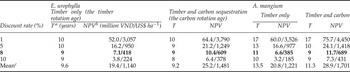
This section reports the optimal rotation ages for timber only (the timber rotation age) and carbon sequestration models (the carbon rotation age) for both E. urophylla and A. mangium. According to the results in table 5, at the chosen discount rate, the optimal timber rotation age for E. urophylla was nine years. Adding carbon benefits had no effect on the optimal rotation age for E. urophylla. This is because both the rates of carbon uptake and of timber growth were faster in early years; however, the latter rate was much faster, making the optimal rotation age remain the same (i.e., the carbon sequestration rate is low so that it does not change the optimal rotation age).
The optimal timber rotation age for A. mangium was 11 years at the chosen discount rate. When carbon sequestration had a price of US$3 tonne−1, the optimal carbon rotation age for A. mangium was shorter by two years. This is because of the fact that higher timber productivity outweighed the effect of carbon sequestration on the optimal rotation age for enterprise planted forests. In terms of NPV, the carbon rotations all had higher NPVs as expected, with carbon having a value (table 5).
The finding that the optimal carbon rotation was shorter than the timber-only rotation (more so for A. mangium than for E. urophylla) was in contrast to the results of van Kooten et al. (Reference van Kooten, Binkley and Delcourt1995) and Gutrich and Howarth (Reference Gutrich and Howarth2007). This is probably because of the nature of fast-growing trees in this tropical country study, where carbon uptake and timber growth are greater in the early years compared to the slow-growing tree species in the analyses in the previous two studies. However, it should be noted that the results of van Kooten et al. and this study's results are not easily comparable since forest owners here did not have to pay a tax when carbon was released at the time of harvesting as in the research by van Kooten et al.
3.2.2. Sensitivity analysis to discount rate
The results of a sensitivity analysis of the optimal rotation age to discount rates are shown in Table 5. At positive discount rates, the optimal rotation length for E. urophylla ranged from eight to 10 years. There was hardly any difference between the two except at discount rates 5 per cent and higher, when the optimal rotation age for carbon becomes slightly shorter than the optimal timber rotation age. For A. mangium, the optimal timber rotation age varied from nine to 17 years depending on the discount rates and with the carbon optimal rotation being shorter by several years, especially at lower discount rates (1–5 per cent). Both the timber and carbon optimal rotation ages decreased with an increasing discount rate.
The optimal rotation ages for timber only and carbon sequestration values for household-planted forests in Yen Bai Province, Vietnam

Notes: a Optimal rotation age; b net present value; c mean for all discount rates from 1% to 10%, some of which were not reported here.
Values in bold were the baseline scenario. The results were based on the assumptions of a carbon price (via the CDM or equivalent) equal to 0.051 million VND/m3 or US$3/m3, and a timber price of 0.37 million VND (US$21.76)/m3 for E. urophylla and 0.33 million VND (US$19.41)/m3 for A. mangium.
Given that the actual harvesting age for households was five years, the optimal results from a societal or government perspective indicated the value of longer rotations at all discount rates. This result suggests that policy intervention is potentially desirable to bring the actual harvesting age in line with the optimal rotation age.
3.2.3. Sensitivity analysis to carbon price
The carbon price varied from US$3 to US$10 (equivalent to 0.051–0.17 million VND) tonne−1. In the case of E. urophylla (see online appendix, figure A1), the optimal carbon rotation age decreased slightly with an increasing carbon price, from nine to eight years. The NPVs for carbon rotation age increased with an increasing carbon price as expected. A. mangium experienced a similar relationship between the carbon rotation age and the carbon price to that found with E. urophylla. The households' rotation age for A. mangium was very sensitive to carbon price, decreasing from nine to three years with an increasing carbon price, suggesting that carbon sequestration benefits had a significant impact on the optimal rotation age. The rotation age for E. urophylla was not as sensitive to carbon price as that for A. mangium because of the difference in parameters in the timber growth and the carbon sequestration functions for these species. The NPVs for carbon rotation age for both species increased with an increasing carbon price as expected.
The relationship found between rotation length and carbon price was in contrast to the findings of van Kooten et al. (Reference van Kooten, Binkley and Delcourt1995), but was in agreement with the results of Englin and Callaway (Reference Englin and Callaway1993) with amenity value. Diaz-Balteiro and Rodriguez (Reference Diaz-Balteiro and Rodriguez2006) found that the carbon price level has little effect with no clear pattern on the rotation length.
3.2.4. Sensitivity analysis to carbon payment scheme
The impacts of various carbon payment schemes on the optimal management strategy suggested that carbon value, with a carbon price of 0.051 million VND m−3or US$3 m−3, could be paid to foresters at the beginning of the rotation. To be eligible to receive the carbon payment at the start of the rotation, foresters would have to commit to keeping the trees until the end of the rotation. Alternatively, the carbon payment could be paid every year, or at the end of the rotation. The NPV values in these two payment schemes are comparable since the difference in discounting time periods of these schemes was incorporated into the optimization model.
Sensitivity analyses also suggested that payment schemes had no significant impact on the optimal rotation age. In particular, the optimal rotation age remained the same at nine years in all payment schemes for E. urophylla. The optimal rotation age for A. mangium was nine years in the ending payment scheme, and 10 years for the other two schemes. However, the payment schemes had an impact on the NPV. A lump-sum payment at the beginning of the rotation increased the NPV slightly compared to annual payment and payment at the end of the rotation.
3.2.5. Sensitivity analysis to the structure of timber price
Harvest size of timber was assumed to be positively correlated to timber age based on the preliminary fieldwork of this survey in Yen Bai Province. Let harvest age and the price of timber aged seven be T and P, respectively. Then, P is 0.37 million VND (US$21.72) m−3 for E. urophylla and 0.33 million VND (US$19.41) m−3 for A. mangium. Let the price of timber, which is harvested at any age T, be P t as follows:
 $$P_t=\left\{{ {\matrix{P-0.15\colon for T \lt 5 \cr P-0.05\lpar 7-T\rpar \colon for 5 \le T \le 6 \cr P\colon for T=7 \cr P+0.1\lpar T-7\rpar \colon for 7 \lt T \le 14 \cr P+0.8\colon for T \gt 14\cr } } } \right.$$
The results suggested that a varying timber price made the optimal rotation ages significantly longer compared to those of a constant price. In particular, the varying timber price (P) lengthened the rotation ages to 14 years (NPV 14.94 million/878.82 VND/US$ ha−1) for E. urophylla and 15 years (NPV 59.24 million/3,484.71 VND/US$ ha−1) for A. mangium, which were significantly longer compared to those of the constant price, 9 and 11 years, respectively. The varying timber price was a more realistic assumption compared to the constant price; however, it was not applied to the whole analysis because of great uncertainty in the timber price functions.
4. Conclusions and potential policy implications
Short rotation periods and clear-cutting are common forestry practices in plantation forests throughout Vietnam. Eucalyptus species are also the most commonly grown plantation trees in Southeast Asia, with E. urophylla being the most commonly grown of such species in plantation forests in Vietnam, Thailand and Indonesia (Su-See, Reference Su-See1999). Therefore, the results of this study may have some potential generalizability to other parts of Vietnam, to the Southeast Asia region and even other tropical countries (Nghiem, Reference Nghiem2013).
This study surveyed the actual forest management strategy, examined foresters' attitudes towards forest management for carbon sequestration, and calculated the optimal rotation age accordingly. The regression analysis suggested that financial status was negatively correlated with forest management practices, and ethnicity and financial status were correlated with carbon sequestration management. Furthermore, household features and forest conditions other than the main household characteristics could also partly explain forest management practices and carbon sequestration management. The survey results suggested that the average rotation age was five years for household foresters in this particular Vietnamese province; however, the optimal timber/carbon rotation age of E. urophylla and A. mangium was between 9 and 11 years. When carbon sequestration was valued, the optimal rotation age was slightly shorter and the NPV was higher. Nevertheless, both the timber and carbon rotation ages were well above the actual rotation age currently used by household foresters. Thus, there is a logical opportunity for policy interventions to increase the actual rotation age to achieve a more desirable harvesting pattern both from a private and a societal point of view. The optimal rotation age decreased with an increase in the carbon price, the timber price and the discount rate. The optimal rotation age was not sensitive to the change in carbon payment schemes; however, this change did have an impact on the NPV.
The payment for carbon sequestration services of planted forests in Vietnam therefore appears to be a rational policy option; indeed, this is in line with current government policies. In addition, the study's results suggest that the NPV is higher when carbon sequestration is valued. That is, the household foresters would be better off financially if the carbon sequestration service provided by their forests were paid for. In addition, the majority of household foresters surveyed favoured engaging in a carbon pooling project if this was available.
Another potential policy implication is that mechanisms to reduce uncertainty in managing forest plantations should be encouraged by the government. The actual rotation ages for household-planted forests are too short compared to the optimal rotation ages from a societal perspective. This is because there is significant uncertainty in timber prices and harvest volumes, as well as the poverty of the households. Hence, government policies to encourage the development of forest insurance might help to increase the actual rotation ages. Another policy to lengthen the rotation ages could be to reduce any regulatory or financial barriers to private investment in wood-processing enterprises in the areas with planted forests, which could strengthen the demand side for timber.
This study assumed that timber prices were constant (although a sensitivity with varying timber prices with timber age was performed) and the modelling was deterministic. Further research should ideally take into account timber prices that vary with timber age, and uncertainties in timber prices, carbon prices, timber volume and the amount of carbon sequestered.
In this study, the CDM Project provides carbon sequestration funds based on the assumption that timber production results in a long-term carbon store, for example timber used for building materials and furniture (i.e., it does not consider buildings that get destroyed by storms or fires with subsequent potential release of carbon to the atmosphere). The model also does not consider the release of carbon into the atmosphere at the time of harvest (i.e., via milling equipment and transport to sawmills). The reason is that household foresters in Vietnam are poor, and the government does not impose carbon emission taxes on them. As the forest owners are not penalized for the release of such harvest-associated carbon emissions, it would be inappropriate to include such costs in the model when considering the foresters' perspective. Nevertheless, from a societal perspective, future modelling could take a more comprehensive approach to all the carbon emissions involved, including both in harvesting and from the decay of timber products over time.
Finally, this study did not consider the environmental benefits from planted forests other than carbon sequestration. For example, longer rotational times would benefit both water quality and flood protection since there is greater forest biomass to hold water and release it slowly. Moreover, water quality in local streams may temporarily deteriorate with each harvesting event. Older forests will also tend to support more understorey plants and animals – which benefit biodiversity protection and may provide greater additional human services (medicinal plants and wild animals as a food source) (Nghiem, Reference Nghiem2013). Longer rotational times could also reduce the overall risk of forest worker injury (which increases with each harvesting event). All these additional issues could be considered in more elaborate forestry management models in future work.