



Macrolides are commonly used for the treatment of respiratory infections, which are among the most widespread and serious infections, accounting for over 50 million deaths globally each year [Reference Nicolau1]. Moreover, in the last decades, these antibiotics have been used extensively to treat different types of infections, due to their broad spectrum of activity against many Gram-positive, Gram-negative and atypical bacteria. This is especially the case with the long-acting macrolides, such as azithromycin, that can be administered in a single-dose regimen, therefore being more advantageous and convenient for use. At the same time, an increase in macrolide resistance in a number of bacterial pathogens, including those that typically infect the respiratory tract, has been observed in many regions in the world [Reference Seppala2, Reference Baquero, Martinez-Beltran and Loza3]. Streptococcus pyogenes and Streptococcus pneumoniae are among the most frequent causes of bacterial respiratory infections in paediatric populations that are common carriers of these pathogens. Elevated macrolide consumption has been linked in some countries to a marked rise in resistance of S. pyogenes and S. pneumoniae to this group of antibiotics [Reference Cizman4, Reference Bergman5]. Furthermore, the use of long-acting macrolides has been cited as a significant risk factor for promoting resistance in these bacteria [Reference Cizman4] and macrolide resistance in pneumococci was also strongly associated with paediatric populations [Reference Lynch and Zhanel6]. By contrast, association of resistance and macrolide usage was not observed for two other common respiratory pathogens, Haemophilus influenzae and Moraxella catarrhalis [Reference Cizman4].
Information on macrolide resistance of respiratory tract pathogens in Serbia is largely lacking and only limited data indicate that the level of macrolide resistance in S. pyogenes might be low [Reference Mijac7]. Since the policy of antibiotic usage in Serbia lacked rigour until 2012, and most antibiotics were available without prescription, there are indications that macrolides were frequently used in past years to treat a wide spectrum of illnesses in children, as well as adults. As a consequence, the notion that such practice could have led to an increase of macrolide resistance in Serbia, especially in respiratory strains from children, seems plausible. Therefore, the objective of this study was to determine the level of macrolide resistance in S. pneumoniae, S. pyogenes, M. catarrhalis and H. influenzae in Serbia. In addition, we sought to evaluate the impact of total macrolide consumption on resistance of these pathogens in the paediatric population during the 6-year period 2004–2009.
Data on macrolide resistance of the four respiratory pathogens were obtained from two university children's hospitals and one private microbiology laboratory receiving paediatric oropharyngeal samples, located in Belgrade, the capital of Serbia, where one fourth of the Serbian population reside. The study included specimens from upper and lower respiratory tract (throat, nose, ear, broncho-alveolar lavage, etc.) of children (from birth to age 18 years). Since some respiratory pathogens are the major cause of invasive diseases, such as sepsis and meningitis, the invasive isolates from blood or cerebrospinal fluid were also included. Most (99%) respiratory isolates were from the patients with community-acquired infections, while all invasive strains were collected from hospital patients. Duplicate isolates of the same patient were rejected.
Antimicrobial susceptibility testing was done using disk diffusion test following the recommendations of the Clinical and Laboratory Standards Institute [8] with the recommended reference strains for quality control. Erythromycin susceptibility was tested for all isolates with the exception of H. influenzae when azithromycin was used. Phenotypes of macrolide-resistant strains of invasive S. pneumoniae and S. pyogenes were determined by the double disk test. Minimal inhibitory concentrations (MICs) of penicillin and erythromycin were determined by E test (bioMérieux, France) for invasive S. pneumoniae isolates non-susceptible to penicillin and erythromycin by disk test. Serotyping of invasive pneumococci was performed by Neufeld Quellung reaction with specific antisera (Statens Serum Institute, Denmark). All participating laboratories performed well in national quality control surveys during the course of the study.
Data on overall macrolide consumption, as well as the consumption of suitable paediatric drugs were obtained from the Medicines and Medical Devices Agency of Serbia, on the basis of pharmacy sales, as defined daily dose (DDD)/1000 inhabitants per day, according to the Anatomical Therapeutical Chemical classification/defined daily dose (ATC/DDD) system. Based on number of daily doses, macrolides are divided into those administered 3–4 times a day (TD), twice a day (BD) and once a day (OD). Those that are used in Serbia include erythromycin (TD), midekamycin (TD), clarithromycin (BD), roxithromycin (BD) and azithromycin (OD).
For statistical analysis of resistance trends the χ 2 test was used. The relationship between macrolide consumption and rate of resistance was calculated using linear logistic regression analysis. Resistance rates were compared to antibiotic consumption in the previous year.
Over a period of 6 years, 14 044 respiratory isolates from children were tested for macrolide susceptibility: 5207 isolates of S. pneumoniae, 4296 S. pyogenes, 2566 M. catarrhalis and 1975 H. influenzae. Overall, the highest level of macrolide resistance was detected in S. pneumoniae isolates (36·6%), followed by S. pyogenes (9·9%) and H. influenzae (7·6%), but was rare in M. catarrhalis isolates (1·6%). During the same study period, 110 isolates from invasive infections were also recovered, with S. pneumoniae being the most frequent (86 isolates) followed by H. influenzae (21 isolates). Macrolide resistance in invasive pneumococci was also high (38·4%), but absent from the other species. More than two-thirds (68%) of the macrolide-resistant pneumococci were also resistant to penicillin. The MIC90 of erythromycin for invasive macrolide-resistant S. pneumoniae was ⩾256 mg/l, while the MIC90 of penicillin for invasive macrolide and penicillin co-resistant S. pneumoniae strains was 2 mg/l. Constitutive MLS phenotype was detected in 24/33 invasive macrolide-resistant S. pneumoniae tested (72·7%), while M phenotype was less frequent (27·3%). The most frequently encountered serotypes in macrolide-resistant invasive pneumococci were 19F (n = 11) and 14 (n = 9), followed by serotypes 23F (n = 5), 6A (n = 4) and 1 (n = 2). Serotypes 3 and 6B were represented only by single isolates.
During the study period (2004–2009), a significant rise in macrolide resistance was observed in both S. pneumoniae (P < 0·01) and S. pyogenes (P < 0·01) isolates, whereas it did not change much in the other two respiratory pathogens (Table 1). The distribution of resistance phenotypes in S. pyogenes isolates tested (n = 147) was as follows: M phenotype (74%), inducible MLS (21%) and constitutive MLS (5%).
Susceptibility of respiratory tract pathogens to macrolides from 2004 to 2009 in Serbia
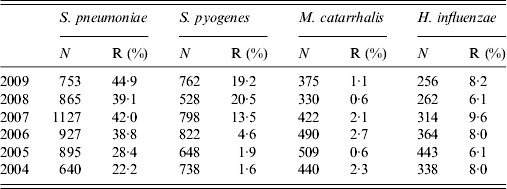
R (%), Percentage of resistant isolates.
The total consumption of macrolides in Serbia increased considerably over the last decade, from 1·3 in 1998 to 5·8 DDD/1000 inhabitants per day in 2008 with continual growth year on year during the study period (Table 2). This rise was due mainly to the higher consumption of newer macrolides, such as azithromycin (OD) and clarithromycin (BD), for which a notable increase in DDD/1000 inhabitants per day was observed (threefold and 11·3-fold from 2004 to 2008, respectively). Similarly, azithromycin alone accounted for 45% of total macrolide consumption in 2007 and 47% in 2008, and was also the first on the list of all antibiotics used in 2008 (data not shown). The increase in total consumption of macrolide antibiotics, and consumption of OD and BD macrolides in particular, correlated with the rise of resistance in S. pyogenes (r = 0·879, P = 0·05 and r = 0·922, P = 0·026, respectively). A similar trend was also observed in S. pneumoniae, although it did not reach statistical significance (r = 0·772, P = 0·126 for total macrolide consumption, and r = 0·749, P = 0·145 for consumption of OD and BD only). There was no significant increase in macrolide resistance in invasive isolates.
Macrolide consumption in Serbia from 2004–2008
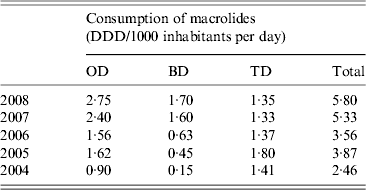
DDD, Defined daily dose; OD, once a day; BD, twice a day; TD, 3–4 times a day.
Although the information on age was only available for some patients, we attempted to correlate the incidence of macrolide resistance in respiratory isolates with the age of children. Interestingly, for pneumococci the highest incidence of resistance was detected in young children (0–5 years) but it was markedly lower in older groups; for S. pyogenes an opposite distribution was observed with the peak in those aged 12–18 years. There was no difference in the macrolide resistance rate of H. influenzae and M. catharrhalis isolates in different age groups.
This study is the first extensive report on macrolide resistance of four common respiratory pathogens in paediatric populations in Serbia. It is also among the first studies in our country in which the relationship between outpatient antimicrobial usage and resistance has been investigated over a period of several years. The results indicate an alarming increase in macrolide resistance of the two major respiratory pathogens, S. pneumoniae and S. pyogenes, that reached 45% and 19%, respectively, in 2009. It is also important to emphasize that, more than half of invasive pneumococcal strains were co-resistant to macrolides and penicillin, which are considered the drugs of choice for pneumococcal infections. At the beginning of the surveillance period, macrolide resistance was already present at a considerable level in pneumococci (~20%), but almost absent in S. pyogenes (<2%). Thus, over the 6-year period, the resistance rate doubled in pneumococci, and increased 12-fold in S. pyogenes. This marked rise in resistance was paralleled with a substantial increase in overall consumption of macrolides, and the long-acting macrolides (OD and BD) in particular, during the study period. Although we are unsure of the exact proportion of macrolide consumption in children, it can be assumed that the increase in macrolide usage occurred in children as well as in adults. Interestingly, it seems that antibiotic usage did not affect resistance in pneumococci and S. pyogenes in the same way and that the effect was much more profound in S. pyogenes. It is known that the incidence of resistance is related not only to antibiotic consumption, but also to the introduction and prevalence of resistant clones, population density and other factors [Reference Lynch and Zhanel6], and these factors may have contributed to the difference in resistance development between S. pneumoniae and S. pyogenes. Further studies on molecular characterization of resistant clones are ongoing in our laboratory. The finding of the highest incidence of resistance in pneumococci in the youngest children (0–5 years) is in line with the previous results [Reference Lynch and Zhanel6]. By contrast, the higher level of resistance of S. pyogenes observed in older children may have been due to greater macrolide consumption compared to the younger group. Of note and of particular concern is the high percentage of resistance found in invasive pneumococcal isolates that is among the highest in Europe [Reference Reinert9]. Seven serotypes were identified in invasive macrolide-resistant pneumococcal isolates and the higher prevalence of serotypes 19F, 14 and 23F is in line with reports from other regions [Reference Reinert9].
On the other hand, macrolide resistance does not seem to represent a major problem in H. influenzae and M. catharrhalis, since rates of <8% and 2% of isolates, respectively, were found and no significant change was detected throughout the 6-year period. This is consistent with reports from other countries [Reference Cizman4].
Macrolide resistance in S. pneumoniae and S. pyogenes has emerged as a worldwide problem in the past decades [Reference Seppala2, Reference Baquero, Martinez-Beltran and Loza3] and its rise in many European countries in the 1990s was coupled with increased macrolide usage [Reference Felmingham and Grüneberg10]. It seems that a decade later, we are witnessing the same problem in Serbia where the lack of a stringent policy for antibiotic usage and their availability without prescription leading to self-medication has surely exacerbated the problem. In addition, the long-acting azithromycin alone accounted for almost 50% of all macrolide usage in Serbia, in 2008, while in most European countries short- and intermediate-acting macrolides are more commonly prescribed with the exception of Croatia where azithromycin and other long-acting macrolides are preferred [Reference Coenen11].
Recent evidence indicates that macrolide resistance in both pneumococci and group A streptococci is decreasing worldwide [Reference Linares12] and this is probably linked to diminished macrolide consumption and the introduction of pneumococcal conjugate vaccines (PCV).
In Serbia, PCV7, PCV10 and PCV13 have only been recently registered and their application is still relatively limited. Currently, vaccination is carried out upon the request of the child's parents or upon the recommendation of paediatricians. Routine vaccination against H. influenzae type b (Hib) was introduced in our country for children aged <1 year from 2006. We can also expect some reduction in macrolide usage as from January 2012 antibiotics are no longer available without prescription and therefore, a decrease in macrolide resistance in Serbia in the near future can be anticipated.
In conclusion, this study presents for the first time data on macrolide susceptibility of four common respiratory tract pathogens in the Serbian paediatric population. It shows an increasing trend of macrolide resistance in both S. pyogenes and S. pneumoniae and a high resistance rate in invasive pneumococci. Further surveillance of antibiotic usage and antimicrobial resistance remains necessary.
ACKNOWLEDGEMENTS
This work was supported by the Ministry of Science and Technology of the Republic of Serbia, Project No. 173014 and Project No. 175039. We gratefully acknowledge all colleagues for data collection.
DECLARATION OF INTEREST
None.



