When Kintu and Nnambi, the founding father and mother of Ganda society, left Nnambi's home in the sky to build their family on earth, they were followed by Nnambi's brother Walumbe (Death). After Nnambi had given birth to three children, Walumbe – their maternal uncle – asked Kintu to give him one of them. Kintu refused. Walumbe replied that he would, then, kill all the children. Nnambi gave birth to several more children and Walumbe returned. He reminded Kintu that he had asked for a child to raise in his home and that Kintu had refused him. Now that Kintu and Nnambi had many children, Walumbe asked, as their mother's brother, for his share of them. Kintu again refused, explaining that it was Ggulu, Nnambi's father, who had the right to demand a share of the children. If Kintu gave a share of them to Walumbe, he would not be able to give Ggulu his share when he asked for it. After Kintu's second refusal, Walumbe made good on his threat to kill the children, thereby bringing death to Buganda.Footnote 1
This story revolves around lineality, and directs our attention to the need to historicize debates over this issue. Maternal kin held a particular sway over their daughters' and sisters' children, despite Buganda being a patrilineal society, and despite many challenges to their role in social organization. Indeed, maternal kin have held pivotal positions in the social organization of otherwise patrilineal North Nyanza societies since the late first millennium CE. This was neither an unchanging nor a monolithic feature of North Nyanzan kin governance. Neither did it unfold everywhere in the same way, as North Nyanza gradually diverged into its descendant societies of Buganda, Busoga and Bugwere.Footnote 2 In Buganda, for example, the relationship between a maternal uncle and his sister's children remained but became increasingly fraught, while in Bugwere a woman's children grew in importance for her clan.
In writing a long-term history of lineality in precolonial Uganda, this article, like other recent work in the field, demonstrates both that such social processes can be historicized in the longue durée and that this can be achieved in the absence of conventional archival sources.Footnote 3 Written sources date only to the mid-nineteenth century in Uganda. I use historical linguistic, ethnographic and oral historical evidence to uncover the history of kin governance from the late first millennium. In so doing, I show that it is possible to use these sources to write surprisingly rich histories that stretch well beyond material and economic developments and into the intellectual and ideological worlds of historical actors whose individual lives are lost to us.
Patrilineal descent is an ancient social practice in the Great Lakes region, which can be traced back to the Great Lakes Bantu-speaking communities some 2,500 years ago.Footnote 4 While men and women retained their membership in their natal patriclan throughout their lives, women's clan and lineage ties became increasingly complicated as they married and had children.Footnote 5 In nineteenth-century Buganda, Busoga and Bugwere, membership of the patriclan determined much that was important in a person's life, in spiritual, material and social terms. Yet, the foundation myth of the Ganda – their social charter – includes a clear reference to the rights maternal grandfathers and maternal uncles held in their daughters' and sisters' children. This article argues that applying the label of patrilineality to these societies elides as much as it illuminates, because they and their ancestors, to varying ends and degrees, also gave importance to kin networks created by mothers.
Wyatt MacGaffey has recently argued against the existence of matrilineal and patrilineal societies in Africa.Footnote 6 He does not argue that matrilineal and patrilineal descent do not exist or have not historically existed. Indeed he shows how powerful men in Kongo were able to use different models of descent to their advantage during the turbulence of the eighteenth century. What he is arguing against is the determinism that accompanies the labelling of a society as patrilineal or as matrilineal. MacGaffey is not alone in his discomfort with the wholesale application of models of lineality onto societies; neither is this discomfort limited to Africa. Medievalists have taken issue with the depiction of eleventh- to thirteenth-century France as a place where family structures and inheritance practices ‘restricted property to the line of the eldest male’, thereby eliminating aristocratic women from political power.Footnote 7 There is substantial evidence to show precisely the contrary: aristocratic women, if not their commoner counterparts, inherited property and wielded political power alongside and in the place of their husbands and sons.Footnote 8
One of the problems with lineage models is their ‘just-so’ nature. This emerges from the fact that they are, as with kinship systems more generally, ‘emic models of reality at the same time that they channel the behaviour of men and women’.Footnote 9 Any discussion of lineality needs to navigate between these two spheres. Because lineage models are supposed to determine behaviour – e.g. who inherits what – it can be difficult to avoid deterministic arguments. One way to get at contingency is by looking closely at how people have navigated institutions like patrilineality. By paying attention to the particular meanings of the words used, Naomi Tadmor has shown that people in early modern England had much more fluid understandings of family, household and kinship than scholars had previously allowed for.Footnote 10 Another approach is to look carefully at the specific ways in which people managed issues of descent and inheritance at different moments in time. Even for precolonial Uganda, where we do not have the rich written sources available for early modern Europe, it is possible to examine the ideal descent structures and the tensions within them in ways that extend far beyond the simple labelling of a particular society as patrilineal.Footnote 11
For MacGaffey the lineage model in Kongo is fundamentally political. It is not ‘a true description of what exists in real life now or at any time in the past. Nor is it an idealized or approximate description’. Rather, ‘the model is an agreed formula for making political claims’.Footnote 12 This allows us to explore how and why people chose one descent system over another (or even any descent system over none at all), rather than attempting to corral all aspects of a particular society into a social scientific model. The ‘historical question’ then becomes ‘in what circumstances can groups hope to expand by retaining reproductive capacity rather than by exchanging it?’Footnote 13 In the Kongo, ‘matrilineal descent is an unstable and relatively superficial phenomenon’ which emerged ‘in the eighteenth century in response to new opportunities for competitive accumulation of women’.Footnote 14
MacGaffey dismisses efforts by historians of Central Africa's deep past to trace matrilineality back beyond the eighteenth century.Footnote 15 And yet, societies have followed one or other of the descent systems over several generations. Because each generation was born into a kin network of reciprocal responsibilities, there were necessarily constraints on the extent to which any individual could switch from one descent system and start making claims on the basis of another. Societies have, however, changed their models of descent and communities have developed specific forms of those models to serve their needs (or the needs of influential groups within them), and the evidence from North Nyanza shows that such changes occurred over long periods. By looking at the historical contingency of lineality over the longue durée, I argue for a recognition of the complexity and diversity of lineal systems labelled ‘patrilineal’.
Historians writing about Africa's deeper past argue that communities have moved between models of lineal descent,Footnote 16 and anthropologists have been able to describe these transitions as they unfold, such as in the contemporary Gwembe valley in Zambia, where communities are changing from matrilineal to patrilineal descent in a context of environmental degradation and new economic opportunities.Footnote 17 In all these contexts of flux and complexity, an important point remains: lineality does exist. Critics of kinship theory tend towards dismissing it wholesale and argue that Western scholars have imposed, through faulty translations, their worldview on other societies.Footnote 18 Neil Kodesh has recently noted, however, that we need to be as wary of universally dismissing phenomena such as lineality and clanship as we are of universally discovering them.Footnote 19
NORTH NYANZA AND THE HISTORICAL RECORD
Like a great many other parts of sub-Saharan Africa, and indeed of the world, the Great Lakes region, of which North Nyanza forms part, does not have a long documentary history. It does, however, have a long history. We know from archaeological data that the region has been inhabited for several millennia, with human activity becoming more marked in the archaeological record from 1000 BCE.Footnote 20 We know from linguistic data that the people living there before 1000 BCE spoke Eastern Sahelian and Central Sudanic languages and that it is only in the last 3,000 years that Bantu-speakers settled there and came to completely dominate the linguistic and cultural landscape.Footnote 21 In order to write the rich longue durée history of this and other sub-Saharan African regions that lack written documents for the precolonial past, historians have turned to a range of different methods, including the ‘words-and-things’ approach, which is grounded in the methods of comparative historical linguistics.Footnote 22
Just as the words we speak today name and describe not only the physical world we inhabit, but also our spiritual and ideological worlds, the words spoken by those in the past did the same. By reconstructing the vocabularies of now-dead ancestors to languages spoken today, we can uncover the material, spiritual and ideological worlds inhabited by the speakers of those languages. The first step in reconstructing such vocabularies is a genetic classification of the languages to establish a historical framework in which to place those words. It is then possible to trace when new words were coined or borrowed by particular speech communities and use these etymologies to make arguments about historical change.
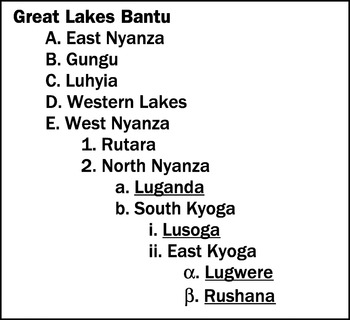
North Nyanza is the proto-language of four languages spoken today in east-central Uganda: Rushana, Lugwere, Lusoga and Luganda. The genetic classification of these languages reveals that they form a sub-group of the West Nyanza branch of Great Lakes Bantu (Fig. 1).Footnote 23 Proto-North Nyanza gradually diverged from West Nyanza and became its own language, no longer comprehensible to speakers of Rutara, the other West Nyanza dialect, in the second half of the first millennium. North Nyanza broke up in three stages. The first, which occurred in the early second millennium, resulted in Luganda and South Kyoga. The second split, around the middle of the second millennium, saw South Kyoga give way to Lusoga and East Kyoga and, finally, within the last 500 years, East Kyoga split, leaving Lugwere and Rushana. Language divergence tends to proceed slowly over generations as sub-groups have decreasing contact and dialects gradually become mutually incomprehensible and so can be described as languages. It is thus impossible to pinpoint a moment in time when dialects of a single language become distinct languages. As a result the dates derived from glottochronology can never be more than approximations but, especially when used in conjunction with correlations from the archaeological record and pollen studies, they give us the time-frame within which particular ancestral languages were spoken.Footnote 24
The sub-classification of North Nyanza languages and their place in Great Lakes Bantu.

While the reconstructed vocabularies for proto-North Nyanza and its offspring provide the historian with the basis for writing history, we cannot tell from words alone the contexts in which they were used. Drawing on the ethnographic record allows us to reconstruct some of those contexts.Footnote 25 The use of ethnography to write precolonial history can cause some unease, for ethnography is the study of the present. It has been noted that ‘pursued by itself, the comparative study of contemporary cultural practices harbors anachronism’.Footnote 26 But when we anchor comparative ethnographic data with independent evidence in the form of reconstructed vocabulary it becomes possible to mine the rich source that it is without yielding to ahistoricism. By relating ethnographic descriptions to specific words that we know were used by proto-North Nyanza-speakers, or one of the speech communities descended from them, it is possible to develop a richer and more nuanced picture of the meanings given to those words and thus to acquiure a greater understanding of the past.
The third principal source that I draw on to write the longue-durée history of North Nyanza peoples is oral traditions. The use and abuse of oral traditions and oral history in the writing of African history has preoccupied many people and filled many pages. Scholars who sought to find an ‘original’ versionFootnote 27 were criticized by those who sought to make oral traditions equate to archival sources,Footnote 28 while asserting that they could not be used for creating chronologies.Footnote 29 Later scholarship has challenged the search for ‘historical truth’ in early work using such traditions and has led to an emphasis on colonial and postcolonial history, with an implicit suggestion that these traditions cannot be used to write about the deeper past.Footnote 30 Historians, however, have continued to produce work that demonstrates the importance of such sources in writing about precolonial events.Footnote 31 Kodesh shows that we can make effective use of oral traditions to write about precolonial history by incorporating insights about performance and sites of memory into our approach.Footnote 32 The oral traditions that exist for Buganda, Busoga and Bugwere are particularly helpful in reconstructing the history of more recent centuries as state formation became a central political feature in the region, but they also shed light on wider and older social features.
NORTH NYANZA, MID FIRST MILLENNIUM TO THE MID SECOND MILLENNIUM
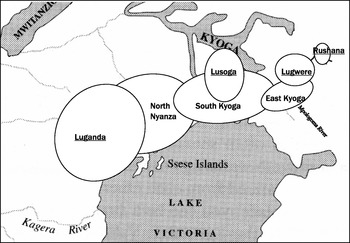
Living on the north-western shore of Lake Victoria-Nyanza in the second half of the first millennium, speakers of proto-North Nyanza inhabited a changing world (see Fig. 2). This was a time of technological transition from the early Iron Age to the late Iron Age, of agricultural change as North Nyanzans increasingly cultivated bananas, and of political innovation as power bases came more and more to be centred in royal families. Towards the beginning of this period, North Nyanzans would have placed a premium on the creation of secure communities as they gradually expanded across the landscape, creating new settlements with each generation. As they did so, they used the relationships and alliances created through marriage and motherhood, among other strategies, to protect the current and future well-being of their communities. People speaking proto-South Kyoga, from the early second millennium onwards, slowly settled to the east and northeast of the North Nyanzan heartland. In so doing, they not only created new, and at times precarious, settlements, but also interacted with people who spoke different languages and practised different cultures. The latter was particularly the case towards the end of the South Kyogan period and into the centuries during which Lusoga and East Kyoga were spoken. On this ongoing internal frontier,Footnote 34 South Kyogans and their descendants used maternal networks to ensure the social health of their communities and to negotiate their interactions with Luo-speaking immigrants. The Ganda, by contrast, faced different pressures and opportunities, which centred on growing political centralization and increasing competition for the most fertile agricultural land. In dealing with these challenges, they gave a greater prominence to patrilineal ideology in social and political organization.
Historical geography of North Nyanza, its sub-groups and present-day languages.Footnote 33

People speaking proto-North Nyanza and the languages descended from it, formed a borderlands world. From about the sixteenth century, the Soga came into increasing contact with Luo-speakers. The history of the Luo shows a pattern of interaction with existing populations.Footnote 35 While in some places such interactions led to the integration of existing populations into Luo culture,Footnote 36 in Busoga this was largely reversed as the Luo adopted Lusoga.Footnote 37 At the same time, interactions between Luo and Soga peoples led to changes throughout Soga society, including in marriage patterns and child fostering. To the east, speakers of East Kyoga also adopted aspects of Luo social and cultural life. More recently, the Gwere came into contact with Ateso-speakers and incorporated elements of this new culture into their own.
The interactions of the ancestors of North Nyanza-speaking peoples with other linguistic and cultural groups are fairly well documented, especially in the economic fields of cultivation and herding.Footnote 38 More recent political connections between (once) Luo-speaking groups and speakers of Great Lakes Bantu languages have been studied, especially with reference to Bunyoro and, less convincingly, Buganda.Footnote 39 These studies emphasize immigrant elites introducing centralized governance. Writing about Soga states from the seventeenth century, David Cohen has shown how immigrant Luo-speakers formed new states or took power in existing ones by creating networks of relationships with the indigenous population through exogamous marriage and by sending sons to live with their non-Luo maternal kin.Footnote 40 Working from the linguistic and comparative ethnographic evidence, it is clear that the ongoing roles for maternal kin in this patrilineal society had implications for the populations of both elite and commoners. It is those wider social interactions which facilitated the maintenance, if not the seizure, of power by an ‘outsider’ elite. Mothers and motherhoods were at the very heart of those interactions.
MOTHERS, MARRIAGE AND PATRILINEALITY
Women and girls in North Nyanza, and mothers in particular, found themselves at the centre of intersecting webs of patrilineages and patriclans. They were born into their father's lineage or *ssiga,Footnote 41 and to his clan or *-ka (noun class 7/8) [2],Footnote 42 but their mother's patriclan also had rights in them. As adults, it was taboo for them to marry someone of either their father's or their mother's clan. When they married into a third clan and became pregnant, they had to follow the avoidances and taboos of the husband's clan.Footnote 43 Their children belonged to that clan, again with the mother's clan retaining certain rights in them. The patrilineage and patriclan, however, had particularly strong interests in the children born to its sons. In the moral world of North Nyanza, motherhood was supposed to occur within the confines of matrimony. This was because many people beyond the biological parents held interests in the children born to a woman. Those various interests were physically represented in the form of bridewealth given by the lineage of the man to the lineage of the woman. And the economic ties created by bridewealth were part of what activated kin interests in a lineage's offspring. North Nyanzans inherited a word from their Great Lakes Bantu-speaking ancestors to describe the action of the man and his relatives bringing bridewealth to his fiancée's family: *-kwa [4]. This term is derived from the verb *-kó- which has been reconstructed to proto-Bantu with the meaning ‘give bridewealth’.Footnote 44 According to this analysis, North Nyanzans used a word inherited from their proto-Bantu-speaking ancestors to talk about the payment of bridewealth.
The practice of giving bridewealth as part of the marriage contract is an ancient one among Bantu-speaking and other communities. In North Nyanza, a marriage which followed the giving of bridewealth was the ideal sphere within which motherhood should occur, because it connected all those with an interest in the offspring born to the marriage. As Cohen has noted for Busoga:
the goods paid over as brideprice would have been circulated through the lineage of the bride, with the understanding – in fact it is a highly durable contract – that if the marriage should break up a reasonably equivalent mix of goods would be returned to the lineage of the husband.Footnote 45
Through the distribution of the bridewealth among the patrilineage of the bride and their commitment to return it (or its equivalent) should the marriage fail, the two patrilineages – that of bride and groom – became enmeshed in economic as well as social relationships. Claude Meillassoux asserts that the ‘kinship relations resulting from marriage’ are ‘relationships that form around the reproduction of individuals’. While such relationships also result from birth, birth is subsumed within marriage because it is ‘only an event regulated by rules fixed at marriage’.Footnote 46 For Cohen the relationship between ‘kinship relations resulting from marriage’ and those resulting from birth is more complicated, for the latter outlive the former. Even if a marriage failed, had children been born to it the bako, or in-law, relations formed would continue through the interests of the two lineages in those children.Footnote 47 This better reflects the importance of relationships formed through the mother, which shaped much of North Nyanzan social life.
Aside from the bridewealth given to the father and brothers of the bride, her mother also received special recognition. In Bugwere this took the form of a goat which was given to her after the wedding night.Footnote 48 Ganda grooms gave their mothers-in-law clothing in recognition of the taboo of avoidance that existed between them. They also gave them 1,000 cowries.Footnote 49 While the use of cowries may be a relatively recent development, the underlying practice of giving such a gift is probably older. Because there are similar practices of giving a gift of appreciation to the bride's mother in both Bugwere and Buganda, we can reconstruct the practice back to North Nyanzan times. For North Nyanzans, the gift would have marked both an appreciation of the work of mothering and a recognition of the taboos created by the marriage between the groom and his mother-in-law.
Ganda mothers were prominent in the preparations for and rites associated with marriage. It was they, and not the paternal aunt or any other woman, who had to wash the bride on the last day of her prenuptial seclusion.Footnote 50 Similarly it was the bride's mother who, together with her father, performed the cleansing rite, known as kukuza, immediately after the bride left her childhood home and on her first return visit with her husband. Mair noted that ‘only her actual parents could do this, and to this day if the mother has left her husband she is expressly fetched back for it and may stay with him for the whole period between the two occasions’.Footnote 51 The kukuza rite consisted of a man stepping over the outstretched legs of his wife and symbolized sexual intercourse.Footnote 52 It was also performed in relation to fishing and hunting practices and in several other contexts, and can be understood as marking moments of both danger and creation.Footnote 53 In this particular contex, it marked the moment of becoming the parents of a married daughter: a moment which changed the status of the parents and entered them into a new set of relationships with their son-in-law and his kin. The ceremony points to an ongoing recognition of the importance of the mother as the link between her natal kin, her children and her daughter's marital kin. It supports Cohen's argument about the enduring nature of bako relationships even after the failure of marriage, if children had resulted from it. The mother of the bride remained the central nexus of those relationships and, as such, had to perform the rite, because her daughter's marriage in turn created a new layer of bako relations. In addition to the bako relations, a daughter's marriage and her subsequent motherhood created a new set of inter-lineal relations that were of great importance to healthy social reproduction.
MOTHERHOOD IN SOCIAL ORGANIZATION
Speakers of North Nyanza lived in a society that they organized patrilineally, and yet the evidence shows that the connections formed by and through mothers were also important to them. Mothers were the essential link between their clan and lineage members and their children. North Nyanzans had a specific term (*-ihwa [noun class 1/2] [1]) to refer to the children of their female clan members. In addition to that relationship, a mother's brother had a particular interest in his sister's children: he had rights in and responsibilities towards them. This is not to say that North Nyanza followed bilateral descent or that there were matrilineal clans. It is quite clear that all the clans and lineages were patrilineal. However, depending on the particular circumstances at different moments in time, North Nyanzans changed the form of their social organization in order to serve varying political, economic and social needs.
North Nyanzans did not innovate the term *-ihwa to describe their sisters' children, but inherited it from proto-Bantu speakers.Footnote 54 Schoenbrun notes that, for Great Lakes Bantu-speakers, what is important about *-jìpύá, the Great Lakes Bantu form of the noun, is that it describes ‘the new member of the group, lost to the group which gave the wife and gained by the group which received the wife’.Footnote 55 It is true that *-ihwa in North Nyanza were ‘lost’ to the patrilineage, but the relationship between a mother's kin and her children demonstrates a continued importance of *-ihwa to their maternal kin. It was these children who washed the bodies of their aunts and uncles in preparation for burial and who assisted in the special ceremonies for twins and at other ritual occasions.Footnote 56 Furthermore, when an *-ihwa succeeded to political office, his maternal kin could expect to benefit from their connection to power.Footnote 57 So while *-ihwa did not belong to their mother's lineage or clan, they were not entirely ‘lost’ to their maternal kin group. Indeed it was the very distance created by their belonging to another lineage and clan that permitted them to carry out many of the ritually dangerous duties required of them. The continued connection between a mother's kin and her children was a strong feature of North Nyanzan social and political life.Footnote 58
The concept of *-ihwa continued to play a similar role in South Kyogan social organization. After the break up of South Kyoga, however, there was significant innovation in the institution and role of *-ihwa in Bugwere and Busoga. Among the Gwere, baiwa Footnote 59 had a number of ritual duties that their Soga and Ganda counterparts did not share. In addition to performing burial rites and playing a central role in twin ceremonies, they were involved in rainmaking ceremonies and the new millet ceremony – both of which were intimately connected with fertility.Footnote 60 A mwiwa would eat the first harvest from a banana plant under which a placenta had been buried, and participated in the kulya embenenwa ceremony which was performed when a new baby was first brought out of the house in which he or she was born.Footnote 61Baiwa also played a prominent role in the purification rites that took place if two members of the same clan had sexual relations with each other.Footnote 62 And baiwa could turn to their maternal uncle for assistance should they encounter the social disaster of being expelled from their paternal clan.Footnote 63 There does not seem to have been a stigma attached to Gwere baiwa living in their maternal uncle's household, in contrast to the situation in Buganda, as we will see below. In Bugwere, then, there was not only a continued importance for the connection between a woman's children and her kin and clan but, in fact, an increased emphasis on this relationship. That this increased emphasis was expressed by the involvement of baiwa in ceremonies associated with fertility serves to underline that Gwere did not see them so much as being ‘lost’ to the clan, but rather as a central part of healthy social reproduction. As was the case in North Nyanzan society, it was their very distance from the clan which allowed Gwere baiwa to perform tasks that were ritually dangerous for clan members, but which were essential to the well-being of the clan.
A major change in the institution of baiwa among the Soga was that many of the patrilineal clans (bika) innovated specific names for them. These names, particularly those for girls, often reflected the name of the eponymous founder of the clan. For example, the abaiseIhemula clan named their female baiwa ‘Naihemula’ and the abaiseIruba clan named their female baiwa ‘Nairuba’.Footnote 64 While it is not yet possible to conclusively date the start of this practice, Cohen's work on how Luo-speaking immigrants took power in Soga states is suggestive. Writing about the Owiny Karuoth Luo, he notes that, while the sons of Karuoth men were raised in the households of their Lusoga-speaking maternal kin, daughters tended to remain in their father's household. He goes on to argue that ‘the daughters may have been crucial in the cultural exchange between Karuoth and non-Karuoth … and oriented toward a bilinguality and a cultural education in two different worlds’. This cultural straddling was intensified through their marriage to non-Karuoth, i.e. Soga, men.Footnote 65 By giving particular names to their daughters' children, Owiny Karuoth and others living in Busoga marked the ongoing connection with them and reinforced their role as cultural intermediaries.
As in North Nyanza-speaking communities, Soga baiwa had central roles in ceremonies and rites associated with the birth and naming of twins and with funerals and successions.Footnote 66 The connection between a mwiwa and his or her maternal kin was strong in Busoga and a grievance committed against a powerful mwiwa could lead to warfare, as occurred between Busiki and Nkono in the eighteenth century.Footnote 67 For the Soga, baiwa's ritual connections with their mothers' kin groups led to strong political ties between them. Because a clan benefited greatly from the accession to the throne of a mwiwa, powerful clan members got involved in succession disputes.Footnote 68 Indeed, while members of a mother's kin group stood to benefit from a mwiwa's success, the mwiwa was often dependent on his maternal kin for that success. There was, then, a situation of mutual dependence which served to reinforce the connections between baiwa and their maternal kin.
The Ganda, too, placed the concept of bajjwa Footnote 69 at the heart of their social organization. Bajjwa retained their ritual role, particularly in ceremonies marking the birth and naming of twins.Footnote 70 Furthermore, the maternal uncle or kojja had particularly strong rights to his sister's children, unless their father gave him compensatory payment for each child. And, should a mujjwa prince succeed to the throne, his maternal clan benefited greatly from their connection to him.Footnote 71 Despite this, the Ganda had a complicated relationship with their bajjwa. A kojja could abuse his rights in them. Indeed any bajjwa who lived with their kojja because they had not been claimed and compensated for by their father were treated with disdain in the household. As Mair noted, such a child ‘had none of the advantages of belonging either to his father's or his mother's family … but … he was not his uncle's child either, and in the latter's household he had no rights’.Footnote 72 There was in Buganda a growing tension at the heart of the mujjwa–kojja relationship that led the dominance of the kojja's rights over his responsibilities towards his nieces and nephews. This coincided with the growing power of the Ganda state which led to an increased emphasis on patrilineality over any maternal ties, as older ideologies of motherhood were co-opted and transformed by the state.
The developments in the relationship between *-ihwa and their maternal kin, from the time North Nyanza was spoken to the period when all the descendant languages were well established, were paralleled in the evolution of the specific relationship between a maternal uncle and his nieces and nephews.Footnote 73 Speakers of proto-East Bantu (or Eastern Savanna Bantu) innovated a word for ‘maternal uncle’, *máá-dÚmè, which had the literal meaning of ‘male mother’. North Nyanzans inherited this term, but shifted the meaning so that the word referred to ‘male-in-laws’.Footnote 74 They then innovated a new noun, *koiza (noun class 9/2) [3], to describe a mother's brother. The etymology of this noun remains unclear. There is a Nyoro verb -koija with the meaning ‘to be greedy or gluttonous’ and it is common for nouns to be derived from verbs. Thus it is possible that there was a West Nyanza verb *-koija from which North Nyanza speakers derived the noun *koiza. If this etymology is correct it reflects the right of the maternal uncle to make demands of his nephew.Footnote 75 However, because the verb is found only in Nyoro and in no other Rutaran or North Nyanzan languages, it is possible that the Nyoro verb was derived from the North Nyanza noun for maternal uncle. The Nyoro verb may thus reflect the perceived greed of maternal uncles among a neighbouring people.
Irrespective of its etymology, the fact that North Nyanzans innovated a new noun to name the maternal uncle suggests a change or evolution in his role during the time that North Nyanza was spoken as a language. From ethnographic evidence we know that it was not only the maternal uncle who had rights in his sister's children, for the maternal grandfather could also make claims on them. It appears that, at least initially, it was the latter who could demand compensation from his son-in-law for some of the children born to his daughter,Footnote 76 though this right may well have passed to the *koiza on the grandfather's death. Yet, it was only the maternal uncle who was renamed. One explanation for the renaming lies in the political developments of the period, which opened up new possibilities for power. The North Nyanzan period saw the continuation of a political evolution that was initiated by West Nyanzans, namely ‘the emergence of instrumental kingship’ with at least ‘some control over land’.Footnote 77 This manifested itself in the consolidation of power by what became royal families. It is most likely that the institution of the queen mother emerged along with early states in North NyanzaFootnote 78 and thus that ideologies of motherhood were at the heart of political complexity. This meant that an *-ihwa relied on his maternal kin to support his claims to power and, in turn, his *koiza benefited from his *-ihwa's political success. In this analysis, the *koiza of a politically successful man would have wielded considerable authority in the region's early polities.Footnote 79 All of this suggests that the maternal uncle as a power broker may have grown in importance at this time.Footnote 80
After Luganda had emerged as a distinct language, the kojja Footnote 81 became the most important relative on the maternal side. In addition to the benefits he could expect to derive from his adult nephew's political success, a Ganda kojja could claim his sister's children, particularly the first-born girl, unless their father paid a further gift for them.Footnote 82 We saw above that a child not redeemed by her or his father faced an uncertain future in the kojja's household, for while this right of the kojja derived from maternal ties it was the patrilineage that marked a child's place in society. Should a mujjwa be properly compensated for by his father, however, he ‘was entitled to ask for anything he liked in his mother's brother's house and, if his request was refused, to help himself’.Footnote 83 This derived from the shift in Ganda society to emphasize patrilineal descent to the exclusion of maternal connections, while retaining some elements of the older system. In Bugwere, baiwa who were expelled from the paternal clan could turn to their koiza for assistance and be accepted into his household. In Buganda, only a mujjwa who had been publicly recognized by his patriclan could rely on his kojja's support. A mujjwa who was expelled from his patriclan could not expect to be accepted as an equal by his mother's kin. The shift towards a male-dominated ideology in Buganda may have resulted from centralization of wealth in immobile banana gardens, alongside the emergence of an increasingly centralized state which co-opted and distorted older ideologies based around motherhood.
As we saw in the opening story, the right of the maternal uncle to claim some of his sister's children is enshrined in the foundation myth of the Ganda, the story of Kintu and Nnambi. By refusing to recognize his brother-in-law's right to his endobolo (share) of his nephews and nieces, Kintu broke an ancient social more and thus brought death into his land. And yet, the moral of this tale is more complicated. The maternal uncle is the one who brought death and his behaviour reflected growing tension within Ganda society between the recognition of patrilineal descent and the rights of maternal kin – a tension which grew out of the changing economic and political landscape. In addition to highlighting the rights of the kojja, this story points to a conflict between the rights of the kojja in his bajjwa and the older rights of the maternal grandfather in them. In the historical texts of Busoga and Bugwere, there are several examples of maternal grandfathers raising their daughters' children,Footnote 84 and so the shift in favour of the kojja's claims over the children of the female lineage members in Buganda must have occurred after the break-up of the proto-North Nyanza speech community.
The emphasis on the relationship between a Ganda maternal uncle and his bajjwa was particularly marked within the royal realm. A prince was unlikely to succeed to the throne without the assistance of his mother (who would become queen mother on his accession) and her relatives.Footnote 85 The role of his maternal kin was recognized by the successful prince who would appoint his kojja to the important chiefship of ssaabaganzi.Footnote 86 The connection between the king and his kojja continued into the next generation as each of the king's sons was introduced to the ssaabaganzi immediately after being weaned. The ssaabaganzi in his turn gave each of his great-nephews ‘a well-dressed skin to wear’.Footnote 87 Those great-nephews would have been of a different clan again from their father, for the children of the kabaka belonged to their mother's clan, in as much as they belonged to any, and yet there remained a connection with their paternal grandmother's clan.
South Kyogans and their descendants did not give the *koiza as much power within the kin group as their Luganda-speaking neighbours. But the special relationship between a maternal uncle and his *-ihwa that had led to North Nyanzans innovating the term *koiza continued in these societies. In Busoga the benefit a koiza could accrue from the political success of a nephew was significant. If the nephew succeeded to a chieftainship or kingship he would award his koiza the post of katikkiro or prime minister.Footnote 88 This was very much a reciprocal relationship, just as in Buganda, for a mwiwa was unlikely to win the succession to his father's throne without his maternal kin's assistance, even though there was a preference for the successor to be the son of the senior wife.
The renewed and durable connection between a woman's children and her kin and clan in what are consistently described as patrilineal and even patriarchal societies challenges the conventions of this labelling. Meillassoux argues that, in a patrilineal system, ‘a married woman[‘s] … descent relations are always subordinate to her conjugal relations’.Footnote 89 Furthermore, women are ‘deprived of actual rights over their progeny’ and so ‘the relations women maintain with their children do not involve obligation, as do those between children and their father’.Footnote 90 But, as we have seen, a mother's father or brother could claim at least some of her children if they were not compensated for their loss. Even when compensation was paid, children performed ritual functions for their mother's lineage and clan. And the mother of a prince who succeeded his father to the throne could and did make significant claims based on her motherhood. So, while fatherhood was the central ideology around which kin networks (including fictive kin networks such as clans) were organized, motherhood was also key to the organization of social relationships in North Nyanza and its descendant societies.
CONCLUSION
The North Nyanza speech community responded to the particular challenges it faced in building sustainable societies along the lake shore by placing motherhood at the heart of its social organization, despite following patrilineal descent. In so doing, North Nyanzans created seriated networks of kinship and obligation that reached outside of the patrilineage and the patriclan. These networks centred around mothers, who served as bridges between their own patrilineages and those of their children. As their children married, the networks extended to yet more patrilineages. As the Luganda and proto-South Kyoga speech communities diverged, their attitudes towards the roles of mothers and maternal kin in social organization also diverged. Luganda-speakers came to emphasize the male line, to the growing exclusion of social ideologies of motherhood. This manifested itself in an increasingly tense relationship between maternal uncles and their bajjwa, but it did not result in the total exclusion of maternal uncles from kin governance. For South Kyogans and their Lusoga- and Lugwere-speaking descendants, the premium on creating enduring communities, first in new lands and later alongside people speaking distinct languages, meant that the connections formed by and through mothers were, if anything, more important than in North Nyanzan times. The many and varied tasks that *baiwa performed for their maternal kin reflect their importance to social reproduction. It was in Bugwere that children of female members of a patrilineage played the greatest roles in that lineage's social reproduction. The situation here differed from that of growing tension between patrilineal ideology and the roles of maternal kin in Buganda. The reasons why this was so remain speculative, but probably lie in the lower degree of centralization of political power and wealth and in the more tenuous nature of Gwere communities in an ethnically diverse landscape. This multi-layered picture of patrilineality in North Nyanza demonstrates the complexity of social organization. While the labels of ‘patrilineality’ and ‘matrilineality’ are valid and useful, exploring the specific content of these models in different societies across time demonstrates the importance of recognizing their historical contingency.
APPENDIX: RECONSTRUCTED VOCABULARYFootnote 91
1. *-ihwa (noun class 1/2) ‘child of female clan member’
Luganda, Lusoga, Lugwere, Rushana
Proto-Bantu noun, but with some semantic shift in Great Lakes Bantu.Footnote 92
2. *-ka (noun class 7/8) ‘patriclan’
Luganda, Lusoga, Lugwere, Rushana
Derived from proto-Great Lakes Bantu *-ka (5/6) ‘household’Footnote 93 with noun class change to 7/8 for augmentation from immediate family to clan.
3. *koiza (noun class 9/2) ‘maternal uncle’
Luganda, Lusoga, Lugwere
North Nyanza noun. Possibly derived from hypothetical West Nyanza verb *-koija ‘be greedy’ but this needs further confirmation. There is areal spread to Luhyia languages.
4. *-kwa (v.t.) ‘pay bridewealth’
Luganda, Lusoga, Lugwere, Rushana
Possibly of Eastern Savanna Bantu (East Bantu) origin, although the preponderance of Great Lakes Bantu suggests that the Pende and Nyamwezi attestations might be areal spreads of a proto-Great Lakes Bantu innovation. Derived from proto-Bantu *-kó- ‘give bridewealth’.