The concept of Emotional Intelligence (EI) is rooted in early works on emotions and social intelligence. However, it is not until the 1990s that the term is given particular consideration. Such interest reflects the theoretical proposition that individuals who are high in EI are likely to experience better results in life. According to the ability model proposed by Mayer and Salovey (Reference Mayer, Salovey, Salovey and Sluyter1997), EI is defined as the capacity to perceive, assimilate, understand, and manage emotions in oneself and others.
Indeed, studies suggest that EI is positively related to psychological well-being criteria such as life satisfaction and mental health (e.g., Schutte, Malouff, Thorsteinsson, Bhullar, & Rooke, Reference Schutte, Malouff, Thorsteinsson, Bhullar and Rooke2007). Others have shown this association remains significant even after controlling the effects of personality variables (e.g., Petrides, Pérez-González, & Furnham, Reference Petrides, Pérez-González and Furnham2007) and/or mood states (i.e., positive and negative affect) (e.g., Gignac, Reference Gignac2006; Palmer, Donaldson, & Stough, Reference Palmer, Donaldson and Stough2002; Thompson, Waltz, Croyle, & Pepper, Reference Thompson, Waltz, Croyle and Pepper2007).
Referring to measurement, different instruments have been developed to assess EI. One self-report typically used is the Trait Meta-Mood Scale (TMMS, Salovey, Mayer, Goldman, Turvey, & Palfai, Reference Salovey, Mayer, Goldman, Turvey, Palfai and Pennebaker1995). Trait meta-mood, or perceived EI, refers to the meta-knowledge people have about their own emotional abilities. The TMMS is a measure of beliefs concerning one’s own emotional Attention (perceived ability to attend to moods and emotional states), Clarity (perceived ability to understand and discriminate moods and emotional states), and Repair (perceived ability to regulate and repair moods and emotional states). A very recent cumulative meta-analysis by Martins, Ramalho, and Morin (Reference Martins, Ramalho and Morin2010) concluded that this instrument has already reached sufficiency and stability.
Correspondingly, the construct of self-efficacy has been studied as an individual resource related with a range of beneficial outcomes. Findings include positive associations with life satisfaction (Vecchio, Gerbino, Pastorelli, Del Bove, & Caprara, Reference Vecchio, Gerbino, Pastorelli, Bove and Caprara2007) and mental health (Moeini et al., Reference Moeini, Shafii, Hidarnia, Babaii, Birashk and Allahverdipour2008), as well as negative links with anxiety and depression (Leganger, Kraft, & Roysamb, Reference Leganger, Kraft and Roysamb2000).
Although there has been plenty of research examining the relationship between EI and health outcomes, there are very few studies that have analyzed the association between EI and psychological well-being, controlling for the effects of self-efficacy (e.g., Durán, Extremera, Rey, Fernández-Berrocal, & Montalbán, Reference Durán, Extremera, Rey, Fernández-Berrocal and Montalbán2006). As a result, this paper´s unique contribution will focus on providing evidence regarding the importance of EI dimensions in predicting two components of psychological well-being (life satisfaction and mental health), beyond what is accounted for by self-efficacy.
EI and psychological well-being
The term psychological well-being has been subjected to extensive research. Overall, it represents a generalized feeling of happiness; a relative absence of unpleasant moods and emotions (Ryff & Keyes, Reference Ryff and Keyes1995). In the present paper it is operationalized as comprising of two components: life satisfaction and mental health. The former refers to a cognitive evaluation or judgment of one’s overall life (Diener, Emmons, Larsen, & Griffin, Reference Diener, Emmons, Larsen and Griffin1985), while the latter is the psychological state of someone who is functioning at a satisfactory level of emotional and behavioral adjustment (World Health Organization, 2004).
Scientific theories suggest that people who easily identify emotions during life situations will spend less time attending to their reactions, using fewer cognitive resources, which in turn will allow them to assess alternative actions or use more adaptive coping strategies (Gohm & Clore, Reference Gohm and Clore2002). For that reason, emotionally intelligent individuals are likely to experience higher levels of psychological well-being due to their ability in managing emotions, recognizing, distinguishing, and adjusting them (Mayer & Salovey, Reference Mayer, Salovey, Salovey and Sluyter1997). Some researchers have analyzed the impact of EI on individual’s psychological well-being taking into consideration EI as a global construct (e.g., Gignac, Reference Gignac2006; Schutte et al., Reference Schutte, Malouff, Thorsteinsson, Bhullar and Rooke2007), while others have focused on the predictive validity of different EI dimensions (e.g., Extremera & Fernández-Berrocal, Reference Extremera and Fernández-Berrocal2005a).
EI and life satisfaction
Studies have also analyzed the association between EI dimensions and life satisfaction. With regard to Clarity, although we found an exception (Thompson et al., Reference Thompson, Waltz, Croyle and Pepper2007), most research suggests that emotional Clarity positively affects satisfaction with life. For instance, Palmer et al. (Reference Palmer, Donaldson and Stough2002) found that only this subscale accounted for further variance in life satisfaction not accounted for by positive and negative effect. Landa, López-Zafra, Antoñana, and Pulido (Reference Landa, López-Zafra, Antoñana and Pulido2006) also found evidence supporting that life satisfaction most significant predictor was Clarity. In the same line, other findings indicated that emotional Clarity account further variance to the prediction of life satisfaction independently from personality traits (Extremera & Fernández-Berrocal, Reference Extremera and Fernández-Berrocal2005a; Palomera & Brackett´s, Reference Palomera and Brackett2006). Finally, researchers confirmed that emotional Clarity still remained significant in predicting life satisfaction after the influence of optimism/pessimism and perceived stress were controlled (Extremera, Durán, & Rey, Reference Extremera, Durán and Rey2007, Reference Extremera, Durán and Rey2009).
In respect to emotional Repair, some investigations observe no effect of this EI component over life satisfaction (Palmer et al., Reference Palmer, Donaldson and Stough2002; Extremera & Fernández-Berrocal, Reference Extremera and Fernández-Berrocal2005a). However, most studies suggest that the ability to control and maintain emotions is positively related to the degree of life satisfaction. In 2007, Thompson and colleagues found that Repair predicted a small amount of the variance in life satisfaction, even when affect was accounted for. The authors suggest that Repair would have the greatest relationship with one’s overall well-being. Based on late research, theoretical arguments in favor of the Clarity and Repair dimensions as good predictors of life satisfaction appear to be warranted.
On the other hand, results regarding the relationship between Attention and life satisfaction are more complex. Empirical evidence of several previous studies suggests no significant relationship between Attention and life satisfaction (Extremera et al., Reference Extremera, Durán and Rey2009; Extremera & Fernández-Berrocal, Reference Extremera and Fernández-Berrocal2005a; Extremera et al., Reference Extremera, Durán and Rey2007; Palmer et al., Reference Palmer, Donaldson and Stough2002; Thompson et al., Reference Thompson, Waltz, Croyle and Pepper2007). From a theoretical point of view it has been argued that paying too much attention to emotions can promote the development of ruminative thoughts negatively affecting one´s emotional well-being. Equally, low attention could be also detrimental to adaptation, which means this association between emotional attention and well-being could be curvilinear (Extremera & Fernández-Berrocal, Reference Extremera and Fernández-Berrocal2006). However, most part of researchers test the linear connection between this dimension of emotional intelligence and well-being (e.g., Extremera et al., Reference Extremera, Durán and Rey2009, Landa, Pulido, & López-Zafra, Reference Landa, Pulido and López-Zafra2011). Consequently, future research may examine differential patterns of associations between the Attention dimension and life satisfaction (Gignac, Reference Gignac2006).
In sum, individuals who know, understand and regulate feelings might deal better with emotional issues, engaging in positive reinterpretations of events and experiencing greater life satisfaction (Gohm & Clore, Reference Gohm and Clore2002). It might also be assumed that the way people manage emotions provide individuals knowledge about themselves, conferring a sense of confidence and control on future affective events, establishing a conceptual link between EI and mental health, even influencing towards the development of personality and mental disorders (Lane & Schwartz, Reference Lane and Schwartz1987).
EI and mental health
Studies have also analyzed the relationship between EI dimensions and psychological health. Considering the Clarity component, scholars agree that a high perception on the ability to distinguishing moods and emotions is related to higher mental health, as well as to lower levels of anxiety and depression (Extremera & Fernández-Berrocal, Reference Extremera and Fernández-Berrocal2006).
In respect to Repair, back in 1996, Goldman, Kraemer, and Salovey showed that individuals who believed they had the ability to maintain positive moods were less likely to report illness compared to those who evidenced not engaging in mood repair. Current research yields empirical evidence in which perceived skill at mood Repair is significantly associated with scores on health-related functioning, including social, physical, and psychological symptoms (Extremera & Fernández-Berrocal, Reference Extremera and Fernández-Berrocal2002). All the above findings provide complementary support on the claims that there is a relationship between Clarity and Repair and mental health outcomes.
The results regarding the relationship between emotional Attention and mental health are somewhat interesting. Some few studies have not found significant links (e.g., Velasco, Fernández, Páez, & Campos, Reference Velasco, Fernández, Páez and Campos2006) suggesting, again, the possible curvilinear association between Attention and psychological well-being. However, the majority of them indicate a negative and significant linear relationship between Attention and mental health. People who are emotionally attentive are characterized by paying constant attention to their moods in an effort to understand them, which is not always productive for the individual (Extremera & Fernández-Berrocal, Reference Extremera and Fernández-Berrocal2006). As literature has pointed out, the negative associations between Attention and mental health are not entirely unexpected since this subscale has been demonstrated in previous studies to be positively associated with neuroticism (Warwick & Nettelbeck, Reference Warwick and Nettelbeck2004), a greater number of symptoms (Thompson et al., Reference Thompson, Waltz, Croyle and Pepper2007), emotional distress (Shulman & Hemenover, Reference Shulman and Hemenover2006) and some personality disorders (Leible & Snell, Reference Leible and Snell2004).
It is notable that Goldman et al. (Reference Goldman, Kraemer and Salovey1996) identified quite early the moderating role of emotions’ regulation on the relationship between Attention and mental health. They indicated that those who believed in greater attention to mood were more likely to report physical symptoms of illness. At that time, very few studies had found similar results proposing an association between monitoring feelings and unhealthy-related outcomes. More recently though authors have coincided on evidences demonstrating a negative association between Attention and mental health. For instance, this subscale has been positively and significantly associated with depression and ruminative responses (Fernández-Berrocal, Extremera, & Ramos, Reference Fernández-Berrocal, Extremera and Ramos2004), anxiety and to low levels of mental health (Extremera & Fernández-Berrocal, Reference Extremera and Fernández-Berrocal2006). Indeed, the Attention subscale has demonstrated the higher variability of association in previous studies (Extremera et al., Reference Extremera, Durán and Rey2007). The diversity of results makes necessary more research to explore the possible mechanisms that link Attention and psychological healthy functioning.
EI, self-efficacy, and psychological well-being
The interest on individual’s wellness has also influenced research on traditional constructs such as self-efficacy. It refers to a person’s belief about their capabilities to produce designated levels of performance that exercise influence over events that affect their lives (Bandura, Reference Bandura1977). Interestingly, Petrides et al. (Reference Petrides, Pérez-González and Furnham2007) suggested that EI can be termed ‘emotional-self-efficacy’. However, even though self-efficacy may be a cornerstone component of emotional competence, they are conceptually distinct. One of the sources of self-efficacy is emotional arousal. Therefore, self-efficacy makes a difference on how people feel, think, and act, which furnishes this construct with additional explanatory and predictive power in a variety of personal processes. Besides, owing to the fact that enhancing EI is a challenging process requiring significant practice and sustained motivation, we believe that self-efficacy is likely to play a role in affecting EI.
General self-efficacy has been related to well-being criteria worldwide. Research includes positive associations with quality of life and life satisfaction (Luszczynska, Gutiérrez-Doña, & Schwarzer, Reference Luszczynska, Gutiérrez-Doña and Schwarzer2005), physical health and freedom from depression and anxiety (Sahu & Rath, Reference Sahu and Rath2003). Other pieces of evidence have attested to self-efficacy beliefs as long-term predictors of life satisfaction (Vecchio et al., Reference Vecchio, Gerbino, Pastorelli, Bove and Caprara2007) and mental health (Moeini et al., Reference Moeini, Shafii, Hidarnia, Babaii, Birashk and Allahverdipour2008). As such, previous researches have verified general self-efficacy to play an important role in individuals’ psychological well-being.
Overall there has been a wide corpus of research relating important concepts such as EI and self-efficacy with well-being. For instance, the meta-analysis by Martins et al. (Reference Martins, Ramalho and Morin2010) revealed a highly significant, positive relationship between EI and health. These effects were higher and no additional studies are needed to establish the existence of the phenomenon. “This reinforces the idea that future research should not concentrate on establishing the importance of the relationship between EI and health, but should instead focus on incremental validity issues” (Martins et al., Reference Martins, Ramalho and Morin2010, p. 562). Nevertheless, the majority of studies have investigated incremental validity over and above personality. So far, there appears to be no published work analyzing the contribution of EI dimensions on psychological well-being (life satisfaction and mental health), after controlling for general self-efficacy beliefs and sociodemographic characteristics.
One valuable exception is the work of Durán et al. (Reference Durán, Extremera, Rey, Fernández-Berrocal and Montalbán2006), who explored the role of EI dimensions on different psychological well-being indicators -academic burnout and engagement-, controlling the influence of demographic characteristics, perceived stress and general self-efficacy. Their results highlighted the contribution of EI abilities (especially Attention and Repair) to well-being criteria, confirming the relevance and consistency of the construct.
In sum, we have considered relevant to examine the effects of EI dimensions on life satisfaction and mental health, controlling for the variance of socio-demographic characteristics and general self-efficacy. By including the latter, we also aim to overcome limitations in the field where self-efficacy has not been taken into account.
Based on previous findings, our main hypothesis is that emotional Clarity and Repair will significantly predict life satisfaction and mental health positively, while emotional Attention will predict them negatively, after controlling for the effects of socio-demographic variables and general self-efficacy.
Method
Participants
The sample consisted of 1078 undergraduate students who voluntarily participated in the study (333 men and 738 women); the mean age was 22.98 years (SD = 6.73). The students came from a variety of disciplines (e.g., psychology, medicine, business, and engineering) from universities in Spain (N = 413), Mexico (N = 243), Portugal (N = 161), and Brazil (N = 261). Participants completed a packet of tests. The completion required approximately 20 minutes. Data was collected between 2007 and 2009.
Measures
The following assessment instruments were employed in this study:
Trait Meta-Mood Scale (TMMS, Salovey et al., Reference Salovey, Mayer, Goldman, Turvey, Palfai and Pennebaker1995)
This scale evaluates the extent to which people attend to and value their feelings (Attention), feel clear rather than confused about their feelings (Clarity), and use positive thinking to repair negative moods (Repair). Fernández-Berrocal et al. (Reference Fernández-Berrocal, Extremera and Ramos2004) have developed a Spanish shorter version of the Trait Meta-Mood Scale with 24 items (eight for each subscale). The subscales include items such as: “I think about my mood state continuously” (Attention); ‘‘I am usually very clear about my feelings” (Clarity) and “Although sometimes I feel sad, I usually have an optimist vision” (Repair). Participants are asked to answer items rated on a Likert scale ranging from 1 (strongly disagree) to 5 (strongly agree). In the present paper we used the Spanish and the Portuguese (Queirós, Fernández-Berrocal, Extremera, Carral, & Queirós, Reference Queirós, Fernández-Berrocal, Extremera, Carral and Queirós2005) versions of the TMMS-24. Cronbach’s alpha was .90 for Attention, .86 for Clarity, and .87 for emotional Repair.
Satisfaction with Life Scale (SWLS; Diener et al., Reference Diener, Emmons, Larsen and Griffin1985)
This is a self-report measure of life satisfaction, where respondents indicate their level of agreement with each of five statements (e.g., “I am satisfied with my life”) on a five-point scale ranging from 1 (strongly disagree) to 5 (strongly agree). We used the Spanish and Portuguese versions of the SWLS, which have been adapted by Atienza, Balaguer, and Garcia-Merita (Reference Atienza, Balaguer and Garcia-Merita2003) and Neto (Reference Neto1993), respectively. The alpha coefficient showed a satisfactory value of .81.
General Health Questionnaire (GHQ-12; Goldberg, Reference Goldberg1972)
Participants are invited to respond how they have felt during the last weeks (e.g., “Have you recently felt constantly under strain?”). Each item is scored on a four-point Likert scoring system, ranging from 1 (much more than usual) to 4 (less than usual). The first six items of the scale were inverted so that higher scores on the whole scale indicated greater general mental health. We used a Spanish (Rodríguez, Hontangas, Bravo, Grau, & Ramos, Reference Rodríguez, Hontangas, Bravo, Grau, Ramos, Peiró, Prieto, Bravo, Ripoll, Rodríguez, Hontangas and Salanova1993) and a Portuguese (Sarriera, Schwarcz, & Câmara, Reference Sarriera, Schwarcz and Câmara1996) variation of the GHQ-12. A Cronbach’s alpha of .84 was obtained for this sample.
General Self-Efficacy Scale (GSES; Schwarzer, Reference Schwarzer1993)
Self-efficacy was evaluated with a Spanish modified version of the GSES (Baessler & Schwarcer, Reference Baessler and Schwarzer1996), along with a Portuguese version (Nunes, Schwarzer, and Jerusalem, Reference Nunes, Schwarzer and Jerusalem1999). The instrument consists of 10 items (e.g., “I can solve most problems if I invest the necessary effort”), which answers are reported on a five-point scale ranging from 1 (strongly disagree) to 5 (strongly agree). Reliability coefficient was calculated for the scale and demonstrated internal consistency (α = .89).
Statistical Analyses
To examine the incremental validity of TMMS dimensions over General Self-efficacy in accounting for variance in life satisfaction and mental health, two hierarchical regression analyses were conducted. Socio-demographic variables (age, gender, and cultural dimensions) were entered as covariates in the first step. The gender was introduced as Dummy (0 = Male/1 = Female). Countries were dichotomized following Hofstede’s median scores (1991) on cultural dimensions of Individualism-Colectivism (IDV) and Uncertainty Avoidance (UAI) (Fernández, Carrera, Sánchez, Paez, & Candia, Reference Fernández, Carrera, Sánchez, Paez and Candia2000).
In individualistic cultures the ties between individuals are loose. Everyone is expected to look after him/herself and his/her immediate family. In collectivistic cultures, early in life people are integrated into cohesive groups, often extended families, which continue protecting them in exchange for unquestioning loyalty. Uncertainty avoidance dimension refers to the extent a culture programs its members to feel; either uncomfortable or comfortable in unstructured, unknown or surprising situations (Hofstede, Reference Hofstede1991). Countries classified with 1 mean they are collectivist (Mexico, Portugal and Brazil) and high uncertainty avoidance (Spain and Portugal). Countries classified with 0 mean they are individualistic (Spain) and low uncertainty avoidance (Mexico and Brazil).
General self-efficacy was introduced in the second step. Finally, EI dimensions (Attention, Clarity and Repair) were entered.
Results
Descriptive Analyses
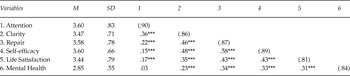
Table 1 shows correlations among the variables included in this study, their descriptive results, and alpha coefficients. The results indicate that emotional Clarity and Repair were positively related to life satisfaction and mental health. Emotional Attention was positively related to life satisfaction. The relationship between emotional Attention and mental health did not reach statistical significance. General self-efficacy was positively related to life satisfaction, mental health and the three dimensions of EI. Emotional Attention, Clarity and Repair were positively related to each other.
Means, Standard Deviations, Correlations, and Reliabilities of the Study Variables

Note.
Internal Reliabilities (Cronbach’s Alpha) are in parentheses. *p < .05 **p < .01 ***p < .001
The next set of analyses explored the transcultural differences between the samples studied in the four countries. Specifically, analyses of variance were carried out to explore the differences in the EI dimensions. The results show that there were significant differences between the countries for the three EI dimensions (table 2). The Tukey post-hoc test was used to identify the significant differences between the means. Participants from Portugal and Brazil had the higher scores of emotional attention. There were differences in clarity and repair between Spain and the students from the other three countries, showing lower scores the Spanish sample.
Cross-cultural differences in EI dimensions between the samples studied in the four countries

Note.
***p < .001
Regression analyses
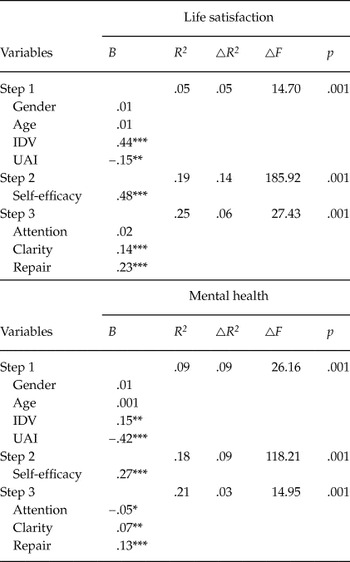
In the first model, variables were regressed on life satisfaction. A total 25% of the variance was accounted for (R 2 = .25, p < .001), with socio-demographic variables accounting 5% of the variance, general self-efficacy 14%, and EI subscales accounting for an additional 6%.
Gender and age were not predictors of life satisfaction. In contrast, results showed that people living in collectivist countries had higher scores of life satisfaction than people living in individualist areas (B = .44, p < .001). Uncertainty avoidance was negatively related to life satisfaction (B = −.15, p < .01). Participants from low uncertainty avoidance cultures had higher scores of life satisfaction. General self-efficacy was positively related to life satisfaction (B = .48, p < .001). Finally, results indicate that Clarity (B = .14, p < .001) and Repair (B = .23, p < .001) were positively and significantly associated with life satisfaction, even after controlling for the effects of gender, age, cultural dimensions, and self-efficacy. In contrast, although correlations suggest that emotional attention was positively related to life satisfaction, the regression analysis shows that this relationship was not significant when gender, age, IDV, UAI and self-efficacy were controlled for (see Table 3).
Summary of Hierarchical Regression Analysis for Emotional Intelligence Predicting Life Satisfaction and Mental Health (N = 1078)

Note.
B are the unstandardized regression coefficients.
*** p < .001. ** p < .01. *p < .05.
In addition, the same analyses were carried out with the sample of each country separately to explore the transcultural similarity of the results. Clarity and Repair were also positively associated with life satisfaction in the four samples. However, for the Brazilian sample, the result did not reach statistical significance with the dimension emotional Clarity. Emotional Attention was not significant in the relationship with life satisfaction, except for the Spanish sample. In this case, the relationship between emotional Attention and life satisfaction was negative.
In the second model, variables were regressed on mental health. A total 21% of the variance was accounted for in this model (R 2 = .21, p < .001), with 9% accounted by socio-demographic variables, 9% by general self-efficacy, and 3% by EI subscales.
Results indicate that the cultural dimensions were related to levels of mental health (IDV: B = .15, p < .01; UAI: B = -.42, p < .001). Specifically, participants living in collectivist countries presented better mental health than in individualistic ones. People from low uncertainty avoidance cultures had higher scores of mental health. Yet we noticed no main effect regarding perceived mental health as a function of neither gender nor age. Moreover, general self-efficacy was positively and significantly related to mental health (B = .27, p < .001).
All three EI dimensions were significantly associated to mental health after controlling for the effects of socio-demographic variables and general self-efficacy. Clarity and Repair (B = .07, p < .05 y B = .13, p < .001, respectively) were positively related, while Attention (B = -.05, p < .05) revealed a negative link with mental health (see Table 3).
The results of the regression analyses considering the sample of each country separately also indicate that Clarity was positively associated with mental health. However, this relationship only reached statistical significance for the Mexican sample. Emotional Repair was positively related to mental health in the four samples but this result was not significant in the sample from Mexico. Finally, the negative relationship between emotional Attention and mental health was found in the samples from Spain and Mexico but not in the samples from Portugal and Brazil. In general, the similarity of the results obtained with the different samples is high and the differences can be explained because of different sample size.
Discussion
The present study examined the incremental validity of EI components in predicting psychological well-being. Our findings not only indicate that EI is not redundant with cognitive processes reflected in perception of self-efficacy, but that EI may be a significant and independent predictor of life satisfaction and mental health. Despite the modest magnitude of the effects observed “when studying new constructs such as EI, predicting even small amounts of variance independent of known variables can be a substantial advance in understanding” (Shulman & Hemenover, Reference Shulman and Hemenover2006, p. 167).
Specifically, from the socio-demographic variables analyzed – gender, age and culture of participants – only the latter produced differences in psychological well-being. The proposal is that culture shapes the way people perceive and evaluate themselves, which in turn influences experiences, judgments, and expressions of psychological well-being (Hofstede, Reference Hofstede1991). Collectivistic cultures displayed greater levels of life satisfaction and mental health. Moreover, people living in an individualistic culture (Spain) had the lowest scores in emotional clarity and repair. These results are in line with the findings of other studies that suggest that in individualistic cultures the experience and expression of negative emotions is more intense (Fernández et al., Reference Fernández, Carrera, Sánchez, Paez and Candia2000). However, some studies contradict those results, showing that in collectivistic culture, feelings of life satisfaction are lower (e.g., Yetim, Reference Yetim2003). One potential explanation is the positive profile of Latin-American collectivistic nations, probably associated to a highly sociable and “sympathetic” society, different from self-controlled Asiatic collectivism (Diener, Oishi, & Lucas Reference Diener, Oishi and Lucas2003).
Our results indicate that people living in cultures low in uncertainty avoidance had higher scores of psychological well-being (life satisfaction and mental health). These findings support the assumption that high uncertainty avoidance societies are associated to higher levels of stress and anxiety (Fernández et al., Reference Fernández, Carrera, Sánchez, Paez and Candia2000; Hofstede, Reference Hofstede1991).We also observed a positive link between general self-efficacy and psychological well-being, corroborating findings in which a strong sense of personal efficacy importantly contributes to the quality of psychological functioning, especially feelings of life satisfaction (Vecchio et al., Reference Vecchio, Gerbino, Pastorelli, Bove and Caprara2007) and mental health (Moeini et al., Reference Moeini, Shafii, Hidarnia, Babaii, Birashk and Allahverdipour2008).
Consistent with recent research, Clarity and Repair were related to higher psychological well-being. Individuals who easily identify what they are feeling and have the capacity to interrupt negative moods and prolong the positive ones deal better with emotional adjustment (Extremera & Fernández-Berrocal, Reference Extremera and Fernández-Berrocal2005b) and experience greater psychological well-being. Moreover, Clarity and Repair confer a sense of accomplishment and control over emotions (Shulman & Hemenover, Reference Shulman and Hemenover2006) which may enhance psychological well-being. These explanations might help us understand, in part, the results highlighted.
On the other hand, results with emotional Attention were a bit more complex. The ability to attend to and monitor moods and emotions has not been useful for predicting life satisfaction. However, attention was negatively and significantly related to mental health. This association indicates that individuals who have their resources focused inward may experience more negative emotions. It seems that greater attention to moods could lead to rumination and subsequent distress, “revealing the maladaptive and harmful nature of paying too much attention to one’s emotions, especially when they are negative” (Extremera & Fernández-Berrocal, Reference Extremera and Fernández-Berrocal2006, p. 49). Gignac (Reference Gignac2006) on the other hand defend that some of the items within the Attention subscale (e.g., ‘‘I often think about my feelings’’) may measure a more chronic focus on emotions that would be expected to be exhibited by those experiencing stress. The mechanisms that link attention to psychological well-being should definitely be more explored. Future studies analyzing the effects of this EI dimension on psychological well-being could differentiate between attention to negative and positive emotions.
Although our study provides important evidence of the incremental validity of EI dimensions on psychological well-being, the findings should be interpreted in light of some limitations. First, we believe that the analyzed variables may operate in a different way in populations who vary significantly in demographics. For instance, there was some range restriction in the age of respondents (i.e., most of the sample was under 25 years old). In addition, although there seems to be no support for the skeptic idea that studies using samples of university students would not apply to the general population (Martins et al., Reference Martins, Ramalho and Morin2010) future researchers may want to include other types of groups to see how the findings could be interpreted.
Also, the self-report method used may have influenced the results. Even though current studies have proved efficacy for the TMMS (Martins et al., Reference Martins, Ramalho and Morin2010), it would be worthwhile to explore objective measures of EI (e.g., MSCEIT). Both approaches might be seen as complementary more than exclusive (Extremera et al., Reference Extremera, Durán and Rey2007). Finally, our study used a cross-sectional design, which focuses on isolated outcomes, and therefore no conclusions about causality can be drawn from it. Longitudinal assessment seems necessary in order to explicating causal relations between EI and well-being.
Despite these limitations, the present investigation shows that a person’s manner of evaluating and appraising emotions plays an important role in how they experience life, independently from the level attributable to self-efficacy. The practical relevance of these results indicates the possibility of improving the quality of psychological well-being through the promotion of emotional abilities. Just training students in cognitive abilities to be able to cope effectively with educational demands and difficulties of everyday life may not be sufficient. It might be possible that educational programs also focusing on stimulating emotional abilities. Thus, improving their emotional management, young people could increase their life satisfaction and mental health, which could also be beneficial for their academic performance.