Interstate commercial activity raises significant issues in federations where multiple jurisdictions can claim the right to tax the same income. If a single dollar of profit is taxed twice, firms have fewer incentives to invest or engage in activities that span multiple states, and this may hamper economic growth.
In the United States (US), this coordination problem is resolved by splitting the corporate tax base according to the geographic distribution of firms’ sales, capital and workforce. The weight of each factor in the apportionment formula is determined on a state-by-state basis, which opens room for competitive legislative behaviour: states can reduce the capital and labour weights of their formulas with the hope of attracting new investments.
In this article, we argue that certain states are better positioned than others to engage in this form of tax competition. As we explain below, the apportionment formula is a complex instrument and its effects are difficult to anticipate. Moreover, legislators cannot rely on partisan heuristics or on coherent signals from firms and voters when they create policy in this domain. In this context, legislators must invest lot of resources to monitor competitors, evaluate policy alternatives and shepherd tax reform through the legislative process. This implies that highly professional legislatures, which have access to more time and staff than semiprofessional legislatures, should find it easier to redefine their tax base in response to exogenous shocks to the competitive environment. In other words, formula-based tax competition should be characterised by conditional spatial dependence.
We begin our analysis by taking a closer look at the mechanics of tax coordination between American states. We explain that tax base apportionment schemes can have important distributional consequences, and that the lack of policy coordination at the national level can give rise to interstate competition.
Subsequently, we use spatial econometric techniques to study data on most American states over the period from 1986 to 2013. We find strong patterns of regional interdependence in the definition of taxable corporate income. This is consistent with the idea that state governments compete not just over the more visible nominal tax rates but also over other policy vectors. Tax codes are extremely complex, and this complexity gives legislatures opportunities to competitively redefine the tax base in a bid to attract investors.
This straightforward economic story serves as a useful overarching narrative, but it suffers from two important (political) blind spots. First, even if tax policies are clustered regionally, there remains considerable heterogeneity in the timing and speed of reforms across neighbouring states. Explaining the sources of such heterogeneity is, in itself, an important goal for political science; moreover, differences in the speed at which policies spread from state to state offer an opportunity to draw broader lessons in the field of legislative studies: they allow us to study how political and institutional factors condition policy diffusion. By looking at these conditioning effects, we move closer to identifying the mechanisms that carry policies across borders.
Second, standard economic theories of tax competition often fail to explain, empirically, the reason for tax rates rarely being driven all the way down to zero. In Why is there no race to the bottom in capital taxation?, Plümper et al. (Reference Plümper, Troeger and Winner2009, 761) argue that even if all governments are subject to the pressure of capital mobility, competitive legislative behaviour is often held back by the societal demand for positive tax rates: states are “restricted by budget constraints and equity norms”. Our article suggests that this demand-side explanation must be supplemented by a supply-side one: governments do not always have the institutional capacity to use complex policy levers in order to attract investors. Indeed, a lack of professionalism can impede state governments’ responsiveness to competitors’ policies.
In short, our work not only finds strong evidence of policy diffusion across states but also highlights important limits to standard theories of tax competition. We emphasise the importance of legislative capacity for policy diffusion and argue that institutional factors can explain why, after 30 years of formula-based tax competition, American states have yet to reach the logical end point of this race-to-the-bottom.
To develop our explanation, we build on seminal work by authors such as Charles Shipan and Craig Volden, who have studied the relationship between professionalism and policy diffusion. It is well established that resource-rich and highly professional legislatures are innovators and thought leaders in many fields, whereas resource-poor and semiprofessional legislatures tend to emulate the actions of their better-resourced neighbours (Walker Reference Volden1969; Shipan and Volden Reference Shipan and Volden2008). Our article adds to this body of knowledge by showing that professionalism does not just spur more innovation but also increases the capacity of states to strategically emulate policy to stave off competitive threats from neighbours. Conversely, a lack of professionalism introduces friction in diffusion processes and can impede policy convergence.
Importantly, we show that professionalism, by itself, does not necessarily predispose a government to adopt a particular apportionment formula. This is because, as we explain below, the “optimal” policy for a given state is context-dependent; it is a function of competitors’ policies. As a result, professional legislatures need not converge towards a specific policy. Rather, the main advantage of such governments is that they are better able to take decisive action in response to changes in the competitive environment. In other words, legislative capacity allows state governments to be more strategic and more responsive.
Taken together, our results strongly indicate that political as well as institutional factors moderate policy diffusion and suggest that studying the mechanism by which such factors can speed up or slow down diffusion is a promising avenue for future research.
Tax coordination in American states
Several problems arise when the taxable activities of a firm span many jurisdictions. One major concern is the possibility that a single dollar of profit will be taxed by multiple states. This, of course, would reduce incentives to engage in interstate commerce and cross-border production operations and ultimately hurt investment and economic growth. Two main strategies have been devised to curtail double taxation.
The first approach, separate accounting, considers the operations that a firm runs in each state as if they were conducted by different legal entities. Under this system, transactions between subsidiaries of a single company must be conducted at “arm’s length”, that is, at market price. Profits are then computed and taxed on a state-by-state basis. Separate accounting is the cornerstone of the current international tax system.Footnote 1
American states use a second approach to split the tax base: formulary apportionment.Footnote 2 The profits of all US branches of a firm are added up to calculate the company’s total profits. This aggregate is then apportioned to each state based on the geographic distribution of firm activity. Typically, profits are split according to the shares of national sales, payrolls and property that the firm holds in each state. The tax liabilities of a firm in state j, τ j are thus computed as follows:
 $$\tau _{j} \,{\equals}\,t_{j} \left( {w_{j}^{P} {{P_{j} } \over P}{\plus}w_{j}^{L} {{L_{j} } \over L}{\plus}w_{j}^{S} {{S_{j} } \over S}} \right)$$
where t
j
is the corporate tax rate of the state j;
 $$w_{j}^{f} $$
the weight of factor f in j’s apportionment formula; P
j
/P, L
j
/L and S
j
/S the share of total property, payroll and sales that occur in j.
Historically, most states have weighted the three factors equally:
 $$w_{j}^{P} \,{\equals}\,w_{j}^{L} \,{\equals}\,w_{j}^{S} \,{\equals}\,1/3$$
. In recent years, however, several jurisdictions have increased the value of the sales factor relative to the other two. Typically, emphasising the sales factor means giving it a double weight (
 $w_{j}^{P} \,{\equals}\,w_{j}^{L} \,{\equals}\,1/4\,;\,w_{j}^{S} \,{\equals}\,1/2$
) or adopting a single-sales (or sales-only) formula (
 $w_{j}^{P} \,{\equals}\,w_{j}^{L} \,{\equals}\,0\,;\,w_{j}^{S} \,{\equals}\,1$
), but some states choose intermediary positions for some years.
Economic consequences of apportionment formulas
States’ choice of an apportionment formula has three principal economic consequences that relate to (1) government revenue, (2) taxation of the underlying factors of production and (3) arbitrage and externalities.
Government revenues
A first important economic consequence of formula choice is highlighted by Gupta et al. who find that “states with a double-weighted sales factor experience lower revenues than do states with an equally-weighted sales factor” (Reference Gupta, Moore, Gramlich and Hofmann2009, 237). This is in line with the results of Clausing Reference Clausing2016, and of the Illinois Economic and Fiscal Commission (2002), who estimated that Illinois lost $96 million in 2001 because of the adoption of a single-sales factor formula. Giving more weight to the sales factor can reduce government revenue.
A tax on factors of production and sales
Second, a corporate income tax that is allocated using an additive apportionment formula can be seen as three separate taxes on the underlying components (i.e. labour, capital and sales). This should already have been clear from a cursory look at Equation 1, but McLure (Reference McLure1980) demonstrates formally that increasing the sales weight amounts to converting the corporate income tax into a sales tax.Footnote 3 Of course, this could have important distributional implications, because sales taxes tend to be regressive.
As in the case of sales, the payroll and property weights can be viewed as implicit taxes on employment and capital. This, in turn, suggests that high payroll and property formula weights could discourage firms from expanding their production operations in states that use an equal-weights formula. It also implies that increasing the sales weight (and reducing the payroll and property weights) could attract local investment in capital and labour.
This intuition is in line with the theoretical work of McLure (Reference McLure1980), Gordon and Wilson (Reference Gordon and Wilson1986) and Anand and Sensing (Reference Anand and Sensing2000), and it has already been subjected to several empirical tests. For instance, Goolsbee and Maydew (Reference Goolsbee and Maydew2000) find that “reducing the payroll weight from one-third to one-quarter increases manufacturing employment around 1.1%”. This result is generally consistent with other works by Klassen and Shackelford (Reference Klassen and Shackelford1998) and Gupta and Hofmann (Reference Gupta and Hofmann2003).Footnote 4
Externalities and arbitrage
The third important economic consequence is that the lack of a harmonised apportionment formula across US states opens up room for arbitrage by firms that operate in multiple jurisdictions. As Gordon and Wilson note, “when a sales component to the tax is added, there are incentives for the crosshauling of output, with production in low tax rate states sold in high tax rate states, and conversely” (Reference Gordon and Wilson1986, 1357).
To understand how such a strategy would work in practice, consider this simple numerical example: two states apply identical tax rates (t a =t b =5%), but different apportionment formulas. State A weighs payroll and sales equally, whereas State B only considers sales. Firm X has total profits (π) of $1 million from sales that are evenly spread across the states. Now consider X’s tax burden in two different scenarios: Scenario 1, all employees are located in State A; Scenario 2, all employees are located in State B. Total tax liabilities (T) are computed as follows:
 $$T\,{\equals}\,\pi \left[ {t_{a} \left( {w_{a}^{L} {{L_{a} } \over L}{\plus}w_{a}^{S} {{S_{a} } \over S}} \right){\plus}t_{b} \left( {w_{b}^{L} {{L_{b} } \over L}{\plus}w_{b}^{S} {{S_{b} } \over S}} \right)} \right]$$
 $$T\,{\equals}\,1,000,000\left[ {0.05\left( {0.5{1 \over 1}{\plus}0.5{1 \over 2}} \right){\plus}0.05\left( {0{0 \over 1}{\plus}1{1 \over 2}} \right)} \right]\,{\equals}\,62,500\:$$
 $$T\,{\equals}\,1,000,000\left[ {0.05\left( {0.5{0 \over 1}{\plus}0.5{1 \over 2}} \right){\plus}0.05\left( {0{1 \over 1}{\plus}1{1 \over 2}} \right)} \right]\,{\equals}\,37,500$$
This example shows that moving production operations to State B allows firm X to minimise its tax burden.Footnote 5 In the next section, we discuss how states can manipulate formula weights to attract investment, and how this strategy has hampered policy coordination.
Formula choice: harmonisation or competition?
Theoretical work suggests that social welfare maximisation does not require states to adopt a specific formula, but rather that it depends on the harmonisation of the formulas used in different jurisdictions (Anand and Sensing Reference Anand and Sensing2000). Accordingly, much effort has been expended to improve state coordination in that policy domain.Footnote 6
Such efforts, however, have been hampered by the strong economic pressures that we highlighted in the previous section. Given that increasing the sales weight of the apportionment formula can attract investment, it is rather unsurprising to see that many states have used this policy instrument strategically. This competition was given a boost in 1978, when the Supreme Court ruled that Iowa’s single factor sales formula did not run afoul of the Due Process or Commerce clauses. In the wake of this decision, many other states have increased the weight that they accord to sales in their apportionment process.
Several authors have attempted to explain why harmonisation has not occurred. Anand and Sensing, for instance, develop “a two-state equilibrium model of location choice by firms”, and show that “aggregate social welfare is maximized when both states choose the same apportionment formula, regardless of which formula is chosen” (Reference Anand and Sensing2000, 183). However, the authors also find that at least one state will always have an incentive to deviate from the coordinated solution.Footnote 7 Similarly, Edmiston (Reference Edmiston2002) models tax competition via formula apportionment as a prisoner’s dilemma, where states have incentives to undercut one another by adopting a sales-only formula. This article also suggests that states’ decisions in that respect can have important revenue consequences.Footnote 8
Perhaps most relevant to our own work is an article by Omer and Shelley (Reference Omer and Shelley2004), who find that changes in a state’s apportionment formula tend to be associated with changes in geographically contiguous states’ policies. Like Omer and Shelley (Reference Omer and Shelley2004), we analyse the determinants of state income tax competition based on apportionment formulas; however, unlike Omer and Shelley, who look at how geographic contiguity and some political (gubernatorial rather than legislative) factors additively drive competition, we propose and find evidence for a theory in which legislative capacity moderates income tax competition-based policy diffusion between the states.Footnote 9
Conditional spatial dependence in tax policy
The studies cited above suggest that apportionment formulas affect corporate investment behaviour. This, in turn, creates a new vector of competition for investment-seeking state governments who can manipulate the sales weight to attract investors. In this section, we shine light on the phenomenon of formula-based tax competition by drawing on the rich literature on policy diffusion in American states. We then refine the analysis by arguing that, in complex policy-making environments, a legislature’s response to competitive pressures is conditioned by its capacity and professionalism.
Formulary apportionment and policy diffusion in American states
Cross-state competition over policy outputs has long been featured in the literature on state policy diffusion in American states. Looking at areas such as state lotteries (Berry and Berry Reference Berry and Berry1990), welfare (Peterson and Rom Reference Peterson and Rom1990; Rom et al. Reference Rom, Peterson and Scheve1998; Volden 2002) and smoking (Shipan and Volden Reference Shipan and Volden2008), a number of scholars have shown that economic competition is a prominent driver of policy diffusion or interdependence across the states.
By increasing the sales apportionment weight, states can compete to attract corporate investment. However, legislators may be uncertain about whether the corporate investment-generating benefits of this policy change outweigh losses to government revenue. Increasing the sales weight deprives state governments of revenue that can fund popular programmes.Footnote 10
Uncertainty about the economic consequences of increasing a corporate tax’s sales weight can generate disagreement among copartisan legislators about the merits of increasing the sales weight, and can weaken party heuristics about how party members should vote: some Democrats may support increasing the sales weight to retain and attract job-creating investments, whereas other Democrats may oppose reducing government revenues by decreasing property and payroll weights.
Legislators can also face conflicting signals from firms, as apportionment formulas have heterogeneous effects: increasing the sales weight benefits corporations that have large in-state production facilities and a small amount of local sales. Conversely, firms with small production facilities but many in-state customers prefer lower sales apportionment weights. This means that this policy cannot simply be understood as a tax cut that would benefit all firms. In testimony to the Maryland legislature of 1999, for example, Philip Morris opposed Maryland’s adoption of a single-sales factor on the grounds that this action “would provide an unfair advantage to certain corporations” (McCoy Reference McCoy1999).
Legislative professionalism moderates the diffusion of tax policies
Facing conflicting signals from the business community, and uncertainty about the policy’s effects, legislators can learn from the experiences of other states and emulate successful peers (Volden Reference Volden2006). However, not all legislatures have the same capacity to observe, assess and formulate responses to tax reforms in other states. In fact, legislative professionalism – or a legislature’s resource capacity in terms of the amount of staff, compensation and time (Squire Reference Squire2007) – can affect the propensity of governments to respond to changes in competitors’ policies.
Several scholars have shown that professional legislatures are more likely to adopt new policies than semiprofessional legislatures (e.g. Carter and LaPlant Reference Carter and LaPlant1997; Mossberger Reference Mossberger2000; Boushey Reference Boushey2010). In this line of work, the effect of legislative professionalism on a state’s policies is often modelled as additive and independent of other states’ behaviour, but an emerging strand of literature points out that professionalism can also condition the process of policy diffusion. For instance, Shipan and Volden (Reference Shipan and Volden2006) study the “bottom-up” diffusion of antismoking policy from municipal to state governments and find that highly professional state legislatures are more likely to emulate antismoking policies that have already been adopted by within-state municipalities. Shipan and Volden (Reference Shipan and Volden2014) report similar findings.
We follow in the footsteps of these authors, but consider a very different issue area: instead of looking at how legislative professionalism facilitates the diffusion of public health initiatives, we argue that professionalism can improve a state’s ability to respond to rivals’ tax policies. This distinction between issue areas matters, because it ties our respective arguments to very different kinds of policy diffusion mechanisms (Shipan and Volden Reference Shipan and Volden2008). On the one hand, youth antismoking laws are a classic example of a public health policy area where states can cooperate, working together to overcome a shared social problem. Here, legislative professionalism can facilitate diffusion because professional legislatures have more staff and time to contact officials in peer states who can help streamline policy responses around shared best practices.Footnote 11 On the other hand, when states compete against one another, governments may not want to work together, and the ability of states to respond to their rivals’ policy actions can be stunted because of resource insufficiency. In such an instance, we argue that legislative professionalism allow states to respond to economic challenges from rivals.
To see why professionalism acts as a catalyst for tax competition, consider the conditions that need to be met for legislators to behave strategically in this field. First, they must be aware that other states are manipulating their apportionment formulas. Second, to assess the costs and benefits of the policy change, they must be able to anticipate how it would affect economic investment and revenue generation in their districts. Third, legislators need the knowhow to craft corporate tax policies that effectively respond to competitors and are attractive to investors. Finally, they must expend the resources and political capital necessary to formulate new law and shepherd it through the legislative process.
In semiprofessional legislatures, information gathering, policy assessment and legislative action tend to be more difficult because the typical legislator has limited access to both time and expertise. For instance, he or she may hold outside employment in addition to his or her legislative responsibilities (Kousser 2005) or may simply be unaware of the competitive threat posed by rival states on technical issues like formulary apportionment. Even if the legislator is aware of other states’ competitive behaviour, he or she may not be able to obtain district-specific analysis on how an apportionment change would influence corporate investment and revenue streams relevant to his or her constituents. This is because, with small staff sizes and short legislative session lengths, typical members of the state legislature have limited exposure to outside experts and specialist legislators who serve on fiscal committees. In this context, time and resource-strapped politicians may choose to expend efforts on the development of legislative proposals that are more visible to the electorate, instead of focussing on abstruse questions like apportionment formulas. As a result, it seems reasonable to expect that semiprofessional legislatures will be relatively slow to respond to threats from rival states.
In contrast, even a typical, non-committee member in a professionalised legislature has resources to devote to low-visibility issues outside his or her purview of expertise. This legislator does not typically hold employment outside of his or her legislative responsibilities, has more interactions with other legislators (including expert committee members), has access to more staff and can also call upon the expertise of better-resourced agencies that exist to help legislators with their job responsibilities. Even though this legislator may not have originally been an expert on tax apportionment policy, the resources of time and staff accruing from professionalism could allow him or her to gain sufficient expertise to push for reform. In this context, expert committee members may also be more willing to pursue tax reform if they could depend on the interest and support of non-committee legislators. In other words, professionalism reduces the knowledge gap between experts and nonexperts in the legislature, and it facilitates information acquisition, policy assessment and legislative action. The net result, we argue, is an increase in the likelihood that a state will respond to tax policy competition from rivals.
Of course, the cost of engaging in formula-based tax competition must not be overstated. Even in semiprofessional contexts, information about formulary apportionment is available to the motivated legislatorFootnote 12 and the set of available policy options is relatively limited. Nevertheless, information gathering, policy assessment and formulation and adoption of legislative responses are never costless. In semiprofessional legislatures, these costs can often slow down or even stop legislative action; professionalism can make a government’s policies less insular and more responsive to legislative actions taken across state lines.
Illustration: the cases of Michigan and New Hampshire
There is ample qualitative evidence to support our argument. Consider a comparison of legislative operations in two states: Michigan and New Hampshire. At the time of writing this article, Michigan applied a single-sales apportionment model, whereas New Hampshire used a 50% sales factor. Michigan also has one of the most professional state legislatures in America, whereas New Hampshire consistently ranks at or near the bottom of the Squire scale.
In Michigan, the resources available to a non-committee nonexpert legislator who wants to inquire about tax policy are substantial. First, there is the resource of time: Michigan’s full legislature often meets and conducts business year-round. This means that non-committee nonexpert legislators have more opportunity to contact specialised committee members and staff to inquire about the potential district-specific effects of tax reform. Second, there is the resource of staff: Michigan’s House of Representatives and Senate each maintain permanent fiscal agencies that share the same purpose of “providing confidential nonpartisan expertise to the House (and Senate) Appropriations Committee(s)” in addition to “all other members of the House (and Senate) on all legislative fiscal matters” (Michigan House Fiscal Agency 2017; Michigan Senate Fiscal Agency 2017a). The fiscal agencies are not small operations; they both work year-round and each includes over 23 members (Michigan House Fiscal Agency 2017; Michigan Senate Fiscal Agency 2017b). The staff in these agencies has extensive expertise that may be useful to legislators: they host fiscal analysts, who “prepare reports and documents to assist legislative deliberations; and prepare special reports at the request of Representatives”, economists, who “respond to Representatives’ inquiries regarding state tax revenue, revenue sharing, and other economic issues” and legislative analysts, who provide information including “a description of the problem being addressed, arguments for and against [a] bill, and positions of interested organizations” (Michigan House Fiscal Agency 2017). The depth of knowledge and quality of the staff at the fiscal agencies, combined with Michigan’s long legislative session, gives typical legislators, who tend not to be experts on tax policy and usually do not serve on committees dealing with tax and fiscal policy, the opportunity and means to develop expertise on tax apportionment issues. This, we argue, increases the likelihood that the state legislature as a whole will respond to apportionment threats from other states.
In New Hampshire, on the other hand, the resources available to a non-committee nonexpert legislator who wants to inquire about tax policy are minimal. First, there is a shortage of time: New Hampshire’s full legislature meets for 45 legislative days a year and usually concludes its session by midsummer of each year. This means that there are limited opportunities in session for dialogue between expert committee member legislators and non-committee nonexpert legislators and that the legislative agenda can be very crowded. Moreover, several members of New Hampshire’s “citizen legislature” hold nonlegislative employment, which further limits the time they can invest in learning about technical policy questions. Second, there is also a shortage of staff: unlike Michigan’s fiscal agencies that bring together fiscal analysts, economists and legislative analysts to help legislators, New Hampshire’s “Legislative Budget Assistant” consists mainly of accountants, and it chiefly audits state agencies and provides technical budgetary assistance to committees rather than the broad-based analysis that is provided by the Michigan agencies. Moreover, the staff size of the New Hampshire Legislative Budget Assistant’s Budget Division is much smaller than that of Michigan’s agencies: 7 versus 49, even if New Hampshire has a higher number of legislators than Michigan.
That is not to say that New Hampshire legislators are unable to acquire relevant information about formulary apportionment or that they are never exposed to such information. In 2014, for example, the Department of Revenue Administration gave a presentation on tax policy to the state’s House Ways and Means Committee. That presentation covered several aspects of business taxation and mentioned apportionment formulas in peer states. In the end, however, representatives from the Department of Revenue Administration recommended more “legislative study” on the grounds that a change in the apportionment method would engender an “unknown fiscal impact to state revenues” (New Hampshire Department of Revenue Administration 2014). In making this recommendation, the Department of Revenue Administration explicitly referred to a failed 2012 legislative attempt to establish a committee to study the apportionment of business profits.Footnote 13 This failed attempt and the call for deeper study highlight the transaction costs that can be involved in conducting policy assessment. In semiprofessional legislatures, these costs weigh heavier than in well-staffed, well-resourced legislatures.
In sum, our argument hinges on the capacity-augmenting benefits of increased legislative professionalism: when interstate competition occurs in complex or less-visible policy areas, highly professional legislatures are more likely to seek out ways to redress competitive balance. As a result, we expect highly professional legislatures to have spatially interconnected and less-insular policies than less-professional ones.
Empirical analysis
The goal of this section is to assess three empirical implications from the preceding theoretical discussion. First, if there is formula-based tax competition between states, we should observe convergence over time towards a 100% sales weight. Second, if legislatures respond to the policies of their competitors, policy changes should be geographically clustered, with similar (i.e. proximate) states adopting similar policies. Third, the spatial diffusion of policies should be moderated by legislatures’ professionalism: high-capacity governments should be more responsive to other states’ policy changes.
Exploratory data analysis
States that tax corporate income typically choose one of three apportionment regimes: 100% sales, double-weighted sales (i.e. 50% sales, 25% payroll, 25% capital) or equal weights for each factor (i.e. 33% sales, 33% payroll, 33% capital). When a legislature decides to move from one regime to another, it usually does so incrementally, raising the sales weight in a stepwise fashion by a few percentage points per year. For instance, when Pennsylvania decided to switch from double-weighted sales to 100% sales, it did so in a staggered manner: the state raised its sales weight from 50 to 60% in 1999, and then gradually moved from 60 to 100% over the period from 2005 to 2013.
We assembled data on the apportionment formulas of most American statesFootnote 14 over the period from 1986 to 2013.Footnote 15 In our sample, payroll and capital weights always move in the inverse direction of the sales factor. Therefore, we can consider the latter as a dependent variable in all empirica tests.
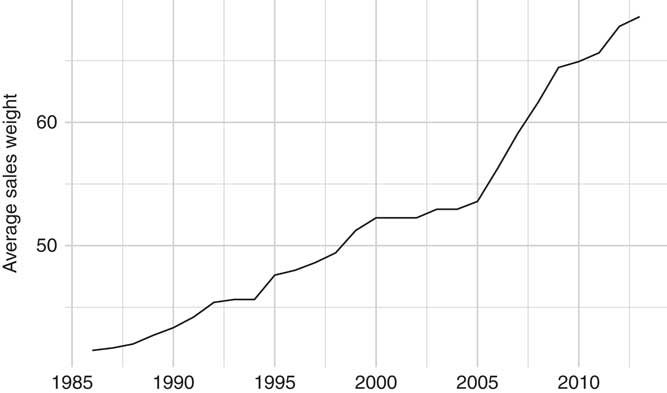
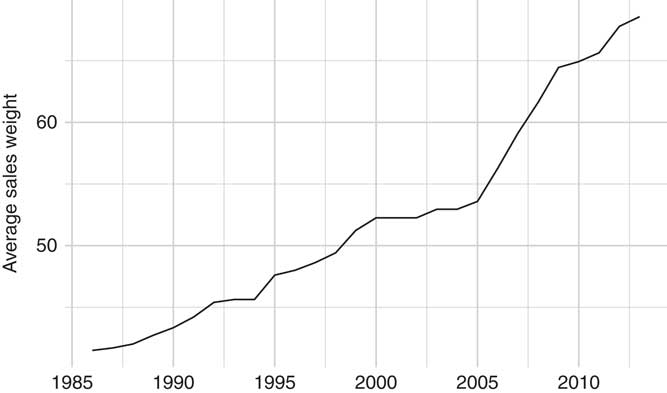
As a first cut, it is useful to look at temporal variation in our variable of interest. Figure 1 shows changes over time in the average sales weight across all states in our sample. The pattern is clear: although the modal policy in the mid-1980s was to weigh each factor equally, we see a gradual increase in the sales factor weight over the past three decades. In 1986, only 7% of the states in our sample had adopted a sales-only formula; by 2013, that proportion had risen above 40%. Likewise, the proportion of states using equal weights dropped by about 50 percentage points over the same window. Importantly, no state has reduced the sales weight of its apportionment formula during the period of study. This pattern is consistent with the idea that interstate competition leads to policy convergence across jurisdictions.
Historical evolution of formula weights across all US states.
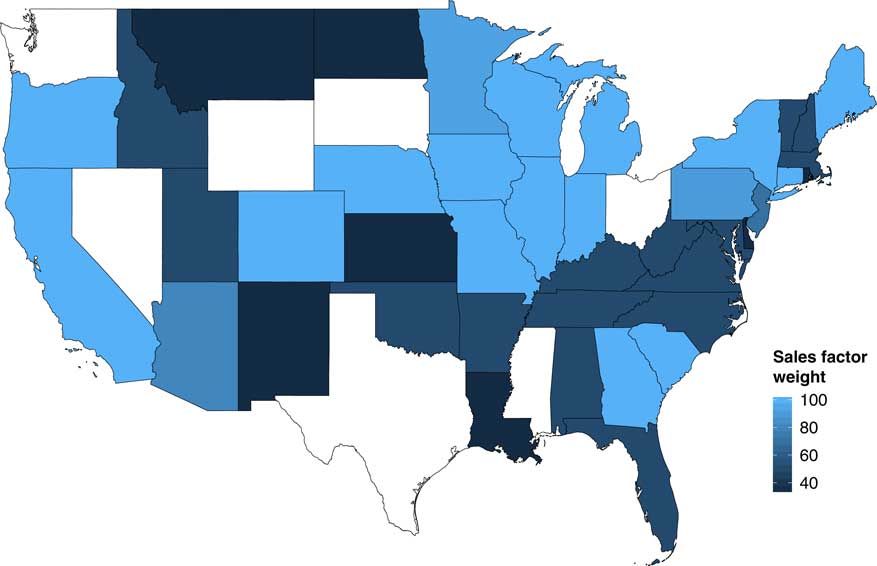
The second important dimension to consider relates to the spatial distribution of policy. Figure 2 shows the sales apportionment weight of each state in 2012. As this map makes clear, there are distinct geographical clusters, with neighbouring states often adopting similar policies. This visual pattern is striking, and it also appears to be statistically significant: tests using Moran’s I reject the null hypothesis of no spatial autocorrelation in most years of the sample.
Sales apportionment weights in 2012. Note: States in white are excluded from the analysis.
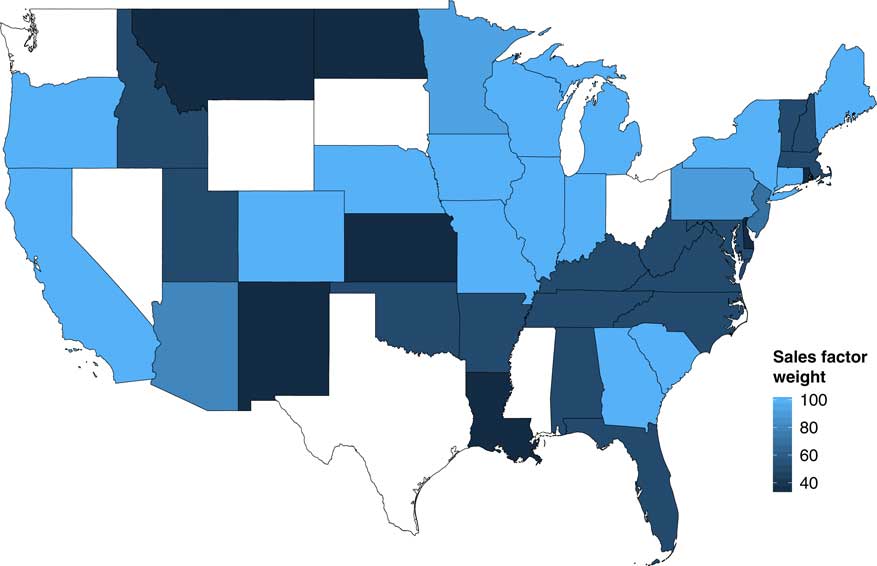
Figures 1 and 2 suggest that two of the empirical implications of our theory are correct (policy convergence and geographic clustering). In the next section, we develop a spatial econometric model to assess the third implication of our theory: that is, we test whether spatial policy diffusion is conditioned by legislatures’ professionalism.
An econometric model of conditional spatial dependence
The dependent variable we used is the sales apportionment weight, measured on a continuous scale from 33 to 100. In terms of explanatory variables, we use spatial econometrics to assess the influence of other states on the choices of state i (Beck et al. Reference Beck, Gleditsch and Beardsley2006; Franzese and Hays Reference Franzese and Hays2007). This is typically achieved by adding a “spatial-lag” variable to the right side of a regression equation. This variable essentially acts as a weighted average of other states’ policies, with weights chosen to represent theorised patterns of interdependence between states. In the state policy diffusion literature, for instance, scholars often argue that state I’s policy choices are particularly sensitive to nearby competitors; therefore, they design spatial-lag variables that attribute more weight to proximate states (Berry and Berry Reference Berry and Berry1990; Berry and Baybeck Reference Berry and Baybeck2005; Volden Reference Volden2006; Pacheco Reference Pacheco2012).
Typically, analysts consider the effect of a proximate state’s policies to be separate from and independent of the effect of other nonspatial variables on policy choice. As a result, spatial-lag variables tend to be entered as additive components in regression models of policy choice. This assumption of additive spatial influence makes sense if one believes that the effect of neighbours’ policies on state policy choice is not amplified or ameliorated by the presence of other independent variables; however, if another variable conditions the responsiveness of a state to spatial stimuli, and if we fail to take this conditioning effect into account, our model will produce biased estimates.
In this article, we argue that legislative professionalism conditions governments’ response to interstate competition. To test this, we fit a model using ordinary least squares with spatial lags and multiplicative interactions. The baseline specification is this:
 $$f_{{it}} \,{\equals}\,\lambda _{1} Wf_{{i,t{\minus}1}} {\plus}\lambda _{2} Wf_{{i,t{\minus}1}} p_{{i,t}} {\plus}\lambda _{3} p_{{i,t}} {\plus}\beta X{\plus}{\varepsilon}_{{i,t}} $$
where f i,t is the sales weight of the apportionment formula in state i at time t; W a matrix of weights, which represents the influence that every other state has on i’s policy (Neumayer and Plümper Reference Neumayer and Plümper2012, Equation7);Footnote 16 p i,t a column vector which represents state legislative professionalism (Squire Reference Squire2007); and ε a disturbance term.
To guard against omitted-variable bias, we control for a vector X of control variables, which includes the log of a state’s gross domestic product. We also add the log of a state’s unemployment rate to reflect the possibility that states with high unemployment could face different corporate tax demands. In some specifications, we include state and year fixed effects.
Our main quantity of interest is λ 2, which represents the conditioning effect of legislative professionalism on policy interdependence between jurisdictions. If λ 2 is positive, we can conclude that professional legislatures are more responsive to changes in other states’ policies. In other words, this specification allows us to account for heterogeneity in responsiveness to competitive pressure.Footnote 17
Connectivity matrix specification
Before estimating the model described in Equation 3, we must decide how to specify the W connectivity matrix. This decision matters, because different weights in W imply different theories of policy diffusion. We consider four main possibilities.
First, there is a long history of work in economics, which shows that geography drives and constrains investment-location decisions (Krugman Reference Krugman1991; Porter Reference Porter1998). When firms decide where to invest, they must often choose between nearby states in order to protect existing relations with customers and suppliers. For example, in 2006, Honda of America decided to build a new automobile factory in Indiana. At the time, Honda’s main base of operations was in Ohio, and it wanted to preserve its relationships with 150 supplier locations in that state. Honda received bids from five states and ultimately chose Indiana, in part because of fiscal inducements, but also largely because of its proximity to Ohio (Hannah Reference Hannah2006; Maynard Reference Maynard2006).
If geography drives investment decisions, legislatures should feel more pressure to reform their tax codes when nearby states engage in a race-to-the-bottom; distance should be an important driver of tax competition. This basic intuition explains why geographic proximity is, by far, the most common measure of influence in empirical studies of tax competition, and why it is an ubiquitous feature of gravity models of trade and investment. To remain consistent with previous work on tax competition, we present results using a measure of inverse distance between states as weights in the W matrix.
Second, Case et al. (Reference Case, Rosen and Hines1993) and Volden (Reference Volden2006) suggest that policies can spread across states, not simply because of their geographic proximity but also based on the similarity of their economic structures. Indeed, it seems reasonable to expect that a state’s tax policies can sometimes have an influence on far-flung jurisdictions. For instance, if two distant states have similar resource endowments and present similar investment opportunities, they could compete to attract the same businesses. In this context, policy diffusion may be a function of economic similarity between states, rather than geography per se. To account for this possibility, we estimate results using two alternative spatial-lag matrices. The first is constructed using data from the 2007 Commodity Flow Survey conducted by the US Census Bureau (Reference Zucman2007). For each pair of states, we take the correlation between the states’ baskets of commodity exports. The other spatial-lag matrix uses the squared differences in states’ personal income per capita.Footnote 18
Third, an interesting possibility is that state legislators wear ideological blinders when looking for policies to emulate. If this is the case, legislators could be influenced by copartisans, but not by legislators from a different party, and states with similar ideological profiles may adopt similar policies. We thus construct four connectivity matrices to capture this pattern of diffusion. To begin, we consider as “influencers” only the states in which both the house and senate are governed by the same party that governs the house and senate of the state being influenced. In alternative specifications of W, we take the squared difference in ideological scores between pairs of states, using measures given by Berry et al. (Reference Berry, Fording, Ringquist, Hanson and Klarner2013).
Fourth, Desmarais et al. (Reference Desmarais, Harden and Boehmke2015) use a network algorithm to study the sequence of adoption across American states for 187 policies. This approach allows them to inductively recover a list of “source” or “influencer” states. The core idea behind this method is that if state i consistently adopts policies after state j has adopted them, then j probably influences policy decisions in i. This has obvious implications for our study: if two states are linked through policy networks across 187 issue areas, they may also monitor each other’s tax policies. Accordingly, we construct connectivity matrices using the two measures of “source state” produced by Desmarais et al. (Reference Desmarais, Harden and Boehmke2015).Footnote 19
These four theoretical mechanisms could plausibly explain tax policy diffusion across American states. Unfortunately, our study design is ill-suited to adjudicate between the relative explanatory power of each mechanism; doing so would require a more fine-grained microlevel analysis using other methodological tools such as interviews or developing measures of contact frequency between legislators in different states. As a result, we must remain largely agnostic with respect to the “correct” specification of W, and we treat alternative specifications of W as robustness checks rather than competing explanations.Footnote 20
Below, we present baseline results using a measure of inverse distance between states, which is “industry standard” in the tax competition literature. In Supplementary Materials, we show that our results are robust to eight alternative specifications of the connectivity matrix specification, following the four theoretical mechanisms described above. The stability of our results is interesting and reassuring but not entirely surprising as geographic, economic, partisan and policy clusters are strongly correlated.
Regression results
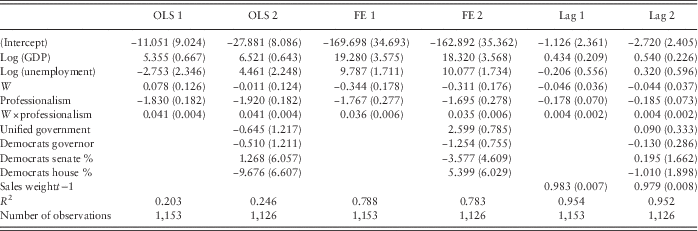
In Table 1, we see that, as expected, the interaction term is positive and statistically significant. This is consistent with the theory developed above.
Conditional spatial diffusion of tax policy in American states
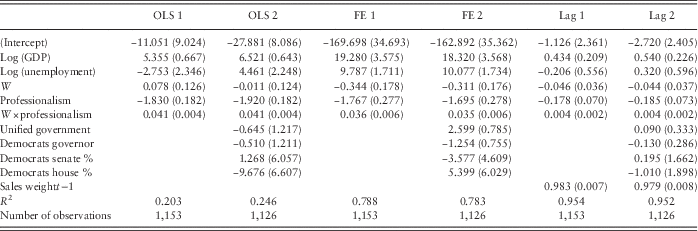
Note: Heteroskedasticity-consistent standard errors in parentheses.
OLS=ordinary least squares; GDP=gross domestic product; FE=fixed effects.
To assess the substantive significance of the regression results in Table 1, it is useful to compare counterfactuals for two states with different professionalism scores: New York (high Squire score) and New Hampshire (low Squire score). For the year 2000, the left-most model of Table 1 predicts that the sales weight in New York should be 80%. For New Hampshire, the same model predicts a sales weight of 49%. Now consider what happens when we artificially increase the sales weight of their neighbours (New Jersey and Massachusetts) by 50 percentage points (i.e. from double weight to sales-only). Here, the model predicts sales weights of 95% for New York and 51% for New Hampshire. In sum, we expect a 15-point increase in New York, but only a two-point increase in the less-professional legislature of New Hampshire.
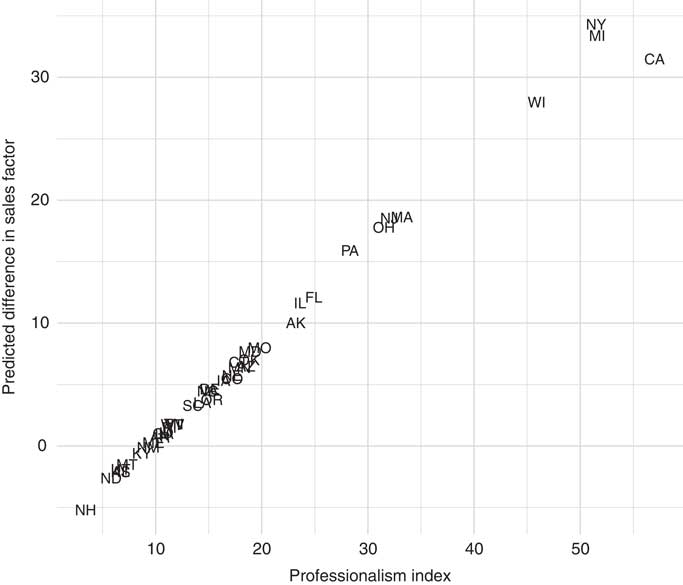
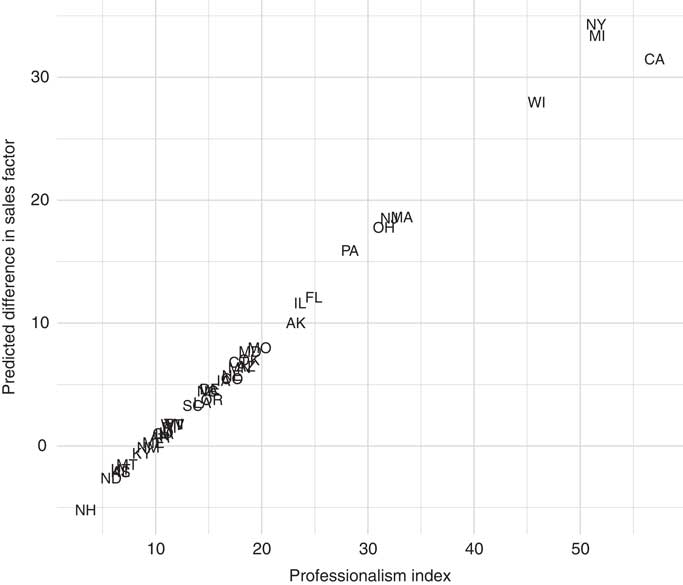
The above example highlights the strong conditioning effect of professionalism, but it may understate the substantive impact of changes in the competitive environment. To get a better sense of the pressure that states face when many neighbours change their policies, we conduct the following simulation: we use the value of each variable in 2000 to predict values of the dependent variable. Then, we add 25 percentage points to each of the states’ sales factors and make a new prediction.Footnote 21
Figure 3 shows the results from this exercise, which can be interpreted as illustrating the effect of a large change in the whole competitive environment, or of a long-run ratcheting-up process that affects all states simultaneously. Two main conclusions emerge. First, when legislative professionalism is very low, responsiveness to changes in the competitive environment hovers around the null; semiprofessional legislatures do not appear to monitor and react to changes in others’ policies. Second, the strength of the diffusion mechanism increases almost linearly in the professionalism index. For highly professional states, there is almost a one-to-one relationship between changes outside the state and changes inside the state. This finding is consistent with our argument that professionalism makes a state more likely to act upon external threats to its economic well-being in this complex policy area.
Expected response to a 25 percentage point increase in other states’ sales factor weight.
Robustness
We estimate several alternative models to address concerns and probe the robustness of our results. All robustness checks are reported in Tables A1 to A4 of the online appendix.
To begin with, we consider the most important potential confounders: ideological variables. If Republicans and Democrats hold different preferences over tax policy, and if there is geographic clustering in the ideological composition of state legislatures, our main results may be a byproduct of omitted-variable bias. To guard against this possibility, the second model in Table 1 controls for several political variables: the party of the Governor, the percentage of a state’s senate that is controlled by Democrats and the percentage of a state’s house that is controlled by Democrats. A unified government dummy variable also captures the ease with which state governments can adjust corporate tax apportionment formulas.
Another potential confounding factor is gubernatorial power. As several authors have recently pointed out, governors can have a strong influence on the budget process, even if their proposals must navigate the legislative process (Kousser and Phillips Reference Kousser and Phillips2012; Krause and Melusky Reference Krause and Melusky2012). This raises legitimate questions about the role of executive power in formula-based tax competition. To ensure that our empirical results are not skewed by this, the Appendix shows results from regression models, which include a control for “unilateral executive control over fiscal policymaking and fiscal-spending growth” (Krause and Melusky Reference Krause and Melusky2012).
In the exploratory data analysis section, we explained that sales weight is a continuous variable. Despite the fact that states could theoretically choose any value in the 0–100 interval, in practice they tend adopt one of three tax “regimes”: equal (1/3), double (1/2) or sales-only (1). To take this into account, we recode the sales weight as an ordinal variableFootnote 22 and reestimate the baseline models. Also, because our dependent variables could be thought of as continuous but censored (between 33 and 100), we estimate a Tobit model. Yet another approach is to recode the dependent variable such that any increase in sales weight corresponds to a binary event and to treat those events in a duration framework using the Cox Proportional Hazards model. These three tests are presented in the Appendix.
The baseline models shown above were estimated in a sample that excludes states without a corporate income tax. One way to bring these states back into the analysis is to code each of them as having a 100% weight on the sales factor. Indeed, as we explained above, increasing the sales weight converts the corporate income tax into what is effectively a sales tax (McLure Reference McLure1980). In general, states that do not use a corporate income tax must rely on other forms of revenues such as sales taxes to finance their operations. In this sense, the structure of their tax system is akin to that of states using 100% weight on the sales factor. In the Appendix, we estimate models that include all states, filling in values of the sales weight with 100 when a state does not have a corporate income tax.
It is also important to recognise that the Squire index of professionalism that we use as our main conditioning variable is a rather crude empirical proxy for the specific resources that facilitate legislative response to tax competition. For instance, this index ignores important factors like the frequency of interactions between legislators and staff, as well as the quality of those interactions. Although developing a new measure of professionalism that better approximates our theory lies outside the scope of this article, it is possible to conduct a more fine-grained analysis by disaggregating the Squire index into its three constituent parts: staff size, session length and legislator salary. Table A3 shows results using these alternative measures as our conditioning variable. Staff sizes, session lengths and salaries all appear to play a positive role in facilitating diffusion. This is broadly consistent with our theory, which hinged on the capacity-augmenting nature of legislative professionalism.
Finally, we address four issues related to model specification and estimation. (1) Despite the fact that it is common in this literature to estimate spatial ordinary least squares models of the form described above (here we follow Neumayer and Plümper Reference Neumayer and Plümper2012), several authors have noted that such models can be subject to endogeneity bias (e.g. Beck et al. Reference Beck, Gleditsch and Beardsley2006). To guard against this possibility, we reestimate our baseline model using the spatial maximum likelihood (S-ML) method described in Franzese and Hays (Reference Franzese and Hays2007).Footnote 23 (2) We reestimate the baseline models using both state fixed-effects and a lagged dependent variable. (3) We control for time trends by including controls for the year and its square. (4) We compute different types of standard errors for our baseline models (heteroskedasticity-consistent, state and year-clustered).
The results from all robustness tests are reported in the Online Appendix. Our subjective assessment is that although the magnitude of estimated marginal effects varies considerably across specifications, they remain substantively high, in the expected direction and statistically significant.Footnote 24
Discussion
In this article, we showed that US states engage in tax competition by increasing the sales component of their apportionment formulas. Using spatial econometric techniques, we also presented evidence that a legislature’s reaction to other states’ policies is conditioned by its degree of professionalism: when a policy is not highly visible, and when its effects are uncertain and hard to ascertain, policymakers must expend a lot of resources to observe, understand and assess the policies of rival states to inform their own decision-making process. High-capacity legislatures are better positioned to do this and are more likely to respond to rivals’ policies in order to redress competitive balance. This finding has several important implications for our understanding of both tax competition and legislative behaviour.
The first set of implications pertains to the use of formulary apportionment in the fight against corporate tax avoidance. In recent years, several scandals have drawn attention to the aggressive tax minimisation strategies of multinationals.Footnote 25 Given the scale of the tax haven problem – Zucman (Reference Wellisch2015) estimates that $7.6 trillions are held offshore – many analysts and activists consider that fundamental reform of the international tax system is necessary. Several economists and legal scholars have argued that formulary apportionment could be the cornerstone of a promising reform agenda.Footnote 26
The findings in this article can help us assess the feasibility of different apportionment systems, both in federations and at the international level. Indeed, the US experience shows that in the absence of strong coordination between legislators in different jurisdictions, competition is likely to produce convergence towards a single-sales apportionment factor. This has major implications for the distribution of the fiscal burden because, as we have seen above, corporate income taxes that are apportioned without regard for the geographic distribution of payroll and capital act as a sort of sales tax. One obvious concern is that this type of tax could be more regressive than those currently in place in most countries.
This is not to say that coordination around a different set of weights is impossible. In Canada, for example, provinces have long used a common formula, but this cooperative outcome came in a very specific institutional context: most of the Canadian provinces delegate the administration and collection of their corporate income taxes to the federal government (Krchniva Reference Krchniva2014). When the European Commission proposed the adoption of a EU-wide formulary apportionment system (under the Common Consolidated Tax Base initiative), it, perhaps wisely, sidestepped the problem by suggesting that each country adopt a single-sales formula from the outset; however, the distributional concerns remain.
Moving beyond the narrow problem of apportionment formula design, our work also highlights the fact that governments can deploy a slew of instruments when they compete to attract investment. Even if legislatures are politically constrained in their ability to change headline tax rates, the complexity of the tax code allows them to compete over less-visible policies like apportionment formulas. More generally, this means that professionalised legislatures can tap an important source of comparative advantage over semiprofessional legislatures by deploying their knowhow to adjust policy in understudied, complex and more opaque issue areas.
The above suggests an economic rationale for making investments in legislative capacity. Indeed, a state that seeks to improve its competitiveness relative to rival jurisdictions could benefit from improving the professionalism of its legislature, as this could allow it to act more quickly to redress competitive imbalance in highly technical legislative fields such as tax policy.
The present work also shows that, in cases involving cross-state competition, legislative professionalism can increase jurisdictional interdependence by facilitating emulation. The reverse is also true: state legislatures with low informational capacity make more insular policy choices. As a result, the lack of legislative professionalism can increase friction in interstate competition and slow down policy convergence. Our finding linking legislative professionalism to increased state responsiveness to economic challenges is important and represents an extension of previous research linking professionalism to increased diffusion in areas where states are cooperative and not necessarily rivals of one another. Our finding could reasonably apply to policy areas where races to the bottom could occur, and a fruitful extension of this work could analyse the role of legislative professionalism-moderated competition in environmental or welfare policy.
One specific issue area where our theory may have explanatory power is the formulation and adoption of state land-use policy. States utilise land-use policies in order to manage development and maintain a sound quality of life for residents; however, overly stringent land-use policies may negatively impact economic development and encourage firms and even some residents to relocate. States therefore have the task of devising land-use policies that strike a balance between promoting quality of life without chasing away businesses and residents to other states. States with professional legislatures may be quicker in learning about and embracing a mix of the best land-use practices that promote quality of life without hampering economic development, whereas states with semiprofessional legislatures may have a mix of more insular land-use policies that do not achieve the same quality of life/economic development balance. More generally, our theory extends to issue areas in which states view each other as competitors and in which the issue is highly technical in nature.
Finally, the results presented here show that the diffusion of policies across legislatures should not be thought of as uniform or unconditional. Rather, the institutional characteristics of legislatures affect how responsive those legislatures are to developments in other states.
Legislative scholars could build on these insights to illuminate several other important problems. For instance, one could extend the analysis and evaluate whether legislative professionalism moderates states’ responsiveness to federal laws, regulations and grant programmes. Alternatively, scholars could study the factors that facilitate policy diffusion in semiprofessional legislatures: given their resource constraints, members of semiprofessional legislatures may need to rely on networks like the National Conference of State Legislatures (NCSL)Footnote 27 or on lobbyists (Hall and Deardorff Reference Hall and Deardorff2006) to bridge the “knowledge gap” and serve as catalysts for policy diffusion. Future work in either of these directions would add to our knowledge on the legislative determinants of policy diffusion.
Acknowledgement
The authors thank André Blais, William Fox, Rob Franzese, Jude Hays, Jeff Harden, Jennifer Wolak, the editors and reviewers of the Journal of Public Policy.
Supplementary material
To view supplementary material for this article, please visit https://doi.org/10.1017/S0143814X17000071