
Nickel-base superalloys manufactured by a powder metallurgical (P/M) technique have been widely used as turbine disk materials in the advanced aeroengine due to their excellent mechanical properties, i.e., extraordinary high-temperature strength, exceptional creep, and low cycle fatigue resistance.[Reference Pollock and Tin1–Reference Gopinath, Gogia, Kamat, Balamuralikrishnan and Ramamurty7] Polycrystalline nickel-base superalloys possess a two-phase microstructure comprising the γ-phase (face-centered cubic) and the L12-type intermetallic γ′ precipitate.[Reference Pan, Zhang, Huang and Jiang6,Reference Uchic, Groeber, Dimiduk and Simmons8,Reference Zhao, Xie, Smith and Patel9] It is commonly accepted that the mechanical strength of nickel-base superalloy is primarily determined by the grain size, in combination with the γ′ precipitate (geometry, size, distribution, and volume fraction).[Reference Yoon, Noebe and Seidman4,Reference Zhao, Xie, Smith and Patel9–Reference Zhong, Gu, Yuan, Yokokawa and Harada13] In the past decades, substantial research work[Reference Tsao, Yeh, Kuo, Kakehi, Murakami, Yeh and Jian5,Reference Gopinath, Gogia, Kamat, Balamuralikrishnan and Ramamurty7,Reference Zhong, Gu, Yuan, Yokokawa and Harada13–Reference Zhang, Li, Qu, Qin, He and Li17] has demonstrated that tensile strength and failure mechanism are closely associated with the working temperature and strain rate in nickel-base superalloys. Considering the isotropic nature of polycrystalline superalloy, the influence of specimen orientation on its mechanical behavior receives little attention in the community. As a result, few relevant papers have been published so far.
In this report, we investigated the impact of specimen orientation on the tensile property of a polycrystalline nickel-base superalloy, after the accomplishment of hot extrusion processing. Two groups of tensile samples cut from the extruded superalloy ingot along with longitudinal and transverse directions were mechanically tested at elevated temperatures (25–750°C). The longitudinal direction is literally parallel to the extrusion direction, while the transverse orientation is vertical to it. Interestingly, we found that the tensile strength of the superalloy shows a strong dependence on specimen orientation. In addition to the mechanical property investigation, the microstructure of the superalloy in two orientations were characterized systematically. The fracture mechanism coupled with the deformed structures of both longitudinal and transverse specimens were studied and discussed in the context of mechanical anisotropy. This research provides new insights into understanding the mechanical behavior of nickel-base superalloys upon the completion of hot extrusion.
The nominal chemical composition (wt%) of the nickel-base superalloy is presented in Supplementary Table S1. The superalloy powder was atomized with an average size of 50–80 µm and subsequently consolidated by hot isothermal pressing (HIP) under 1090°C and 150 MPa for 3 h. The HIPed column was further processed by hot extrusion at the temperature of 1146°C with an extrusion ratio of 6:1. The supersolvus heat treatment was carried out at 1150°C (CM furnace 1610BL) for 1 h and then oil quenched, followed by an aging treatment at 760°C for 8 h and cooled in air.
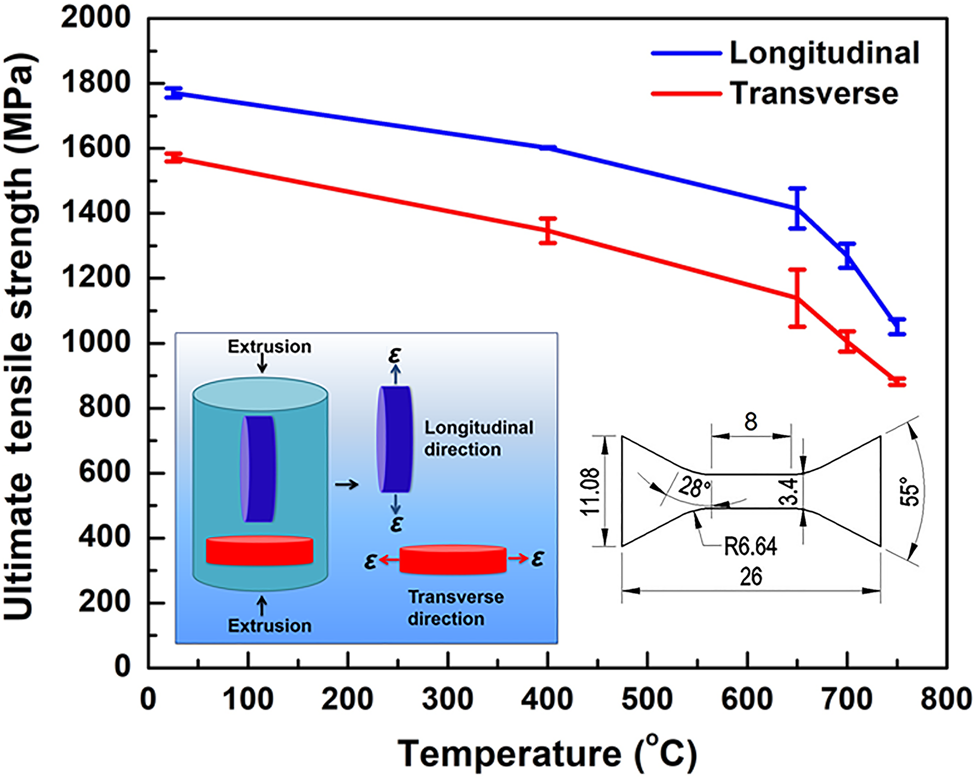
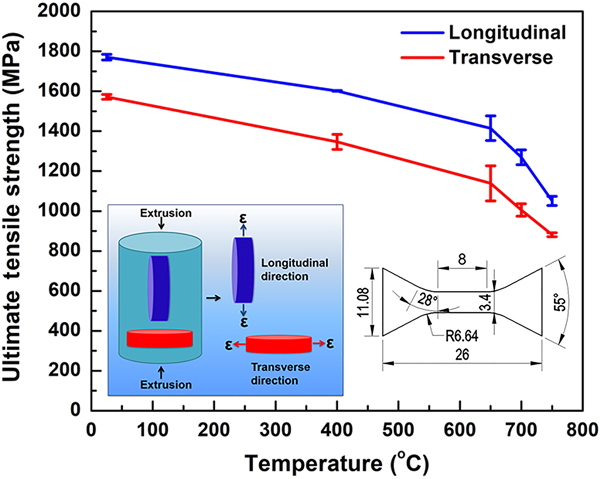
The tensile specimens (geometry is shown by the right inset in Fig. 1) were cut via the technique of electrical discharged machining. The tensile tests were executed at the temperatures of 25, 400, 650, 700 and 750°C with a nominal strain rate of 10−4 s−1 employing the tensile testing machine (INSTRON 3369). The recipe used for etching grain boundaries is 5 g CuCl2+ 100 mL HCl + 100 mL C2H5OH with an etching time of 90 s. The etchant for selectively etching the γ′-phase is 5 mL H2O + 5 mL HNO3+ 5 mL CH3COOH + 0.1 mL HF, and the etching time is 10–12 s. Crystallographic and microstructural observations were performed using an optical microscope (Leica DM 4000M) and a field emission scanning electron microscope (SEM; FEI Quanta 650), respectively. The electron backscatter diffraction (EBSD) analysis was carried out utilizing an Oxford EBSD detector (NORDLYS NL 04-2364-30) attached to the SEM (FEI Quanta 650). The foils for transmission electron microscope (TEM) observation were prepared by ion milling (Gatan 691) and then transferred to a TEM (FEI TECNAI G2) for deformed microstructure characterization. Note that the high tension for TEM analysis is 300 kV.
Curves of the ultimate tensile strength (UTS) as a function of the temperature of the hot-extruded superalloy. The inset (left) defines that the longitudinal direction is parallel to extrusion, while the transverse direction is perpendicular to it; the inset (right) displays the geometry and size of the “dog-bone” tensile sample.

Dog-bone shaped tensile specimens with a gauge length of 8 mm were cut from the hot-extruded ingot along with longitudinal and transverse directions. The left inset in Fig. 1 shows that the longitudinal direction is parallel to that of hot extrusion, while transverse orientation is normal to the extrusion direction. The geometry and size of the tensile sample are displayed by the right inset in Fig. 1. Tensile testing is then carried out at elevated temperatures ranging from 25 to 750°C. Note that at least three samples were tested under each temperature, and then, the average ultimate tensile strength coupled with the standard deviation are computed for evaluation and comparison. The results are presented in Fig. 1 with showing UTS as a function of temperature. It appears, however, that the tensile strength remarkably varies between longitudinal and transverse samples, indicating that tensile property of the hot-extruded superalloy is anisotropic. At the room temperature, the variance of UTS between longitudinal and transverse samples is approximately 200 MPa. As the temperature increases, i.e., 400 and 650°C, the discrepancy of UTS becomes slightly higher than 200 MPa, roughly 260 MPa. When a higher temperature is imposed, e.g., 750°C, the difference changes to be about 170 MPa. This unexpected specimen orientation dependence of tensile strength in superalloy is rather interesting since it is polycrystalline material and is normally considered to be isotropic in terms of mechanical properties. Previous results have demonstrated that texture stimulated by hot extrusion acts as the primary role for enhancing mechanical strength in Mg[Reference Garcés, Pérez and Adeva18] and Zn alloys[Reference Kleiner and Uggowitzer19]. However, the mechanism of this phenomenon in polycrystalline nickel-base superalloy has not yet been well understood.[Reference Kovarik, Unocic, Li, Sarosi, Shen, Wang and Mills20,Reference Viswanathan, Karthikeyan, Sarosi, Unocic and Mills21]
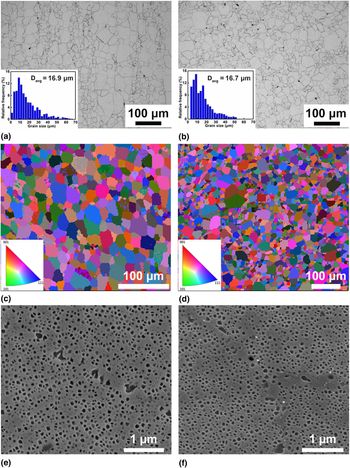
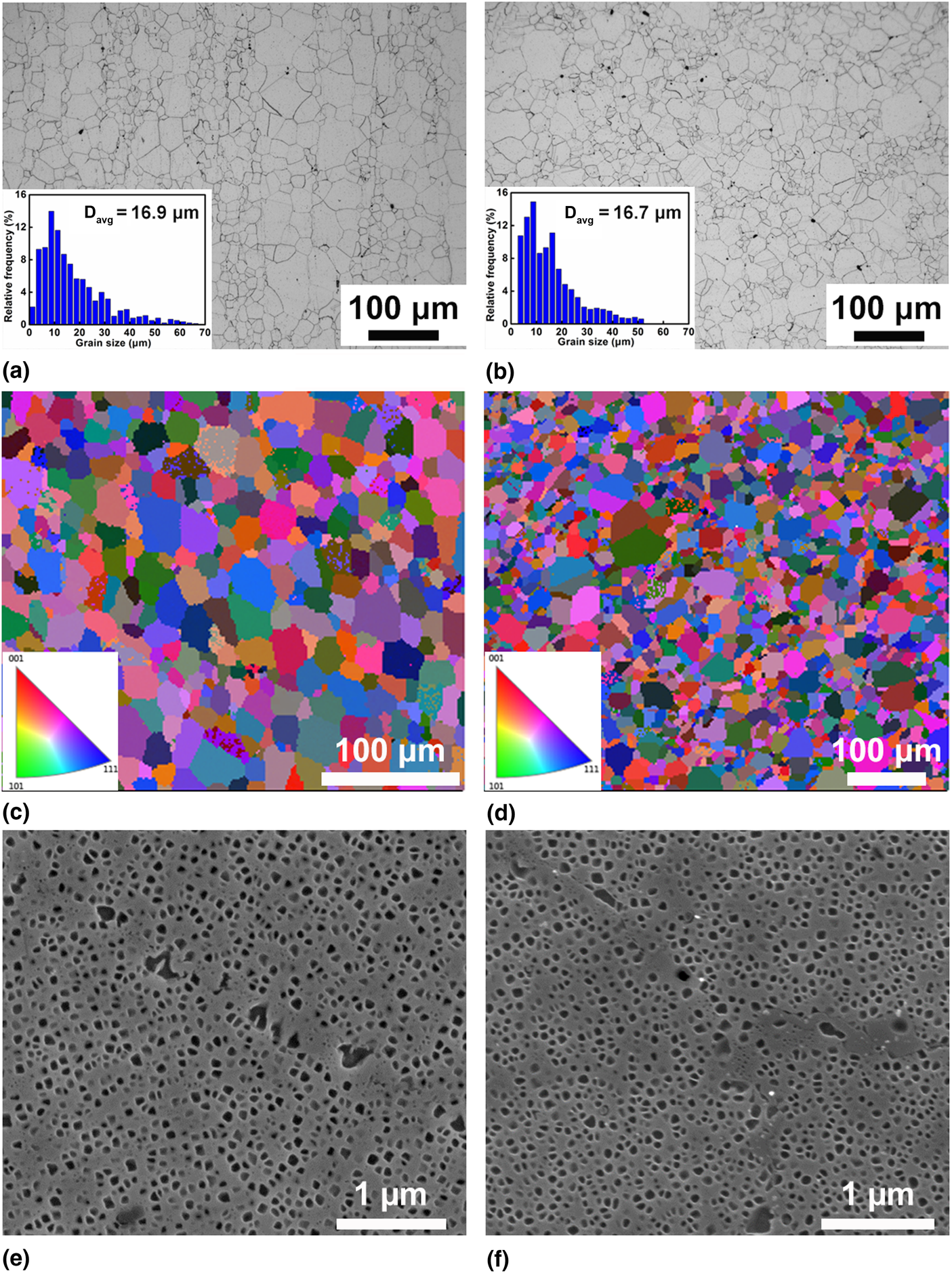
To study mechanisms underlying the anisotropic tensile properties of the hot-extruded nickel-base superalloy, microstructure including grain size and the γ′ precipitation (size, shape, distribution,and volume fraction) of the superalloy are quantitatively investigated, as presented in Fig. 2. It can be seen from Figs. 2(a) and 2(b) that the typical grain microarchitectures from longitudinal and transverse directions consist of equiaxed grains with varying grain size. Moreover, the corresponding average grain sizes were numerically determined to be 16.9 and 16.7 µm by means of EBSD measurements [insets in Figs. 2(a) and 2(b)], respectively. It is worth noting that no residual prior particle boundary (PPB), which intrinsically originates from the powder fabrication and the subsequent HIP processes and has deleterious effect on the mechanical properties of superalloys,[Reference Bai and Lin22] can be observed in neither longitudinal nor transverse specimens, suggesting that the hot extrusion process has completely removed PPBs. EBSD analyses show randomly oriented equiaxed grains in both longitudinal sample [Fig. 2(c)] and the transverse counterpart [Fig. 2(d)], implying no texture in either direction. In addition to grain-level analysis, size, shape, distribution, and volume fraction of γ′ precipitation from longitudinal to transverse directions are studied, as shown in [Figs. 2(e) and 2(f)], individually. It reveals that the precipitated γ′ phases are approximately 100 nm and are distributed uniformly inside grains in both orientations. The shape of γ′ phases is primarily near sphere or irregular squares in both directions. The volume fraction of the γ′-phase in longitudinal and transverse specimens is further determined through quantitative analysis using the software of Image Pro Plus. The theory of this quantified computation is essentially using an areal fraction to estimate the corresponding volume fraction. It discloses that the volume fraction of the γ′-phase in the longitudinal specimen is 40.94 ± 0.71%, roughly equal to the amount in the transverse counterpart (42.03 ± 1.24%). As suggested by the Thermo-Calc computation (see Supplementary Fig. S1 and Table S2), the volume fraction of the γ′-phase of this superalloy under thermodynamic equilibrium state is 44.09%, showing a good agreement with the experimental results.
Microstructure investigation of the hot-extruded nickel-base superalloy from longitudinal and transverse directions. Crystallographic images and the corresponding grain-size distribution (inset) for longitudinal sample (a) and transverse sample (b); EBSD analysis of the longitudinal sample (c) and transverse sample (d); the γ′ phase in the chemically etched longitudinal specimen (e) and transverse specimen (f).
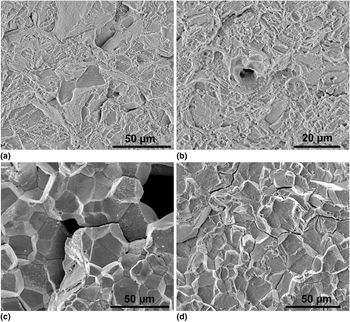
Fractography of longitudinal samples after tensile deformation at elevated temperatures is studied utilizing SEM, as presented in Fig. 3. At low temperatures, e.g., 25°C [Fig. 3(a)] and 400°C [Fig. 3(b)], it is a typical transgranular fracture as evidenced by smooth cleavage planes, voids, and shallow dimples. As the tensile temperature rises to 650°C [Fig. 3(c)], a bimodel comprising transgranular and intergranular fractures takes place. One typical micrograph showing the intergranular fracture part is exhibited in Fig. 3(c) from where cracking occurs along the grain and subgrain boundaries. When a higher temperature is applied, e.g., 700°C [Fig. 3(d)], the fracture mechanism changes to be completely intergranular fracture and more secondary cracks arise.
SEM micrographs of the tensile fracture surface of the longitudinal samples deformed at (a) 25°C, (b) 400°C, (c) 650°C, and (d) 700°C.

Similarly, representative fracture surfaces of the transverse tensile samples are examined, as displayed in Supplementary Fig. S2. At the room temperature, it demonstrates a representative transgranular fracture (Supplementary Fig. S2a), while at the temperature of 400°C, it converts to bimodel fracture as indicated by intergranular fractured patches bounded by transgranular fractured parts (Supplementary Fig. S2b). When the temperature increases to 650°C, it retains the bimodel fracture as implied in Supplementary Fig. S2c. As the temperature rises to 700°C (Supplementary Fig. S2d), it changes to be completely intergranular fracture and, moreover, the fracture surface becomes significantly oxidized. It is worth pointing out that for transverse tensile tests, the transition temperature from pure transgranular fracture to bimodel fracture is about 400°C, lower than that of longitudinal samples. This is in accordance with the lower UTS for transverse tensile samples in comparison with longitudinal counterparts.
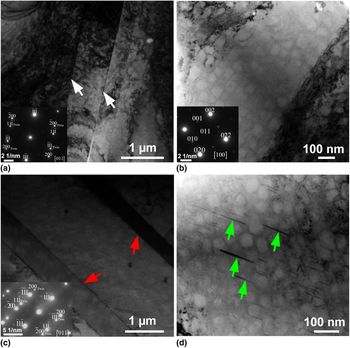
To further elucidate the mechanism during tensile deformation, high-resolution TEM observation is employed to inspect the microstructure after tensile testing. Two sets of representative tensile deformed specimens are selected, namely 25 and 650°C, as shown in Fig. 4. It reveals that sharp microtwins can be evidently seen in the longitudinal sample after tensile deformation at 25°C, as marked by white arrows in Fig. 4(a). The twin is further verified via the technique of selected area electron diffraction, as the inset displayed in Fig. 4(a). In addition, ample of dislocations get entangled at the twin boundaries, indicating that the microtwins impede the move of dislocations and hence enhance its mechanical properties.[Reference Kovarik, Unocic, Li, Sarosi, Shen, Wang and Mills20,Reference Pande, Imam and Rath23] However, almost no twin defect can be detected in a wide range of screening for the transverse sample after tensile deformation at 25°C, as shown in Fig. 4(b). Instead, a high volume fraction of γ′ precipitates is irregularly arranged with a roughly average size of 100 nm. The inset in Fig. 4(b) displays a superlattice diffraction pattern, corresponding to the L12 crystal structure of the γ′-phase in superalloys.
TEM observation of the microstructures after tensile deformation: (a) longitudinal sample, 25°C, (b) transverse sample, 25°C, (c) longitudinal specimen, 650°C, (d) transverse specimen, 650°C.

Likewise, the deformed microstructures of longitudinal and transverse samples with performing tensile testing at 650°C are studied, as exhibited in Figs. 4(c) and 4(d), respectively. It is found that at the temperature of 650°C, twinning bands ranging from nanometer to micrometer in the longitudinal foil is still ubiquitous, as denoted by red arrows in Fig. 4(c). Nevertheless, for the transverse observation, what can be seen is high volume fraction of γ′ precipitates embedded inside the γ-matrix [Fig. 4(d)]. It is worth noting that some needle-shaped precipitates are observed on the transverse direction after tensile testing at 650°C which are probably the brittle topologically close-packed phases[Reference Gabb and Miller24,Reference Matuszewski, Müller, Ritter, Rettig, Kurzydłowski and Singer25] [Fig. 4(d)].
As discussed above, the tensile strength of the hot-extruded nickel-base superalloy is anisotropic and the variation ranges from 170 to 276 MPa at an elevated testing temperature of 25–750°C. As the aforementioned, tensile property of nickel-base superalloys is basically governed by the grain size and γ′ precipitate encompassing its shape, size, distribution, and volume fraction. However, according to the microstructure study, both grain size and γ′ precipitates are almost identical from longitudinal and transverse orientations in this superalloy, implying that the mechanical discrepancy is not led by them. Furthermore, as revealed by TEM observation, abundant twins uniquely exist in longitudinal samples after tensile deformation under either 25 or 650°C which stands in sharp contrast to transverse tensile specimens where few twins can be detected. It is believed that twin boundaries act as obstacles to hinder dislocation motion and thus augment mechanical properties of the structure materials.[Reference Kovarik, Unocic, Li, Sarosi, Shen, Wang and Mills20] Therefore, it may be reasonable to attribute the mechanical anisotropy to the twins evolved during tensile deformation. The occurrence of microtwinning can be rationally ascribed to the low stacking fault of nickel, yet the twinning mechanism in the course of deformation is still under debate and needs to be further studied.[Reference Kovarik, Unocic, Li, Sarosi, Shen, Wang and Mills20,Reference Xu, Du, Cui and Ye26–Reference Yuan, Gu, Cui, Osada, Yokokawa and Harada28]
In summary, the influence of specimen orientation on the mechanical behavior of a hot-extruded nickel-base superalloy is investigated. Fracture models coupled with deformation mechanisms are also clarified. Some conclusions could be drawn from this study:
(1) Tensile strength of the hot-extruded nickel-base superalloy is specimen orientation dependent. UTS of the longitudinal specimens is higher than that of the transverse counterparts by 170–276 MPa at the temperature range of 25–750°C.
(2) A gradual transition from pure transgranular fracture to bimodel comprising transgranular and intergranular fractures has been identified in both longitudinal and transverse tensile specimens at elevated temperatures. Furthermore, as to transverse samples, the appearance of intergranular failure occurs earlier than the counterparts, which is in line with the smaller UTS at the same conditions.
(3) The mechanical discrepancy between the longitudinal and transverse orientations is possibly due to twins which solely exist in deformed longitudinal specimens.
Supplementary material
The supplementary material for this article can be found at https://doi.org/10.1557/mrc.2019.146.
Acknowledgments
This work was supported by the National High-Tech Research and Development Program of China (863 Program under agreement/grant no. 2012AA03A514). The authors are grateful to Dr. Yan Chong at Lawrence Berkeley National Laboratory for the fruitful discussion.