Introduction
As pervasive human impacts threaten global biodiversity through species extinctions and wildlife population declines, novel conservation approaches such as ‘ecological rewilding’ are gaining prominence. In Europe rewilding implies wildlife restoration in abandoned agricultural systems, while in North America rewilding involves re-establishing wildlife populations in remnant natural habitats. Range expansion of wild animals into their former range(s) through dispersal is also an implicit form of passive rewilding (Corlett Reference Corlett2016). Despite being a prospective conservation tool, an ensuing challenge of passive rewilding is the potential for human–wildlife conflict. Such conflicts can be particularly acute in densely populated tropical Asian countries that are inherently rich in biodiversity and support large, potentially dangerous mammals. The endangered Asian elephant (Elephas maximus) is a case in point.
The local communities bearing the costs of human–elephant conflict (HEC) tend to be economically weak and socially disadvantaged (Bandara & Tisdell Reference Bandara and Tisdell2003). HEC imposes direct costs, such as tangible property loss and human casualties, and a multitude of indirect costs that are difficult to quantify (Barua et al. Reference Barua, Bhagwat and Jadhav2013, Thondhlana et al. Reference Thondhlana, Redpath, Vedeld, van Eden, Pascual, Sherren and Murata2020). Although only a small fraction of the interactions result in human deaths, such incidences are regarded as the most acute form of conflict (Gulati et al. Reference Gulati, Karanth, Le and Noack2021). Loss of human lives can have societal ramifications, particularly when breadwinners are lost, leading to marginalization of families and the creation of demographic orphans. Thus, conflict-related human fatalities can potentially convert zones of human–elephant co-existence into hotspots of HEC, eliciting bio-phobic responses and anguish in people. Therefore, from an elephant conservation perspective as well as in terms of human welfare considerations, developing strategies to reduce threats to people’s lives and livelihoods is crucial to enabling local participation in conservation.
In India, over 500 human lives are lost to HEC every year (Rangarajan et al. Reference Rangarajan, Desai, Sukumar, Easa, Menon and Vincent2010), and HEC is a major threat facing elephant conservation (Natarajan et al. Reference Natarajan, Kumar, Qureshi, Desai and Pandav2021). Annually, c. 100–150 elephants die due to unnatural causes (Rangarajan et al. Reference Rangarajan, Desai, Sukumar, Easa, Menon and Vincent2010). Elephant habitats in India are embedded in human-use areas with vast zones of interaction (Rangarajan et al. Reference Rangarajan, Desai, Sukumar, Easa, Menon and Vincent2010). Therefore, garnering local support for elephant conservation rests heavily on reducing threats to human life and safety. Elephant-related human fatalities can be attributed to a complex set of causes including an interplay between landscape configuration (Ram et al. Reference Ram, Mondol, Subedi, Lamichhane, Baral and Natarajan2021), the behavioural ecology of elephants (Sukumar Reference Sukumar2003) and human demography, behaviour, lifestyles and livelihood patterns (Naha et al. Reference Naha, Sathyakumar, Dash, Chettri and Rawat2019, Ram et al. Reference Ram, Mondol, Subedi, Lamichhane, Baral and Natarajan2021).
Despite its severity and sensitivity, the issue of elephant-related human mortalities has not been thoroughly assessed. The frontline management staff of the areas where these mortalities occur often lack the resources and requisite training to collect such information that can be quantitatively analysed. Furthermore, the absence of reliable eyewitnesses makes it difficult to fully gauge and understand the circumstances surrounding such incidents. Consequently, narratives on elephant-related human fatalities tend to be dramatic, exaggerated and, thus, not very informative. Barring a few studies (e.g., Sukumar Reference Sukumar1992), even the sparse empirical efforts that exist often rely entirely on secondary information such as forest department records (Gubbi et al. Reference Gubbi, Swaminath, Poornesha, Bhat and Raghunath2014), interviews with local residents (Chartier et al. Reference Chartier, Zimmermann and Ladle2011) and media reports. This background underscores the need for an objective approach to understanding elephant-related human fatalities and the underlying reasons for it.
The east-central region of India accounts for 50% of all HEC-related human deaths in the country despite harbouring only 10% (c. 3000) of the country’s elephant population (Project Elephant Division 2020). In the Adivasi-dominated Chhattisgarh State, over 60 human lives are lost annually in an area with a population of 250–300 elephants (Natarajan Reference Natarajan2022). Elephants returned to Chhattisgarh through dispersal c. 30 years ago from the neighbouring states of Odisha and Jharkhand after nearly eight decades of local absence (Natarajan Reference Natarajan2022). Their home ranges in Chhattisgarh are large and undefined, thereby rendering HEC as an emergent problem (Natarajan Reference Natarajan2022). For moral, social and political reasons, the overarching priority of wildlife management has been to minimize elephant-related human deaths.
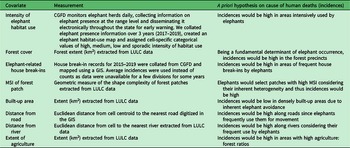
The aims of our study were: (1) to examine the spatial factors influencing the occurrence of human fatalities due to HEC at the landscape scale, covering 80% of Chhattisgarh’s elephant range; and (2) to characterize the incidences of HEC-related human fatalities in order to understand the patterns and circumstances underlying them. The novelty of our assessment lies in the details obtained in the context of elephant dispersal. Here, dispersal implies mass elephant movement from previous home ranges, possibly triggered by saturated habitat conditions. This is unlike the pre-saturation natal dispersal of individual animals. Based on inductive reasoning, we formulated a priori hypotheses to explain the observed patterns of HEC-related human deaths (Table 1).
Covariates and a priori hypotheses for explaining the spatial patterns of human–elephant conflict-related human fatalities.

Note: Information obtained using 10-m resolution pre-classified layer developed by National Remote Sensing Centre during 2018.
CGFD = Chhattisgarh Forest Department; GIS = geographical information system; LULC = land use, land cover; MSI = mean shape index.
Methods
Study area
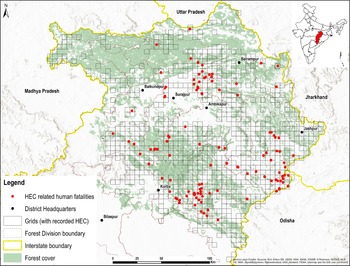
Our study was carried out in Raigarh, Korba, Jashpur, Balrampur, Koriya, Surajpur and Surguja districts administered under nine forest divisions and two forest circles (Fig. 1). The annual rainfall range is 800–1600 mm, peaking during the monsoon months (July–September). The natural forests are sal (Shorea robusta)-dominated moist and dry deciduous formations (Champion & Seth Reference Champion and Seth1968). The extent of forests with either seasonal or sporadic elephant occupancy in Chhattisgarh is c. 17 500 km2. Over 50% of northern Chhattisgarh is forested, characterized by high interspersion of forests and human settlements. The landscape is rich in Cambrian mineral ores of coal, iron and bauxite. Mineral mines and associated infrastructure development are still present in the fragmented forests. With a human population density of 150 persons per km2 (Directorate of Census Operations 2011), over 55% of local people comprise different forest-based Indigenous communities collectively known as Adivasis. In India, most of these communities are legally termed as scheduled tribes. Paddy (Oryza sativa) is the staple food crop, which is widely cultivated during the monsoon.
Grid cell overlay and locations of human fatalities due to elephants in north and north-central Chhattisgarh where the study was carried out during August 2017–April 2020. Inset: location of the state of Chhattisgarh. HEC = human–elephant conflict.

Field surveys and secondary data
We collected information on human fatalities between August 2017 and April 2020. The data used for making landscape-level spatial predictions comprised both primary data collected as part of site visits and secondary data obtained from Chhattisgarh Forest Department (CGFD). For characterizing human fatalities and understanding fine-scale patterns and circumstances, we only relied on the primary data. Primary data collection entailed visiting human death sites within 2 days of the incidents to record site variables (habitat type, distance from the forest, crop availability and micro-habitat details), victim particulars (age, gender, ethnicity, physical condition and possible activity during the incident) and elephant details (sex and group size) construed from signs and opportunistic direct observations. In addition, we recorded qualitative information regarding the circumstances associated with human fatalities through informal interviews with CGFD staff, volunteers and local villagers.
Victim age groups were classified as children1 (<4 years of age), children2 (5–14 years of age), adult1 (15–24 years of age), adult2 (25–54 years of age) and old (>55 years of age). The time of day of the incident was classified into morning (5:00–8:00 AM), day (8:00 AM–4:00 PM), evening (4:00 PM–7:00 PM) and night (7:00 PM–5:00 AM). ‘Season’ was recorded as dry (March–June), monsoon (July–September) or winter (October–February). The elephants involved in the incidences were classified as males (including solitary bulls and all-male groups) and female herds (typically family units comprising adult females and offspring).
Model structure and data analysis
We overlaid 4-km2 grid cells across the elephant range in northern Chhattisgarh and retained cells with at least one record of an elephant-related conflict incident. The response variable in the models was the presence (1) or absence (0) of human death in the cell, which was assumed to follow a binomial distribution. We checked for multi-collinearity between predictor variables and retained covariates if their variance inflation factor was less than 2. Following Burnham and Anderson (Reference Burnham and Anderson2002), we ranked plausible covariate models against a null model using Akaike information criterion (AIC) values. Model fit was assessed using the receiver operating characteristic (ROC) curve, with values above 0.7 indicating good fit (Sitati et al. Reference Sitati, Walpole, Smith and Leader-Williams2003). The relative influence of covariates was assessed using the precision of the slope coefficient estimates and by comparison of the z-scores. We performed the regression analysis in R (R Core Team 2019).
Primary field data were used to compare possible differences in the frequency of human fatalities between victim genders, age classes and ethnicities, across different time intervals of the day and seasons of the year and between elephant social groups using Pearson’s χ2 tests (Sokal & Rohlf Reference Sokal and Rohlf2012). For calculating expected values of gender, age class and ethnicity to perform hypothesis tests, official census data from the Directorate of Census Operations (2011) were used. Elephant demographic classification was performed based on the population structure recorded during the all-India synchronized elephant census data that CGFD carried out during 2017 (Project Elephant Division 2020).
Results
A total of 130 incidences of HEC-related human fatalities were reported between August 2017 and April 2020, for which we carried out regression analyses. Among these, we visited the sites of 61 cases to record primary information, and for the sites we were not able to visit secondary data were obtained from CGFD. We evaluated 15 binomial regression models with different covariate combinations to compare cells with the presence/absence of a human fatality (Table S1). Four models had comparable support (ΔAIC < 6.2) with a reasonably good fit (ROC = 0.807). Since these were nested, they were averaged across models to obtain the final parameter estimates. The covariates in the top models included elephant habitat use, distance from road, patch geometry mean shape index (MSI), extent of house damage, extent of agriculture and forest cover. Probability of HEC-related human deaths was high in areas that were intensively used by elephants, accounting for nearly 70% of recorded incidences. Approximately 30% of HEC-related human deaths occurred in areas of medium, low and sporadic elephant use. The probability of human deaths was high along roads and in forest patches with high MSI. The probability of human deaths was also high in areas with frequent house break-ins by elephants. The extent of agricultural area and forest cover had weak statistical support in terms of correlating with probability of human deaths (Table 2); the correlation of human deaths with human population density, built-up area and distance from rivers was not supported by the data.
Parameter estimates of the variables in the averaged top models to assess the spatial occurrence of human fatalities due to human–elephant conflict in Chhattisgarh.

**p < 0.01; ***p < 0.001.
AG = percentage of crop fields in the grid; CI = confidence interval; ELEUSE = intensity of habitat use by elephants; FOR = percentage of forest cover in the grid; HD = intensity of house damage by elephants in the grid; MSI = mean shape index; ROD = Euclidean distance between grid and the nearest road; SE = standard error.
The 61 primary cases based on direct site visits indicated that victims were more likely to be male (χ2 = 4.73, df = 1, p = 0.02), with there being a preponderance of adults (χ2 = 29.88, df = 4, p < 0.01) from Adivasi communities (χ2 = 10.45, df = 1, p < 0.01). Death incidences were higher during the night (χ2 = 15.63, df = 3, p < 0.01) and occurred throughout the year with no seasonal differences (χ2 = 2.10, df = 2, p = 0.34). Human fatalities occurred both within and outside the forests but were more numerous outside (χ2 = 24.45, df = 1, p < 0.01). Of the 25 incidences of human fatalities that occurred in the forests, 44% (n = 11) occurred when the victims were collecting forest produce. Approximately 32% (n = 8) occurred when the victims were commuting through the forest along roads and trails. A small fraction of incidences occurred when the victims were herding livestock in forests (12%, n = 3) or simply watching elephants (12%, n = 3). Of the 36 cases of human fatalities that occurred outside forests, 47% (n = 17) occurred in crop fields and 47% (n = 17) occurred in and around human settlements. Bull elephants were more frequently involved in human fatality incidences than were breeding herds (χ2 = 35.78, df = 1, p < 0.01).
Discussion
Spatial occurrence of human fatalities
As expected a priori, a significant fraction (c. 70%) of elephant-related human deaths occurred in areas intensively used by elephants. Since elephants predominantly occur in a patchy mosaic of forests interspersed with human-use areas rather than in large forest complexes (Natarajan Reference Natarajan2022), the frequency of interactions between people and elephants is inherently high. In areas with intensive habitat-use by elephants, numerous factors predispose these areas to HEC-related human deaths. For example, we found that the probability of human deaths was high along roads. Numerous roads with sparse vehicular traffic connect the villages in our study region. Elephants frequently use the roads during low-light hours for movement. Villagers commuting on foot, bicycles and motorcycles are particularly vulnerable to confrontations with elephants that sometimes result in a human fatality. In terms of forest patch configuration, the probability of a human fatality was high in patches with high MSI. In northern Chhattisgarh, high patch MSI corresponds to the heterogeneity of forest patches with relatively long non-forest interfaces, which elephants seem to prefer over homogeneous patches.
An important finding from our study is that of the effect of elephant house break-ins. The problem is widespread in Chhattisgarh and other east-central states and is attributable to such break-ins providing elephants with easy access to stored food grain (Natarajan Reference Natarajan2022). In northern Chhattisgarh, nearly 1400 incidences of house break-ins by elephants are reported annually. House break-ins by elephants create fear among local communities as they invariably occur at night, rendering the local residents particularly vulnerable (Nigam et al. Reference Nigam, Pandav, Mondol, Natarajan, Kumar and Nandwanshi2022). As rural houses are typically fragile, mud-walled huts with flimsy tile rooves, elephants can push them down with relative ease. Night-lighting in most settlements is poor. When met with little or no resistance, house break-in events could embolden elephants and make them more habituated to human areas. Given their complex sociality, such behaviour can rapidly spread in the elephant population through cultural transmission (Moss Reference Moss2012), which could explain the widespread nature of the problem.
Characteristics of HEC-related human fatalities
Male members of the local community are more frequently engaged in activities such as night guarding, driving elephants and travelling during low-light hours, predisposing them to elephant attacks. Since males are often the bread-winners in their houses, their deaths can be financially devastating for families, with amplified negative impacts on any children’s education (Thondhlana et al. Reference Thondhlana, Redpath, Vedeld, van Eden, Pascual, Sherren and Murata2020). The majority of human victims belonged to the Adivasi communities, reflecting the local demography and their forest-dependent artisanal livelihood. In relatively intact elephant landscapes, human deaths usually occur within forests (Sukumar Reference Sukumar2003). In Chhattisgarh, HEC is widespread due to undefined and exploratory elephant home ranges in human-use areas interspersed with forest patches (Natarajan Reference Natarajan2022). Human deaths therefore occurred somewhat indiscriminately across forests, agricultural fields and around settlements.
That bull elephants were more frequently involved in human attacks leading to mortalities is consistent with findings from other parts of their range (Sukumar Reference Sukumar2003, Ram et al. Reference Ram, Mondol, Subedi, Lamichhane, Baral and Natarajan2021). The bulls range widely and often unpredictably through human-use areas and are thus difficult to monitor. Satellite collars are not well suited for young bulls, and telemetry is also logistically prohibitive and expensive. These limitations call for long-term behavioural and demographic monitoring of bull elephants in conflict hotspots to inform management interventions.
Management perspectives
In areas intensively used by elephants, daily monitoring by incentivized village-level volunteers to strengthen community-based early-warning systems is crucial. Such investments need to be targeted specifically to vulnerable locations such as roads, bus stops and weekly markets. Early-warning approaches are aimed at alerting local communities about elephant presence in the locality so that routine activities can be subtly modified to avoid encounters with elephants (Kumar & Raghunathan Reference Kumar and Raghunathan2019). There were incidences of villagers encountering elephants while returning from weekly markets due to a lack of such information. With active community involvement, elephant herds can be better tracked to widely broadcast such information, although monitoring of bulls would still be difficult. Early-warning approaches are effective in HEC mitigation (Graham et al. Reference Graham, Adams and Kahiro2012). Nevertheless, early-warning systems that are developed based on site-specific information on elephant ecology and implemented with the active involvement of local communities can contribute to minimizing HEC (Kumar & Raghunathan Reference Kumar and Raghunathan2019).
Until long-term solutions that discourage elephants from breaking into houses are developed, judicious use of physical barriers in vulnerable settlements can be effective (Kumar et al. Reference Kumar, Mudappa, Raman and Madhusudan2004, Gross et al. Reference Gross, Lahkar, Subedi, Nyirenda, Klebelsberg and Jakoby2021). Since house break-ins by elephants were spatially widespread and difficult to predict (Nigam et al. Reference Nigam, Pandav, Mondol, Natarajan, Kumar and Nandwanshi2022), portable physical barriers are preferrable over permanent ones. Ideally, aberrant elephant behaviours such as damaging houses and kitchens should be identified early and rectified through non-lethal aversive conditioning before it spreads through the population.
Approximately 30% of human deaths occurred in areas that were less intensively used by elephants, which are outside the known elephant range. This is a management paradox that is far more challenging to counter because elephant movement in such areas would be difficult to track or predict. In Chhattisgarh, elephant home ranges were large and showed considerable inter-annual shifts possibly due to exploratory behaviour (Nigam et al. Reference Nigam, Pandav, Mondol, Natarajan, Kumar and Nandwanshi2022). Elephants that disperse out of natal ranges tend to have unstable and exploratory home ranges. While there could be a complex set of underlying reasons that trigger the mass movement of elephants from their home ranges, habitat saturation could have an overriding effect (Sukumar Reference Sukumar2003). In India’s east-central region, the integrity of elephant habitats continues to be compromised by mining, infrastructure development and food production (Singh & Chowdhury Reference Singh and Chowdhury1999). Such threats can decrease the carrying capacity of these habitats and trigger elephant range shifts towards more suboptimal habitats, culminating in chronic HEC. Conflict-ridden rewilding will only undermine elephant conservation in addition to affecting human welfare. Therefore, implementing ecologically pertinent landscape zonation that prioritizes elephant conservation over other land-use forms in the region will be vital to minimizing elephant displacement.
Acknowledgements
We acknowledge the support provided by the Principal Chief Conservator of Forests (Wildlife), Additional Principal Chief Conservator of Forests (Wildlife), the Chief Conservators of Forests (Surguja and Bilaspur), Divisional Forest Officers (Surguja, Surajpur, Balrampur, Koriya, Jashpur, Dharamjaigarh, Raigarh, Korba and Katghora forest divisions) and other frontline staff of CGFD. We thank the Director, Dean and Research Coordinator at the Wildlife Institute of India for institutional support. We thank S Mondol, B Habib, MA Kumar, U Srinivasan, A Srivathsa, AD Udhayaraj, J Das, (late) A Desai, R Sukumar, Q Qureshi and K Ankit for their inputs to this study. We acknowledge the support provided by RK Singh and KK Bisen. We thank A Kumar, P Dubey, Rewat, Bomman, Manikandan, Gnanaprakash, Raj and Iyyappan for their field support. We also thank the editors, two anonymous reviewers and the editorial team for their constructive comments, which immensely improved the manuscript.
Supplementary material
To view supplementary material for this article, please visit https://doi.org/10.1017/S0376892923000115.
Financial support
We thank CGFD for funding, providing research permits and field support.
Competing interests
The authors declare none.
Ethical standards
None.