INTRODUCTION
Gray matter loss has been reported in normal aging (Courchesne et al., Reference Courchesne, Chisum, Townsend, Cowles, Covington and Egaas2000; Raz et al., Reference Raz, Lindenberger, Rodrigue, Kennedy, Head and Williamson2005), Alzheimer disease (AD; Guo et al., Reference Guo, Wang, Li, Li, Qi and Jin2010; Karas et al., Reference Karas, Burton, Rombouts, van Schijndel, O’Brien and Scheltens2003), and its prodromal stage, the so-called mild cognitive impairment (MCI; Karas et al., Reference Karas, Scheltens, Rombouts, Visser, van Schijndel and Fox2004; Pihlajamaki, Jauhiainen, & Soininen, Reference Pihlajamaki, Jauhiainen and Soininen2009). In normal aging, the frontal regions were the primarily affected areas (Raz, Gunning-Dixon, Head, Dupuis, & Acker, Reference Raz, Gunning-Dixon, Head, Dupuis and Acker1998; Raz et al., Reference Raz, Lindenberger, Rodrigue, Kennedy, Head and Williamson2005) whereas in MCI a prominent atrophy was found in the medial temporal lobe. However, some structural neuroimaging studies have shown a pattern of atrophy in MCI that is not restricted to medial temporal regions and includes atrophy in other areas such as the frontal lobe (Bozzali et al., Reference Bozzali, Filippi, Magnani, Cercignani, Franceschi and Schiatti2006; Duarte et al., Reference Duarte, Hayasaka, Du, Schuff, Jahng and Kramer2006). The frontal lobe is well-known as playing a major role in executive cognition (Roca et al., Reference Roca, Parr, Thompson, Woolgar, Torralva and Antoun2010; Shallice & Burgess, Reference Shallice and Burgess1991), and dysexecutive disturbances have been found in both normal aging and MCI. Healthy elderly subjects showed mild difficulties in a variety of executive components such as complex working memory tasks, set-shifting, management abilities, and inhibition of habitual responses (Bopp & Verhaeghen, Reference Bopp and Verhaeghen2005; Gunning-Dixon & Raz, Reference Gunning-Dixon and Raz2003; Meiran, Gotler, & Perlman, Reference Meiran, Gotler and Perlman2001; Verhaeghen & Cerella, Reference Verhaeghen and Cerella2002; Wecker, Kramer, Wisniewski, Delis, & Kaplan, Reference Wecker, Kramer, Wisniewski, Delis and Kaplan2000). In addition to amnesia, impairments in executive subdomains such as working memory, perseveration, problem-solving, and conceptual abilities have been reported in MCI subjects (Brandt et al., Reference Brandt, Aretouli, Neijstrom, Samek, Manning and Albert2009; Espinosa et al., Reference Espinosa, Alegret, Boada, Vinyes, Valero and Martinez-Lage2009; Kramer et al., Reference Kramer, Nelson, Johnson, Yaffe, Glenn and Rosen2006). Moreover, some authors have hypothesized that the presence of concurrent executive deficits is necessary to consider MCI subjects as prodromal AD (Albert, Moss, Tanzi, & Jones, Reference Albert, Moss, Tanzi and Jones2001; Royall et al., Reference Royall, Palmer, Mulroy, Polk, Roman and David2002). At the same time, other researchers have found that the presence of impairments in multiple domains, rather than in a single amnestic domain, increases the risk of progression to AD (Brandt et al., Reference Brandt, Aretouli, Neijstrom, Samek, Manning and Albert2009; Rasquin, Lodder, Visser, Lousberg, & Verhey, Reference Rasquin, Lodder, Visser, Lousberg and Verhey2005; Seo et al., Reference Seo, Im, Lee, Kim, Kim and Kim2007; Tabert et al., Reference Tabert, Manly, Liu, Pelton, Rosenblum and Jacobs2006), although not all the evidence on the topic concurs (Yaffe, Petersen, Lindquist, Kramer, & Miller, Reference Yaffe, Petersen, Lindquist, Kramer and Miller2006). Thus, the study of executive alterations and frontal brain atrophy in MCI seems a relevant issue for their possible use in the prediction of developing dementia.
Recent studies using cortical thickness analysis, an approach that permits the collection of data concerning the width of the grey matter layer that covers the brain, have also found the presence of cortical thinning in frontal areas prior to dementia onset (Bakkour, Morris, & Dickerson, Reference Bakkour, Morris and Dickerson2009; Chang et al., Reference Chang, Jacobson, Fennema-Notestine, Hagler, Jennings and Dale2010; Im et al., Reference Im, Lee, Seo, Yoon, Kim and Kim2008; Singh, Chertkow, Lerch, Evans, Dorr, & Kabani, Reference Singh, Chertkow, Lerch, Evans, Dorr and Kabani2006). Furthermore, frontal cortical thinning has demonstrated usefulness, jointly with neuropsychological testing, in the identification of those subjects who will finally convert to dementia (Julkunen et al., Reference Julkunen, Niskanen, Muehlboeck, Pihlajamaki, Kononen and Hallikainen2009). Some of these studies also present data about cognitive correlations, but mainly using short screening tests or global dementia scales (Bakkour et al., Reference Bakkour, Morris and Dickerson2009; Julkunen et al., Reference Julkunen, Niskanen, Muehlboeck, Pihlajamaki, Kononen and Hallikainen2009). There is a paucity of evidence on the relationship in MCI between cortical thickness and specific neuropsychological measures. One recent study published by Chang et al. (Reference Chang, Jacobson, Fennema-Notestine, Hagler, Jennings and Dale2010) presented correlational data for an executive composite score and obtained low, but significant, Pearson’s r ranging from 0.14 to 0.22 with frontal and cingulate thickness in a large sample of MCI and healthy controls. Analysis restricted to the MCI group showed a significant, but again low, correlation between executive performance and the cortical thickness in the right lateral orbitofrontal region (r = 0.16) (Chang et al., Reference Chang, Jacobson, Fennema-Notestine, Hagler, Jennings and Dale2010).
Whereas in AD and MCI a positive relationship between brain volumes and cognition has been consistently found (Baxter et al., Reference Baxter, Sparks, Johnson, Lenoski, Lopez and Connor2006; de Jong et al., Reference de Jong, van der Hiele, Veer, Houwing, Westendorp and Bollen2008; Sanchez-Benavides et al., Reference Sanchez-Benavides, Gomez-Anson, Molinuevo, Blesa, Monte and Buschke2010; Stonnington et al., Reference Stonnington, Chu, Kloppel, Jack, Ashburner and Frackowiak2010), in normal subjects a different pattern has been observed. A negative relationship with brain volumes has been reported with regard to executive function (Duarte et al., Reference Duarte, Hayasaka, Du, Schuff, Jahng and Kramer2006; Salat, Kaye, & Janowsky, Reference Salat, Kaye and Janowsky2002) and memory performance (Foster et al., Reference Foster, Meikle, Goodson, Mayes, Howard and Sunram1999; Van Petten, Reference Van Petten2004). Duarte et al. (Reference Duarte, Hayasaka, Du, Schuff, Jahng and Kramer2006), using voxel-based morphometry, reported an interesting pattern in the relationship between frontal lobe volumes and executive function in the range from healthy elderly subjects to AD patients. The fact that negative correlations were found in controls, none in MCI, and positive ones in AD, suggests that distinct processes may influence the regional brain volumes that support executive function in these groups. A more efficient pruning of ineffective synapses in development has been suggested to explain the counterintuitive relationship in healthy adults, whereas the effect of pathological changes may explain the inversion of the pattern in AD. Regarding cortical thickness, Dickerson et al. (Reference Dickerson, Fenstermacher, Salat, Wolk, Maguire and Desikan2008) in their study addressing the reliability of these measures across MRI sessions and scanners, presented correlations for verbal memory and the Trail Making Test part B (TMT-B) in healthy elderly people (Dickerson et al., Reference Dickerson, Fenstermacher, Salat, Wolk, Maguire and Desikan2008). Although TMT-B is usually considered a frontal related task, a positive correlation was found between the TMT-B and thickness in the left lateral parietal lobe, but no correlation with frontal areas. The authors related this finding to the consistent additional recruitment of parietal areas that has been observed in functional neuroimaging studies using this test. To our knowledge, there is no other study addressing cortical thickness and executive function correlations in normal aging.
This study aimed at exploring MRI-based frontal lobe cortical thickness in MCI and healthy controls, and at studying within each group the relationship of these measures with high-order executive function performance measured by means of a problem-solving task. Problem-solving tasks are commonly used to test executive function and are frequently described as tapping a planning ability, defined as an ability that involves mapping out a sequence of moves in preparation for a task (Morris, Miotto, Feigenbaum, Bullock, & Polkey, Reference Morris, Miotto, Feigenbaum, Bullock and Polkey1997). These tasks are considered high-order executive tests as they involve other executive subdomains such as working memory, visuospatial memory, psychomotor speed, and inhibition for a successful performance (Phillips, Wynn, Gilhooly, Della Sala, & Logie, Reference Phillips, Wynn, Gilhooly, Della Sala and Logie1999; Welsh, Satterlee-Cartmell, & Stine, Reference Welsh, Satterlee-Cartmell and Stine1999; Zook, Davalos, Delosh, & Davis, Reference Zook, Davalos, Delosh and Davis2004).
We hypothesized that a cortical thinning in MCI subjects would be found in the whole frontal lobe, as well as in specific frontal areas, with regard to normal controls, and that the severity of executive impairments would correlate to this atrophy. A negative relationship between executive cognition and frontal cortical thickness was expected in healthy controls.
METHODS
The study was part of the NEURONORMA project of normalization and validation of cognitive measures in a Spanish population (Pena-Casanova et al., Reference Pena-Casanova, Blesa, Aguilar, Gramunt-Fombuena, Gomez-Anson and Oliva2009a). This neuroimaging substudy was conducted in accordance with the Declaration of Helsinki and its subsequent amendments and was approved by the Ethics Committee at both centers in which it was carried out, the Hospital Clinic and the Hospital del Mar (Barcelona, Spain). All participants signed an informed consent.
Subjects
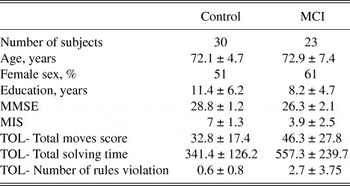
Twenty-three MCI patients and 30 healthy elderly controls from the NEURONORMA sample were included. MCI subjects were amnestic type (scored below percentile 10 in delayed story recall; Peña-Casanova, Reference Peña-Casanova2005) and fulfilled IPA-WHO criteria (Levy, Reference Levy1994), which require cognitive impairment reported by an informant that was present for more than 6 months, and neuropsychological performance below 1 SD with regard their normative group. In addition to memory impairment, 7 MCI subjects presented scores below percentile 10 in at least one of the three Tower of London (TOL) (Cullbertson & Zillmer, Reference Cullbertson and Zillmer2001) variables considered. Age and education were adjusted according to norms for the Spanish population (Pena-Casanova et al., Reference Pena-Casanova, Blesa, Aguilar, Gramunt-Fombuena, Gomez-Anson and Oliva2009b). Patients were recruited from Dementia Consultations at Hospital Clinic and Hospital del Mar (Barcelona, Spain). Control subjects were recruited from the community and relatives of the patients. All subjects (n = 53) underwent dedicated MRI study and comprehensive neuropsychological testing. Characteristics of the sample are shown in Table 1.s
Demographic characteristics and cognitive scores in controls and MCI patients (mean ± SD)

Note
MCI, mild cognitive impairment; MMSE, Mini-Mental Status Examination; MIS, Memory Impairment Screen; TOL, Tower of London; TMT, Trail Making Test. Mean comparisons were performed by means Mann-Whitney tests. Sex percent comparison was performed by means chi-square test with continuity correction.
MRI Measures
Subjects were imaged in a Signa LX 1.5 Tesla magnet (General Electric, Milwaukee, WI) using a specific T1 3D SPGR protocol (TE = Min Full; TR = 12; TI = 450; angle = 15; 256 × 192; FOV = 25; 1NEX; thickness = 1.5; 128 locs). Voxel size was 0.97 × 1.5 × 0.97 mm). Initial visual assessment was performed to discard any other relevant brain pathology and to ensure appropriate study quality. Standard DICOM images were anonymized and processed by means of FreeSurfer v4.0.2 (http://surfer.nmr.mgh.harvard.edu/). Among other measures, FreeSurfer’s processing provides white matter and cerebral cortex models to produce representations of cortical thickness. Cortical thickness is calculated as the closest distance from the gray/white boundary to the gray/cerebrospinal fluid boundary at each vertex on the tessellated surface (Fischl & Dale, Reference Fischl and Dale2000). A parcellation of the cerebral cortex into units based on gyral and sulcal structure (Desikan et al., Reference Desikan, Segonne, Fischl, Quinn, Dickerson and Blacker2006; Fischl et al., Reference Fischl, van der Kouwe, Destrieux, Halgren, Segonne and Salat2004) was also provided. FreeSurfer has been implemented in the cluster of the Port d’Informació Científica, at the Universitat Autonòma de Barcelona. It is composed of 170 HP blades with 2 quad-core CPU (Hewlett Packard, USA), each one with 16 GB of RAM, running over Scientific Linux 4 (https://www.scientificlinux.org/). Subjects are processed in parallel launched through a batch system. The PIC-Neuroimaging Center (PICNIC; https://neuroweb01.pic.es) remote Web-based system was used to perform the processing.
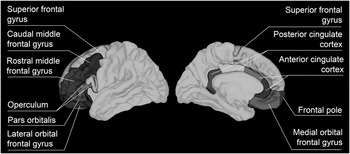
Those regions of interest (ROIs) of the frontal cortex, based on the Freesurfer automated parcellation, that were assumed to be involved in executive function were included in the main analysis, excluding motor areas, see Figure 1. Cingulate cortex subcomponents were also included. The various cingulate and frontal operculum ROIs outputted from FreeSurfer were combined, following Chang et al. (Reference Chang, Jacobson, Fennema-Notestine, Hagler, Jennings and Dale2010) methods, as follows: the caudal and rostral anterior cingulate were combined as the anterior cingulate cortex (ACC); the isthmus and the posterior cingulate were combined as the posterior cingulate cortex (PCC); and the pars triangularis and opercularis were combined as the frontal operculum, see Figure 1 for details. A global frontal cortical thickness measure was also computed as the mean value of the nine frontal areas assessed (PCC was not included). Two additional global measures were computed: a whole brain cortical measure accounting for the data of all the regions provided by FreeSurfer parcellation (except unknown regions) (Desikan et al., Reference Desikan, Segonne, Fischl, Quinn, Dickerson and Blacker2006; Fischl et al., Reference Fischl, van der Kouwe, Destrieux, Halgren, Segonne and Salat2004), and a non-frontal thickness measure computed as the mean of all areas except those that were part of the global frontal cortical thickness measure. All measures were obtained for both right and left hemispheres.
Cortical regions of interest included in the analysis based on FreeSurfer cortical parcellation.

Neuropsychological Assessment
Two screening tests were used to characterize the sample: a global cognition measure, the Mini-Mental Status Examination (MMSE) (Folstein, Folstein, & McHugh, Reference Folstein, Folstein and McHugh1975) in its Spanish validated version (Blesa et al., Reference Blesa, Pujol, Aguilar, Santacruz, Bertran-Serra and Hernandez2001), and memory function by means of the Memory Impairment Screen (MIS) (Buschke et al., Reference Buschke, Kuslansky, Katz, Stewart, Sliwinski and Eckholdt1999). For problem-solving assessment the Tower of London (TOL), in its Drexel University version (Cullbertson & Zillmer, Reference Cullbertson and Zillmer2001), was administered. The version used was the one that had been recently adapted and normalized in a Spanish population within the context of the NEURONORMA project (Pena-Casanova et al., Reference Pena-Casanova, Blesa, Aguilar, Gramunt-Fombuena, Gomez-Anson and Oliva2009a; Pena-Casanova et al., Reference Pena-Casanova, Quinones-Ubeda, Gramunt-Fombuena, Quintana, Aguilar and Molinuevo2009b).
The TOL was originally developed by Shallice (Reference Shallice1982) to assess higher-order problem-solving and, specifically, executive planning abilities in subjects with frontal lobe damage. Although similar to the TOL originally developed by Shallice, the Drexel University version used (Cullbertson & Zillmer, Reference Cullbertson and Zillmer2001) presents several modifications in administration and test scoring. In brief, the TOL consists of two boards with three pegs. On one the examiner places three colored wooden balls (blue, green, and red) in a goal position, and on the other board there are another three colored wooden balls that the subject must rearrange from a standard start position to the examiner’s model position observing two rules: only one ball may be moved at a time, and only a specified number of balls may be left on each peg at a time. Two practice items and 10 target problems of increasing difficulty are given. The maximum time allowed to complete each item is 2 minutes. Three TOL outcome variables were analyzed in this study: (1) the total moves score, that is based on the number of moves the examinee executes in solving the problems, computed by subtracting the minimum theoretical number of solution moves from the examinee’s actual moves; (2) the total solving time, computed as the sum of total time dedicated to the problems; and (3) the number of rules violation, computed as the times that subjects break the rules all along the test. In all measures higher scores means worse performance.
Statistical Analysis
Sample size, and the non-normal distribution of some of the data, made the use of non-parametric analysis necessary. Mann-Whitney tests were used to compare means between groups in sociodemographic, neuropsychological, and MRI-based data. Differences in sex proportions were assessed by means of Chi-square tests. Correlations to cognition were calculated only for global frontal measures. Partial correlations, after controlling for age, education, MMSE score, and non-frontal cortical thickness measure were used for testing the specific relationship between frontal cortical thickness data and executive function. Partial correlations, after controlling for education were performed to explore the relationship between age and problem-solving measures. Non-frontal cortical thickness measure was also included in the model to examine the specific relationship between age and frontal cortical thickness. All correlations were performed within groups. Effect sizes were calculated for significant comparisons between the groups in cognitive and MRI variables using the d of Cohen computed by dividing the mean difference of the groups by the pooled standard deviation. Statistical analysis and graphics were performed using R statistical software (v2.7.0) (R Development Core Team, 2008). The significance level was set to .05 and Bonferroni corrections for multiple comparisons were applied when necessary.
RESULTS
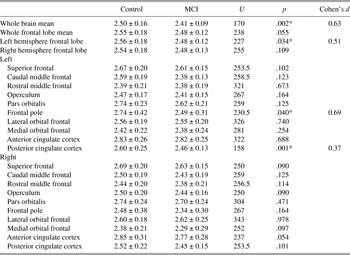
Neuropsychological scores are shown in Table 1. Although MCI patients presented a lower education level and were older than the healthy elderly sample, these differences were not significant. Table 2 shows the quantitative measures of thickness by ROI together with p value for mean comparison between groups, and a calculation of Cohen’s d effect size coefficient for significant differences. Effect size values for neuropsychological measures were as follows: d = 1.46 for MMSE, d = 1.56 for the MIS, d = 0.46 for total moves score, d = 1.13 for total solving time, and d = 1.04 for number of rules violation.
Cortical thickness measures (in mm) of cortical regions assessed

Note
Means, standard deviations, p value, and Cohen’s d values for significant differences. *p < .05
Partial correlations between the three global frontal cortical thickness measures (the left and the right frontal measures, and the combination of both) and TOL scores, after controlling for age, education, MMSE score, and non-frontal cortical thickness, showed significant results (with an alpha level set to .017 based on Bonferroni corrections) only in the control group between solving time and left frontal cortical thickness (r = 0.47; p = .011), solving time and bilateral frontal cortical thickness (r = 0.45; p = .015), and total moves score and left frontal cortical thickness (r = 0.51; p = .005). Nonsignificant correlations within control group were as follows: solving time and right frontal cortical thickness (r = 0.35; p = .045); total moves and right frontal cortical thickness (r = 0.19; p = .181); number of rules violation and left frontal cortical thickness (r = 0.29; p = .082), right frontal cortical thickness (r = 0.23; p = .141), and bilateral frontal cortical thickness (r = 0.28; p = .090).
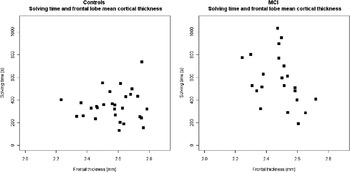
No significant correlations were found within the MCI group. For solving time: left frontal cortical thickness (r = 0.05; p = .495); right frontal cortical thickness (r = −0.18; p = .238); and bilateral frontal cortical thickness (r = −0.07; p = .387). For total moves: left frontal cortical thickness (r = 0.06; p = .404); right frontal cortical thickness (r = −0.19; p = .227); and bilateral frontal cortical thickness (r = −0.07; p = .390). For number of rules violation: left frontal cortical thickness (r = 0.03; p = .495); right frontal cortical thickness (r = −0.01; p = .485); and bilateral frontal cortical thickness (r = −0.03; p = .495). Scatterplots of global frontal thickness and solving time are shown in Figure 2.
Scatterplots showing the relationship between global frontal cortical thickness and solving time in controls and mild cognitive impairment (MCI) subjects.

Partial correlations between age and frontal ROIs, after controlling for education and non-frontal cortical thickness, were not significant (with an alpha level set to .017 based on Bonferroni corrections) in either the control group or MCI. The correlation between age and TOL scores after removing the effect of education showed a trend to significance in the control group for solving time (r = 0.44; p = .020) and total moves score (r = 0.45; p = .019).
DISCUSSION
A difference in cortical thickness was found between MCI subjects and healthy controls in whole brain and several frontal measures, with the left frontal lobe showing more marked cortical loss than the right one. In controls, problem-solving performance correlated negatively with frontal cortical thickness, irrespective of non-frontal thickness, global cognition and sociodemographic factors. There was no correlation in MCI patients.
As expected, controls outperformed MCI in all cognitive scores, both screening and problem-solving tasks. Findings in executive measures agreed with the previously reported common presence of dysexecutive difficulties in subjects with MCI (Brandt et al., Reference Brandt, Aretouli, Neijstrom, Samek, Manning and Albert2009; Crowell, Luis, Vanderploeg, Schinka, & Mullan, Reference Crowell, Luis, Vanderploeg, Schinka and Mullan2002; Kramer et al., Reference Kramer, Nelson, Johnson, Yaffe, Glenn and Rosen2006). In their recent study, Brandt et al. (Reference Brandt, Aretouli, Neijstrom, Samek, Manning and Albert2009) have suggested the selectivity of executive deficits in this pathology, with two highly reliable components, planning/problem-solving and working memory, as the mainly impaired subdomains. It is of interest that our data, although limited because only one test was used, concur with this proposed model, as the TOL test is typically considered a planning/problem-solving task. We observed that time-related measures were significantly lower in patients than in controls. On the other hand, variables that were independent of time showed fewer differences, and, in the case of the total move score mean comparison test did not reach significance, although it was near. Some studies have reported slowness (Levinoff, Saumier, & Chertkow, Reference Levinoff, Saumier and Chertkow2005; Tabert et al., Reference Tabert, Manly, Liu, Pelton, Rosenblum and Jacobs2006) in MCI subjects. In a similar manner, a more ecological approach has demonstrated an increased time to perform activities of daily living, despite a final adequate result (Wadley, Okonkwo, Crowe, & Ross-Meadows, Reference Wadley, Okonkwo, Crowe and Ross-Meadows2008). Because psychomotor speed is highly involved in many executive tasks, it is difficult to partial out its effect from other components, such as planning or complex attention, using conventional testing. Future studies in MCI using paradigms accounting for executive function subdomains could elucidate the specific role of speed processing and of other components in the final executive achievement.
MCI showed a significant thinning of the global cortex with respect to control subjects. The bilateral frontal lobe, taken as a whole, almost reached significance (p = .055), driven by the consistent significant thinning found when the analysis was restricted to the left frontal lobe. Two specific ROIs showed differences: the left frontal pole, and the bilateral posterior cingulate cortex. Our results were similar to those recently reported using the same technique in healthy controls and MCI (Chang et al., Reference Chang, Jacobson, Fennema-Notestine, Hagler, Jennings and Dale2010; Fennema-Notestine et al., Reference Fennema-Notestine, McEvoy, Hagler, Jacobson and Dale2009). Chang et al. studied the cortical thickness differences between two groups of MCI (high vs. low performance in executive function) and found more extended thinning in the frontal lobe in the low performance executive function group than in the high performance one. Additionally, they also presented data comparing the entire MCI sample versus a control group regardless of executive ability and reported a more restricted, but significant, thinning in several frontal regions. Although our sample of MCI is smaller our data are consistent with these later findings and support the existence of frontal gray matter loss in MCI. In a similar manner, our results agree with some of the findings presented by Fennema-Notestine et al. (Reference Fennema-Notestine, McEvoy, Hagler, Jacobson and Dale2009) in their in-depth study on structural MRI biomarkers for preclinical AD. They reported measures of cortical thickness and subcortical volume in single amnestic MCI, multidomain MCI, healthy controls, and AD. With regard to normal controls, amnestic MCI only showed a significant difference in frontal areas in the caudal middle frontal region bilaterally, based on the same FreeSurfer’s frontal cortical parcellation used in our study. It is of interest that, in multidomain MCI, all the FreeSurfer’s frontal cortical regions were thinner than in controls. In comparison, we found more restricted differences in our sample. These discrepancies between our results and Fennema-Notestine et al. could be explained in two ways, and were probably due to a combination of both. First, our MCI group was heterogeneous. Although all the subjects were amnesic, they may have been impaired in other domains, and no criteria regarding single versus multiple domain were applied. In fact, approximately one-third of the sample presented executive function impairment (below percentile 10 in age and education adjusted normative data). Thus, we assumed that our sample was probably composed of a mix of both types of MCI and, as a result, our findings seem to fall between those of the Fennema-Notestine et al. groups. Although domain-related splitting of the sample could have been applied to our study, a limitation related to sample size, which is the second issue to discuss, would have weakened the results even more. As our MCI sample was one-seventh of that used in this previous study, the ability to statistically detect subtle differences was poor, and probably the lack of other significant differences than frontal pole and posterior cingulate in specific ROIs could also be related to the limited number of subjects included.
The posterior cingulate region showed a bilateral difference between controls and MCI. There is a well-known hypometabolism in this area in early AD (Minoshima, Giordani, Berent, Frey, Foster, & Kuhl, Reference Minoshima, Giordani, Berent, Frey, Foster and Kuhl1997) and MCI (Mosconi, Reference Mosconi2005). Regarding cortical thickness, Julkunen et al. reported a more marked thinning in the cingulate in those MCI subjects that finally progressed to dementia with regard to those that remained stable (Julkunen et al., Reference Julkunen, Niskanen, Muehlboeck, Pihlajamaki, Kononen and Hallikainen2009). In a similar manner, the posterior cingulate was used, together with temporal cortices, to compute a normalized thickness index that was able to distinguish progressors from stable MCI quite accurately (Querbes et al., Reference Querbes, Aubry, Pariente, Lotterie, Demonet and Duret2009). The bilateral changes found in our study support this previous evidence on the early involvement of this region in MCI-related brain atrophy.
Concerning laterality differences, Singh et al. (Reference Singh, Chertkow, Lerch, Evans, Dorr and Kabani2006), using voxel-based morphometry, reported a bilateral, but mainly right-sided, thinning in some prefrontal areas that accompanied temporal and parietal atrophy in MCI. Conversely, our results point to a slightly more marked cortical loss in left frontal regions, especially in the left frontal pole. This hemispheric difference may be related to sampling issues rather than to an actual side effect in frontal lobes, because bilateral thickness alterations are seen in both studies in a similar manner.
Significant differences in frontal ROIs showed moderate effect size values. A fact that indicates a poor ability of these measures to discriminate by their selves between healthy aging and MCI. Cognitive measures used in this study have shown to be more discriminative for such a purpose with the MMSE showing the highest effect size.
A different pattern in correlations with executive performance between groups was not unexpected, because negative relationships with brain volumes were fairly common in healthy subjects (Duarte et al., Reference Duarte, Hayasaka, Du, Schuff, Jahng and Kramer2006; Foster et al., Reference Foster, Meikle, Goodson, Mayes, Howard and Sunram1999; Van Petten, Reference Van Petten2004). Although not all the evidence on the topic concurs, it has been suggested that positive relationships in normal subjects emerged only in samples containing a large proportion of poor performing ones (Raz et al., Reference Raz, Gunning-Dixon, Head, Dupuis and Acker1998). A possible explanation for this negative relationship could be related to the early pruning of ineffective synapses in development, which might result in smaller brain volumes within the context of high performance in young adults (Foster et al., Reference Foster, Meikle, Goodson, Mayes, Howard and Sunram1999). This pattern could be maintained in healthy aging despite minimal age-associated atrophy suggesting that cerebral volumes, and also cortical thickness, are more dependent on developmental changes than age changes. On the other hand, in the presence of pathological conditions, such as AD, positive relationships could emerge within the context of atrophy related cognitive decline (Duarte et al., Reference Duarte, Hayasaka, Du, Schuff, Jahng and Kramer2006). We hypothesized that MCI frontal cortical thickness would correlate to executive outcomes, but a lack of relationship was observed. Chang et al. (Reference Chang, Jacobson, Fennema-Notestine, Hagler, Jennings and Dale2010) reported a low but significant correlation with their composite executive score and the discrepancy could be related to the limited statistical power in our study driven by sample size. Our results, however, concur with those found by Duarte et al. (Reference Duarte, Hayasaka, Du, Schuff, Jahng and Kramer2006), who reported similar findings and suggest that the lack of correlations in MCI may be explained by the combination of the two opposite patterns found in healthy controls and AD. Although Dickerson et al. (Reference Dickerson, Fenstermacher, Salat, Wolk, Maguire and Desikan2008) found no correlation between the TMT-B and frontal cortical thickness in healthy elderly subjects, in our study negative correlations in the frontal lobe were quite robust, as they were present after controlling for sociodemographic variables, global cognition and, more importantly, after removing the effect of non-frontal cortical thickness. The discrepancies between studies may be related to differences in the processes involved in both tasks. Because the TOL test is more complex and resource-demanding it may need more high-order executive control, and may be more frontally mediated, rather than the TMT-B, in which visual tracking and shifting, without complex planning, are involved. Our results, therefore, suggest that in elderly normal subjects there was a probable specific relationship between the thickness of the frontal cortex, mainly in the left hemisphere, and high-order executive function (measured by problem-solving), in which a thinner gray mantle is related to better performance, probably mediated by the elimination of ineffective or redundant synapses in early development (Sowell, Thompson, Leonard, Welcome, Kan, & Toga, Reference Sowell, Thompson, Leonard, Welcome, Kan and Toga2004).
Our results on the effect of aging in the frontal cortical thickness did not show a significant specific correlation in either of the groups. Although previous reports indicate that some frontal atrophy occurs in the process of aging (Raz et al., Reference Raz, Gunning-Dixon, Head, Dupuis and Acker1998, Reference Raz, Lindenberger, Rodrigue, Kennedy, Head and Williamson2005), in our case this relationship was absent after controlling for the non-frontal thickness. This lack of association may be simply driven by the age distribution of the sample, because many studies reporting this negative relationship also included young subjects. Age and TOL outcomes showed a trend in the correlational analyses within control group that do not survive the correction for multiple comparisons.
There are some limitations in this study that need further clarification. First, our sample sizes are relatively small for the study of brain-behavior relationships. Despite this limitation, our results in healthy controls and the lack of relationship in MCI agree with previous similar reports (Duarte et al., Reference Duarte, Hayasaka, Du, Schuff, Jahng and Kramer2006). Second, it is noteworthy that some positive correlations could be driven by the scores of normal but poor-performing subjects. For instance, correlations between solving time and frontal thickness measures in controls were no longer significant (bilateral frontal thickness: r = 0.325; p = .1; left frontal thickness: r = 0.388; p = .06), when the subject taking more than 700 seconds to perform the task (see Figure 2) was removed from the analysis. Although this subject could be considered an outlier (3 SD above the normal control group mean) for this variable, he was finally included in the main analysis because he demonstrated performances within the normal range on the rest of cognitive measures. And third, our MCI group is heterogeneous. Although all the subjects were amnesic, they could have also been impaired in other domains, including executive function impairment, as we did not restrict the recruitment criteria to isolated memory deficits. Because different patterns in brain atrophy were reported in amnestic versus dysexecutive single-domain MCI type (Pa et al., Reference Pa, Boxer, Chao, Gazzaley, Freeman, Kramer and Miller2009), further studies on the relationship of executive cognition and cortical thickness, in more accurately selected single and multiple domain impaired MCI, could aid to a better characterization of the functional outcome of selective brain atrophy in this pathological condition.
In conclusion, we found a frontal cortical thinning, mainly in the left hemisphere, in MCI with regard to healthy controls, supporting the existence of early widespread brain atrophy in MCI. Frontal cortical thickness negatively correlated to problem-solving performance in the healthy elderly, in which a thicker cortex was associated with a poorer performance. These results support previous findings that reported a similar negative relationship between brain volumes and cognition, suggesting the primacy of developmental pruning of ineffective synapses over the mild atrophy associated with age. In MCI there was a lack of correlation. Taken together, these findings suggest that there was a qualitative change in the relationship between high-order executive function and cortical thickness in the transition from healthy elderly to MCI, probably due to the acceleration of neuronal loss related to the probable presence of neuropathology in these subjects. As those MCI that presented additional dysexecutive impairments, probably mediated by frontal atrophy, were supposed to be at a major risk of dementia, the use of automated frontal cortical thickness measures would aid in characterizing subjects more likely to progress.
ACKNOWLEDGMENTS
This study is part of a large multicentric project to collect normative and validation data of neuropsychological instruments (NEURONORMA Project) which was mainly supported by a grant from the Medical Department of Pfizer, SA, Spain. It was also supported by the Neuropsychology group of the Program of Neuropsychopharmacology of the Institut Municipal d’Investigació Mèdica (Barcelona, Spain), and the Port d’Informació Científica (Universitat Autònoma de Barcelona). Dr. J. Peña-Casanova has received an intensification grant from the CIBERNED (Centro de Investigación Biomédica en Red sobre Enfermedades Neurodegenerativas), Instituto Carlos III (Ministry of Health & Consumer Affairs of Spain). The authors also thank Arnau Bria and Jordi Delgado, from the Port d’Informació Científica, for their technical support.