Consanguineous marriage is common in many Arab societies and has been regarded as a part of Arab culture (Bittles, Reference Bittles2011; Hamamy, Reference Hamamy2012). In the Western world, the prevalence of consanguineous marriage is considered to be very low (~1%). The frequency of consanguineous marriage in many Arab societies has been found to have decreased over time (Al-Abdulkareem & Ballal, Reference Al-Abdulkareem and Ballal1998; Hamamy et al., Reference Hamamy, Jamhawi, Al-Darawsheh and Ajlouni2005). In spite of this, the relative occurrence of consanguineous marriages is still regarded as being high in Arab communities (25–55%). Demographic and religious factors, socioeconomic status, local traditions and educational level have all been found to affect the rate of consanguineous marriages (Jaber et al., Reference Jaber, Shohat and Halpern1996; Fuster & Colantonio, Reference Fuster and Colantonio2004).
When the State of Israel was created in 1948 the majority of Palestinian Arabs were forced out of their homeland to live either in Gaza, the West Bank or surrounding Arab countries (Zlotogora, Reference Zlotogora2002). Those who remained in Israel at that time numbered about 156,000, but currently there are in excess of 1.3 million Arabs living in the country (Central Bureau of Statistics, Israel, 2014).
Sharkia et al. (Reference Sharkia, Zaid, Athamna, Cohen, Azem and Zalan2008) found that the rate of consanguinity in four selected villages of Arab society in Israel had undergone a decrease over two time periods. More recently, Na’amnih et al. (Reference Na’amnih, Romano-Zelekha, Kabaha, Rubin, Bilenko, Jaber, Honovich and Shohat2015) found that the rate of consanguineous marriages among Israeli Arabs decreased over three time periods. Previous studies of consanguinity in the Israeli Arab community have concentrated on specific regions and/or periods of time. To the best of the authors’ knowledge, none has been conducted on a representative sample of this community for the entire period spanning from the establishment of the State of Israel in 1948 to recent times. The aim of the current comprehensive, cross-sectional study was to determine the trends in consanguineous marriage types within the Arab community in Israel by religion and educational level.
The study, carried out in 2007 and 2008, used a multistage sampling design. For the purpose of the study the country was divided into four ‘regions of residence’: North, Centre, Haifa and South. Each region was stratified by ‘place of residence’: urban (>10,000 population), semi-urban (between 5000 and 10,000 population) and rural (<5000 population). The total sample constituted 3173 couples from the Arab community in Israel. Regarding religion, the sample constituted 2472 Muslim, 363 Christian and 338 Druze couples. By region, the sample was divided into 1650 couples from the North region, 570 from the Haifa region, 540 from the South region and 510 from the Centre region. These divisions reflect the relative percentages of the Arab community of Israel.
The couples completed questionnaires, through face-to-face interview, providing information on personal status, religion, education and on consanguinity between the couple. Couple marriages were grouped into two major categories: consanguineous and non-consanguineous. Consanguineous marriages types were recorded as: double first cousin (DFC), first cousin (FC), first cousin once removed (FCOR), second cousin (SC) and second cousin once removed (SCOR). The mean inbreeding coefficients (α) were calculated using the formula ΣP i F i , where P i is the percentage of each marriage type and F i is the inbreeding coefficient of the respective marriage type.
Comparative analysis of consanguineous and non-consanguineous marriage types was carried out by religion and husband/wife’s educational attainment. The statistical program SPSS was used for data management and statistical analysis. The statistical significance of associations between consanguinity and various determinants was examined using the chi-squared test. The Kruskal–Wallis test was used to evaluate the significance of the differences observed across time periods. A p-value <0.05 was considered significant.
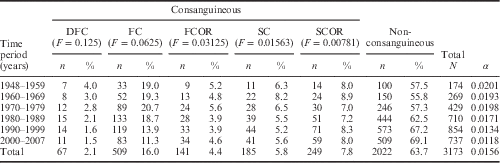
Table 1 shows the distribution of the sample by marriage type and time period in which the marriage occurred between the years 1948 and 2007. It was found that over the whole time period the rate of consanguineous marriage decreased significantly, from 42.5% to 30.9% (p=0.001). The main type of consanguineous marriage was found to be first-cousin marriage, which constituted 509 cases (16%) over the whole time period. The prevalence of first-cousin marriage slowly increased over the first three time periods, then decreased significantly after the third period, from 20.7% to 11.3% (p<0.05). The frequency of double-first-cousin marriages decreased significantly over the whole time period, from 4.0% to 1.5% (p=0.01). The mean inbreeding coefficient (α) decreased over time, from 0.0201 to 0.0118.
Frequencies, rates and mean inbreeding coefficients (α) of all marriage types in a sample of Israeli Arab couples over successive time periods
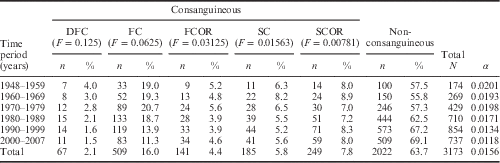
Consanguineous marriage types: DFC, double first cousin; FC, first cousin; FCOR, first cousin once removed; SC, second cousin; SCOR, second cousin once removed.
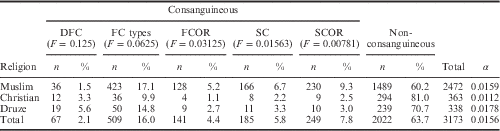
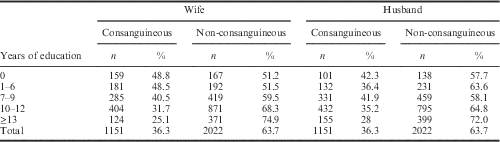
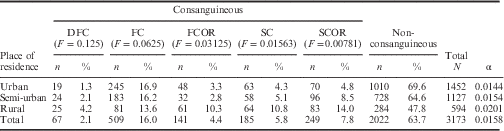
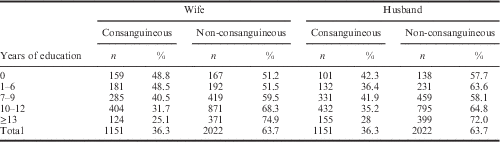
Table 2 shows the distribution of the numbers and frequencies of all types of marriages for the study sample by religion. The highest prevalence of consanguineous marriages was found in Muslims (39.8%), followed by Druze (29.34%), with the lowest prevalence being observed in Christians (19%). These differences were found to be statistically significantly (p=0.001). The highest frequency of first-cousin and closer marriage prevailed in Druze (20.4%), followed by Muslims (18.4%) and then Christians (13.2%). The mean inbreeding coefficient (α) was highest among the Druze (0.0178), slightly lower among Muslims (0.0159) and lowest among Christians (0.0112). The frequency of consanguineous marriage was found to decrease significantly (p<0.05) with an increase in wife’s, as well as husband’s, educational attainment (Table 3). The highest prevalence of consanguineous marriage was found in rural populations, followed by the semi-urban, while the lowest prevalence was observed in urban populations (Table 4).
Distribution of frequencies, rates and mean inbreeding coefficients (α) of consanguineous and non-consanguineous marriages by religion among a sample of Israeli Arab couples
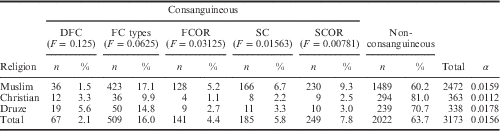
Consanguineous marriage types: DFC, double first cousin; FC, first cousin; FCOR, first cousin once removed; SC, second cousin; SCOR, second cousin once removed.
Distribution of frequencies and rates of consanguineous marriages by wife’s and the husband’s years of education among a sample of Israeli Arab couples
Distribution of frequencies, rates and mean inbreeding coefficients (α) of consanguineous marriages by place of residence among sample of Israeli Arab couples
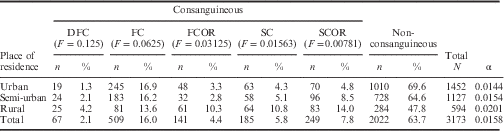
Consanguineous marriage types: DFC, double first cousin; FC, first cousin; FCOR, first cousin once removed; SC, second cousin; SCOR, second cousin once removed.
The results demonstrated a decrease in the frequency of consanguineous marriage in Israeli Arabs over successive time periods since 1948. This trend could be explained by socio-demographic changes that have taken place in Arab villages, such as increased population size and density, modernization, the advancement of telecommunications and increased access to communication tools. Another possible factor is the advancement of the medical care system, particularly educational health programmes, which have raised awareness among Israeli Arabs of the negative health effects of consanguinity. Another possibility that might explain the decline in the frequency of consanguineous marriage is the reduction in family size, which has led to a decline in the number of marriageable cousins.
This study found that first-cousin marriage was predominant over successive time periods, but in the first three time periods (from 1948 to 1979) the rate of first-cousin marriage was nearly constant (~20%). However, in the next three successive time periods (from 1980 to 2007), it started to decrease substantially, from 20.7% to 11.3%. Even though first-cousin marriage has decreased in the Arab community, it continues to be the most prevalent type. This might be attributed to deep-rooted traditional beliefs.
This study observed that the highest rate of consanguineous marriage was found to be among Muslims, followed by Druze, with the lowest rate in Christians. However, the mean inbreeding coefficient (α) was higher among the Druze than in Muslims. This was due to the higher rate of double-first-cousin marriages in the Druze community, accounting for 5.6% of marriages. This could be explained by the fact that the Druze community in Israel is small. It is a community that greatly prefers intra-community marriages and encourages close-relative marriages (Vardi-Saliternik et al., Reference Vardi-Saliternik, Friedlander and Cohen2002). The present study shows that consanguinity rates are higher in rural than in urban and semi-urban areas, which is in agreement with reports from several other countries (Khoury & Massad, Reference Khoury and Massad1992; Saadat & Tajbakhsh, Reference Saadat and Tajbakhsh2012).
These results show that rates of consanguineous marriages in Israeli Arabs are inversely proportional to both husband’s and wife’s level of education. There is no doubt that education spreads awareness and knowledge to community members about the risk factors and drawbacks of consanguineous marriage. Furthermore, education widens and enlightens peoples’ perspectives about life and building a healthy family, and informs them about the genetic disorders and congenital malformations that can result from consanguineous marriage. It is therefore important to enhance health educational programmes that spread knowledge about the deleterious effects of consanguineous marriage.