

Explaining vote choice necessarily involves examining behavioral patterns. But do all voters follow the same patterns? Most voting models assume that they do. For instance, the Michigan School's Funnel of Causality posits that the order in which various factors come into play in determining vote choice is the same for all citizens (Campbell, Reference Campbell, Converse, Miller and Stokes1960). Moreover, the findings of the early Columbia School studies conceptualize voting behavior by minimizing citizens’ individual input; voters’ choices are constrained by social groups (Berelson et al., Reference Berelson, Lazarsfeld and McPhee1954). Spatial theories of voting, on the other hand, assume that voters are motivated by self-interest (Downs, Reference Downs1957; Enelow & Hinich, Reference Enelow and Melvin1984). They usually posit that preferences are static and that issues have a homogeneous effect upon the electorate. But some scholars argue that voting behavior is more complex (Bartle, Reference Bartle2005). Different types of voters can be affected by different factors or behave according to different causal orders. For example, the marketing model accepts that preferences and vote choice are the result of a complex interplay (Kotler, Reference Kotler1984; Bartle & Griffiths, Reference Bartle, Griffiths, Henneberg and O'Shaughnessy2002). In fact, political marketing focuses on the interaction, or exchange, between voters and political parties. In such an interaction, positional issues are key elements in parties’ toolboxes and are used to attract or mobilize voters. This model holds that issue effects can indeed operate heterogeneously.
The heterogeneous nature of issue effects underpins political marketing philosophy. Thus, parties benefit from segmenting the electorate, targeting strategic groups and positioning their policy proposals accordingly. Cwalina, Falkowski and Newman distinguish two levels of voter segmentation. The first one divides voters according to voter party identification and partisan strength, hence allowing candidates “to skip those segments that are most likely to be very resistant to persuasion activities” (Cwalina et al., Reference Cwalina, Falkowski and Newman2011: p. 85). Floating or uncertain voters – normally those without a clear partisan identification or with preferences that shift over time – are the ones we target using the secondary segmentation.
Such a line of speculation, however, significantly complicates voting theories. In fact, the complexity of voters’ decision-making poses fewer problems to statistical modeling than the diversity of reasoning paths that might precede vote choice (Rivers, Reference Rivers1988). Heterogeneity in voters’ decision-making processes has at least two causes. First, heterogeneity might originate in differences in voters’ general ability to reason about politics. This ability to reason is assessed with measures such as political knowledge (Delli Carpini & Keeter, Reference Delli Carpini and Keeter1996; Roy, Reference Roy2009), awareness (Converse, Reference Converse and Apter1964; Zaller, Reference Zaller1992) and education (Sniderman, Reference Sniderman, Brody and Tetlock1991). Second, voters may have more specific or specialized knowledge than general knowledge, and they might accord different levels of salience to different issues (RePass, Reference RePass1971; Krosnick, Reference Krosnick1990). These two types of heterogeneity are referred to here as sophistication-based heterogeneity and salience-based heterogeneity, respectively.
There are some similarities between the two types of heterogeneity. Both relate to information effects. Greater information about issues increases the weight that issues have in voters’ decision-making processes. Sophistication-based heterogeneity recognizes that political knowledge is concentrated among specific segments of the population and implies a rather dichotomous view of the electorate – see, for example, the Black-and-White model (Converse, Reference Converse and Tufte1970).Footnote 1 Alternatively, the salience-based conception of heterogeneity implies a more specialized political knowledge. Many voters may only care about a limited set of issues and thus might act as issue publics (Krosnick, Reference Krosnick1990). The current literature is inconclusive regarding whether the tendency to attend to politics is concentrated among few information generalists or numerous smaller groups of information specialists (Bolsen & Leeper, Reference Bolsen and Leeper2013). The concept of issue publics is particularly relevant here because it relaxes some of the limitations to positional-issue voting identified in the literature: those that relate to the general lack of political attitudes. Indeed, despite the fact that few issues concern the entire electorate enough to trigger widespread attitude formations, the issue-public hypothesis contends that even unaware voters can hold attitudes toward a limited number of issues about which they care. This idea is at the core of the political marketing strategy, which implies targeting strategic groups, including habitual ‘non-voters’, often perceived to have the greatest influence on many electoral contests (Baines et al., Reference Baines, Brennan and Egan2003). Issue publics can sustain stable and consistent attitudes toward a limited set of issues because of environmental and psychological reinforcement processes, such as selective exposure (Iyengar, Reference Iyengar, Hahn, Krosnick and Walker2008). The issue-public perspective also implies heterogeneous issue effects. The level of salience accorded to issues may vary by the voter and by the issue. For instance, the effect of gun control or abortion attitudes on voting behavior might exhibit very little homogeneous effect. But, as an issue, gun control or abortion might be decisive for a small proportion of the electorate that cares specifically about those particular issues. This is especially the case when a party takes a clear position on a particular issue or already has a degree of ownership over the issue (Petrocik, Reference Petrocik1996). Moreover, some research seems to indicate that there is a fragmentation of political knowledge along lines that are different from the education stratification implied by the sophistication-based heterogeneity concept. Soft news in the USA, for example, has been shown to increase the information level of otherwise politically inattentive individuals on certain issues like foreign affairs and law and order (Baum, Reference Baum2002).
The idea of a salience-based heterogeneity among the electorate adds some nuance to the theoretical frameworks inherited from the Columbia and Michigan schools – among the most enduring concepts in explaining voting patterns – which hold that voters do not meet classic democratic citizenship standards because they do not have strong opinions about issues (Berelson et al., Reference Berelson, Lazarsfeld and McPhee1954). It also challenges spatial models of voting, which generally claim that all issues matter equally for each voter. The question of the relevance of issues is indeed consequential. If voters had no significant attitudes about positional issues, party platforms and campaign promises would be irrelevant. In fact, why would parties try to reach specific electorate segments with narrow-casted messages if issues do not count?
This article explores the possibility that positional-issue effects operate in a heterogeneous manner. More specifically, the article investigates the presence or absence of sophistication-based and salience-based types of heterogeneity in the Canadian electoral context. Salience-based heterogeneity supposes an electorate fragmented into various issue publics, which are the foundation of political marketing strategies such as segmentation of the market and micro-targeting techniques like direct mailing and wedge politics.
Heterogeneity and the citizen competence problem
One of the core findings to repeatedly emerge from decades of public opinion research is that many voters lack political sophistication (Campbell, Reference Campbell, Converse, Miller and Stokes1960; Converse, Reference Converse and Apter1964; Delli Carpini & Keeter, Reference Delli Carpini and Keeter1996). But no scholar has ever claimed that all voters are politically ignorant. Campbell (Reference Campbell, Converse, Miller and Stokes1960) found that there is a great divide between average citizens and political elites in terms of their engagement in politics, levels of political information and ideological connectedness. Compared to elite belief systems, mass public belief systems tend to be more disorganized and more dependent on charismatic leaders than on political substance (Converse, Reference Converse and Apter1964). According to Converse (Reference Converse and Tufte1970), only around 20% of voters do not answer political questions at random. This dichotomous view of the electorate is known as the Black-and-White model. Neuman (Reference Neuman1986) is even more pessimistic than Converse. In his view, roughly 75% of voters are politically uninterested and unsophisticated. Another 20% of voters are completely apolitical; they exhibit only minimal awareness of and concern for politics. Only 5% of the public constitutes what Neuman calls opinion-elite citizens. Yet, this small number of competent citizens is not necessarily alarming: “It is in the nature of representative democracy that only a small proportion of the population can participate in politics to the fullest” (Luskin, Reference Luskin1990). Other scholars are more optimistic. Delli Carpini and Keeter conclude their study on political information by arguing that, despite the unequal distribution of knowledge across citizens, “more than a small fraction of the public is reasonably well informed about politics – informed enough to meet high standards of good citizenship” (Reference Delli Carpini and Keeter1996: p. 269). Lau and Redlawsk (Reference Lau and Redlawsk1997) claim that classic democratic theory holds utopian expectations about the nature of human cognition. Relying on notions of ‘fully informed’ interests, they thus conclude that 75% of voters do ‘vote correctly’. Spatial models, by claiming that rational citizens will use information shortcuts to evaluate whichever party will benefit them the most, also make efforts to mitigate the citizen competence problem. Information shortcut perspectives offer evidence that voters can hold political attitudes without being unrealistically politically sophisticated (Popkin, Reference Popkin1991; Sniderman et al., Reference Sniderman, Brody and Tetlock1991). The debate about citizen competence is evidently closely related to the debate about the distribution of political sophistication in the population. Voters need a minimum level of political sophistication to be considered as having genuine attitudes on positional issues.
A black-and-white electorate: sophistication-based heterogeneity
Many scholars describe the electorate in a way that leaves little room for issue voting to be important. Such a perspective is apparent in the Columbia School's Minimal Thesis, according to which voting patterns are considered to be so stable and so ingrained that it is almost possible to predict electoral outcomes ahead of time (Lazarsfeld et al., Reference Lazarsfeld, Berelson and Gaudet1948). The Michigan School tradition of research is another well-known example. The authors of The American Voter Revisited (Lewis-Beck et al., Reference Lewis-Beck, Jacoby, Norpoth and Weisberg2008) consider the lack of issue familiarity and intensity as individual limitations that explain the absence of issue voting. People do not recognize political issues and cannot express degrees of preference for one issue position over another. This situation is a product of the fact that there are often too many issues discussed in a campaign, which is considered an external limitation. Ascribing such a minimal role to issues downplays the effect of electoral campaigns on voting. This perspective is also of limited use to parties in guiding their strategies since it sees candidates as passive. Following Lazarsfeld et al. (Reference Lazarsfeld, Berelson and Gaudet1948), some scholars still argue that campaigns do not matter, or matter very little (Lewis-Beck et al., Reference Lewis-Beck, Jacoby, Norpoth and Weisberg2008). More educated voters can overcome these limitations, but the pool of potential issue voters is too ‘small’ to allow issues to matter for vote choice (Lewis-Beck et al., Reference Lewis-Beck, Jacoby, Norpoth and Weisberg2008). According to one widely shared view, education is the key to positional issues mattering (Kuklinski, Reference Kuklinski, Peyton, Dalton and Klingemann2007). A rise in levels of education should be accompanied by a corresponding increase in the importance of positional issues. Some scholars argue that such an increase in the effect of issues on vote choice has indeed occurred (Franklin, Reference Franklin, Mackie and Valen1992; Dalton, Reference Dalton2012). For instance, Dalton (Reference Dalton2012) observes an improved cognitive mobilization among the electorates of most developed nations. As he repeatedly states, we are becoming ‘better citizens’. But others show that higher levels of formal education do not automatically lead to political interest and political sophistication (Neuman, Reference Neuman1986). Education turns out to be an imperfect proxy for more relevant factors such as political awareness or political interest (Kwak, Reference Kwak1999; Highton, Reference Highton2009). More politically aware individuals are those who are motivated enough to both gather information and put cognitive effort into developing ideas about politics (Zaller, Reference Zaller1990). Hence, political awareness appears as a predictor of the amount of information gained during an electoral campaign (Nadeau, Reference Nadeau, Nevitte, Gidengil and Blais2008). Similarly, there is persuasive evidence showing that the knowledge gap widens when a public issue becomes salient (Althaus, Reference Althaus2003). But there are reasons to doubt that having new information automatically translates into having genuine attitudes.
Different theories assume a dichotomy in the electorate in terms of political sophistication. Whether this cleavage is caused by varying education, information or awareness levels matters less than the idea that only a small proportion of voters have the ability to vote according to positional issues. According to this view, positional issues matter, but only for the most politically enlightened in society. However, another line of research explores a deeper level of heterogeneity – salience-based heterogeneity – which presumes a more fragmented electorate.
A fragmented electorate: salience-based heterogeneity
Positional issues can matter for political experts because these experts can access their policy attitudes from memory (Goren, Reference Goren1997). When a public issue becomes salient, more people take it into consideration when making political decisions. This is the logic behind the priming effect (Scheufele, Reference Scheufele2000). As the author of The American Voter (Campbell, Reference Campbell, Converse, Miller and Stokes1960) acknowledges, highly salient public issues contribute to the dynamism of political behavior. Sometimes, priming strategies are used to boost the salience of particular issues among targeted subgroups of the electorate. This is the way ‘wedge issues’ – those issues salient enough to have the potential to influence voters to defect from their parties – are being used by parties to attract voters that would typically not vote for them (Hillygus & Shields, Reference Hillygus and Shields2008). According to Hillygus and Shields (Reference Hillygus and Shields2008), these strategies appear to be working. In order for a public issue to become salient, it needs to be extensively diffused through the population: “[…] the more attention the media pay to an issue, the more likely that issue is to come to mind and thus influence people's political judgments” (Gidengil, Reference Gidengil1992: p. 21). However, as Lewis-Beck and colleagues (Reference Lewis-Beck, Jacoby, Norpoth and Weisberg2008) note: “[the] widespread availability of information does not, in itself, guarantee that issues will become part of a voter's conscious reasons for supporting one candidate over another” (p. 166). For their part, spatial models claim that most voters are relatively ignorant, as it is irrational to collect a great deal of information about politics (Bartler & Griffiths, Reference Bartle, Griffiths, Henneberg and O'Shaughnessy2002). Is it likely, then, that different voters care about different issues? If different voters cared about different issues, each would presumably inform him or herself about the particular issue he or she cares about. After all, the acquisition of political information is considered to be the result of complex interactions between individual factors and environmental supply (Huckfeldt et al., Reference Huckfeldt and Sprague1995). Yet, people are often characterized as being generalists rather than specialists in their political knowledge (Delli Carpini & Keeter Reference Delli Carpini and Keeter1996: p. 199). This characterization means that familiarity with one issue should translate into an increase in the probability of familiarity with another (Lewis-Beck et al., Reference Lewis-Beck, Jacoby, Norpoth and Weisberg2008). That may be true, but many scholars also argue that issue salience operates at the individual level.
Determining why voters care about different issues is not a simple endeavor. Even the authors of The American Voter Revisited (Lewis-Beck et al., Reference Lewis-Beck, Jacoby, Norpoth and Weisberg2008) were puzzled by the individual variance among voters in familiarity with certain issues. For them, “the existence of cognition is the critical factor” (Lewis-Beck et al., Reference Lewis-Beck, Jacoby, Norpoth and Weisberg2008: p. 171). Many analysts supply different explanations regarding what could account for the difference in cognition. First, voters are not all exposed to the same sources of information. In post-industrial societies, the workplace and the media environment are becoming more complex and more fragmented. The mass media is less uniform than it once was, when presidents were sold like “soap powder or a can of beer” (McGinnis, Reference McGinnis1968: p. 2). The multiplication of television channels and the advent of the internet has contributed to an environment that favors the expression of sub-interests. For example, Baum (Reference Baum2002) shows how viewers of soft news become inclined to care about some issues more than others. The fragmentation of the media environment also facilitates selective exposure, which implies a reversed order: viewers choose their sources of influence. Kim (Reference Kim2007) shows how this new media environment greatly facilitates the development of distinctive groups of issue publics who can now more easily focus on the topics they are concerned with. Indeed, citizens now have more opportunity to avoid political information that does not conform to their worldview. Bolsen and Leeper extend the literature on selective exposure among issue publics by showing that “it is tied to self-interest across a broad range of issues, different types of groups, and over time” (Reference Kim2013: p. 342). That way, self-interest would serve as an additional source of motivation for attending to political issues. Stroud (Reference Stroud2008) demonstrated how voters’ political beliefs are increasingly related to voters’ media exposure. Selective exposure to media sources is consistent with Festinger's (Reference Festinger1957) cognitive dissonance theory, which argues that people tend to reject information that is not consistent with their belief system. Moreover, there is evidence that voters do not react in the same ways to the same sources of influence (Erbring et al., Reference Erbring, Goldenberg and Miller1980). For example, elderly citizens are more affected by news reports about social security than are younger citizens, and African–Americans are more affected by news about racial discrimination than other citizens (Iyengar, Reference Iyengar and Kinder1987). Thus, acquisition of issue-specific information is predominantly driven by issue-specific interest and the availability of this information (Henderson, Reference Henderson2014).
On another note, secular transformations among the electorate – among others, a spreading partisan misalignment due to higher education and a diminishing need for the psychological crutch of party identification – should shift the sources of voting from long-term habitual party ties toward more weight for short-term factors such as issues (Dalton, Reference Dalton1988). Furthermore, as voters have become more educated, informed and critical of politics and parties, their demands have become less class-based. Moreover, Dalton (Reference Dalton2012) demonstrates the emergence of what he calls ‘cognitive partisans’ and ‘cognitive apartisans’ among industrialized countries. Both types are equipped to synthesize information in order to reach conclusions about politics, but the ‘cognitive apartisan’ voter holds policy goals as the most important variable in his or her vote choice. Subsequently, issues become more important than party affiliation for a significant part of the electorate.
Since the nature of the electorate has become more heterogeneous, parties have become market-oriented (Lees-Marshment, Reference Lees-Marshment2008). The structural changes associated with the rise of post-industrial societies, combined with psychological concepts such as cognitive dissonance and selective exposure, might jointly contribute to the creation of issue-specific experts, in turn contributing to the increasing electoral volatility.
Information specialists: issue-public theory
An issue public is composed of voters who are more alert, attentive, interested and informed about a given issue (Key, Reference Key1961). Those voters may not have a broad base of knowledge about politics, but on the topic of their concern, they exhibit more structured attitudes and larger stores of background information (Krosnick, Reference Krosnick1990). Ironically, it was Converse (Reference Converse and Apter1964) who first introduced the concept of issue publics. According to Converse, “[…] we come a step closer to reality when we recognize the fragmentation of the mass public into a plethora of narrower issue publics” (p. 245). But it was Krosnick (Reference Krosnick1990) who primarily elaborated the contemporary version of the concept to create the issue-public theory. The salience-based heterogeneity of the effect of positional issues on vote choice is central to issue-public theory:
Policy attitudes that citizens consider important are highly accessible in memory, are highly resistant to change, are highly stable over time, are extensively linked to and consistent with individuals’ basic values, instigate polarized perceptions of competing presidential candidates’ policy attitudes, and are powerful determinants of candidate preferences (Krosnick, Reference Krosnick1990: p. 70).
Hence, depending on the salient issues emerging during an election period, issue publics are especially responsive to this information and are expected to show strong campaign learning (Henderson, Reference Henderson2014). The issue-public idea complicates elitist views of the electorate. However, the idea of different causal mechanisms operating for different subgroups does not have the same appeal as theories that are more universally applicable and parsimonious. Krosnick's issue-public theory is important because it relaxes the conditions under which issue voting can matter. All voters do not need to know, as is implicitly assumed by spatial models, the positions of all the parties on all the issues (Lewis-Beck, Reference Lewis-Beck, Jacoby, Norpoth and Weisberg2008). Voters can handle being knowledgeable about a small set of issues that are important to them: “[…] people probably accumulate large stores of knowledge in memory relevant to important policy attitudes and smaller amounts of knowledge relevant to unimportant policy attitudes” (Krosnick, Reference Krosnick1990: p. 68).
The issue-public theory is not necessarily inconsistent with the Michigan School model. Indeed, some Michigan School scholars seem to recognize the role of salience-based heterogeneity in vote decisions: “[…] even though familiarity and opinionation are widespread, citizens are much more narrowly focused with respect to the policy questions that arouse strong feelings” (Lewis-Beck et al., Reference Lewis-Beck, Jacoby, Norpoth and Weisberg2008: p. 175). But not all voters are necessarily members of an issue public. Moreover, other factors such as values, party identification or even elite discourse can contribute to voters developing attitudes about issues that are less important to them as well. In Krosnick's view, “It seems more sensible […] to view linkage between an attitude and values, needs, and goals as one possible cause of importance” (Reference Krosnick1990: p. 60). From this vantage point, issue publics can hardly be considered campaign-specific, short-term factors. The origins of issue publics might be motivated by self-interest and might grow as the relevant issues become more prominent (Key, Reference Key1961). In short, the issue-publics literature is ambiguous about where exactly in the causal chain leading to vote choice issue-public membership should be placed. But by considering salience-based heterogeneity, this literature implicitly assumes that attitudes on positional issues precede party identification. The assumptions underlying issue-publics theory, because they leave room for issue voting to be meaningful, are consistent with political marketing strategies. More importantly, it validates the political marketing notion that political parties take positions on issues in order to attract voters (O'Shaughnessy, Reference O'Shaughnessy1990). As explained by Plasser and Plasser (Reference Plasser and Plasser2002) and adapted by Strömbäck (Reference Strömbäck2008) in a modeling of changing campaign practices, the marketing logic involves targeted micro-messages to specific publics, thus implying an issue-based and volatile voting behavior conception.
Carried to the extreme, this fragmentation might separate the issues from one another and lead to what Lakoff (Reference Lakoff2008) calls ‘issue silos’. By assuming uniformity across demographic categories, policy-makers would poll on which issues are ‘most important’ across different subgroups (e.g., single woman or minority groups). This strategy is widely criticized as people need to unite around values that transcend issues (Lakoff, Reference Lakoff2008).
Hypotheses
The different theories concerning the distribution of political attitudes provide the foundation for a number of testable hypotheses.
Hypothesis 1: The impact of positional issues on vote choice should be stronger among members of issue publics.
Hypothesis 2: The strength of the salience-based heterogeneity effect should be statistically comparable to the conventional sophistication-based heterogeneity indicators on attitudes toward parties.
The first hypothesis is derived from the most conventional theories on voting behavior, which contradict several political marketing assumptions. However, the second hypothesis is more relevant for our purpose. In fact, if all voters care about some but not all issues, techniques such as segmentation and targeting take all their value.
Methodology and data
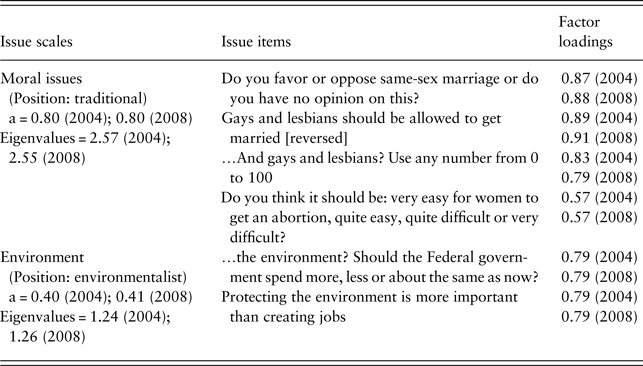
The 2004 and 2008 Canadian Election Study (CES) surveys are useful platforms for testing these hypotheses.Footnote 2 Since 1965, the CES has allowed researchers to go beyond the study of vote choice to inspect a wide array of reported attitudes and political behavior. In fact, the 1965 and 1968 Canadian National Election Studies were largely offshoots of the Michigan studies in design. Philip Converse was part of the 1965 team, as he was a member of the Survey Research Center at the University of Michigan (Gidengil, Reference Gidengil1992). Providing high-quality data, the CES is now among the most used datasets in Canadian political science research. It is the Canadian equivalent of other thoroughly mined and well-known datasets such as the American National Election Studies (ANES). The CES questionnaires include all the conventional variables used in electoral behavior studies such as variables about issues, party affiliations, vote intentions and sociodemographic indicators. They also include various measures of political sophistication like education, political information and political interest. The various questions asking respondents how much importance they accord to issues provide our measure of salience. Open-ended questions, like the ones that probe which issues respondents consider most important, prevent an over-standardization of the responses (Kuklinski, Reference Kuklinski, Peyton, Dalton and Klingemann2007). Such a consideration is particularly relevant for exploring the heterogeneity of the electorate. Moreover, these datasets permit us to build multi-item issue scales to assess the potential heterogeneity of positional issue effects in the electorate (Ansolabehere, Reference Ansolabehere, Rodden and Snyder2008). Details about the reliability of these multi-item scales are presented in Table 1. Finally, in addition to the questions that relate directly to the paper's theoretical focus, the CES includes a battery of sociodemographic questions. These were used to assess the robustness of the results by the inclusion of standard control variables conventionally used in electoral behavior models (Lazarsfeld et al., Reference Lazarsfeld, Berelson and Gaudet1948; Campbell, Reference Campbell, Converse, Miller and Stokes1960). When applicable, all models in this article include the full set of statistical controls prescribed by the ‘Funnel of Causality’ theoretical model based on the works of the Michigan and Columbia schools and the research in Canadian electoral studies (Blais et al., Reference Blais, Gidengil, Nadeau and Nevitte2002; Gidengil et al., Reference Gidengil, Nevitte, Blais, Everitt and Fournier2012). All results are robust to the inclusion or exclusion of these control variables.
Issue scales information

Source: Canadian Election Study (CES), 2004 and 2008.
Note: Eigenvalues are for the first factors.
The concept of heterogeneity is not intuitive and it can represent operationalization challenges. One way to detect heterogeneity is to consider interaction terms that capture non-additive effects (Bartle, Reference Bartle2005). Goren (Reference Goren1997) used similar interval-level knowledge scales and similar formal interaction tests to demonstrate the effects of sophistication. In this analysis, positional issues are interacted with the two types of heterogeneity bases. For sophistication-based heterogeneity, interactions between positions on issues and various measures of political sophistication reveal whether issues matter more for politically sophisticated voters than for unsophisticated voters. More precisely, these measures of political sophistication include political interest scales, dummy variables for education levels and a political information scale: three indicators that tap voters’ motivation, ability and opportunity to develop general political sophistication (see Luskin, Reference Luskin1990; Delli Carpini & Keeter, Reference Delli Carpini and Keeter1996).Footnote 3
When assessing salience-based heterogeneity, interactions between issue positions and individual salience probe whether specific interest in an issue is associated with heterogeneous effects of issues on voting behavior. Individual salience is measured using a scale that includes various items tapping the importance respondents accord to a particular issue. The previous literature has suggested that a personal issue importance scale is the most effective way of identifying members of an issue public (Kim, Reference Kim2007). Moreover, the use of such a scale is motivated by the difficulty inherent in capturing the concept of issue salience with a single item. However, the use of only the conventional ‘most important problem’ question to measure importance is problematic (Wlezien, Reference Wlezien2005). It is unclear if this question taps the importance of an issue to the respondent personally or if it simply reflects the respondent's perception of the most publicly discussed issue. Hence, it is important to employ a measure that distinguishes between the fact of being a member of an issue public, which involves having strong feelings toward a specific issue, and detached knowledge of the public issue of the day. This distinction is not always made in the literature. For instance, Lewis-Beck and colleagues (Reference Lewis-Beck, Jacoby, Norpoth and Weisberg2008) consider political information and perception of objective reality on one issue as measures of personal issue salience when, according to Krosnick (Reference Krosnick1990), political information should be a consequence of issue salience. Therefore, members of issue publics are defined by their level of attachment to a particular issue. The use of multi-item scales that include questions asked at different points in the survey and with various wordings provides further foundation for a more valid measure of individual issue salience.
Continuous scales measuring attitudes toward parties are used as dependent variables instead of vote choice because there are so few Green Party voters in the sample. To be consistent, a similar scale is used to evaluate the impact of attitudes toward moral issues on support for the Conservative Party. But note that when vote choice is used as a dependent variable, the substantive results are the same. Indeed, there is a theoretical correspondence between attitude toward a party and vote choice. Despite the fact that the variables are based on different measurement scales – a binary scale was used for vote choice and a continuous scale was used for attitude – there is a strong statistical correlation between the two concepts (p < 0.05). Moreover, since political marketing logic seeks to identify not only decided voters, but also electors having an inclination toward the party, looking at the attitude allows for fine-grained results. However, the substantive conclusions of this paper are not affected by this theoretical choice.
Results
The data reveal evidence of the first two types of heterogeneity. In fact, both help explain the variation in issue voting. However, salience-based heterogeneity has a greater impact on the effect of positional issues than sophistication-based heterogeneity. The evidence thus provides some support for an electorate composed of issue publics.
The issue-public hypothesis stipulates that the effect of issue attitudes on vote choice will differ depending on the level of salience that voters accord to particular issues of interest. One way to test this proposition is to consider those positional issues clearly associated with a specific party: moral issues for the Conservative Party and the environmental issue for the Green Party.Footnote 4 These choices aim to avoid the confusion that disputed issue ownership might have on issue voting – see, for instance, Damore (Reference Damore2004). The conventional wisdom is that for an issue attitude to have an effect on the vote, there must be perceived party differences on that issue (Lewis-Beck et al., Reference Lewis-Beck, Jacoby, Norpoth and Weisberg2008).
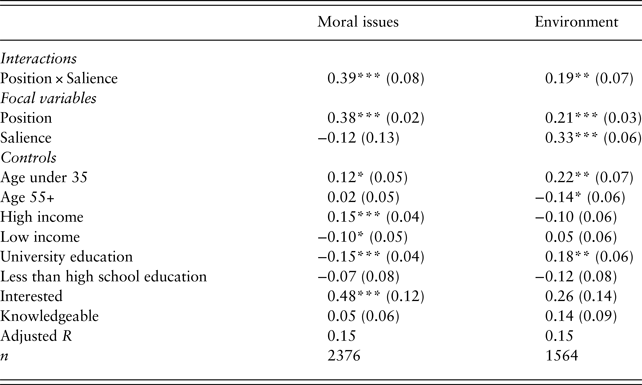
All following figures illustrate the effect of issue attitudes on the predicted level of attachment to a given party. Those predicted probabilities are estimated from least squares regression models whose precise specifications – for instance, regarding the interaction terms used to capture the heterogeneous effects of issues and the statistical controls – and coefficient estimates are shown in Table 2.
The effect of issue salience: full regression results

Source: Canadian Election Study (CES), 2004 and 2008 (pooled).
Method: Least squares regression. Robust standard errors in parentheses.
Dependent variables: Attitude (Conservative, Green). Factor scales.
*p < 0.05; **p < 0.01; ***p < 0.001.
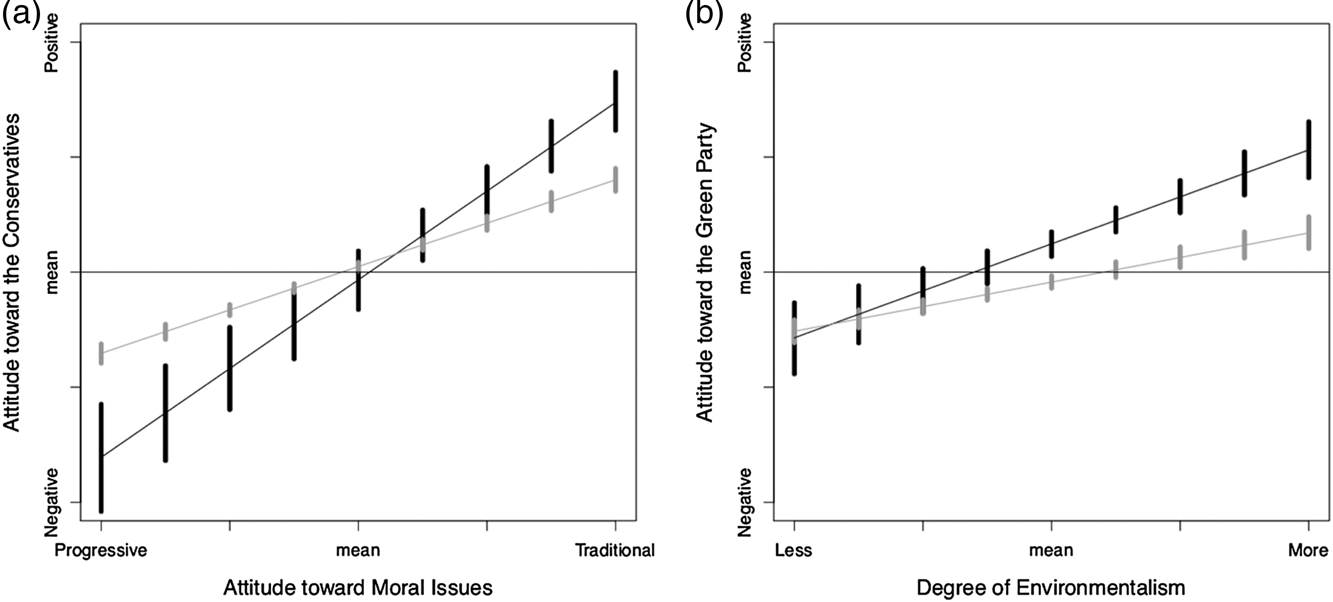
Figure 1 suggests that views on moral issues of those who care a lot about these issues have a stronger impact on evaluations of the Conservative Party than do other voters’ views on moral issues. A similar pattern emerges with individuals’ positions on the environmental issue and their evaluation of the Green Party. On the graphs presented in Figure 1, the darker lines that represent the voters who accord a high level of salience to the issue have a steeper slope than the lighter lines representing the other voters. There is a statistically significant interaction effect (p < 0.01). Heterogeneity appears to influence how issue attitudes can matter for electoral politics. The results in Figure 1, then, provide some support for the issue-public hypothesis. It is possible that these results might mask the effects of sophistication-based heterogeneity in political sophistication. Issue voting, after all, is more pronounced among those with higher levels of expertise (Goren, Reference Goren1997).
The effect of issue salience: issue publics?
Source: Canadian Election Study (CES), 2004 and 2008 (pooled). (a) n = 2376; (b) n = 1564.
Method: Least squares regression (full results in Table 2). Predicted values. Vertical bars indicate 95% confidence intervals.
Dependant variables: Attitude (Conservative), Attitude (Green).
Independant variables: Issue scales (a) Moral issues (Position and Salience); (b) Environment (Position and Salience). Rescaled from 0 to 1.
Controls: Age, Income, Education, Political information and Political interest.
Interactions (Position × Salience): Moral issues (p < 0.01); Environment (p < 0.01).
The darker lines represent the predicted level of attachment to a given party when the issue is salient for voters and the lighter lines represent when the issue is not salient.

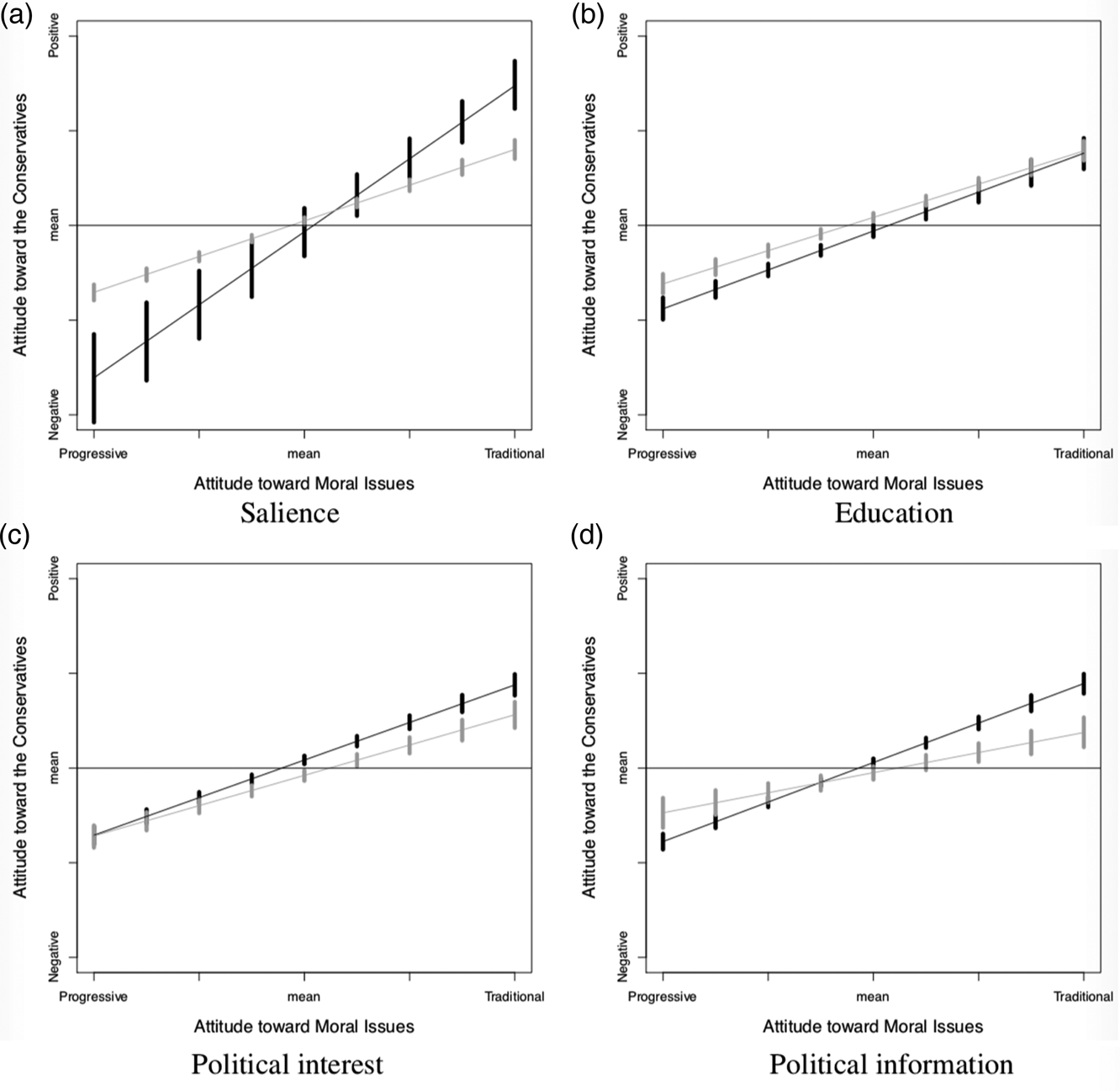
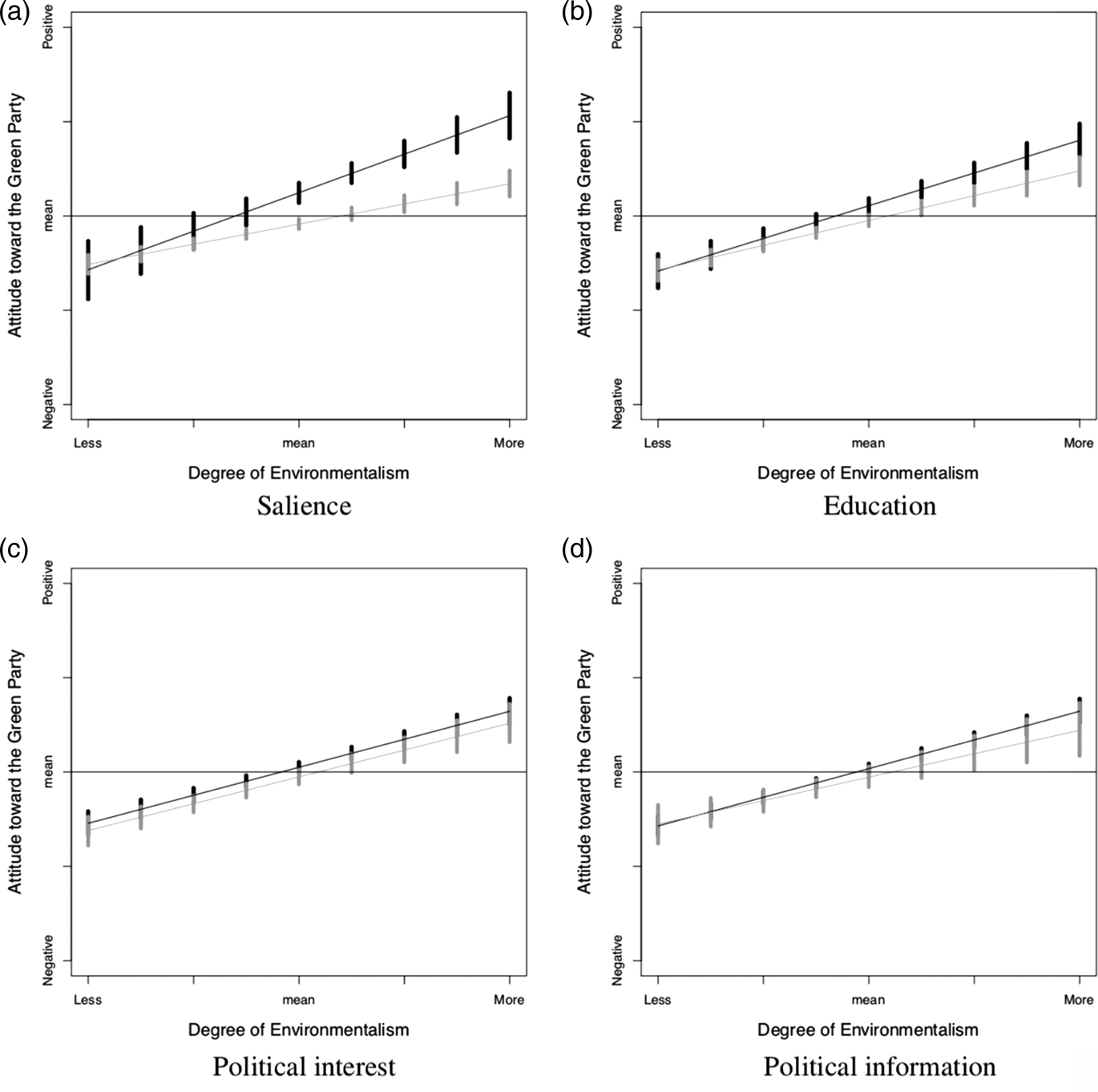
Is it possible that general expertise about politics matters more than specific expertise on an issue? The results reported in both Figure 2 and Figure 3 indicate that sophistication-based heterogeneity also matters. However, the significant finding that emerges from these data is that the personal salience accorded to an issue has a greater interactive effect than different conventional measures of political sophistication.Footnote 5 These measures of political sophistication, tested separately, have different impacts on attitudes toward parties. Figure 2 suggests that an interest in politics has an impact (p < 0.001) on attitudes toward the Conservative Party. Figure 3 suggests that the same effect holds for the impact of education (p < 0.01) on attitudes toward the Green Party. However, the impact of political sophistication is made more nuanced by the absence of statistically significant effects between political knowledge and attitudes toward neither the Conservative Party nor the Green Party. Hence, Figure 2 and Figure 3 illustrate that political sophistication does not always appear to influence the strength of issue attitudes. Thus, if political sophistication can influence issue voting, the impact of salience-based heterogeneity is even stronger.
Sophistication or issue publics (moral issues)?
Source: Canadian Election Study (CES), 2004 and 2008 (pooled). (a)–(d) n = 2376.
Method: Least squares regression. Predicted values. Vertical bars indicate 95% confidence intervals.
Dependant variables: Attitude (Conservative), Attitude (Green).
Independant variables: Issue scales for (a)–(d) Moral issues (Salience and Position). Rescaled from 0 to 1.
Controls: Age, Income, Education, Political information and Political interest.
Interacting variables: Salience (High salience); Education (University education);
Political interest (High political interest); Political information (High political information).
The darker lines represent the predicted level of attachment to a given party when the level of the interacting variable is high and the lighter lines represent when its level is not high.

Sophistication or issue publics (environment)?
Source: Canadian Election Study (CES), 2004 and 2008 (pooled). (a)–(d) n = 1564.
Method: Least squares regression. Predicted values. Vertical bars indicate 95% confidence intervals.
Dependant variables: Attitude (Conservative), Attitude (Green).
Independant variables: Issue scales (a)–(d) Environment (Salience and Position). Rescaled from 0 to 1.
Controls: Age, Income, Education, Political information and Political interest.
Interacting variables: Salience (High salience); Education (University education);
Political interest (High political interest); Political information (High political information).
The darker lines represent the predicted level of attachment to a given party when the level of the interacting variable is high and the lighter lines represent when its level is not high.

Discussion
The findings presented in this article suggest that positional issue effects vary as a function of the extent to which some individuals care about a particular issue. While different positional issues might have a negligible effect on voting behavior at large, they seem to have substantial effects on the voting behavior of the particular groups to whom they are salient. This heterogeneity of issue effects can thus be labeled ‘salience-based heterogeneity’.
The data also demonstrate that there is an unequal distribution of issue attitudes among citizens. That is to say, following the issue-publics hypothesis, people differ in the extent to which they have sophisticated issue attitudes. This attitudinal heterogeneity, however, does not simply reflect the classic elite–mass divide on political sophistication. The Black-and-White model of the electorate elaborated by Converse (Reference Converse and Tufte1970) has been shown to be more complex. Simply put, on the same issue, an elector (A) could act as predicted by the social-psychological approach, while another one (B) could act as predicted by the rational choice model and change his or her vote according to that issue. However, one needs to realize that to distinguish voter A from voter B, we need to detect and measure the salience of the issue we are interested in. Citizens’ knowledge about different political issues varies as a function of the extent to which they care about those issues. Thus, political expertise can be fragmented and dispersed across various issue publics. The goal is certainly not to tear down and replace well-established theories. To be clear, the existence of issue publics does not undermine the need for political parties to elaborate strategies based on valence issues or the state of the economy (Clarke et al., Reference Clarke, Kornberg and Scotto2008; Vavreck, Reference Vavreck2009). Political parties must still elaborate such strategies. However, they can, at the same time, target precise voter segments. By doing so, macro-campaigns that focus on country-wide strategies and micro-campaigns that target specific issue publics can coexist.
Thus, despite the existence of a horizontal fragmentation of political sophistication, an elitist view of the electorate still holds. Variables measuring political sophistication are all found to consistently impact voters’ choices. Certainly, the effects of structural variables such as education must be considered when attempting to uncover the underlying composition of voting behavior. However, it is reasonable to suppose that the fragmentation of the workplace and the media environment have corresponding effects that make the electorate less homogeneous. In a multichannel universe, voters have more opportunities to avoid topics that do not interest them and focus on topics that do interest them. Exposure to mass media narrows the knowledge gap between the elites and the general public (Kwak, Reference Kwak1999). In that regard, Druckman (Reference Druckman2014) advocates a stronger focus on motivation rather than opinion substance when exploring ‘competence’ and conceptualizing what might be the ‘ideal standard citizen’. And it is possible, as Baum (Reference Baum2002) argues, that soft news motivates politically uninvolved voters to become more interested in specific political issues, such as foreign crises. Even Zaller (Reference Zaller1998) acknowledges that his previous works might have exaggerated citizens’ lack of competence. After seeing Bill Clinton's approval rating improve in the midst of the Monica Lewinsky scandal, Zaller concluded that citizens might actually be better at handling political substance than he had originally thought. Moreover, Kuklinski (Reference Kuklinski and Segura1995) showed that concerns over some issues such as abortion can emerge from the grassroots level. The voice of the people might thus be more than an echo. Those findings are consequential because of their potential impact on electoral strategy research. In any case, if some positional issues matter for specific subgroups of voters – but not for others – political parties have incentives to devise targeted campaign strategies. Though positional issues might only explain a small percentage of overall electoral change, small percentages can be decisive. Therefore, political marketers have every incentive to look at issues and their individual salience as a basis for market segmentation strategies.