Mountaineering is a dangerous activity. For many mountaineers, part of its very attraction is the risk, the thrill of danger. Yet mountaineers are often regarded as reckless or even irresponsible for risking their lives. In this paper, we offer a defence of risk-taking in mountaineering. Our discussion is organised around the fact that mountaineers and non-mountaineers often disagree about how risky mountaineering really is. We hope to cast some light on the nature of this disagreement – and to argue that mountaineering may actually be worthwhile because of the risks it involves. Section 1 introduces the disagreement and, in doing so, separates out several different notions of risk. Sections 2–4 then consider some explanations of the disagreement, showing how a variety of phenomena can skew people's risk judgements. Section 5 then surveys some recent statistics, to see whether these illuminate how risky mountaineering is. In light of these considerations, however, we suggest that the disagreement is best framed not simply in terms of how risky mountaineering is but whether the risks it does involve are justified. The remainder of the paper, sections 6–9, argues that risk-taking in mountaineering often is justified – and, moreover, that mountaineering can itself be justified (in part) by and because of the risks it involves.
1. Disagreement about risk
It is common for mountaineers to find themselves in disagreement with non-mountaineers about the degree and nature of risk involved in mountaineering. On the one hand, many non-mountaineers have a certain image of a mountaineer in mind, one often ‘informed’ by stereotypes of a risk-seeking climber. On the other hand, while mountaineers usually acknowledge that there are risks, they tend to regard these as ‘acceptable’ and suggest that non-mountaineers often overestimate them. After all, they urge that competence and experience reduce the risks – and the remaining risks are worth taking: it is such things as the spirit of adventure, the beauty of remote places, the aesthetic of movement, and the comradeship of the rope, say, that not only motivate their risk-taking but also make the risks worth it.Footnote 1
Let us dwell on this disagreement a bit. There are two common ways to resolve a disagreement. One is to show that (at least) one party is mistaken. The other is to dissolve the disagreement by showing that the different parties are not actually disagreeing; in the present context, for instance, one could demonstrate that they are actually employing different notions of ‘risk’ and are therefore talking past one another. We will discuss the second option first.
It is common to distinguish different aspects of risk. One aspect concerns the likelihood that a certain event occurs. There is also a loss aspect: an event is risky if its occurrence would bring a significant loss. Most often, risk is viewed as a combination of these: something's being risky depends on both the likelihood of its occurring and the seriousness of the loss were it to occur. Lastly, there is also a more psychologistic notion of risk: risk is often associated with feeling out of control. People don't always clearly distinguish these different aspects.Footnote 2 Thus, there could be occasions when disagreements between mountaineers and non-mountaineers are explained by the fact that they are deploying different notions of risk and hence are talking past each other. However, we doubt that all such disagreements can be explained away like that. When they cannot be so explained, further work is required to resolve the disagreement.
In the following, we treat risk as a combination of the likelihood of an accident occurring and the significance of the resulting loss. Then, it seems, the disagreement about risk in mountaineering will be due to conflicting judgements about at least one of these two ingredients. Before turning to the likelihood aspect, we'll briefly consider the loss component.
One possible thought here is that many mountaineers may actually judge the prospect of injury (or even death) more acceptable than many non-mountaineers do. For one thing, mountaineers may hear about climbing-related injuries and simply come to regard these as ‘part of the game’ they love. Importantly, though, they also hear of fellow climbers recovering from serious injuries and returning to the sport. This may in turn ‘desensitise’ mountaineers in ways that make commonplace losses appear less serious. Thus, the thought goes, conflicting risk verdicts might sometimes be explained by differing views about how bad bad outcomes actually are. However, we think that there are also likely to be other, more relevant explanations for the disagreement. We'll now turn to the likelihood aspect.
2. Heuristics and biases when judging mountaineering risks
Given that relatively few people (mountaineers or not) actually study statistics about the relation between mountaineering and risk, when making judgements about those risks it seems that we naturally rely on certain ‘heuristics’: useful shortcuts that help us reach conclusions efficiently, including (for our purposes) conclusions about the likelihood of an event occurring. Although these shortcuts may yield adequate judgements in many cases, they can sometimes result in inaccurate judgements or biases.
Psychologists have identified a number of such heuristics. The first we'll look at is the so-called availability heuristic. Footnote 3 The idea, roughly, is that when people face difficult questions about the frequency of a category – numbers of dangerous plants, divorces among couples over 60, or, more relevantly, deaths while mountaineering – people often think of relevant instances of this category by retrieving them from memory. In cases where the retrieval is easy and straightforward, people tend to think the category has many such instances. In cases where instances aren't so easily obtained, people tend to think there will be fewer instances. However, the easiness of recalling such instances might not always be a very good guide to judging frequencies. In the present context, given that mountaineering disasters make for good newspaper headlines and are often widely publicised (even made into movies), it becomes fairly easy to recall instances that exhibit the dangers of mountaineering. And since non-mountaineers can readily retrieve such disasters from memory, this might lead them to overestimate the risks in mountaineering. This is not to say that they definitely do overestimate the risk (we will look at some statistics later) but rather a warning that the intuitive mechanism people use to judge those risks might be less reliable than they realise.
Another relevant factor is imaginability. In their original article, Kahneman and Tversky mention the following case:
Imaginability plays an important role in the evaluation of probabilities in real-life situations. The risk involved in an adventurous expedition, for example, is evaluated by imagining contingencies with which the expedition is not equipped to cope. If many such difficulties are vividly portrayed, the expedition can be made to appear exceedingly dangerous, although the ease with which disasters are imagined need not reflect their actual likelihood.Footnote 4
Such considerations could help explain why people tend to overestimate the likelihood of accidents in mountaineering, though they will not explain why mountaineers and non-mountaineers differ in their judgements. However, a further heuristic, the so-called affect heuristic, expands on the imaginability idea and may help to explain this disagreement. According to the affect heuristic, it is not only the ease with which climbing disasters come to mind that affects our risk judgement, but also our emotional reactions to those disasters. Death in mountaineering conjures up frightening images of long falls leading to horrid injuries, or of long and painful suffering before dying. In short, to die in mountaineering is to die a gruesome and often lonely death; and such thoughts can exacerbate fear. The affect heuristic describes how our risk judgements are influenced by such emotional reactions. We here have a case where the difficult question about the actual risk in mountaineering is substituted by the easier question of how one feels about the activity (especially in light of the bad outcomes one might conjure up). What the affect heuristic implies is that the disagreement with respect to mountaineering risks might not merely be a disagreement about the presumed likelihood of a bad outcome but that it also involves an important emotional dimension. Non-mountaineers, who have no positive emotional attachment to the activity and who might recall only emotionally distressing outcomes, are likely to judge the risks higher than mountaineers.Footnote 5 Hence, the affect heuristic may explain why mountaineers and non-mountaineers differ when judging the risks.
3. Media bias and risk
In addition to the above heuristics, there are further elements that may help explain the disagreement. There is, in particular, an important element of media bias. Due to widespread media-coverage, many non-mountaineers are aware of numerous mountaineering fatalities. To name but a few: Mallory's ill-fated 1924 Everest expedition; the 1996 disaster on Everest when eight mountaineers died; and the 2012 tragedies on both Everest and Mont Blanc (four mountaineers died on Everest, nine from a single avalanche on Mont Blanc). It is fair to say that most mountaineering related news a non-mountaineer receives concerns the dangers it involves. Yet comparatively few mountaineering successes (or even great achievements) are mentioned in national media. For example, the Piolet d'Or – the most prestigious award for outstanding mountaineering achievement, given on a yearly basis – hasn't been covered by the BBC news website.Footnote 6 Typically, we only hear about successful mountaineering endeavours when a new ‘record’ is set (the youngest or oldest or fastest alpinist to ascend a well-known peak, say) or when the first 3G phone-call is made from Everest's summit. Mountaineers, though, are more likely to hear about a wide range of impressive achievements (through specific climbing media, friends, and so on).Footnote 7 Given another feature of our cognitive life, namely that humans have a tendency to regard the evidence they have as all the evidence there is,Footnote 8 this media-bias may explain why non-mountaineers judge the activity very risky.
In addition, as Nick ColtonFootnote 9 nicely observes, there is a further side to mountaineering that rarely makes it into current media and that many non-mountaineers are unaware of. Colton distinguishes two ‘models’ of a mountaineer. There is a conqueror-model, on which mountaineers are goal-oriented conquerors – very much the type of figure that might make it into the news and sustain common stereotypes. But there is also a connoisseur-model. Here, the mountaineer is less goal-oriented and is not climbing at the limit of her ability; she instead climbs less risky routes and is motivated largely by aesthetic considerations (of movement, or beautiful surroundings, say). While non-mountaineers often know little about the connoisseur-model, most mountaineers move from one model to the other and thus have a more informed, indeed balanced view of their activity. As a result, mountaineers are likely to judge mountaineering as a whole less risky than someone who is exposed only to popular media conceptions of it.
4. Risk, uncertainty, competence
The final aspect we'll consider when it comes to explaining disagreements about the degree of risk concerns mountaineers' competence. By climbing regularly, mountaineers become more ‘in tune’ with the risks involved, developing the skills to identify, assess and manage them. When a non-mountaineer looks at a rock face and thinks it crazy for anyone to climb, a competent climber might see an established and well-protected route on immaculate rock and rightly judge it not very risky. What for a non-mountaineer will seem an unquantifiable uncertainty, and hence be judged too risky, may to a mountaineer's eye present a more specifiable and indeed lower risk. Hence, competence plays an important role in making informed judgements about mountaineering dangers.Footnote 10
So far we have offered different ways to explain how the disagreement about risk in mountaineering can arise. These explanations combine nicely to offer a multifaceted picture of the possible sources of disagreement. However, we haven't settled yet who is correct in their risk judgement. It is now time to have a look at some recent statistics and to discuss how they might help adjudicate whether non-mountaineers overestimate the risks or whether mountaineers underestimate them.
5. Accident statistics
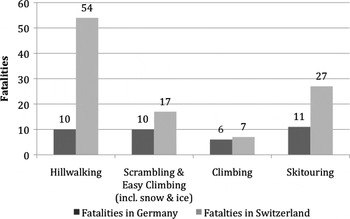
Statistics available from European Alpine Clubs usually only provide the number of accidents (including deaths) that occur in mountains. To properly evaluate the risks involved, however, this isn't enough. To see why, let us look at the fatalities involved in the following activities in Germany and Switzerland in 2010:Footnote 11
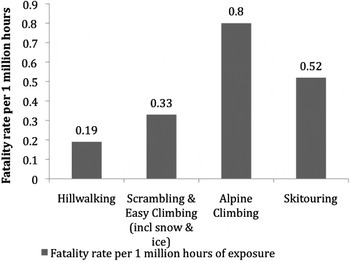
What is surprising is that hillwalking results in more fatal accidents in Switzerland than the other activities listed here combined (in that year)! However, the total number of accidents is not a good indication for how dangerous the activity is, unless we have some indication of how many people are engaged in it. Even then, there are further difficulties. We cannot straightforwardly use the population of Swiss hillwalkers as a base class, since many people who hillwalk in Switzerland come from other countries. Moreover, finding out how many people go hillwalking in Switzerland is not enough: some may go hillwalking every week, others once a month, and so on. So, to more accurately quantify the dangers across these activities we would need to know how many fatal accidents occur per day (or even hour) spent doing them.Footnote 12 Unfortunately, there are very few such statistics. Nonetheless, the following was published by the German Alpine Club:Footnote 13
It is important to note that, although Table 1 suggests that hillwalking (in Switzerland) has surprisingly many deaths in comparison to the other activities listed, when normalised to hours spent (as in Table 2) alpine climbing has a considerably higher fatality rate (amongst members of the German Alpine Club). Now there may be a temptation, when assessing the risks of the activities listed under Table 2, to compare these with the fatality rates (per hours of exposure) for other (non-mountainous) activities. And doing so may appear to deliver some surprising results: cycling (~0.46)Footnote 14, motorcycling (~3.42–8,5)Footnote 15, competitive marathon running (~1.5)Footnote 16, swimming in New South Wales (Australia) (2.5)Footnote 17. This certainly looks surprising: alpine climbing and mountaineering aren't as dangerous as these other (supposedly more mundane) activities! However, much care has to be taken before reading too much into such comparisons. Here are some reasons why: Firstly, the statistic is based on members of the German Alpine Club, who have easy access to affordable outdoor education and training. So we may assume that the sample is biased towards more informed, better trained mountaineers.Footnote 18 Secondly, the statistic is based on German Alpine Club members, who, we may assume, pursue their activities mainly in and around Germany; yet most of the higher and more dangerous alpine ranges lie outside Germany. So, we surmise, the above statistic may underestimate the risks of mountaineering in general and might not yet provide a solid basis for comparison with non-mountaineering activities.
Table 1.

Table 2.

Furthermore, it would be wrong to conclude from this that mountaineering isn't dangerous. For one thing, there are ‘many games climbers play’:Footnote 19 high-altitude climbing, fast and light alpine climbing, big wall climbing, ice climbing, ski-mountaineering, sport climbing, soloing, and more. And there are different ways to play these games – as connoisseurs or conquerors, for instance. These different games and ways to play them have very different associated risks. On the one hand, for instance, the fatality rate for climbing Denali (6196m) is roughly 6.3 fatalities per 1 million hours exposure time;Footnote 20 and the results for some other high-altitude routes will likely be even worse. Yet on the other hand, other climbing activities – like sports climbing and indoor climbing, which often involve quite long falls – have a low risk of injury and death.Footnote 21 So, what can we take from this and how can it inform the above disagreement?
While the German study may suggest that mountaineering considered as a general activity (encompassing all different sub-disciplines, including alpine climbing and skitouring) are not as high-risk as often thought, there is no denying that some specific mountaineering games are (statistically speaking) very dangerous.Footnote 22 Could this observation be used to explain the disagreement between mountaineers and non-mountaineers?
Maybe there is a story that can be told here that would dissolve the disagreement: perhaps mountaineers are correct with respect to the overall activity, whereas non-mountaineers are correct with respect to some quite specific mountaineering games. Hence, they are not really disagreeing because they are making judgements about different things. But even so, there may be a way for non-mountaineers to maintain that mountaineering as a general activity is too risky, even assuming that accident rates are fairly low. The thought is this: Whether mountaineering is too risky doesn't depend merely on the fatality or injury rate, but is rather a matter of whether the kinds of risks mountaineers willingly take on are justified. Hence, the judgment that mountaineering is ‘too risky’ is best explained as a normative judgement (justification being a normative notion). This, we suspect, may be what really underlies the disagreement.Footnote 23
To motivate this concern consider, by way of contrast, the case of marathon running: here most fatalities are caused by cardiac arrest, due most likely to an underlying genetic disposition. Such deaths are not foreseeable or ‘to be expected’; and a competent runner wouldn't ordinarily be to blame for putting herself at such a risk.Footnote 24 Yet, so the charge might go, mountaineers knowingly put themselves into a risky situation: there is always the possibility of a minor slip, a little stumble that ‘so easily happens’ (yet, statistically speaking, rarely does) but that can kill you. There are also objective dangers when crossing glaciers, traversing underneath seracs, or climbing a rock face. Of course, these can be minimised by experience, competence, good equipment, paying attention to reliable weather forecasts, and so on. Nonetheless, there are always residual risks and taking these on is, to put it crudely, no different than taking part in a lottery – in which most people ‘get away with it’ but those who don't lose their lives on a gamble. Of course, such tragedies rarely happen, and the risk might be minimal in many cases (even though they are easily imagined and there are many stories involving ‘close-calls’). Still, perhaps, we should expect them to happen. Given this, taking on the risks in mountaineering isn't justified; and a climber is ultimately reckless for risking her life on a gamble.
6. Risky, Despite and Because: three claims about risk and justification
The suggestion, then, is that the disagreement between mountaineers and (informed) non-mountaineers may not be simply about how risky mountaineering is, but whether the risks it does involve are justified. Assuming so, let's characterise the objection to mountaineering as follows:
[Risky] Mountaineering is not a justifiable activity; and that is because of the risks it involves.
In the rest of the paper, we takes issue with [Risky] and argue that mountaineering can be (i.e. sometimes is) justified. If our arguments are plausible, this will help resolve the disagreement about mountaineering risks in favour of mountaineers.
Now one way to oppose [Risky] is to claim that mountaineering is justified despite the risks it involves, since the disvalue of those risks is counterbalanced by various other goods mountaineering offers. We'll call this ‘[Despite]’:
[Despite] Mountaineering endeavours can be justified; when they are justified, they are justified (a) despite the risks they involve, and (b) by the further goods (distinct from risk) they bring (not by the risks themselves).
[Despite] appears to have become something of an orthodoxy in the few academic discussions on this topic.Footnote 25 However, we think that [Despite], even though it gets to the (correct) conclusion that mountaineering is justifiable, gives the wrong explanation for this. In what follows, we'll therefore challenge orthodoxy by arguing that risk is one of the things that actually gives mountaineering its value, whereby mountaineering has the value it does in part because of the risks it involves. We'll argue for this in Sections 7 and 8. Section 9 then uses this to get to the following conclusion:
[Because]: Mountaineering endeavours can be justified – (in part) because of the value that engaging with mountaineering risks has.Footnote 26
Our arguments for [Because], if defensible, will in turn undermine [Risky]. In defending [Because], our claim is that it is partly in virtue of the residual risks associated with the possibility of injury or death – due to falling, getting lost on a big face, or failing to overcome the physical challenges – that mountaineering is valuable and sometimes justified.
7. The role of risk
We'll begin our case by noting four assumptions. First, mountaineering does involve some risk. Second, mountaineers know this, yet knowingly and intentionally put themselves into risk situations by mountaineering. Nonetheless, and third, they typically put themselves into situations in which they believe the risks are ‘acceptable’ – situations in which they believe they can (and will) reduce or otherwise control the risk to (what they judge is) an ‘acceptable level’.Footnote 27 Fourth, good mountaineers are generally competent at assessing the risks of the climbs they undertake. These points are important. They allow us to say that, although mountaineers intentionally put themselves into risk situations, insofar as they are competent at judging whether the risks are acceptable they need not be the foolhardy risk-seekers commonly portrayed by popular media.
To help motivate our views about the value of risk, we'll contrast them to a line of thought recently pushed by a proponent of [Despite]. Kevin Krein argues that mountaineering can be worth doing, despite the risks, given the value of various other goods it realizes.Footnote 28 Such goods include, on the one hand, interacting with nature, the opportunity to challenge oneself, freedom from certain rule-governed aspects of social life,Footnote 29 and, on the other hand, certain ‘experiential goods’ like pleasure and exhilaration, and attending senses of personal fulfilment.Footnote 30 Realizing such goods may require taking certain risks. Nonetheless, Krein believes, risk-taking is only a means to these other (independently specifiable) goods and has no real value aside from that. Hence we get a version of [Despite]: the value of mountaineering consists in a range of goods that are distinct from (specifiable independently of) risk and that do not depend for their value on risk itself having any (non-instrumental) value.
Now we agree that mountaineering can be valuable in virtue of the various goods Krein recognises. However, we doubt that the experiential goods he mentions, when they come from mountaineering, can be so easily separated from the risks involved in mountaineering. To see why, it will be useful to outline a central part of Krein's argument for [Despite]. Krein supposes that what motivates mountaineers to climb gives a good indication of what is valuable about mountaineering. Mountaineers are often motivated by experiential goods like exhilaration. However, he believes, it is not the risk as such that motivates, because there are much easier ways to get the kinds of experiences to which risk-taking in mountaineering gives rise.Footnote 31 And thus, since one could get these experiential goods without mountaineering, the value of mountaineering must lie in something other than the risks it involves – for instance, the experiential goods it brings. Hence we get to a version of [Despite].
However, we think it highly questionable whether mountaineers could experience sufficiently similar kinds of exhilaration and fulfilment in ways other than mountaineering. For the kinds of exhilarating and fulfilment mountaineers get from (facing and overcoming the residual risks involved in) mountaineering are typically quite specific to mountaineering: surmounting technically difficult, exposed, or unprotected climbs; being isolated or committed on a big mountain face; the experience of prolonged physical adversity; and so on. Take all these elements away and whatever experiences of exhilaration or fulfilment one might get will be qualitatively rather different from the experience of risk in a mountaineering situation. So, sure, you can get exhilaration from many activities besides mountaineering. But the kind of exhilaration and fulfilment involved in mountaineering is very different from that generated by these other activities – and cannot be replicated by them.Footnote 32
Nevertheless, we can learn from Krein's argument. One of the things we think problematic about it is its underlying assumption that the risks involved in mountaineering are merely means to other, independently specifiable goods – but somewhat unfortunate or undesirable means, whereby mountaineers would eliminate the risks more or less entirely if only they could.Footnote 33 We've implicitly been suggesting an alternative view: risk-taking is constitutively bound up with mountaineering – with both the very activity and the experiential goods like exhilaration it brings. More precisely, risk is not just a means to these other goods but a constitutive and ineliminable part of them; the character of these goods, when realized through mountaineering, is shaped by the risks which can bring them about and that are quite specific to mountaineering. Crucially, then, insofar as mountaineers cannot experience the same kind of exhilaration (say) from other activities, a constitutive ingredient in these forms of exhilaration and fulfilment is the fact that they involve overcoming the risks involved in mountaineering. These ‘constitutive’ theses will be central to our positive account of the value of risk, to which we now turn.
8. The value of risk
We've so far talked rather loosely about the ‘value of (engaging with) risk’. This section clarifies what we mean: first by clarifying what is involved in engaging with risk, second by outlining what it is about engaging with risk that has value, third by explaining what kind of value this is. We'll then be in a position to state our thesis that risk is one of the things that gives mountaineering its value and makes it justified.
First, then, risk is something mountaineers ‘engage with’; and it is this engagement that we'll argue can contribute to the value mountaineering has. But what do we mean by ‘engaging with risk’? One thing it involves is taking a risk. However, risk-taking can go very wrong. For that reason, we are not committing to the claim that risk-taking is always or in all circumstances valuable or justified. Rather, the value of engaging with risk comes from both taking and overcoming risk. However, that's not quite adequate either: someone might by sheer luck overcome a risk that it is exceptionally reckless to take. The central case in which engaging with mountaineering risks has value, we therefore suggest, is when the risk is taken and overcome competently. There are several things such competence involves; we'll mention two. First, the risk-taker must be warranted in believing, given the evidence available to her, that the risk is not unacceptable (where that evidence includes evidence about both the intended route and her own abilities) – i.e. is something she has the skill to overcome.Footnote 34 Second, the process of taking and overcoming the risk must be executed with a sufficient degree of mountaineering skill. For short we'll call this ‘competent risk-engagement’. Risk-taking is of course an essential component of competent risk-engagement. And, we want to say, risk-taking itself can have value. Its value, however, typically depends on the risks being overcome competently.
Second, if risk-taking in mountaineering has value that is because of the role it plays in relation to various other features of mountaineering which themselves have value. What features do we have in mind?
On the one hand, they include quite general goods to which mountaineering gives expression – goods commonly associated with impressive and admirable human achievements: adventure and exploration, overcoming challenges few are capable of meeting, the telling of incredible skill and determination, and so on.
On the other hand, risk-taking is good in relation to the value of (what we'll continue to label, subject to some provisos to follow) certain ‘experiential’ goods. Two are particularly notable. One is that risk-taking can make one ‘feel alive’ and ‘in the zone’. This may take multifarious forms. It can involve a supercharged adrenaline rush; but it can also have a more serene, meditative and sublime exhilarative quality. In either case, the experience often involves a heightened focus upon and appreciation of both yourself and your surroundings, in which salient features of your situation take on an intensified quality – yet a kind of ‘wholeness’ in which you are not only vividly aware of both yourself and your surroundings, but feel ‘at one’ with all around you. These quite intense experiences of utter exhilaration often extend long after the real danger is over and can give rise to a sense of personal fulfilment.Footnote 35 A second value – one that particularly to attends overcoming mountaineering risks competently – concerns the ways mountaineers experience themselves as agents. Again this has numerous dimensions. It can involve quite simply experiencing yourself as an effective agent: in general terms, you achieve the things you set out to achieve by competently overcoming the risks constitutive of the challenges you set yourself; at a more specific level, the experience of moving competently (fluently, in control) through the medium in which you are climbing gives rise to a deeply gratifying experience of effective agency. Furthermore, it can involve expressing, through the activity of climbing, something about who you really are and what is deeply important to you; indeed, many mountaineers talk about how climbing is something they need to do in order to be who they really are. This, plausibly, is why they get a deep sense of exhilaration and fulfilment from mountaineering.Footnote 36
Two further points about the value of these experiential goods. First, we want to say, in the context of risk it is not just the experience (of exhilaration, say) that is valuable but the experience that is produced by actually taking and overcoming risks. Second, these valuable experiences can in turn be constituents of more general abstract goods, like wellbeing and fulfilment: a person may be more fulfilled in virtue of the experiences yielded by competently engaging risk.
So far we have shown that competently overcoming risk in mountaineering is related to a variety of values involved in mountaineering: engaging in adventurous activities, overcoming challenges, expressing one's agency, exhilaration, fulfilment, and so on. These are general goods that almost everyone agrees have value. All this is compatible with [Despite], however. But there are two additional and crucial claims that distinguish our view from [Despite]: First, risk is a constitutive and ineliminable element of mountaineering and the character of the experiences it brings (we argued for this earlier). This implies that, if the risk were completely absent, the activity engaged in wouldn't really be a form of mountaineering and the experiences produced would not be experiences of mountaineering. So, since the value of mountaineering depends in part on the character of the experiences it brings, the value of mountaineering depends (in part) on the risks it involves. We thus arrive at our second crucial claim: mountaineering and the goods it brings have the particular type of value they do (in part) because of the risks they involve. This is distinct from [Despite], since risk is not a mere (causal) means to the various mountaineering goods we've identified. Rather, risk is a constitutive and ineliminable part of the goods themselves: the character and content of these values, as realised through mountaineering, is essentially shaped by the mountaineering risks they involve. It is in this sense that mountaineering has the value it does (in part) because of the risk it involves.Footnote 37
To summarise our argument so far, then: risk is valuable (in part) because of the goods it realizes – goods that need not be specific to mountaineering, but that are widely recognised as good by non-mountaineers too. But these goods, when realized in the context of mountaineering, have the particular value they do only because they involve competently engaging mountaineering risks. Thus, risk is one of the things that gives mountaineering its value, whereby mountaineering has the value it does in part because of the risks it involves.
9. Because it is risky
If defensible, this undermines [Risky]. [Risky] claims that, because of the risks involved, mountaineering is not justified. But we've argued that risk is one of the things that gives mountaineering its value; and it is hard to see how something which gives mountaineering its value could also serve to render it unjustified, especially when the risk is overcome competently and the mountaineering goods it is constitutively bound up with are widely acknowledged (by both mountaineers and non-mountaineers) to be valuable. So, [Risky] as a general thesis looks false. Note, though, that we have argued against [Risky] without recourse to the orthodox approach embodied by [Despite]. Indeed, given that risk is a constitutive and inseparable part of mountaineering and the goods it brings, [Despite] is wrong to suggest that the value of these goods is independent of risk.
It may be objected that our arguments (assuming they are successful) do not get us to [Because], however. For one thing, although these arguments may show that mountaineering is not unjustified, they do not show that it is justified; furthermore, the argument of the last section delivered claims about the value of risk, whereas [Because] is a claim about justification. In response, though, we will here repeat the suggestion that competently engaging risk by mountaineering expresses and realizes important human values. Given that, it is then hard to see what the objection might be to the claim that mountaineering is justified (in part) because of the risks it involves. For why could mountaineering never be justified, insofar as (a) it is undertaken and completed competently, and (b) it expresses and realizes deep human values? To sustain the objection against moving from the denial of [Risky] to [Because], one would need to give an adequate answer to that question. Such an answer, we submit, looks unlikely.
Note, in conclusion, that our arguments also place competent mountaineers in rather a strong position when it comes to the disagreement with non-mountaineers about the risks the activity involves. On the one hand, if the disagreement concerns how risky mountaineering as a general activity is, what evidence there is suggests that it is less extreme or high-risk than many people believe. While, on the other hand, if the disagreement ultimately concerns whether or not the risk-taking is justified, we've argued that it can be. One worry was that the kinds of risk mountaineering involves render it an unjustified gamble. However, we argued that competence reduces the odds of the gamble, and, more importantly, that the kinds of risks the gamble involves are valuable because constitutively bound up with various other goods that everyone recognises. In short, and putting these two points together, risks are sometimes worth taking. We should emphasise here that we are not saying that everyone ought to take mountaineering risks, nor even that competently overcoming such risks will always bring about the kinds of goods we've identified. Rather, sometimes risk-taking in mountaineering is justified. Finally, we've also implicitly provided an answer to the question mountaineers perennially face: ‘Why mountaineer, given the risks it involves?’. Answer: ‘Because it's risky – and sometimes it's good to take risks’.Footnote 38