Korea has long been recognized as host to an English ‘fever’ (Kim, Reference Kim2013; J. K. Park, Reference Park2009; Shim & Park, Reference Shim and Park2008), the intensity of which is such that ‘the entire nation, from the president to average citizens, is emotionally and discursively invested in globalization and English language education’ (Lee, Reference Lee2011: 146). Many universities have minimum TOEIC/TOEFL scores as a graduation requirement (J. S. Y. Park, Reference Park2009: 42), and of Koreans who took the TOEIC exam in 2016, more than eight out of ten were re-taking the test (Educational Testing Services, 2017). It was estimated that by 2006, Koreans were spending up to $752 million a year on English proficiency tests alone (Song, Reference Song2011: 38). The question of who is able to speak English is clearly not a trivial one.
This case study examines the ways in which four working-class Koreans are discursively constructed, by both Korean society and themselves, as non-English speaking, despite possessing relatively high levels of communicative competence in English. I argue that the discourse of standardized English tests, in combination with popular discourses of segyehwa (globalization), contribute to my study's participants’ obsession with English, as well as their sense of inadequacy regarding their own command of the language. The result is that they are discursively constructed, and discursively construct themselves, as non-English speakers. I choose to focus especially on the self-narrative aspects of discourses of English because the public/popular discourses of English in Korea have been explored with some vigor in recent years (see Park & Abelmann, Reference Park and Abelmann2004; Lee, Reference Lee2006, Reference Lee2011, Reference Lee2016; J. S. Y. Park, Reference Park2009, Reference Park2010; Song, Reference Song2011), and the gatekeeping functions of English have also been documented to some degree (see Song, Reference Song2011; Piller & Cho, Reference Piller and Cho2013). However, working class individuals’ interactions with and perceptions of English remain relatively little explored (with the exception of Lee's Reference Lee2016 piece on elderly working-class Koreans’ perceptions of, and attitudes toward, English).
In light of the distribution of English in Korea across class lines (see Lee, Reference Lee2016), more research is needed that addresses the experiences of non-elite and non-middle class Koreans, who have been largely overlooked in the Anglophone literature. This paper seeks to begin to address this omission by examining as a case study the experiences of Korean English learners who lack the capital (both cultural and financial) necessary to study abroad, attend expensive private academies (hakwon), and engage in the other forms of middle- and upper-middle-class consumption of English that have been discussed previously (Kang, Reference Kang, Plüss and Kwok-bun2012a, Reference Kang2012b; Park & Abelmann, Reference Park and Abelmann2004; J. S. Y. Park, Reference Park2009). The four participants in the case study are working-class Koreans whose interactions with English are mediated through their labour. Despite all four possessing varying degrees of English fluency necessitated by work, they are uncredentialed; they lack both high levels of education and possession of high English test scores. Thus, they are unable to reap the economic and social benefits of English fluency.
Literature Review and Theory
The majority of the empirical work on English in Korea has focused on the experiences of middle- and upper-class individuals/families (Kang, Reference Kang, Plüss and Kwok-bun2012a, Reference Kang2012b; Park & Abelmann, Reference Park and Abelmann2004; J. S. Y. Park, Reference Park2009). Considering the thousands of hours of English education that the average Korean receives (Kim, Reference Kim2013), it is clear that the majority of Koreans, rather than just a specific subset of the population, have a great deal of exposure to English learning. In addition, it has been noted that public discourse surrounding English penetrates deeply into every stratum of Korean society (see Lee, Reference Lee2006, Reference Lee2011, Reference Lee2016; J. K. Park, Reference Park2009; Piller & Cho, Reference Piller and Cho2013).
In discussing discourses of English, this paper takes the position that discourse, ‘defines and produces the objects of our knowledge’ (Hall, Reference Hall, Wetherell, Taylor and Yates2001: 72). English is itself a particular type of knowledge; a social construction that, through social mediation, comes to be reified and accepted (see Fiske & Hancock, Reference Fiske and Hancock2016: 16). When this process is complete, individuals themselves are defined in relation to a social product: English. Evidence of this trend can be found in the fact that individuals’ moral worth and industriousness is tied to their English ability (J. S. Y. Park, Reference Park2010).
One of the primary means through which discourses of English become institutionalized – and in turn shape identity – is through tests. In her work on ‘testing discourse’ and its internalized effects on identity, Shohamy (Reference Shohamy2006, Reference Shohamy2013, Reference Shohamy2014) concludes that ‘tests are powerful tools that play a central role in creating social classes, determining knowledge, affecting distribution of wealth, shaping language policies, and transforming teaching and learning’ (Reference Shohamy2013: 226). Indeed, because tests gatekeep access both to entering university, as well as graduating (J. S. Y Park, Reference Park2009: 42), tests themselves serve to affect the movement and direction of English learning, English deployment, and the identities of those whose who take English tests.
The image of the Korean who passes English tests and yet cannot communicate is riffed on a great deal in Korea (one recent hakwon advertisement features a Korean who literally bursts into sweat while trying to help a foreigner navigate Seoul) and the image of the orally non-proficient Korean is certainly rooted in reality. However, in this study I present the opposite of this stereotypical image; Koreans who are able to communicate orally – who indeed need to be able to do so in order to execute their job duties – yet who cannot pass the tests that in Korea construct one as a proficient English speaker.
Data and methodology
This paper considers four individuals and their experiences with English through the lens of a holistic case study, with each individual an embedded unit within the case study (see Baxter & Jack, Reference Baxter and Jack2008: 550). That is, I treat the four individuals as comprising a single case because of their shared experiences of learning English, enjoying English, and importantly, interacting/using English through labour. At the same time, I consider each individual as a unique subject of analysis within the case study, with divergent experiences and attitudes. Such a conceptualization allows for easy comparison between the four individuals individually, as well as between the case study as a whole and the experiences and attitudes presented in the extant literature.
The use of four individuals whose relationship with English is mediated by the same variable (labour), yet who all have different experiences and attitudes toward English, allows for a process of triangulation (Stake, Reference Stake, Denzin and Lincoln2000: 454) through which each individual's answers can be compared and assessed in relation to the other three. Yin (Reference Yin2003) argues that a case study design should be considered when, among others things, ‘the boundaries are not clear between the phenomenon and context’ (cited in Baxter & Jack, Reference Baxter and Jack2008: 545). Likewise, this study is intimately concerned with the interplay and overlap between phenomenon and context. In this study, the phenomenon is the four individuals’ relationship with English, and the context is their jobs, and Korean society in general. Because of the different discourses of English, it is difficult to assess the complex and multifaceted relationships that Korean individuals have with English, and thus a focus on the way in which individuals discuss their relationship with English is vital to advancing a deeper and more nuanced understanding of English in Korea if ‘English in Korea’ is to be conceptually useful to researchers.
After meeting informally with several dozen people during the summer of 2015, I selected four people for in-depth interviews. I met each multiple times for individual recorded interviews. The interviews were semi-structured, typically lasting 1.5–2 hours, and I recorded our conversations for roughly half of each interview. The pertinent parts of the interviews, including discussions of English, education, and employment, were transcribed and translated with the assistance of an undergraduate student from Seoul National University. The four individuals were chosen because they possessed high levels of communicative competence in English, yet lacked the credentials necessary to demonstrate their proficiency within the Korean context. Three were female, one was male, and all were in their twenties. Hyemin (age 22), had been working at the World University Games (WUG). Minhyeok (age 25) was a barista at a café I used to frequent and expressed interest in my study when I ran into him on the subway. I met Minju (age 22) at a language exchange club, and Emma (age 29) contacted me on a social media site in order to practice her English.
All the participants shared in common a relatively high level of communicative competence, a lack of formal credentialization, a working class background, and a conflicted attitude towards English. All the interviews were conducted in a mixture of English and Korean, featuring near constant code-mixing. It should be noted that once I started audio recording, my interviewees invariably stopped speaking as much English. I posit that their comfort in English during the more casual conversations, and their reticence to use English within the formal confines of a recorded interview, was a result of their awareness and internalization of their discursively constructed non-proficiency.
Results of the Case Study
All four of my participants eagerly took advantage of opportunities to practice English. For example, Minhyeok practised English with, and expressed particular interest in, the English-speaking foreigners who frequented the café where he worked; he would sometimes even break café policy and bring foreigner guests extra drinks or snacks, thereby increasing his likelihood of interaction. Likewise, Hyemin traveled several hours by train from Seoul to Gwangju in order to volunteer at the WUG. Her decision to do so was motivated by the desire to improve her English and pad her resume. She received little incentive to volunteer, besides receiving cramped dormitory housing and money for the bus. In fact, the volunteers were even forced to pay to eat in the athlete village's cafeteria. Considering the considerable workload demanded of her, Hyemin's decision to volunteer speaks to her active and determined pursuit of English. Hyemin's major was English literature and she hoped to someday become an English teacher, a coveted and respected position in contemporary Korea. Despite her English conversation skills and her good grades, she was realistic about her chances of success, and admitted that her English test scores were currently insufficient to reach her goal.
Unlike the other three participants I interviewed, Minju was outspokenly critical of Korea's English education system, which she said focused too much on tests, and not enough on oral proficiency. She noted that she was better at English than her little sister and her sister's friends, despite their more intensive study. Minju noted, ‘My younger sister and my friends have studied English a long time, but they still seem to be afraid of English. People just keep repeating “you have to learn English”, so you don't have an interest in English, but in getting English test scores.’
Minju, on the other hand, was far more interested in using English for communicative purposes, and she admitted that her dream was to someday work for an international NGO. Minju pushed back against being discursively constructed as a ‘non-English speaker.’ Despite her working-class background, she constructed herself as cosmopolitan and confident. She was even attempting to ‘bypass’ English, and was now taking French lessons, at considerable personal expense.
It is important to note that I met Minju at a language exchange club which was frequented primarily by Western men who did not appear at all interested in learning Korean, as well as Korean men and women who very much wanted to practice English, but a majority of whom lacked the financial means to attend hakwon. In this sense, Minju and others at the event were engaged in a type of labour; different obviously than the labour of Minhyeok at the café, but a transactional exchange nonetheless (see Zelizer, Reference Zelizer2000, on labour and intimacy). These were economic exchanges, in which Minju and others were forced to deal with the unwanted advances of men at the event in return for being able to practice English with native speakers. In fact, the opportunity may have been appealing precisely because native speakers, especially white men, are socially constructed as the pinnacle of English ability (Ruecker & Ives, Reference Ruecker and Ives2015).
However, despite the pride that Minju took in her ability to speak English and understand American television shows, she admitted that her English ability was lacking. She eventually confided to me that in a recent job interview, she had spoken English only to have the Korean interviewer tell her that her English was ‘not that good’ and merely ‘average’. This is an example of a case in which the discourse of segyehwa (globalization), which Minju embodies, comes into conflict with the discourse of testing, and the result forces Minju to reassess (negatively) her linguistic identity.
Minju's views and experiences contrast in interesting ways with those of Emma, the last of the participants to be discussed here. Emma had the highest level of spoken competence of the four (as assessed by me), which is in keeping with the fact that she had lived in New York City for three years. Thus, she was exposed to English at a far deeper level than the other three members of the case study. I met Emma several times over the course of summer 2015. She was 29 years old, and was transitioning from work at a hair salon to working full-time at a skin-care facility, where she would work at the front desk in a clerical role. She had attended a small two-year college outside of Seoul, where she said she had studied ‘Art Beauty’. After graduation, she moved to New York City, after which she quickly become a certified hair specialist. She lived in New York City for three years, and spent the majority of those years working at a hair salon at which she used English on a daily basis.
Examining the ways that Emma talked about English is useful in explicating the tension between the different discourses of English. In addition, Emma's discussion of English elucidates the fact that one's linguistic identity is in many ways a by-product of one's geographic location. Included below is an excerpt from my interview with Emma. I have italicized those words which were in English in the original interview. Note the very specific ways in which Emma would code switch between English and Korean, even within individual sentences. Such code-switching is representative of her fluency in oral communication, as she would easily move between English and Korean in an effort to make herself understood. ‘M’ is the interviewer, myself, and ‘E’ is Emma.
M What do you think of English?
E: I love it. I love it so much. It's very comfortable to me. It depends on the … I love speaking English.
M: Why?
E: I don't know how to say … it's more comfortable.
M: What, what -why?
It's just … and have to learn English.
M: Why?
E: Because when Korean company recruits, ummm, what's it called … ’apply’ when you are applying you have to have good English.
[ … a few minutes later]
M: What do you want to do in the future?
E: I want to work for a global company, doing English related work … only if I can.
M: Really? Can you explain more? Which work? Global company? But you don't work for a global company now …
E: My English is not good enough yet.
M: No! Your English is good. You're really good at speaking.
E: But it's not nearly enough. Not enough.
Emma expresses a love for English and her desire to work at an international company, yet is at the same time aware of her socially constructed status as a non-speaker. She has internalized the discourse of globalization, and is eager to pursue a fulfilling career at a global company. However, she simultaneously constructs herself as lacking in English ability. Her comment of ‘not enough’ is not a humble refusal of a compliment, but a heartfelt admittance of defeat in a society in which English competence is most often expressed by test-scores and university certifications.
Emma's case is especially useful in that it illustrates the way in which one can be a competent language speaker in one geographic context, and an incompetent speaker in another. Emma's English was quick and comfortable such that I never struggled to understand her, but her low test-scores meant that she had never even been called in for an interview, despite her enthusiasm for English learning.
Discussion
What is most necessary going forward is that researchers and educators alike recognize that while in theory, ‘English’ is not a monolithic and rigid social product, it may be experienced as such in practice. Therefore, while Emma's English skills can be considered across a spectrum, and measured according to her ability to deploy them in communicatively competent ways, she herself is considered to be a non-English speaker in the Korean context. This is an important distinction. Going forward, it would be useful if researchers would clearly differentiate between English as a theoretical device, symbolizing a wide variety of uses and competencies, and English as a gatekeeping mechanism that is discursively maintained through tests and test scores.
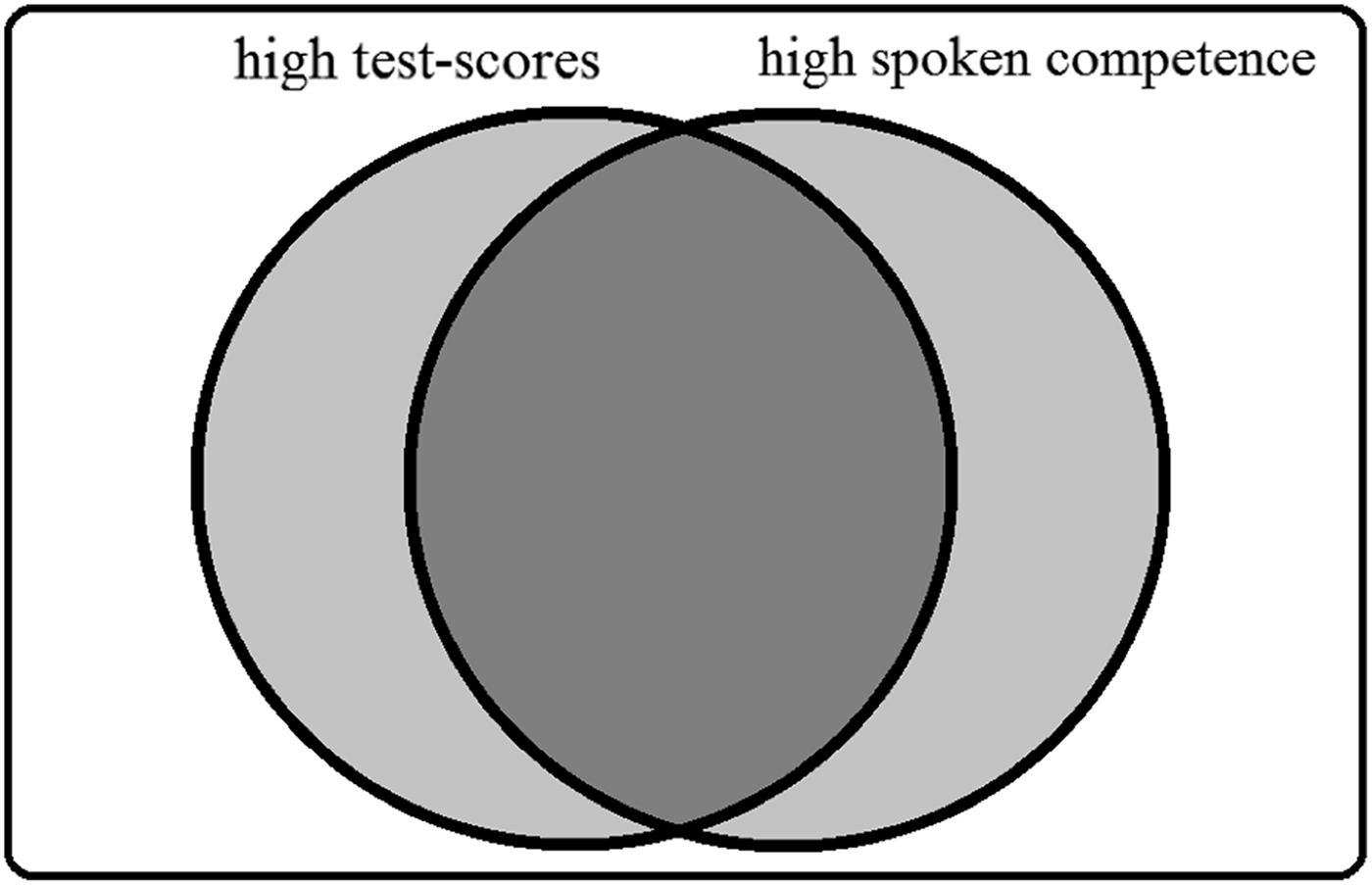
To this end, Figure 1 displays what may be a useful way of illustrating the differences between different English competencies and the way they are discursively constructed. The Venn diagram features two circles. The left of which represents those Koreans with high test-scores, while the right represents those with high spoken competence. There is a large degree of overlap, and the area in the middle represents those who would be considered English speakers both inside and outside of Korea. However, there are some on the far right who, like those in the case study, have oral proficiency, yet are not considered English speakers in Korea. Likewise, on the far left, there is a small population who have extremely high test scores, but are unlikely to be considered English speakers in a non-Korean context. Individuals in the far left sliver are well represented in Korea popular media, depicted as knowing how to read English, but being too shy or slow to understand or produce English sentences orally. Unlike individuals from the left sliver, individuals in the far right sliver are not represented in the Korean media, and, troublingly, are also largely absent from the Anglophone academic literature on English in Korea.
English Competencies

Conclusion
Superficially, the participants in my study seem uninvested in English; they don't attend hakwons, they don't (with the exception of Hyemin) take English tests, and they don't work in a ‘global’ industry. However, English plays a major role in their daily lives, serving an important role in the construction and maintenance of their identities. Their self-worth is tied up in the issue of their English ability, or rather, their socially sanctioned inability. When I first asked Hyemin what she thought about when she heard the word English, she replied at first exuberantly, ‘the world’ but quickly followed with the more somber admittance, ‘something I have to be good at.’ Each of the four participants feels pressure from English, which is discursively necessitated by a globalization that manifests daily in advertisements and presence of foreigners. However, English is also mediated through the discourse of testing, which devalues the four's spoken English competence, and validates only test scores, which are largely a byproduct of intensive (and expensive) preparation in sterile, highly localized (non-global) environments. That English spoken competence is often seen as less important than one's test score is reflective of the fact that second language testing is often less about communicative competence than a measurement of someone's time spent studying English at a hakwon; what McNamara & Roever (Reference McNamara and Roever2006: 210) highlight when they speak of English tests measuring ‘not [their] ostensible construct -communicative language proficiency- but intellectual ability and industriousness.’ J. S. Y. Park (Reference Park2010) and Piller & Cho (Reference Piller and Cho2013) reach similar conclusions in their discussions of English in Korea.
I am not arguing that the findings from the case study of these four individuals can be generalized to the Korean population at large, or even to those Koreans who use English in their jobs in the service industry. In fact, my purpose in sharing this research is quite the opposite; I merely wish to offer insight into the experiences of Koreans whose relationship with English is vastly different than that found in the majority of the Anglophone literature. Indeed, Stake (Reference Stake, Denzin and Lincoln2000: 460) suggests that cases studies can be of great value precisely because they help ‘to establish the limit of generalizability’. Likewise, the differing experiences of these four individuals, despite their shared experience of English-mediated-through-labour, implies the necessity of further research to examine the diversity of experiences that Koreans have in relationship to English. Such diversity of experience may be surprising in light of the apparent uniformity and ubiquity of English education in Korea, but this diversity is itself reflective of conflicting attitudes, opinions, and discourses of English that exist not just between different individuals of varying socioeconomic status, but within individuals themselves.
The participants in my study pushed back against the dominant discourse of English in many ways. They did so most fundamentally through their deployment of the English language on a daily basis. However, as the interview with Emma indicates, they have also internalized the dominant discourses of English to a large degree; their own self-narratives serve to delegitimize their considerable English abilities. However, delegitimization is not necessarily inevitable, the fact that Emma can be a competent English speaker in the U.S. context, and an incompetent one in Korea speaks to the fact that discourses are mobile, transient, and, as Fiske notes, open to contestation (Fiske & Hancock, Reference Fiske and Hancock2016: 16).
In summary, I advocate taking an approach to understanding English in Korea that refuses to essentialize English or assign it a purely utilitarian designation. Paying close attention to the mutability of English and the underlying discourses and power structures that it sustains (the testing/hakwon/gatekeeping system) and is sustained by, is important if we are to understand the full range of experiences engendered by the pervasiveness of English in South Korea.
 NATHANIEL MING CURRAN is a PhD student at the University of Southern California's Annenberg School for Communication and Journalism. He received his MA degree from the University of California at Berkeley, where he focused on contemporary Korea. Currently, his research centers around practices and discourses of globalization, cosmopolitanism, and neoliberalism. He focuses especially on the ways in which these issues are framed by the media and imagined by individuals. Email: ncurran@usc.edu