Introduction
Pisione Grube, 1857 is a genus of scaleless scale worms commonly inhabiting shallow sandy bottoms on sea coasts (Rouse and Pleijel, Reference Rouse, Pleijel, Rouse and Pleijel2001; Gonzalez et al., Reference Gonzalez, Petersen, Di Domenico, Martínez, Armenteros, García-Machado, Møller and Worsaae2017), mainly occurring in tropical Indo-Pacific waters (Yamanishi, Reference Yamanishi1998; Salcedo et al., Reference Salcedo, Hernández-Alcántara and Solís-Weiss2015). It includes 46 recognized species and sub-species, with a few millimetres in length and with over 50 segments. Previously, members of Pisione were considered rare (Hartman, Reference Hartman1959), but numerous species have been recently described, likely indicating a diversity much higher than currently known (Rouse and Pleijel, Reference Rouse, Pleijel, Rouse and Pleijel2001; Aguado and San Martín, Reference Aguado and San Martín2004; Martinez et al., Reference Martinez, Aguirrezabalaga and Adarraga2008).
Male copulatory organs are a key character allowing us to distinguish the species of Pisione. However, they only develop when the worms become sexually mature (Schroeder and Hermans, Reference Schroeder and Hermans1975), and are absent in most specimens. Species identification therefore depends on the careful analysis of non-sexual characters which are not affected by sexual maturity (Gradek, Reference Gradek1991). Besides buccal aciculae ornamentation, these include the type and number of chaetae and the shape of second dorsal cirri, prechaetal lobes and neuroacicula (Yamanishi, Reference Yamanishi1998; Salcedo et al., Reference Salcedo, Hernández-Alcántara and Solís-Weiss2015).
Pisionids have rarely been recorded in benthic surveys along the Indian coastal waters, even though Pisione alikunhi Tenerelli, Reference Tenerelli1965, Pisione complexa Alikunhi, Reference Alikunhi1947, Pisione gopalai (Alikuhni, Reference Alikunhi1941) and Pisione remota (Southern, Reference Southern1914) were described as occurring in the region. The former three are endemic species on the eastern Indian coast (Alikunhi, Reference Alikunhi1941, Reference Alikunhi1947, Reference Alikunhi1951; Tenerelli, Reference Tenerelli1965). This paper reports a new species of Pisione in Palk Bay (southern coastal waters of Tamil Nadu, India), which is fully described and illustrated here. We also provide an updated comparison of all species of Pisione based on key taxonomic characters and a discussion on the genus organization based on morphological characters.
Materials and methods
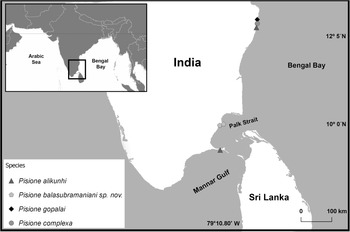
As part of the research project ‘Polychaete diversity of Tamil Nadu coastal waters, southeast India’, sponsored by the Ministry of Environment, Forest and Climate Change (Government of India), the specimens were collected monthly from June 2020 to March 2021 along the Tamil Nadu coast, in nearshore and offshore fishing grounds of Kottaipattinam (10–30 m depth, 1–5 km off the shoreline, Table 1) at Palk Bay, India (Figure 1).
List of sampling stations in Palk Bay

Occurrence of the species Pisione along the Indian coast.

Sediments were collected with a Van Veen grab (0.1 m2) following Mackie (Reference Mackie1994). After sampling, the organisms were anaesthetized using hypertonic MgCl2 diluted in seawater, extracted by decantation on a 63 μm mesh (Higgins and Thiel, Reference Higgins and Thiel1988), sorted and identified to the genus level with a field microscope. Specimens were fixed either in 3% glutaraldehyde or trialdehyde (in 0.1 mol l−1 cacodylate buffer with 5% sucrose) or in 2–4% paraformaldehyde in phosphate-buffered saline buffer, as described in Kerbl et al. (Reference Kerbl, Bekkouche, Sterrer and Worsaae2015). Then whole specimens were mounted on slides with glycerol to observe under a KL-300LED Carl Zeiss-inverted microscope with a digital camera.
Additional specimens were prepared for scanning electron microscopy (SEM) by first transferring them to cacodylate buffer, then post-fixing in 1% osmium tetroxide (in 0.1 mol l−1 cacodylate solution) for 1 h, rinsing with distilled water, dehydrating in a graded ethanol series (20–100%) and transferring over three graded steps to 100% acetone. Once dried, the specimens were mounted on aluminium stubs, sputter-coated with platinum/palladium using a high-resolution fine coater (JFC-2300HR), and examined using a JEOL JSM-6335F field emission SEM at the Central Laboratorial Unit of the Annamalai University.
Specimens of Pisione were identified and described according to Alikunhi (Reference Alikunhi1941, Reference Alikunhi1947, Reference Alikunhi1951); Schroeder and Hermans (Reference Schroeder and Hermans1975); De Wilde and Govaere (Reference De Wilde and Govaere1995); Gradek (Reference Gradek1991); Yamanishi (Reference Yamanishi1998); San Martín et al. (Reference San Martín, López and Camacho1998); Moreira et al. (Reference Moreira, Quintas and Troncoso2000); Martínez et al. (Reference Martinez, Aguirrezabalaga and Adarraga2008) and Martins et al. (Reference Martins, San Martin, Rodrigues and Quintino2012). We followed the group classification proposed by Yamanishi (Reference Yamanishi1998). The description was based on the morphology of all specimens of the type series. The holotype, one paratype and additional specimens were deposited at the Museum of Indian Council of Agricultural Research–National Bureau of Fish Genetic Resources (ICAR–NBFGR) of Lucknow (India). The other two paratypes were deposited at the Centre of Advanced Study in Marine Biology of the Annamalai University Reference Museum (CASMB-AU-RM) of Chidambaram (India).
The electronic version of this article in portable document format (PDF) will represent a published study according to the ICZN (International Commission of Zoological Nomenclature, 1999). Hence, the new name in the electronic version is effectively published under that Code from the electronic edition alone. Furthermore, this published study and its nomenclatural acts have been registered in ZooBank (http://zoobank.org/) under urn:lsid:zoobank.org:pub:AD0A63C7-5AAB-4513-83CA-712AEBE58117.
Results
Systematics
Family SIGALIONIDAE Kinberg, Reference Kinberg1856
Subfamily PISIONINAE Ehlers, Reference Ehlers1901
Genus Pisione Grube, Reference Grube1857
Pisione balasubramaniani sp. nov. Murugesan, Miranda, Punniyamoorthy and Mahadevan
(Figures 2 and 3)
urn:lsid:zoobank.org:act: AD0A63C7-5AAB-4513-83CA-712AEBE58117
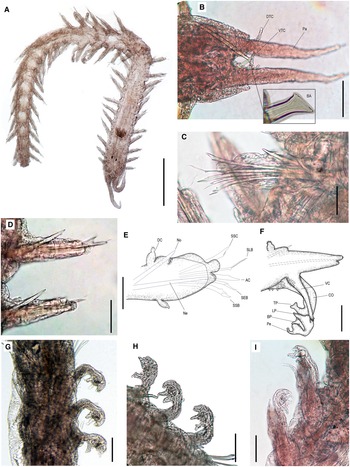
P. balasubramaniani sp. nov.: (A) complete specimen, dorsal view (holotype); (B) anterior end, dorsal view (paratype SIGPBAL.1/NBFGR); (C) midbody parapodium, lateral view (holotype); (D) posterior parapodia with protruding notoacicula, dorsal view (holotype); (E) midbody parapodium (dashed lines correspond to the posterior parapodial lobe); (F) parapodium and copulatory organ; (G) copulatory organs, dorso-lateral view (paratype SIGPBAL.1/NBFGR); (H) same inventral view; (K) copulatory organs, ventral view (paratype SIGPBAL.1/NBFGR). Scale: (A) 0.2 mm; (B) 70 μm; (C, E) 25 μm; (D, G, I) 50 μm; (F) 40 μm; (H) 80 μm. Ac, acicular chaeta; BA, buccal acicula; BP, blunt process; CO, copulatory organ; DC, dorsal cirrus; DTC, dorsal tentacular cirrus; LP, long process; Ne, neuroacicula; No, notoacicula; Pa, palp; Pe, penis; SEB, sub-acicular compound chaeta with spinose blade; SLB, supra-acicular compound chaeta with long blade; SSB, sub-acicular compound chaeta with smooth blade; SSC, supra-acicular simple chaeta; TP, T-shaped process; VC, ventral cirrus; VTC, ventral tentacular cirrus.

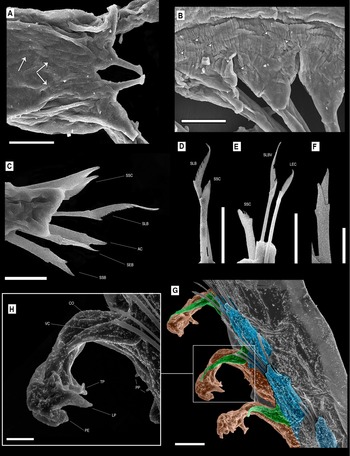
P. balasubramaniani sp. nov.: (A) prostomial region (arrows pointing on epithelial pore openings); (B) midbody dorsal epithelial pores (arrows pointing on pore openings); (C) first parapodia, anterior view; (D) supra-acicular chaetae; (E) supra-acicular chaetae and subacicular compound chaeta with spinose blade; (F) sub-acicular compound chaeta with smooth blade; (G) copulatory segments (blue: parapodial lobes; green: ventral cirri; red: male copulatory organs); (H) close view of male copulatory organ. Scales: (A, B, G) 50 μm; (C, H) 20 μm; (D, E): 25 μm; (F) 10 μm. Ac, acicular chaeta; CO, copulatory organ; LP, long process; Pe, penis; PP, papillae; SEB, sub-acicular compound chaeta with spinose blade; SLB, supra-acicular compound chaeta with long blade; SSB, sub-acicular compound chaeta with smooth blade; SSC, supra-acicular simple chaeta; TP, T-shaped process; VC, ventral cirrus.

Holotype: SIGPBAL/NBFGR; mature male, Palk Bay (India), 9°57′42.83N, 79°18′07.21E; collectors Murugesan and Punniyamoorthy, 25 March 2021, 12 m depth, coarse sand.
Paratypes: SIGPBAL.1/NBFGR; 1 male specimen, 41 chaetigers; Palk Bay (India), 9°57′33.54N, 79°17′20.83 E; collectors Murugesan and Punniyamoorthy, 25 March 2021, 14.5 m depth, coarse sand. CASMB-AU-RM; 2 male specimens, 32 and 26 chaetigers; Palk Bay (India), 9°57′33.54N, 79°17′20.83 E; collectors Murugesan and Punniyamoorthy, 25 March 2021, 14.5 m depth, coarse sand.
Non-Type Material
CASMB-AU-RM.1; 4 male specimens; Palk Bay (India), station 1, collectors Murugesan and, Punniyamoorthy, 25 March 2021, coarse sand. CASMB-AU-RM.2; 1 male and 2 specimens sex, undetermined; Palk Bay (India), station 2, collectors Murugesan and, Punniyamoorthy, 25 March 2021, coarse sand. CASMB-AU-RM.3; 3 male specimens; Palk Bay (India), station 3, collectors Murugesan and, Punniyamoorthy, 25 March 2021, coarse sand. CASMB-AU-RM.4; 1 specimen sex, undetermined; Palk Bay (India), station 4, collectors Murugesan and, Punniyamoorthy, 25 March 2021, coarse sand.
Additionally Examined Species
Pisione oerstedi Grube, Reference Grube1857 Syntype, ZMB 3834, Valparaiso (Chile), 2 specimens, incomplete. Pisione cf. remota: LACM-AHF 02586, Tjarno Fjord (Sweden), 20 specimens. Pisione hermansi Gradek, Reference Gradek1991: holotype: USNM 139293, California (USA). 1 specimen; paratype: USNM 139295, California (USA). 1 specimen; paratype, LACM-AHF 1732, California (USA), 1 specimen; Pisione spA, São Paulo (Brazil), 10 specimens, VRM personal collection.
Diagnosis
Short dorsal cirri on chaetiger two, ventral cirri elongated but shorter than parapodial lobe. Pharynx extending from the fifth to the ninth chaetigers. Copulatory organs occurring on chaetigers 15, 16 and 17, are not fused to the parapodial lobe and have four terminal digital processes (remota-like organs). Notoacicula protruding the parapodial lobe dorsally, from the fifth to the last chaetiger. Parapodia with up to six chaetae, of which two are simple chaetae and three to four compounds.
Description
Body short, thin, translucid to whitish (preserved), dorsal and ventral surfaces smooth, segmentation slightly visible (better distinguishable laterally) (Figure 2A), shallow ventral longitudinal groove; pores on dorsal surface all along body, mainly near parapodial basis, not observed on lateral surfaces (Figure 3A, B).
Prostomium completely fused to peristomium and first (tentacular) segment, narrow anteriorly, widening posteriorly towards the second segment (Figures 2A, B, 3A). Cerebral ganglia dorsally visible as two round lobes, greyish, from middle of buccal segment to middle of chaetiger 4 (Figure 2A). Two pairs of eyes at the level of chaetiger 3, each pair so tightly arranged that appears as single eyespots.
Tentacular segment as two small lobes anterior to the prostomium, supported by the buccal acicula; tentacular cirri emerging frontally (Figures 2B, 3A). Palps inserted ventrally to tentacular lobes, slender, smooth, non-annulated, reaching to chaetiger 5 (Figure 2A, B). Tentacular cirri inserted above palps, half as wide as palps width, elongated; dorsal cirri longer than ventral, 1/3 as long as palps length, smooth except for scattered distal ciliation; ventral cirri 2/3 as long as dorsal cirri, smooth, lacking distal ciliation (Figure 2B). Buccal acicula light yellow, prolonging from basis of first parapodia to internal tentacular lobe border, emerging off body wall; tips of aciculae expanding to distal plates with small worn denticles (Figures 2B, 3A).
Pharynx short, extending from segments 5–9. Two pairs of jaws visible by segment 5, with stout bases and sharp tips; two wing-like semi-rectangular sheaths at both sides of each jaw; sheath 1/3 wider on external border than on internal border.
Dorsal cirri (DC) at the basis of the parapodia, shorter on chaetiger 2, lengthening to chaetiger 4, then with similar lengths; cirri small, articulated, with globular basis twice as long as upper globular papillose article, giving a bottle shape.
Ventral cirri on first chaetiger elongated, cirriform, with scattered papillae on the distal end, length equal to parapodial lobe. Remaining cirri emerging in the middle of the parapodial lobe; small, flask-shaped, smooth. Smaller on chaetiger 2, lengthening to chaetiger 5, then with similar length through the body (except for those in copulatory parapodia).
Parapodial sesquiramous. Parapodial lengthening until chaetiger 4, then of the same size. The parapodia in chaetiger 2 is half the length of those on chaetiger 4; those on chaetiger 3 barely as long as those on chaetiger 4. Notopodia restricted to notoacicula region. Neuropodia long, oval, prechaetal lobe longer than postchaetal and distally bilobed, lower lobe smaller than dorsal and with a glandular tissue at the tips (Figures 2C, D, 3C); postchaetal lobe distally rounded.
Notoacicula slightly curved dorsally, protruding off epidermis on the middle of parapodia from chaetiger 5, first only tips, then lengthening until most posterior chaetigers (Figure 2C, D). Neuroacicula twice as long as notoacicula, straight, with pointed tips, non-protruding off epidermis.
Two supra-acicular and 3–4 subacicular neurochaetae per parapodium (Figure 2C, E). Uppermost supraacicular simple chaeta (SSC), stout, obliquely truncated, with dense, fine spines on outer margin (Figures 2C, E, 3C–E); lower supraacicular long-bladed compound chaeta (SLB), heterogomph, shaft half as wide and blade twice as long as in other compound chaetae, with short spines on internal margin (Figures 2C, E, 3C, D). One infra-acicular simple chaeta (AC), stout, wider than the remaining chaetae, external margin distally curved, internal margin indented subdistally, pointed tip (Figures 2C, E, 3C); 2–3 lowermost subacicular chaetae (usually two), compound heterogomphs, with short blades (half the length of supraacicular compound chaeta), distally unidentate; superior one with internal margin spinose (SEB) (Figure 3C, E), and inferior with slightly shorter and smooth blades (SSB) (Figure 3F).
Pygidium subtriangular, pigidial cirri not observed; anus terminal (Figure 2A).
Three pairs of copulatory organs on chaetigers 15–17 (Figures 2A, G–I, 3G), with parapodial lobes similar to those in remaining segments and ventral cirri longer than those in the rest of the body, similar in length or slightly longer than parapodial lobes (Figures 2F, 3G, H). A tuft of cilia covers the basis of the ventral cirri and the copulatory organ. Chaetae as in non-modified chaetigers. Male copulatory organ arising as a thick process from axis of parapodial lobe and ventral body wall, 1/3 longer than parapodial lobe, tapering terminally, ending in a recurved, hand-like structure with four digitated processes (Figures 2I–K, 3F, G); most proximal as a soft T-shaped process (TP) (Figures 2I, J, 3G); median anterior process 1.5 times longer than the remaining, somewhat conical (LP); median posterior process digitiform, with blunt tip (BP); distal process with a large base, tapering distally into a recurved S-shaped penis with chitinized tip (Pe) (Figures 2J, K, 3G). Female copulatory organ not seen.
Measurements
Holotype a complete mature male, 2.5 mm long (excluding palps), 0.2 mm wide (excluding parapodia), smaller specimen with 28 chaetigers. The longest specimen is a complete paratype, mature male, 3.5 mm long (excluding palps), 0.2 mm wide (excluding parapodia), with 41 chaetigers. In number of segments the smaller specimen has 26 chaetigers and the largest has 42 chaetigers.
Distribution
Known only from the type locality at Palk Bay (Figure 1), South India Ecoregion.
Etymology
This species is named in honour of Professor Thangavel Balasubramanian (Annamalai University), a mentor of Perumal Murugesan and a source of inspiration and constant support right from the beginning of his career.
Discussion
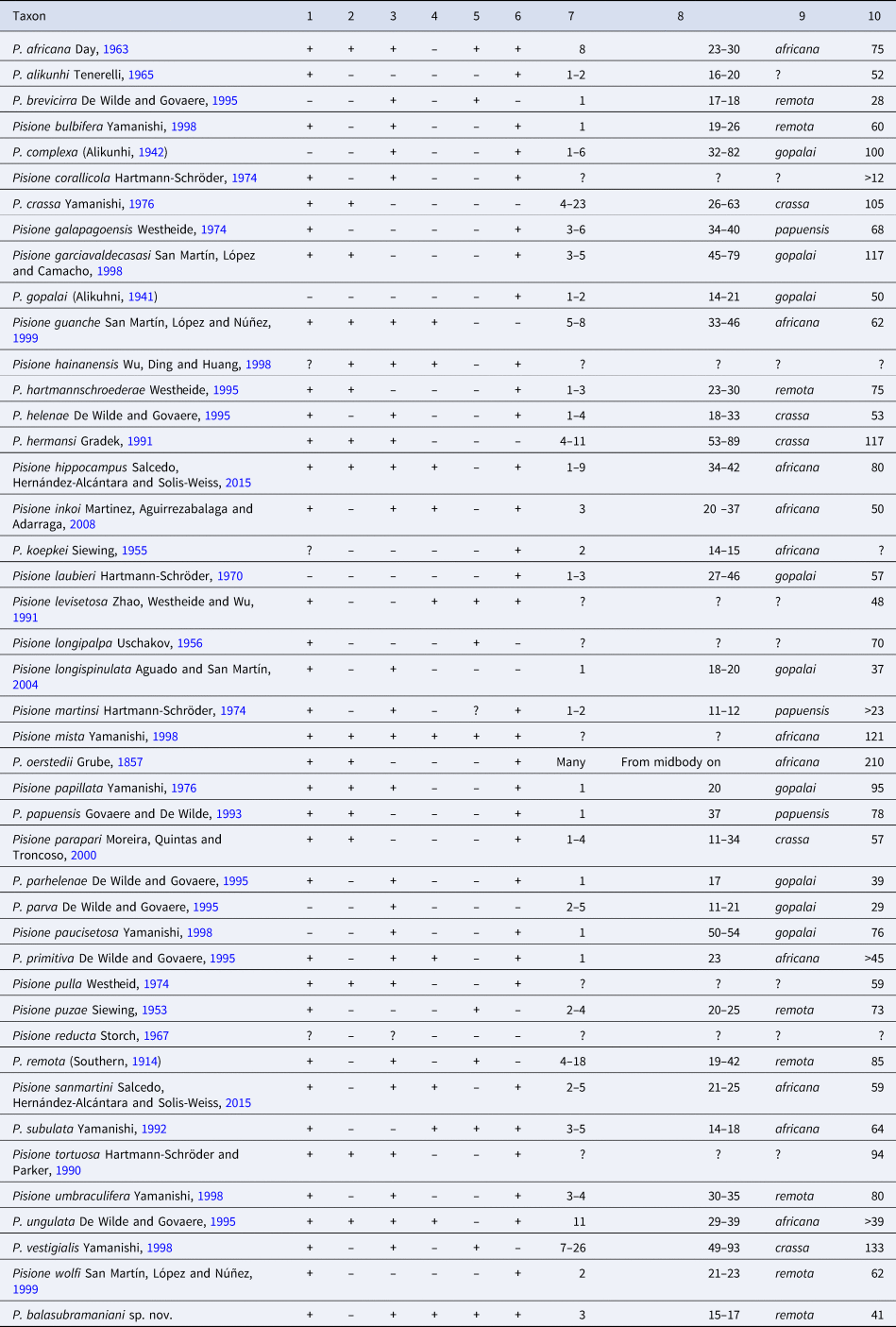
Despite the number of known species and articles dealing with the morphological aspects of Pisione species, the diagnostic characters are still poorly understood (Salcedo et al., Reference Salcedo, Hernández-Alcántara and Solís-Weiss2015). The morphology and position of the male copulatory organ are thus key characters allowing the distinction of the species of Pisione and Pisionidens Aiyar and Alikunhi, Reference Aiyar and Alikunhi1943. Based on this structure, Yamanishi (Reference Yamanishi1998) first proposed an idea of evolution for the group separating the genus into five different groups based on its increasing complexity: africana, crassa, gopalai, papuensis and remota. However, this proposal was later disregarded based on morphological and molecular evidence proving that sexual characters had a high degree of homoplasy (Gonzalez et al., Reference Gonzalez, Petersen, Di Domenico, Martínez, Armenteros, García-Machado, Møller and Worsaae2017). Nevertheless, sexual characters still appear useful for distinguishing and describing species, as they show different grades of fusion to the parapodial lobes and different structures and types of papillae. Considering the above, we updated the synoptic comparisons made by De Wilde and Govaere (Reference De Wilde and Govaere1995), Yamanishi (Reference Yamanishi1998) and Salcedo et al. (Reference Salcedo, Hernández-Alcántara and Solís-Weiss2015) to include our new species (Table 2).
Key morphological characters for the currently accepted species of Pisione

Modified from De Wilde and Govaere (Reference De Wilde and Govaere1995), Yamanishi (Reference Yamanishi1998) and Salcedo et al. (Reference Salcedo, Hernández-Alcántara and Solís-Weiss2015).
Characters: (1) ventral cirri of the first chaetiger elongated, (2) dorsal cirri of the second chaetiger elongated, (3) prechaetal lobe divided, (4) protruding notoacicula, (5) infra-acicular simple chaeta, (6) long-bladed compound chaeta, (7) number of male copulatory organ, (8) occurrence of male copulatory organ (segments range), (9) reproductive group, (10) number of segments; (+) character present; (–) character absent; (?) character unknown or not observed.
Pisione balasubramaniani sp. nov. belongs to the remota group, which is characterized by an elongated copulatory organ with a terminal penis (which may or not be spiralized) and a subterminal bidigitate process (Yamanishi, Reference Yamanishi1998) and currently includes eight species (Table 2). These species also share the presence of elongated ventral cirri on the first chaetiger (except in Pisione brevicirra De Wilde and Govaere, Reference De Wilde and Govaere1995) and a short dorsal cirrus on chaetiger 2 (except in Pisione hartmannschroederae Westheide, Reference Westheide1995). P. balasubramaniani sp. nov. differs from all other species in the group in having a protruding notoacicula from the most anterior to the last chaetiger, a character mainly present in the africana group (except in Pisione africana Day, Reference Day1963 and Pisione koepkei Siewing, Reference Siewing1955). Besides the differences in male copulatory organ, P. balasubramaniani sp. nov. differs from the africana group in lacking the elongated dorsal cirri on chaetiger 2 and in having a divided pre-chaetal lobe, a sub-acicular simple chaetae and a long-bladed compound chaeta (Table 2).
P. balasubramaniani sp. nov. differs from the gopalai and papuensis groups, in having a protruding notoacicula and an infra-acicular simple chaeta (Table 2). Also, the species in these groups show a remarkable fusion of the male copulatory organ with the parapodial lobe, being completely fused even with the ventral cirri in the gopalai group, which also lacks chaetae in the copulatory segments. In the papuensis group, the male copulatory organ is only fused with the parapodial lobe while the cirri remain unmodified (yet it seems swollen in some species), and the chaetae are still present (yet less numerous).
P. balasubramaniani sp. nov. differs from the crassa group in having protruding notoaciculae (absent in all species of this group) and sub-acicular simple chaetae (absent in all species of the group except in Pisione vestigialis Yamanishi, Reference Yamanishi1998). In addition to the protruding of notoaciculae, our new species differs from P. vestigialis in the presence of a long-bladed neurochaeta and in having three times fewer chaetigers than the latter (Table 2).
Among the four species of Pisione previously recorded in India, P. alikunhi was described by Tenerelli (Reference Tenerelli1965), together with a partial revision of Italian and German species and the worldwide occurrence of P. remota. Consequently, the presence of the latter in India must be disregarded, as Tenerelli based the description of the new species on the same specimens Alikunhi (Reference Alikunhi1951) used to describe the copulatory organs of ‘P. remota’. However, it is unclear whether he observed the Indian specimens or just relied on Alikunhi's (Reference Alikunhi1951) description, which was based on specimens from Madras beach (Chennai) and at least 440 km far from Krusadai Island (Gulf of Nammar). The latter were all mature females, while the mature males were all sampled at Madras beach, the type locality of the other Indian species of Pisione. Therefore, P. alikunhi sensu Tenerelli (Reference Tenerelli1965) must be considered valid until further examination of type specimens. However, it is unclear whether the females described by Tenerelli (Reference Tenerelli1965) truly belong to that species or could belong to another one, including P. balasubramaniani sp. nov., as both species differ in the bilobed pre-chaetae lobe, the protruding notoacicula and the sub-acicular simple chaetae present in our new species.
P. alikunhi was described by both Alikunhi (Reference Alikunhi1951) and Tenerelli (Reference Tenerelli1965) as having mature males with a reduced number of chaetae in the copulatory segments, which only occurs in the papuensis and gopalai groups. However, Alikunhi (Reference Alikunhi1951, p. 18) describes the male copulatory organ as having a ‘knife blade-like appendage in the form of a recurved hook with the inner edge cutinized and raised into minute projections’, which only occurs in the remota and crassa groups, whereas it was illustrated as having the typical form of the remota group in Alikunhi (Reference Alikunhi1951, fig. 3) as well as by Tenerelli (Reference Tenerelli1965). The placement of P. alikunhi in any of the groups of Pisione remains thus unclear, and the species certainly needs a careful redescription based on the type or topotype materials.
P. balasubramaniani sp. nov. differs from P. complexa (Alikunhi, Reference Alikunhi1942) in keeping the parapodial morphology and elongated ventral cirri in the copulatory segments instead of having parapodia reduced to a globose/papillary structure and ventral cirri transformed into a wide foliaceous structure as in P. complexa. Moreover, P. balasubramaniani sp. nov. has three sexual segments vs up to six in P. complexa, the latter also has shorter ventral cirri on the first chaetiger and lacks protruding notoacicula and simple subacicular neurochaetae.
P. balasubramaniani sp. nov. and P. gopalai (Alikunhi, Reference Alikunhi1941) vary in the morphology of the male copulatory organs, being quite simple, almost completely fused to parapodial lobes and with single tips in the latter, and hand-like with four soft tips in the former. Also, there is only one pair of copulatory organs in P. gopalai instead of three in our new species. Additionally, P. gopalai lacks simple subacicular neurochaetae and protruding notoaciculae, has shorter ventral cirri in the first segment (elongated in P. balasubramaniani sp. nov.), and undivided pre-chaetal lobes (bilobed in P. balasubramaniani sp. nov.).
Relatively close to India, seven species of Pisione were described from Papua New Guinea by De Wilde and Govaere (Reference De Wilde and Govaere1995): Pisione helenae, Pisione parhelenae, Pisione parva, P. brevicirra, Pisione ungulata, Pisione primitiva and P. papuensis. They all differ from P. balasubramaniani sp. nov. in the morphology of male copulatory organs. Moreover, all species, except that P. primitiva and P. ungulata, lack protruding notoaciculae, while these two lack the subacicular simple neurochaeta. P. brevicirra is unique showing subacicular simple neurochaeta, but in addition to the protruding notoacicula, it also lacks the long-bladed compound neurochaeta.
Pisione subulata Yamanishi (Reference Yamanishi1992), originally described from Japan, was also reported in Papua New Guinea (De Wilde and Govaere, Reference De Wilde and Govaere1995). Yet, this species resembles P. balasubramaniani sp. nov. in the morphology of the copulatory organs, the protruding notoacicula after chaetiger 6, the absence of the elongated dorsal cirrus on segment 2 and the number and types of chaetae. However, the specimens from Papua New Guinea diverge from the Japanese because ‘The copulatory organs are also “fistlike” but we did not observe the “ribbon”. The ventral cirrus seems much larger than mentioned in the original description, the tip bending into the “fist”’ (De Wilde and Govaere, Reference De Wilde and Govaere1995, p. 60). We assume that the ‘ribbon’ would be the chitinous structure on the proximal larger papilla of the copulatory organ, but this requires verification. Yet, such chitinous structure is absent in P. balasubramaniani sp. nov., which shows three pairs of copulatory organs (instead of up to five like in P. subulata), protruding notoacicula up to the last parapodial lobe before the pygidium (absent in few posterior segments in P. subulata), long-bladed compound neurochaeta (absent in P. subulata) and pre-chaetal lobes distally bifurcate (entire in P. subulata).
Despite the difficulties associated with morphologically distinguishing and characterizing new species within Pisioninae, we believe many more species await being described, particularly in Pisione. This genus is known to include many species described even in small-scale geographic regions (e.g. Yamanishi, Reference Yamanishi1992, Reference Yamanishi1998; Govaere and De Wilde, Reference Govaere and De Wilde1993; De Wilde and Govaere, Reference De Wilde and Govaere1995; San Martín et al., Reference San Martín, López and Camacho1998; Moreira et al., Reference Moreira, Quintas and Troncoso2000; Aguado and San Martin, Reference Aguado and San Martín2004; Martinez et al., Reference Martinez, Aguirrezabalaga and Adarraga2008; Moreira et al., Reference Moreira, Veiga and Rubal2010; Salcedo et al., Reference Salcedo, Hernández-Alcántara and Solís-Weiss2015; Gonzalez et al., Reference Gonzalez, Petersen, Di Domenico, Martínez, Armenteros, García-Machado, Møller and Worsaae2017). The description of P. balasubramaniani sp. nov. is thus our contribution to the growing knowledge on the poorly investigated polychaete diversity in India and nearby regions.
Data
All data are provided within the manuscript. Specimens are deposited at the Museum of ICAR-National Bureau of Fish Genetic Resources, and at the Centre of Advanced Study in Marine Biology (Annamalai University).
Acknowledgements
The authors gratefully acknowledge the Ministry of Environment, Forests and Climate Change of the Government of India (MoEF&CC) for the financial support. We also thank the authorities of Annamalai University for allowing using their facilities.
Author's contributions
Perumal Murugesan, Rengasamy Punniyamoorthy and Gopalan Mahadevan are responsible for specimen sampling and sorting, specimens' photography, preparation of slides and SEM analysis. Vinícius da Rocha Miranda is responsible for the first version of the manuscript, in which all authors contributed equally.
Financial support
VRM received a scholarship from CAPES/PDSE (process number: 88881.132417/2016-01) supporting his visit to the Los Angeles County Museum of Natural History, which allowed the study of additional material examined.
Conflict of interest
The authors declare that they have no conflict of interest.