


The Indus is one of the great rivers of the world. It has been central to economics, politics, and identity in the Indian peninsula since at least the early Harappan civilization over 5,000 years ago. Today, nearly 300 million people across Tibet, India, Pakistan, Kashmir, and Afghanistan reside in the Indus basin. Future historians will probably see 2025 as a landmark year in the governance of the mighty river. In April of that year, New Delhi unilaterally announced that the legal instrument governing the waters of the transboundary river basin between India and Pakistan, the 1960 Indus Waters Treaty,Footnote 1 (“the Treaty”), would “be held in abeyance with immediate effect until Pakistan credibly and irrevocably abjure[d] its support for cross-border terrorism”.Footnote 2 Pakistan called this “usurpation of the rights of a lower riparian [state] … [an] Act of War”.Footnote 3 The “abeyance” was one of the measures announced by the Indian government in retaliation against Pakistan for an attack by gunmen which claimed the lives of 26 civilians in Pahalgam (Indian-Administered Kashmir).Footnote 4 Despite repeated denials from Islamabad, the Foreign Secretary of India clarified that the Indian government believed the attack had “cross-border linkages”.Footnote 5
In the following weeks, India and Pakistan fought a “Four-Day War” through long-range missiles and drones, which ended with a Donald Trump-brokered ceasefire.Footnote 6 Even as the firing of missiles has ceased, Pakistan has continued to litigate the legality of India’s dam-building in Indian-Administered Kashmir before the Permanent Court of Arbitration. Islamabad has argued that India’s actions since April 2025 constitute “a policy of unlawful suspension or of breach or abrogation of the Treaty”.Footnote 7
Meanwhile, India’s Prime Minister Narendra Modi (2014–present) declared in his national address on Indian Independence Day (15 August 2025) that “blood and water [would no longer] flow together”.Footnote 8 Modi asserted that the “unjust and one-sided” Treaty allowed India’s rivers to irrigate “the fields of [India’s] enemies while the farmers and soil of [India] remain[ed] thirsty”.Footnote 9 Instead, New Delhi would now ensure that “the water that rightfully belongs to [India would] be reserved solely for [India], solely for the farmers of [India]”.Footnote 10 Farmers in North India have been a difficult constituency for Modi. In 2020, these farmers organized what one commentator called the “biggest protest in world history”,Footnote 11 which was only halted by a combination of brutal police repression and the coronavirus pandemic.Footnote 12 In the summer of 2026, peasants from Punjab were again out on the streets protesting the looming India–US free trade agreement which would open Indian markets to American agricultural exports.Footnote 13 Modi’s promise to boost agricultural productivity using the waters of the Indus basin must be understood against this backdrop.
International commentators have read the destabilization of the technocratic treaty regime as part of a global story which indicates the “death of international law”.Footnote 14 Mainstream narratives have long celebrated the agreement as a diplomatic masterpiece that bucked the cantankerous trend of India–Pakistan relations.Footnote 15 The World Bank (“the Bank”) itself calls the Treaty an instance of the “Bank at its best in development diplomacy”.Footnote 16 Through a pre-history of the Treaty, I demonstrate that contemporary anxieties of both countries are reflected in older political and legal arguments which pre-dated the agreement. This history, when juxtaposed against our current moment, reminds us that political claims in the international arena are continually made, at least partially, through a legal vocabulary. Instead of lamenting the “death” of international law, we must pay careful attention to the different forms of arguments in public and private forums to assess whose interests they represent.
The technocratic gambit of the Treaty was that it could quarantine the Indus system from sovereignty claims through the carapace of international law. I show that this project was fraught with contradictions. Despite the Bank’s best efforts to engender cooperation in the Indus system, supported by the US and the UK, both India and Pakistan approached the Indus negotiations as a zero-sum game between 1948 and 1960. This attitude meant they contested the dispute in every available forum. This paper juxtaposes a debate between John Laylin and S.M. Sikri at the Rivers Committee of the International Law Association (ILA) against the records of confidential diplomatic negotiations between India, Pakistan, the US, the UK, and the Bank between 1948 and 1956.
Laylin was an American lawyer who had been representing Pakistan in the Indus waters dispute (“IWD”), while Sikri was the Advocate General of (East) Punjab (1961–64). As members of the ILA, their only fidelity was meant to be to a “scientific study of the law”.Footnote 17 They were supposed to check their loyalties to Pakistan and India at the door when they entered the halls of the ILA. Nevertheless, I show how Laylin and Sikri advanced the interests of their clients in the IWD at the ILA discussions.
The work of the “Rivers Committee” of the ILA has been cited as the arch-example of the Association realizing its aims of developing international law to regulate interstate politics. A book celebrating the Association’s 100th anniversary pointed out that the 1966 Helsinki Rules governing the shared use of transboundary waters were cited by the International Court of Justice (ICJ) and the United Nations General Assembly.Footnote 18 The Introduction to the Helsinki Rules credits the 1958 New York Resolution as a central breakthrough in discussions. This Resolution was the culmination of a debate at the Dubrovnik (1956) and New York (1958) meetings, studied here through the prism of the paper’s two protagonists: Laylin and Sikri. However, scholars of riparian law have not understood these formative ILA discussions on riparian rights within the context of the IWD.
Conversely, the ILA debate also emerged as a crucial node of politics in the IWD. Writing to the UK government in July 1957, the US Embassy in Karachi warned Westminster that Pakistan intended to make the “best use possible of the resolution adopted [on] 31 August 1956 by the International Law Association at Dubrovnik”Footnote 19 in the Bank negotiations. The ILA documents were crucial to “buttress Pakistan’s demand that India pay [the] entire cost”Footnote 20 of dams in Pakistan to replace waters lost to India due to the 1947 Partition, or pave the way for a referral of the IWD to the ICJ. In its 2026 Award, the Permanent Court of Arbitration acknowledged this history by noting that the ILA’s 1958 Report was “among the sources of international law relied upon during the negotiations of the Treaty”.Footnote 21
Reading the Bank negotiations and ILA discussions together shows the adjacency of the political and technocratic modes of international law. The same actors can engage in international legal discourse in surprisingly different registers depending on the forum. In the process, I demonstrate that the stories institutions tell about themselves shape how political interests are translated into legal arguments presented before those institutions. The Bank positioned itself at the vanguard of a “development diplomacy” that created legal rules through mutual consent in order to solve complex geopolitical problems and promote economic prosperity.Footnote 22 Therefore, the Bank was adamant that a solution to the IWD “would not be based on the views of international lawyers but would rather help to establish international law for the future”.Footnote 23 In this vision, conflicting parties needed to agree to a development-oriented, win-win solution. Principles were useful only insofar as they helped solve the problem at hand. The role of law, therefore, was epiphenomenal – created simply to lend authority and stability to this consensus.
On the other hand, the ILA saw itself as a body of legal professionals whose duty was to “find” and progressively codify international legal principles. The technique of legal reasoning was meant to uncover and develop legal norms that could then be applied to political situations. These principles would contribute to world peace by regulating interstate conflicts – or at least, this was the founding faith of the ILA. Hence, these were two different visions of constructing a “technocratic” architecture which emphasized different “techniques” as solvers of political problems: development for the Bank and law for the ILA. Both governance narratives, though, simultaneously strived to order the world and be insulated from “politics”, particularly popular politics.
As a result, New Delhi – which was the upper riparian in the Indus basin – defended the rights of upper riparians in different ways in the Bank negotiations and ILA discussions. In the former, it confidently asserted that while India was not factually interfering with water supplies, it was legally entitled to do so because of the Harmon doctrine.Footnote 24 Yet, in the ILA, Sikri shied away from defending the Harmon doctrine outright. Instead, he mobilized the methodological ambiguity of determining international legal rules to argue that a norm against the Harmon doctrine could not be firmly established in international law. The Nehru regime could use the Harmon doctrine as a bargaining chip in Bank negotiations because the Bank was unconcerned about the potential dangers of legitimating a legal rule for future interstate river disputes. However, the ILA was not blinkered on one dispute. By definition, it was concerned with the status of international law as a whole. As a result, Sikri probably calculated that the best strategy for defending Indian interests at the ILA was to methodologically destabilize the case against the Harmon doctrine.
However, when these states (India and Pakistan) simultaneously contested a dispute through both the Bank and the ILA, frictions emerged between the different ways of doing international law. India and Pakistan found themselves in argumentative entanglements, created by the gap between their maximalist legal claims and their pragmatic diplomatic compromises. For instance, Pakistan used India’s assertions during the Bank negotiations – that New Delhi was not in fact interfering with water supplies – against Sikri in the ILA. Laylin argued that this factual claim by India implicitly acknowledged the Nehru regime’s acceptance that the Harmon doctrine was bad law and that upper riparians owed a duty not to deprive lower riparians of waters from a shared river system. For the ILA, the politicization of what was supposed to be a debate among legal professionals risked unsettling its claims of being an apolitical, professional legal organization. And the Bank was frustrated by India and Pakistan’s insistence on arguing about the IWD through the language of legal entitlements rather than working out a consensual, forward-looking solution that maximized economic development for both post-colonial states.
Thus, this paper shows how the Indus dispute influenced the formation of modern riparian law, and how these abstract discussions over the status of riparian law shaped negotiations between India and Pakistan. It proceeds as follows. Section I outlines the contributions of this paper to international legal and historical scholarship. Section II draws on archival work to summarize the position of the IWD between 1948 and 1956 and shows that the Bank-led mediation process was failing as the Dubrovnik meeting of the ILA approached in 1956. Section III then contextualizes the ILA as a professional legal body dedicated to achieving peace through the legalization of politics. The next section analyses the debate between Laylin and Sikri at the ILA in detail. I demonstrate how disagreements on four apparently technical legal topics – the appropriate sources of international law, the status of the “Harmon doctrine”, the rights of lower riparians to existing uses in a transboundary water system, and the requirement of consultation with a lower riparian before constructing works on a shared water system – reflected the interests of India and Pakistan in the IWD. Section V concludes with reflections on the contemporary politics of international law in the Indus system.
I. Contextualizing the contributions of this paper
The first contribution of this paper is to demonstrate the fragility of the distinctions between “technocracy”, “politics”, and “law” in existing geopolitical disputes. I build on recent scholarship that scrutinizes the legitimating strategies of institutions as objects of inquiry.Footnote 25 I take seriously Fleur Johns’ and Dimitri van der Meersche’s call to study the messiness of the “managerial” practices of international lawyers through detailed empirical work.Footnote 26 While Johns and van der Meersche rely on ethnography, this paper draws on archival research to provide empirical texture to debates about international law’s role in creating a technocratic system of global governance.
The conceptual sketches for the relationship between international law and technocracy were traced most famously by Martti Koskenniemi and David Kennedy.Footnote 27 Koskenniemi called specialized international legal regimes governed by norms of managerial rationality as “imagined communities”, akin to nations.Footnote 28 These institutions claim to create a depoliticized legal space. Both the ILA and the Bank pursued this aim in different ways. While the ILA saw itself as part of a scientific study of law to engender peace in international relations, the Bank instrumentalized law towards development and therefore, in its vision, peace. This paper looks at these international institutions as creators of legal forums which, like “imagined communities”, must “invent” their traditions.Footnote 29 I study how these assertions of technocratic institutions themselves constituted political facts which influenced the processes and outcomes of legal governance. These self-styled institutional narratives of the Bank and ILA created opportunities and contradictions for India and Pakistan to pursue their political projects in the IWD. Since scholars have long thought about international lawyers as “people with projects”,Footnote 30 I am not interested in litigating the truth or falsity of these “invented traditions”. Instead, I treat these narratives and their legal effects as part of international law’s pluralism. They show the different, sometimes conflicting, modes that can be contained within “international law” simultaneously.
Second, the paper revises existing historiography of the IWD as well as of the “Rivers Committee” of the ILA.Footnote 31 Contra previous histories of the IWD, I show that the Bank’s authority and position as the primary mediator of the dispute was contested and unstable throughout the 1950s. The Bank’s mediation was only one of several institutional forums in which New Delhi and Karachi contested the dispute. By the mid-1950s, a technical resolution of the dispute under the auspices of the Bank looked unlikely. Consequently, success at the ILA assumed greater importance because it could mean a favourable decision by a future judicial tribunal and privileged access to the waters of the Indus system for India or Pakistan. Yet, historians of the IWD have ignored this seemingly dry legal debate, choosing instead to focus on the 1951 intervention of David Lilienthal and the subsequent nine years of Bank negotiations.Footnote 32 On the other hand, international lawyers have treated debates in the Rivers Committee of the ILA as one step along the long march of the crystallization of international riparian law post-1945.Footnote 33 This paper unsettles both narratives by showing the interstate politics bubbling under the surface of the ILA discussions, and by demonstrating the importance of the ILA debates to the actors negotiating the IWD.
Lastly, this paper makes a methodological intervention in the history-writing of international law. Lauren Benton has argued that detailed empirical research allows historians of international law to appreciate how international law was integral to negotiating claims and counter-claims from diverse actors.Footnote 34 I read the debates at the ILA between lawyers unofficially representing India and Pakistan (accessed at the Institute of Advanced Legal Study Archives in London), against and with the records of political negotiations from the UK National Archives, Kew Gardens (London), the US National Archives and Records Administration (Washington, DC), the World Bank Archives (Washington, DC), newspaper records at the University of Cambridge, the personal papers of David Lilienthal at the Mudd Library in Princeton University, and records at the National Archives of India as well as at the Nehru Memorial Museum and Library, New Delhi. Therefore, I study a river dispute between two Global South nations largely through “political” archives – what Megan Donaldson has called the “hinterland” of international law – to illuminate the geopolitical stakes of a technical legal debate.Footnote 35
II. The IWD and the Bank in the 1950s: another failure of “development diplomacy”?
This section summarizes the position of the IWD between 1948 and 1956 and shows how the Bank, backed by the US and UK, structured IWD negotiations between India and Pakistan after 1951. Bilateral negotiations had made little headway until then. The Bank’s approach strived to use development as the primary strategy of diplomacy. It argued that a win-win solution for the IWD could be worked out consensually between India and Pakistan by sidelining politics and maximizing the economic value of the Indus system for both Karachi and New Delhi. The Bank rejected any quibbling over existing legal rights or obligations of India and Pakistan in the Indus system as this would not contribute towards solving the problem. Yet, between 1951 and 1958, Bank negotiations also made little progress. It looked like the IWD may join the Anglo-Iranian Oil case and the Suez Canal disputes as ignominious failures of the Bank’s problem-solving approach to international relations. As a result, both Indian and Pakistani diplomats approached the 1956 meeting of the ILA Rivers Committee determined to shape the law in the image of their respective positions in the IWD.
***
The colonial state in British India developed the Indus River and its five tributaries – the Sutlej, Ravi, Beas, Jhelum, and Chenab – as an integrated irrigation system to turn areas which were “wasteland” into some of the most productive lands in the Indian subcontinent, called the “canal colonies”. The Partition of British India in 1947 meant that this unitary system had to be severed. After much consternation and political jockeying, the Radcliffe Line, which divided Punjab, split up the irrigation system in a peculiar way. Most of the cultivable land dependent on the waters was now to be in West Punjab, Pakistan. However, two of the key headworks controlling the irrigation system (Ferozepore and Madhopur) were placed in the territory of East Punjab, India. The tensions immanent in this arrangement came to the fore when East Punjab cut off the supply of water to West Punjab at a crucial point of the agricultural cycle in April 1948.Footnote 36 This kickstarted what I refer to as the “Indus waters dispute”.
Karachi was incandescent about the interference with its vital water supplies. On the other side of the border, Indian Prime Minister Jawaharlal Nehru (1947–64) asserted that “the rights in the canal headworks and the water vested completely in East Punjab”.Footnote 37 The dispute was temporarily settled through the Inter-Dominion Agreement of 4 May 1948, which resumed water supplies to Pakistan on the condition that West Punjab (Pakistan) pay charges to East Punjab (India) and eventually find alternative sources of irrigation. Speaking of this Inter-Dominion Agreement, the Commonwealth Relations Office (CRO) of the UK government assessed that in 1948, “India had the whip hand and [had] used it”.Footnote 38 Internally, the Indian government could not decide if the May 1948 Agreement was an international treaty or simply a détente between provinces.Footnote 39 This uncertainty underlines the political flux of partition, and the flexibility of international law as a discourse. Despite the 1948 Agreement, disputes about payments for river waters and disruption of water supplies persisted between India and Pakistan before Karachi eventually repudiated the Agreement on 23 August 1950. They argued the Agreement had been signed “under compulsion”,Footnote 40 even as New Delhi insisted the Agreement regulated the rights of the parties in the Indus system. Subsequent bilateral talks between India and Pakistan made little progress between 1948 and 1951.
During this time period, Pakistan’s attempts to judicialize the dispute failed because Karachi could not bring the case to the International Court without New Delhi’s consent. India only accepted the compulsory jurisdiction of the Court under Article 36(2) of the ICJ Statute in 1956, and even this declaration excluded disputes with countries that were members of the Commonwealth of Nations at the time (which included Pakistan).Footnote 41 Pakistan had also unsuccessfully tried to lobby the US and UK to pressure India into agreeing to a judicial resolution of the issue.Footnote 42 Privately, Nehru was open to the idea of an international judicial body adjudicating the IWD, claiming that if “three independent foreign judges of repute [were] appointed”, arbitration might be the best course of action.Footnote 43 Nonetheless, the official Indian policy was that a judicial referral would “compromise Indian sovereignty”.Footnote 44 In this way, New Delhi used its newly won sovereignty as a shield against international judicial intervention.Footnote 45 Therefore, while Pakistan wanted the principles of international law to be applied to resolve the Indus dispute, Indian state officials were keen to maximize the political advantages of being the upper riparian state.
After September 1951, the IWD was negotiated under the supervision of the Bank as mediator. The stated goal of the negotiations was to construct a technical solution to the water dispute that met the hydraulic needs of both developmental states.Footnote 46 This was part of the Bank’s attempt at forging itself as a global diplomatic actor which used “development” to solve complex geopolitical disputes – similar efforts had been unsuccessfully made in the Anglo-Iranian Oil case and the Suez Canal dispute.Footnote 47 The fledgling international organization argued that a solution for the IWD would be based on technical cooperation and not on an ascertainment of legal rights over the waters.
Eugene Black, President of the World Bank (1949–62), insisted that the Bank’s “role in the Indus waters question [was not] to pass judgment on the legal position of the parties”.Footnote 48 The Vice President of the Bank and its primary representative in the IWD, William Iliff, similarly maintained that the IWD needed to be settled through a new treaty because “international law on the subject” of transboundary rivers “was obscure and subject to unilateral interpretations”.Footnote 49 Instead, a new treaty “would bind the Indian government in specific terms and could only be modified by the consent of both parties”,Footnote 50 and therefore offered more promise of stable governance.
This forward-looking vision of international law sought to break free from the constraints of existing legal doctrine. The goal of private negotiations was to mobilize the authority of legality to institute a consensual solution between the parties. The primary guiding light for such a solution would not be the “rights” of different parties, but the efficacy of the arrangement in delivering economic development to both states.Footnote 51 Therefore, this method of creating legal norms through mutual agreement escaped law as a radically indeterminate system of action-constraining rules. These new norms would then form the infrastructure of development by creating a stable arrangement between conflicting parties. In this vision of diplomacy, international politics was a set of problems to be solved. Any fidelity to legal principles beyond their functional ability to immediately solve problems was a form of legal “fetishism”.Footnote 52
However, by 1954, the Bank-led negotiations had ground to a halt, and the “Working Party” of Indian, Pakistani, and Bank engineers was disbanded.Footnote 53 The primary reason for the failure of the Working Party was that it was impossible to construct a “technical” solution to the IWD insulated from “politics”. First, any technical solution to the IWD remained contingent on the outcome of the territorial dispute between India and Pakistan over Kashmir, as three of the rivers implicated in the IWD – Indus, Jhelum, and Chenab – traversed the disputed region. Despite the best efforts of diplomats and engineers, it proved impossible to disappear Kashmir from the IWD. Second, India and Pakistan kept arguing over whether India had been tampering with the water supplies downstream into Pakistan. Third, India insisted on proceeding with the opening of the Bhakra Dam (Sutlej River).Footnote 54
Meanwhile, the Bank, the US, and the UK were convinced that the best way forward was to resolve the IWD through private negotiations between India and Pakistan. These Anglophone diplomats insisted that public legal battles over entitlements to the river basin would only stoke further conflict.Footnote 55 Frustrated by the failure of its Working Party, the Bank took firm aim at “politics” being the essential stumbling block of the negotiations. They argued that:
on a purely technical basis, reconciliation would be simple as the whole Indus basin could and should be treated as a unit; but since it [was] divided by a political boundary between two sovereign states, the simple technical solution [was] not practicable.Footnote 56
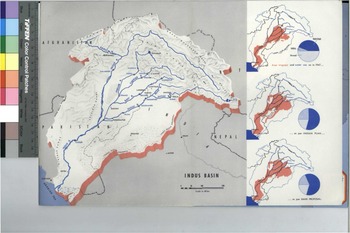
In this narrative, the key problem derailing technical negotiations was the politics of sovereignty. As a result, the Bank’s 1954 Plan (“the 1954 Plan”) sought to accept sovereignty as a postulate and based its recommendations on each country controlling the waters within “its” territorial control: the “Western Rivers” (Indus, Jhelum, and Chenab) would belong to Pakistan, and the “Eastern Rivers” (Sutlej, Ravi, and Beas) would be under India’s jurisdiction. New Delhi would also be obligated to pay for canals connecting lands in Pakistan formerly irrigated by the Sutlej, Ravi, and Beas to the “Western Rivers” (see Figure 1).Footnote 57
The World Bank’s 1954 Plan for Indus Basin, Taken from Pakistan-Indus Basin Multi-Purpose Project – Negotiations 04 (1960) in [World Bank Archives, Washington, DC], Folder ID 1787827.

Figure 1 Long description
A) Main map labeled, Indus Basin, with a north arrow pointing upward. A vertical legend bar at the far left has multiple stacked swatches and a vertical title that is not legible. The basin outline fills most of the page. Many branching river lines are drawn across the basin, with thicker main channels and thinner tributaries. Several shaded zones occur along the basin margins and in a few interior patches, but the category names for these zones are not legible from the legend. Text labels visible on the main map include, Afghanistan and, India. A scale bar is present near the bottom, but its numbers and unit are not legible. B) Inset map at upper right showing the same basin outline with shaded zones concentrated along one side of the basin and a smaller interior patch. A pie chart to the right of this inset has two slices, but the slice labels and numeric values are not legible. C) Inset map at middle right with the same basin outline and shaded zones in a similar general area as B), but with a different footprint that extends farther along the basin edge. The paired pie chart again has two slices, with labels and values not legible. D) Inset map at lower right with the same basin outline and shaded zones that cover a broader continuous band along the basin edge than in B) and C), plus an additional small patch. The paired pie chart has two slices, with labels and values not legible.
However, this 1954 Plan was rejected by Pakistan because it did not guarantee them adequate water. Karachi argued that the 1954 Plan did not make provisions for financing the construction of expensive storage dams that would be necessary to replace their historic reliance on the Eastern Rivers.Footnote 58 In contrast, New Delhi welcomed the Plan, partly because it knew the proposal would be unacceptable to Karachi.Footnote 59 This allowed India to claim that Pakistan was obstructing progress in the negotiations. Consequently, New Delhi argued that the Bank could not expect India to delay the opening of the Bhakra Dam (Sutlej River) to accommodate Pakistan’s objections.Footnote 60
At the opening of the Bhakra Dam later that summer, Nehru emphasized that India was “prepared to help [Pakistan] to the best of [their] ability”.Footnote 61 However, New Delhi was “not prepared to continue the present state of affairs and to accept a position which would encourage Pakistan to do nothing in regard to improving their existing canal system”.Footnote 62 He dismissed the “fantastic nonsense”Footnote 63 carried by the Pakistani press that “crores of Pakistanis”Footnote 64 would starve if the Bhakra Dam were operated. Although exaggerated, fears that the Bhakra Dam would impact the use of the Sutlej River in Pakistan were legitimate. Agricultural lands in Pakistan had historically relied on the Sutlej River, whose flow was eventually altered by the Bhakra Dam. Yet India insisted that the IWD could be a win-win for both Karachi and New Delhi if the path of developmentalism was adopted. Nehru conveniently omitted that unilateral “development” by an upper riparian in a shared water system would harm the downstream state.
Therefore, Bank negotiations reached an impasse. The steadfast commitment of the Bank to development diplomacy, with the support of the US and the UK, had failed to quarantine negotiations from subcontinental politics.
Yet the issue kept simmering without reaching a boil between 1954 and 1956. This changed when, following a game of political musical chairs, Huseyn Suhrawardy came to power as Prime Minister (September 1956–October 1957) in Pakistan. Suhrawardy wanted to start negotiations from the premise that “Pakistan [had] legal claim[s] which would stand up in [the] ICJ for [the] entire historic supply from [the] Eastern rivers”.Footnote 65 Therefore, any concession by Pakistan to India regarding the waters of the Sutlej, Ravi, and Beas would be an “act of grace” by the government, granted if New Delhi paid “adequate compensation”.Footnote 66 The lead Indian negotiator in the IWD, Niranjan Das Gulhati, had “indicated [a] negative Indian reaction to Suhrawardy’s statements … because there was no firm international law to provide a basis for [the] Court [to handle] this question”.Footnote 67 Suhrawardy’s position was also clearly incompatible with the main stipulation of the Bank negotiations – which was to focus on constructing durable solutions through law rather than fighting over indeterminate legal “rights”.
The following ILA debates must be read in this light. Pakistan wanted to establish firm principles of international riparian law to strengthen its hand in a possible judicial arbitration or in any bilateral negotiations that may resume. India, on the other hand, asserted behind closed doors and in the ILA that the legal position on the uses of transboundary rivers remained too indeterminate to meaningfully restrain state conduct. New Delhi argued that the best course of action, therefore, was for the IWD to be settled in accordance with the 1954 Plan.
Brief timeline of relevant events.

III. What is the ILA, and why was it debating norms governing transboundary rivers?
This section recounts the history of the ILA to explain how the Association conceptualized itself as an international institution dedicated to developing international law in an apolitical and scientific manner. Sikri and Laylin were members of the ILA as eminent jurists but were also well-connected within the state machineries of India and Pakistan. This put them in a prime position to advance the interests of the subcontinental states in the ILA discussions on the rights of co-riparian states.
***
The ILA was founded in 1873 along with the Institut de Droit International (IDI). Until 1895, the ILA was known as “The Association for the Reform and Codification of the Law of Nations”. This title suggested a dual mandate for the body: to codify existing legal norms and work towards their progressive reform. The current website of the ILA outlines its goals as the “study, clarification, and development of public and private international law and the furtherance of international understanding and respect of international law”.Footnote 68 We can see that the initial mandates outlined for the organization in 1873 remain its official tenets.Footnote 69
The ILA had a much wider membership base than the IDI, with branches all over the world.Footnote 70 A book released to mark the centenary of the ILA proclaimed that the “broad representation of membership of the ILA [is] its greatest asset for the promotion of international law throughout the world”.Footnote 71 This push towards wider representation meant that members of subject-specific committees were chosen simultaneously as subject-matter experts and “with a view to being representative[s] of differing legal systems and Association branches [from] different parts of the world”.Footnote 72 The next section shows how Sikri mobilized the ILA’s pride of being representative of different legal systems to derail the process of ascertaining universal legal norms. Despite this diversity, members came to the ILA as professional legal individuals and not as representatives of national governments. In fact, the ILA does not recognize “national delegations” per se.Footnote 73 Formed amid the rising tide of nationalism in Europe, the ILA sought to insulate legal discussions about global governance from ephemeral national politics.
Notwithstanding their different membership models, both the ILA and the IDI were part of a movement to professionalize international law. The lawyers who founded these organizations envisioned international law as a sophisticated and technical discipline that could serve as a “complete alternative mode of conducting relations between states”.Footnote 74 Koskenniemi argues that this vision of international law found its apotheosis in the work of the twentieth-century international lawyer Hersch Lauterpacht.Footnote 75 He summarizes Lauterpacht’s project as one of creating a “technically complex web of rules and institutions that would tie down the state like Gulliver”.Footnote 76 In this vision, the role of bodies like the ILA and the IDI (and later the International Law Commission) was to clarify legal norms that could be used by international courts while adjudicating legal and “political” disputes.Footnote 77 These courts could subsequently remake international politics in the image of legal norms and thus restrict state sovereignty and promote peace through law. For these jurists, more international law meant more peace.
This historical background allows us to appreciate why Laylin and Sikri argued their deeply political cases in an abstract, technical register at the ILA. This was a particular mode of doing international law – one that was different from their work advising governments through confidential briefs. The platform for their arguments was provided by the “Rivers Committee” of the ILA, a subject-specific committee set up in 1954 to “study the various legal, economic, and technical aspects of rights and obligations between states as to … inland waters”.Footnote 78 India and Pakistan saw in the work of the Rivers Committee an opportunity to strengthen their claims in the IWD. By 1956, Pakistan felt its best opportunity in the IWD lay in submitting the waters dispute to an international judicial body, such as the ICJ. For this purpose, the unofficial Pakistan delegation approached the 1956 Dubrovnik meeting of the Rivers Committee with renewed vigour to cement the rights of lower riparians in international law. The informal Indian delegation responded with a set of international legal arguments that prioritized the entitlements of upper riparians in a transboundary system.Footnote 79 I stress the “unofficial” and “informal” nature of these delegations because, as I mentioned earlier, the ILA did not recognize its members as representatives of national delegations.
IV. ILA: from negotiation to contestation
This section dives into the debate between Laylin and Sikri on the rights of co-riparian states at the ILA. I show how debates between India and Pakistan’s lawyers shaped the outcome of the ILA discussions and outline the lasting impact of these discussions on modern riparian law. In contrast to the preceding section, the mode of argumentation here shifts to a technical, legal one, reflecting the values of the “imagined community” of globalist lawyers at the ILA. The fulcrum of Laylin and Sikri’s interventions was a report (“the ILA Committee Report”) submitted by the chairman of the Rivers Committee which, according to him, captured the position of international law on riparian disputes.
A. Are decisions of domestic courts a valid source of international law?
Laylin’s first response to the ILA Committee Report concerned the appropriate sources of international law. He argued that the jurisprudence of the US Supreme Court settling “inter-state” disputes – to use Laylin’s phrase – was pivotal to understanding international law because states in the US enjoyed a certain degree of sovereignty, and the Court had been “confronted” with riparian disputes as “though it were dealing with independent nations”.Footnote 80 Therefore, according to Laylin, US Supreme Court decisions should hold similar weight for the Association as cases decided by international arbitral tribunals such as Trail Smelter.Footnote 81 This argumentative move was important because the US Court had laid down elaborate principles of responsibility owed by upper riparians to lower riparians.
The claim that the decisions of a domestic court and an international tribunal held equivalent weight in international law was an odd one. Sikri, in his response to Laylin, pointed out this anomaly. He argued that US Supreme Court cases could not help the Committee ascertain international law because the issue facing the Court “was not one of depriving American citizens of their rights in favour of foreign nationals or vice versa but one of determining the rights of American citizens inter se”.Footnote 82 Laylin retorted that even if his argument was unconventional, it was not incorrect because municipal law constituted a valid “subsidiary source” for determining international law, since it represented the opinions of “the most highly qualified publicists”.Footnote 83 My purpose here is not to delve into the legal “correctness” of Sikri’s or Laylin’s arguments. Instead, it is to show that the methodological ambiguity of international law had real political consequences. If Laylin could establish US Supreme Court cases as valid authorities in international law, Pakistan’s case would be strengthened in the Indus dispute.Footnote 84
The dispute over the valid sources of international law was the prelude to the substantive debate between Laylin and Sikri. The crux of their disagreement revolved around three points: first, the validity of the Harmon doctrine, which allowed upper riparian states full sovereignty over shared waters; second, the rights of lower riparians to have existing uses respected; and third, the obligation of an upper riparian to obtain the consent of the lower riparian before constructing diversionary works upstream on a transboundary river.
B. Did India’s participation in the Bank negotiations compromise Sikri’s veiled defence of the Harmon doctrine?
The Harmon doctrine was formulated in 1895 by the former Attorney General of the US, Judson Harmon, to assert that the US was not obligated to allow water from the Rio Grande River to flow to Mexico. As a result, Harmon asserted that the US could exploit the river under its jurisdiction regardless of the consequences for the lower riparian Mexico.Footnote 85 Although the doctrine had since been largely discredited in international law, India had mobilized it in bilateral negotiations to justify their actions in April 1948.Footnote 86 For Laylin, it was important to rebut this doctrinal argument in the abstract. Demolishing the Harmon doctrine’s credibility in the ILA would reduce the possibility of it being invoked by the Indian state in the IWD negotiations.
He relied on US Supreme Court jurisprudence, the Trail Smelter decision, a report submitted to the ILA by the UN Secretary-General, and the decision of the Indus Commission headed by Sir Benegal Rau (1942), to argue that the Harmon doctrine held no weight in international law.Footnote 87 Laylin argued that “any assertion in any field of international relations that a state ha[d] no rights as against [the] action[s] of another state regardless of the consequences” must “be examined against the system of obligations accepted in the Charter of the United Nations”.Footnote 88 Therefore, he mobilized a variety of legal authorities at different levels of generality. The UN Charter was relevant insofar as it created general obligations for states to respect one another, act in good faith, and be good neighbours. From this general obligation, Laylin derived that it was not permissible for a state to assert that it could “do with an international river whatever it [chose] without regard to the consequences of other states sharing the river”.Footnote 89 This principle was then buttressed by the slew of specific authorities Laylin had mobilized from different jurisdictions – from the declarations of the IDI to municipal court and international arbitral decisions.
The invocation of the Indus Commission is particularly poignant – the Commission was formed in British India to settle an inter-provincial dispute between (undivided) Punjab and Sind. The central question before the Commission was whether the upper riparian Punjab was legally constrained from constructing works on the Indus system which might affect the uses of the river in downstream Sind.Footnote 90 The Commission ruled that the Harmon doctrine was invalid in law, and that Sind was entitled to an equitable apportionment of the Indus River.Footnote 91 I argue that Laylin’s use of the Indus Commission Report was not an accident – it shows that the Indus negotiations were the animating force behind these otherwise abstract arguments.
Laylin demurred that the minimal principle that international law restrained how states exercised their sovereignty over waters in their jurisdiction “would hardly have been open to debate … had it not been for occasional official assertions of a contrary view”.Footnote 92 However, he claimed that these assertions had been “for the most part opportunistic” and were “belied by the actions of the nations making them when it came to the actual settlement of disputes”.Footnote 93 For instance, the US continued to formally reserve “a right to assert this doctrine” in its disputes with Mexico and Canada, but in treaties with them, Washington acknowledged limits to sovereignty over waters in its territorial jurisdiction.Footnote 94 Implicitly, Laylin was arguing that the best resource to determine international legal principles was the practice of states, not their statements. Announcements by state officials were too prone to the exigencies of politics to be relied upon as a stable foundation for legal science.
After establishing that the paradigmatic case of the Harmon doctrine itself contradicted its status as an international legal principle, Laylin cited another controversial example. He recalled that “India asserted in 1948” that it was “legally entitled to cut off from West Pakistan” the waters of the Indus basin. However, India had since 1951 participated in negotiations with Pakistan under the “good offices of the International Bank for Reconstruction and Development”. During the course of these negotiations, India had “accepted in principle a proposal of the Bank that works necessary to replace supplies for existing beneficial uses in Pakistan, historically received from rivers flowing from India, should be completed with funds furnished by India before the supplies were withheld”.Footnote 95 Here, Laylin referred to the 1954 Plan which proposed a territorial division of the Indus system. As I showed in Section II, Pakistan had rejected the 1954 Plan, partly because it did not guarantee them enough water.Footnote 96 New Delhi, on the other hand, had reacted amenably to the 1954 Plan primarily to exert pressure on Karachi. In an ironic reversal, Pakistan’s lawyer in the IWD used India’s acceptance of the 1954 Plan as evidence of state practice contradicting the Harmon doctrine in the Rivers Committee.
This was symptomatic of the contradictions between the Bank negotiations and ILA discussions. The former aimed at solving the Indus dispute through multiparty negotiations. As a result, India’s acceptance of the 1954 Plan had won New Delhi goodwill from the Bank, the US, and the UK. Law was purely epiphenomenal in this approach. On the contrary, the ILA sought to articulate abstract legal rules with adequate clarity to be able to solve a variety of complex political disputes. Thus, any concession in the Bank negotiations, no matter the motivation, could be mobilized by the other state in the ILA discussions as evidence of state practice of a legal norm. Here, we see how the different stories of the Bank and the ILA about the role of law in solving political issues simultaneously moulded Laylin and Sikri’s arguments and created contradictions for them.
In his response, Sikri did not contest the validity of the Harmon doctrine. He probably recognized that the doctrine was nearly impossible to defend in a forum of jurists. This move departed from Nehru’s confident assertions in diplomatic communications that India was entitled to fully use the waters in its territory.Footnote 97 Instead, Sikri quibbled with Laylin’s characterization of US practice regarding the Harmon doctrine. He argued that even when US state officials asserted that they must respect the rights of Canada or Mexico, they did not clarify that such respect stemmed from a legal obligation. As a result, these acts were not in recognition of a legal principle of reasonable use but out of the political pragmatism of good neighbourliness.Footnote 98 If the practice of states was motivated by “politics” and not by a sense of legal obligation, the practice would not constitute a norm of customary international law.Footnote 99 Again, we see that the self-conception of the ILA as an apolitical body of legal professionals shaped how Sikri argued his case – he tried to destabilize Laylin’s arguments rather than launching a full-throated defence of the Harmon doctrine.
The most significant argument constructed by Sikri against Laylin’s position regarding the equitable utilization of transboundary waters was that the doctrine had not crystallized into a universal norm of customary international law. Sikri claimed that “after having studied many treaties” governing transboundary rivers, he found too much regional plurality for there to be a universal custom regulating the conduct of transboundary waters.Footnote 100 He admitted that there were numerous treaties in Europe which could evidence a norm of reasonable and equitable utilization crystallizing into custom – however, this was inadequate to establish a universal custom.Footnote 101 He effectively argued to provincialize customary norms.Footnote 102 In a rapidly decolonizing world, the thrust of Sikri’s argument was that European norms could no longer be assumed to be universally applicable.Footnote 103 A detailed study of rivers across the world demonstrated to Sikri that “each river ha[d] its individuality” which was “derived from the region”Footnote 104 in which the river existed, and the kind of uses that were derived from its waters. Therefore, Sikri mobilized an empirically-minded methodological conservatism to argue that the international legal rules governing transboundary waters remained indeterminate.
Crucially for Sikri, Asia furnished “hardly any evidence for any rule of international law”Footnote 105 governing the use of transboundary watercourses. The ILA, which prided itself on its wide representation of different legal systems, was a particularly appropriate forum for emphasizing the regional specificity of norms. Sikri pointed out that while India and Pakistan were “still negotiating” the Indus dispute, both had signed an Agreement on 4 May 1948 which “recognized the natural anxiety of [the] East Punjab government to discharge the obligation to develop areas where water [was] scarce”.Footnote 106 The “agreed” upon basis for this development was for “the East Punjab Government [to] progressively [diminish] its supply” to the canals in West Punjab (Pakistan). Sikri conveniently omitted from his brief that Pakistan had subsequently denounced the 1948 Agreement as having been signed under duress, as I showed in Section II.
Therefore, we see that the Indus dispute was used to shape riparian law by both Sikri and Laylin. Laylin argued that India’s principled acceptance of the 1954 Plan showed that even New Delhi did not think the Harmon doctrine was a valid international legal principle. On the other hand, Sikri argued that the practice of states across the world was too diverse to be distilled into a norm of international law which restricted the sovereignty of upper riparians. Whereas Laylin cited the 1942 Indus Commission Report to support his claim that co-riparians were entitled to equitable apportionment of the waters of a transboundary river, Sikri relied on the 1948 Inter-Dominion Agreement to privilege the rights of upper riparians. Each beat of the long IWD negotiations constituted potential state practice for Laylin and Sikri. Both lawyers selectively mobilized these events to bolster their arguments.
C. Existing uses of a transboundary river and the Bhakra Dam
The next point of contention was whether lower riparians were entitled to historic uses of a transboundary water system. If an upper riparian planned to construct infrastructure on a shared water system which could impact these “existing uses” of the lower riparian, what were the international legal obligations of the upper riparian state? The stakes of this question in the IWD were pressing: India had partially opened the Bhakra Dam in the summer of 1954 and was planning to start full operation of the dam soon. This vital infrastructure was designed to divert the supplies of the Sutlej River to areas in India which needed irrigation, and thus cut off irrigation to lands in West Pakistan which had historically relied upon the river.
Principle V of the ILA Committee Report suggested that states should account for the effects of new infrastructural works on the “pre-exist[ing] appropriation of water by one state” and the “pre-exist[ing] agreements among the states concerned”.Footnote 107 Other factors which would influence the governance of a transboundary river included “the right of each [state] to a reasonable use of the water”, “the extent of the dependence of each state upon the waters of that river”, and the “comparative social and economic gains accruing to each [state] and to the entire river community”.Footnote 108
Laylin argued that the “importance attached to existing uses [across the world] naturally varie[d], because the degree of physical and economic dependence varie[d] … between arid and well-watered regions”.Footnote 109 His framing of economic dependence as the key criterion already dovetailed well with Pakistan’s arguments regarding the Indus system. Karachi had consistently argued that it was an arid nation which depended on the Indus rivers for its water supply in contrast to India, which had several other river systems it could draw upon.Footnote 110 In such arid regions, Laylin argued that “not only [were] existing uses protected” but they “enjoy[ed] a priority” over new uses.Footnote 111 He once again quoted from the Indus Commission: “In the general interests of the entire community inhabiting dry, arid territories, priority may usually have to be given to an earlier irrigation project over a later one: ‘priority of appropriation gives superiority of right’”.Footnote 112
Laylin argued that the goal of development should be to make “more supplies” of water available while preserving “existing beneficial uses”Footnote 113 of lower riparian states.Footnote 114 Sikri did not contest the claims around existing uses extensively, except to reiterate that “pre-existing appropriation [was] not necessarily sacrosanct”, and respect for such appropriation depended “on the circumstances”.Footnote 115 The key point of contention, therefore, was what constituted these circumstances. In particular, did an upper riparian require the consent of a lower riparian state before constructing works which could impact the latter’s existing uses of water?
D. Consultation or consent: would India need the consent of Pakistan to operate the Bhakra Dam?
Principle VI of the ILA Committee Report laid down that “a state, which propose[d] new works (construction, diversion, etc.) … which might injuriously affect another state, must first obtain the consent of the other state, which consent shall not … be unreasonably withheld”.Footnote 116 In response to this recommendation, Laylin constructed a special system of interstate obligations regarding riparian disputes citing the social and economic importance of river waters. He claimed that the “interests of a riparian state in an international river [were] … so vital … that prior agreement to any substantial change in a river regime should … be included in a statement of principles concerning international rivers”.Footnote 117 Laylin argued that in his approach, the “initial requirement upon a state proposing new works would be one of notification to other riparians”.Footnote 118 This requirement, he argued, would kick in when a proposed work “might affect” rather than “might injuriously affect” another state. Therefore, he was increasing the burden on upper riparians by lowering the standard of harm required to lower riparians. In a professional body like the ILA dedicated to developing the international legal craft, political contests took the shape of quibbles over such legal qualifiers and adjectives.
Laylin continued that the notification from the upper riparian state should “describe the works … to enable the other state to determine whether its interest was enough to warrant further steps”.Footnote 119 If the lower riparian state took “no action, it … [would] be assume[d] that its rights [would] not be violated”.Footnote 120 However, “if the state receiving the notification wished to pursue the matter further, the most desirable course [of action] would be a joint study of the problem”.Footnote 121 If the states disagreed on the construction of works, “it would still be desirable to forbid the state proposing the works … to proceed without obtaining consent”Footnote 122 of the upper riparian state. As a result, Laylin’s interpretation of Principle VI effectively required upper riparians to defer to the lower riparian’s judgment of how a proposed work affected its interests and prohibited upper riparians from proceeding with the development of transboundary rivers without the consent of lower riparians. This interpretation of riparian law would have effectively allowed Pakistan to prevent India from operating the Bhakra Dam without Karachi’s consent.
Sikri’s brief on the subject was a mirror image of Laylin’s arguments. Where Laylin argued that a lower riparian must be informed of proposed works which might “affect” the downstream state, Sikri restricted the need for such notification to cases where works would “substantially affect the utilization”Footnote 123 of the lower riparian state. Therefore, he raised the standard of harm which would trigger an obligation for the upper riparian to notify a lower riparian. Once again, Sikri argued that state practice on the issue was too diverse to be distilled into a discrete principle. Furthermore, he protested that Principle VI effectively gave the lower riparian a veto. Instead, he suggested that in cases of disagreement, states should set up a technical commission that focused on “increasing the supply that [could] be harnessed to the advantage of both parties” rather than being bogged down by a “vague idea of hypothetical grievances”.Footnote 124 If, in the judgment of the upper riparian, the lower riparian state was withholding consent “unreasonably”, the former must be allowed to proceed with their construction, according to Sikri.Footnote 125
His suggestion that, at best, the upper riparian was obligated to engage in technical consultations with a lower riparian reflected India’s position in the IWD. Before the Bank started its version of technical negotiations to solve the IWD, Nehru had argued that “the [Indus] water question was not a political question but an engineering question”Footnote 126 where a technical solution should be worked out so that “both countries [c]ould profit fully [from] the [Indus] waters”.Footnote 127 We can see how Sikri’s suggested legal position aligned with Delhi’s previous proposals. Through his argument about the rights of upper riparians to proceed with development works, the Indian lawyer effectively justified New Delhi’s decision to open the Bhakra Dam despite Karachi’s objections.
Laylin responded by claiming that Sikri’s counterproposal would hand the upper riparians “more than a veto”Footnote 128 by allowing them to proceed regardless of the consequences for other states in a river basin. If Sikri was concerned about lower riparians unreasonably withholding consent for proposed works, disagreements could be settled by the “decision of judges less inclined to be blinded by their own interests”.Footnote 129 Once again, Laylin buttressed his arguments by referring to Article 33 of the UN Charter, which obligated member states to settle disputes through “mediation, conciliation, arbitration, [or] judicial settlement”.Footnote 130 This echoed almost precisely Pakistan’s position in the Indus dispute: knowing that India had the advantage of being the upper riparian, the Pakistani government had urged a judicial settlement of the IWD, as I showed in Section II.Footnote 131
The Final Resolution adopted at the Dubrovnik Conference dropped the requirement of consent but obligated upper riparians to consult with lower riparians before constructing works which would affect their interests in the river basin.Footnote 132 Principle VI of the Dubrovnik Resolution set up an escalating mechanism of dispute resolution – if states could not agree on a course of action through consultation, they were to “seek the advice of a technical commission; and if [that did] not lead to agreement, resort should be had to arbitration”.Footnote 133 The general tenor of the Resolution discouraged unilateral actions by states and mandated some form of cooperation. However, the Committee shied away from articulating precise circumstances in which such obligations would kick in. This attitude was also reflected in the 1966 Helsinki Rules, which remain the enduring product of the work of the Rivers Committee and form the bedrock of modern riparian law.Footnote 134
Perhaps the minimalism of the rules laid down by the Rivers Committee reflects the limits of the ILA’s project of resolving complicated geopolitical disputes by laying down abstract legal rules.Footnote 135 However, this paper shows that Sikri and Laylin were fighting for every possible edge for their clients. Any word or qualifier that they could include in the final draft which could potentially strengthen India or Pakistan’s case was worth struggling for. This was important given the virtual failure of the Bank negotiations at this time, and the real possibility that the Indus dispute might yet be referred to an international judicial tribunal for settlement. Even if the dispute was not settled judicially, winning some ground in the ILA debates could strengthen the hand of either party in a bilateral/multilateral negotiation.
The debate between Laylin and Sikri was an important episode in the work of the ILA.Footnote 136 The central concept of modern riparian law remains “reasonable and equitable utilization” of shared water sources, effectively dismissing the Harmon doctrine.Footnote 137 This paper has shown how debates around this doctrine at the ILA were infused with interstate politics. While I have brought to light the impact of the IWD on the ILA discussions, future scholarship can study how other regional water disputes shaped discussions in international legal forums.
Nevertheless, I have also shown how the efforts of Laylin and Sikri were burdened with contradictions. Both lawyers found themselves being tripped up by the tensions between their maximalist legal claims – where they tried to win the most possible ground for their clients – and their clients’ pragmatic compromises in negotiations. The frictions between these legal claims and diplomatic practices allowed their adversary to undercut the legitimacy of their legal arguments. India’s strategic compromises in the Bank negotiations designed to pressure Pakistan were used by Laylin to evidence the Nehru government’s belief in the legal norm of equitable utilization of transboundary waters. On the other hand, Sikri used concessions the Indian government had won from Karachi to show that Pakistan recognized that the rights of upper riparians were legally protected. This dilemma incentivized New Delhi and Karachi to be mutually suspicious and cautious in negotiations moving forward, much to the frustration of the Bank, the US, and the UK.
V. Conclusion
The debate at the ILA did not settle the IWD. It would be almost impossible for a legal debate at that level of abstraction to settle such a messy political dispute. Instead, the water dispute was resolved, at least temporarily, through the Indus Waters Treaty signed in 1960. The catalyst for the agreement was an \$800 million aid package for India and Pakistan to develop the Indus system secured by the Bank from Western countries. The promise of aid meant that both New Delhi and Karachi were able to temporarily sideline their respective objections and agree to a territorial division of the rivers.Footnote 138 This paper has shown how the IWD was negotiated and contested in different institutional forums via legal arguments through the 1950s. My contention has been that this history demonstrates the pluralism of international law – that the political and technocratic modes of international law often co-exist in different forums. The work of international lawyers, like Laylin and Sikri, was to juggle these different modes depending on whether they were wearing the hat of a legal scientist or a government adviser.
For much of that decade, the Bank negotiations were heading nowhere. The premise of the Bank’s intervention was to divorce the Indus dispute from “politics” and treat it as an economic problem to be solved in partnership with Karachi and New Delhi. In the aftermath of the 1947 Partition, this assumption proved absurd. At every step, the efforts of the Bank to abstract the Indus system away from the political quagmire of subcontinental politics were frustrated. Yet it remained steadfast that the IWD would be solved through mutual consent to maximize economic development. The role of law was understood as epiphenomenal – it would simply lend authority and stability to the bargain worked out between conflicting parties. In this vision of global politics, nitpicking over existing legal rights and obligations in the Indus system was a waste of time and energy.
By 1956, the stalemate in Bank negotiations and the ascent of Huseyn Suhrawardy to the Prime Ministership of Pakistan meant the IWD might be submitted to the ICJ for adjudication. In that scenario, the work of the ILA determining the legal rules governing access to a transboundary water system assumed greater importance for New Delhi and Karachi. As a result, both participated in the Rivers Committee with enthusiasm. However, the ILA’s foundational stories about itself meant that Indian and Pakistani legal officials had to speak in a register befitting impartial jurists in the Rivers Committee.
This paper has thus shown two things. First, that the arguments of Laylin and Sikri reflected their political projects as counsels for Karachi and New Delhi in the IWD. Second, the form of India and Pakistan’s argumentation in the Bank negotiations and at the ILA were different. While the former was a game of finding the optimal economic solution, the latter sought to find the “correct” legal answer to the puzzle of shared transboundary waters. Thus, arguments to the same effect, but in different forums, were articulated in diverse registers. However, Laylin and Sikri found themselves in argumentative entanglements at the ILA. This was because their opponent could mobilize concessions of India or Pakistan in the Bank negotiations to undercut their legal arguments.
Seven decades on, we see a similar story. On the one hand, New Delhi has issued political statements to a domestic audience which outline plans to utilize the waters in India’s territory to the maximum. This seems to evidence a disregard for international law and has been read as such by some commentators.Footnote 139 Yet, simultaneously, the Indian government stopped shy of explicitly saying it was revoking or suspending the Treaty. Instead, it framed its actions in the language of “abeyance” – a term which does not exist in the international legal lexicon.Footnote 140 This intentional legal ambiguity, like Sikri’s methodological objections at the ILA in 1956, is probably designed to muddy the waters and leave the Treaty in a legal limbo which allows New Delhi freedom of action on the Jhelum and Chenab Rivers. This could pose a significant threat to Pakistan’s agricultural economy, and the expansion of hydro-electric dams in Indian-Administered Kashmir will compound the severe environmental damage of existing Indian dams in Kashmir.Footnote 141
Simultaneously, the Indian delegation also boycotted proceedings at the Permanent Court of Arbitration instituted under the Treaty to evaluate the legality of dams in Indian-Administered Kashmir. This boycott was again justified through the language of law. The Indian Ministry of External Affairs argued that India did not recognize the “existence in law of this so-called Court of Arbitration” because the arbitral body was “itself a serious breach of the Indus Waters Treaty”. As a result, “any award or decision” of the forum is “illegal and per se void”.Footnote 142 However, the statement also argued that because the Treaty is “in abeyance”, New Delhi “is no longer bound to perform any of its obligations under the Treaty”.Footnote 143
Thus, New Delhi simultaneously violates the most basic principles of international law – pacta sunt servanda – and claims to do so through its international legal entitlements as a sovereign state to put a treaty “in abeyance”. Commentators who see the “death” of international law in the unilateral suspension of the Treaty miss that arguments over entitlements to the Indus system continue to be made through international legal resources. Therefore, this paper adopted the approach that it is more productive to pay close attention to how legal resources are used to articulate political claims, and whose interests are left out of international law and politics. This process requires meticulous consideration of the diverse institutional forms of these arguments.
Acknowledgments
I am grateful to the reviewers and the editors of the Journal for their support. The paper benefitted from the engagement of Surabhi Ranganathan, Urvi Kumbhat, Raja Dandamudi, Tanuj Luthra, Nehal Bhuta, Sarah Nouwen, Joseph H.H. Weiler, Sze-Hong Lam, Bethan Hall, Tine Deschuytere, and Vincenzo Elia.
Funding statement
This research was funded by the Centre for International Law (National University of Singapore), the Leverhulme Trust, as well as the Gates Cambridge Trust.
Competing interests
None.

 Open access

