Introduction
Over the last three decades several studies have recorded the existence of rare forest vegetation in southwest Arabia. In a paper entitled ‘Were there forests in the Yemen?’ Hepper & Wood (Reference Hepper and Wood1979) described the existence of the last remaining forest vegetation occurring in the wadi valleys of Jabal Melhan and Jabal Bura between 500 and 1500 m. They noted the rarity of this vegetation and found it dominated by the tree species Combretum molle R.Br. ex G.Don, Terminalia brownii Fresen., Ziziphus mucronata Willd. and Piliostigma thonningii (Schumach.) Milne-Redh. Al-Hubaishi & Müller-Hohenstein (Reference Al-Hubaishi and Müller-Hohenstein1984) also recorded the existence of this tree-dominated wadi vegetation in narrow valleys in the Tihama foothills on the higher slopes between 500 and 1000 m. They observed that the best example of this vegetation was also in the Jabal Bura region, from where they described a closed canopy forest dominated by trees such as Combretum molle, Tamarindus indica L., Trichilia emetica Vahl, Ficus populifolia Vahl, Mimusops laurifolia (Forssk.) Friis and Breonadia salicina (Vahl) Hepper & J.R.I.Wood.
Later studies revealed that this vegetation was not confined to Jabal Bura and Jabal Melhan. Deil & Müller-Hohenstein (Reference Deil and Müller-Hohenstein1985) recorded the existence of forest vegetation (which they called ‘wadi woodland’) in the At-Tur basin, near Wadi Mawr, between 450 and 900 m. This was dominated by Combretum molle, Tamarindus indica, Berchemia discolor (Klotzsch) Hemsl., with Mimusops laurifolia and Ficus populifolia also present. The tree layer of the wadi woodland was also described by Scholte et al. (Reference Scholte, Al-Khulaidi and Kessler1991), who recorded several large Ficus species, Combretum molle, Tamarindus indica, Trichilia emetica and Mimusops laurifolia as the main constituents. Their vegetation map of Yemen records five broad localities where this vegetation occurs:
• 20 km east of Zabid, centred on Jabal Qarazan
• On the western slopes of Jabal Raymah and Jabal Bura
• On the western slopes of Jabal Melhan
• 10 km southwest of Hajjah, centred around the At-Tur basin
• 45 km northeast of Hajjah, centred on Jabal Ash Sharafayn.
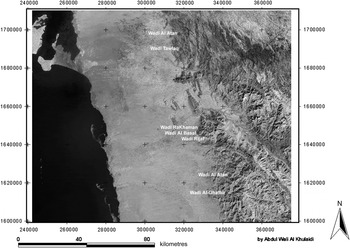
Wood (Reference Wood1997) broadly termed this rare vegetation ‘valley forest’, a type of forest only occurring between 500 and 1000 m on the western escarpment, dominated by Combretum molle, but with several Ficus species, Tamarindus indica, Celtis toka (Forssk.) Hepper & J.R.I.Wood and Mimusops laurifolia also characteristic. Wood (Reference Wood1997) noted that ‘valley forest’ only occurred at localities with locally high levels of orographic rainfall and with westerly or southwesterly aspects that trapped mist during the drier times of year. Wood (Reference Wood1997) provides the most detailed records for a number of fragmented valley forest localities (see Fig. 1):
• Above Alujah, below Hadiyah and around Suq ar Ribat, Jabal Raymah
• In Wadi Yur and Wadi Hillah, Jabal Melhan
• Above Hillah and in Wadi Rijaf, Jabal Bura
• At Rajamah and in Wadi Har, Haraz Mts.
• In Wadi Liyah, Khawlan Ash Sham.
The surveyed valley forest sites in the western escarpment mountains of Yemen. Map scale 1:1,000,000. Numbers along axes are UTM reference points.

The most recent survey of this vegetation in Yemen (Hall et al., Reference Hall, Al-Khulaidi, Miller, Scholte and Al-Qadasi2008) agrees that the term valley forest best defines this rare habitat. Such a definition is in line with the definition of forest as an area of land of more than 0.5 ha, with trees taller than 5 m, which cover more than 10% of the land area (FAO, 2000). The density of this vegetation also qualifies it as forest under the criteria developed for Arabia by Scholte (Reference Scholte2000).
The valley forest vegetation in Wadi Rijaf, Jabal Bura, measures some 80 ha, of which the densest areas are centred on the lowest slopes of the catchment, near the wadi channel between 400 and 800 m (Hall et al., Reference Hall, Al-Khulaidi, Miller, Scholte and Al-Qadasi2008). Widespread tree species are Mimusops laurifolia, Phoenix caespitosa Chiov., Tamarindus indica, Terminalia brownii, Acacia asak (Forssk.) Willd., Combretum molle, Berchemia discolor, Ziziphus mucronata, Trichilia emetica, Commiphora kataf (Forssk.) Engl., Ficus sycomorus L. and Ficus ingens (Miq.) Miq. The shrub layer was noted to be dominated by Carissa spinarum L. (syn. C. edulis (Forssk.) Vahl), several species of Grewia and Maytenus, and Teclea nobilis Delile. Hall et al. (Reference Hall, Al-Khulaidi, Miller, Scholte and Al-Qadasi2008) regard the valley forest in Jabal Bura as a ‘relict forest’ which has acted as a refuge for a number of tropical African tree species, with varying centres of endemism (White, Reference White1983).
Hall et al. (Reference Hall, Al-Khulaidi, Miller, Scholte and Al-Qadasi2008) note that as well as being physiognomically rare, the valley forest in Wadi Rijaf is also home to 12 regionally rare plant species, including Stereospermum kunthianum Cham., Antiaris toxicaria Lesch. and Nuxia oppositifolia (Hochst.) Benth. (see Table 2). Most of these species are known only from a handful of localities and many are almost entirely restricted to the vegetation in Wadi Rijaf.
In terms both of uniqueness of habitat and the occurrence of rare species, Wadi Rijaf has been listed as a potential Important Plant Area in Arabia (GSPC, 2002; Plantlife International, 2004) and has recently gained legal protection, after much of Jabal Bura was designated as part of a Protected Area Management network (Environment Protection Authority, Yemen, 2005). The remaining areas of valley forest identified by Hepper & Wood (Reference Hepper and Wood1979), Deil & Müller-Hohenstein (Reference Deil and Müller-Hohenstein1985), Scholte et al. (Reference Scholte, Al-Khulaidi and Kessler1991) and Wood (Reference Wood1997) are also potentially important for plant conservation in Arabia. In particular, these areas of valley forest have the potential to contribute to targets (v) and (vii) of the Global Strategy for Plant Conservation, the conservation of important habitats and endangered species (GSPC, 2002).
Aims and Methods
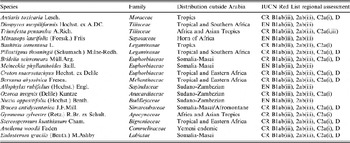
As the remaining fragments of valley forest had not been surveyed for more than a decade, the current study was undertaken in order to provide a basic assessment of their extent, quality, composition and ultimately their conservation value. Field studies were undertaken between April and October 2005 and in December 2007. As part of their general conservation goals, these surveys were also directed towards providing data for IUCN Red List assessments of the 18 regionally rare species that Wood (Reference Wood1997) lists as restricted to valley forest (see Table 1).
From the list of valley forest localities provided by Scholte et al. (Reference Scholte, Al-Khulaidi and Kessler1991) and Wood (Reference Wood1997) and from preliminary assessments on the ground, the following sites were selected as the most promising locations for surveying valley forest in the western escarpment mountains. The areas of valley forest included in the field studies were:
• Wadi Tawlaq and Wadi Hillah – Jabal Melhan
• Wadi Al Atan (near Wadi Ar Ribat), Wadi Al Ghalbir (Alujah) – Jabal Raymah
• Wadi Al Basal – Jabal Bura
• Wadi Rakhaman (above Hillah) – Jabal Bura.
The site at Wadi Liyah was discounted because of the current security situation in northern Yemen. The locality at Wadi Yur identified by Wood (Reference Wood1997) was not included in the present study as surveys by Scholte (unpublished field data) in 1988 revealed that the forest cover in the wadi had been severely degraded. Scholte noted that only isolated Mimusops individuals remained and no tree cover was recorded on the catchment slopes.
The specific aims of the surveys at the selected sites were to:
1 Assess the extent and quality of the vegetation.
2 Provide a basic, concise description of the vegetation.
3 Record any regionally rare species.
Basic floristic descriptions are based upon 26 vegetation relevés of 25 × 25 m conducted within these remaining valley forest fragments. These qualitative descriptions are intended to form the basis for a more detailed quantitative floristic study which will incorporate data from Saudi Arabia and northeast Africa. Qualitative description of the vegetation structure followed Scholte (Reference Scholte2000). Each site was georeferenced and basic topographical information was recorded. Identifications were predominantly made in the field, but when required, voucher specimens were taken for identification at the Royal Botanic Garden Edinburgh. Specimens of rare and significant species were made, with duplicates deposited in the Taiz herbarium. The location of each rare species was recorded with a GPS and the number of individuals was recorded to assist future conservation assessments using IUCN Red List criteria (IUCN, 2001). Digital photographs were also taken for inclusion in a photographic database of Arabian plant species, to be used as a platform for photographic field guides (see Hall & Miller, Reference Hall, Miller, Hodkinson, Jones, Waldren and Parnellin press).
Results
Wadi Tawlaq
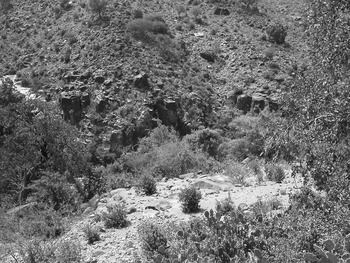
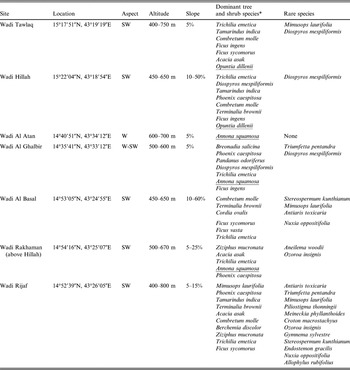
Wadi Tawlaq is a relatively open wadi valley on the southwestern side of Jabal Melhan (Table 2). The valley can be accessed via a rocky track leading from the Tihama. At the time of the field study (October) the wadi channel was flowing and there were numerous large standing pools of water. Despite the abundance of water, the valley forest is in a degraded state compared with that found in Wadi Rijaf on Jabal Bura (see Fig. 2). The majority of the valley slopes are covered in an Acacia shrubland that is dominated by Acacia ehrenbergiana Hayne, the Arabian endemic Acacia johnwoodii Boulos and Acacia tortilis (Forssk.) Hayne. A relatively dense area of vegetation is found in a very narrow band alongside the wadi channel from approximately 400–750 m. The wadi channel is littered with large boulders and slopes gently at about 5% gradient.
A patch of degraded valley forest in Wadi Tawlaq, Jabal Melhan.

The remaining valley forest in Wadi Tawlaq is very patchy, and is degraded to the extent that it takes the appearance of (open) woodland. It is interspersed with Acacia shrubs, and measures less than a hectare in area. Several tree species that are characteristic of valley forest are present, but the most predominant of these are the widespread riparian species Trichilia emetica, Tamarindus indica, Combretum molle, Ficus ingens and Ficus sycomorus, as well as Acacia asak. These are covered in the climbing species Cissus rotundifolia (Forssk.) Vahl and the parasite Cassytha filiformis L. By far the most abundant tree is the naturalised invasive species Annona squamosa L., which covers large parts of riparian vegetation in Wadi Tawlaq. The composition of the shrub layer also highlights the degraded nature of this valley forest. It is dominated by the invasive Opuntia dillenii (Ker Gawl.) Haw., Acalypha fruticosa Forssk. and Premna resinosa (Hochst.) Schauer. The non-woody vegetation is relatively sparse and consists mainly of the grass Dactyloctenium scindicum Boiss., Aristolochia bracteata Retz., Ruellia patula Jacq., Boerhavia repens L. and several species of Commelina.
Between 450 and 650 m, two mature individuals of Mimusops laurifolia and 13 mature individuals of Diospyros mespiliformis Hochst. ex A.DC. were found. These are the first records of these regionally rare species from this locality. The absence of any saplings or seedlings is perhaps an indication of the poor regeneration in Wadi Tawlaq.
Wadi Hillah
Wadi Hillah is a southwest-facing relatively narrow and steeply sloping valley on the western slopes of Jabal Melhan above the small village of Al Awda (Table 2). During the field visit, the wadi channel was flowing and there were abundant pools of water. The vegetation in the valley is less dense and extensive than that of Wadi Rijaf, but it is less degraded than at Wadi Tawlaq. The wadi channel is steeply sloping (up to 50% in parts) and between 450 and 650 m there are approximately 5–6 ha of vegetation that cover both the sides of the wadi channel and the slopes of the catchment. The wadi channel extends to approximately 900 m and although this area was not surveyed, local people indicated that the best quality forest could be found between 650 and 900 m. This vegetation could be characterised as open woodland that in patches (around 525 m altitude) becomes forest.
The tree canopy reaches about 12 m and is dominated by Trichilia emetica and Diospyros mespiliformis. Abundant tree species also include Tamarindus indica, Phoenix caespitosa, Combretum molle, Terminalia brownii and Ficus ingens. Less common tree species include Acacia asak, Acacia johnwoodii and Berchemia discolor. A notable absence from the tree layer is Mimusops laurifolia, the regionally rare species which is so characteristic of the valley forest in Wadi Rijaf.
At lower altitudes, many of the larger trees had been cut for wood and fodder. However, the vegetation in Wadi Hillah appears to suffer less from invasive species than other sites in Arabia. The naturalised species Annona squamosa is present but it is sparsely distributed. Opuntia dillenii also occurs, but it is far less abundant than in Wadi Tawlaq. The most common shrub is Acalypha fruticosa, but Oncoba spinosa Forssk., Carissa spinarum, Grewia schweinfurthii Burret and several species of Maytenus also make up the shrub layer. In places this can be very dense – to the exclusion of a developed herbaceous layer. Where gaps in the shrub layer occur, the herbaceous layer is not particularly rich but includes Ruellia patula, Hibiscus deflersii Schweinf. ex Cufod. and Aristolochia bracteata, as well as species of Commelina and Aneilema.
The regionally rare tree Diospyros mespiliformis was particularly abundant in Wadi Hillah and more than 50 mature individuals were recorded. This species is valued for its particularly strong wood and the majority of mature trees showed signs of cutting. However, unlike at other sites, Diospyros mespiliformis showed signs of regeneration in this locality. Another significant find in Wadi Hillah was the regionally rare tree Antiaris toxicaria. Two mature trees and several seedlings were recorded in the wadi – the first record of this species on Jabal Melhan. This species was previously known only from Jabal Bura and the Haraz Mts.
In a neighbouring wadi channel to Wadi Hillah, above the village of Bani Schraib at 1674 m (15°20′48″N, 43°21′01″E), we recorded four juvenile individuals of the extremely rare tree Brucea antidysenterica J.F.Mill. Although Wood (Reference Wood1997) describes these as being restricted to valley forest, they were growing in a deep shaded gulley above coffee terraces. Brucea antidysenterica was previously only known in Arabia from two trees on Jabal Raymah (Wood, Reference Wood1997).
Wadi Al Atan (Wadi Ar Ribat)
Wadi Al Atan is a very narrow, steep-sided wadi channel on Jabal Raymah (Table 2). This small valley connects with Wadi Ar Ribat, the main wadi in the Suq Ar Ribat area, identified by Wood (Reference Wood1997) as a valley forest locality. Surveys were conducted in Wadi Al Atan between 600 and 700 m. This site was chosen as it was the only locality in the Wadi Ar Ribat area with significant tree cover. Since Wood's surveys in the 1970s the valley forest in Wadi Ar Ribat has become almost completely degraded. The tree cover in Wadi Al Atan is extremely sparse and is little more than a very patchy scrubland. At the time of the study, there was no water in the wadi channel, and it appeared that much of the tree cover was interspersed with areas of abandoned cultivation.
Within the areas of patchy (sparse) shrubland there are very few tree species. The most common species is the naturalised Annona squamosa, but Breonadia salicina, Ziziphus mucronata, Trichilia emetica, Phoenix caespitosa, Tamarindus indica and Terminalia brownii are also present. The shrub layer is dominated by Acalypha fruticosa with occasional individuals of Premna resinosa, Oncoba spinosa, Euclea racemosa Murr. and several species of Maytenus. With such a sparse tree and shrub cover, the vegetation in Wadi Al Atan is mainly herbaceous. The most common species recorded were Achyranthes aspera L., Becium filamentosum (Forssk.) Chiov., Pupalia lappacea (L.) Juss., Hibiscus deflersii and Ruellia patula.
Wadi Al Ghalbir
Wadi Al Ghalbir is a wide, gently sloping valley located near the settlement of Alujah on Jabal Raymah (Table 2). The Alujah area was identified by Wood (Reference Wood1997) as a site for valley forest, but like the other sites on Jabal Raymah the tree cover in Wadi Al Ghalbir is not very extensive. The only vegetation resembling valley forest is open riparian woodland found immediately alongside the rocky wadi channel. Despite the abundance of water in the wadi, this open woodland occupies less than 1 ha between 500 and 600 m. It is heavily degraded, shows signs of being heavily utilised and is interspersed with areas of abandoned agriculture. Many of the trees show signs of being extensively cut.
Few tree species were recorded, but the most common trees in Wadi Al Ghalbir are Breonadia salicina, Phoenix caespitosa, Pandanus odoriferus (Forssk.) Chiov., Diospyros mespiliformis, Trichilia emetica, Annona squamosa and Ficus ingens. The shrub layer is dense and is dominated by Carissa spinarum, Anisotes trisulcus (Forssk.) Nees and Acalypha fruticosa. Grewia villosa Willd. is also present but in lower numbers. A very sparse herbaceous layer is restricted to species straggling over the many rocks in the wadi such as Ipomoea cairica (L.) Sweet and Tridax procumbens L., as well as the grass Dactyloctenium aegyptium (L.) Willd.
Several regionally rare species were observed including one record of the woody annual Triumfetta pentandra A.Rich. (which is known from only two other sites in Arabia; Hall, Reference Hall2005), and more than 20 individuals of Diospyros mespiliformis.
Wadi Al Basal
Although Wadi Rijaf is well known as the least degraded, most extensive site of valley forest in Arabia, the neighbouring wadi system of Wadi Al Basal has received little attention. The only published description of the catchment (Herzog, Reference Herzog1998) records the area as an ‘impoverished riparian forest’ dominated by Combretum molle, and mentions that degradation of the vegetation has occurred as a result of human activity. Preliminary investigations revealed it to be one of the most significant areas of valley forest in Yemen (Hall, Reference Hall2005).
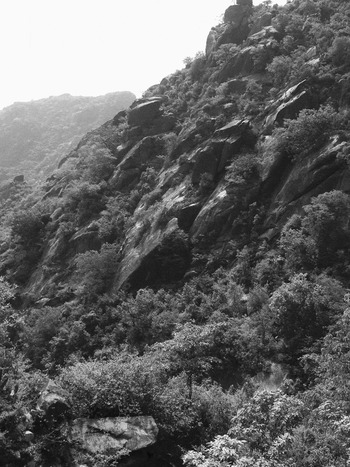
Wadi Al Basal is a narrow, steep-sided valley, located to the northwest of Wadi Rijaf (Table 2). The wadi extends from the Tihama plain, at 300 m, to over 1000 m altitude, and has a rocky watercourse with a channel approximately 15 m wide. From the Tihama plain up to 450 m the vegetation is a sparse Acacia–Commiphora shrubland dominated by Acacia mellifera (Vahl) Benth. and Commiphora myrrha (Nees) Engl., with Grewia schweinfurthii, Anisotes trisulcus and Adenium obesum (Forssk.) Roem. & Schult. also common. From 450 m up to about 650 m, a valley forest exists in between the large boulders in the wadi channel and on the catchment slopes. As Figure 3 shows, this valley forest is less dense and of a smaller stature than in Wadi Rijaf, possibly due to the steepness of the valley.
The valley forest on the slopes of Wadi Al Basal, Jabal Bura. This newly surveyed area is the most extensive and intact area of valley forest after Wadi Rijaf.

The vegetation shows few signs of being degraded and it is estimated that c.30 ha of valley forest exists in the wadi channels and on the slopes of Wadi Al Basal. The dominant tree species are Combretum molle and Terminalia brownii with Cordia ovalis R.Br. ex A.DC., Ficus sycomorus, Ficus vasta Forssk. and Trichilia emetica also common. Notably, the regionally rare species Antiaris toxicaria and Mimusops laurifolia, and the Arabian endemic Acacia johnwoodii, are also present above 550 m. Cissus quadrangularis L. and Cissus rotundifolia climb over the tree layer, and Cassytha filiformis is also present. The shrub layer is also dense, with Acalypha fruticosa, Grewia schweinfurthii, Grewia villosa and Teclea nobilis the most common species. At the time of the surveys (April 2005), the non-woody ground flora was sparse and consisted principally of Commelina spp., Ipomoea spp., Jasminum fluminense Vell. and, in damper sites, Selaginella imbricata (Forssk.) Spring.
In addition to its coverage and the presence of Acacia johnwoodii the vegetation of Wadi Al Basal is notable for the occurrence of several regionally rare species, previously unrecorded from the catchment. One mature tree and two saplings of Stereospermum kunthianum were recorded at 625 m. Six mature trees of Antiaris toxicaria were recorded between 435 and 650 m, with noticeable regeneration of this species. Mimusops laurifolia is relatively common in Wadi Basal between 570 and 650 m, and a single juvenile tree of Nuxia oppositifolia was found in the wadi channel. Due to time limits and difficult access, we were restricted to surveying the vegetation closest to the wadi bed and were unable to access the densest part of the vegetation at an altitude of 700 m.
Wadi Rakhaman (above Hillah)
Wadi Rakhaman is a narrow, sloping valley above the small village of Hillah, Jabal Bura (Table 2). The wadi channel is narrow and littered with large boulders, and slopes gently at about 5% gradient until the upper slopes which reach 25% gradient. Wood (Reference Wood1997) notes that this catchment was an important collecting locality for Schweinfürth, who recorded many of the regionally rare taxa that are restricted to valley forest in Yemen (see Hall, Reference Hall2005). From the visit to Hillah in October 2005 it is clear that the valley forest is in a very degraded state, with the only significant tree cover occurring in a narrow band (less than 1 ha in area) along the wadi channel between 500 and 670 m.
It appears likely, from observations in the field, that degradation of the valley forest has occurred through extensive cutting and localised heavy flooding, which according to local reports destroyed many of the taller trees. Few tree species were recorded, but the most common were Ziziphus mucronata, Acacia asak, Trichilia emetica, Annona squamosa and Phoenix caespitosa. Although noted by Wood (Reference Wood1997), the regionally rare tree species Mimusops laurifolia was not recorded from Wadi Rakhaman. However, a single individual of the regionally rare tree species Ozoroa insignis (Delile) Kuntze was recorded at 670 m.
Within areas of tree cover, there is also a dense shrub layer. The shrub layer extends across much of the catchment and is dominated by Carissa spinarum, Anisotes trisulcus and Acalypha fruticosa, along with several species of Grewia. A very sparse herbaceous layer is restricted to species straggling over the many rocks in the wadi, such as Ipomoea cairica and Tridax procumbens, as well as the grass Dactyloctenium aegyptium. The most notable feature of the herbaceous vegetation in Wadi Rakhaman is the presence of Aneilema woodii Faden, an endemic perennial herb. Several individuals of this species, which is only known from above Hillah, were recorded in the present study (Miller 27163 (E)).
Like Wood (Reference Wood1997), we failed to find the tree species Bersama abyssinica Fresen. which had previously only been recorded from above Hillah by Schweinfürth. On account of the degraded nature of the valley forest we are in agreement with Wood (Reference Wood1997) that this species is now extinct on Jabal Bura. We also failed to find Bridelia scleroneura Müll.Arg. which was last recorded by Wood (Reference Wood1997) from Wadi Rakhaman and Wadi Ar Ribat.
List of 18 species that are restricted in Arabia to valley forest habitat. Preliminary IUCN Red List assessments are provided for each species (CR – Critically Endangered, EN – Endangered)

Summary of the most important features of the surveyed valley forest sites in Yemen

* Invasive species are underlined.
Discussion
The present study, although not exhaustive, is the first survey of southwest Arabia's valley forest fragments for over a decade. Although qualitative, it comprises the most comprehensive assessment to date of this regionally important vegetation. It is intended that the current study will provide a platform for more quantitative floristic assessments of all the valley forest sites in southwest Arabia and northeast Africa.
Of the six remaining valley forest fragments surveyed, only three remain significant for plant conservation in Arabia, both for the quality of their vegetation and as the principal locations for the Endangered and Critically Endangered species listed in Table 1. One of these localities, Wadi Al Basal, is newly recognised as an important site for the preservation of Arabia's rarest vegetation. Wadi Al Basal holds up to 30 ha of reasonably dense valley forest that is home to three of these 18 regionally threatened plant species. This catchment deserves recognition as an important area for plant conservation because of the rarity of the habitat type and presence of several species threatened with extinction in the region (GSPC, 2002). Although currently outside the reserve boundaries, under the same criteria, Wadi Al Basal also deserves inclusion in the Jabal Bura protected area. Further fieldwork in the densest areas of valley forest may strengthen the case for its conservation.
Wadi Hillah on Jabal Melhan holds approximately 6 ha of valley forest vegetation which although somewhat degraded still represents one of the best sites in Yemen. This vegetation also contains two regionally rare tree species, including Antiaris toxicaria which is known from only three other sites in Arabia. For these reasons Wadi Hillah should also be recognised as an important site for plant conservation in the Arabian region. Due to the rarity of the valley forest vegetation, formal protection and conservation measures should be considered. In particular, action should be taken to mitigate pressures associated with resource use and the proliferation of invasive species such as Opuntia dillenii, a considerable conservation problem in large parts of Yemen (Al-Hubaishi & Müller-Hohenstein, Reference Al-Hubaishi and Müller-Hohenstein1984; Ellenberg, Reference Ellenberg1989).
Finally, the patchy and degraded valley forest of Wadi Tawlaq is one of a handful of localities for two regionally rare tree species. The wood of these species is valued by the local people for building and making tools, and all the individuals showed signs of cutting or pollarding. The relative rarity of these species and other large trees such as Breonadia salicina is most probably due to sustained overuse and overgrazing. Local people were adamant that there had previously been many more trees in the wadi, but that these had been felled for timber. To ensure the continuation of these species in Arabia, this site also deserves conservation recognition and action directed at both resource use and the management of the invasive alien species Opuntia dillenii.
Unfortunately, the sites of valley forest on Jabal Raymah are now in such a degraded state that they are currently of little value for conservation. Although the valley forest in Wadi Rakhaman, above the village of Hillah, is similarly degraded, it is still an important site for conservation, being the only locality of the endemic Aneilema woodii. The loss of several tree species from the Wadi Rakhaman catchment highlights the need for conservation initiatives to safeguard the existence of the remaining sites of Arabian valley forest.
As well as the sites surveyed above, the present study confirms the conservation importance of Wadi Rijaf as an outstanding example of valley forest in Yemen. Wadi Rijaf holds approximately 80 ha of valley forest, c.10 ha of which has a closed canopy. It is also home to 12 of the regionally rare tree species listed in Table 1. In terms both of the extent and quality of the vegetation, and the number of rare species they hold, every valley forest site in this study was inferior to that of Wadi Rijaf. Following the work of Hall et al. (Reference Hall, Al-Khulaidi, Miller, Scholte and Al-Qadasi2008), this study confirms the need for the effective protection of the vegetation in Wadi Rijaf.
With this focus on conservation, we have completed regional IUCN Red List assessments (IUCN, 2001) for 18 species restricted to valley forest (see Table 1). Using IUCN Red List criteria, 13 species have been listed as Critically Endangered and five as Endangered in the Arabian region. Due to low population numbers, their occurrence in only a small number of fragmented sites and the continuing threat of habitat degradation, all these taxa are threatened with extinction in Arabia. Wadi Rijaf remains the most intact locality for the majority of these species (see Hall et al., Reference Hall, Al-Khulaidi, Miller, Scholte and Al-Qadasi2008).
The findings of the current study also highlight the importance of further field surveys of valley forest sites being conducted, both in Yemen and in Saudi Arabia. The current study was unable to survey the valley forest sites in the At-Tur basin and in the area of Jabal Qarazan and Jabal Ash Sharafayn. To gain a basic understanding of the conservation importance of these areas, any future studies should undertake to provide preliminary surveys of these localities. Valley forest sites in Saudi Arabia also require basic studies to determine their importance for conservation initiatives in the region.
In a Saudi Arabian study, Al-Turki (Reference Al-Turki2004) reported the occurrence of small pockets of valley forest on the western slopes of Jabal Fayfa, dominated by the regional endemic Acacia johnwoodii, Combretum molle, Trichilia emetica, Tamarindus indica and Mimusops laurifolia. The vegetation was noted to be in a heavily degraded state as a result of poor land management practices, and Al-Turki (Reference Al-Turki2004) reports that species such as Mimusops laurifolia are on the verge of local extinction. In Wadi Jawrah (close to Jabal Fayfa) there is a significant grove of 14 mature Mimusops laurifolia trees. These are to be incorporated into a new botanic garden in the region, which has the potential for ex situ conservation of regionally rare valley forest tree species. Future studies in Saudi Arabia should be directed towards determining the composition of the valley forest on Jabal Fayfa and to assessing the local abundance of regionally threatened species such as Mimusops laurifolia.
From a recent visit to Saudi Arabia, Miller (unpublished field data) recorded several individuals of Mimusops laurifolia on Jabal al-Qahar (an isolated mountain massif in the southern Tihama, northwest of Jabal Fayfa) in the Asir Governorate, at the confluence of Wadi Shi'ib and Wadi Tharb, and on Jabal Shada. These sites are potentially significant valley forest localities. They all require basic assessments of the extent, quality and composition of the valley forest in order to determine their importance for regional conservation initiatives. Similarly, on Jabal al-Qahar, particularly within Lejib Gorge, Miller (unpublished field data) noted the occurrence of valley forest patches. These patches also require further investigation to determine their extent, quality and species composition, particularly the abundance of regionally rare species. This will enable a complete, quantitative floristic analysis for Arabian valley forest. With further work, all these sites could be recognised as important areas for plant conservation in the Arabian Peninsula.
The similarity of vegetation in southwest Arabia and northeast Africa has been emphasised by many authors (e.g. Schweinfürth, Reference Schweinfürth1891; White & Leonard, Reference White and Leonard1991; Le Houerou, Reference Le Houerou2003). Descriptions of valley forests in northeast Africa, however, generally focus on higher altitudes (> 1800 m) where Afromontane species dominate, with a different botanical composition from the Arabian low to middle altitude valley forests (Friis, Reference Friis1992; Hall et al., Reference Hall, Al-Khulaidi, Miller, Scholte and Al-Qadasi2008). Le Houerou (Reference Le Houerou2003) argued that deciduous woodlands ‘are the equivalent of the Combretaceae savanna of W, E and S Africa’ (the closest to the Arabian valley forests; see Hall et al., Reference Hall, Al-Khulaidi, Miller, Scholte and Al-Qadasi2008). His wide-ranging survey of the Red Sea region notes that ‘This type of woodland has become more or less vestigial and restricted to areas of rugged terrain and difficult access. In the area under study it has apparently been often replaced by Acacia–Commiphora woodlands and savannas, [but] the successional relationships between these two plant formations are far from clear’ (Le Houerou, Reference Le Houerou2003).
None of the studies of Somaliland (Collenette, Reference Collenette1931; Gillett, Reference Gillett1941; Gilliland, Reference Gilliland1952; see also Hemming, Reference Hemming, Ash and Miskell1998) or of Djibouti (Audru et al., Reference Audru, César, Forgiarini and Lebrun1987) have noted the existence of valley forests in the foothills of this region at altitudes of 500–1500 m. Instead, they have reported, at more humid locations at these altitudes, the existence of an evergreen Buxanthus hildebrandtii (Baill.) Tiegh. shrubland that is absent from the Arabian Peninsula. Interestingly, locally isolated Mimusops spp. occur at these altitudes as well (Gillett, Reference Gillett1941). The presence of winter rains in northeast Africa's coastal plains and low mountains (in contrast with the summer rains of southwest Arabia) may well explain these differences.
Only Schweinfürth (Reference Schweinfürth1891), with his first-hand knowledge of the Arabian valley forests (see above), reported the presence of valley forests on the eastern slopes of the Eritrean highlands, but he did not provide locations or altitudes. Schweinfürth (Reference Schweinfürth1891) emphasised the presence in both Arabian and Eritrean valley forests of Ficus sycomorus, Phoenix reclinata Jacq., Cordia africana Lam. (syn. C. abyssinica R.Br.), C. ovalis, Ehretia cymosa Thonn. (syn. E. abyssinica R.Br. ex Fresen.), E. obtusifolia Hochst. ex A.DC., Nuxia oppositifolia (syn. N. dentata R.Br. ex Benth.), Carissa spinarum (syn. C. edulis), Diospyros mespiliformis, Mimusops laurifolia (syn. M. schimperi A.Rich.), Trichilia emetica and Tamarindus indica. The absence of species such as Combretum molle and Terminalia brownii is, however, remarkable. Another significant difference between this vegetation and the southwest Arabian valley forests is the presence of the Arabian endemic Acacia johnwoodii. Until further research is done on the present state of the Eritrean valley forests, we are therefore inclined to emphasise the unique nature of the low to middle altitude valley forests in southwest Arabia.
Acknowledgements
We are grateful for the support extended by the National Commission for Wildlife Conservation and Development (NCWCD) and the Centre of Excellence in Biodiversity Research (CEBR) at King Saud University, Riyadh, Saudi Arabia. We would also like to thank the Environment Protection Authority, Yemen (EPA) for facilitating our field studies.