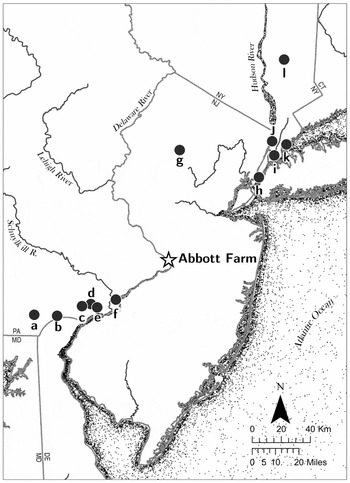
The Abbott Farm National Historic Landmark (28ME1) is a complex of numerous archaeological sites spanning the Paleoindian period to the contact period. The landmark, encompassing the former family farm of Dr. Charles Conrad Abbott, is located along roughly 5 km of the east bank of the Delaware River below Trenton, New Jersey (Figure 1). Abbott began collecting artifacts at the eponymously named site during the nineteenth century, and most of his archaeological activities related to his search for evidence of a Paleolithic occupation of the Americas (Abbott Reference Abbott1881; Joyce et al. Reference Joyce, Sandy and Horan1989; Kraft Reference Kraft1993). Abbott is widely known outside of the Middle Atlantic for his involvement in debates concerning the Pleistocene antiquity of humans in North America (Meltzer Reference Meltzer2015); however, a large portion of the materials he collected are representative of Holocene-era archaeological cultures.
Map of the Middle Atlantic showing the location of Abbott Farm National Historic Landmark and geological sources of mica sampled in this study: (a) London Grove, Chester County; (b) Fairville, Chester County, PA; (c) Delaware County; (d) Crumb Creek, Delaware County; (e) Ridley, Delaware County; (f) Philadelphia, Philadelphia County; (g) Roxbury, Morris County; (h) Harlem and Manhattan, NY; (i) West Farms, Bronx; (j) Yonkers, Westchester County; (k) New Rochelle, Westchester County; (l) Putnam County.

Subsequent to Abbott's early collecting activities, the farm complex was subjected to numerous archaeological and avocational investigations (Hunter et al. Reference Hunter, Tvaryanas, Byers and Stewart2009). Of these, the large-scale excavations conducted as part of the Works Progress Administration's (WPA) Indian Site Survey under the direction of New Jersey State Archaeologist Dorothy Cross provided the first systematic and well-documented study of the site (Cross Reference Cross1956). Cross's work documented evidence for occupations at the farm throughout prehistory. However, by far the most extensive and intensive occupation of the farm comes from a Middle Woodland (Fox Creek\Selby Bay) component, dating to between ca. A.D. 200 and 900. The Middle Woodland component is particularly noteworthy for the presence of a large number of caches, pits, and cremation burials. Cross (Reference Cross1956:68–71) described 35 caches, nearly all of which contained only one kind of artifact (usually large leaf-shaped bifaces) made on a single kind of raw material (typically argillite). Mica sheets were found in at least 28 pits, half of which were assigned by Cross to the Middle Woodland (Cross Reference Cross1956:182). She also reported finding large numbers of copper artifacts, as well as distinctive varieties of ceramics exhibiting zoned incised decorations (Abbott Zoned wares), for which the Abbott Farm became the type site.
In discussing the Middle Woodland component from Abbott Farm, Cross (Reference Cross1956:179) noted that its distinguishing characteristics were “probably inspired by the Hopewell culture, but rather remotely.” Since that time, archaeologists have explored the similarities of Abbott Farm material culture and artifacts found at contemporaneous Adena and Hopewell sites of the midcontinent, as well as what those similarities may reveal about the relationship, if any, that Middle Atlantic peoples had with Adena/Hopewell people. Thomas (Reference Thomas and Swartz1970) found significant differences in burial traditions and artifact styles between Adena/Hopewell sites in Ohio and Middle Woodland sites in the Middle Atlantic. He concluded that the Middle Atlantic sites likely represented several different cultural groups that may have participated in intensive trade with Adena/Hopewell groups to the east. Pollak (Reference Pollak1971) suggested that Abbott Farm was a satellite settlement of Hopewellian people, though this conclusion was strongly criticized by Thurman (Reference Thurman1978). Despite similarities to Adena/Hopewell materials elsewhere in North America, most researchers today do not view the Middle Woodland component at Abbott Farm as a direct settlement of Ohio Hopewell peoples. Rather, current perspectives focus on how aspects of Hopewell culture were incorporated by autochthonous Middle Atlantic cultures through intra- and interregional exchange beginning in the Early Woodland and becoming well established by Middle Woodland times (see Stewart Reference Stewart1995 for a summary and synthesis of current work). Some amount of Adena/Hopewell influence is evident in the Middle Atlantic and broader Northeast over these periods, and Abbott Farm is frequently viewed as having been a central place for both local and extra-local exchange networks that facilitated this influence (e.g., Gardner Reference Gardner and Moeller1982; Lattanzi Reference Lattanzi2013; Stewart Reference Stewart1994).
Nonlocal materials, including mica, shark teeth, copper, and exotic lithics, provide direct evidence for increasing inter- and intraregional exchange at Abbott Farm during the Middle Woodland. Several authors have proposed models of trade and exchange to account for these items being in the region and for apparent Hopewellian influences (Custer Reference Custer1984, Reference Custer1989; Stewart Reference Stewart1989, Reference Stewart1994; Thomas Reference Thomas and Swartz1970; Weslager Reference Weslager1968). Yet one obstacle in the study of these exchange networks is the absence of quantitative data that would allow confident identification of the geological sources of artifacts and raw materials (but see Prothero and Lavin Reference Prothero, Lavin, Lasca and Donahue1990). Here, we present results of a study seeking to apply concepts of archaeological geochemical provenance—sourcing—to the study of mica in general and Abbott Farm materials in particular. This study is part of a larger effort to apply modern analyses to extant archaeological collections of the New Jersey State Museum (e.g., Lattanzi and Stinchcomb Reference Lattanzi and Stinchcomb2015; Ward and Lattanzi Reference Ward and Lattanzi2015) in order to extract meaningful data and additional information pertaining to prehistory.
Mica and the Middle Woodland Component at Abbott Farm
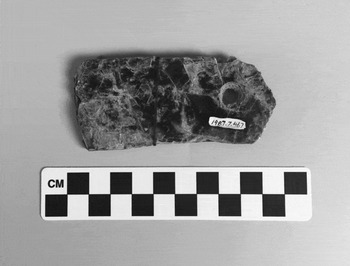
Abbott collected thousands of prehistoric artifacts from the farm, and most of these date to between the Archaic and Woodland periods. A small portion of his collection consisted of mica, mostly in a raw state, though clearly within cultural contexts. For example, he reported finding a small ceramic vessel filled with a mixture of burned animal bone and sediment, which was encountered in situ, capped with a one-foot square mica plate (Abbott Reference Abbott1876:345). Of the mica plate, Abbott noted that they “are quite common about the fields in the neighborhood of Trenton” (Abbott Reference Abbott1876:345). Only one formal artifact of mica, a pentagonal pendant (Figure 2), was reported by Abbott, though later study of his collection identified a fragment of another cut-and-drilled pendant (Parris and Williams Reference Parris and Williams1986:2). Subsequent to Abbott's activities, Ernest Volk conducted several large-scale excavations at the site. Volk, too, reported finding perforated and cut mica artifacts in several pits at sites on the farm, and in some cases mica sheets appeared to have been used to line the pit margins (Volk Reference Volk1911:67).
Worked mica pendant (GDM028 in this analysis) found by Charles Conrad Abbott on his farm.

Published accounts of Abbott's and Volk's works on the farm are largely descriptive, and neither of them provided much detail regarding the mica they encountered. In most cases, it is simply mentioned as having been present. Cross's (Reference Carpenter1956) WPA excavations in the 1930s and 1940s provide a more controlled and quantitative accounting of the importance of mica at Abbott Farm. She reported finding pieces of mica from nearly every excavation unit at the farm, including large unworked mica sheets, modified (cut and/or drilled) sheets, and crushed mica fragments (Cross Reference Cross1956:161). Most of the sheet mica recovered from Abbott Farm came from 28 pits, two of which were burials. Cross attributed half (14) of these pits to the Middle Woodland component, and Stewart's (Reference Stewart1994) analysis of the WPA collections found that four of these pits contained diagnostic Middle Woodland pottery or lithic tools. Many specimens were “thick slabs measuring over 12 inches in length and [three-quarters] inch thickness” that had been cut with a sharp instrument (Cross Reference Cross1956:161–162). In total, the WPA excavations recovered a total of over 4,000 gm of sheet mica from the farm. We also note that, in the 1950s, contractors building a house on a parcel directly adjacent to Abbott Farm encountered two pits containing enough mica to fill two five-gallon buckets (Andrew Stanzeski, personal communication 2016).
This is an astounding amount of mica, and we are inclined to agree with the claim of Williams and Thomas (Reference Williams, Thomas and Chesler1982:119) that the amount of mica recovered from Abbott Farm is greater than at any other Early/Middle Woodland site in the New England or Middle Atlantic regions. The amount of mica from the site is even more astounding considering the size of some of the sheets (up to 30 cm long), the fact that nearly all of the mica came from storage pits, and the fact that only two formal artifacts have been found at the farm. Most of the mica exhibits varying degrees of cutting/shaping, ranging from completely unmodified to having been cut into squares and rectangles. Pollak (Reference Pollak1976:18) reported that an unspecified amount of crushed mica was found in association with unfired potter's clay within a locus associated with pottery production. Indeed, Cross (Reference Cross1956:134) had previously noted that several of the Abbott Zoned pottery types she defined were (at least partially) tempered with crushed mica. In spite of the apparent use of mica as a tempering agent, Parris and Williams (Reference Parris and Williams1986) suggested that the storage of large sheets of mica implied the production of mica crafts such as ornaments and perhaps mirrors.
Not precluding its use as a temper, we are inclined to agree with Parris and Williams (Reference Parris and Williams1986:2) that much of the mica at Abbott Farm was likely destined for the production of mica crafts. We also tentatively suggest that some of the mica may have been cut and shaped into simple rectangular sheets, and that these sheets were the intended final form. Several pieces from the farm have been cut into long rectangular pieces, possibly for ease of transport, and most occurrences of mica in ceremonial Middle Woodland contexts elsewhere in the Middle Atlantic, though rare, tend to be cut sheets. Perhaps the most notable of these is a cache of 150 mica plates found at Morris-Schurz in the Bronx (Kaeser Reference Kaeser1963). The largest of these plates is less than 5 cm in length (Silver Reference Silver1991:232), much smaller than the pieces found at Abbott Farm. Less than a mile north of Abbott Farm, excavations of the Douglas Gut complex recovered a sheet of mica (ca. 10 × 5 cm) under the chin of an adult burial (Stewart Reference Stewart, Obermeyer, Grumet, Stewart, Rementer and Brown2015). A single mica sheet was also found associated with an adolescent burial at Burial Ridge (Tottenville) on Staten Island, New York (Jacobson Reference Jacobson1961). Further afield in western New York and Pennsylvania, Ritchie (Reference Ritchie1944:128–132) suggested that the local Point Peninsula focus exhibited a degree of influence from Hopewell groups to the west. This influence appears to increase through time, culminating in what he referred to as the Squawkie Hill phase (Ritchie Reference Ritchie1980) known primarily from burials and mounds (e.g., Carpenter Reference Carpenter1950, Reference Carpenter1956; McConaughy Reference McConaughy2011; McConaughy and Johnson Reference McConaughy, Johnson, Raber and Cowin2003; Ritchie Reference Ritchie1937). Materials considered diagnostic of the Squawkie Hill phase include exotic goods such as copper and silver, marine shell, pearls, Flint Ridge (Ohio) chalcedony, curved-base pipes of Ohio fireclay, and mica (Ritchie Reference Ritchie1937:183–185).
Western Pennsylvania and New York are significantly closer to the Adena/Hopewell heartland in Ohio, and thus it is not unreasonable to expect the presence of items of exchange originating from there. Abbott Farm is a great deal farther away (ca. 660 km straight-line distance), yet Thurman (Reference Thurman1978:77) stated that a biface on Flint Ridge chalcedony was recovered from Abbott Farm. Archaeologists have documented Flint Ridge bifaces, as well as other exotic trade goods, elsewhere in the Middle Atlantic, particularly for the Early Woodland and early Middle Woodland (e.g., Custer Reference Custer1987, Reference Custer1989; Kraft Reference Kraft1976; Lattanzi Reference Lattanzi2013; Luckenbach Reference Luckenbach2013; Ritchie and Dragoo Reference Ritchie and Dragoo1959; Thomas Reference Thomas and Swartz1970). It is unclear what items, if any, may have reached back to the Adena and later Hopewell heartlands in return. Given the presence of numerous primary geological sources of mica in the Middle Atlantic, one possible exchange item is mica. Howard Winters, well known for studying how exotic objects found their way into ritual ceremonialism of Early and Middle Woodland cultures of the Midcontinent (Brown et al. Reference Brown, Kerber, Winters and Smith1990; Winters Reference Winters, Binford and Binford1968, Reference Winters1969, Reference Winters, Cantwell, Griffin and Rothschild1981), examined all the mica from Abbott Farm in the 1970s to explore the possibility of connections between Abbott Farm and Ohio Hopewell sites (Lorraine Williams, personal communication 2016). The results of Winters's examination are not known.
We hold varying opinions on the likelihood that Middle Atlantic mica reached the Hopewell heartland; however, we all agree that this is a question that can be resolved only through empirical data. We also agree that current archaeological evidence demonstrates that, whatever the nature of exchange throughout the Middle Atlantic, mica held special significance. The sheer amount of mica found at Abbott Farm suggests that residents there played a key role in its exchange. Was mica brought to the farm from one or multiple localities for ceremonial purposes, or was Abbott Farm an economic hub in the production and distribution of mica crafts and other items? As noted above, reliable quantitative data are needed to address these questions. Determining the geological source(s) of mica, therefore, has the potential to inform on the nature of mica exchange networks in the Middle Atlantic Middle Woodland as well as the broader Hopewell interaction sphere.
Distinguishing Mica Sources
Mica occurs quite commonly within the sedimentary, igneous, and metamorphic rocks of the Middle Atlantic; however, these occurrences are typically small flakes. Very large crystals of mica, sometimes referred to as books, occur only within intrusive veins and dikes of pegmatites (Klein Reference Klein2002; Sterrett Reference Sterrett1923). What matters here is that geologists have identified several varieties and sources of mica within pegmatite intrusions in the Middle Atlantic. Gordon (Reference Gordon1922:106–108), for example, reports several muscovite-bearing pegmatite veins in southeastern Pennsylvania containing crystals exceeding 25 cm in length and weighing up to 100 lbs. Other sources of mica occur south of New Jersey (Gordon Reference Gordon1922; Griffitts and Olson Reference Griffitts and Olson1953a, Reference Griffitts and Olsonb; Griffitts et al. Reference Griffitts, Jahns and Lemke1953; Heinrich et al. Reference Heinrich, Klepper and Jahns1953; Heinrich and Olson Reference Heinrich and Olson1953; Jahns et al. Reference Jahns, Griffitts and Heinrich1952; Lemke et al. Reference Lemke, Jahns and Griffitts1952).
In their preliminary study, Parris and Williams (Reference Parris and Williams1986) observed several potentially diagnostic petrological characteristics of the Abbott Farm mica. Nearly all the Abbott Farm mica can be classified as a colorless or light-brown muscovite (KAl2[AlSi3O10][OH2]) that contains “conspicuous inclusions of black skeletal crystals of magnetite” (Parris and Williams Reference Parris and Williams1986:3) or exhibits some degree of magnetite staining. They further observed that mica crystals of the size recovered from Abbott Farm are found only within intrusive pegmatites. By comparing these petrological observations to published descriptions of historic mica-mining localities, Parris and Williams (Reference Parris and Williams1986:4) identified several localities from which the Abbott Farm muscovite may derive. Specifically, they suggested that the most likely source(s) may be within pegmatite intrusions in the Wissahickon mica gneiss of southeastern Pennsylvania (Bastin Reference Bastin1910: Plate VIII; Sterrett Reference Sterrett1923) and that no sources of magnetite-bearing muscovite crystals of such large size are present in the immediate vicinity of Abbott Farm (contra Cross Reference Cross1956:162). We concur with the findings of Parris and Williams, though we note that some researchers report large crystals of colorless and light-brown magnetite-stained muscovite from pegmatite intrusions in the Manhattan schist and gneiss in modern-day New York City (Frondel Reference Frondel1936; Hovey Reference Hovey1895; Manchester Reference Manchester1931).
Chemical Analysis of Mica
Establishing trade requires determining the original provenance of traded items. Here, we explore the use of portable X-ray fluorescence (pXRF) and neutron activation analysis (NAA) for the chemical characterization of mica-source samples and mica artifacts. Our goal is to evaluate the potential of these two analytical methods for identifying potentially provenance-related geochemical differences.
Several geographically restricted geologic sources of mica are present within the Middle Atlantic, several of which Parris and Williams (Reference Parris and Williams1986) sampled. They reported that the atomic absorption spectrophotometryFootnote 1 (AAS) chemical characterization of two source specimens and an unspecified number of Abbott Farm artifacts was encouraging, in that the specimens had similar Na/K ratios (ranging from 0.054 to 0.071). We are not aware of other attempts at chemically characterizing mica artifacts from the Middle Atlantic or from the broader Northeast.
Bonomo (Reference Bonomo2011) reported the analyses of over 300 mica-source specimens from the southeastern United States and muscovite artifacts recovered from Etowah (9BR1) in northwestern Georgia. He also compiled geochemical data for several southeastern muscovite sources from published and unpublished documents. The northernmost source discussed by Bonomo (Reference Bonomo2011:7–11) comprises several historic (and potentially prehistoric) mines in Mitchell County, North Carolina.
Bonomo (Reference Bonomo2011:66–77) employed pXRF to generate data for his source and artifact specimens. Through discriminant function analysis and integration of optical mineralogy, he proposed a local source attribution for the majority of artifacts. However, he noted that his “geochemical data alone is insufficient for making a definitive provenance determination” (Bonomo Reference Bonomo2011:167).
Portable X-ray Fluorescence
Portable X-ray fluorescence presents an attractive option in the chemical characterization of archaeological artifacts in that the analyst can rapidly analyze specimens without the need to remove a sample from the artifact; however, there is a trade-off. Most pXRF instruments have relatively high detection limits and are limited in terms of the number of elements detected. Indeed, Bonomo's (Reference Bonomo2011) study reports only seven elements consistently above the detection limits of his instrumentation. Moreover, as with all XRF instruments, there is a need to use matrix-matched standard reference materials (Hunt and Speakman Reference Hunt and Speakman2015; Shackley Reference Shackley2010).
The New Jersey State Museum's Bureau of Archaeology and Ethnography loaned 24 archaeological mica specimens from Abbott Farm for this study. Additionally, the Bureau of Natural History of the New Jersey State Museum and the Geology Department at Rutgers University provided 16 mica-source specimens. Our selection of geological samples is admittedly opportunistic, drawing from what is available in existing mineral collections. Given that we have not yet attempted to systematically sample all potential sources, it is possible that our mica-source database does not account for all sources used by Native Americans. Identifying potential sources and collecting samples from those sources is certainly a priority; however, we also note that several of our specimens were collected from exposures in the New York City metropolitan area. It is distinctly possible that urbanization has destroyed some of these, as well as other sources used by Native Americans. Thus, the limited museum samples on hand may represent one of the few remaining possibilities to analyze mica from these sources.
The hand-held pXRF spectrometer has an Rh-based X-ray tube that we operated at low- and high-energy modes to measure a broad suite of elements. The low-energy scan lasted 60 s under vacuum to facilitate detection of low-Z elements (Z refers to the atomic number, the number of protons in the nucleus). The high-energy scan was not performed under vacuum, and it lasted 180 s. Three separate assays were performed on each mica specimen to evaluate internal homogeneity.
Empirical calibrations for each energy level were created using spectra obtained from 17 geological standard reference materialsFootnote 2 (SRMs). Reference values for each SRM were drawn either from certified values from issuing institutions or from the preferred values of GeoRem (Jochum et al. Reference Jochum, Nohl, Herwig, Lammel, Stoil and Hofmann2007). Analysis of NIST 610 glass and pressed planchets of USGS RGM-1, NIST 688, and NIST 278 established quality control.
pXRF Results
Results of our preliminary pXRF study (Supplemental Table 1) suggest that there is significant intersource chemical variation among mica sources. A principal components analysis of our data indicates that a majority of the Abbott Farm mica specimens are of a generally similar composition, tending to be enriched in Ba and Sr relative to most of the geological specimens. A cluster analysis supports this conclusion. All but three specimens, one of which is the aforementioned pentagonal pendant recovered by Abbott (GDM028), appear to represent a single compositional profile. The geological specimens appear to be quite different from each other in their chemistry. Only three source specimens exhibit Ba and Sr concentrations similar to those observed in the artifacts. These come from Fairville, Pennsylvania; High Bridge Park, New York; and Roxbury, New Jersey.
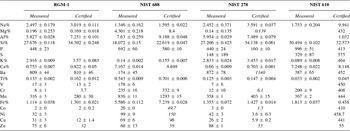
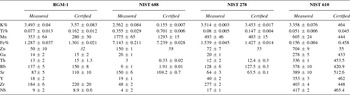
Our pXRF data suggest that the analytical method has some promise for the discrimination of mica sources in the Middle Atlantic. However, the accuracy and precision of our pXRF measurements left much to be desired. Comparison of our check-standards to certified values suggests that measurements of most elements (especially low-Z elements such as Na, Mn, K, and Ca) had analytical uncertainties exceeding 10 percent (Tables 1, 2). Moreover, replicate assays of the same specimens had a high degree of variation (as measured by the corrected coefficient of variation; see Supplemental Table 1). This variation and uncertainty is, we believe, attributable to several factors: calibration, sample thickness, and instrumentation. It seems likely that our calibration is in part problematic, given the unavailability of, and hence our failure to use, matrix-matched standards. Additionally, most of our specimens are quite thin. Even though we adjusted instrument parameters (i.e., energy level and filter) to account for this, it is possible that the thinness of the mica sheets contributed to the highly variable results (see Davis et al. Reference Davis, Jackson, Shackley, Teague, Hampel and Shackley2011). We also suspect that poor accuracy and precision, as well as high variability, of our results relate to problems quantifying low-energy elements that are inherent to pXRF instruments. It was with these issues in mind that we decided to supplement our analyses with additional assays by NAA.
Measured and Certified Reference Material Values Used in the Low-Energy pXRF Analysis.

Note: All data in ppm unless otherwise noted. Italics represent reference values.
Measured and Certified Reference Material Values Used in the High-Energy pXRF Analysis.

Note: All data in ppm unless otherwise noted. Italics represent reference values.
Neutron Activation: Methodological Study
At the outset of this study we were unsure how best to prepare the sheet-mica specimens for NAA, largely because the majority of our combined experience has focused on sample matrices that are easily ground to a powder (e.g., pottery) or crushed into small chips (e.g., obsidian and chert). Powdering or crushing the sheet mica specimens proved difficult following standard procedures at the University of Missouri Research Reactor (MURR), as the material broke apart into fine flakes and adhered to equipment. We also were unsure as to how the mica specimens would react upon activation. That is, would the concentrations of certain elements such as the rare earth elements (REEs) be high enough that they might interfere with standard sample-counting procedures? We therefore devised a preliminary assessment using six specimens to explore these issues and to assist in developing a standard procedure for the preparation and irradiation of mica.
Six specimens (numbered GDM001-006) were split into three aliquots each (suffixed A, B, and C). Aliquot A of each specimen was crushed with a clean agate mortar and pestle into coarse flakes. Aliquot B of each specimen comprised fragments that were finely ground, but not pulverized. Aliquot C consisted of powdered matrix, pulverized in an agate mortar.
Approximately 100 mg of each aliquot were weighed into high-density polyethelene vials used for the short-irradiation procedure at MURR. A further 100 mg was weighed into high-purity quartz vials for the long-irradiation procedure. These amounts are significantly less than the 150 mg (short) and 200 mg (long) weights that are typically used for powdered pottery/clay at MURR.
Comparator samples made from certified standard reference materials (SRMs) issued by the National Institute for Standards and Technology (NIST) were similarly prepared. These SRMs included SRM-1633b (coal fly ash) and SRM-688 (basalt). Quality-control samples—reference materials treated as unknowns—of NIST SRM-278 (obsidian), SDC-1 (mica schist, issued by the United States Geological Survey), and New Ohio Redart Clay (an internal reference material used at MURR) were similarly prepared.
We used standardized protocols (Glascock Reference Glascock and Neff1992; Glascock and Neff Reference Glascock and Neff2003) to irradiate the samples. These protocols consist of two irradiations and three gamma counts. The short irradiation is carried out through a pneumatic-tube system. Polyvials are sequentially irradiated, two per assay, for 5 s by a neutron flux of 8 × 10¹³n cm−2 s−1. Following this irradiation, each specimen is counted for 720 s. This gamma-ray count allows quantification of nine short-lived isotopes: Al, Ba, Ca, Dy, K, Mn, Na, Ti, and V.
The second irradiation requires immersing the analytical samples sealed in quartz vials within the MURR reactor pool and exposing them to a neutron flux of 5 × 10¹³n cm−2 s−1. After irradiation, specimens are allowed to decay for seven days, and they are then counted for 1,800 s. This gamma count allows quantification of seven elements whose isotopes have medium half-lives: As, La, Lu, Nd, Sm, U, and Yb. Following an additional three-week decay period, a final 8,500 s gamma count is performed on these same specimens in order to yield the following 17 elements of long half-lives: Ce, Co, Cr, Eu, Fe, Hf, Ni, Rb, Sb, Sc, Sr, Ta, Tb, Th, Zn, and Zr.
Preliminary Results
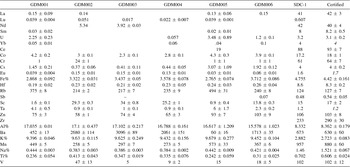
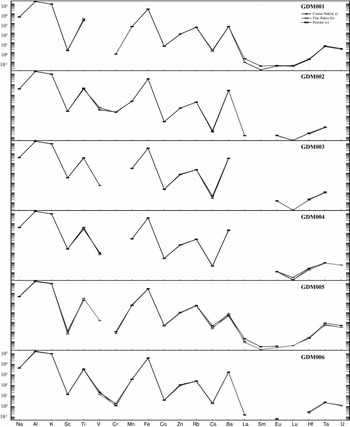
The results of our preliminary study (Table 3, Supplemental Table 2) reveal that the abundances of elements within the mica specimens are well within the bounds of safe handling and detection using standard MURR irradiation and counting protocols developed for pottery and cryptocrystalline silicates. We also found no substantive geochemical differences resulting from the use of fine or coarse fragments or of powders (Figure 3).
Six Replicate Mica Aliquots, and USGS SDC-1 Measurements.

Note: USGS certified values are also shown (reference values in italics). All data in ppm except as otherwise noted. As, Ni, Sr, Tb, Th, Ca, and Dy were at or below detection limits for all mica samples.
Spider diagrams of replicate assays for the six preliminary samples. No substantive differences were observed in the geochemical data generated using (a) coarse flakes, (b) fine flakes, or (c) powders. Data shown here are generated by NAA.

Expanding the Sample
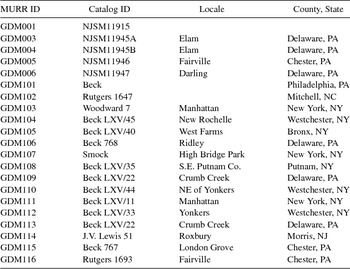
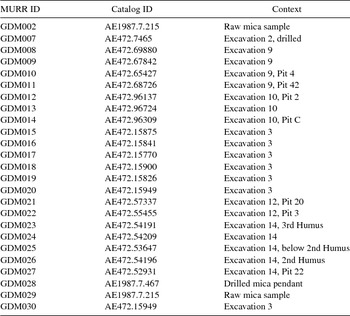
We analyzed an additional 16 specimens that derive from geological source areas in the Middle Atlantic, bringing the total number of sources represented in our data to 21 (Table 4). These specimens were obtained from the geological collectionsFootnote 3 of Rutgers University and the New Jersey State Museum. In addition to these source materials, we analyzed 25 artifact specimens from the Abbott Farm collections at the New Jersey State Museum (Table 5). All of these specimens were obtained during the WPA excavations led by Cross in the 1930s.
Identifications (MURR and NJSM) of Mica-Source Specimens and their Reported Collection Locales.

Note: GDM001 is from an unknown locality in the Middle Atlantic.
Identifications (MURR and NJSM) of Mica Artifacts from Abbott Farm.

Note: Excavation numbers and contexts from Cross (Reference Cross1956).
Building on the results of our preliminary study, each specimen was rinsed in water and scrubbed lightly with a stiff-bristle brush to remove adhering sediment. Fragments from each specimen were removed and then lightly crushed with an agate mortar and pestle. The resulting flakes were then placed in a drying oven for more than 24 h.
After drying, each specimen was split to provide analytical samples for two irradiation routines. We again used approximately 100 mg of fragments for the short and long irradiations, though we suspect that future assays might reasonably use larger samples. Irradiation and counting procedures were identical to those discussed above.
Results of the Expanded Study
Results of the expanded NAA sample are provided in Supplemental Table 2. Many of the elements we attempted to quantify were found to be at or below detection limits of our current NAA procedures. These elements were stripped from the database, and the remaining elemental abundances were examined using a variety of statistical analyses.
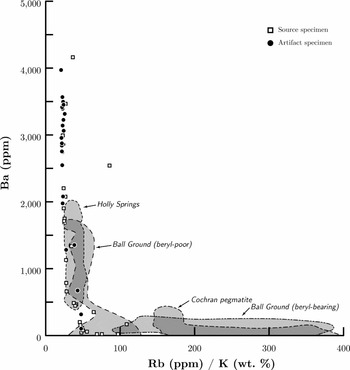
Comparison of our data with data from mica deposits in the Southeast suggest that the Middle Atlantic micas are, as Parris and Williams (Reference Parris and Williams1986:5) suggested, from a beryl-poor pegmatite granite source (Figure 4). Compared to previously analyzed micas, the micas from New Jersey, New York, and Pennsylvania show significant enrichment in Ba, as well as very low Rb/K ratios. Muscovite artifacts and source samples tend to overlap slightly with those from the Holly Springs pegmatites from Cherokee County, Georgia (Gunow and Bonn Reference Gunow and Bonn1989), but nearly all of the Abbott Farm artifacts are well outside the range of Ba concentrations reported for the Georgia muscovites.
Plot of barium over rubidium:potassium ratio for the Abbott Farm mica artifacts and Middle Atlantic mica sources compared to four mica sources in the Southeast (after Gunow and Bonn Reference Gunow and Bonn1989:Figure 6). Data shown here are generated by NAA.

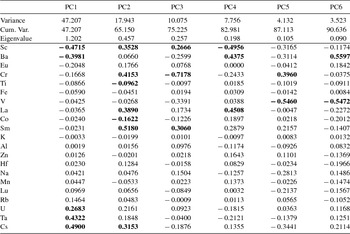
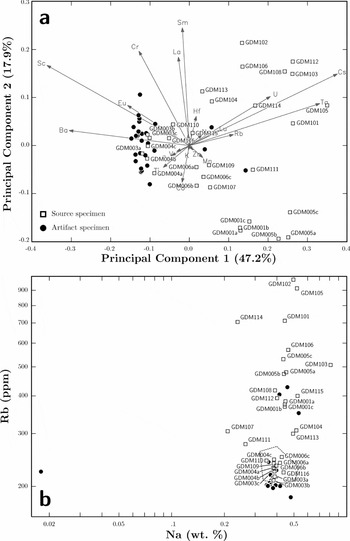
Principal component (PC) analysis (Table 6) of the NAA data indicate that greater than 90 percent of the cumulative variation in the data can be described by six components. The first component is strongly loaded on Sc, Ba, U, Ta, and Cs. Recall that Ba was also identified as a significant source of variation in our initial pXRF study. A biplot of PC scores and elemental-loading vectors (Figure 5a) suggests that many of the Abbott Farm artifacts share a similar chemistry, whereas geological source specimens are quite variable. We note that, in this projection of the data, geological specimens from Elam (Delaware County) and Fairville (Chester County), Pennsylvania, appear most similar to the main cluster of Abbott Farm mica artifacts.
Principal Component Analysis of Compositional Data.

Note: Strong elemental loading is indicated by bold.
Plots of the geochemical data, generated by NAA, for the Middle Atlantic mica database. Source samples are labeled. Note the tight clustering of mica artifacts along with source specimens from Delaware and Chester Counties, Pennsylvania: (a) Biplot of principal component scores and loading vectors calculated for the Middle Atlantic mica database; (b) Bivariate plot of rubidium and sodium, dashed line surrounds source specimens from Delaware and Chester Counties. The artifact with anomalously low sodium is GDM028, the pendant found by Abbott (see Figure 2).

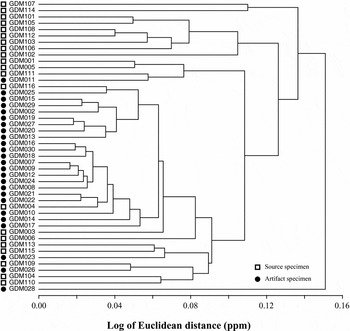
Hierarchical cluster analysis of these data produces similar results (Figure 6). As with the PC biplots, nearly all of the Abbott Farm artifacts cluster together in the resulting dendrogram. Source samples from Elam and Fairville are, again, most similar to these artifacts. Four of the Abbott Farm artifacts appear distinct from the main cluster of artifacts, and these are dissimilar to each other—perhaps suggesting that they represent individual pieces from several chemically distinct sources.
Dendrogram of a hierarchical cluster analysis of compositional data for the Middle Atlantic mica data. Note the strong clustering of nearly all artifacts from Abbott Farm along with source specimens from Darling (GDM006), Elam (GDM003–004), and Fairville (GDM116). Data shown here are generated by NAA.

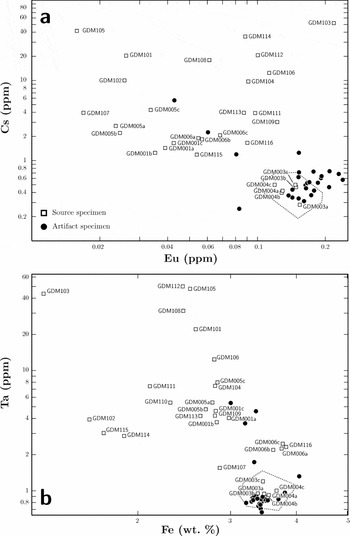
A series of bivariate plots of elemental-abundance data further suggests that the majority of artifact samples share a distinct chemical composition that is most similar to source samples from Elam and Fairville (Figures 5b, 7a). Specifically, we note that the artifact specimens show a relative depletion in alkali metals (K, Rb, and Cs) and enrichment in Eu and other REEs relative to most geological specimens. The Abbott Farm artifacts are also depleted in Ta relative to most sources (Figure 7b). These chemical properties (depletion in alkali metals, markedly low concentrations of Ta, and slight enrichment in REEs) are also observed in mica source specimens from the Elam locality as well as some of the source specimens from the Darling (Delaware County, Pennsylvania) and Fairville localities. Of note, source specimens from Manhattan, Long Island, and New Jersey are easily distinguished from all of the Abbott Farm artifacts.
Plots of the geochemical data, generated by NAA, for the Middle Atlantic mica database. Source samples are labeled, and dashed line surrounds source specimens from Delaware and Chester Counties. (a) Bivariate plot of cesium and europium; (b) Bivariate plot of tantalum and iron concentrations. All data shown here are generated by NAA.

Discussion
Results of our study have several implications relating to studies of mica artifacts as well as to the understanding of mica-artifact production and trade at Abbott Farm. We discuss each of these in turn below.
Methodological Discussion
The pXRF results for sheet mica samples are suggestive, but they do not provide sufficient resolution to discriminate individual sources reliably. Moreover, we note high analytical uncertainty for many key elements. In part, this may be a result of our own calibration process. That is to say, we could conceivably obtain better results with more time and experimentation with the instrument. We note, however, that Bonomo's (Reference Bonomo2011) study also reported relatively high analytical uncertainty and that nearly all elements he attempted to quantify were below the detection limits of his instrument. Thus, we suspect that several issues, including the absence of matrix-matched standards and the relatively high detection limits for most elements, might plague use of pXRF to “source” sheet mica samples.
Our NAA results suggest that, at least in the case of these specimens, analysis by neutron activation is a relatively straightforward process for sheet mica. We observe no abnormally high elemental abundances that might interfere with gamma-ray counting or that might require significant changes to standard protocols. We also observe no distinct differences between powdered and crushed aliquots. Thus, there appears to be no need to grind the mica into a fine powder—a process that proved exceptionally difficult using hand tools and that may introduce metal contamination if done using a shatterbox or drillbit (e.g., Boulanger et al. Reference Boulanger, Fehrenbach and Glascock2012).
Archaeological Discussion
Our findings indicate that the majority of mica artifacts from Abbott Farm appear to exhibit a single geochemical fingerprint that is presumably representative of a single geological source. Three separate treatments of the geochemical data suggest that source specimens most similar to the Abbott Farm mica come from geological localities in Delaware and Chester Counties, south of Philadelphia, Pennsylvania. As noted above, Parris and Williams (Reference Parris and Williams1986) used petrological observations to identify this same region as the most likely source of mica artifacts. Thus, our results confirm and expand on their conclusions, leading to a hypothesis of provenance supported by both geochemical and mineralogical data.
We note that a handful of artifacts in the Abbott Farm collection exhibit unique chemical profiles. In the absence of a large number of geological-source specimens, we are limited in our ability to confidently identify the most likely sources for these artifacts; however, we infer from this finding that not all mica artifacts derive from southeastern Pennsylvania localities. Thus, it seems as if at least some artifacts represent a variety of other sources. Interestingly, one of these artifacts (GDM028) is one of only two formal ornaments found at the site: the drilled pentagonal pendant collected by Abbott.
The results of our analysis provide some answers, but they also present interesting questions. Why has Abbott Farm yielded very few finished mica objects but an enormous amount of raw and cut mica? Historically, archaeologists have suggested that this is because Abbott Farm functioned as a regional center from which artifacts carrying ideological significance were distributed (e.g., Pollak Reference Pollak1971; Silver Reference Silver1991). Indeed, this seems plausible in light of the quantity of sheet mica and other cached materials found there. Our finding that most of the mica comes from a single source locality could certainly be explained by repeated task-specific forays to this locality. But, if Abbott Farm was a sort of regional distribution hub for mica crafts, why are such crafts so rare at Middle Woodland sites throughout the region? Perhaps mica was being traded into the Hopewell core area in Ohio. Or perhaps the ultimate disposition of mica sheets was the caches themselves. That is to say, perhaps the mica sheets were ritually brought from a specific locality in southeastern Pennsylvania to Abbott Farm, where they were cached. The rarity of formal artifacts at the farm and the finding that the chemistry of the only formal mica ornament we tested is significantly different from the rest of the mica—and indeed from all Middle Atlantic mica sources we have sampled (e.g., Figures 5, 6, and 7)—may actually support such a scenario.
Ultimately, our study does not provide answers to the above questions, nor is it intended to. Rather, studies such as this one are necessary to establish methodologies and preliminary data that can be used to approach these questions empirically. Whether the Abbott Farm mica was destined for exchange within the immediate vicinity, the broader Middle Atlantic, or even into the Hopewell core area in Ohio remains to be determined. Future characterization studies of mica from both the Abbott Farm and other Middle Atlantic Middle Woodland sites, as well as from Adena/Hopewell sites of the midcontinent are clearly required.
Conclusions
Exploration of archaeometric methods to chemically characterize sheet mica artifacts from Abbott Farm and from geological sources suggests that NAA may be a viable means of sourcing mica artifacts. Although pXRF may be an appealing analytical method, our results were suggestive, but not definitive. Further studies involving assays of mica using both methods appear warranted, though quantitative analysis by pXRF might be restricted by several factors. Given our results, pXRF may best serve as an initial test that could identify gross differences in major-element chemistry between mica artifacts. It remains to be seen how useful such information could be.
We are somewhat hamstrung by the limited number of geological specimens in our sample that represent individual sources. In the absence of a large number of specimens from each source, we are unable to rely on multivariate statistics that might allow us to express a specific degree of confidence in associating artifacts with specific sources. Thus, we prefer to focus on our observation that most of the artifact specimens share a very similar chemical composition. It is intriguing that mica-source specimens from Elam and Fairville also exhibit this composition, supporting earlier petrological observations regarding the source of these artifacts.
Acknowledgments
We thank three anonymous reviewers and Robert Kelly for comments and suggestions that greatly improved this paper. We also thank Catherine Boulanger for translating our abstract. A preliminary report on this study was presented at the 2013 Annual Meeting of the Society for American Archaeology, Honolulu, Hawai'i. This research was supported by grants from the National Science Foundation (1415403 and 1110793).
Data Availability Statement
Data reported here are freely available for download at the MURR Archaeometry Laboratory website (http://archaeometry.missouri.edu/) as well as upon request to the two senior authors.
Supplemental Materials
Supplemental materials are linked to the online version of this paper, which is accessible via the SAA member login at https://doi.org/10.1017/aaq.2017.1.
Supplemental Table 1. Portable XRF Data for Mica Specimens.
Supplemental Table 2. Neutron Activation Data for Mica Specimens.