

%20--%3e%3c!DOCTYPE%20svg%20PUBLIC%20'-//W3C//DTD%20SVG%201.0//EN'%20'http://www.w3.org/TR/2001/REC-SVG-20010904/DTD/svg10.dtd'%3e%3csvg%20version='1.0'%20id='Layer_1'%20xmlns='http://www.w3.org/2000/svg'%20xmlns:xlink='http://www.w3.org/1999/xlink'%20x='0px'%20y='0px'%20width='64px'%20height='64px'%20viewBox='5.5%20-3.5%2064%2064'%20enable-background='new%205.5%20-3.5%2064%2064'%20xml:space='preserve'%3e%3cg%3e%3ccircle%20fill='%23FFFFFF'%20fill-opacity='0'%20cx='37.785'%20cy='28.501'%20r='28.836'/%3e%3cpath%20fill='%23595959'%20d='M37.441-3.5c8.951,0,16.572,3.125,22.857,9.372c3.008,3.009,5.295,6.448,6.857,10.314%20c1.561,3.867,2.344,7.971,2.344,12.314c0,4.381-0.773,8.486-2.314,12.313c-1.543,3.828-3.82,7.21-6.828,10.143%20c-3.123,3.085-6.666,5.448-10.629,7.086c-3.961,1.638-8.057,2.457-12.285,2.457s-8.276-0.808-12.143-2.429%20c-3.866-1.618-7.333-3.961-10.4-7.027c-3.067-3.066-5.4-6.524-7-10.372S5.5,32.767,5.5,28.5c0-4.229,0.809-8.295,2.428-12.2%20c1.619-3.905,3.972-7.4,7.057-10.486C21.08-0.394,28.565-3.5,37.441-3.5z%20M37.557,2.272c-7.314,0-13.467,2.553-18.458,7.657%20c-2.515,2.553-4.448,5.419-5.8,8.6c-1.354,3.181-2.029,6.505-2.029,9.972c0,3.429,0.675,6.734,2.029,9.913%20c1.353,3.183,3.285,6.021,5.8,8.516c2.514,2.496,5.351,4.399,8.515,5.715c3.161,1.314,6.476,1.971,9.943,1.971%20c3.428,0,6.75-0.665,9.973-1.999c3.219-1.335,6.121-3.257,8.713-5.771c4.99-4.876,7.484-10.99,7.484-18.344%20c0-3.543-0.648-6.895-1.943-10.057c-1.293-3.162-3.18-5.98-5.654-8.458C50.984,4.844,44.795,2.272,37.557,2.272z%20M37.156,23.187%20l-4.287,2.229c-0.458-0.951-1.019-1.619-1.685-2c-0.667-0.38-1.286-0.571-1.858-0.571c-2.856,0-4.286,1.885-4.286,5.657%20c0,1.714,0.362,3.084,1.085,4.113c0.724,1.029,1.791,1.544,3.201,1.544c1.867,0,3.181-0.915,3.944-2.743l3.942,2%20c-0.838,1.563-2,2.791-3.486,3.686c-1.484,0.896-3.123,1.343-4.914,1.343c-2.857,0-5.163-0.875-6.915-2.629%20c-1.752-1.752-2.628-4.19-2.628-7.313c0-3.048,0.886-5.466,2.657-7.257c1.771-1.79,4.009-2.686,6.715-2.686%20C32.604,18.558,35.441,20.101,37.156,23.187z%20M55.613,23.187l-4.229,2.229c-0.457-0.951-1.02-1.619-1.686-2%20c-0.668-0.38-1.307-0.571-1.914-0.571c-2.857,0-4.287,1.885-4.287,5.657c0,1.714,0.363,3.084,1.086,4.113%20c0.723,1.029,1.789,1.544,3.201,1.544c1.865,0,3.18-0.915,3.941-2.743l4,2c-0.875,1.563-2.057,2.791-3.541,3.686%20c-1.486,0.896-3.105,1.343-4.857,1.343c-2.896,0-5.209-0.875-6.941-2.629c-1.736-1.752-2.602-4.19-2.602-7.313%20c0-3.048,0.885-5.466,2.658-7.257c1.77-1.79,4.008-2.686,6.713-2.686C51.117,18.558,53.938,20.101,55.613,23.187z'/%3e%3c/g%3e%3c/svg%3e)
%20--%3e%3c!DOCTYPE%20svg%20PUBLIC%20'-//W3C//DTD%20SVG%201.0//EN'%20'http://www.w3.org/TR/2001/REC-SVG-20010904/DTD/svg10.dtd'%3e%3csvg%20version='1.0'%20id='Layer_1'%20xmlns='http://www.w3.org/2000/svg'%20xmlns:xlink='http://www.w3.org/1999/xlink'%20x='0px'%20y='0px'%20width='64px'%20height='64px'%20viewBox='5.5%20-3.5%2064%2064'%20enable-background='new%205.5%20-3.5%2064%2064'%20xml:space='preserve'%3e%3cg%3e%3ccircle%20fill='%23FFFFFF'%20fill-opacity='0'%20cx='37.637'%20cy='28.806'%20r='28.276'/%3e%3cg%3e%3cpath%20fill='%23595959'%20d='M37.443-3.5c8.988,0,16.57,3.085,22.742,9.257C66.393,11.967,69.5,19.548,69.5,28.5c0,8.991-3.049,16.476-9.145,22.456%20C53.879,57.319,46.242,60.5,37.443,60.5c-8.649,0-16.153-3.144-22.514-9.43C8.644,44.784,5.5,37.262,5.5,28.5%20c0-8.761,3.144-16.342,9.429-22.742C21.101-0.415,28.604-3.5,37.443-3.5z%20M37.557,2.272c-7.276,0-13.428,2.553-18.457,7.657%20c-5.22,5.334-7.829,11.525-7.829,18.572c0,7.086,2.59,13.22,7.77,18.398c5.181,5.182,11.352,7.771,18.514,7.771%20c7.123,0,13.334-2.607,18.629-7.828c5.029-4.838,7.543-10.952,7.543-18.343c0-7.276-2.553-13.465-7.656-18.571%20C50.967,4.824,44.795,2.272,37.557,2.272z%20M46.129,20.557v13.085h-3.656v15.542h-9.944V33.643h-3.656V20.557%20c0-0.572,0.2-1.057,0.599-1.457c0.401-0.399,0.887-0.6,1.457-0.6h13.144c0.533,0,1.01,0.2,1.428,0.6%20C45.918,19.5,46.129,19.986,46.129,20.557z%20M33.042,12.329c0-3.008,1.485-4.514,4.458-4.514s4.457,1.504,4.457,4.514%20c0,2.971-1.486,4.457-4.457,4.457S33.042,15.3,33.042,12.329z'/%3e%3c/g%3e%3c/g%3e%3c/svg%3e)
%20--%3e%3c!DOCTYPE%20svg%20PUBLIC%20'-//W3C//DTD%20SVG%201.0//EN'%20'http://www.w3.org/TR/2001/REC-SVG-20010904/DTD/svg10.dtd'%3e%3csvg%20version='1.0'%20id='Layer_1'%20xmlns='http://www.w3.org/2000/svg'%20xmlns:xlink='http://www.w3.org/1999/xlink'%20x='0px'%20y='0px'%20width='64px'%20height='64px'%20viewBox='5.5%20-3.5%2064%2064'%20enable-background='new%205.5%20-3.5%2064%2064'%20xml:space='preserve'%3e%3cg%3e%3ccircle%20fill='%23FFFFFF'%20fill-opacity='0'%20cx='36.924'%20cy='28.403'%20r='28.895'/%3e%3cpath%20fill='%23595959'%20d='M37.442-3.5c8.99,0,16.571,3.085,22.743,9.256C66.393,11.928,69.5,19.509,69.5,28.5c0,8.992-3.048,16.476-9.145,22.458%20C53.88,57.32,46.241,60.5,37.442,60.5c-8.686,0-16.19-3.162-22.513-9.485C8.644,44.728,5.5,37.225,5.5,28.5%20c0-8.762,3.144-16.343,9.429-22.743C21.1-0.414,28.604-3.5,37.442-3.5z%20M12.7,19.872c-0.952,2.628-1.429,5.505-1.429,8.629%20c0,7.086,2.59,13.22,7.77,18.4c5.219,5.144,11.391,7.715,18.514,7.715c7.201,0,13.409-2.608,18.63-7.829%20c1.867-1.79,3.332-3.657,4.398-5.602l-12.056-5.371c-0.421,2.02-1.439,3.667-3.057,4.942c-1.622,1.276-3.535,2.011-5.744,2.2%20v4.915h-3.714v-4.915c-3.543-0.036-6.782-1.312-9.714-3.827l4.4-4.457c2.094,1.942,4.476,2.913,7.143,2.913%20c1.104,0,2.048-0.246,2.83-0.743c0.78-0.494,1.172-1.312,1.172-2.457c0-0.801-0.287-1.448-0.858-1.943l-3.085-1.315l-3.771-1.715%20l-5.086-2.229L12.7,19.872z%20M37.557,2.214c-7.276,0-13.428,2.571-18.457,7.714c-1.258,1.258-2.439,2.686-3.543,4.287L27.786,19.7%20c0.533-1.676,1.542-3.019,3.029-4.028c1.484-1.009,3.218-1.571,5.2-1.686V9.071h3.715v4.915c2.934,0.153,5.6,1.143,8,2.971%20l-4.172,4.286c-1.793-1.257-3.619-1.885-5.486-1.885c-0.991,0-1.876,0.191-2.656,0.571c-0.781,0.381-1.172,1.029-1.172,1.943%20c0,0.267,0.095,0.533,0.285,0.8l4.057,1.83l2.8,1.257l5.144,2.285l16.397,7.314c0.535-2.248,0.801-4.533,0.801-6.857%20c0-7.353-2.552-13.543-7.656-18.573C51.005,4.785,44.831,2.214,37.557,2.214z'/%3e%3c/g%3e%3c/svg%3e)
%20--%3e%3c!DOCTYPE%20svg%20PUBLIC%20'-//W3C//DTD%20SVG%201.1//EN'%20'http://www.w3.org/Graphics/SVG/1.1/DTD/svg11.dtd'%3e%3csvg%20version='1.1'%20id='Layer_1'%20xmlns='http://www.w3.org/2000/svg'%20xmlns:xlink='http://www.w3.org/1999/xlink'%20x='0px'%20y='0px'%20width='64.000977px'%20height='64px'%20viewBox='0%200%2064.000977%2064'%20enable-background='new%200%200%2064.000977%2064'%20xml:space='preserve'%3e%3cg%3e%3ccircle%20fill='%23FFFFFF'%20fill-opacity='0'%20cx='32.064453'%20cy='31.788086'%20r='29.012695'/%3e%3cg%3e%3cpath%20fill='%23595959'%20d='M31.943848,0C40.896484,0,48.476562,3.105469,54.6875,9.314453C60.894531,15.486328,64.000977,23.045898,64.000977,32%20s-3.048828,16.457031-9.145508,22.513672C48.417969,60.837891,40.779297,64,31.942871,64%20c-8.648926,0-16.152832-3.142578-22.513672-9.429688C3.144043,48.286133,0,40.761719,0,32.000977%20c0-8.723633,3.144043-16.285156,9.429199-22.68457C15.640137,3.105469,23.14502,0,31.943848,0z%20M32.060547,5.771484%20c-7.275391,0-13.429688,2.570312-18.458496,7.714844C8.381836,18.783203,5.772949,24.954102,5.772949,32%20c0,7.125,2.589844,13.256836,7.77002,18.400391c5.181152,5.181641,11.352051,7.770508,18.515625,7.770508%20c7.123047,0,13.332031-2.608398,18.626953-7.828125C55.713867,45.466797,58.228516,39.353516,58.228516,32%20c0-7.3125-2.553711-13.484375-7.65625-18.513672C45.504883,8.341797,39.333984,5.771484,32.060547,5.771484z%20M44.117188,24.456055%20v5.485352H20.859863v-5.485352H44.117188z%20M44.117188,34.743164v5.481445H20.859863v-5.481445H44.117188z'/%3e%3c/g%3e%3c/g%3e%3c/svg%3e)
Compared to several decades ago, Thai women have improved their education, skills, and qualifications, which has raised their employment opportunities. However, the persistence of sexism at work and traditional gender stereotyping continues to be a barrier for Thai female employees’ career progression in male-dominated industries (Bui & Permpoonwiwat, Reference Bui and Permpoonwiwat2015). Thai female managers in Hansatit's study (Reference Hansatit2014) reported having some form of career block and discrimination in their roles as managers and that these perceptions may give rise to a lack of confidence and ambition, which might result in the continued absence of women from senior position levels. Although many people today seem not to hold explicitly sexist beliefs toward women (Swim, Aikin, Hall, & Hunter, Reference Swim, Aikin, Hall and Hunter1995), less intense forms of gender discrimination (e.g., sexist jokes or remarks suggesting that women are less skilled, valued and productive than men) are still held by Thai employers. Thai women still lag behind in employment opportunities in business settings, political participation, and upper management positions (Vichit-Vadakan, Jaturongkachoke, Tansanguanwong, Björkman, & Stalker, Reference Vichit-Vadakan, Jaturongkachoke, Tansanguanwong, Björkman and Stalker2006). Thus, the mechanisms that produce the sense of demotivation and disengagement in Thai women in male-dominated areas should be examined. Despite widespread evidence for the detrimental effects of pervasive sexism, very little research has discussed a mechanism through which the experience of sexism can demotivate women's prospects of success in their career in non-Western countries, especially in Thailand. The current study attempts to fill that gap.
Sexism is defined as a prejudicial attitude and discriminatory behaviours based on gender identity. Modern sexist behaviours come in various forms, including overt or blatant sexism and covert or subtle sexism (Swim & Cohen, Reference Swim and Cohen1997). Blatant sexism is obviously harmful and includes the unequal treatment of women that is intentional, visible, and unambiguous (e.g., sexual harassment, gender pay gaps, sexist hiring processes, and a lack of promotions). However, subtle sexism includes the unequal and unfair treatment of women that is hidden or unnoticed because it is built into cultural and social norms (e.g., sexist remarks, sexist jokes, sexist climates; Benokraitis & Feagin, Reference Benokraitis and Feagin1995; Swim & Cohen, Reference Swim and Cohen1997). As noted by Logel et al. (Reference Logel, Walton, Spencer, Iserman, von Hippel and Bell2009), sexist behaviours in the male-dominated domains such as mathematics and engineering can trigger both social identity threat and stereotype threat. Compared to working on tasks in domains that are not relevant to the stereotype, females working in male-dominated fields are more likely to face the psychological threat of confirming a negative stereotype (Steele, Spencer, & Aronson, Reference Steele, Spencer and Aronson2002). Based on theories of social identity (Tajfel & Turner, Reference Tajfel, Turner, Worchel and Austin1986) and stereotype threat (Steele & Aronson, Reference Steele and Aronson1995), in a domain in which women are likely to be negatively stereotyped, sexist behaviours can create an atmosphere that devalues women's contributions and performance. Social identity theory proposes that an individual's social identity may be at risk of being devalued in a particular context. Interacting with a sexist man may make women sensitive to cues suggesting that he holds sexist attitudes, and their gendered social identity will be devalued. The mere suggestion of sexism may evoke the concern that they will be the target of unfair treatment or discrimination (Adams, Garcia, Purdie-Vaughns, & Steele, Reference Adams, Garcia, Purdie-Vaughns and Steele2006). Such social identity threat can lead to reduced performance, feelings of distrust, and uncertainty about social belonging (Walton & Cohen, Reference Walton and Cohen2007).
Stereotype threat is a specific form of social identity threat, in which negatively stereotyped group members feel pressure to avoid being judged according to that stereotype and fear that they could confirm it through their performance in that domain (Steele & Aronson, Reference Steele and Aronson1995). The threat of being negatively stereotyped can push women away from success in their career in several ways: it can lead them to performance decrements by increasing anxiety, arousal and negative thoughts; it can disrupt the process of problem-solving and reduce memory capacity and task confidence (Shapiro & Neuberg, Reference Shapiro and Neuberg2007); it can lead them to feel that they do not belong to that domain (Walton & Cohen, Reference Walton and Cohen2007); and it can cause them to steer their interest away from a threating domain and cause them to disengage from a threatening domain (Davies, Spencer, Quinn, & Gerhardstein, Reference Davies, Spencer, Quinn and Gerhardstein2002). Prior research has sought to identify the situations that lead to stereotype threat and performance decrements for the stereotyped group. The majority of this research has examined the effects of solo status (Beaton, Tougas, Rinfret, Huard, & Delisle, Reference Beaton, Tougas, Rinfret, Huard and Delisle2007), group identity salience (Ambady, Shih, Kim, & Pittinsky, Reference Ambady, Shih, Kim and Pittinsky2001; Marx & Goff, Reference Marx and Goff2005), and stereotype salience (Frantz, Cuddy, Burnett, Ray, & Hart, Reference Frantz, Cuddy, Burnett, Ray and Hart2004) on academic performance. Other recent research in this area (Blascovich, Spencer, Quinn, & Steele, Reference Blascovich, Spencer, Quinn and Steele2001; Marx, Stapel, & Muller, Reference Marx, Stapel and Muller2005; von Hippel, Issa, Ma, & Stokes, Reference von Hippel, Issa, Ma and Stokes2011) has explored other antecedents (e.g., social comparison with men or women) and the consequences of stereotype threat (e.g., stress, anxiety, identity separation, likelihood of reaching career goals, job satisfaction, intention to quit). These findings suggest that stereotype effects can go beyond the scope of performance deficit. In Study 1, we sought to extend the prior findings by examining perceived sexism as the antecedent of stereotype threat and psychological responses (i.e., identity separation and lowered career aspirations) as a consequence in non-Western countries and outside laboratory settings.
However, very little research (e.g., Koch, Konigorski, & Sieverding, Reference Koch, Konigorski and Sieverding2014) has investigated the influence of sexism on stereotype threat and behavioural outcomes (e.g., performance in a job application context) and possible protective factors of performance decrements among those experiencing sexism. The experience of sexism and stereotype threat can drain cognitive resources and inhibit the target persons from exercising cognitive control and efficiently directing their attentional resources (Beilock, Rydell, & McConnell, Reference Beilock, Rydell and McConnell2007). As noted by Salmon, Hanneman, and Harwood (Reference Salmon, Hanneman and Harwood2010), mindfulness can facilitate the mode of cognitive attentional resource allocation. The core concept of Eastern mindfulness is the ability to pay attention (Kabat-Zinn, Reference Kabat-Zinn2003). Many studies (e.g., Chan & Woollacott, Reference Chan and Woollacott2007; Jha, Krompinger, & Baime, Reference Jha, Krompinger and Baime2007) have revealed that mindfulness practice can improve attentional abilities (e.g., selective attention, situational awareness, and attentional flexibility). It can be suggested that mindfulness may be an important protective factor of performance decrements during exposure to a sexist environment. Mindfulness can be considered to be a dispositional trait and state that involves awareness of the present moment with non-judgmental acceptance (Brown, Ryan, & Creswell, Reference Brown, Ryan and Creswell2007). As our Study 2 aimed to examine whether mindfulness will mitigate the negative effect of sexism, state-mindfulness was manipulated through practice.
Overview of Studies
In accordance with social identity threat and stereotype threat theories (Steele et al., Reference Steele, Spencer and Aronson2002), sexism can create an environment where women fear being judged through the lens of negative stereotypes. These feelings, known as stereotype threat, can cause women to engage in disidentification (i.e., identity separation and lowered career advancement) and intellectual performance decrements. Mindfulness practice can be used to facilitate performance by combating against the resource-depleting effect of stereotype threat as exposure to stereotype threat can drain working memory resources (e.g., Mrazek, Franklin, Phillips, Baird, & Schooler, Reference Mrazek, Franklin, Phillips, Baird and Schooler2013). In Study 1, we hypothesised that the experience of sexism in a male-dominated workplace setting elicits feelings of stereotype threat, which leads to disidentification and lowered career aspiration among Thai female employees. In Study 2, we examined whether mindfulness will combat the detrimental effect of sexism on females’ reasoning test performance. To test this hypothesis, we used an experimental design to manipulate sexist cues and state-mindfulness.
STUDY 1
Sexism and Stereotype Threat
As noted by Leary and Baumeister (Reference Leary and Baumeister2000), people are sensitive to how others view them, and this makes social interactions become an important trigger of social identity threat or, more specifically, stereotype threat, among women in the real-world social environment at work. Many studies reveal that women face many forms of prejudice, stereotyping, and discrimination (Leaper & Brown, Reference Leaper and Brown2008; Swim, Hyers, Cohen, & Ferguson, Reference Swim, Hyers, Cohen and Ferguson2001). The most frequent stereotype toward females is academic sexism, in which male students are assumed to have higher abilities than female students in certain areas such as mathematics, science, technology, and engineering (Stout, Dasgupta, Hunsinger, & McManus, Reference Stout, Dasgupta, Hunsinger and McManus2011). Considerable research has identified that sexist behaviours toward women can trigger social identity threat and impair women's performance and advancement, particularly in the domains in which women are negatively stereotyped (Koch et al., Reference Koch, Konigorski and Sieverding2014; Schmader, Johns, & Forbes, Reference Schmader, Johns and Forbes2008).
Previous experimental studies (Adams et al., Reference Adams, Garcia, Purdie-Vaughns and Steele2006; Koch et al., Reference Koch, Konigorski and Sieverding2014; Logel et al., Reference Logel, Walton, Spencer, Iserman, von Hippel and Bell2009) have indicated that behavioural interaction in a sexist manner can elicit stereotype threat and subsequently impair women's intellectual performance. Interacting with sexist men created an implicit stereotype threat that subsequently impaired women's performance in cognitive ability test scores and in job interviews. In Koch et al.’s (Reference Koch, Konigorski and Sieverding2014) simulated job interview study, female participants who were exposed to sexist behaviours exhibited by a male interviewer performed significantly worse on the mathematical test than their female counterparts in the non-sexist condition. Sexist behaviours exhibited by a male job application interviewer in Koch et al.’s (Reference Koch, Konigorski and Sieverding2014) study and male engineering classmates in Logel et al.’s (Reference Logel, Walton, Spencer, Iserman, von Hippel and Bell2009) study were intended to determine whether women experienced decreased working memory capacity and lower math scores under such conditions, respectively. The findings of Adams et al.’s (Reference Adams, Garcia, Purdie-Vaughns and Steele2006) study was also supportive of the concept of social identity threat and stereotype threat in which a suggestion of sexism in an instruction situation could harm women's logic test performance. Although sexism effects appear to be robust, the specific mechanism by which it can elicit stereotype threat and other psychological responses beyond the scope of performance deficits is still not entirely clear. In an extension of these previous studies on sexism and stereotype threat, the current study hypothesised that stereotype threat would mediate the relationships between sexism and its consequences among a sample of Thai female employees in male-dominated domains.
Disidentification
In addition to the scope of acute performance deficits, disengagement with the threatening domain is one strategy that may be used by stereotype-threatened people. As noted by Steele (Reference Steele1997), individuals who encounter stereotype threat may respond to the threat by disengaging from the negatively stereotyped group. Women in the workplace might adopt this strategy by clearly separating their work roles from their female roles (Pronin, Steele, & Ross, Reference Pronin, Steele and Ross2004). By weakening identification with the negatively stereotyped domain, feelings of self-worth are dependent on neither successes nor failures in the domain (Steele et al., Reference Steele, Spencer and Aronson2002). Separating their female role from the work role allows women to emphasise their role as a skilled worker in the workplace (Pronin et al., Reference Pronin, Steele and Ross2004). Maintaining a clear distinction between female and work roles enables women employees to prevent their female characteristics from serving as a source of stereotyping at work. There has been limited research (e.g., von Hippel et al., Reference von Hippel, Issa, Ma and Stokes2011) examining disidentification as an outcome of stereotype threat in work settings. This identity separation is highly important, as it can be associated with negative consequences (e.g., depression, intention to leave a job, and job dissatisfaction) for women who feel that they cannot express their female role while enacting their work role. Another form of disidentification is redirecting or altering their aspirations and career paths. Those women who perceive a stereotypical environment tend to show less interest in participating in that negatively stereotyped domain. In Good, Rattan, and Dweck's (Reference Good, Rattan and Dweck2012) study, women were less likely to express their interest in taking more math classes in the future if they perceived that their college math classes were conveying negative stereotypes about women's math abilities. This threat to their identity as a future mathematician or scientist might affect their achievement and career aspiration. Individuals with higher aspirations to advance within their careers often pursue opportunities for leadership, promotion, training or managing others (O'Brien, Reference O'Brien1996), and they persist in their attempts to achieve more senior level positions than those with lower aspiration (Tharenou, Reference Tharenou2001). The prior research has revealed that the experience of stereotype threat reduces self-efficacy in stereotype-relevant domains (Aronson & Inzlicht, Reference Aronson and Inzlicht2004), and lowers leadership aspirations (Davies, Spencer, & Steele, Reference Davies, Spencer and Steele2005) and career aspirations (von Hippel et al., Reference von Hippel, Issa, Ma and Stokes2011). These findings suggest that experiencing stereotype threat diminishes confidence in achieving career goals (Steele & Aronson, Reference Steele and Aronson1995). The current study seeks to extend these findings by examining how sexism can elicit stereotype threat and subsequently identity separation and lowered career/leadership aspiration in Thai work contexts.
Method
Samples and Procedure
A total of 296 female employees from various male-dominant industries in the Bangkok metropolitan area completed the questionnaire, with 44.9% of the respondents in the age range of 26 to 33. The industries in which most of the respondents worked were the military and police institutions (64.35%), electronic and information and communications technology (ICT; 8.4%), heavy industries (5.9%), construction and real estate (4.9%), energy and public utilities (4.5%); the remaining respondents were employed in other industries (e.g., law and finance). The participating organisations comprised 25% or fewer women. Their education level was high, with 84.7% holding an undergraduate degree and higher. The average tenure for women in the organisation was 5.40 years, and the average tenure for women in their current position was 6.03 years. The sample used in this study included predominantly public sector employees (67.9%) with 32.1% in the private sector.
After obtaining ethical approval from Research Affairs, Chulalongkorn University, the representatives of the participating organisations were contacted seeking permission regarding the administering of the questionnaire to their female employees. After completion, the respondents posted the questionnaire to the first author with a self-addressed envelope that was provided. This ensures the anonymity and confidentiality of the responses.
Measures
The measures of sexism, stereotype threat, identity separation, and career aspiration were translated into the Thai language. The back-translation technique (Brislin, Reference Brislin, Lonner and Berry1986) was used to check the equivalence of the wording in the original and back-translated versions by using three English-Thai bilinguals.
Sexism
The Schedule of Sexist Events (SSE; Klonoff & Landrine, Reference Klonoff and Landrine1995) consists of four factors: sexist degradation, sexism in distant relationships, sexism in close relationships, and sexist discrimination in the workplace. In this study, only four items of recent sexist events in the workplace subscale (α = .88) were assessed: ‘How many times have you been treated unfairly by your employer, boss, or supervision because you are a woman?’ and ‘How many times were you denied a raised, a promotion, tenure, a good assignment, a job, or other such thing at work that you deserved because you are a woman?’ The response was a 6-point Likert scale, ranging from The event has never occurred to you to The event occurs almost all the time (more than 70% of the time).
Stereotype threat
Stereotype threat was measured with 10 items (α = .89) that were adapted from the stereotype threat scales of Steel and Aronson (Reference Steele and Aronson1995), Bergeron, Block, and Echtenkamp (Reference Bergeron, Block and Echtenkamp2006), and von Hippel et al. (Reference von Hippel, Issa, Ma and Stokes2011), to assess the stereotypes relevant to women in the workplace (e.g., ‘Some of my co-workers feel that I have less ability because I am a woman’). The responses were given on a 7-point Likert scale ranging from 1 = strongly disagree to 7 = strongly agree.
Identity separation
Women's identity separation (α = .83) was assessed with two items developed by von Hippel et al. (Reference von Hippel, Issa, Ma and Stokes2011): ‘I am conflicted between the feminine and work ways of doing things’, and ‘I feel I am continuously switching between my usual feminine-self and my work-self’. The response choice was on a 7-point Likert scale ranging from 1 = strongly disagree to 7 = strongly agree. Higher scores indicate higher levels of identity separation.
Career aspiration
The career aspiration scale (CAS; Gray & O'Brien, Reference Gray and O'Brien2007) consists of two subscales: the Leadership and Achievement Aspiration Scale (eight items, e.g., ‘I hope to become a leader in my career field’) and the Educational Aspiration Scale (two items, e.g., ‘I think I would like to pursue graduate training in my occupational area of interest’). Although the measure of career aspiration developed by Gray and O'Brien (Reference Gray and O'Brien2007) is comprised of two dimensions, the CAS score was computed as a single index, dropping four items of the factor Leadership and Achievement Aspirations because of low reliability and the confirmatory factor analysis (CFA) results indicating a single factor and high cross-loadings for the current sample. This decision is in line with the previous research that has reported very low reliabilities of the Educational Aspiration Scale, and it was suggested that two items of the Leadership and Achievement Aspiration Scale be dropped (e.g., Study 3 in Gray & O'Brien, Reference Gray and O'Brien2007). The reliability for the total CAS score of the remaining items was .73. The respondents were asked to indicate how true each statement is for them by using a 5-point response scale (ranging from not at all true of me = 1 to very true of me = 5), with a higher score indicating greater aspiration within their career.
Controls
Controlling for the effect of organisational types on career aspiration may be important, as the prior research (Rashid & Rashid, Reference Rashid and Rashid2012) suggests that career development policies appear to be more prevalent in the private sector than in the public sector. Regarding the possible organisational type effect on career aspiration, the subgroup analyses indicated differences in career aspiration between the two organisation types (F = 4.89, df = 294, 162.72, p < .01), with those employees in public institutions reporting lower scores on career aspiration (M = 3.46, SD = .66) than their counterparts in private institutions (M = 3.77, SD = .76). Thus, organisation type was included as a control variable in further analyses. Dummy codes of organisational types (1 = public sector, 0 = private sector) were included into the tested model. As suggested by Fritz and Knippenberg (Reference Fritz and van Knippenberg2017), working tenure might influence leadership aspiration. However, organisational and job tenures had no significant correlation with career aspirations (r = -.12 and -.10, ns., respectively) in the current sample. Thus, these two variables were not included as control variables.
Results
Prior to conducting the analysis, all variables were tested for multivariate outliers and normality. The criterion for multivariate outliers in the present research was a Mahalanobis distance at p < .001. The χ2 critical value with degrees of freedom equal to the number of variables (four) was 13.28 at p < .001 (Tabachnick & Fidell, Reference Tabachnick and Fidell2007). The result of the Mahalanobis distance test (D 2) yielded five multivariate outlying cases. After the outlier deletions, a total of 296 cases were retained for further analyses. The skewness and kurtosis values of each variable fell within an acceptable range.
Measurement Model
In the current research, the chi-square difference test, fit statistics: χ2/df, standardised root mean squared residual (SRMR), comparative fit index (CFI), and root mean square error of approximation (RMSEA) and parameter estimates were used for the evaluation of model fit. Although the chi-square value should ideally be non-significant, indicating a good fit of the model, the chi-square value is always inflated and statistically significant in large sample sizes (Byrne, Reference Byrne2013). For these reasons, the χ2/df ratio was used. A good-fitting model may be indicated when the ratio of the chi-square to the degree of freedom (χ2/df) is less than 2 and values up to 5 are considered acceptable (Jackson, Wall, Martin, & Davids, Reference Jackson, Wall, Martin and Davids1993).
To determine which factor structure of career aspirations produced the best fit to the present data for the current Thai samples, the fit of two different factor structures was compared. The first was a one-factor model comprising 10 items indicative of one career aspiration factor. The second was a two-factor model including leadership and achievement aspiration as one factor (8 items) and educational aspiration as the other (2 items). The CFA results for career aspirations revealed that the one-factor model was significantly better than the two-factor model. In the two models, 4 items of leadership and achievement aspiration dimension were dropped due to non-significant parameter estimates. To assess which model had a better fit than others, a chi-square difference (Δχ2) test was used. The one-factor model with 6 items (χ2 = 25.11, df = 7, p = .000, RMSEA = .094, SRMR = .037) was significantly better than the two-factor model with 6 items (χ2 = 54.63, df = 8, p = .000, RMSEA = .141, SRMR = .064) (Δχ2(df =1) = 19.52, p < .01). Thus, the one-factor model with 6 items was used for the further analyses.
Sexism was modelled as one latent factor with 4 items as its indicators. Fit of the measurement model was good: χ2 = 3.07, df = 1, p = .080, RMSEA = .084, SRMR = .013.
Stereotype threat was modelled as one latent factor with 10 items as indicators of the latent factor. The model showed a good fit: χ2 = 43.96, df = 30, p = .048, RMSEA = .04, SRMR = .021.
Identity separation was a one-factor model with 2 items. As noted by Kline (Reference Kline, Thompson and Subotnik2010), models with less than four indicators per latent variable tend to fail to converge and error estimates can be unreliable. Therefore, we ran the CFA on identity separation with other criterion variables (i.e., career aspirations), that is, the model with two latent factors (i.e., identity separation and career aspirations), with the items as indicators of the latent factors. The fit of the model was within an acceptable range: χ2 = 20.90, df = 14, p = .104, RMSEA = .041, SRMR = .040.
In sum, the four CFAs (each of the four study variables) gave us confidence in the construct validity of our four scales, demonstrated for each scale item loaded onto one factor.
Descriptive Statistics and Structural Model
Table 1 presents the means, standard deviations, and intercorrelations of the measures. The scale reliabilities are displayed on the diagonal, ranging from .73 to .89. The correlations between all variables were in the expected direction. Perceived sexism had a significant correlation with stereotype threat, and the two criteria variables (i.e., identity separation and career aspiration).
Mean, Standard Deviation, and Intercorrelations of the Study Variables (N = 296)

Note: ST = stereotype threat; IS = identity separation, CA = career aspiration. Scale reliabilities are shown on the diagonal within the parenthesis.
** p < .01, ***p < .001 (one-tailed).
To test the structural model, item parcels were created to reflect latent variables. This approach allows us to estimate fewer parameters and obtain a more parsimonious and stable model (Little, Cunningham, Shahar, & Widaman, Reference Little, Cunningham, Shahar and Widaman2002). The model consists of five latent variables with single indicators. The measurement error variance for single-item indicators of all latent variables, except organisational type dummy variable, was fixed at a value equal to 1-reliability × variance of the observed score (Schumacker & Lomax, Reference Schumacker and Lomax2004). As organisational type was not a scale and does not have any estimate of reliability, the error variance of a single item for organisational type was fixed at a value equal to zero (assuming perfect reliability in the single item; Kelloway, Reference Kelloway1998). To examine the mediation model, structural equation modelling (SEM) was employed using LISREL 8.72. We compared three models: the main effect model with no mediation paths, the full mediation model, and the partial mediation model (hypothesised model). The results showed the hypothesised model had significant better fit indices (Δχ2(1) = 5.513, p < .05) than the full mediation model (χ 2 = 13.92, df = 4, p = .007, RMSEA = .092). Although the fit indices indicated satisfactory overall goodness-of-fit for the main effect model, χ2 = 1.77, df = 2, p = .41, CFI = 1.000, SRMR = 0.19, RMSEA = .000 [.000; .111], no significant direct path from sexism to career aspiration was found (β = -.13, ns), and sexism was significantly related to identity separation (β = .67, p < .001). The hypothesised model fit well to the observed data, χ2 = 8.407, df = 3, p = .04, CFI = .985, SRMR = .03, RMSEA = .07 [.0162; .143]. After including stereotype threat, the path coefficients from the predictor (sexism) to mediator (stereotype threat) and from the mediator to criterion (identity separation) were significant. The standardised path coefficients for the partial mediation model are presented in Figure 1.
Standardised path coefficients for the relations between sexism, stereotype threat, and criterion variables (identity separation and career aspiration). The coefficient in the parenthesis represents the direct effect without the mediator in the model.
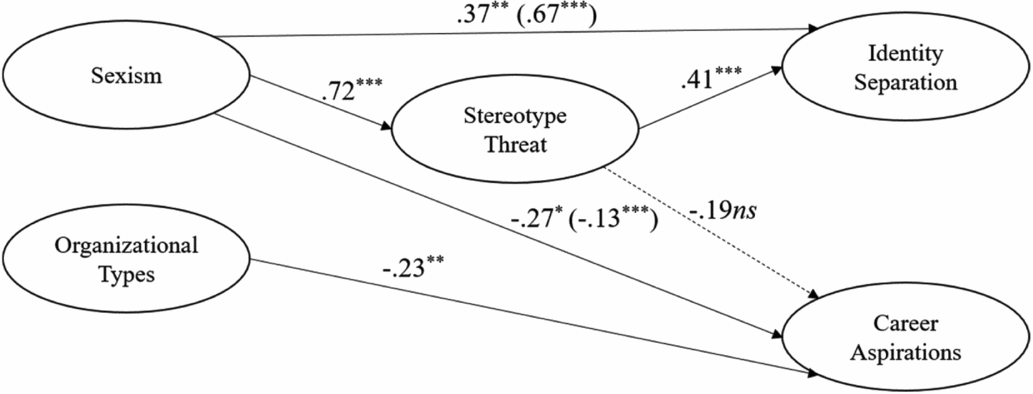
Perceived sexism had a positive relationship with stereotype type threat (β = .72, p < .001) and career aspirations (β = -.27, p < .05). As expected, stereotype threat was positively related to identity separation (β = .37, p < .01). These suggest that the precondition for mediation testing was met for the relationships among sexism, stereotype threat, and identity separation. The indirect effects of sexism on identity separation via stereotype threat was significant (β = .30, p < .001). The standardised total effects of sexism on the criterion variable were .67, p < .001. These results were supportive of the hypothesised mediation model for identity separation. However, a significant relationship between stereotype threat and career aspiration was not observed. Due to no significant direct path from stereotype threat to career aspiration, the mediating effect was not found for career aspirations. Sexism explained 53% of the variance in stereotype threat, and 53% of the variance in identity separation. Sexism, organisational type, and stereotype threat altogether explained 11% of the variance in career aspiration. As expected, the dummy variable of organisational type that represents public organisations had a significant path with career aspirations (β = -.23, p < .01). These indicated that those in the public organisations had a significantly lower score on career aspiration than those in the private organisations.
In short, the results were supportive of the partial mediating role of stereotype threat in the sexism-identity separation link, whereas no support was found for the sexism-career aspiration link. Sexism had a significant direct effect on career aspirations.
Discussion
Our hypothesis was that the experience of sexism would elicit stereotype threat and consequently lead to identity separation and career aspiration. The overall results were partially supportive of this hypothesis and provide several important implications for sexism research. First, the results of the current study revealed a partial mediating role of stereotype threat in the relationship between sexism and identity separation. Consistent with the concept of stereotype threat theory, exposure to sexism at work can invoke feelings of stereotype threat and cause females to separate their female identity from their work identity to keep their self-esteem intact. This indicates that the detrimental effect of sexism on identity separation was pronounced in a sample of Thai female employees. Those exposed to sexism feel afraid of being judged through the lens of negative stereotype and feel that their female identity cannot be displayed while enacting their work identity (Settles, Reference Settles2004). Although the mediating role of stereotype threat was supported for the sexism-identity separation link, there was the absence of a relationship between stereotype threat and career aspirations. This is in line with Von Hippel et al.’s study (Reference von Hippel, Issa, Ma and Stokes2011), in which the feeling of stereotype threat had no impact on reducing female employees’ career aspirations. Their study suggests that rather than reducing aspirations, female employees reduced their confidence in reaching their career goals.
Another possible reason for the absence of the stereotype threat-career aspiration relationship could result from the use of one summation score of the CAS in this study. The 8-CAS items reflect mainly the two aspects of career aspirations: educational and leadership aspiration. Due to low reliability for the Educational Aspiration Subscale and high cross-loadings, the CAS was computed as a single overall score. One reason for the low reliability is perhaps the low number of items (two items) for the Educational Aspirations. Although Gray and O'Brien (Reference Gray and O'Brien2007) suggested that the CAS may not be components of a single construct, those two items on the Educational Aspiration Subscale loaded onto the Leadership Aspiration dimension in the current study. The 8-item CAS only captures women's desire to become a leader and their interest in continued education within their careers; however, it still cannot assess the level of achievement aspirations. Von Hippel's (Reference von Hippel, Issa, Ma and Stokes2011) study also failed to detect the stereotype threat-career aspiration relationship perhaps due to the use of a single item to assess occupational aspirations. As noted by Fassinger (Reference Fassinger1990), operationalising career choices with single-dimension items might not address the degree of achievement to which women aspire within their career. During the data collection period, the revised version of the 24-items CASR of Kim, O'Brien, and Kim (Reference Kim, O'Brien and Kim2016), with three subscales assessing achievement, leadership and educational aspirations, was not available. Future research should further examine this scale validation and its relationship to sexism and stereotype threat among a sample of Thai female employees.
Nevertheless, the results of this study revealed that exposure to sexism at work had significant direct effect on career aspirations. This is in line with Bradley-Geist, Rivera, and Geringer's (Reference Bradley-Geist, Rivera and Geringer2015) experimental study, which found that merely observing or interacting with a male interviewer's sexist behaviours toward female job applicants can deteriorate career aspiration in female participants. The suggestion of sexism can create a threat in the air (Steele, Reference Steele1997), make the situation less comfortable for the target persons (Hyde & Kling, Reference Hyde and Kling2001), and may be sufficient to produce less positive interaction (Brown & Dobbins, Reference Brown and Dobbins2004). This may lead women to avoid interacting with their supervisors and have lowered career aspiration.
More interestingly, organisation type had a significant direct path to career aspiration. The results of this study indicated that public sector employees had a significantly lower score on career aspiration compared with those in the private sector. This is consistent with the previous research (Rashid & Rashid, Reference Rashid and Rashid2012) suggesting that public sector employees tend to value and be motivated by career advancement opportunities less than their private sector counterparts. As noted by Moore (Reference Moore1979), career development policies appear to be more prevalent in the private sector than in the public sector. According to Fagenson (Reference Fagenson1990), individual, organisational and societal factors simultaneously have an impact on women's career advancement. Women may create barriers to their own career advancement by demonstrating poor skills and competencies, and low commitment to work. At the organisational level, discriminatory organisational culture and human resource practices were perceived as barriers to career advancement among Thai female executives (Napasri & Yukongdi, Reference Napasri and Yukongdi2015). Regarding societal pressures, cultural norms that have restrictions based on gender may also act as barriers. The future research on stereotype threat and career aspiration should take individual, organisational and societal barriers into account.
In sum, Study 1 suggests that experiencing sexist behaviours is associated with greater feelings of stereotype threat and that stereotype threat in turn affects two forms of disidentification (identity separation and lowered career aspirations). Despite these findings indicating the negative impact of sexism on females’ advancement in the applied settings, the use of a correlational design does not provide the establishment of causality. The goal of Study 2 was to demonstrate the effect of sexism on females’ objective performance in a reasoning test and the use of mindfulness practice to reduce this disastrous influence of sexism by using an experimental approach.
STUDY 2
The existing studies (Koch et al., Reference Koch, Konigorski and Sieverding2014; Logel et al., Reference Logel, Walton, Spencer, Iserman, von Hippel and Bell2009) have shown that exposure to sexist behaviours can induce feelings of stereotype threat and impair women's intellectual performance. These previous studies involve the activation of gender stereotypes, in which individuals are aware of relevant sexist cues. Based on the stereotype threat framework of Steele et al. (Reference Steele, Spencer and Aronson2002), stigmatised group members may confront performance decrements in situations where the stereotype is evoked and the individuals are conscious of the fact that their behaviours may confirm negative views of a group to which they belong. The feeling of stereotype threat may negatively affect performance through mechanisms such as increased anxiety, reduced working memory capacity and cognitive resources (Quinn & Spencer, Reference Quinn and Spencer2001). Stigmatised group members suffered decreased performance only on particular tasks for which working memory is required, such as math problems (Beilock et al., Reference Beilock, Rydell and McConnell2007), language processing (e.g., Daneman & Carpenter, Reference Daneman and Carpenter1980), and reasoning tests (Su¨ß, Oberauer, Wilhelm, & Schulze, Reference Süß, Oberauer, Wittmann, Wilhelm and Schulze2002).
As proposed by Roeser and Pinela (Reference Roeser and Pinela2014), and Weger, Hooper, Meier, and Hopthrow (Reference Weger, Hooper, Meier and Hopthrow2011), mindfulness is a potential way to decrease the detrimental effect of stereotype threat. Mindfulness is a state-trait in which individuals experience their environment by paying attention in the present moment with an unbiased and non-judgemental way (Brown et al., Reference Brown, Ryan and Creswell2007). While stereotype threat drains the cognitive resources necessary for task performance (Beilock et al., Reference Beilock, Rydell and McConnell2007), mindfulness practice has been used to modulate working memory capacity and direct attentional resources to a target (e.g., Jha et al., Reference Jha, Krompinger and Baime2007). This can reverse the effect of stereotype threat on decreased performance. In an extension of Weger et al.’s (Reference Weger, Hooper, Meier and Hopthrow2011) study, our Study 2 additionally used sexist behaviours by a male confederate to activate stereotype threat in which female participants are aware of relevant cues of sexism. This is in contrast with the previous study in which they activated stereotype threat by informing the participants that the test is about assessing gender differences in maths. Compared to Weger et al.’s study (which used a 5-minute audio file providing instruction on how to practise mindfulness while eating two raisins), this study allowed female participants in the sexist condition to have longer periods of mindfulness practices (5 minutes for the confederate's explanation on the definition of mindfulness and demonstration on how to practise mindfulness with a raisin task and another 5 minutes to practise the task on their own). We expected that those female participants in the sexist condition after practising mindfulness would have a higher score on a reasoning test than those with no mindfulness practice.
Additionally, we conducted a mixed-gender group experiment under conditions that resemble authentic workshop activity to create a sexist environment and activate more intense gender stereotypes (rather than merely presenting cues such that women might underperform in a cognitive task).
Methods
Sample and Design
The participants were Thai female undergraduate students recruited from psychology courses at three universities in the Bangkok metropolitan areas (N = 160) and given course credits for their participation. This study was a randomised experiment with four conditions: Group 1 — sexist cues + mindfulness practice (n = 40); Group 2 — sexist cues + non- mindfulness practice (n = 40); Group 3 — non-sexist cues + mindfulness practice (n = 40); and Group 4 — non-sexist cues + non- mindfulness practice (n = 40). The participants were randomly assigned to one of these four conditions in a 2 (sexist cues vs. non-sexist cues) × 2 (mindfulness practice group vs. control group) between subjects design.
Experimental Procedures
During the sample recruitment weeks, those undergraduate students who registered in psychology courses at three universities were all invited to participate in this study. They were initially informed that this study would offer them a ‘Mindfulness and Positive Work Psychology Workshop’. A total of 230 (160 = females and 70 = males) agreed to participate in the study. Data collection occurred in an experimental laboratory. The male participants were recruited to allow us to induce the experience of sexism around gender and reasoning test performance among the female participants. However, the data obtained from the male participants were not used for further analysis.
In the Sexist cues + Mindfulness condition, the participants were informed by a male confederate that prior to attending this workshop, female participants were required to take a reasoning ability test and that their scores obtained from the test would be used to form a mixed-gender group for the workshop activities, to place them in the most appropriate group based on their reasoning ability. However, the confederate informed the participants that males were not required to complete the test due to their previous academic records that showed the outperformance of men in math and reasoning ability tests. This situation indicates behavioural interaction in a sexist manner that induces a feeling of stereotype threat. After the completion of the survey of stereotype threat for the manipulation check, a confederate gave both female and male participants in this condition a 5-minute demonstration on mindfulness practice using a raisin task and another 5 minutes for practising on their own. Then, the participants were asked to fill out a state-mindfulness survey for the manipulation check. Lastly, the female participants were asked to complete 15 multiple-choice reasoning test questions within 15 minutes before being debriefed.
In the sexist cues + non-mindfulness group, the participants received the same treatment as those in the sexist cues + mindfulness condition, except for mindfulness practice. However, in the non-sexist cues + mindfulness condition, both the male and female participants were informed that they had to complete the reasoning test and were not exposed to sexist cues, followed by filling out a stereotype threat survey and mindfulness practice before completing the test. Those in the non-sexist cues and non-mindfulness group followed the same instructions as the non-sexist group but received no additional manipulation of mindfulness before beginning the test.
Experimental Manipulations
Our stereotype threat and mindfulness manipulations had the desired effect. The female participants in the sexism condition (n = 80), M = 2.47, SD = .61, reported higher scores on stereotype threat than those in the non-sexist cues condition (n = 80), M = 2.17, SD = .40, F(1, 156) = 14.31, p < .001. In the mindfulness group, the female participants had significant higher scores on mindfulness, M = 4.13, SD = .53, than their counterparts in the non-mindfulness group, M = 3.32, SD = .70, F(1, 156) = 72.77, p < .001.
Materials
Reasoning ability test
The participants were given 15 minutes to complete 15 items of a reasoning ability test that was taken from Raven's Advanced Progressive Matrices (APM; Raven, Raven, & Court, Reference Raven, Raven and Court1998). The APM is a test of non-verbal or abstract reasoning ability that was constructed as a more difficult version of the test designed for older adolescents and adults. The previous studies have indicated gender differences in both the Standard and Advanced Progressive Matrices (Lynn & Irwing, Reference Lynn and Irwing2004), and they found that males had the advantage from age 15 to older age. Mackintosh and Bennet (Reference Mackintosh and Bennett2005) also found that males did better than females on some items requiring addition/subtraction or the distribution of two rules to solve the problem. From item analyses on APM SET II, we selected 15 out of 36 items with no gender differences from the scores obtained from 361 Thai college students (87 males and 274 females) to measure reasoning ability in this study.
Stereotype threat measure
To assess whether the sexist cues had the desired effect, five items of the gender stereotype threat (α = .76) were employed for a manipulation check. The measure was adapted from Study 1 to assess the negative stereotypes of women in a cognitive ability test (e.g., ‘Some people feel I have less cognitive ability because of my gender’). Three out of eight items used in Study 1 were excluded as they were not applicable for the context of Study 2. The responses were given on a 5-point Likert scale ranging from 1 = strongly disagree to 5 = strongly agree.
Mindfulness practice
The raisin mindfulness practice was employed to induce the state of mindfulness. The raisin mindfulness practice was an adapted version of the mindful raisin-eating task used at the beginning of the Mindful Attention-Based Stress Reduction program (MBSR; Kabat-Zinn, Reference Kabat-Zinn2003), which has been used in many previous experimental studies (e.g., Hong, Lishner, & Han, Reference Hong, Lishner and Han2014; Weger et al., Reference Weger, Hooper, Meier and Hopthrow2011). As this approach is appropriate for beginning mindfulness practitioners, the raisin task was employed in this study. This exercise encouraged the participants to bring their awareness to the present moment by regulating their attention to their current activity. Before the mindfulness practice, the participants in the mindfulness group would learn about the concept of mindfulness, including the procedure to practise mindfulness by eating raisins for 5 minutes. Next, the participant was given 3–4 raisins to practise mindfulness on their own for 5 minutes.
The Mindful Attention Awareness Scale (MAAS) — State
The MAAS — State (Brown & Ryan, Reference Brown and Ryan2003) was used as a manipulation check for the mindfulness state of the participants in the mindfulness group. The participants were asked to complete five items of the MAAS — State (α = .75; e.g., ‘I was finding it difficult to stay focused on what was happening.’) after the raisin-eating exercise. The responses described the degree to which the participants experienced each item ranging from 0 (not at all) to 4 (very much). Due to low item-total correlation, one out of five items was dropped.
Results
As predicted, a two-way ANOVA (sexist cues versus non-sexist cues × mindfulness vs. control group) on the female participants’ reasoning test scores revealed a significant two-way interaction, F(1, 156) = 4.089, p < .05, ηp 2 = .026, such that when experiencing sexist behaviours, those female participants performed significantly better on the reasoning ability test in the mindfulness condition compared to the control condition (see Table 2 for complete ANOVA table and Figure 2 for the interaction effect). The main effects of sexism, F(1, 156) = 29.85, p < .001, ηp 2 = .161, and mindfulness, F(1, 156) = 34.74, p < .001, ηp 2 = .182, were significant. Simple effect tests revealed that the participants in the sexist cues condition had a significantly higher score on the reasoning test after engaging in mindfulness practice (M = 12.00) than those with no mindfulness practice, M = 9.70), F(1, 156) = 31.332, p < .001, ηp 2 = .167. There was significant difference across conditions when the participants were not exposed to sexist behaviours, M = 13.00 in the mindfulness group opposed to M = 11.87 in the non-mindfulness condition, F(1, 156) = 7.496, p < .01, ηp 2 = .046. In the non-mindfulness condition, the participants who experienced sexism (M = 9.70) performed significantly worse than those with no exposure to sexism, M = 11.875, F(1, 156) = 28.019, p < .001, ηp 2 = .152 (see Figure 3).
Two-Way ANOVA Summary: A Score for Reasoning Ability Test

Note: SS = sum of squares; MS = mean square.
* p < .05, ***p < .001.
Sexism × mindfulness on mean scores of reasoning ability test.

Reasoning test scores as a function of sexist cues and mindfulness.

Discussion
In this study, the use of sexist behaviours could activate stereotype threat and consequently impair performance on the intellectual task (Davis, Aronson, & Salinas, Reference Davis, Aronson and Salinas2006). Mindfulness practice appeared to be a successful intervention that reduced the effects of sexist behaviours shown by a male confederate that elicited feelings of stereotype threat and caused the female participants to underperform on a subsequent reasoning test. These findings are in line with the notions that mindfulness can produce positive outcomes such as increased emotion regulation, increased attention regulation, decreased anxiety and increased cognitive processes including working memory and mental flexibility (Hölzel et al., Reference Hölzel, Lazar, Gard, Schuman-Olivier, Vago and Ott2011; Moore & Malinowski, Reference Moore and Malinowski2009) under stressful events. In contrast with Weger et al. (Reference Weger, Hooper, Meier and Hopthrow2011), our study found a significant main effect of sexism on the female participants’ reasoning test performance and a significant difference across conditions when the participants experienced non-sexist behaviours between a mindfulness group and a non-mindfulness group. This suggests that the female participants’ performance on the reasoning test was affected by the confederate's sexist behaviours. Additionally, a longer period of 10-minute mindfulness practice in the current study (compared to a 5-minute mindfulness manipulation in the previous study) may enhance attention regulation and provide greater resources to devote to learning, which helps participants transform their mental abilities into academic skills (Zimmerman, Reference Zimmerman2002).
Limitations and Future Directions
The limitations of our Study 2 include no establishment of the mechanism leading to decreased performance (e.g., anxiety levels and effort of the threatened individuals, Steele & Aronson, Reference Steele and Aronson1995; physiological indication of mental load, Croizet et al., Reference Croizet, Després, Gauzins, Huguet, Leyens and Méot2004), and small interaction effects of sexism and mindfulness. Although this study revealed the effect of sexism on reasoning test performance, the confederate's sexist behaviours may have reduced the female participants’ working memory capacity and effort to complete the test, or increased their anxiety levels and thus their reasoning test scores. Mechanisms other than stereotype threat and leading to performance deficit should be explored in future studies. Larger interaction effects should be expected if future studies design the simulation of sexist situations (e.g., group placement for a workshop or project participant selection) to be more realistic and adopt other mindfulness techniques for the participants (e.g., mindful breathing meditation and mindful body scan) to buffer the detrimental influence of sexism and stereotype threat. However, in this study, the simulated situation of participant placement into a mixed-gendered group for the workshop in the sexist condition expressed discrimination in a way of protecting women from stress (working in the group that may not be suitable for them; Glick & Fiske, Reference Glick and Fiske2001). As most educational and professional settings explicitly forbid gender discrimination, men may not behave in a way such that their actions could be attributed to sexism (Uhlmann & Cohen, Reference Uhlmann and Cohen2005). In addition, the use of undergraduate female students as in the sample of Study 2 may be questioned with regard to the generalisation of the results. However, Bergeron et al.’s study (Reference Bergeron, Block and Echtenkamp2006) on the effect of stereotype threat on women's performance found no significant difference on the stereotype threat scale between those who were working full time and those who were non-working students. Future research in this area, particularly in the work settings of male-dominated industries, should use a more heterogeneous population.
Overall Discussion
This research contributes to our understanding of gender bias in the Thai workplace by exploring the impact of experienced sexism on identity separation, career aspiration, and performance in male-dominated areas. Our findings suggest that perceived sexist behaviours at work directly diminished females’ career aspiration due to demotivation and fewer attempts to attain senior or management level positions. A psychological strategy, by simultaneously separating their female identity from their work-related identity, is adopted to cope with gender identity threat. As this responsive approach causes many adverse consequences, future research should consider strategies to prevent women from the negative effects of stereotype threat, perhaps through self-affirmation training (Sherman & Cohen, Reference Sherman and Cohen2002), creating a positive work climate, celebrating the success of women, and providing female role models (Lockwood, Reference Lockwood2006). These might promote gender equality and encourage anti-sexist norms within organisations. The effectiveness of mindfulness as an intervention to inoculate against the pressure of being judged or treated based on stereotypes was supported in the current study. Mindfulness can increase the ability to focus attention and effort on tasks. Our recommendations to decrease the detrimental effect of stereotype threat from sexist behaviours in work or intellectual contexts are to encourage a more gender-fair climate (having role models available for both males and females), raise awareness of ambiguous situations in which discrimination may be justified as a means of protecting women from stress or danger, and provide mindfulness training for inoculation against the effects of sexism and stereotype threat on cognitive performance, especially among stigmatised group members. Our study demonstrated that short-term mindfulness induction can be beneficial in settings where attentional cognitive resources are necessary for task performance. Bringing mindfulness (non-biased perceptions) to any stressful situations can facilitate our decision-making by using our awareness rather than ‘going on automatic pilot’ (which might be primed or influenced by sexist attitudes or behaviours). When negative gender stereotypes are activated, objective self-awareness might lead the target persons to experience automatic comparison (Duval & Wicklund, Reference Duval and Wicklund1972), and distracting thoughts may occur during the completion of cognitive tests (Mrazek et al., Reference Mrazek, Franklin, Phillips, Baird and Schooler2013). Mindfulness might prohibit these automatic cognitive processes and mind distraction. Organisations should promote the cultivation of mindfulness through training or practices to improve cognitive function, which is associated with task performance.
Funding
This research was supported by the Office of Research Affairs, Chulalongkorn University, for the social development research cluster (Grant Number 858SD).


 Open access

