Introduction
Out-patient specialist appointment non-attendance represents a significant problem for health systems that are often resource-restrained. It is estimated that approximately 23 per cent of appointments in primary care or specialist clinics are not attended, although significant variations exist.Reference Dantas, Fleck, Cyrino Oliveira and Hamacher1 Missed appointments remain unfilled, and often further appointments are required, which frequently represents additional costs to the health system. In addition, there is an association between non-attendance and subsequent visits to the emergency department and hospitalisation, both of which represent considerable additional costs.Reference Nuti, Lawley, Turkcan, Tian, Zhang and Chang2 Non-attendance could also result in an interruption to the continuity of care and has been shown to lead to poor health outcomes.Reference Hwang, Atlas, Cronin, Ashburner, Shah and He3 In the New Zealand context, Māori patients (the indigenous people of New Zealand) often have poorer health outcomes, and non-attendance may further compound the health inequalities experienced.
In 2020, we also faced the coronavirus disease 2019 (Covid-19) pandemic, which has had a significant impact on healthcare delivery and on our social behaviour.Reference Choi4 In addition to the challenges that the health system faces associated with this pandemic, Covid-19 may also represent a new barrier for patients attending out-patient clinics.Reference Fung, Kuet, Patel and Puri5
As part of New Zealand's national response to the pandemic, a stringent lockdown and Covid-19 alert levels (ranging from 1 to 4) were introduced.Reference Jefferies, French, Gilkison, Graham, Hope and Marshall6,7 During alert levels 3 and 4, almost all elective out-patient face-to-face clinic appointments were cancelled. At alert levels 1 and 2, most out-patient clinics were scheduled as normal, with additional personal protective equipment for staff, social distancing of patients in the waiting area and screening of patients in the waiting room (using a short survey and temperature assessment). However, the impact of Covid-19 on out-patient clinic non-attendance rate in New Zealand remains unknown.
This study aimed to examine the non-attendance rate at an otolaryngology and head and neck out-patient clinic, and assess the impact of Covid-19, and environmental, demographic and clinical factors on non-attendance rate.
Materials and methods
The out-patient clinic appointment schedule for 18 May to 26 June 2020 at the Department of Otolaryngology and Head and Neck Surgery, Waikato Hospital, Hamilton, New Zealand, was retrieved. The first three weeks of this time corresponded to New Zealand Covid-19 alert level 2 and the last three weeks corresponded to alert level 1. In order to assess the impact of Covid-19 on non-attendance rate, the out-patient clinic appointment schedule at the same clinic in a similar period (20 May to 28 June) in 2019 was also retrieved. Ethical approval from appropriate local and national bodies were sought; however, given the nature of this study, it was advised that ethical approval was not required.
For each appointment date, the following environmental variables were retrieved from Meteorological Services of New Zealand Ltd (MetService.com): the average, minimum and maximum temperatures, and the weather. The weather was defined as clear (≤5 oktas), cloud (>5 oktas) and rain (any rainfall). For weather information, the data between 0600 and 1600 hours were used; it was assumed that these times are likely to have an impact on attendance (the last clinic appointment of the day is scheduled at 1600 hours).
For each appointment, the following data were recorded: the day of the week (Monday to Friday) and time of day (am or pm) of the clinic session; the Covid-19 alert level; the nature of the appointment (follow-up or new); and the clinic type (otology, rhinology, head and neck, paediatrics, acute and nurse clinics).
For each patient, the following information was obtained: age, sex and ethnicity; whether the appointment was confirmed a week prior via telephone call, text message or an e-mail; and the New Zealand Deprivation Index 2006 (‘NZDep06’) values. The New Zealand Deprivation Index is a validated indirect measure of socioeconomic status based on a defined geographical unit, with a scale ranging from 1 (least deprived) to 10 (most deprived).8 Based on the patient's address, the distance of travel (in kilometres) and time of travel (driving) were also established using Google Maps. For patients who did not attend, the number of previous non-attendances to the same clinic was also recorded.
Univariate analysis was undertaken to examine the impact of the recorded variables on attendance using the student's t-test, Mann–Whitney U test and chi-square test as appropriate. A logistic regression model was created, with attendance as the dependent variable and other variables as the independent variables. Independent variables were defined as those that showed a statistically significant relationship with attendance on univariate analysis. Statistical analysis was carried out using SPSS Statistics software, version 25 (IBM, New York, USA). Statistical significance was defined as p < 0.05.
Results
In total, 1963 appointments were scheduled from 20 May to 28 June 2019 (n = 875) and from 18 May to 26 June 2020 (n = 1088). Overall, 1769 appointments (90.1 per cent) were attended, while 194 (9.9 per cent) were not, as summarised in Table 1. There was a bimodal age distribution, as illustrated in Figure 1.
Univariate analysis findings*

* Regarding the impact of coronavirus disease 2019, and clinical, demographic and environmental variables, on out-patient clinic attendance. †Excluding 50 unknown responses. Ref = reference; SD = standard deviation
Histogram illustrating age distribution of the study sample (n = 1963).

Table 1 summarises the univariate analysis of the impact of different variables on attendance. We found the rate of non-attendance to be slightly higher in year 2020 (10.7 per cent) compared to year 2019 (8.9 per cent); however, this was not statistically significant (p = 0.223). Similarly, when non-attendance rate in Covid-19 alert level 1 (10.2 per cent) and alert level 2 (11.2 per cent) were compared to the pre-Covid-19 period (8.9 per cent), there was no statistically significant difference.
Variables that had a statistically significant impact on attendance according to the univariate analysis were: clinic type; patient age, sex and ethnicity; travel time and travel distance; New Zealand Deprivation Index; and whether the clinic appointment was confirmed beforehand or not. The day of the week, weather and temperature on the day of the clinic appointment (mean, maximum and minimum), time of the clinic session, and nature of the appointment had no statistically significant effects on attendance based on univariate analysis.
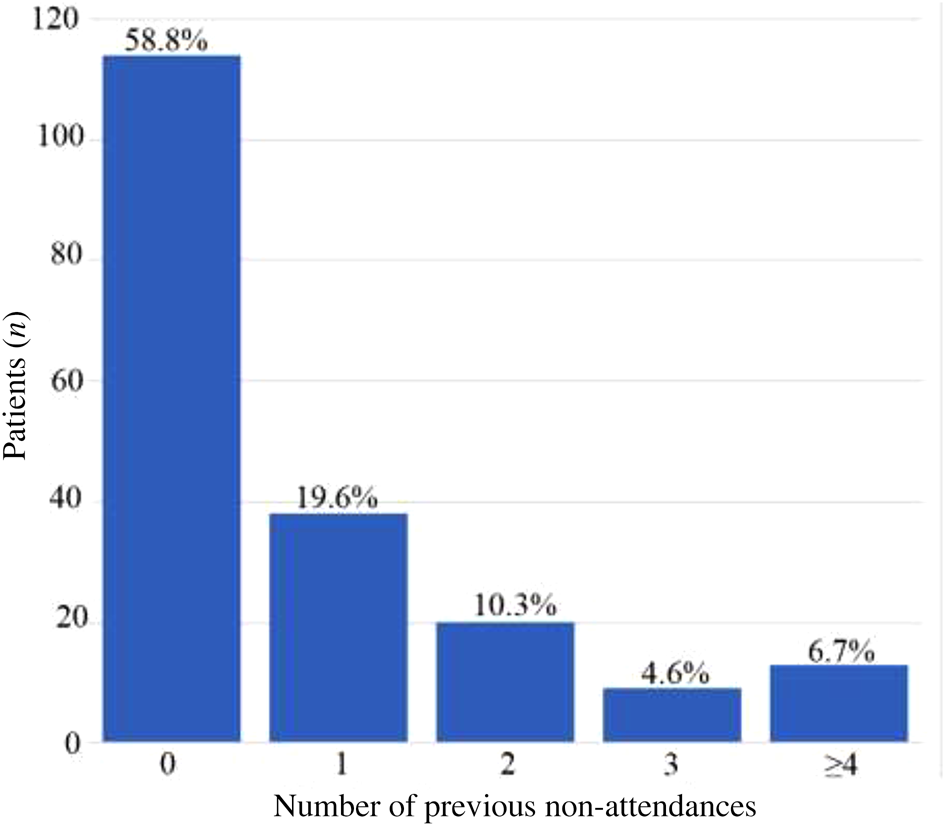
Amongst those patients who did not attend their clinic appointment, the median number of previous non-attendances to the same clinic was 0 (range, 0–8), with 58.8 per cent of patients having no previous non-attendances, as illustrated in Figure 2.
Bar graph illustrating the number of previous non-attendances amongst patients who did not attend their out-patient clinic appointment (n = 194).

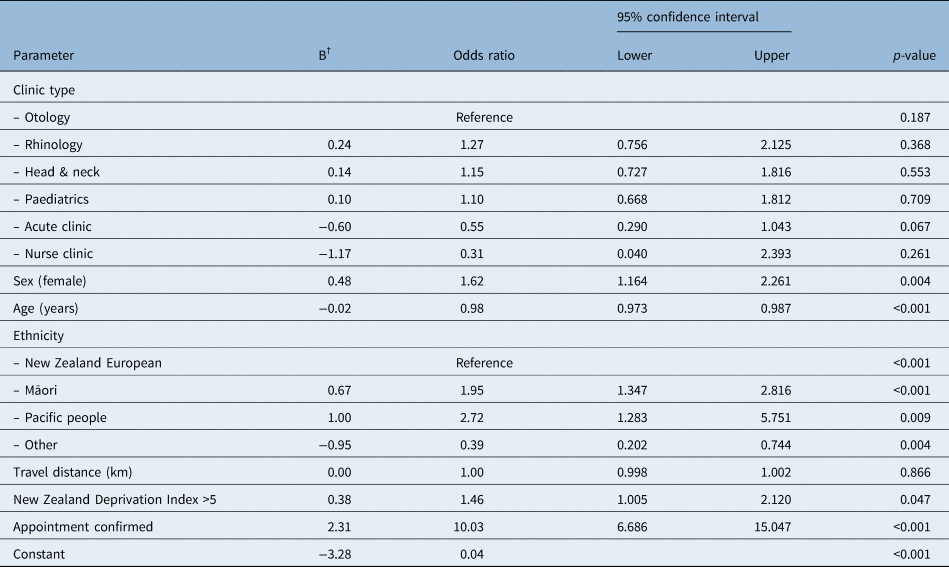
A logistic regression model was constructed (Table 2), with clinic type, patient sex, age and ethnicity, travel distance, New Zealand Deprivation Index, and confirmed appointment as covariates. This model explained 29.5 per cent (Nagelkerke's R 2) of the variance in attendance events and correctly classified 90.4 per cent of cases. Patients whose appointments were confirmed were 10.0 times more likely to attend their clinic appointment (95 per cent confidence interval (CI) = 6.69–15.05, p < 0.001). Female patients were less likely to attend their clinic appointment (odds ratio = 1.62, 95 per cent CI = 1.16–2.26, p = 0.004). Māori patients were 1.95 times more likely not to attend their clinic appointment compared to New Zealand Europeans (95 per cent CI = 1.35–2.82, p < 0.001). There was a 2 per cent decline in the rate of non-attendance for every year advancement in a patient's age. Finally, those from areas of lower deprivation had a lower rate of non-attendance (odds ratio = 0.68, 95 per cent CI = 0.47–0.99, p = 0.047).
Summary of logistic regression model findings*

* Regarding the impact of clinical, demographic and environmental variables on out-patient clinic attendance. †Unstandardised co-efficients
Discussion
This study examined the impact of multiple demographic, clinical and environmental factors, including Covid-19, on out-patient otolaryngology and head and neck clinic attendance in New Zealand. Examination of 1963 out-patient clinic appointments revealed an overall non-attendance rate of 9.9 per cent, at an estimated immediate cost of NZ$ 66 500 (based on a unit price of $389 for new appointments and $306 for follow-up appointments). Coronavirus disease 2019 had no statistically significant impact on the rate of non-attendance. The factor that had the strongest independent impact on non-attendance rate was appointment confirmation in the week prior to the clinic session. Other variables with an independent impact on non-attendance were age, sex, ethnicity and New Zealand Deprivation Index.
A study of 264 patients from Derby, UK, examining attendance rate at an out-patient ophthalmology clinic between 27 April and 1 May 2020, found a non-attendance rate of 46 per cent.Reference Fung, Kuet, Patel and Puri5 A telephone survey of those who did not attend revealed that 85 per cent identified the fear of contracting Covid-19 as the reason for non-attendance. In New Zealand, the national response to Covid-19 has led to a relatively small number of positive cases, with low mortality, and it achieved initial elimination of Covid-19.Reference Jefferies, French, Gilkison, Graham, Hope and Marshall6 This may have reduced the level of patient fear of contracting Covid-19 associated with attending their out-patient clinic appointment. If the experience of other clinics and hospitals in New Zealand supports our findings, then this further lends support for the New Zealand national response to Covid-19.
Clinic appointment confirmation, in form of a text message, e-mail or telephone call, was found to have the strongest impact on attendance rate, with a nearly 10-fold decrease in non-attendance rate. This is likely to be an underestimate of the true impact, as in this study the group with ‘unknown’ clinic appointment confirmation may have also included patients who had their appointment confirmed but this was not recorded as such. In a study of 13 505 clinic appointments, Parikh et al. showed that reminders in the week prior to the clinic appointment resulted in a significant decrease in non-attendance rate.Reference Parikh, Gupta, Wilson, Fields, Cosgrove and Kostis9 They found that a telephone reminder by a staff member was more effective at reducing non-attendance rate than an automated appointment reminder, but both of these were superior to no reminder (13.6 per cent vs 17.3 per cent vs 23.1, respectively; p < 0.01). Clinic appointment reminders are likely to achieve a lower non-attendance rate by: reminding patients who would have otherwise forgotten their appointment, and by allowing patients who would have liked to ‘cancel’ or ‘reschedule’ their appointment to do so.
Younger age was found to be associated with a higher non-attendance rate, with a 2 per cent decrease in the rate of non-attendance with every year of age advancement. An inverse correlation between advancing age and rate of non-attendance has previously been reported.Reference Dantas, Fleck, Cyrino Oliveira and Hamacher1,Reference Torres, Rothberg, Garb, Ogunneye, Onyema and Higgins10 We also found that female sex was an independent risk factor for non-attendance (odds ratio = 1.62, 95 per cent CI = 1.164–2.261, p = 0.004). This finding is in contrast to previous studies which found that men were more likely to not attend.Reference Torres, Rothberg, Garb, Ogunneye, Onyema and Higgins10–Reference Dickey and Morrow13 A similar relationship, however, was reported amongst adults visiting an otolaryngology clinic in Israel.Reference Cohen, Kaplan, Kraus, Rubinshtein and Vardy14 Here, the authors proposed that the study location was a confounding factor, as care of a family is, in Israel, traditionally the responsibility of women. The finding of the current study, which is also set in an otolaryngology and head and neck clinic, raises the possibility that there may be another reason for higher non-attendance amongst women. Further investigation will be required to establish the underlying reason for this finding.
Ethnicity was independently associated with non-attendance rate, with Pacific people having the highest odds ratio for non-attendance (odds ratio = 2.72, 95 per cent CI = 1.28–5.75, p = 0.009). However, the number of Pacific people in this study was relatively small (n = 58). Māori patients also had a higher rate of non-attendance than New Zealand Europeans. Interestingly, the ‘other’ ethnicities, a combination of other minority ethnicities in New Zealand, were most likely to attend their clinic appointment (Table 2). Our findings confirm those of Milne and colleagues’ study of rheumatology clinic appointment attendance in New Zealand.Reference Milne, Kearns and Harrison15 Here, they also showed higher odds ratios of non-attendance for Māori and Pacific people when compared to New Zealand Europeans, while ‘other’ ethnicities had a lower rate of non-attendance. One theory is cultural barriers and, for Pacific people, language barriers.Reference Maniapoto and Gribben16 However, the ‘other’ ethnicities, who may also face cultural and language barriers, had the lowest rate of non-attendance.
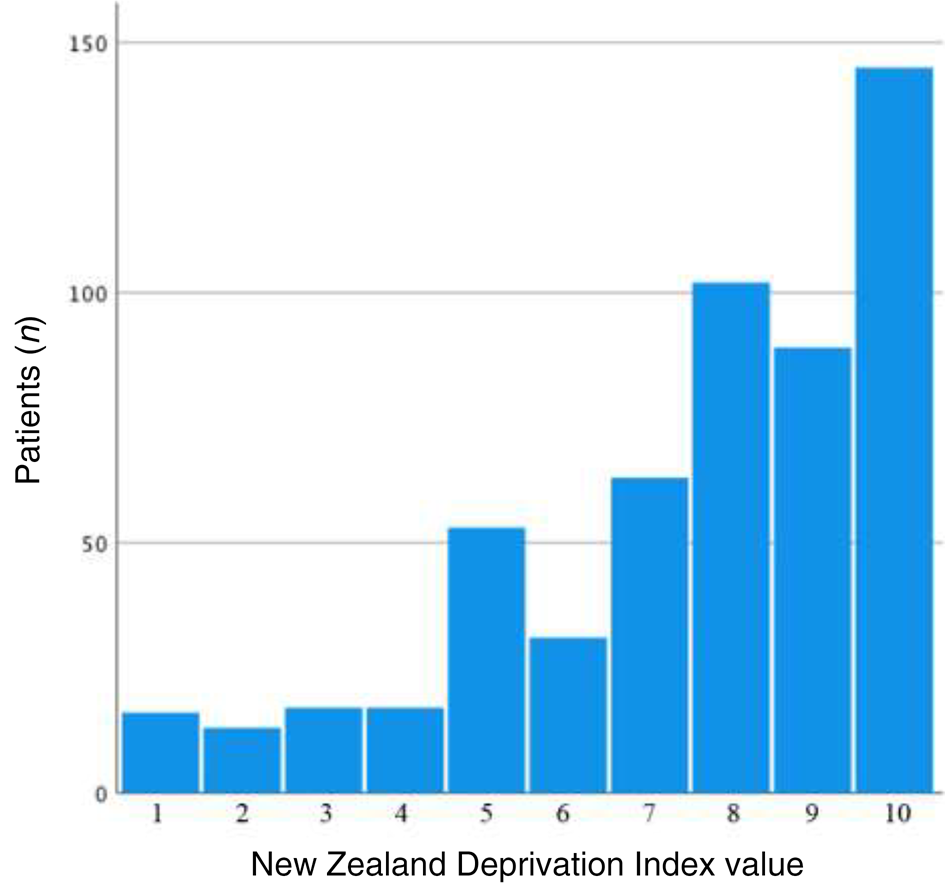
Another potential barrier to attendance amongst Māori and Pacific people is the cost, particularly in the primary care setting where the fees are only partially funded.Reference Maniapoto and Gribben16 Māori patients are more likely to experience higher levels of deprivation, as illustrated in Figure 3. Unlike primary care, specialist clinics are completely funded publicly and are therefore free of charge for New Zealanders. However, there are other associated costs with attending a clinic, such as transport, parking, time off work (and potential loss of income) and a potential need for childcare arrangements. More in-depth examination is required to ascertain the underlying reason for higher non-attendance rate amongst Māori and Pacific people.
Bar graph illustrating the distribution of New Zealand Deprivation Index values amongst Māori patients included in the study sample (n = 559).

The New Zealand Deprivation Index was also found to be an independent variable affecting attendance rate, with those with a score of more than 5 being 1.5 times more likely not to attend than those with a score of 5 or less (odds ratio = 1.46, 95 per cent CI = 1.01–2.12, p = 0.047). In this study, the New Zealand Deprivation Index score was used as a surrogate of socioeconomic status. The impact of socioeconomic status on clinic attendance has been reported previously.Reference Miller, Chae, Peterson and Ko17,Reference Neal, Lawlor, Allgar, Colledge, Ali and Hassey18 In addition to the direct cost of clinic appointment attendance, socioeconomic status is also a potential risk factor for low health literacy, which is associated with adverse health-related behaviours.Reference Stormacq, Van den Broucke and Wosinski19 In a review examining the role of health literacy as a mediator between socioeconomic status and health disparities, Stormacq et al. argued that addressing ‘upstream’ determinants of socioeconomic status may be difficult and it may be easier to address the ‘midstream’ health literacy. This approach requires health services to increase or consider people's low health literacy, in order to reduce the impact of the ‘upstream’ socioeconomic status on ‘downstream’ health disparities.Reference Stormacq, Van den Broucke and Wosinski19
One strategy for reducing non-attendance rate is open appointments, where patients contact the clinic to schedule an appointment at a time of their convenience.Reference Nuti, Lawley, Turkcan, Tian, Zhang and Chang2 However, this strategy is likely to disadvantage those with low health literacy, as this approach requires that the patient understand their health needs to initiate the next appointment. This may be challenging for a person with a low level of health literacy. Hwang et al. have suggested that non-attendance may be used as a surrogate for psychosocial complexity, and can be employed to identify ‘high-risk’ individuals who may benefit from additional support.Reference Hwang, Atlas, Cronin, Ashburner, Shah and He3
This study had a number of limitations. It relied on demographic, social, environmental and clinical information that is analysed retrospectively. In this study, the New Zealand Deprivation Index was used as a surrogate of the socioeconomic status of individual patients. However, this index applies to defined geographical units rather than individual people. Attendance at an otolaryngology and head and neck clinic was examined, and therefore the findings should be applied to other clinics with caution. Finally, clinic appointment confirmation data were not well documented. This has led to the ‘unknown’ category also containing those whose appointment was confirmed but this information was not recorded, as well as those whose appointment was not confirmed.
• Out-patient clinic non-attendance represents a significant cost to health systems and leads to poor health outcomes
• Many factors influence non-attendance, with the latest potential barrier being coronavirus disease 2019 (Covid-19)
• This study is the first to examine the impact of Covid-19 on clinic attendance in New Zealand
• The Covid-19 pandemic did not affect non-attendance rate at an out-patient clinic in New Zealand; this may be due to elimination of community transmission
• Confirmation that a patient will attend their clinic session in the week prior to the appointment reduced non-attendance 10-fold
• Patient's age, sex, ethnicity and socioeconomic status, and clinic appointment confirmation, were independent factors influencing clinic attendance
In conclusion, we have reported a non-attendance rate at an otolaryngology and head and neck clinic in New Zealand of nearly 10 per cent, with Covid-19 having no impact on this rate. Patient's age, sex, ethnicity and socioeconomic status, and clinic appointment confirmation, were found to be independent factors influencing clinic attendance. Further studies should examine the impact of Covid-19 on out-patient clinic attendance, particularly in the New Zealand setting, to confirm our findings. More targeted studies, directed at those groups with higher rates of non-attendance, may help our understanding of the reasons for non-attendance. This information could help reduce non-attendance, which would benefit the health system and improve the health outcomes for patients.
Acknowledgement
The authors wish to thank Neal Osborne at Meteorological Services of New Zealand Ltd for his assistance with retrieving weather information for this study.
Competing interests
None declared