Introduction
Nonarteritic anterior ischemic optic neuropathy (NAION) is associated with various cerebro-cardiovascular risk factors, such as hypertension, diabetes, ischemic heart disease, dyslipidemia, hypercoagulable states, sleep apnea syndrome, and vasculopathic variants of optic nerve vasculature (Salomon et al., Reference Salomon, Huna-Baron, Kurtz, Steinberg, Moisseiev, Rosenberg, Yassur, Vidne, Zivelin, Gitel, Davidson, Ravid and Seligsohn1999; Hayreh, Reference Hayreh2009). Recent studies have examined the association of NAION with genes involved in the regulation of platelet function or blood pressure, with conflicting results (Salomon et al., Reference Salomon, Dardik, Steinberg, Kurtz, Rosenberg, Moisseiev and Huna-Baron2000, Reference Salomon, Rosenberg, Steinberg, Huna-Baron, Moisseiev, Dardik, Goldan, Kurtz, Ifrah and Seligsohn2004) suggesting a genetic component for NAION.
Endothelial nitric oxide (NO) is a potent vasodilator (Zhou & Zhu, Reference Zhou and Zhu2009) involved in the maintenance of vascular homeostasis and regulation of circulation (Casas et al., Reference Casas, Bautista, Humphries and Hingorani2004). NO synthase (NOS) regulates the synthesis and availability of NO, and alterations in the NOS gene have been linked to ischemic stroke and heart disease (Casas et al., Reference Casas, Bautista, Humphries and Hingorani2004; Zhou & Zhu, Reference Zhou and Zhu2009). The endothelial nitric oxide synthase (eNOS3) G894T (Glu298Asp) polymorphism within exon 7 on chromosome 7 has been associated with diabetes mellitus type 2, insulin resistance, metabolic syndrome, and coronary artery disease (Casas et al., Reference Casas, Bautista, Humphries and Hingorani2004; Szolnoki et al., Reference Szolnoki, Havasi, Bene, Komlosi, Szoke, Somogyvari, Kondacs, Szabo, Fodor, Bodor, Gati, Wittman and Melegh2005).
As NO is involved in the regulation of circulation (Casas et al., Reference Casas, Bautista, Humphries and Hingorani2004), we hypothesized that genetic expression activity of NOS affects local circulation and predisposes to NAION. We investigated the potential association of NAION with the specific polymorphism G894T of eNOS gene. The study was conducted in a stroke reference center in northwest Greece, a well-defined area with homogenous population.
Materials and methods
Subjects
The studied NAION patients were recruited prospectively from May 2006 to December 2007. All patients met the NAION criteria, including sudden visual loss, relative afferent papillary defect, visual field defects consistent with ischemic optic neuropathy, and characteristic fundus changes. Exclusion criteria included any clinical or paraclinical evidence of autoimmune or rheumatic disease. The control group comprised healthy volunteers with no stroke or history of stroke or any etiology optic neuritis and normal computed tomography brain scan. A standard neurological, ophthalmological, and fundoscopic examination documented the absence of stroke or neuritis, and a standardized questionnaire assessed the absence of previous ischemic cardio-cerebrovascular events. Patients and controls underwent standard biochemical and autoimmune blood testing. The study protocol was approved by the institutional ethics committee. All participants gave informed consent.
Genetic analysis
All the molecular genetic studies were performed blinded to case–control status. A G/T transition at position 894 that results in a Glu→Asp substitution at codon 298 was genotyped using polymerase chain reaction (PCR), with a forward primer 5′-catgaggctcagccccagaac-3′ and a reverse primer 5′-agtcaatccctttggtgctcac-3′. After an initial denaturation step for 5 min at 95°C, 11 cycles were performed for 15 s at 96°C and 20 s at 65°C, followed by 22 cycles for 40 s at 96°C, 1 min at 60°C, and 1 min and 20 s at 72°C and a final extension for 5 min at 72°C.
PCR was performed with 100-ng genomic DNA in a total volume of 25 μl, 10 pmol of each primer, 5 nmol deoxynucleotide triphosphate, 2.5 U Taq DNA Polymerase (Sigma, Saint Louis, MO), and 2 mM MgCl2 in the manufacturer’s buffer.
The 206 base pair (bp) amplified products were digested with 2.5 U MboI (New England Biolabs Inc., Ipswich, MA) at 37°C for 4 h. The fragments were separated on 3% agarose gel with ethidium bromide and were visualized under ultraviolet light. The NOS3 G allele yielded a single 206-bp fragment as the NOS3 T allele gave two fragments of 119 and 87 bp.
Statistical analysis
The gene counting method estimated allele frequencies at the individual loci. The agreement of genotype frequencies with Hardy–Weinberg equilibrium expectations was tested using the chi-square test. All P values were two-tailed and were considered statistically significant at <0.05. Confidence intervals were calculated at the 95% level. Odds ratios were defined as the odds ratio of patients with NAION divided by the odds ratio of the control group and were calculated to provide an estimate of the relative risk of NOS3 (G894T) polymorphism associated with NAION. Analysis was performed with the StatXact software.
Results and discussion
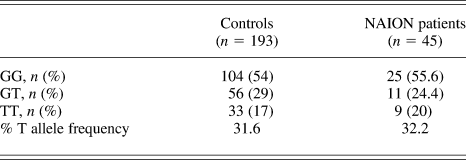
Forty-five patients, 29 men and 16 women, and 193 controls, 122 men and 71 women, were recruited for this study. The patients’ age ranged from 50 to 82 years, with a mean age of 65.1 years, and the age range of the controls was from 48 to 77, with a mean age of 63.4 years. The polymorphisms were in Hardy–Weinberg equilibrium in the study population and the control group. The genotype and allele frequencies were not significantly different between the control and patient groups (TT vs. GG + GT: P = 0.646 and T vs. G: P = 0.86). The detailed results are provided in Table 1.
Distribution of eNOS G894T genotypes in controls and NAION patients

TT vs. GG + GT: P = 0.646 and T vs. G: P = 0.91.
In this study, we have shown that eNOS G894T polymorphism is not associated with NAION. The precise mechanism of optic nerve ischemia is not identified yet, and the contribution of the various vascular risk factors is not entirely known (Hayreh, Reference Hayreh2009). Although we did not prove any possible correlation of the specific polymorphism, the relative low attributable risk of vascular risk factors in NAION development implies the co-occurrence of other factors, potentially genetic factors (Salomon et al., Reference Salomon, Huna-Baron, Kurtz, Steinberg, Moisseiev, Rosenberg, Yassur, Vidne, Zivelin, Gitel, Davidson, Ravid and Seligsohn1999, Reference Salomon, Dardik, Steinberg, Kurtz, Rosenberg, Moisseiev and Huna-Baron2000, Reference Salomon, Rosenberg, Steinberg, Huna-Baron, Moisseiev, Dardik, Goldan, Kurtz, Ifrah and Seligsohn2004).
A possible association of NO with NAION was suggested by the development of NAION within hours of use of phosphodiesterase type-5 (PDE-5) inhibitor (Thurtell & Tomsak, Reference Thurtell and Tomsak2008; Laties, Reference Laties2009). PDE-5 inhibitor could blunt the vasculoprotective actions of NO through cyclic guanosine monophosphate hydrolysis and altered NO concentration (Muzaffar et al., Reference Muzaffar, Shukla, Bond, Sala-Newby, Newby, Angelini and Jeremy2008; Laties, Reference Laties2009), leading to NAION in some patients. We examined any difference in the distribution of TT genotype and T allele that causes decreased levels of NO (Casas et al., Reference Casas, Bautista, Humphries and Hingorani2004; Szolnoki et al., Reference Szolnoki, Havasi, Bene, Komlosi, Szoke, Somogyvari, Kondacs, Szabo, Fodor, Bodor, Gati, Wittman and Melegh2005) compared to GT + GG genotypes and G allele, respectively, in our case–control study but did not find any association between NOS3 polymorphism and NAION.
NAION is not clearly a thrombotic or an embolic disease, and the compromised watershed microcirculation was suggested as the underlying pathophysiological mechanism (Hayreh, Reference Hayreh2001; Arnold, Reference Arnold2003, Salomon et al., Reference Salomon, Rosenberg, Steinberg, Huna-Baron, Moisseiev, Dardik, Goldan, Kurtz, Ifrah and Seligsohn2004). Insufficient or altered autoregulation of circulation may provoke NAION development (Arnold, Reference Arnold2003, Salomon et al., Reference Salomon, Rosenberg, Steinberg, Huna-Baron, Moisseiev, Dardik, Goldan, Kurtz, Ifrah and Seligsohn2004), and factors that affect circulation may have a role in the disease occurrence. Although our results did not show that the specific polymorphism is a predisposing factor in NAION, other alterations in the NOS gene that affect systemic or regional circulation may be implicated in NAION development.
The small number of cases may be responsible for the absence of statistical significance in our findings. The genetically homogenous population is the strength of our study. Large-scale, multicenter prospective studies are needed to further explore the effects of NOS polymorphisms and genetic factors on NAION susceptibility.
Acknowledgments
The authors report no potential conflict of interest. This paper is part of the 03ED research project, implemented within the framework of the Reinforcement Programme of Human Research Manpower (PENED) and cofinanced by the National and Community Funds (25% from the Greek Ministry of Development-General Secretariat of Research and Technology and 75% from European Union–European Social Fund).