Disparities in the availability of health care and the related wide differences in health outcome indices such as life expectancy and early childhood mortality have been evident for many years. For every 1000 children born in Denmark, for example, fewer than five will die before the age of 5 and in the United States of America, eight will die, but in Sierra Leone, 316 will not survive to their fifth birthday.Reference Dwyer 1 CHDs requiring surgery occur in roughly 1% of all live births. Surgical treatment is readily available in Western Europe, North America, and some Pacific Rim countries,Reference Cardarelli, Molloy and Polivenok 2 but approximately 90% of the world’s children are born in places where there is minimal or no access to heart surgery. Attempts to address this problem have evolved from efforts to bring individual children to major centres for treatment, to isolated medical service trips, and more recently – in at least some cases – to efforts focussed on sustainability of the programme within the target country.
Although surgeons and others involved in humanitarian assistance have good intentions of helping both patients and local health care providers, criticism of medical service work in general, and of the practice of taking short-term “brigades” to provide medical or surgical care in particular, has become increasingly a commonplace. One author refers to the practice as “humanitarian colonialism”, and stresses his impression that his local medical colleagues feel they must “trade” poor children to obtain the needed medical equipment.Reference Dupuis 3 Others point out that often, in the context of a short trip, there may not be enough time or opportunity to carefully and completely evaluate patients. Some even refer to trips that do not include teaching as “surgical tourism”Reference Martiniuk, Manoucheherian, Negin and Zwi 4 or as “medical-surgical safaris”,Reference Leon-Wyss, Veshti and Veras 5 alluding to the idea that physicians participate in order to see interesting cases. Certainly, there are risks of harm associated with short-term service work, which can be costly, ineffective, and self-serving.Reference DeCamp 6 Foreign physicians may not be familiar with the local needs and problemsReference Martiniuk, Manoucheherian, Negin and Zwi 4 and may often unwittingly displace local providers and foster dependency.Reference DeCamp 7 On the other hand, visiting and caring for others in need may be perceived as a sign of solidarity,Reference Martiniuk, Manoucheherian, Negin and Zwi 4 and can lead to improvement of the health care system with the growth of sustainable surgical programmes.Reference Novick, Stidham and Karl 8 , Reference Dearani, Neirotti and Kohnke 9 This is most likely to result in identifying and helping make available what the local community wants and needs rather than planning a project around what we want to give,Reference DeCamp 10 and when we emphasise education of, and partnership with, the local providers,Reference DeCamp 11 it results in developing strong relationships based on respect for their own knowledge and practice.Reference Wolfberg 12 As humanitarian assistance becomes increasingly more common, it will be important to establish standards,Reference Martiniuk, Manoucheherian, Negin and Zwi 4 both in order to be more effective and to make sure that what we are doing is morally good.
Perhaps because humanitarian work seems, at first glance, to be “inherently ethical”, until recently very little had been done to study the ethics of efforts to improve medical care in underserved countries.Reference Crump and Sugarman 13 We set out to investigate how organisations performing medical service work in congenital heart surgery envision their relationships with health care providers in their target countries, and how information is presented to the public. We then used this information to evaluate the ethics of these relationships.
Methods
This is a qualitative research study in which publicly available information from different sources was systematically analysed to permit emergence of patterns.Reference Creswell 14 Non-profit organisations performing paediatric heart surgery in developing countries were identified from two sources: the CTSnet “volunteerism” web page (https://www.ctsnet.org/surgical-volunteer-opportunities) and from an Internet search using the term “Pediatric Heart Surgery Medical Mission”. All organisations listed in either site were included in the study. These included some organisations that provided cardiac surgical assistance along with other medical services, as well as those that focussed specifically on congenital heart surgery. The website of each organisation was carefully reviewed to identify a specific “mission statement” or “statement of purpose”; one was present in eight of the ten groups. In the two cases where no such statement was specified, a summary description of the organisation’s work was used for the purpose of the study. Information regarding educational aspects of the work and relationships with the local health care providers was then sought. Next, using the “Google news” search feature, we searched for news stories about each individual organisation using its official name in English. The top five articles, according to the order of listing on Google news, were analysed for each organisation. These media reports were evaluated to see if there was discussion of mentoring or teaching, or even any mention of the role of local health care providers. Results were then evaluated and discussed using Principlist and Utilitarian ethical systems.
Results
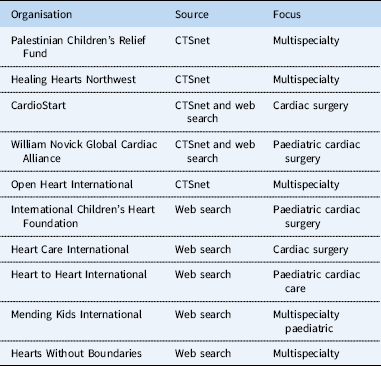
Five distinct humanitarian organisations were identified from the CTSnet volunteerism page (Table 1), of which three provide heart surgery among other types of medical care, one provides both adult and paediatric cardiac surgery, and one is dedicated completely to congenital heart surgery. An Internet search using the term “Pediatric Heart Surgery Medical Mission” yielded five additional non-profit groups, three dedicated solely to paediatric cardiac surgery and two duplicates, that is Novick Cardiac Alliance and CardioStart.
Non-profit organisations.

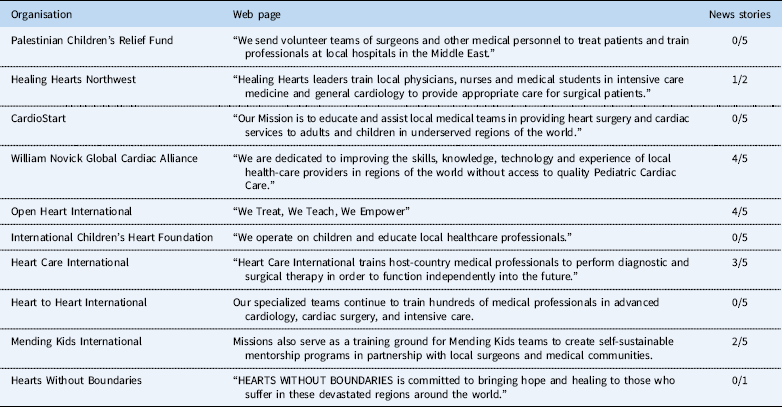
The web pages of eight organisations (80%, Table 2) place significant emphasis on the educational aspects of their work and/or on interaction with local professionals. For example, the CardioStart website states: “Our Mission is to educate and assist local medical teams in providing heart surgery and cardiac services to adults and children in underserved regions of the world” (http://cardiostart.org/). Similarly, Open Heart International tells us: “We Treat, We Teach, We Empower” (http://www.ohi.org.au/) and Novick Cardiac Alliance promises: “We are dedicated to improving the skills, knowledge, technology and experience of local health-care providers in regions of the world without access to quality Pediatric Cardiac Care” (www.cardiac-alliance.org). Statements by other organisations are similar. In contrast, two organisations were clear that their aim was directed primarily at providing care. Even so, both of these groups made reference to teaching and to programme sustainability elsewhere on their websites. It seems evident, therefore, that non-profit organisations involved in paediatric cardiac assistance recognise the importance of collaboration with the local providers.
Representative quotes from each organization’s purpose statement, and number of news stories referring to working with local providers.

Review of the articles in the news media (Table 2) tells a different story. Google News search revealed multiple articles for all but two of the 10 organizations. Two organizations had fewer than 5 articles each; these were reviewed, along with the first 5 articles listed for each of the other groups. Four articles were in Spanish and were included in the study; no other foreign language articles appeared in the search. Of a total of 43 news articles reviewed, only 14 (33%) mentioned education of, or interaction with, local professionals, and 4/10 organisations studied had no mention of the local providers in any of the articles in the study. Many emphasised fund raising, reported donations, or discussed success stories involving individual patients.
Discussion
Although there is a general consensus that it is important for any form of humanitarian assistance in the medical field to be both in keeping with the culture, needs, and priorities of the local population and directed towards building up as opposed to replacing the local providers, there is a clear difference of opinion reflected in the literature as to whether or not this can be achieved and, in fact, as to whether or not aid in the form of medical brigades or surgical trips is a good thing. The data here present one potential explanation for this controversy. Non-profit organisations and providers involved in humanitarian work recognise the importance of collaboration with the physicians and nurses in each country where they work, as is evidenced by the emphasis on this aspect of their efforts on their websites. The perception of the public, though, is largely affected by reports in the lay media; these articles often focus on individual patient “success” stories, and state or imply that no treatment was otherwise available.
Why is there such a difference in emphasis between the news articles and the web pages? The motivation for developing websites and for publishing news items, in broad terms, is the same: to raise awareness and thus to increase donations so that the work can continue. There are, of course, important differences between web pages and media reports. Most of the news articles are brief communications; reporters are interested in being able to rapidly get the attention of the public and “sell” their story or their publication. Explaining mentoring and teaching is complicated; it is easier to quickly tell a success story. Web pages are able to go into more detail, and are directed towards a different audience: one that has already expressed enough interest to go to the site. Furthermore, though the news articles may be directed to helping raise donations, the web pages are looking for not only money but, more importantly, volunteers. The intention is good behind both. Putting a human face on the need is clearly beneficial, but when should it be the face of the patient, and when should it be the face of the young doctor or nurse who is trying to help her but whose resources and experience are limited? Does it really matter? Questions phrased with the words “should” and “ought” are fundamentally ethical questions, asking what is the right or correct thing to do in a given situation.
Principlist analysis
The ethical analysis begins with the commonly used Principlist approach of Beauchamp and Childress,Reference Beauchamp and Childress 15 which relies on the four principles, that is autonomy or respect for persons, beneficence, non-maleficence, and justice. In this ethical system, each principle has equal weight; none is more important than the others, though in any given situation one may take precedence. The primary benefit of the Principlist approach is that it helps define the issues involved in ethical dilemmas so that a solution can be negotiated that is acceptable to everyone involved.
Humanitarian workers enter into a country that has a culture distinct from their own; it is important to recognise the values and preferences of those they encounter. We usually think of the principle of respect for persons as referring primarily to the patient or surrogate, but we can apply this principle also to our interactions with providers in other countries. It is their country, their hospital, and their cardiac surgery programme: what do they want? Disregarding the thoughts and preferences of the local team is not merely disrespectful; it may result in lack of cooperation on their part, with ultimate failure of the project.
Related to this is the principle of justice, we are not working with students or residents, but rather with educated professionals, albeit sometimes – and only sometimes – with professionals who have had less experience and/or training in a specific field than we have had the opportunity to have. Justice, seen also as the virtue of giving each his due, demands that we treat the providers who are recipients of humanitarian assistance as equal partners, as colleagues. The principle of justice, though, must be applied in the first place to the patients. This can become complicated and controversial, as exemplified by the famous question: “Who is my neighbour?” The broader questions of distributive justice, addressing to what extent we have a responsibility to provide health care to patients inside and outside our own country and when that should include interventions such as heart surgery, are beyond the scope of this paper. Here, we want to look at a fair treatment of the individual patient who is seen in the context of humanitarian outreach programmes. Each patient, approached as an individual, must be treated justly and have his/her needs addressed, according to the situation and the resources available.
In this situation, the principle of justice intersects with the other two principles of beneficence and non-maleficence. “Do no harm” may seem obvious, at first glance, but as we already noted, accusations have been made that patients might sometimes be “traded” for economic gain, or may be used as training tools for local or visiting providers.Reference Dupuis 3 Teaching and mentoring staff in the host country are important for programme sustainability and for future patients in the same way that training the next generation of physicians at home is important, but in neither case should welfare of an individual patient be compromised. As the philosopher Immanuel Kant famously taught with his categorical imperative, a person must never be used merely as a means to an end.Reference Kant 16
All the above-mentioned four principles help us identify areas of concern in this type of humanitarian work, and the principle of justice, in particular, stands out reminding us that both patients and local medical teams must be treated fairly.
Consequentialist analysis
We can also look at the ethics of the situation by applying a consequentialist approach: What will result in the most good for the most people? Humanitarian assistance in paediatric heart surgery is directed towards the admirable goal of saving children’s lives. This includes, of course, not only children who are already here but also those who will be born in the future. As such, the ethical evaluation cannot focus merely on what will result in saving the greatest number of children right now, but must consider also the vast number of children whose lives can be saved by the “pyramid effect” of programme development. If we base our consequentialist analysis, then, solely on the outcome of saving the lives of children, certainly whatever optimises programme development will be the best approach, because in this manner the highest number of children will be saved over time. In its purest form, then, this approach would permit or even encourage “sacrificing” the good of an individual child towards the goal of teaching or gaining experience; for this reason, the principle of non-maleficence as well as Kant’s categorical imperative must always be kept in mind.
A more complete consequentialist analysis would include optimising the outcome for everyone involved: the children, their families, the local medical team, the visiting medical team, the organisations responsible on each end, and society in general. Perhaps, for example, there are individuals or organisations within the host country whose livelihood is intertwined with supporting visiting medical teams who come to help; they will stand to lose their income once the assistance is no longer needed. Similarly, drawing attention to the plight of an individual child may be a necessary aspect of raising awareness. These are problems that need to be addressed, but they should not be the reasons to resist the progression to independence. Although maintaining the status quo may be of short-term benefit to some people, on balance clearly the greatest benefit to the most people is to work towards the establishment of sustainable programmes by fostering growth of and cooperation with the local medical team.
Limitations
Perhaps the most important limitation to this study relates to language. English, as the current unofficial “international” language, likely gives a good representation of the emphasis of the organisations’ websites, but since many or perhaps most of the news stories are in local publications, in the local languages of the countries where the work is carried out, the fact that the news search was performed using the organisations’ names in English may have biased the results. Since the identified organisations work in multiple countries with many languages, though, limiting the present study to English language search seemed to be a more straightforward course of action than choosing to add one or more other languages but not others.
The data presented here tell us only that there is an apparent difference between the information presented on the website and that in the news; we are unable to determine to what extent the actual efforts of each organisation are directed towards cooperation and teaching, nor whether or not they are successful. Certainly, there is evidence in the literature that various organisations have helped to establish sustainable programmes using a system of repeated surgical trips with an emphasis on teaching.Reference Novick, Stidham and Karl 8 , Reference Dearani, Neirotti and Kohnke 9 Future work could include interview or focus-group studies of local providers to learn their perceptions of the relationships. It could also be informative to do similar work focussing on other forms of humanitarian assistance, such as the effect on or perception of local providers when patients are either sent out for surgery, or when a permanent local institute is established totally or partly staffed by foreigners.
Finally, we limited our ethical analysis to the Principlist and Consequentialist ethical systems, which are the two most commonly used approach in bioethics and medical ethics. There are many ethical systems that could have been used, and some of them might have led to other conclusions. Nevertheless, we feel confident concluding that it is incumbent upon those who do humanitarian work to encourage the news media to adequately portray both the nature of our work and the important contribution made by local health care providers.
Acknowledgements
The original draft of this work formed part of the Masters’ Thesis project for the first author’s Master’s degree in Bioethics at Alden March Bioethics Institute. The authors would like to acknowledge the advisory contributions made by Dr Paul Burcher and Professor Evelyn Tenenbaum.
Financial Support
This research received no specific grant from any funding agency, or from commercial or not-for-profit sectors. Dr Fenton’s Masters studies were supported in part by a Cardiothoracic Ethics Forum Scholarship.
Conflicts of Interest
None.