Introduction
Human effects on nature are easily forgotten as perceptions adjust to progressively impoverished ecosystems (Turvey et al. Reference Turvey, Barrett, Hao, Zhang, Zhang, Wang, Huang, Zhou, Hart and Wang2010). This “shifting baseline syndrome” (Pauly Reference Pauly1995: 430) affects not only scientific understanding of past ecosystems but also limits the options that can be considered for their future conservation and management. Knowledge of the abundance and geographic distributions of past species is fundamental to an understanding of the significance of their recovery, to define targets for their conservation and to inform decisions regarding their exploitation. Species records from archaeological and historical sources are therefore crucial for conservation and management (Lyman Reference Lyman2006).
Establishing an accurate baseline is particularly important for whales, given their millennia-old history of interaction with humans. Whale exploitation developed independently in many parts of the world, and by the fifteenth century whaling had become a massive international industry, sequentially depleting populations until the world's oceans had been almost emptied of their largest animals (Reeves & Smith Reference Reeves, Smith, Estes, DeMaster and Doak2007). An international agreement in 1982 finally ended commercial whaling, and some species have now begun to recover (Magera et al. Reference Magera, Mills Flemming, Kaschner, Christensen and Lotze2013).
The identity of whale species in ancient records matters to archaeologists and historians, as well as to conservation scientists, because these marine mammals vary enormously in their ecology, behaviour and morphology: factors that have influenced the way in which they interacted with, and were exploited by, people in the past. In particular, while most whale species inhabit the high seas, and were only sporadically accessible to past peoples, some species congregate regularly and predictably close to the coastline, where they could be actively and more easily pursued. Thus, identifying the species of whale represented in archaeological collections and historical sources can shed light on the history of their exploitation (Buckley et al. Reference Buckley, Fraser, Herman, Melton, Mulville and Palsdottir2014).
Hominid exploitation of marine resources from the Mediterranean Sea began in the Middle Palaeolithic, c. 147000 BP (Cortés-Sánchez et al. Reference Cortés-Sánchez, Morales-Muñiz, Simón-Vallejo, Lozano-Francisco, Vera-Peláez, Finlayson, Rodríguez-Vidal, Delgado-Huertas, Jiménez-Espejo, Martínez-Ruiz, Martínez-Aguirre, Pascual-Granged, Bergadà-Zapata, Gibaja-Bao, Riquelme-Cantal, López-Sáez, Rodrigo-Gámiz, Sakai, Sugisaki, Finlayson, Fa and Bicho2011); by the classical antiquity period it had expanded and developed into extensive fisheries and trade systems in marine products (Marzano Reference Marzano2013). Given the rarity of records of whales in archaeological collections from this region (Bernal-Casasola et al. Reference Bernal-Casasola, Gardeisen, Morgenstern, Horwitz, Piqués, Theodoropoulou and Wilkens2016), it has been generally assumed that their exploitation was only occasional, involving the opportunistic use of stranded individuals (Papadopoulos & Ruscillo Reference Papadopoulos and Ruscillo2002). The rarity of bones in the archaeological record is not, however, incompatible with active whale exploitation, as butchering would have taken place on the beach, with few bones transported inland (Mulville Reference Mulville and Monks2005). More informative is the identity of the whale species represented in the archaeological record (Buckley et al. Reference Buckley, Fraser, Herman, Melton, Mulville and Palsdottir2014), yet little effort has been made to determine with precision the species represented in, for example, Mediterranean sites (Bernal-Casasola et al. Reference Bernal-Casasola, Gardeisen, Morgenstern, Horwitz, Piqués, Theodoropoulou and Wilkens2016).
Our aim is to demonstrate that an understanding of the whale species present in antiquity could elucidate the extent to which whales were exploited by past peoples in the Mediterranean region. We explore the hypothesis that whale communities might have changed substantially over the past centuries, and discuss how the species composition of the whale communities may have influenced the feasibility of ancient whaling in this region.
Ancient forms of whale exploitation
Human societies have exploited whales along a gradient of increasing levels of premeditation: the scavenging of naturally stranded whales; ‘low-level’ or opportunistic killing; and organised whaling (Savelle Reference Savelle2005).
Scavenging of naturally stranded whales
Naturally stranded whales are those whose death and arrival onshore are not caused by humans. Most represent the whole or partial carcasses of animals that died at sea (e.g. from illness or natural predation) and were swept ashore by currents or wind. Whales can also become stranded alive and subsequently die, sometimes in large numbers (‘mass strandings’). The reason for such events remains uncertain; possible causes include illness, rough weather, disorientation and toxic algal blooms (Geraci & Lounsbury Reference Geraci and Lounsbury1993). Beached whales are more frequent at ‘stranding hotspots’ with particular oceanographic and topographic conditions (e.g. Brabyn & McLean Reference Brabyn and McLean1992) or, at certain times of the year, with specific weather and oceanographic circumstances (Evans et al. Reference Evans, Thresher, Warneke, Bradshaw, Pook, Thiele and Hindell2005), but their occurrence is inherently unpredictable. Furthermore, as no dedicated technology or skills are needed to make use of a beached whale, no premeditation is needed for this type of whale exploitation, and no particular tools would be expected in the archaeological record.
Stranded whales can belong to any species; their diversity and abundance on a given coastline generally reflect the composition of the live community in the nearby seas (Pyenson Reference Pyenson2011). Hence, all species—and particularly the most common—can potentially be exploited in this way. Mass strandings are, however, more common in social species such as sperm, pilot and false killer whales (Geraci & Lounsbury Reference Geraci and Lounsbury1993). Blooms of toxic algae can cause mass stranding events involving multiple taxa such as whales, dolphins and seals (Pyenson et al. Reference Pyenson, Gutstein, Parham, Roux, Chavarría, Little, Metallo, Rossi, Valenzuela-Toro, Velez-Juarbe, Santelli, Rogers, Cozzuol and Suárez2014). The reference in Pliny's Naturalis Historia (9.4; Bostock & Riley Reference Bostock and Riley1855) to “a subsidence of the ocean” in western France that “left exposed on the shores [. . .] as many as three hundred animals or more, all at once, quite marvellous for their varied shapes and enormous size” may describe a mass stranding caused by an earthquake.
Opportunistic killing
Opportunistic killing refers to the active hunting of individual whales found close to shore. Such captures would not have been predictable in time or space, but rather an impromptu response to the presence of vulnerable whales. This might have involved nets and boats to prevent whales returning to the high seas, making noise to scare them towards land, attacking them with piercing instruments and attaching floats to prevent the whale sinking (Mitchell et al. Reference Mitchell, Reeves and Evely1986). Whales accidentally caught in fish traps would also fall into this category. The unpredictability of these captures means that they are unlikely to have involved methods and equipment dedicated specifically to killing whales, with people making use of whatever means were already in place as part of other activities (Savelle Reference Savelle2005). We can assume that the success of such attempts was probably higher in regions with ongoing fisheries of large marine animals such as tuna or swordfish, where people would be better prepared to respond quickly and effectively to the presence of whales alongside their usual target species. Evidence of the technology suited for such a task (craft, nets, implements for killing and butchering large animals) may be found in the archaeological record.
In theory, it is possible that healthy individuals of any whale species would occasionally be found near the coastline, where they could fall prey to opportunistic killing. In practice, the frequency of these events is expected to be proportional to the propensity of species to use coastal habitats. High-seas species (e.g. fin whales, Balaenoptera physalus; Cuvier's beaked whales, Ziphius cavirostris) may be found near to the coast under exceptional oceanographic conditions that bring their prey to low-depth areas, but this happens very infrequently. Even today, there are some species of deep-diving beaked whales whose individuals have never been seen alive, and are known only from stranded individuals (Wilson & Mittermeier Reference Wilson and Mittermeier2014).
Organised whaling
Organised whaling is defined here as the premeditated capture of whales at specific seasons and places, hence a regular fisheries operation in its own right. Given the challenges involved with capturing such large animals, this often involves specialised skills, co-operative methods and particular instruments (Mitchell et al. Reference Mitchell, Reeves and Evely1986). Further, given the speed at which whale carcasses decompose, there would be little point in whaling unless the infrastructure was in place for quickly processing, storing and trading the huge quantities of meat and blubber obtained. Organised whaling therefore requires a much higher level of social organisation and preparation than occasional killing. It also requires a predictable presence of whales (Whitridge Reference Whitridge1999).
Prior to the development of methods for offshore whaling (in the sixteenth century, led by Basque expertise), whaling focused almost exclusively on a narrow set of species: bowhead whales (Balaena mysticetus), right whales (Eubalaena sp.), grey whales (Eschrichtius robustus) and humpback whales (Megaptera novaeangliae) (Reeves & Smith Reference Reeves, Smith, Estes, DeMaster and Doak2007). The ecology of these species places them predictably and regularly in coastal areas as part of their feeding, calving and migrating grounds (see online supplementary material), and hence within reach of human predation.
Ancient whale exploitation in the Mediterranean?
Long-distance seafaring, trans-Mediterranean trade and commercial-scale fishing have been practised in the Mediterranean Sea since at least the Late Bronze to Early Iron Ages (Morales-Muniz & Rosello-Izquierdo Reference Morales-Muniz, Rosello-Izquierdo, Rick and Erlandson2008; Tartaron Reference Tartaron2013), raising the possibility of intentional exploitation of whales at this time. This is even more feasible for later periods. Given the technological sophistication of the Mediterranean classical civilisations in terms of fisheries and seafaring (Marzano Reference Marzano2013), as well as the impressive infrastructure in place for processing fish products (cetariae) (Trakadas Reference Trakadas and Bekker-Nielsen2005), it seems undeniable that the necessary skills and technology were in place for the active exploitation of whales. In fact, Greek and Latin literature provides one example of opportunistic killing and one of (presumed) organised whaling. Pliny's description of the attack on an “orca” that had entered the Port of Ostia (Naturalis Historia 9.14; Bostock & Riley Reference Bostock and Riley1855) is a clear illustration of the methods and utensils that could have been used to opportunistically kill whales that came close to shore: “Cæsar ordered a great number of nets to be extended at the mouth of the harbour, from shore to shore [. . .] boats assailed the monster, while the soldiers on board showered lances upon it”. Oppian's description of the capture of a sea-monster (Haliaeutica V; Mair Reference Mair1928) reveals many details reminiscent of the methods employed by whalers elsewhere (Mitchell et al. Reference Mitchell, Reeves and Evely1986), including:
-
• The coordinated nature of the attack, involving multiple rowing boats launched from the coast and approaching the whale silently, “With quiet oars they gently make white the sea, carefully avoiding any noise”.
-
• The attachment to the whale through a very long rope as “the fishers allow him all the length of the line; for there is not in men strength enough to pull him up and to overcome the heavy monster against his will”.
-
• The attachment of inflatable floaters to that rope, which tired the whales by creating drag in the water: “as he dives they let go with him into the water large skins filled with human breath and fastened to the line”.
-
• The final killing of the exhausted whale with multiple piercing tools, wherein “one brandishes in his hands the long-barbed trident, another the sharp-pointed lance, others carry the well-bent bill, another wields the two-edged axe”.
-
• The towing of the animal back to shore: “then they take him in tow and joyfully haul him to the land”.
Some details in this narrative suggest that it is probably a mix of hunting stories of several large animals rather than a pure whaling scene. In particular, the use of bait (“they put upon the hook a portion of the black liver of a bull or a bull's shoulder suited to the jaws of the banqueter”) and the triple row of teeth in the dead animal (“some marvel at the deadly ranks of his jaws, even the dread and stubborn tusks, like javelins, arrayed in triple row with close-set points”) both suggest a shark. Nonetheless, this scene illustrates how methods for the successful capture of whales were in place in the Mediterranean in antiquity.
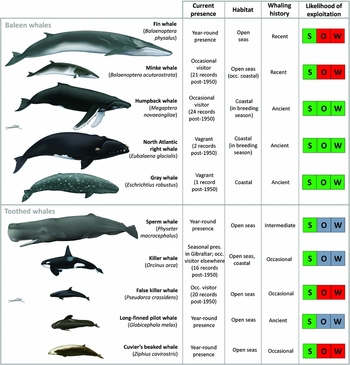
Given that ancient whaling in the Mediterranean was technologically possible, we must now consider whether it was ecologically realistic, i.e. whether suitable whale species were present. We discuss this below in relation to two contrasting scenarios: a) if the species composition of the whale population in antiquity was similar to that of the present day; and b) if coastal species currently absent from the region were previously present (Figure 1; further details are provided in the online supplementary material).
Whale species of the Mediterranean Sea, including those present today and those that may have been present in the past. The spatial scope for ‘presence’, ‘habitat’ and ‘likelihood of exploitation’ is the Mediterranean Sea; for ‘whaling history’ it is the world. ‘Likelihood of exploitation’ is our estimated probability that the species would have been exploited in each of three ways (S = scavenging; O = opportunistic killing; W = whaling) during classical antiquity, if regularly present in the Mediterranean at the time; green = probably; blue = possibly; red = unlikely (whale illustrations © Uko Gorter, reproduced with permission). See online supplementary material for more details.

Plausibility of ancient whaling given the present-day whale community
Today, eight whale species are found with some regularity in the Mediterranean Sea and the Strait of Gibraltar region. Four species are resident and regularly present across the Mediterranean: the fin whale (the most common), the sperm whale (Physeter macrocephalus), the long-finned pilot whale (Globicephala melas) and Cuvier's beaked whale. A small population of killer whales (Orcinus orca) is seasonally present in the Strait of Gibraltar and adjacent Atlantic waters. Three other species are occasional visitors from the Atlantic Ocean: the common minke whale (Balaenoptera acutorostrata), the humpback whale and the false killer whale (Pseudorca crassidens) (Reeves & Notarbartolo di Sciara Reference Reeves and Notarbartolo di Sciara2006). Most of these species have a strong preference for deep, offshore waters, two exceptions being the killer whale, which favours shallow waters and is generally restricted to the Gibraltar region, and the humpback whale, which may be found in coastal habitats (see below) but only occasionally in the Mediterranean (Reeves & Notarbartolo di Sciara Reference Reeves and Notarbartolo di Sciara2006). Hence, if the Mediterranean whale community in antiquity was similar to that of today, it is unlikely that organised forms of whaling would have developed, as the presence of whales close to the coastline would have been rare and unpredictable.
Stranded individuals, on the other hand, would most certainly have been exploited whenever found. The following statistics provide some perspective on the frequency and composition of stranding events: in the western Mediterranean, around 7.1 individuals are stranded per year per 1000km of coastline (128 individuals between 1991–2008 in the Alborán Sea and Strait of Gibraltar: 58 pilot whales, 25 fin whales, 20 Cuvier's beaked whales, 10 minke whales, 10 sperm whales, 3 humpback whales, 1 false killer whale; Rojo-Nieto et al. Reference Rojo-Nieto, Álvarez-Díaz, Morote, Burgos-Martín, Montoto-Martínez, Sáez-Jiménez and Toledano2011). This compares to 6.6 per 1000km in the eastern Mediterranean (19 strandings between 1993–2009 in Israel: 7 Cuvier's beaked whales, 4 minke whales, 4 fin whales, 3 sperm whales, 1 false killer whale; Kerem et al. Reference Kerem, Hadar, Goffman, Scheinin, Kent, Boisseau and Schattner2012). Many of these are, however, caused by humans (e.g. net entanglement, ship collisions, sonar disturbance) and would not have occurred in antiquity.
Opportunistic killing would probably have been very occasional. The two most plausible target-species are killer whales, given their current coastal habitat (in the Strait of Gibraltar and adjacent Atlantic waters), and long-finned pilot whales, given their gregarious behaviour and tendency to mass strand (Dhermain et al. Reference Dhermain, Soulier and Bompar2002), particularly in the Alborán Sea, where they are more common (Reeves & Notarbartolo di Sciara Reference Reeves and Notarbartolo di Sciara2006). Whales could also have become caught in fish traps. This would particularly apply to killer whales chasing tuna.
Plausibility of ancient whaling if coastal whale species were present
Organised whaling would have been very feasible if coastal whale species were regularly found in the Mediterranean Sea, and even more so if these species came to the Mediterranean to reproduce: calves would have been easier to catch given their smaller size and tendency to remain closer to the shore (as defence against predators; Ford & Reeves Reference Ford and Reeves2008). Furthermore, the development of organised whaling operations for coastal whales could, in turn, have increased the likelihood of opportunistic captures of other non-coastal whale species by increasing the readiness and effectiveness of fishermen.
The possibility that migratory coastal whales once came to the Mediterranean to calve is worth serious consideration. Three species of whale that use coastal winter calving grounds previously lived in the European Atlantic coast, and could plausibly have entered the Mediterranean (see online supplementary material). These species were hunted for millennia across the world (Reeves & Smith Reference Reeves, Smith, Estes, DeMaster and Doak2007) and their populations were heavily affected by whaling in the North Atlantic, such that they are now either totally absent or very rare off European shores. The grey whale became extinct in the North Atlantic in the eighteenth century (Lindquist Reference Lindquist2000), and is currently found only in the North Pacific. The most coastal of all whale species, it spends its entire life cycle in shallow waters. The fate of the North Atlantic population is poorly understood, given the paucity of historical and archaeological records. The only confirmed record of grey whales in the Mediterranean dates from 2010, when a vagrant individual was observed off the coast of Israel and later Spain (Scheinin et al. Reference Scheinin, Kerem, MacLeod, Gazo, Chicote and Castellote2011). The North Atlantic right whale (Eubalaena glacialis) came very close to extinction in the nineteenth century, surviving today as a small population in the western North Atlantic (Reeves et al. Reference Reeves, Smith, Josephson, Kraus and Rolland2007). In the eastern North Atlantic, calving grounds were known in the Gulf of Biscay and Cintra Bay (off the western Sahara), so the Mediterranean was well within reach. The few historical records from the Mediterranean relate to winter and spring periods, and are therefore compatible with a presence during the calving season. Finally, the humpback whale is currently an occasional (presumably non-breeding) visitor to the Mediterranean, with a calving ground in the Cape Verde islands. It might have been a regular winter migrant in the Mediterranean before its North Atlantic population became extremely depleted (Reeves & Smith Reference Reeves and Smith2002).
A second line of evidence comes from descriptions of what appear to be coastal whales in Greek and Roman literature. There is the detailed description by Pliny (Naturalis Historia 9.12; Bostock & Riley Reference Bostock and Riley1855) of whales coming at the winter solstice to Cadiz, a “calm capacious bay, in which they take a delight in bringing forth”. This coastal winter calving behaviour does not apply to the whale species currently found in the area, but could easily refer to grey, right or humpback whales. Pliny's description of orca attacking the pregnant whales and their young, as “an enormous mass of flesh armed with teeth”, is a biologically realistic description of killer whales attacking these species (Ford & Reeves Reference Ford and Reeves2008). A second text is the presumed whaling scene in Oppian's Haliaeutica (book V). The author places the action unambiguously near the coast, with the monster being spotted from land before being approached by rowing boats, with whalers coming to land to fasten a line to a rock, and the whole dramatic scene being witnessed by goat-herders and wood-cutters.
The presence of right, grey and humpback whales in the Mediterranean opens new possibilities for the interpretation of some puzzling literary passages. For example, Oppian's statement (Haliaeutica 1.390; Mair Reference Mair1928) that “even the shameless Whale, they say, leaves the sea for the dry land and basks in the sun” is reminiscent of several subsequent descriptions of grey whales using low-depth waters: “Repeated instances have been known of their getting aground and lying for several hours in but two or three feet of water, without apparent injury from resting heavily on the sandy bottom, until the rising tide floated them” (Scammon Reference Scammon1874). Similarly, Aelian's descriptions of ram-fishes, with “[a] white band running round its forehead [like] the tiara of [a king of Macedon]” in males, and “curls, just as cocks have wattles, attached below its neck” in females (De Natura Animalium 15.2; Scholfield Reference Scholfield1959), could perhaps correspond, respectively, to the white callosities of right whales and the deep ventral grooves of humpbacks. Aelian further states that “the hairs which grow from the nostrils of the Ram-fish serve many purposes”, suggesting baleen, and he clarifies that ram-fishes spent winter between Corsica and Sardinia, which is compatible with right and humpback whales if, in the past, they were winter migrants to the Mediterranean.
In summary, it is ecologically plausible that one or more of these coastal species might once have been present in the Mediterranean and so supported an ancient whaling industry. This hypothesis finds some credence in historical evidence, although it is uncorroborated by the identification of remains from archaeozoological sites (Bernal-Casasola et al. Reference Bernal-Casasola, Gardeisen, Morgenstern, Horwitz, Piqués, Theodoropoulou and Wilkens2016).
Interpreting the archaeological record through an ecological lens
Determining the identity of whale bones represented in the archaeological record of the Mediterranean is therefore fundamental to an understanding of the possible ways in which humans exploited these animals in antiquity. If these records reveal only the high seas species that are currently present in the region, then it is very probable that coastal communities simply engaged in the opportunistic use of naturally stranded individuals or (much less frequently) in occasional opportunistic killings. The archaeological evidence would then support the currently accepted view that there was no systematic exploitation of whales in antiquity (Papadopoulos & Ruscillo Reference Papadopoulos and Ruscillo2002).
If, on the other hand, the archaeological records yield remains of one or more of the coastal species (grey, right or humpback whale), then a whole new realm of possibilities opens up. As coastal species can also become stranded, an osteological find from one of these species would not, per se provide evidence of whaling. It would, however, indicate that coastal species were, historically, part of the Mediterranean whale assemblage, increasing the likelihood of opportunistic killing and even organised whaling in antiquity. Such a hypothesis could be investigated by further exploring the archaeological and historical record for evidence of whale capture and the processing and trade of whale-derived products. If whaling did occur, we predict that the most probable locations for such activity would be the Strait of Gibraltar, where migratory whales could be intercepted entering the Mediterranean from the Atlantic in the early winter and leaving in the early spring, and also in the sheltered bays of the western Mediterranean, which would be suitable winter calving sites.
Conclusion
The species composition of the Mediterranean whale community in antiquity is crucial to evaluating the possibility of ancient forms of whaling in the Mediterranean: if similar to that of today, it is largely incompatible with the development of mass ancient forms of whaling; if, in contrast, coastal whale species were present in the past, this would open the possibility of ancient organised whaling. Unfortunately, whale bones are notoriously difficult to identify through classical methods of comparative anatomy (based on anatomical shape description, comparisons with references and osteometry) (Reitz & Wing Reference Reitz and Wing2008). Not only do they have few distinct morphological features (being predominantly composed of cancellous tissue), comparative osteological reference collections of whales are rare and largely incomplete. Furthermore, whale bones are usually only present in a very fragmented state. As a result, many archaeological specimens are labelled simply ‘whale’ or ‘marine mammal’ (Buckley et al. Reference Buckley, Fraser, Herman, Melton, Mulville and Palsdottir2014). When zooarchaeologists do attempt to establish the identity of a particular whale bone through comparative methods, they naturally start from a pool of candidate species, often working by exclusion to narrow down the set of possible species. Species not currently found in the local communities may be overlooked as candidates, and their bones, if found, may be incorrectly attributed to a different species. Hence, a vicious cycle might form, whereby a species is not considered by ecologists to belong to the local fauna given the absence of archaeological records, and archaeologists fail to notice evidence of its presence as it is not considered part of the local fauna.
It is now possible to break this cycle and obtain more accurate species identifications thanks to developments in DNA and collagen fingerprinting in ancient bones, both of which have been successfully applied to ancient cetacean remains (Foote et al. Reference Foote, Hofreiter and Morin2012; Buckley et al. Reference Buckley, Fraser, Herman, Melton, Mulville and Palsdottir2014), although not yet to those from the Mediterranean region (Bernal-Casasola et al. Reference Bernal-Casasola, Gardeisen, Morgenstern, Horwitz, Piqués, Theodoropoulou and Wilkens2016). These methods will shed light on the composition of whale communities prior to their depletion by industrial-scale whaling, thus contributing to the creation of a more accurate ecological baseline to inform conservation and management of Mediterranean marine ecosystems. In turn, this baseline will provide archaeologists with a better ecological context in which to investigate the full extent of ancient human interactions with the planet's largest animals.
Acknowledgements
This research was funded by the Agence Nationale de la Recherche (Project MORSE, CEP&S 2011-ANR-11-CEPL-006). This study is an output of the project ‘Y a-t-il eu une exploitation ancienne des baleines en Méditerranée?’, co-funded by the Maison des Sciences de l'Homme de Montpellier, the Project MORSE, the AniMed network (CNRS, UMR5140 Archéologie des sociétés méditerranéennes, University Paul-Valéry, Montpellier) and the Labex Archimede (IA-ANR-11-LABX-0032-01). We are very grateful to Uko Gorter for permission to use his excellent drawings. Stimulating discussions with Arnaud Zucker, Jean Trinquier, Dario Bernal-Casasola and Armelle Gardeisen have contributed to improving this manuscript.
Supplementary material
To view supplementary material for this article, please visit http://dx.doi.org/10.15184/aqy.2016.109.