Bullying, the systematic and usually intentional abusive behavior characterized by an imbalance of power between bullies and victims, is a complex social phenomenon. Group processes are important for explaining and understanding it (Salmivalli, Reference Salmivalli2010). Defending behavior in bullying situations demonstrates the complexity of the group processes in bullying. Defending is usually defined as comforting and supporting victims or even standing up for them when they are being victimized. Defending can be a risky strategy, because bullies may retaliate and direct their aggression toward defenders (Gini, Albiero, Benelli, & Altoè, Reference Gini, Albiero, Benelli and Altoè2008). Having defenders, however, makes a difference for victims (Sainio, Veenstra, Huitsing, & Salmivalli, Reference Sainio, Veenstra, Huitsing and Salmivalli2011): compared with undefended victims, victims who reported having at least one defender were found to have more self-esteem and were more accepted and less rejected among peers. Hence, antibullying interventions aim to increase the number of children who stand up for victims. Recently, however, it has been suggested that not only victims are defended; bullies can be defended by their in-group members against victims’ reactions (Huitsing & Veenstra, Reference Huitsing and Veenstra2012). In this study, we aimed to examine the interactional relationships among defending, victimization, and bullying. To achieve this aim, we adopted a longitudinal social network approach to disentangle the sequences of defending, victimization, and bullying relations and to investigate how patterns in the networks of bullying and defending (co-)evolve over time.
Bullying and victimization in childhood are known to be precursors for later maladjustment (Barker et al., Reference Barker, Boivin, Brendgen, Fontaine, Arseneault and Vitaro2008; Kim, Leventhal, Koh, Hubbard, & Boyce, Reference Kim, Leventhal, Koh, Hubbard and Boyce2006). Whereas victims are at risk for later internalizing problems (Arseneault, Bowes, & Shakoor, Reference Arseneault, Bowes and Shakoor2009; Reijntjes, Kamphuis, Prinzie, & Telch, Reference Reijntjes, Kamphuis, Prinzie and Telch2010), bullies are at risk for later offending, violence, and psychiatric problems (Sourander et al., Reference Sourander, Ronning, Brunstein-Klomek, Gyllenberg, Kumpulainen and Niemelä2009; Ttofi, Farrington, & Lösel, Reference Ttofi, Farrington and Lösel2012; Ttofi, Farrington, Lösel, & Loeber, Reference Ttofi, Farrington, Lösel and Loeber2011). Bullying is part of a larger spectrum of problematic aggressive behaviors (Olweus, Reference Olweus1993). Not all bullies, however, face problems in the short and long term. Aggressive bullies (also called bully/victims or reactive bullies) are most at risk for adjustment problems (Haynie et al., Reference Haynie, Nansel, Eitel, Crump, Saylor and Yu2001; Salmivalli & Nieminen, Reference Salmivalli and Nieminen2002; Veenstra et al., Reference Veenstra, Lindenberg, Oldehinkel, De Winter, Verhulst and Ormel2005); there are also strategic bullies, who combine prosocial and antisocial behavioral strategies to obtain a powerful position in the peer group (Hawley, Reference Hawley2003; Olthof, Goossens, Vermande, Aleva, & Van der Meulen, Reference Olthof, Goossens, Vermande, Aleva and Van der Meulen2011; Reijntjes et al., Reference Reijntjes, Vermande, Olthof, Goossens, van de Schoot and Aleva2013).
In line with bullying as strategic behavior, we adopted a goal-framing approach (Lindenberg, Reference Lindenberg, Fetchenhauer, Flache, Buunk and Lindenberg2006, Reference Lindenberg2008) as the underlying theoretical approach to understanding children's behavioral strategies. The goal-framing approach theorizes that people behave in line with their goal pursuit, with goals making people selective in interpreting situational cues. Goals help us to understand people's perceptions, because people evaluate situations and determine whether or not they are helpful for reaching their goals. Two goals are important in childhood and preadolescence: status and affection (Veenstra, Lindenberg, Munniksma, & Dijkstra, Reference Veenstra, Lindenberg, Munniksma and Dijkstra2010). Status is the relative social position a person has in the peer hierarchy, and it is often referred to as “perceived” popularity (Cillessen & Rose, Reference Cillessen and Rose2005). Affection can be described as having warm and close relationships with others. Bullying serves the goal of enabling a person to feel superior (status) without losing the affection of significant other peers (Sijtsema, Veenstra, Lindenberg, & Salmivalli, Reference Sijtsema, Veenstra, Lindenberg and Salmivalli2009; Volk, Camilleri, Dane, & Marini, Reference Volk, Camilleri, Dane and Marini2012). Bullies divide the classroom into potential sources of affection, containing significant others from their ingroup, and potential sources of domination from their outgroup, for whom they and their significant others do not care (Gini, Reference Gini2007; Nesdale, Milliner, Duddy, & Griffiths, Reference Nesdale, Milliner, Duddy and Griffiths2009). In defending, the bystander takes a clear stand on behalf of the victim by directly stepping in, seeking help, or comforting the victim (Gini et al., Reference Gini, Albiero, Benelli and Altoè2008; Pöyhönen, Juvonen, & Salmivalli, Reference Pöyhönen, Juvonen and Salmivalli2010). Such behavior is usually highly rewarded and results in affection and status (Veenstra, Verlinden, Huitsing, Verhulst, & Tiemeier, Reference Veenstra, Verlinden, Huitsing, Verhulst and Tiemeier2013). In sum, goal framing can help to explain the joint development of bullying and defending relations, because children are expected to form relations with others in line with their goal pursuit.
Bullying and Defending From a Social Network Perspective
Research on the interplay among bullying, victimization, and defending is founded in the participant role approach to bullying, which recognizes the involvement in the bullying process of more children than only bullies and victims (Salmivalli, Reference Salmivalli2010; Salmivalli, Lagerspetz, Björkqvist, Österman, & Kaukiainen, Reference Salmivalli, Lagerspetz, Björkqvist, Österman and Kaukiainen1996). Defenders side with victims, whereas bullies may be helped by assistants, who join them actively, or be rewarded by positive feedback from reinforcers (e.g., laughing or cheering). Next to these active roles, there are also outsiders who observe the victimization but do not intervene and may pretend that nothing is going on. Children's roles in group processes are dynamic; for example, sometimes children initiate the victimization of peers, and at other times they join in, but they may also decide to observe without intervening. A social network perspective may contribute to our understanding of group processes, because it allows investigation of the variation in children's behavioral patterns toward different classmates.
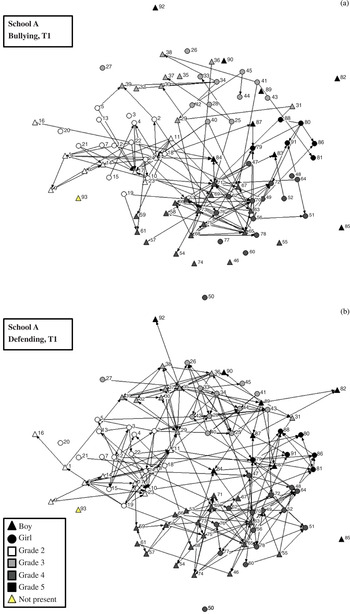
Using a social network perspective, the relations between children are investigated. Bullying (“who bullies whom”) and defending (“who defends whom”) are relational behaviors. They can be investigated at the actor level (e.g., whether children who are frequently nominated as defender are unlikely to be nominated as bully, also called “degree level”), at the dyadic level (relations between two children; e.g., whether children defend each other reciprocally), and at a triadic (or higher order) level, which refers to relations between three (or more) children within small groups. A graphical example of a social network of bullying is given in Figure 1a, which shows for grade (colored nodes) and gender (shaped nodes) self-proclaimed victims (the senders of an arrow) and their bullies (the receivers). The direction of the arrows means that senders report the behavior of receivers. Some children are involved in a large number of bullying relations, as bullies (nominations received, the incoming arrow) or as victims (nominations given, the outgoing arrow), or as both, whereas others are uninvolved. Figure 1b provides the defending relations of the same school, with the children in the same positions as in Figure 1a, meaning that the network positions are comparable across figures. In this figure, senders of an arrow nominate receivers as their defenders.
(Color online) (a) “By which students are you victimized?” Graphical representation of the bullying network at Time 1 (T1) for school A. (b) “Who defends you when you are victimized?” Graphical representation of the defending network at T1 for school A.

To illustrate, at the first wave, boy 92 is an isolate in the bullying network, meaning that he does not engage in bullying or report being victimized. In the defending network, boy 35 reports that boy 92 defends him. Another example is girl 19, who reports being bullied by two boys (53 and 61), whereas she herself is a defender of two other children, including boy 17, with whom she has a mutual defending relation. Together, these figures demonstrate the interdependency of relations between children, because children can be involved in multiple bullying as well as defending relations. The creation or continuation of relations is dependent not only on the existence of children's other relations but also on the relations between others in the network. The collection of relations in a social network can, therefore, be seen as emergent processes: relatively simple interactions between children lead to complex network patterns at the larger network level.
Understanding of the development of social networks has benefited from advances in longitudinal social network analysis using stochastic actor-based modeling (for an accessible introduction to this topic, see Snijders, Van de Bunt, & Steglich, Reference Snijders, Van de Bunt and Steglich2010). This approach has found its way to developmental researchers (Veenstra, Dijkstra, Steglich, & Van Zalk, Reference Veenstra, Dijkstra, Steglich and Van Zalk2013), who have used it to understand the similarity between connected individuals by separating two processes: selection processes, which concern the formation or dissolution of relationships, and influence processes, which concern changes in individuals’ behaviors or attitudes in response to those of their peers (Steglich, Snijders, & Pearson, Reference Steglich, Snijders and Pearson2010). Victimization within friendship networks has been investigated using this approach, and it was found that children with similar levels of physical victimization selected each other as friends (Sentse, Dijkstra, Salmivalli, & Cillessen, Reference Sentse, Dijkstra, Salmivalli and Cillessen2013; Sijtsema, Rambaran, & Ojanen, Reference Sijtsema, Rambaran and Ojanen2013). These researchers, however, examined victimization as a behavioral construct, meaning that they considered victimization to be a characteristic of children without knowing by whom the children were victimized. In this study, we investigated victimization by examining children's relationships: who bullies whom?
The Interplay of Bullying/Victimization and Defending
Social network information allows understanding of the relational basis of behaviors. For example, social network data express with whom and with how many others children are interacting. This can be an important distinction because it has been shown, for example, that children with several bullies have on average more depressive symptoms and lower self-esteem than do victims with few bullies (Huitsing, Veenstra, Sainio, & Salmivalli, Reference Huitsing, Veenstra, Sainio and Salmivalli2012). The social network approach is different from more traditional investigations using self- or peer reports on bullying, from which it is known how children behave but which provide no information about the relational nature of their (bullying) behaviors. Moreover, investigating multiple social networks allows unraveling of the relational patterns of bullying in the group context. This helps in understanding the developmental processes underlying children's relationships.
Victimization, bullying, and defending are entwined relations. Once children become victimized by peers, others in the classroom hopefully stand up for them, by helping and defending them. Defending may even prevent victimization, because bullies are probably reluctant to target children with several potential defenders. Research has shown that rejected children without friends or defenders run the greatest risk of being victimized (Fox & Boulton, Reference Fox and Boulton2006; Hodges, Boivin, Vitaro, & Bukowski, Reference Hodges, Boivin, Vitaro and Bukowski1999; Sainio et al., Reference Sainio, Veenstra, Huitsing and Salmivalli2011).
If defending can prevent or stop victimization, it can be argued that bullies need defenders as well, to “protect” them from victims’ reactions. Strategic bullies usually have a powerful position in the peer group (Caravita, Di Blasio, & Salmivalli, Reference Caravita, Di Blasio and Salmivalli2009; Dijkstra, Lindenberg, Verhulst, Ormel, & Veenstra, Reference Dijkstra, Lindenberg, Verhulst, Ormel and Veenstra2009; Olthof & Goossens, Reference Olthof and Goossens2008; Witvliet et al., Reference Witvliet, Olthof, Hoeksma, Goossens, Smits and Koot2010). Their powerful position helps them in receiving assistance and being defended when they need it: for example, if victims react to bullies’ negative behaviors. In this way, defending and support prevents bullies from being victimized. Thus far, a network approach has been used in one cross-sectional study to examine the relation between defending and bullying (Huitsing & Veenstra, Reference Huitsing and Veenstra2012). The results indicated that victims defended each other when they were victimized by the same bullies, and that bullies also defended each other when they harassed the same victims. These results suggest ingroup–outgroup processes (other terminology that can be used is “cliques” or “subgroups”; e.g., Adler & Adler, Reference Adler and Adler1995; Cohen, Hsueh, Russel, & Ray, Reference Cohen, Hsueh, Russel and Ray2006): children defend ingroup members and may bully children from the outgroup. Experimental studies have also shown that ingroup favoritism can be used to understand and explain bullying (Gini, Reference Gini2007; Nesdale et al., Reference Nesdale, Milliner, Duddy and Griffiths2009; Ojala & Nesdale, Reference Ojala and Nesdale2004).
Some other network studies investigated the interplay between positive and negative networks. Using cross-sectional data, it was found that victims who were victimized by the same bullies liked each other, and bullies who targeted the same victims had a similar positive relation (Huitsing, Van Duijn, et al., Reference Huitsing, Van Duijn, Snijders, Wang, Sainio and Salmivalli2012). Moreover, Berger and Dijkstra (Reference Berger and Dijkstra2013) used a longitudinal design to investigate the interdependence between friendship and rejection (which is another representation of a network with a negative interpretation). They found that friends agreed over time whom to reject.
Hypotheses on Defending Among Victims and Bullies
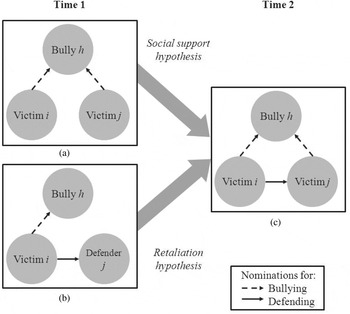
The longitudinal design employed in the current study was necessary to unravel the sequential associations underlying the relational patterns between bullying/victimization and defending. Being victimized is a serious threat to children's social status, but it is also related to immediate negative feelings and distress (Espinoza, Gonzales, & Fuligni, Reference Espinoza, Gonzales and Fuligni2013; Nishina & Juvonen, Reference Nishina and Juvonen2005). From a goal-framing perspective, victims are expected to prevent victimization or ease its negative outcomes by seeking help from others. An obvious source of support for victims may be other victims who are victimized by the same bully or bullies. These victims can defend each other in order to stand stronger against their bullies (Fox & Boulton, Reference Fox and Boulton2006; Hodges et al., Reference Hodges, Boivin, Vitaro and Bukowski1999). This pattern is graphically displayed in Figure 2c. Two pathways can lead to defending among victims. It may be that at Time 1, victims i and j are both victimized by bully h (Figure 2a). Their shared victimization status makes it likely that at least one of them is defended by the other at Time 2 (Figure 2c). Thus, we hypothesized that victims sharing the same bullies defend each other (social support hypothesis).
Triangulation in multivariate networks for bullying (“By which students are you victimized?”) and defending (“Who defends you when you are victimized?”): defending among victims.

Another possibility to arrive at the network state of Figure 2c is that victim i is victimized by bully h and defended by defender j (see Figure 2b). If the proposition that defending victims is a risky strategy is true, it can be expected that defender j also becomes victimized by bully h (Figure 2c). When victims are defended, bullies see their goal of obtaining or maintaining social status thwarted, and they may respond negatively to the defender. Thus, we hypothesized that bullies retaliate and direct their aggression toward the defenders of their victims (retaliation hypothesis).
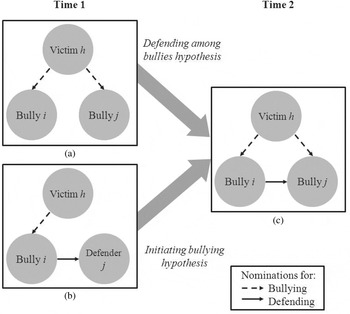
Bullies are likely to divide peers into an ingroup and outgroup, referring to potential sources of affection (significant others) and potential sources of domination (victims for whom significant others do not care; Veenstra et al., Reference Veenstra, Lindenberg, Munniksma and Dijkstra2010). Following goal framing, we argued that bullies aim to acquire status through dominance and are keen to target children from the outgroup, because they know that their ingroup members do not care much about the children from the outgroup. In this way, bullies do not face the risk of losing affection. Bullies may be defended by their ingroup, probably consisting of other bullies, assistants, and reinforcers (see Salmivalli, Huttunen, & Lagerspetz, Reference Salmivalli, Huttunen and Lagerspetz1997). Thus, it can be expected that bullies will support each other, in terms of assisting and defending, when they target victims of the outgroup. Two starting positions may lead to the network state that is graphically given in Figure 3c. The first is two bullies targeting the same victim (Figure 3a), and they start over time to support each other (defending among bullies hypothesis). An alternative possibility is given in Figure 3b: at first, a bully is defended/assisted by a person who can be assumed to be from bullies’ ingroup. Over time, this defender further supports the bully by acting negatively to the outgroup, by starting to harass the bully's victim (initiating bullying hypothesis).
Triangulation in multivariate networks for bullying (“By which students are you victimized?”) and defending (“Who defends you when you are victimized?”): defending among bullies.

Individual Characteristics in Bullying and Defending
Some individual characteristics can further contribute to an understanding of the dynamics of children's relations. Children's gender is known to play an important role in bullying and defending. In elementary school, children's ingroups often consist of children of the same gender (Dijkstra, Lindenberg, & Veenstra, Reference Dijkstra, Lindenberg and Veenstra2007; Maccoby, Reference Maccoby1998; Veenstra et al., Reference Veenstra, Lindenberg, Munniksma and Dijkstra2010). If children defend mainly within their ingroup, it can be expected that same-gender defending would be more prevalent than cross-gender defending (Sainio et al., Reference Sainio, Veenstra, Huitsing and Salmivalli2011). It is known that boys bully more than girls (Card, Stucky, Sawalani, & Little, Reference Card, Stucky, Sawalani and Little2008; Crick & Grotpeter, Reference Crick and Grotpeter1996; Olweus, Reference Olweus, Jimerson, Swearer and Espelage2010; Rodkin & Berger, Reference Rodkin and Berger2008; Tolsma, van Deurzen, Stark, & Veenstra, Reference Tolsma, van Deurzen, Stark and Veenstra2013). This is mainly qualified by consistent findings that boys bully more physically than girls, but the gender differences for relational bullying are usually trivial (Card et al., Reference Card, Stucky, Sawalani and Little2008). Given the competition for valuable resources such as status and affection, it can be expected that bullying would be mainly a same-gender phenomenon (Juvonen & Graham, Reference Juvonen and Graham2013). A possible reason for bullying across sex boundaries may be that boys are physically stronger than girls (Olweus, Reference Olweus1993; Sainio et al., Reference Sainio, Veenstra, Huitsing and Salmivalli2012). Therefore, bullying relations are expected to be most often same-gender or cross-gender with boys as bullies.
Although children spend many hours of their schooldays in the classroom, there are also opportunities to meet and interact with peers from other classrooms and grades. In a sample of 2,766 9- to 11-year-old Dutch students (Fekkes, Pijpers, & Verloove-Vanhorick, Reference Fekkes, Pijpers and Verloove-Vanhorick2005), it was found that two thirds of the victims were victimized only by children from the same grade, 11% only by children from a higher grade, 4% only by children from a lower grade, and 16% by children from various grades. Given the power difference in bullying, it can be expected that children from higher grades are more involved in cross-grade bullying than are children from lower grades, because they are physically stronger and cognitively more developed (O'Connel, Pepler, & Craig, Reference O'Connel, Pepler and Craig1999). Likewise, older children within the same grade may be more involved in bullying than younger children. Because no previous knowledge on the relation between age or grade and defending behavior is available, we explored this further in our study.
The Current Study
The mechanisms behind the dynamics of victimization, bullying, and defending were examined using longitudinal social network analyses. We used three-wave complete network data from three schools where information was collected about the school-level networks of victimization and bullying (“By which students are you victimized?”) and defending (“Who defends you when you are victimized?”) in the upper grades of Dutch elementary schools (Time 1 [T1], Grades 2–5; Time 2 and Time 3 [T2 and T3], Grades 3–6). In The Netherlands, many schools have heterogeneous classrooms (e.g., combined Grades 3/4 and 5/6), resulting in a yearly change of classroom composition. The schools that participated in this study had homogeneous classrooms (with respect to grade level) where no major changes occurred in classroom composition between the three waves of data collection. Although the data come from the Dutch KiVa evaluation study, the schools that participated in this study were assigned as control schools, implying that they continued in their usual ways of dealing with bullying in the classroom. This choice of schools enabled us to investigate the “natural” dynamics of children's relations and the coevolution of bullying, victimization, and defending within relatively stable peer groups with children of similar age.
We followed Snijders, Lomi, and Torló (Reference Snijders, Lomi and Torló2013) in their approach of estimating “uniplex” and “multiplex” effects in the stochastic actor-based models for defending and bullying/victimization, which allowed testing of the specific hypotheses on the interplay among defending, bullying, and victimization.
Method
Participants
Data stem from the evaluation of the Dutch implementation of the KiVa antibullying program. After the preassessment in May 2012, schools were randomly assigned by The Netherlands Bureau for Economic Policy Analysis to either the control condition (33 schools) or an intervention condition (34 schools in the KiVa condition and 33 schools in the KiVa+ condition). In this study, we used control schools with only grade-homogeneous classrooms. Five control schools had homogeneous classrooms, but in 1 of those schools about 50% of the students did not participate at T3, and another school was exceptionally large (298 students in the upper grades, which is the second-largest school in the sample). Large schools with many same-grade classrooms can mix students each year. The aim of investigating relatively stable peer groups cannot be reached with such changes in the classroom composition. Thus, these 2 schools were not used in the analyses. The 3 schools used had a total of 354 students in Grades 2–5 at T1 (mean ages at T1, T2, and T3 were 117, 122, and 129 months, respectively, with a standard deviation of 14 months at each wave). The children were in 16 classrooms (4, 5, and 7 classrooms for schools A, B, and C, respectively). Boys and girls were equally represented at the schools: 45 boys (48%) at school A, 56 boys (54%) at school B, and 78 boys (50%) at school C. The participation rate was high in these schools; at most 2 students per school did not participate, and changes in the number of students between waves were relatively low (on average, 1 student entered and 1 student left a school between waves).
Procedure
The school year in The Netherlands is from the end of August to the beginning of July. Data were collected three times: in May 2012 (6 to 8 weeks before the end of the school year), October 2012, and May 2013. Students filled in Internet-based questionnaires in the school's computer lab during regular school hours. The process was administered by the teachers, who were given detailed instructions concerning the procedure. In addition, teachers were offered support though phone or e-mail prior to and during the data collection. Teachers distributed individual passwords to the students, who used them to log in to the questionnaire. The classroom teachers were present to answer questions and to assist students when necessary. The order of questions and scales was randomized so that the order of presentation of the questions would not have any systematic effect on the results.
Students were presented with five short movies, all in a school setting, in which a professional actress explained the goal of the questionnaire (“investigating the well-being of children at school”), how to fill in the questionnaire (including a sample item), and some basic rules, one of which being that students were not allowed to talk to each other. In these movies, it was explained that students’ answers would remain confidential but that their teacher might receive general feedback to improve the classroom climate. In one of the movies, the term bullying was defined in the way formulated in Olweus's Bully/Victim Questionnaire (Olweus, Reference Olweus1996). Several examples covering different forms of bullying were given, followed by an explanation emphasizing the intentional and repetitive nature of bullying and the power imbalance.
Prior to the preassessment in May 2012 (and for new students prior to the other assessments), schools sent passive consent forms to the students’ parents. Students did not participate when their parents objected to their participation or when they themselves did not want to fill in the questionnaire. For all waves, the participation rate exceeded 98%. The main reasons for this high response rate are that the data were collected online and that students who incidentally missed the scheduled day of data collection could participate another time within a month.
Questionnaire
To measure networks of bullying and defending, children were first asked whether they were being victimized on any of the 11 self-reported Olweus's (Reference Olweus1996) bully/victim items (concerning several forms of victimization). If they indicated that they were victimized at least once on any item, they were asked whether they were victimized by classmates, other students from the school, or others outside the school. If children reported that they were victimized by classmates, they were presented with a roster showing the names of all their classmates and asked, “Who starts when you are victimized?” In addition, defending was explained (“defending is helping, supporting, or comforting victimized students”), and all victimized children were asked, “Which classmates defend you when you are victimized?” (classroom-level nominations). If children were victimized by children from other classrooms (school-level nominations), they were asked, “By which students are you victimized?” Children could start typing the name of any student in the school, and using a search function, they could select the names of matching students (and the classroom) from the database. To measure defending at the school level, all victimized children were asked, “Which children from other classrooms defend you when you are victimized?” A graphical example of the complete networks of bullying and defending at T1 for school A can be found in Figures 1a and 1b. The networks for all measurement waves for the three schools are given in the online only Supplementary Materials (S1).
Analyses: Stochastic actor-based models
The networks were analyzed using stochastic actor-based models (see Snijders et al., Reference Snijders, Van de Bunt and Steglich2010, for an introduction; see Snijders et al., Reference Snijders, Lomi and Torló2013, for multiplex analyses), which perform the statistical estimation of models for repeated measures of (multiplex) social networks. The RSiena package (Simulation Investigation for Empirical Network Analysis, version 1.1-251) was used, which is software for estimating stochastic actor-based models for the coevolution of (multiple) social networks over time, where also individual characteristics or behaviors can be included (Ripley, Snijders, & Preciado, Reference Ripley, Snijders and Preciado2013). The networks change, unobserved, between the observation moments. The change between the observed time points is modeled using a sequence of “microsteps”: at stochastically determined moments, one actor (here, a child) in the model has the opportunity to change one relation (here, either “being bullied” or “being defended”) with another actor (child). The advantage of using a model composed of a sequence of several small changes is that instead of specifying the transformation of a network state into a later observed different network, only the probability distribution for the creation and determination of a single relation needs to be specified. A detailed explanation can be found in the online only Supplementary Materials (S2).
Model specification
Several effects were included in the model and used to estimate the costructuration of bullying and defending ties. The following effects can be distinguished: uniplex structural effects that model how the changes in each network (bullying or defending) depend on the network itself; multiplex structural effects that model how the changes in each network depend on the other network (bullying depending on defending and vice versa); and covariate effects that model how changes in each network depend on attributes of actors. In the presentation of results, we focus on the multiplex effects. All effects, including uniplex and covariate effects, are explained in the online only Supplementary Materials (S3–4), including a reference to the RSiena effect names.
Multiplex structural effects
The coevolution of bullying and defending was examined using dyadic, degree-level, and triadic dependencies. At the dyadic level, direct tie-level effects were estimated, where a tie according to an independent relation of one network (defending or bullying) leads to a tie according to the other dependent network (bullying or defending). At the degree level, cross-network dependencies were estimated for the outdegree (i.e., given nominations) of one independent network (bullying or defending) that leads to an outgoing tie in the other dependent network. For example, nominating classmates for bullying leads to nominating (other) classmates for defending (outdegree bullying → outdegree defending). Comparably, indegrees (i.e., received nominations) for one relation can lead to indegrees for the other dependent network. It was also tested whether victims with defenders became nominated as bullies (outdegree defending → indegree bullying), or whether being victimized led to being a defender (outdegree bullying → indegree defending).
The hypotheses involve configurations of three children; therefore, we tested so-called mixed triadic effects. We tested whether defending a victim led to victimization by the bully of the defended victim (retaliation of bullies) and whether being victimized by the same bully led to defending (social support hypothesis). Regarding defending among bullies, we tested whether children nominated as bullies by the same victim defended each other over time (defending among bullies) and whether defenders of bullies would further support the bully by initiating harassment of the bully's victim (initiating bullying hypothesis).
Actor covariate effects
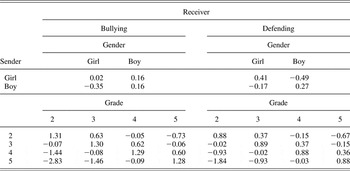
In the analyses we controlled for gender (with boys coded as 1 and girls as 0), grade, and age (age in months divided by 12). For all covariates, three effects were included: the sender effect, measuring whether actors with higher values on the covariate had a higher outdegree; the receiver effect, measuring whether actors with higher values on the covariate tended to be nominated by more others (and have a higher indegree); and the similarity effect, measuring whether ties tended to occur more often between actors with similar values on the covariate. The sender, receiver, and similarity effects can be combined in a sender–receiver table to interpret the effects together (Ripley et al., Reference Ripley, Snijders and Preciado2013). This was done by substituting the average scores of the three schools.
Analytical strategy
The school-level network dynamics for bullying and defending were analyzed separately for the three schools. The online only Supplementary Materials provide the details of the modeling strategy (S2) and the goodness of fit (S9). To summarize the results over the three schools, we used the meta-analysis method in RSiena (Siena08; see Snijders & Baerveldt, Reference Snijders and Baerveldt2003). Because the networks of only three schools were examined, we decided not to report an estimated mean parameter or differences between schools. Instead, we used a Fisher-type combination of one-tailed p values to test whether there was evidence in at least one of the schools of a parameter being positive or negative (Ripley et al., Reference Ripley, Snijders and Preciado2013; Snijders & Bosker, Reference Snijders and Bosker2012). Each parameter in the model was treated separately in the meta-analysis.
Results
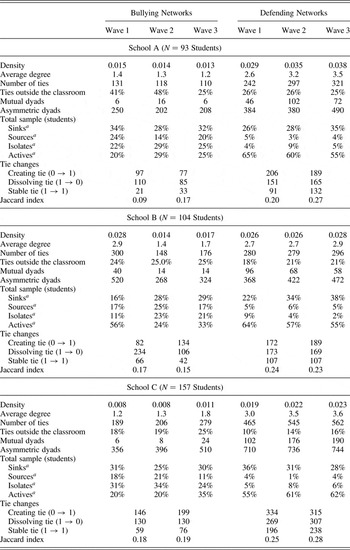
The descriptive statistics for the three school-level networks are given in Table 1. Density reflects the proportion of relations relative to the total number of possible relations. Bullying and defending did not occur often, with bullying nominations occurring half as often as defending nominations in schools A and C. For T1, the density of bullying at school B was relatively high; it dropped by 50% from T1 to T2. The average degree shows that children nominated on average between one and two classmates as bullies, whereas they nominated on average around three defenders. The Jaccard index indicates the proportion of stable relations among the total number of created, dissolved, and stable relations (Snijders et al., Reference Snijders, Van de Bunt and Steglich2010). The proportion of stable relations was low for bullying and defending (a Jaccard index of at least 0.20 is recommended; Snijders et al., Reference Snijders, Van de Bunt and Steglich2010), but this had no consequences for model convergence.
Descriptive statistics of bullying and defending networks for School A, School B, and School C

a Sinks are actors with zero out-ties and at least one in-tie, sources are actors with at least one out-tie and zero in-ties, isolates are actors with zero in-ties and zero out-ties, and actives are children with at least one out-tie and at least one in-tie.
The percentage of nominations outside the classroom, relative to the total number of nominations, ranges from 10% to 48%, with an average over the schools of 27% for bullying and 18% for defending. This suggests that a substantial proportion of bullying and defending occurs outside the classroom.
On average over the three waves for the three schools, 57% of the children were nominated at least once for bullying others (28% of the children had only in-ties and zero out-ties, so-called sinks, and 29% had at least one out-tie and one in-tie). Moreover, 24% of the children were isolates (zero in-ties and out-ties), and 19% nominated others but did not receive a bully nomination (so-called sources, children with zero in-ties and at least one out-tie).
The findings for defending were different. Only 6% of the children were isolates, and 4% were sources. One third of the children were sinks (31%), and 59% had at least one in-tie and one out-tie for defending.
Bullying and defending dynamics
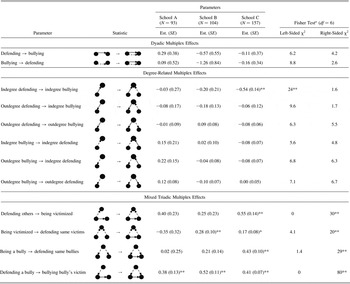
The discussion of the model estimation results is limited to the multiplex effects shown in Table 2 and the effects of gender and grade shown in Table 3. More detailed results can be found in online Supplementary Materials S5–S8. Through careful parameterization of the models, an acceptable goodness of fit was obtained for almost all models, as explained in online Supplementary Material S9.
Multivariate RSiena models for bullying and defending

Note: Dotted lines indicate bully–victim relations; solid lines indicate defending relations in the graphical representations of the (multiplex) parameters. The model also accounts for the univariate network dynamics of bullying and defending; see the complete table in the online Supplementary Materials (Table S.7). The parameter values are part of the objective function of actors, which expresses how likely it is for the actors to change their network ties. Higher values of (effects in) the objective function can be interpreted as preferences for the creation or maintenance of specific relations (see also online Supplementary Materials Table S.2).
a The Fisher Test combines independent p values to test whether there is evidence in at least one of the schools of a parameter being positive or negative.
*p < .05. **p < .01.
Sender–receiver tables for gender and grade

Note: The values show the preference for forming a tie with others, based on the combination of the sender, receiver, and similarity effects for each covariate (see online Supplementary Materials Tables S7 and S8).
The interdependent network dynamics between bullying and defending networks in Table 2 show that, at the dyadic level, bullying was unrelated to defending, and vice versa. At the degree level, there were hardly indications that bullying and defending were related to each other. One significant cross-network degree-related effect was found, suggesting that in school C being nominated as defender made a child unlikely to be nominated as a bully.
Significant interplay between bullying and defending was found at the triadic level. In line with the retaliation hypothesis, defenders of victims were more likely to be victimized by the bully of the defended victim (defending others → being victimized) than nondefenders, χ2 (6) = 30, p < .01. Moreover, in line with the social support hypothesis, it was found that victims who were victimized by the same bullies were more likely to start to defend each other (being victimized → defending same victims) than were nonvictims or victims of different bullies, χ2 (6) = 20, p < .01. Not only victims initiated defending relations; the effects in Table 3 give some indication that bullies who targeted the same victim(s) were more likely to defend each other (defending-among-bullies hypothesis; being a bully → defending same bullies) than were nonbullies or bullies who targeted different victims, χ2 (6) = 29, p < .01. Strong support was found for the initiating-bullying hypothesis, suggesting that defenders of bullies were more likely to initiate the harassment of the bullies’ victims (defending a bully → bullying bully's victim) than were nondefenders or defenders of other children, χ2 (6) = 80, p < .01.
Gender, grade, and age
Strong gender segregation was seen in the combined sender–receiver effects (see upper right part of Table 3): boys and girls were more likely to be defended by their own gender. It was unlikely that boys would be defended by girls, but even more unlikely that girls would be defended by boys. For bullying (upper left part of Table 3), it can be seen that boys were likely to bully both boys and girls. Girls were less likely to bully than boys, but if they did, they were more likely to target girls than boys.
The combined sender–receiver effects for grade are given in the lower left part of Table 3, and show that bullies were most often in the same grade or one grade above their victims. It was unlikely for children to be victimized by lower-grade schoolmates. Similar to bullying dynamics, defenders were most likely to be in children's own classroom or one grade above them (see the lower right part of Table 3 for combined sender–receiver effects). Hardly any age differences were found, which is due to the grade level explaining most of the age differences between bullies and victims. With grade included in the model, the age effect accounts for age differences within the classroom. Because there were no significant differences for age, sender–receiver tables were not calculated.
Discussion
We examined the interplay among defending, victimization, and bullying in grade-homogenous stable classrooms. We deduced predictions from goal-framing theory and tested them using a longitudinal social network approach. Our findings were in line with the social support hypothesis, which states that victims who are victimized by the same bullies are likely to defend each other. The findings were also consistent with the retaliation hypothesis, which proposes that defenders of victims may run the risk of being victimized by the bullies of the victims they defend. In addition, defending among bullies originated from two different processes. Bullies who targeted the same victim subsequently defended each other, but defenders of bullies were also likely to initiate the harassment of the bullies’ victim. Thus, the pathways leading to defending among victims and bullies were disentangled, showing that victims with the same bullies seek support, but bullies also aggress against subgroups of victims and their defenders.
In the present study, we elaborated using a longitudinal design on the earlier cross-sectional findings that victims with the same bullies and bullies with the same victims defend each other (Huitsing & Veenstra, Reference Huitsing and Veenstra2012). The longitudinal design used in the current study enabled us to disentangle the sequences underlying these temporal associations. The findings suggest that understanding of children's development of positive and negative relations can be improved by examining their relations simultaneously.
Defending between victimized children may be explained by accounting for children's embeddedness in subgroups (Ahn, Garandeau, & Rodkin, Reference Ahn, Garandeau and Rodkin2010; Cohen et al., Reference Cohen, Hsueh, Russel and Ray2006; Huitsing & Veenstra, Reference Huitsing and Veenstra2012). When children nominate their defenders, they are likely to mention most if not all children from their ingroup. If victims’ ingroup members are also victimized by the same bullies, network structures arise where children defend each other when they are targeted by the same peers. In a similar way, when bullies defend other bullies from their ingroup, network patterns are found in which bullies defend other bullies who target the same victims. These findings show that it is fruitful to understand bullying by regarding it as a strategic goal-oriented behavior (Veenstra et al., Reference Veenstra, Lindenberg, Munniksma and Dijkstra2010; Volk et al., Reference Volk, Camilleri, Dane and Marini2012). Status and affection are important goals (Rodkin, Ryan, Jamison, & Wilson, Reference Rodkin, Ryan, Jamison and Wilson2013), and bullies maintain their status by receiving support from other bullies with a dominant social position (Dijkstra et al., Reference Dijkstra, Lindenberg, Verhulst, Ormel and Veenstra2009; Witvliet et al., Reference Witvliet, Olthof, Hoeksma, Goossens, Smits and Koot2010).
The multiplex network structures used in the current study can help to improve understanding of bullying between subgroups. Because the actor-oriented models capture children's tendency to form relations, their triadic microstructures induce the evolution of social network structures on the larger network level (Snijders et al., Reference Snijders, Van de Bunt and Steglich2010). The focus of the current study was on children in triads, which we assumed to form the basis for ingroup–outgroup processes. Extending the stochastic actor-based model using parameters for network structures with more than three children, which is feasible but has not yet been implemented, would allow examination of group processes beyond the triad.
The usefulness of a social network perspective was further qualified by the finding that bullying and defending had no significant interplay at the dyadic or actor level. The only significant interplay between bullying and defending relations was found in the multiplex triadic patterns. These results justify the examination of the interaction between bullying and defending at a social network level, in contrast to investigating bullying and defending at the individual level using self-reports or peer reports. Bullying, victimization, and defending are parts of group processes, and they can be better understood when the relationship dynamics in complete networks are the units of analysis.
From a developmental perspective, the current findings also show that being involved in bullying processes may be normative, given that the majority of the children (57%) were mentioned at least once as bullies, and about 90% of the children were mentioned at least once as defenders. If self-reports or peer reports were used to categorize the children (using, for example, cutoff points for the upper 25%), many of those children would be considered uninvolved. Using the current social network design, their involvement in group processes is accounted for and no classification of children into fixed roles is needed. The relational information also provided insight into same- and cross-grade relations. In the grade-homogenous classrooms, the majority of children's nominations for defending and bullying were given to same-grade classmates, but a substantial number of nominations were also given to children in other grades, most often one grade higher. Bullying is usually considered a group process, and the findings of this study show that these group processes can extend outside the classroom.
In this study, we used information on “general” bullying, that is, initiation of bullying in any form. Bullying can prevail in many forms, ranging from direct bullying such as verbal (name-calling) or physical (hitting or kicking someone) forms, to indirect bullying such as relational bullying, by spreading rumors, gossiping, or manipulating relations (Card et al., Reference Card, Stucky, Sawalani and Little2008; Crick, Ostrov, & Werner, Reference Crick, Ostrov and Werner2006). Data on forms of bullying can also be collected at the relationship level, for example, by asking children: “Which classmates bully you by … calling names or saying mean things” (verbal bullying). In that way it can be investigated whether different forms of bullying facilitate defending relations. By collecting data at a triadic level, it can be investigated who defends whom when a child is bullied by a third child, or who is bullied by whom and (in the case of that bully–victim relation) who is defended by a third child. Using triadic data, it would be possible to investigate whether defenders vary in the support they provide in response to a particular bully. For example, if a child is victimized by two bullies, the defender of this victim may defend against one bully but not the other.
The changes in the prevalence of bullying were not consistent among the three schools. In school A, there was a slight tendency for bullying to decrease with each wave; in school B, bullying dropped by 50% from T1 to T2 but increased from T2 to T3; and in school C, bullying increased somewhat from T2 to T3. Despite the relatively low density (around 1%–2% of all possible relations in the schools were bullying relations) and the relatively low stability of bullying relations between the measurements waves, well-estimated models (in terms of convergence and goodness of fit) were obtained. Although the descriptive statistics show that relatively few bullying relations stayed stable over time at the dyadic level, the findings indicate that at the individual level children were relatively stable bullies or victims (see Supplementary Materials S8). Finally, in line with the findings of previous empirical studies (Sijtsema et al., Reference Sijtsema, Veenstra, Lindenberg and Salmivalli2009; Tolsma et al., Reference Tolsma, van Deurzen, Stark and Veenstra2013; Veenstra et al., Reference Veenstra, Lindenberg, Zijlstra, De Winter, Verhulst and Ormel2007), there was some evidence that children responded to bullying by striking back at the bully (reciprocal bullying; see supplementary materials).
Strengths, limitations, and directions for future research
The network dynamics were investigated in grade-homogeneous classrooms. Although this enabled us to investigate the evolution of the networks in stable peer groups, we ignored the dynamics of grade-heterogeneous classrooms. Such classroom compositions are most prevalent in The Netherlands. The dynamics could well be different in these classrooms, because the classroom composition changes yearly. Moreover, the networks of defending and bullying were rather unstable within three quarters of a year, even when it was accounted for that the children were in stable classrooms and stayed in the same classroom throughout the school year from T2 to T3. Given the scarcity of network studies on bullying and victimization, the ideal time frame to examine change in networks is not known. Future studies may address this issue.
Now that we have developed a framework for investigating the joint network dynamics of positive and negative networks, we can investigate the network dynamics in a larger number of schools. In future studies it can be investigated whether network dynamics change in a school setting with clear antibullying norms. The KiVa antibullying program aims to change classroom norms by making assistants and reinforcers stop supporting bullies, having bystanders defend victims, and helping teachers to show that they have clear antibullying norms (Kärnä, Voeten, Poskiparta, & Salmivalli, Reference Kärnä, Voeten, Poskiparta and Salmivalli2010; Salmivalli, Kärnä, & Poskiparta, Reference Salmivalli, Kärnä, Poskiparta, Doll, Pfol and Yoon2010; Veenstra, Lindenberg, Huitsing, Sainio, & Salmivalli, Reference Veenstra, Lindenberg, Huitsing, Sainio and Salmivalli2014). Thus, in the norm-changing context of KiVa, bullies will have fewer incentives to continue their behaviors. It can, therefore, be expected that retaliation of bullies against defenders and defending among bullies will occur less in KiVa schools if the norm is that defending is rewarded. Such questions about the influence of the context on network dynamics remain for future investigations.
The focus in our investigation of the joint development of bullying and defending was on the creation or maintenance of ties, but it is also possible that ties are dissolved as a consequence of changes in bullying and defending ties. For example, defending among victims may also lead to the termination of a bullying relation. This is an important question for future studies. Moreover, such investigations can also incorporate the question of when and why defending would be successful, and for whom? Answers may be found by incorporating the characteristics of defenders and their victims (Pöyhönen et al., Reference Pöyhönen, Juvonen and Salmivalli2010; Sainio et al., Reference Sainio, Veenstra, Huitsing and Salmivalli2011), the characteristics of bullies (e.g., aggressive vs. strategic bullies), or the classroom norms related to bullying and defending (Kärnä et al., Reference Kärnä, Voeten, Poskiparta and Salmivalli2010; Pozzoli, Gini, & Vieno, Reference Pozzoli, Gini and Vieno2012) in a social network analytical framework.
The finding that the interplay between bullying and defending is mostly on the triadic level (and may be extended to configurations of groups of four children or more), rather than on the dyadic or actor level, suggests that complex group processes can be better understood when the relationship dynamics in complete networks are accounted for. As such, this study can be seen as a starting point to unravel the relationship dynamics in bullying, victimization, and defending networks in schools. The social network perspective contributes to a better and richer understanding of the development of children's peer relations and group processes.
Supplementary Materials
The online only supplementary materials mentioned in the article can be found online at http://journals.cambridge.org/dpp