Introduction
Self-harm and suicide among adolescents and young adults are matters of great concern. Self-harm behaviour in youth is increasing in several Western countries (Hawton et al. Reference Hawton, Hall, Simkin, Bale, Bond, Codd and Stewart2003a ; Kokkevi et al. Reference Kokkevi, Rotsika, Arapaki and Richardson2011) and suicide is the second most important cause of death among 10- to 24-year-olds globally (Patton et al. Reference Patton, Coffey, Sawyer, Viner, Haller, Bose, Vos, Ferguson and Mathers2009). To have a first episode of self-harm – defined as self-injury irrespective of suicidal intent – as a young adult can be an indicator of long-term difficulties in adulthood, such as an elevated risk of future ill-health, social problems and labour market marginalization (Fergusson et al. Reference Fergusson, Horwood, Ridder and Beautrais2005; Harrington et al. Reference Harrington, Pickles, Aglan, Harrington, Burroughs and Kerfoot2006; Groholt and Ekeberg, Reference Groholt and Ekeberg2009; Goldman-Mellor et al. Reference Goldman-Mellor, Caspi, Harrington, Hogan, Nada-Raja, Poulton and Moffitt2014; Niederkrotenthaler et al. Reference Niederkrotenthaler, Tinghog, Alexanderson, Dahlin, Wang, Beckman, Gould and Mittendorfer-Rutz2014; Moran et al. Reference Moran, Coffey, Romaniuk, Degenhardt, Borschmann and Patton2015). The risk of a subsequent suicide is high after self-harm in 15- to 24-year-olds (Bridge et al. Reference Bridge, Goldstein and Brent2006), almost ten-fold compared to the general population (Hawton & Harriss, Reference Hawton and Harriss2007). Moreover, depression, generalized anxiety disorder and substance use in adulthood have been described after self-harm at a young age, although mental illness in long-term follow-up has so far only been studied in small or geographically limited samples or with a narrow selection of mental disorders as outcomes (Fergusson et al. Reference Fergusson, Horwood, Ridder and Beautrais2005; Harrington et al. Reference Harrington, Pickles, Aglan, Harrington, Burroughs and Kerfoot2006; Groholt & Ekeberg, Reference Groholt and Ekeberg2009; Goldman-Mellor et al. Reference Goldman-Mellor, Caspi, Harrington, Hogan, Nada-Raja, Poulton and Moffitt2014; Moran et al. Reference Moran, Coffey, Romaniuk, Degenhardt, Borschmann and Patton2015).
Even though the risk of later adverse outcome is increased, most youths who self-harm seem to recover and the self-harm behaviour subsides in adulthood (Moran et al. Reference Moran, Coffey, Romaniuk, Olsson, Borschmann, Carlin and Patton2012). In this heterogenous group, the individuals most at risk need to be identified. Risk factors for suicide after self-harm in youth have been described in several high-quality studies; however, mostly in geographically or numerically restricted samples. Male gender, previous self-harm, high suicidal intent, substance misuse are identified as predictive factors of a subsequent suicide (Hawton et al. Reference Hawton, Fagg, Platt and Hawkins1993; Hawton & Harriss, Reference Hawton and Harriss2007). Further, prior psychiatric treatment is associated with an increased risk (Hawton et al. Reference Hawton, Fagg, Platt and Hawkins1993; Hawton & Harriss, Reference Hawton and Harriss2007), but the significance of specific mental disorders has not been extensively studied in young adults. Among 441 adolescents who had self-poisoned, non-affective psychotic disorder was a risk factor for later suicide (Reith et al. Reference Reith, Whyte, Carter and McPherson2003). In adults, schizophrenia and unipolar and bipolar disorders seem to be the most evident predictors for suicide after a suicide attempt (Tidemalm et al. Reference Tidemalm, Langstrom, Lichtenstein and Runeson2008), but the predictive effect of a mental disorder were not specifically investigated in youths. Even though self-harm is common, suicide is a relatively rare event in young adults; in order to describe prognostic factors, large and representative study populations are required.
Our primary aim was to estimate the long-term risk of mental disorders and suicide after self-harm in a national cohort by use of linked registers. In order to capture both severe and moderate mental disorders, we studied psychiatric hospitalization as well as psychotropic medication during follow-up. Second, we wanted to study possible predictive effects on adverse outcome of various mental disorders present at the time of self-harm, low socioeconomic status and a history of suicide in the family among those who self-harm.
Method
We conducted a national population-based matched case-cohort study by use of linked Swedish national registers. Six longitudinal population registers were linked through the personal identification number, which is assigned to the individual at birth or immigration (Ludvigsson et al. Reference Ludvigsson, Andersson, Ekbom, Feychting, Kim, Reuterwall, Heurgren and Olausson2011).
The National Patient Register (NPR, National Board of Health and Welfare) covers all in-patient care and has national coverage for all psychiatric admissions from 1973 and for all admissions from 1987. Outpatient episodes for specialized psychiatric care have been registered since 2001. The Cause of Death Register (CDR, National Board of Health and Welfare) includes all deaths among persons registered as residents of Sweden at the time of death, and covers more than 99% of all deaths from 1961 and onwards, including those occurring abroad (National Board of Health and Welfare, 2010). Each record contains the date of death and diagnostic codes for causes of death. The Swedish Prescribed Drug Register (SPDR, National Board of Health and Welfare) holds information on all pharmaceuticals prescribed and dispensed since July 2005 (Wettermark et al. Reference Wettermark, Hammar, Fored, Leimanis, Otterblad Olausson, Bergman, Persson, Sundstrom, Westerholm and Rosen2007). We collected information about gender, birth date, and region of birth, emigration and immigration (The Total Population Register; TPR, Statistics Sweden). Data on suicide in parents and full-siblings of the index person was gathered from the CDR via linkage to The Multi-Generation Register (Statistics Sweden) (Ekbom, Reference Ekbom2011) and about highest level of education in parents from The Education Register (Statistics Sweden). All data was de-identified before being made available to the authors.
Study population
We identified all patients aged 18–24 years who were discharged from hospital with a diagnosis of intentional self-harm according to International Classification of Diseases (ICD), ICD-9 (E950-9, E980-9) and ICD-10 (X60-84, Y10-34) between 1990 and 2003, thus including events of undetermined intent, in order to account for geographical and temporal changes in ascertainment methods (Niederkrotenthaler et al. Reference Niederkrotenthaler, Tinghog, Alexanderson, Dahlin, Wang, Beckman, Gould and Mittendorfer-Rutz2014), as registered in the NPR since start of registration (n = 13 760). All individuals with a first hospitalization due to self-harm during the study period were included. To avoid inclusion of self-harm events that had resulted in completed suicides, we excluded those who died in a somatic department during the index hospitalization (n = 29), under the assumption that those deaths were a direct consequence of the self-harm act.
For each exposed individual, ten subjects from the general population, who were alive and had not emigrated at the time of inclusion, were randomly collected from the TPR, and matched on age and sex. They were unexposed for hospitalization due to self-harm up until index, but were allowed to be exposed later in life. If hospitalized due to self-harm within the studied age range during the study period, they were censored as unexposed and included as exposed. The cohort was followed until death of any cause, first emigration or end of follow-up (31 December 2009).
Outcomes
Death by suicide (CDR: ICD-9 codes E950-9 and E980-9; ICD-10 codes X60-84 and Y10-34) was recorded during follow-up. We included unnatural deaths of undetermined cause in suicides because their exclusion might have led to an underestimation of suicide rates and in order to account for geographical and temporal changes in ascertainment methods (Neeleman & Wessely, Reference Neeleman and Wessely1997). In addition, all-cause death during follow-up was recorded, divided into unnatural death (ICD-9 code E or ICD-10 codes V, W, X, Y in any position) and natural deaths (all other causes).
As indicators of mental illness during follow-up we used two outcomes. Psychiatric hospitalization was used as a proxy for severe burden of disease during follow-up and psychotropic medication was employed in order to endorse also the less severe mental disorders treated outside hospitals. Psychiatric hospitalization was defined as having been admitted to a psychiatric hospital at least once, with a diagnosis of a mental disorder at discharge (NPR, yes/no). We defined psychiatric hospitalization in short-term follow-up as inpatient episodes during the period 1–5 years following the index event. Psychiatric hospitalization in long-term follow-up was defined as inpatient episodes commencing ⩾5 years after index. Since the outcome of interest was future mental disorder we did not consider hospitalizations during the first year following the index event, under the assumption that those were closely related to the index event.
Prescribed psychotropic medication dispensed ⩾5 years after index represented use of psychiatric pharmaceuticals in long-term follow-up and covered prescriptions from specialized psychiatric care as well as general practitioners. We categorized psychotropic medication into five subgroups; antidepressants (ATC code N06A), antipsychotics and mood stabilizers (N05A and antiepileptics N03AF01, N03AG01, N03AX09 if prescribed at a psychiatric departement), benzodiazepines and hypnotics (N05B, N03AE01 if prescribed at a psychiatric clinic, N05C), attention deficit hyperactivity disorder (ADHD) medication (N06BA except N06BA07) and medication for alcohol and opioid use disorder (N07BB, N07BC). We did not study short-term psychotropic medication since the SPDR was not in use until July 2005 and data was not available for a majority of the cohort.
Exposures
Mental disorder at baseline was defined as a mental disorder registered at inpatient or outpatient care in the NPR, prior to the index episode, from start of register, or at an in-patient care episode starting up to 7 days after the index episode. If more than one diagnosis had been registered, we chose the most recently recorded; when several diagnoses were registered at the same event, the principal diagnosis was selected. Mental disorders were divided into five diagnostic categories; alcohol and substance use disorders (ICD-8: 291, 303, 304, ICD-9: 291, 292, 303, 304, 305A, ICD-10: F10-19), non-organic psychotic disorders (ICD-8: 295, 297, 298.2-299, ICD-9: 295, 297, 298C, E, W, X, ICD-10: F20-29), affective and anxiety disorders (ICD-8: 296, 298.0, 298.1, 300, 301.1, 305, 307 , 306.8, 306.9, 308.4, ICD-9: 296, 298A-B, 300, 301.B, 306, 307.W, 308, 309, 311, 313.B, ICD-10: F30-39, F40-49), personality disorders (ICD-8: 301.1, 302.0, ICD-9: 301.A, 301.C-J, 301.W, 301.X, ICD-10: F60- F61) and other mental disorders (ICD-8 and ICD-9: 290–319 and ICD-10: F00-99 excluding the diagnoses mentioned above).
A family history of suicide was defined as suicide by a full sibling or a parent before index. Low parental education (<9 school years) was used as a proxy for low socioeconomic status and country of birth was recorded as within or outside of the Nordic countries.
Statistical analyses
Pearson's χ2 test were used to calculate statistical significance in differences in baseline parameters. Missing values were coded as separate categories. To calculate the relative risk of mental illness and suicide, stratified Cox regression models were used for each outcome (death by suicide, any psychiatric hospitalization and psychotropic medication) in exposed compared to unexposed [hazard ratios (HR), 95% confidence interval (CI), adjusted for birth outside of the Nordic countries, mental disorder at baseline, low parental education and family history of suicide]. We performed a sensitivity analysis of the outcome suicide, where only definite suicides (X60-84 and E950-9) were included.
The data was found to comply with the proportional hazard assumption. Interactions between exposure and covariates were tested with the partial likelihood ratio test and we performed Kaplan–Meier survival analyses.
Mental disorder at baseline, a family history of suicide and low parental education were analysed as possible predicting factors of subsequent suicide and mental illness by Cox regression models among those exposed to self-harm, yielding HRs with 95% CIs. The data was found to comply with the proportional hazard assumption.
For the analyses of long-term need of psychiatric care and medication, we studied time at risk from inclusion date (5 years after the index episode) until first admission.
Ethical approval was obtained from the Stockholm Regional Ethics Review Board (2009/939-31/5).
Results
The cohort consisted of 13 731 individuals aged 18–24 years who had a first hospitalization due to self-harm during 1990–2003, and 137 310 who had not been hospitalized due to self-harm during the same period. Mean follow-up time was 12.2 (s.d. = 4.5) years with a maximum of 20.0 years. The average age was 21.3 (s.d. = 2.0) years and 62.3% were women.
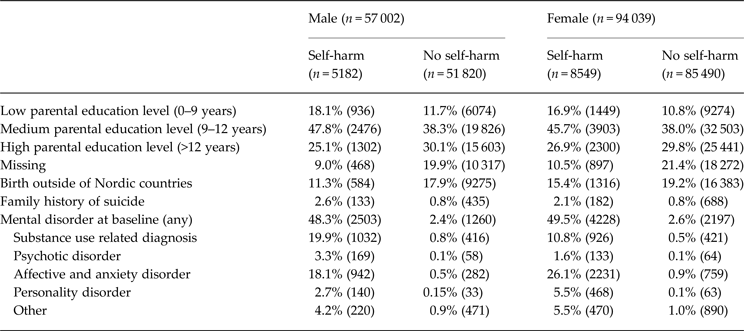
A mental disorder at baseline and a history of suicide in the family were more common among self-harm patients (Table 1). Almost half of them had a mental disorder at baseline; among men the most frequent disorders were substance use disorder (19.9%), followed by affective and anxiety disorders (18.1%). Among women with self-harm, affective and anxiety disorders (26.1%) were most prevalent.
Baseline factors on 18–24 year olds admitted to hospital with diagnosis of self-harm between 1990–2003 and unexposed (n = 151 041)

χ2 test with 1 degree of freedom, p values for all variables were <0.001.
Adverse outcome after self-harm among young adults
Suicide
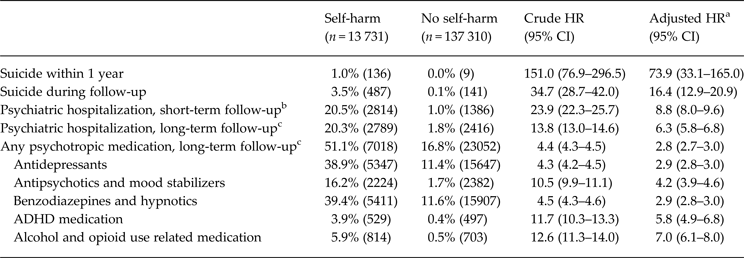
Among those who had self-harmed, 3.5% died by suicide during follow-up (Table 2) (5.4% of the men and 2.4% of the women, data not shown). Death from any cause occurred in 9.9% of the men (8.1% from unnatural causes) and 3.6% of the women with self-harm (2.9% from unnatural causes), compared to 0.7 and 0.3% of the unexposed (p < 0.001) (data not shown). Self-harm signified a HR for suicide during follow-up of 34.7 (95% CI 28.7–42.0) and after adjustment, HR 16.4 (95% CI 12.9–20.9). A sensitivity analysis was performed where only definite suicides (X60-84 and E950-9) as an outcome was included, revealing an adjusted HR of 17.9 (95% CI 13.5–23.7).
Adverse outcome in young adults hospitalized after self-harm between 1990 and 2003, matched on age and sex (n = 151 041). Follow-up until December 2009
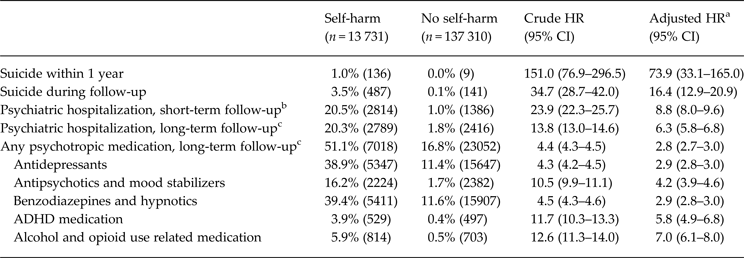
HR, Hazard ratio; CI, confidence interval; ADHD, attention deficit hyperactivity disorder.
χ2 test with 1 degree of freedom, p values were <0.001.
a Adjusted for psychiatric diagnosis at index, birth outside of Nordic countries, family history of suicide and parental educational level.
b Risk-time is set one year after index, 1588 were censored during the first year of follow-up due to death or migration, hence n = 149 453.
c Risk-time is set 5 years after index, 5852 were censored during the first 5 years of follow-up due to death or migration, hence n = 145 189.
An interaction was found between mental disorders at baseline and self-harm with regard to a subsequent completed suicide (interaction term HR 0.3, 95% CI 0.2–0.5). Kaplan–Meier curves showed lower survival rates in self-harming young adults who had a mental disorder at baseline compared to those without a mental disorder (Fig. 1).
Kaplan–Meier curve of survival from suicide in 18- to 24-year-olds with or without self-harm and mental disorder at baseline (n = 151 041). Inclusion between 1990 and 2003, follow-up until December 2009.

Psychiatric morbidity during follow-up
Psychiatric hospitalization
Among men who had self-harmed, 22.0% had a psychiatric hospitalization in the short-term perspective and 23.0% had a psychiatric hospitalization at long-term follow-up. Corresponding numbers for women were 19.6 and 18.7% (data not shown). To have self-harmed implied an adjusted HR for psychiatric hospitalization in the short-term follow-up of 8.8 (95% CI 8.0–9.6) and of 6.3 (95% CI 5.8–6.8) for hospitalization in the long-term (Table 2). An interaction was found between mental disorders at baseline and self-harm (interaction term: HR 0.3, 95% CI 0.3–0.4. Kaplan–Meier curve not shown).
Psychotropic medication
Psychotropic medication had been prescribed to 45.0% (2330) of the men who had self-harmed and to 12.9% (n = 6668) of non-exposed >5 years after index. Among female self-harm patients, 54.8% (n = 4688) had received psychotropic medication and 19.2% (n = 16 384) of those without self-harm (data not shown in table). For both genders, the HR of self-harm was 2.8 (95% CI 2.7–3.0) for use of psychotropic medication in long-term follow-up (Table 2). All medication categories were significantly more common among self-harm patients than among unexposed. Antidepressants and benzodiazepines/hypnotics were each prescribed to almost 40% of those who had self-harmed, the adjusted HR for self-harm was 2.9 (95% CI 2.8–3.0). The adjusted HR for self-harm was 4.2 (95% CI 3.9–4.6) for subsequent use of antipsychotics and mood stabilizers, 5.8 (95% CI 4.9–6.8) for ADHD medication and 7.0 (95% CI 6.1–8.0) for alcohol and opioid use medication. An interaction was found between mental disorders at baseline and self-harm (interaction term: HR 0.6, 95% CI 0.5–0.6. Kaplan–Meier curve not shown).
Factors associated with adverse outcome among self-harm patients
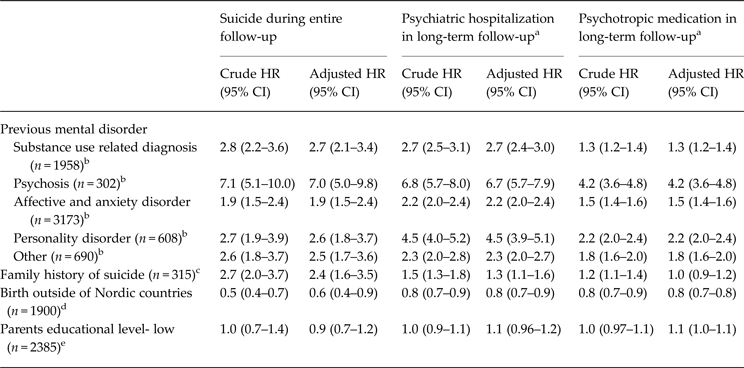
Psychotic disorders at baseline had the strongest associations with suicide (HR 7.0, 95% CI 5.0–9.8) and later psychiatric hospitalization (HR 6.7, 95% CI 5.7–7.9) (Table 3). Personality disorders were associated with suicide and medication in long-term follow-up but more strongly with psychiatric hospitalization (HRs 2.6, 2.2 and 4.5 respectively). All other mental disorders were related to suicide, later psychiatric hospitalization and medication, but with lower risk estimates.
Factors associated with adverse outcome among young adults who were hospitalized after self-harm between 1990–2003 (n = 13 731). Follow-up until December 2009

HR, Hazard ratio; CI, confidence interval.
Calculated with Cox regression models, all variables were included in the model.
Data is matched on age and sex.
a Risk-time is set 5 years after index, 780 were censored during the first 5 years of follow-up due to death or migration, hence n = 12 951.
b Patients with self-harm without a mental disorder in patient register is used as reference group.
c Patients with self-harm without a family history of suicide is used as reference group.
d Patients with self-harm with birth in Nordic countries is used as reference group.
e Patients with self-harm with parents with medium/high education is used as reference group.
Having a family history of suicide was associated with psychiatric hospitalization (HR 1.3, 95% CI 1.1–1.6) in the long-term follow-up and more strongly with a subsequent suicide (HR 2.4, 95% CI 1.8–3.2). To be born outside the Nordic countries was inversely associated with adverse outcome after self-harm, whereas there were no independent associations between parents’ educational level and later mental illness or suicide among those who had self-harmed.
Discussion
In this comprehensive national cohort study of young adults, we were able to study a range of relevant adverse outcomes and assess the effects of several clinical factors on outcomes. The results confirm findings from smaller and geographically restricted studies of a highly increased long-term risk of adverse outcome after self-harm. We found a 16-fold risk increase of suicide and a highly elevated risk of severe as well as moderate mental disorders. We further found that among young adult self-harm patients, a family history of suicide and mental disorders at baseline – particularly a psychotic disorder – were associated with adverse outcome.
Adverse outcome after self-harm among young adults
The 16-fold risk increase of suicide among self-harm patients compared to unexposed young adults is lower than in age-mixed cohorts (Hawton et al. Reference Hawton, Zahl and Weatherhall2003b ; Cooper et al. Reference Cooper, Kapur, Webb, Lawlor, Guthrie, Mackway-Jones and Appleby2005), a notion that corresponds well to previous studies (Haukka et al. Reference Haukka, Suominen, Partonen and Lonnqvist2008; Tidemalm et al. Reference Tidemalm, Beckman, Dahlin, Vaez, Lichtenstein, Langstrom and Runeson2014). Even so, this estimate poses additional evidence that self-harm in young adults is an important risk factor for later suicide.
Mental disorders at long-term follow-up were prevalent among young adults who had self-harmed, even in the absence of a diagnosed mental disorder at the self-harm episode. The finding that one fifth of the young adults were hospitalized in psychiatric care >5 years following the index attempt, indicates that long-standing severe mental illness is common. We can not determine the role of early self-harm in the causal chain of the development of a mental disorder. Since most mental disorders have their onset in youth (Patel et al. Reference Patel, Flisher, Hetrick and McGorry2007), the self-harming behaviour might either represent a first sign of an emerging mental disorder, or, it may be an indicator of severity in a manifest but not yet identified mental disorder. In previous studies, the risk of a later mental disorder is clearly reduced after adjusting for psychopathology at the time of the self-harm (Briere et al. Reference Briere, Rohde, Seeley, Klein and Lewinsohn2015). A possible bias, which calls for cautious interpretation of our findings, is that the index self-harm episode itself may induce further psychiatric evaluation, which then would increase the probability that exposed individuals receive a diagnosis during follow-up (Goldman-Mellor et al. Reference Goldman-Mellor, Caspi, Harrington, Hogan, Nada-Raja, Poulton and Moffitt2014).
By using the prescribed psychiatric drugs as indicators of diagnostic entities, we were able to estimate prevalence as well as hazard ratios for categories of mental disorders during follow-up. SPDR covers all medication prescribed and dispensed in all outpatient settings; hence, we were not limited to study conditions treated in specialized psychiatric care, or to a restricted number of predefined mental disorders. Depression, anxiety disorders and substance use disorders have previously been described in long-term follow-up in small samples (Fergusson et al. Reference Fergusson, Horwood, Ridder and Beautrais2005; Harrington et al. Reference Harrington, Pickles, Aglan, Harrington, Burroughs and Kerfoot2006; Groholt & Ekeberg, Reference Groholt and Ekeberg2009; Goldman-Mellor et al. Reference Goldman-Mellor, Caspi, Harrington, Hogan, Nada-Raja, Poulton and Moffitt2014; Mars et al. Reference Mars, Heron, Crane, Hawton, Lewis, Macleod, Tilling and Gunnell2014). The prevalent use of antidepressants and anxiolytics in the present cohort indicates that depression and anxiety disorders were the most common mental disorders. Notably, the use of antipsychotics and mood stabilizers were highly overrepresented among those who had self-harmed. Psychotic symptoms were prevalent among young adults with a history of self-harm in a population study (Suokas et al. Reference Suokas, Suominen, Heila, Ostamo, Aalto-Setala, Perala, Saarni, Lonnqvist and Suvisaari2011), but has not been noted in previous studies of long-term follow-up after self-harm. ADHD medication was more frequent among self-harm patients compared to unexposed. A neuropsychiatric disorder would by definition be present in childhood, hence already at the time of the index episode (even if not yet recognized). Attention deficit disorder is associated with an increased risk of suicidal behaviour, in particular when there is co-morbidity with depression, antisocial behaviour and substance use (Nigg, Reference Nigg2013). Elevated levels of substance use have previously been noted in long-term follow-up after self-harm in small populations (Fergusson et al. Reference Fergusson, Horwood, Ridder and Beautrais2005; Suokas et al. Reference Suokas, Suominen, Heila, Ostamo, Aalto-Setala, Perala, Saarni, Lonnqvist and Suvisaari2011; Goldman-Mellor et al. Reference Goldman-Mellor, Caspi, Harrington, Hogan, Nada-Raja, Poulton and Moffitt2014; Moran et al. Reference Moran, Coffey, Romaniuk, Degenhardt, Borschmann and Patton2015). Substance use disorder is an important background factor in suicidal behaviour in youth (Haw & Hawton, Reference Haw and Hawton2011; Kokkevi et al. Reference Kokkevi, Rotsika, Arapaki and Richardson2012; Moran et al. Reference Moran, Coffey, Romaniuk, Olsson, Borschmann, Carlin and Patton2012), and occurred frequently at the time of the index episode. Even so, the seven-fold risk of receiving pharmaceutical treatment for alcohol and opioid use in long-term follow-up was unexpectedly high.
Personality disorders are prevalent among young people who self-harm (Fox et al. Reference Fox, Franklin, Ribeiro, Kleiman, Bentley and Nock2015) and are presumed to be common also in this cohort. A range of psychotropic medications, e.g. anxiolytics and antidepressants, are widely used in clinical practice to treat symptoms presenting with a personality disorder, but there are no pharmacological compounds that can be used for identification of the disorder per se.
Factors associated with adverse outcome after self-harm
A family history of suicide is an established risk factor for suicide in youth (Agerbo et al. Reference Agerbo, Nordentoft and Mortensen2002) and was independently associated with suicide after an episode of self-harm in the present study, more strongly than with mental illness.
A mental disorder, past or present, increases the risk of suicide after self-harm (Hawton & Harriss, Reference Hawton and Harriss2007; Hawton et al. Reference Hawton, Bergen, Kapur, Cooper, Steeg, Ness and Waters2012a ), which was confirmed with more detail in the present study. We found that psychotic disorders had the largest impact on suicide risk. Schizophrenia is a well-established risk factor for suicide and is associated with higher risk estimates after a suicide attempt than other mental disorders in age-mixed populations (Tidemalm et al. Reference Tidemalm, Langstrom, Lichtenstein and Runeson2008).
Strengths and limitations
This is a study of a national cohort including all young adults hospitalized after self-harm in Sweden; thereby the risk of selection bias is small. Sweden consists of rural and urban, low- and high-income areas, which adds to diversity of the sample. The size of the cohort allowed us to study death by suicide, which is a rare outcome in this age group. We were also able to study three separate outcomes in the same study population. The magnitude of the cohort further enabled us to study several risk factors for the outcomes, such as different mental disorders. The cohort is fairly recent which is valuable as the rates and perhaps also patterns of suicidal behaviour among youth is changing with time (Hawton et al. Reference Hawton, Saunders and O'Connor2012b ).
Some limitations should be noted. We only included patients with self-harm resulting in inpatient care and most self-harm episodes in youth do not lead to contacts with the healthcare system (Madge et al. Reference Madge, Hewitt, Hawton, de Wilde, Corcoran, Fekete, van Heeringen, De Leo and Ystgaard2008). Conclusions are thus limited to patients with self-harm episodes, which not only lead to presentation to hospital, but also to admittance to inpatient care. Young people who are admitted to hospital care possibly have a higher degree of suicidal intent than youth with acts of self-harm that never receive healthcare. Suicide rates, and potentially also the incidence of future mental illness, are expected to be higher in this population than among the majority of young people who self-harm. However, increased knowledge of those patients who actually seek help is of importance from a clinical perspective. While register data implies high coverage, it does not provide in-depth information such as assessed severity of mental disorders, history of trauma, suicidal intent and treatments other than medication, all of which would have relevance for the outcomes. The information on mental disorders at baseline was based on diagnoses set at discharge form hospitals (1990–2003), and in specialized outpatient care (2001–2003). The prevalence numbers in this study are therefore considerably lower than the true prevalence of mental disorder in this age group, which would also include those treated in non-specialized healthcare and non-detected cases. Also, we only included one diagnosis in the analyses, the most proximal in time and only the main diagnosis or the first of the secondary diagnoses, therefore the effect of co-occurrence of several mental disorders are not captured.
Conclusions, clinical implications and areas of further research
-
• Self-harm in young adults leading to hospital care indicates a highly elevated risk of future mental illness of severe as well as moderate forms, and of suicide.
-
• A mental disorder, past or present, should provoke particular attention after self-harm; it increases the risk of suicide after an act of self-harm, and suggests a highly elevated risk of future mental illness in adulthood. Clinicians should consider the substantially increased risk of suicide after self-harm among young patients with a psychotic disorder.
-
• A substantial share of the cohort had neither been treated with psychotropic medication nor been subjected to psychiatric hospitalization in long-term follow-up after the self-harm episode; resilience factors in this group constitute a field of interest for further research.
Acknowledgements
This work was supported by the Swedish Council for Working Life and Social Research (FAS) (K.B., M.D., grant nos. 2011–0868), Bror Gadelius Foundation (K.B.) and the Swedish Research Council [C.A. through the Swedish Initiative for Research on Microdata in the Social and Medical Sciences (SIMSAM) framework, grant no. 340-2013-5867]. None of the sponsors were involved in design, analyses or interpretation of the results.
Declaration of Interest
H.L. has served as a speaker for Eli-Lilly and has received a research grant from Shire; both outside the submitted work. The remaining authors have nothing to disclose.