One question at the heart of the analysis of gender and politics is whether women and men act and speak in different ways to significant political effect. In terms of political representation, this issue is particularly important. Arguments for increasing the number of women representatives in parliament, for example, are not about an abstract numerical parity, but rest on a claim about the distinctive voice and experience that women bring to political debate and decisions. For some, the difference turns on the view that women bring a more empathetic and less adversarial style to politics. A number of feminist scholars have suggested that the quality of deliberation is correlated with the presence of women in a group—for Mansbridge (Reference Mansbridge, Hirschmann and Di Stefano1996, 123), for example, the process of persuasion is related to a consultative and participatory style that seems to characterize women more than men. For others, arguments for increasing the number of women representatives in parliament turn on a difference of values. Such views were particularly widespread in the 1980s, when psychological and social theories of gender differences claimed to have found evidence of parallel but different moral reasoning in women and men (Gilligan Reference Gilligan1982; Ruddick Reference Ruddick1989; Tronto Reference Tronto1993). Gilligan (Reference Gilligan1982, 57), among others, advanced in her seminal work, In a Different Voice, that female politicians are more likely to espouse an “ethic of care” concerned with responsibility and interpersonal relationships, while men are, by contrast, prone to embrace an “ethic of justice.”
Of course, these claims are not mutually exclusive. Perhaps the different voice will be accompanied by a less adversarial style and in a way that raises issues of distinctive concern to women across the political agenda. Whatever the precise relationship between such differences, however, all such claims must have an empirically observable implication; otherwise we could never know how, in what ways, and to what extent gender differences have significance for political representation.
Over the last decade or so, the influx of substantial numbers of women into political institutions in the United Kingdom, Scotland, and Wales provided researchers with new opportunities to evaluate the extent to which women actually speak “in a different voice” (Bochel and Briggs Reference Bochel and Briggs2000; Childs Reference Childs2001, Reference Childs2004; Lovenduski Reference Lovenduski1998; Norris Reference Norris, Lovenduski and Norris1996; Ross Reference Ross2002). As a result, feminist approaches to politics took what is largely acknowledged as an “institutional turn,” a move characterized by a shift of focus away from the individual on to social and political institutions. Measuring the extent to which women and men behave differently within the confines of political institutions, however, has proved to be a harder task than expected, with empirical evidence on the issue so far remaining mixed. Survey-based studies have pointed out that women themselves often see their behavior as differing from that of men, especially so in male-dominated legislative bodies (Abdela Reference Abdela1989; Childs, Reference Childs2000, Reference Childs2001, Reference Childs2004; Norris and Lovenduski Reference Norris and Lovenduski1995). Successive surveys of local councillors and female parliamentarians reported that women were commonly seen as less adversarial and more likely to seek compromise than conflict (Bochel and Briggs Reference Bochel and Briggs2000, 66). Drawing on in-depth interviews with female Labour members of parliament (MPs), Childs (Reference Childs2004, 5) also found that most respondents believed that they brought a “feminized style of politics” to the House of Commons in the way they approached parliamentary politics, their engagement, and their manner in speaking.
Yet other research has, by contrast, emphasized the similarities between female and male parliamentarians. Interviews with female politicians have revealed that a feminine style is often viewed negatively with regard to dominant “masculinized” norms in the political sphere. As such, even if women are, indeed, endowed with gender-distinctive skills, a “pressure to conform” means that they are not in a position to use those skills (Ross, Reference Ross2002: 193). In addition, some studies have suggested that partisan differences are more likely to trump gender differences on many issues. The British Candidate Study of 1992, for instance, found that gender was a negligible factor in relation to the attitudes and priorities of candidates, with party allegiance being far more significant in helping predict their views on such issues as market economy, Europe, and “moral traditionalism” (Norris Reference Norris, Lovenduski and Norris1996; Norris and Lovenduski Reference Norris and Lovenduski1995). Such findings are in line with empirical analyses of parliamentary debates on abortion in the UK House of Commons. Analyzing voting behavior on the 2007 Human Fertilization and Embryology Bill, Cowley and Stuart (Reference Cowley and Stuart2010, 174) found that even if gender was an important dimension of the debate, party allegiance remained the key determinant of voting outcome. On the other hand, analyzing three second-reading debates on abortion between 1970 and 1990, McBride Stetson (Reference McBride Stetson and McBride Stetson2001, 136) did find that the gender dimension was dominant in at least two out of the three debates.Footnote 1
What used to be an empirical question has now also become a methodological conundrum. Currently, a significant body of literature highlights the present lack of research tools available for adequately capturing the behavior of female and male politicians in institutional settings. As Kenny (Reference Kenny2007, 94) has pointed out, while feminist theorists have developed complex and nuanced views about gendered interactions in political institutions, there is now a “distinct gap between sophisticated theoretical work on gender and empirical gender research” (see also Childs and Krook Reference Childs and Krook2006; Krook and Squires Reference Krook and Squires2006; Lovenduski Reference Lovenduski1998; Mackay 2004; Randall Reference Randall, Marsh and Stoker2002). To date, three important methodological criticisms have been leveled against feminist research in this field:
1. Many studies have focused solely on conducting interviews with female politicians. While these have yielded rich insights into women's experience as political actors, they are not matched with analyses of men's perceptions and are thus criticized as partial (Childs and Krook Reference Childs and Krook2006; Mackay 2004).
2. Surveys of attitudes and values have tended to rely on closed questions and have often used standard scales for their evaluation, which are seen as either inadequate or inappropriate. Such surveys and their responses may involve biases of social desirability, raising concerns about external validity (Lovenduski and Norris Reference Lovenduski and Norris2003).
3. Standard behavioral measures applied to women were, in many studies, originally devised for assessing men in masculine institutions (Duerst-Lahti and Kelly Reference Duerst-Lahti and Kelly1995).
In this article, we propose a new way to deal with these substantive and methodological issues, namely, by computer-aided text analysis (CATA) of parliamentary debates. The particular technique that we use decomposes the text of parliamentary debates into a series of classes in which each class is characterized by a distinctive set of words that occur disproportionately in sentences grouped in the class. To these classes we can also associate speakers—and, since speakers are simply defined by the set of words that they use, they will also be associated with particular patterns of argumentation. In this way, we can see whether, in the aggregate, female parliamentarians do speak in a different voice from their male counterparts. We take as our source the six UK parliamentary second-reading debates on abortion that took place between 1966, when abortion law was significantly reformed in Great Britain, and 1988.
BACKGROUND AND LOGIC OF SELECTION
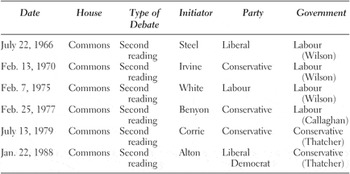
In Great Britain, the main legislative framework for abortion has been determined by the 1967 legislation introduced as a private member's bill by David Steel, who was then a Liberal MP in the House of Commons. The second-reading debate for this legislation took place on July 22, 1966. Before 1967, abortion was governed by the Offences against the Person Act of 1861, which made it a criminal offense to use any unlawful substance or instrument to secure a miscarriage. Because the act did not define what an unlawful substance or instrument might be, however, the law developed through a series of cases, the most important of which was Bourne in 1938; a judge directed the jury that a medical practitioner would be acting lawfully if he or she was convinced that without an abortion, the woman would be seriously harmed either physically or mentally. As case law, however, this left the conditions unclear as to when an abortion could be lawfully undertaken. The Steel bill, therefore, was not an attempt to make something legal that had previously always been illegal, but an attempt to specify more precisely in statute the conditions under which an abortion would be lawful. The 1967 act gave statutory effect to the case law defense, added a condition that permitted abortion when the social circumstances of the mother were adverse, specified that the need for the operation should be certified by two medical practitioners, and imposed a 28-week term on permissible abortions. It is important to the character of the 1966 debate that it was proposed in the context of the deficiencies of the existing case law, rather than being discussed as a pure issue of principle. Since the 1967 legislation, there have been various private members' bills seeking to alter these conditions, most importantly seeking to make more stringent the qualifications of the medical practitioners and shortening the term limits (currently 24 weeks). Table 1 provides a list of all six debates.
Abortion debates included in the analysis

Although there have been subsequent important parliamentary debates about abortion in the House of Commons after 1988, we limit the time frame of our analysis from 1966 to 1988 for the following reasons. First, the aim of our study is to explore whether under unequal representation, a different parliamentary voice is likely to emerge from female politicians, not to test the validity of the critical mass theory (see Dahlerup Reference Dahlerup1988 and Phillips Reference Phillips and Held1993). Second, although our time frame may seem to have little implications for the post-1997 period (when a large number of women were elected to parliament), it actually provides a solid foundation to test whether men and women speak in a different voice. If, following the logic of critical mass theory, one can reasonably expect women's argumentative patterns to differ from that of men once their representation in parliament increases, then it is even more interesting to explore whether this difference in patterns of argumentation was already present under less favorable circumstances—that is, when women were largely underrepresented.
Abortion debates in parliament provide a favorable context in which we might expect the different voice of men and women to be manifest. Abortion is quintessentially an issue that has been taken to be of particular concern for women. Also, by convention in the UK parliament, party discipline is not imposed on conscience issues such as abortion, and so speakers in debates are free to express their opinions without fear that party unity will be disrupted. It is also true, however, that party affiliation has been shown on a number of conscience issues to be an important predictor of the vote. Cowley and Stuart (Reference Cowley and Stuart2010), for instance, have shown that even with the whips off on the Human Fertilisation and Embryology Bill, party affiliation still determined voting outcomes. Pattie, Johnston, and Stuart (Reference Pattie, Johnston, Stuart and Cowley1998), Overby, Tatalovich, and Studlar (Reference Overby, Tatalovich and Studlar1998), and Broughton and Palmeri (Reference Broughton and Palmieri1999) have also found that the voices of women were muffled by the party machine in debates on conscience issues, such as abortion and euthanasia.
Moreover, MPs as a group are used to formulating and expressing their views, and so the measure of their voice is capturing a characteristic on which MPs as a group are selected. Such debates are typically preceded by many months of more general public discussion, in which the relevant considerations are elaborated by the media and interest groups (Cowley Reference Cowley and Cowley1998; Marsh and Chambers Reference Marsh and Joanna1981). Because participants in a debate will frequently have close links to interest groups (on both sides), MPs are often “peaking through the windows” to their constituents, supporters, and sympathetic groups and so have an incentive to frame their arguments in terms that will be recognizable to the groups whose point of view they are expressing.
In terms of the logic of case selection, by choosing abortion debates we are, in effect, providing a highly favorable situation in which differences, if they do exist, will emerge. From this point of view, the logic of our case selection is Popperian, in the sense that if the claim is to be falsified, then this needs to be done in the most favorable circumstance in which any empirical relation will be manifest. On the other hand, a parliamentary debate inevitably imposes constraints on the way and form in which views can be expressed. There are strong norms and conventions about how members address one another, what is taken to be a valid intervention, and the extent to which speeches can be interrupted. From this point of view, if a different voice emerges in a parliamentary context, it provides evidence that representation is affected by gender composition, since there are formidable barriers to such differences emerging. Moreover, although abortion is a divisive issue in the UK, it is also an issue that has not been argued solely, or even mainly, in terms of the “right to life,” on the one side, and “a woman's right to choose,” on the other. Instead, it has been cast in terms of social welfare and the provision of adequate health and social services (Weale, Bicquelet, and Bara, n.d.). As a result, current abortion law is both more restrictive than in many other jurisdictions—for example, two doctors need to certify an abortion even up to 12 weeks—and more liberal—even late (third trimester) abortions can legally take place if medically certified. This approach reflects the strategy of Steel, the original proponent of the 1967 act, who did not advance his reform in terms of “rights.” Even those on the restrictive side have been prepared to allow for legal abortion under some circumstances, so that there has been considerable pressure toward consensus, thus reducing the possibilities for differences of voice.
METHODS OF ANALYSIS
Computer-aided text analysis in different forms is receiving increasing attention (see Bara Reference Bara and Laver2001a; Reference Bara and Budge2001b; Reference Bara, Bara and Weale2006; Laver, Benoit, and Garry, Reference Laver, Benoit and Garry2003; Laver and Garry Reference Laver and Garry2000; Schonhardt-Bailey Reference Schonhardt-Bailey2005, Reference Schonhardt-Bailey2006). The AlcesteFootnote 2 software utilized here was originally developed and applied to the study of the humanities (Reinert Reference Reinert1983; Reference Reinert2005). More recently, its use has spread to the social sciences (Allum Reference Allum1998; Lahlou Reference Lahlou1996) and has attracted political researchers seeking to analyze political speeches and parliamentary debates (Bara, Weale, and Bicquelet Reference Bara, Weale and Bicquelet2007; Schonhardt-Bailey Reference Schonhardt-Bailey2005, Reference Schonhardt-Bailey2006; Weale, Bicquelt, and Bara, n.d.). Critical research employing the Alceste method has been carried out by Schonhardt-Bailey, who has used the software extensively and judiciously to analyze inter alia George W. Bush's and John Kerry's national security speeches in the 2004 U.S. presidential campaign (2005); the deliberative process in the Federal Reserve's Federal Open Market Committee (Reference Schonhardt-Bailey2008a); and congressional debates on the 2003 Partial-Birth Abortion Ban Act in the United Sates (Reference Schonhardt-Bailey2008b).
The principal statistical method incorporated into Alceste aims at the decomposition of a text into its main constituent classes of reference. The unit of analysis is the sentence or quasi-sentence, also called the Elementary Context Unit (ECU). Sentence segments are automatically identified by the software (the selection process is based purely on word length and punctuation). Within these sentences or quasi-sentences, content words and keywords are automatically identified by the software. Unlike other approaches to automated content analysis, therefore, Alceste does not require the researcher to specify a dictionary, but instead uses its own lexicon to search for the co-occurrence of those content terms that give meaning to a text, discarding function words that serve a purely grammatical purpose.
The underlying data matrix, therefore, consists of a table of words with zero or one entered into each cell (typically with many more zeroes than ones). The algorithm aims to permute the rows of the matrix, such that similar quasi-sentences are grouped together, and distinguished as a class from other classes. To achieve this, the program works through a descending hierarchical classification, in which the first two classes show minimum within-group variance and maximum between-group variance. A similar procedure is then followed on each of these classes to produce further classes until no significant differences remain, according to a χ2 measure of distance. Gauged sentences are, therefore, grouped into classes and, substantively, each class can be interpreted as a dimension of debate, in the sense that specific words and speakers are associated with that class to a greater or lesser degree. (In the parliamentary debates that we have analyzed, there are between three and six classes of sentence identified.)
In formal terms, the decomposition can be understood via equation (1), in which the statistical task is to find parameters for the vector matrices on the right hand side of the following equation:

In Alceste, the identification of the classes into which the sentences in the debate fall is a purely statistical matter, relying solely upon the formal properties of the text, in particular on the co-occurrence of content words. Although the number of classes is generated by the formal properties of the co-occurrence of words, the content of the characteristic sentences associated with each class of sentence allows a competent language speaker to give a substantive interpretation to these statistically defined categories. The classification of the sentences, however, emerges inductively from the structural co-associations, rather than as an artifact of the interpretative scheme that the analyst brings to the debate. This can be regarded as a methodological advantage for some purposes (see Bara, Weale, and Bicquelet Reference Bara, Weale and Bicquelet2007).
Alceste also produces a correspondence analysis as part of its results. Correspondence analysis is an exploratory statistical technique providing a simultaneous analysis of rows and columns in a two-way data table (Greenacre Reference Greenacre, Greenacre and Blasius1994), and it is one of a wide family of such techniques (Nishisato Reference Nishisato2007, Chapter 3). It provides a two-dimensional plot of multidimensional data in such a way as maximally to account for the variance in the data. In the case of textual data, this two-dimensional plot is of the co-occurrence of the presence or absence of terms in a gauged sentence, together with a plot of the location of individual speakers who are thought of as occupying a linguistic space defined by their use of terms.
To enhance the analysis of a corpus of data using Alceste, it is possible to conduct a Cross-Data Analysis. This procedure can only be conducted after a Standard Analysis (as described previously) has already been run. Once sentence segments have been automatically identified by the software, it is possible to cross a form (a word) or particular variable of interest (in our case “gender”) with the corpus. Through this procedure, Alceste identifies the strongest associations between the variable and the patterns of argumentation of a speaker. Alceste then produces classes in which the frequency of association between the variable and the vocabulary used by the speakers is ranked, from the strongest to the weakest. The main advantage here is a more precise analysis of a particular feature of the text.Footnote 3
Overall, this method appears well suited to analyzing gendered interactions in political institutions, for several reasons. First, it can be thought of as a “relational frame of reference,” that is, as a tool that enables the assessment of interactions between men and women within a debate in its entirety. Second, in being fully automated, it does not require the construction of categories and thus avoids an essentialist bias often inherent in making the classical distinction between “female” and “male” language; instead, it works solely on the basis of identifying syntactical occurrence and co-occurrences within texts. Finally, Alceste blends qualitative and quantitative analyses while preserving the essential features of each. Put simply, it respects context in the qualitative tradition, while simultaneously generating outputs with the statistical rigor necessary for quantitative study. Alceste is beneficial in allowing for traditional feminist qualitative methods to be maintained, but advancing them in analytical terms. We stress, however, that it is an exploratory data-mining technique. That is to say, its use is to find patterns in data, rather than to establish the statistical significance of hypothesized relations in the hypothetical-deductive mode.
ANALYZING THE DEBATES
The Integrated Debate
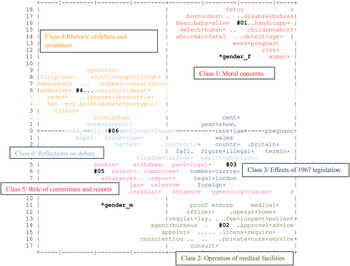
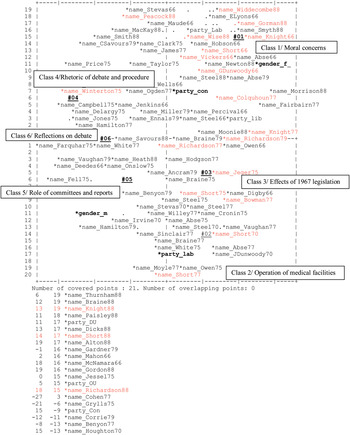
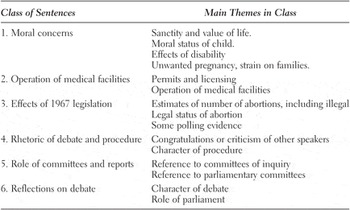
To provide an overview of the principal findings, our analysis begins with a discussion of what we term the “integrated debate.” This is simply a compilation of all six debates within a single corpus. It can be understood as representing a summary of the full debates in the Commons over the 22-year period. In the integrated debate, male and female MPs have been labeled, together with the years of the individual debates in which they took part (e.g., Steel_1966, Steel_1970, Steel_1975, etc.). Doing so allows one to identify the vocabulary used by representatives within an extended period of time, as well as to gauge consistency of the speakers in terms of argumentation. Table 2 shows the classes of the integrated debate that emerged as the most general ones. Added to this, the correspondence analysis (Figures 1 and 2) shows which type of vocabulary has been disproportionately employed by each individual MP, female and male. By identifying the name and sex of a speaker on the correspondence analysis, one can distinguish what type(s) of vocabulary has been disproportionately employed by either sex.
Correspondence analysis of integrated debate, vocabulary.

Correspondence analysis of integrated debate, names, and variables

Classes of integrated debate

Table 2 shows six broad classes of sentences as selected by Alceste, while the accompanying correspondence analysis (Figures 1 and 2) further highlights three salient features within the overall structure of the integrated debate. The first feature is that the discursive space can be broadly divided by procedural and substantive vocabulary; as depicted, the three substantive classes are on the right of the figure. Class 1 highlights “the sanctity of life” along with other core moral issues, and comprises key terms such as human, alive, unborn, fetus, defect, and destroy. Class 2 deals with the “provision of medical facilities,” displaying key terms such as operation, private, nurse, service, patient, and consult. Class 3 addresses the broader consequences of abortion policy with key terms such as decrease, demand, contraception, emergency, and mortality. On the left of the figure are three procedural classes (Classes 4, 5, and 6). Class 4 is made up of procedural terms such as hon., member, speech, congratulate, eloquent and debate, which political representatives usually employ to address each other in parliament. Class 5 deals with the role of committees and reports, including terms like recommendation, select, committee, chairman, report, examine, and evidence. Class 6 comprises MPs' reflections on the character of the debate and the role of parliament, containing key words such as bill, discuss, express, support, govern, parliament, and opposition.
Second, the correspondence analysis shows that female (the variable gender_f represents female parliamentarians) is closely associated with the substantive dimension of the debate, in particular with Class 1 concerning sanctity of life. By contrast, male (the variable gender_m represents male parliamentarians) is strongly associated with the procedural dimension of the debate. Given the tagging of MP names with years of the different debates, one can also see that the distinction between procedural and substantive issues has remained a constant feature over successive debates. Another significant characteristic of the overall debate is the association between substantive issues and female and procedural issues and male.
Such results suggest that women are more likely to use substantive vocabulary when discussing the issue of abortion in parliament, whereas men seem more prone to embrace procedural arguments. Although we have presented this finding in terms of the integrated debate, we note that this result appears throughout the analysis of the individual debates. (Indeed, it was when we were analyzing the individual debates that we noticed this regularity.) To add depth to our principal finding, we assess the extent to which women and men truly deploy contrasting styles of argumentation and speak in a different voice, by looking at each single debate in greater depth and by running a Cross-Data Analysis on the variable “gender” on each of the six debates separately.Footnote 4
The 1966 Debate
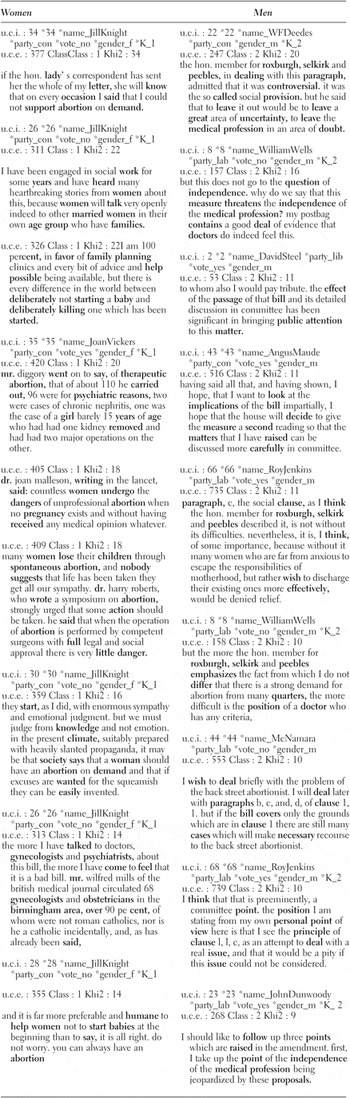
The first Cross-Data Analysis suggests that men and women used different types of arguments to discuss the abortion issue in 1966. The specific vocabulary associated with the variable gender_f in this debate comprises words such as baby, women, gynecologist, kill, and patient. By contrast, the specific vocabulary associated with the variable gender_m is made up of terms such as paragraph, bill, gentleman, clause, and effect. This lends support to the argument developed previously that different types of issue are embraced according to sex; women embrace the more substantive issues, whereas men are prone to focus on the procedural. Confirmation is found in looking at the sentence segments selected by Alceste in which the specific terms employed by either female or male parliamentarians are (re)placed in their original context (see Table 3).
Cross-Data Analysis on the variable “gender”—sentence segments
July 22, 1966, debate

A closer look at the selected sentence segments reveals that women MPs addressed abortion issues in 1966 from a “personal angle,” drawing on letters sent by constituents, testimonies from doctors, and reports from social workers who witnessed abortion-related problems. For instance, as Jill Knight puts it: “I have been engaged in social work for some years and I have heard many heartbreaking stories from women about this, because women will talk very openly indeed to other married women in their own age group who have families.” Crucially, it must be noted that female MPs who take a different view on the issue of abortion speak to each other in a “similar voice”; whether or not they agree on the practice of abortion, women MPs use the same kind of vocabulary and deploy similar style of argumentation. Compare, for instance, the clinical views on abortion by pro-abortion MP Joan Vickers and the view of anti-abortion MP Knight:
Many women lose their children through spontaneous abortion, and nobody suggests that life has been taken; they get all our sympathy. Dr. Harry Roberts, who wrote a symposium on abortion, strongly urged that some action should be taken. He said that when the operation of abortion is performed by competent surgeons with full legal and social approval there is very little danger. (Vickers)
The more I have talked to doctors, gynecologists and psychiatrists, about this Bill, the more I have come to feel that it is a bad Bill. Mr. Wilfred Mills of the British Medical Journal circulated 68 gynecologists and obstetricians in the Birmingham area, over 90 percent of whom were not Roman Catholics, nor is he a Catholic incidentally, and, as has already been said, nor am I. Out of the 68 he found that three thought this change in the law desirable, three were for it and 65 were against it. Those are clinical and not religious views. (Knight)
In contrast, when looking briefly at how male MPs dealt with the bill in 1966, they clearly show a greater concern for procedural issues. For example, Steel argues: “the effect of the passage of that bill and its detailed discussion in committee has been significant in bringing public attention to this matter.” Other such examples abound, as with Angus Maude stating: “having said all that, and having shown, I hope, that I want to look at the implications of the bill impartially, I hope that the house will decide to give the measure a second reading so that the matters that I have raised can be discussed more carefully in committee.” Intriguingly, just as female MPs often shared the same voice despite their positional differences on the issue of abortion, male MPs who held different views also deployed similar modes of argumentation when addressing one another in 1966—essentially comprising procedural arguments.
February 13, 1970
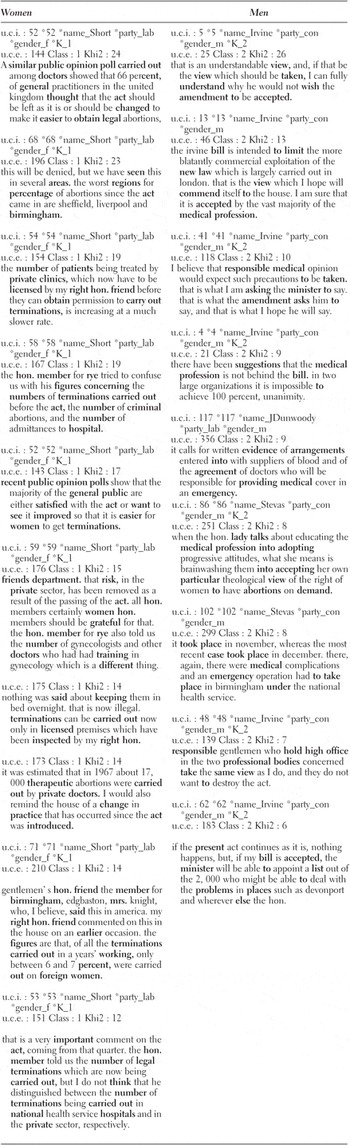
The Cross-Data Analysis results for the February 1970 debate present both similarities and differences with the results for earlier debates. Looking at male MP sentence segments first, these again refer to procedural matters, for example: “responsible gentlemen who hold high office in the two professional bodies concerned take the same view as I do, and they do not want to destroy the act” (Bryant Irvine; see Table 4). Yet here they also reflect significant concerns about the bill's implications for the medical profession, or at least seriously entertain the views of those in the medical profession on several aspects of the bill. For instance: “I believe that responsible medical opinion would expect such precautions to be taken. That is what I am asking the minister to say” (Irivine).
Cross-Data Analysis on the variable “gender”—sentence segments February 13, 1970, debate

As far as the sentence segments for women MPs are concerned, there is an important and more notable change from the earlier debate. Although the main emphasis of women MPs is still on the bill's substantive rather than procedural aspects (especially on health-care issues), how they tend to deal with the substantive issues has developed from their approach in 1966. Instead of drawing on letters, personal conversations with practitioners, and so on, women present their arguments by quoting facts, figures, and polls. They have thus moved from a “personal approach” on the abortion issue to a more concrete and empirically based defense of their case. As Renée Short puts it, for example: “A similar public opinion poll carried out among doctors showed that 66 percent of general practitioners in the United Kingdom thought that the Act should be left as it is or should be changed to make it easier to obtain legal abortions.” Or, as Short noted, “Recent public opinion polls show that the majority of the general public are either satisfied with the act or want to see it improved so that it is easier for women to get terminations.”
An associated change is that there seems to be a great deal more directed interaction between male and female MPs. For instance, consider the following statement drawn from women's statements: “The Hon. Member for Rye tried to confuse us with his figures concerning the numbers of terminations carried out before the Act” (Short). From the “male” perspective, no less than three sentence segments directly refer to points made by women MPs. For example: “When the Hon. Lady [Short] talks about educating the medical profession into adopting progressive attitudes, what she means is brainwashing them into accepting her own particular theological view of the right of women to have abortions on demand (Norman St. John-Stevas).
Several explanations may account for the reason that women employed a vocabulary pointing to the “numerical estimates of abortion” in changing their argumentative style in 1970. First, compared with 1966, the grounds of the debate were somewhat different in 1970. The Irvine Bill was aimed at private clinical abortions and proposed that a legal abortion could only be performed by, or under the supervision of, a consultant gynecologist in the National Health Service. This considerably restricted the rhetorical tools available to the speakers, either male or female. Second, one cannot help but notice that sentence segments selected by Alceste for women in 1970 are entirely dominated by Short, whose style of argumentation most likely differs from that of other female MPs. The analysis of the 1970 debate thus suggests that the rhetorical tools used by women are neither strictly defined nor fixed, but vary according to the circumstances of individual speakers within the debate.
February 7, 1975
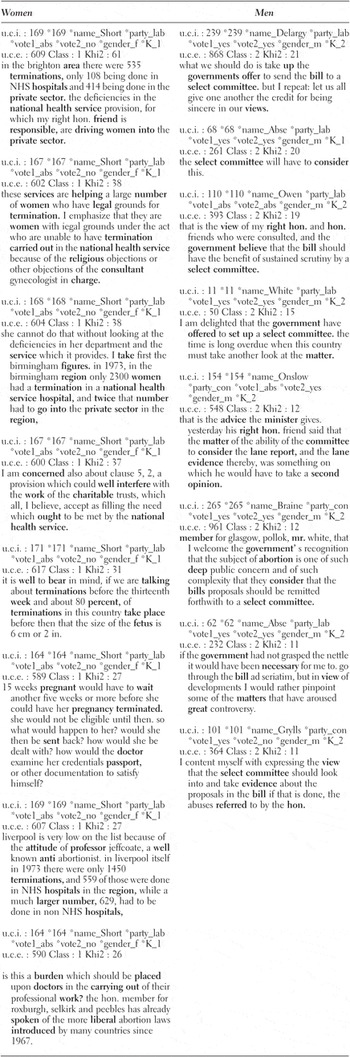
The next Cross-Data Analysis indicates that a similar pattern occurred in 1975. Women MPs continued to emphasize substantive aspects of the bill (especially health), but they presented facts and evidence to support their claims, rather than opinions drawing on personal experiences. Here again, the sentence segments selected by Alceste are entirely dominated by Short, who uses empirically based arguments; for example, “in the Brighton area there were 535 terminations, only 108 being done in NHS hospitals and 414 being done in the private sector. The deficiencies in the National Health Service provision, for which my Right Hon. Friend is responsible, are driving women into the private sector” (Table 5). Occasionally, Short's manner of addressing the abortion issue seems to use argumentative tools more typically employed by male MPs (i.e., procedural arguments); for example, “I am concerned also about clause 5, 2, a provision which could well interfere with the work of the charitable trusts, which all, I believe, accept as filling the need which ought to be met by the national health service.” The focus on the procedural aspects of the bill by male MPs is again quite obvious here. Consider, for instance, the first nine sentence segments selected by Alceste in which all the MPs expressed support for the bill to be sent to a select committee; for example: “what we should do is take up the government's offer to send the bill to a select committee. But I repeat: let us all give one another the credit for being sincere in our views” (Hugh Delargy).
Cross-Data Analysis on the variable “gender”—sentence segments February 7, 1975, debate

February 25, 1977
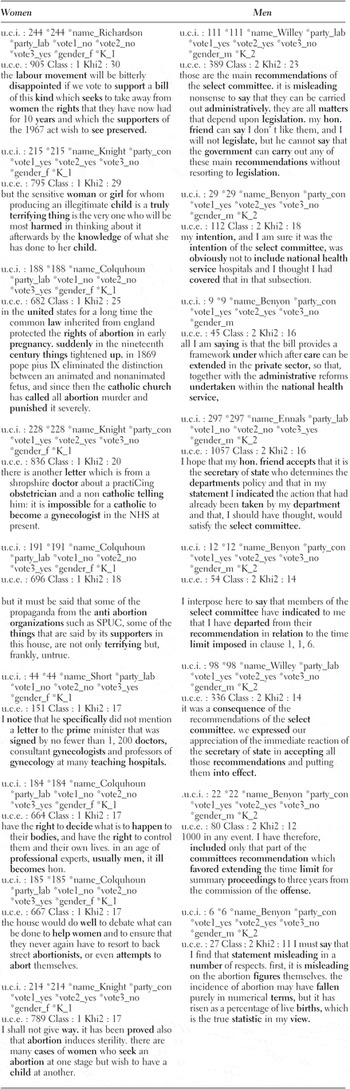
In 1977, women MPs seem to harken back to the style of argumentation employed in 1966, often quoting from letters received from doctors and constituents. Once again, female MPs who take different views on abortion speak to one another in a similar voice (see Table 6). By contrast, male MPs continued to emphasize procedural aspects of the Bill in 1977. The eight first-sentence segments associated with male MPs and selected by Alceste for this debate refer to the recommendations of the select committee; for example:
Those are the main recommendations of the Select Committee. It is misleading nonsense to say that they can be carried out administratively. They are all matters that depend upon legislation. My Hon. Friend can say I don't like them, and I will not legislate, but he cannot say that the government can carry out any of these main recommendations without resorting to legislation. (Frederick Willey)
Cross-Data Analysis on the variable “gender”—sentence segments February 25, 1977, debate

July 13, 1979
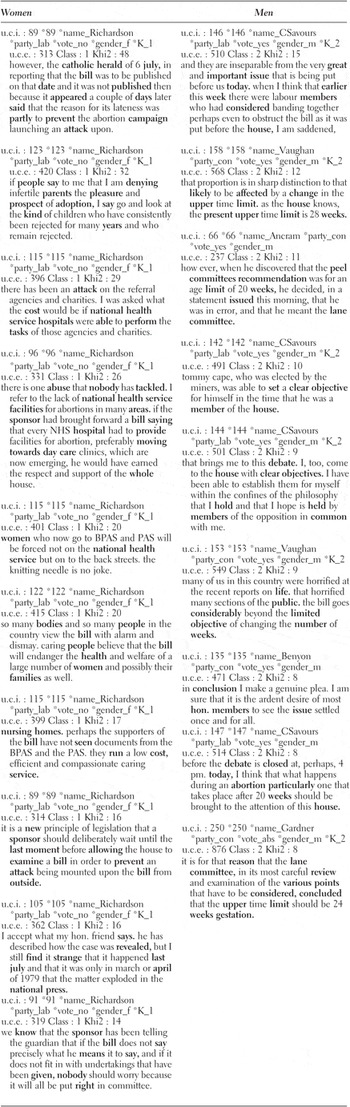
The Cross-Data Analysis on the 1979 debate shows similar characteristics to the 1977 debate. Sentence segments associated with female MPs reflect their concerns about the health of women undergoing abortions and the well-being of children; for example: “if people say to me that I am denying infertile parents the pleasure and prospect of adoption, I say go and look at the kind of children who have consistently been rejected for many years and who remain rejected” (Jo Richardson; Table 7). Yet, unusually, the sentence segments selected by Alceste here now also reflect a concern for more procedural issues on the part of women MPs; for instance:
[I]t is a new principle of legislation that a sponsor should deliberately wait until the last moment before allowing the house to examine a bill in order to prevent an attack being mounted upon the bill from outside. (Richardson)
Since the first 10 sentence segments selected for this Cross-Data Analysis are entirely dominated by Richardson, however, it is difficult to assess whether other female parliamentarians have manifested a similar style of argumentation in 1979.
Cross-Data Analysis on the variable “gender”—sentence segments July 13, 1979, debate

Similarly, sentence segments selected for male MPs show mixed concerns. On the one hand, men have raised procedural issues as usual; for example, “It is for that reason that the Lane Committee, in its most careful review and examination of the various points that have to be considered, concluded that the upper time limit should be 24 weeks gestation” (Edward Gardner). On the other hand, they also discussed the provision of the bill in this instance from a more substantive point of view; for example: “Many of us in this country were horrified at the recent reports on life. That horrified many sections of the public. The Bill goes considerably beyond the limited objective of changing the number of weeks' (Gerard Vaughan).
January 22, 1988
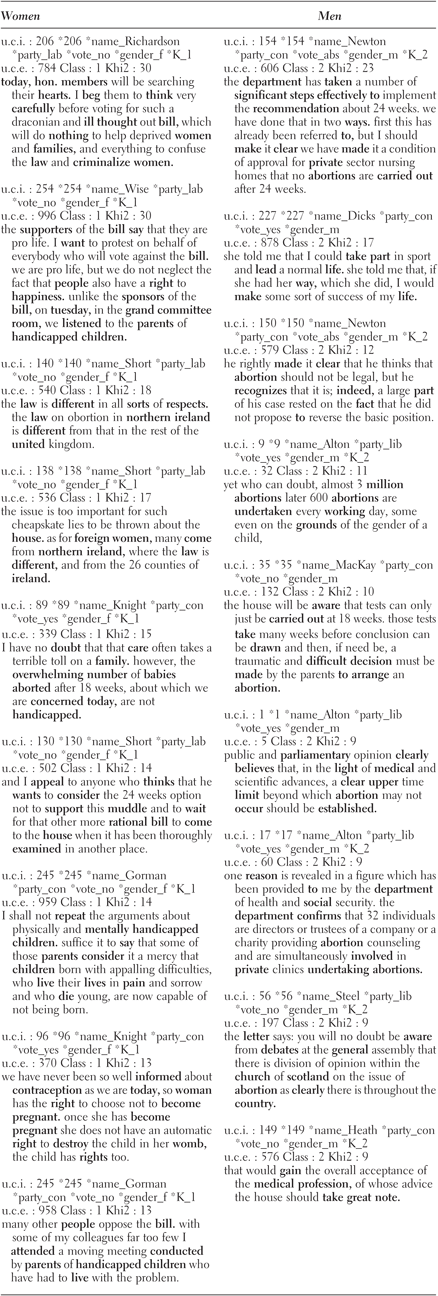
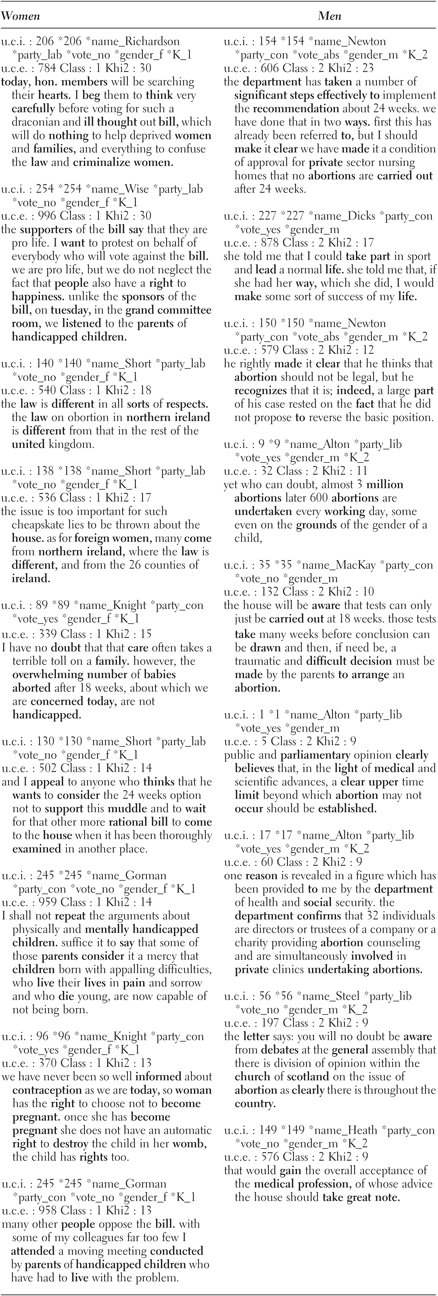
Results of the last Cross-Data Analysis in Table 8 indicate that female MPs have continued to focus on the substantive aspects of the bill and have used two types of argumentative strategies in the 1988 debate. First, they addressed the issue by resorting to arguments about women and families' well-being; and second, they referred to grounds of the legislation. Compare, for instance, MPs Richardson and Short:
[T]oday, Hon. Members will be searching their hearts. I beg them to think very carefully before voting for such a draconian and ill thought-out Bill, which will do nothing to help deprived women and families, and everything to confuse the law and criminalize women. (Richardson)
The law is different in all sorts of respects. The law on abortion in Northern Ireland is different from that in the rest of the United Kingdom. (Short)
By comparison, sentence segments selected for male MPs not only reflect their concerns for procedural issues but now also for the bill's provisions. Consider the following for MPs Tony Newton and David Alton:
[T]he Department has taken a number of significant steps effectively to implement the recommendation about 24 weeks. We have done that in two ways. First, this has already been referred to, but I should make it clear we have made it a condition of approval for private sector nursing homes that no abortions are carried out after 24 weeks. (Newton)
[P]ublic and parliamentary opinion clearly believes that, in the light of medical and scientific advances, a clear upper time limit beyond which abortion may not occur should be established. (Alton).
Cross-Data Analysis on the variable “gender”—sentence segments January 22, 1988, debate
DISCUSSION
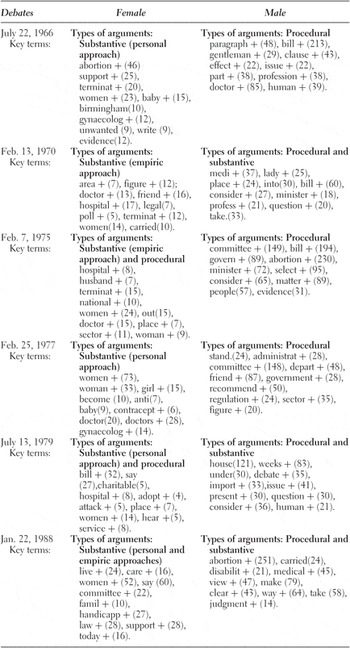
Overall, the results suggest a gendered dimension in early debates on abortion in the UK: female MPs were more likely to focus upon substantive aspects of the abortion issue in parliamentary settings, whereas men seemed more prone to advance procedural arguments. This was noticeable in the integrated debate and was detailed further by the Cross-Data Analysis conducted on each debate separately. Indeed, Table 9 summarizes the main findings of the analysis, as well as displaying the first 10 key terms (those with the highest χ2 value) that are employed most frequently by male and female MPs in each of the debates between 1966 and 1988.
Summary

Having said this, the gender-based distinction appears somewhat mitigated if one looks carefully at the sentence segments and key words automatically selected by Alceste in the attempt to capture the rhetorical strategies of male and female MPs. If initial findings intimated that female MPs act for—or more precisely speak for—women in parliament through more subjective or personal links, this claim has certain caveats. In two out of six debates, women were found to resort to both substantive and procedural arguments (1975 and 1979). Since men were also found to resort to both procedural and substantive arguments in several debates (1970, 1979, and 1988), this suggests that during parliamentary discussions on the abortion issue, women and men do deploy similar rhetorical strategies, but the key difference is in terms of their frequency. In other words, if men and women “speak in a different voice,” then the register of those different voices is defined by the differing frequencies with which certain types of argument and styles of reasoning are used.
Our results thus support earlier research that found that women MPs identify with “women issues” (Bird Reference Bird2005; Bochel and Briggs Reference Bochel and Briggs2000; Childs Reference Childs2000;) and provide further insight into the manner and content of argumentation likely to be employed by male and female MPs in parliamentary settings. Our results are also in line with those of Wilkinson and Diplock, who found that men and women care about the same issues, but think about them in different ways (quoted in Lovenduski Reference Lovenduski1997, 716). If male and female MPs care about the same issues but largely think about them differently, then it is not unlikely that they might occasionally emphasize the same aspect of a particular issue but with a different frequency. Finally, our findings corroborate prior analyses of abortion debates in the UK—especially those by Cowley and Stuart (Reference Cowley and Stuart2010, 178), who found that “in a parliamentary system in which the ties of party normally swamp any other differences, the issue of abortion has been one of the few to produce a gendered dimension in Commons voting.” Even if, ultimately, the gender dimension did not determine the outcome of the debates on abortion, it nevertheless had a noticeable influence on the framing of the arguments.
Inasmuch as abortion is an issue that fundamentally deals with women, it is perhaps unsurprising that female MPs have arguably adopted a “personal approach” to the debate that focuses more on the substantive issues than on the procedural. Yet the results here suggest that despite female MPs' apparent empathy for women having to face abortion (whether they agree with it) and their personal approach to the issue, they were not precluded from engaging with their male counterparts on empirical grounds or even procedural aspects of the bill. An important finding that emerges here is that women have used a larger array of rhetorical strategies than have men, addressing the abortion issue variously from perspectives personal (1966, 1977), empirical (1970, 1988), and occasionally procedural (1975, 1979). On many occasions, female MPs adapted these different rhetorical strategies within the separate debates.
Another important finding is that political alignment and declared party views on abortion did not seem to influence the way in which arguments were being framed by MPs. Both female and male MPs were found, most of the time, to talk to one another in the same way regardless of their positions on the issue. Yet again, however, we must bear in mind that the personality of a speaker and the context of the debate proved at times to have sensibly affected the nature of argumentation. MPs Short and Richardson, in particular, were found to be similar to their male counterparts in raising procedural arguments. This is especially important for theoretical arguments concerning women's representation, which hold that only women can be relied upon to bring women's issues to the political agenda and that it is necessary to have full representation of women in parliament to ensure that women's perspectives are as extensively represented as men's. Rather, our results reinforce the argument that women, like men, are a diverse group rather than a unitary political category (see Lovenduski Reference Lovenduski1997, 709); hence, their approach to a political issue and—by extension—their rhetorical strategies are likely to vary according to their personal style.
CONCLUSION
Focusing on six second-reading debates in the British House of Commons, this article examined gender differences regarding the framing of arguments about the abortion issue in the lower legislative chamber between 1966 and 1988. The computer-assisted textual analysis method used here helped assess whether quantitative and qualitative differences exist concerning the rhetorical strategies of male and female political representatives. We found differences between male and female speakers concerning the extent to which the content of their respective vocabularies is procedural (men) or substantive (women).
That differences in male and female rhetorical strategies are occasionally mitigated, however, suggests that there is perhaps not all that much difference in the way men and women approach politics at large. Of course, further research would be needed to assess whether male and female parliamentarians speak in a different voice either on so-called men's issues or on gender-neutral issues. It is thus hoped that this research will open new avenues for theoretical and empirical research on the topic.