Introduction
The role of nigrostriatal dopamine deficits in Parkinson’s disease (PD) has been firmly established (Perlmutter & Eidelberg, Reference Perlmutter and Eidelberg2012). In recent years, dopamine transporter-single photon emission computed tomography (DaT-SPECT) has been used to detect degeneration of pre-synaptic dopamine receptors and neurons in the nigrostriatal structures (Ba & Martin, Reference Ba and Martin2015; Perlmutter & Eidelberg, Reference Perlmutter and Eidelberg2012). Of interest, multiple studies have shown that more than 10% of individuals who are thought to have PD based upon clinical criteria have normal DaT-SPECT findings (The Parkinson Study Group, 2004; Marek, Jennings, & Seibyl, Reference Marek, Jennings and Seibyl2005). When this occurs, the neuroimaging has been referred to as scans without evidence of dopaminergic deficit (SWEDD; Marek, Jennings & Seibyl, Reference Marek, Jennings and Seibyl2005).
The true etiology of the symptoms experienced by patients with SWEDD remains controversial, and it has been suggested that these individuals may represent a heterogeneous group comprised of different disorders (Erro et al., Reference Erro, Schneider, Quinn and Bhatia2016). When patients with SWEDD were initially discovered, it was hypothesized that these patients might be within a prodromal phase of PD (Stoessl, Reference Stoessl2010); however, subsequent research has demonstrated significant differences between patients with dopamine deficient scans and patients with SWEDD. Patients with SWEDD lack response to levodopa (The Parkinson Study Group, 2004) and do not demonstrate deficits in olfaction as frequently as patients with dopamine deficient PD (Silveira-Moriyama et al., Reference Silveira-Moriyama, Schwingenschuh, O’Donnell, Schneider, Mir, Carrillo and Lees2009). Patients with SWEDD also have more significant cardiovascular and thermoregulatory dysfunction, orthostatic hypotension, sleep disturbances, and higher frequencies of daytime sleepiness than dopamine deficient PD patients (Sprenger et al., Reference Sprenger, Seppi, Djamshidian, Reiter, Nocker, Goebel and Poewe2015).
Although patients with SWEDD can present with motor features similar to those patients with dopamine deficient PD, previous longitudinal research suggests that patients with SWEDD do not demonstrate progression of motor symptoms (Marshall, Patterson, Hadley, Grosset, & Grosset, Reference Marshall, Patterson, Hadley, Grosset and Grosset2006) and continue to have normal DaT-SPECT findings for up to 4 years after they are initially identified (Marek et al., Reference Marek, Seibyl, Eberly, Oakes, Shoulston, Lang and Jennings2014). In a 5-year follow-up study of 16 patients with SWEDD, only two patients demonstrated reduced dopamine uptake on DaT-SPECT, while 14 remained classified as SWEDD (Batla et al., Reference Batla, Erro., Stamelou, Schneider, Schwingenschuh, Ganos and Bhatia2014). These studies seem to indicate that individuals with SWEDD have a distinct pathology different from individuals with dopamine deficient PD (Erro, Schneider, Quinn, & Bhatia, Reference Erro, Schneider, Quinn and Bhatia2016; Marek et al., Reference Marek, Seibyl, Eberly, Oakes, Shoulston, Lang and Jennings2014; Sprenger et al., Reference Sprenger, Seppi, Djamshidian, Reiter, Nocker, Goebel and Poewe2015).
Researchers have demonstrated that cognitive impairment is frequently associated with idiopathic PD (Muslimovic, Post, Speelman, De Haan, & Schmand, Reference Muslimovic, Post, Speelman, De Haan and Schmand2009), and cognitive deficits can be identified in up to 34% of patients even in the early, untreated stages of the disease (Pfeiffer, Lokkegaard, Zoetmulder, Friberg, & Werdelin, Reference Pfeiffer, Lokkegaard, Zoetmulder, Friberg and Werdelin2014). This cognitive dysfunction may be related, in part, to dopaminergic deficit. While there are some inconsistent findings in the literature (Poletti & Bonuccelli, Reference Poletti and Bonuccelli2013), functional MRI (fMRI) studies with patients on and off levodopa indicate that higher levels of dopamine are associated with better cognitive performances on tasks of working memory and response accuracy (Mattay et al., Reference Mattay, Tessitore, Callicott, Bertolino, Goldberg, Chase and Weinberger2002).
Additionally, recent fMRI and DaT-SPECT research has demonstrated a positive correlation between nigrostriatal dopaminergic function and performance on tests of executive functioning and memory (Lebedev et al., Reference Lebedev, Westman, Simmons, Lebedeva, Siepel, Pereira and Aarsland2014). However, dopamine deficiency may not explain all of the cognitive deficits in PD, as some degree of cognitive impairment is common in patients diagnosed with related movement disorders such as dystonia (Scott et al., Reference Scott, Gregory, Wilson, Banks, Turner, Parkin and Aziz2003) and essential tremor (Lombardi, Woolston Roberts, & Gross, Reference Lombardi, Woolston, Roberts and Gross2001), conditions that are not associated with dopaminergic deficiency on imaging (Menéndez-González, Tavares, Zeidan, Salas-Pacheco, & Arias-Carrion, Reference Menendez-Gonzalez, Tavares, Zeidan, Salas-Pacheco and Arias-Carrion2014).
Based on the aforementioned findings, one might expect patients with SWEDD to have some degree of cognitive decline, but these patients might have better cognitive functioning than patients with dopamine deficient PD, since dopamine uptake is intact in patients with SWEDD. Of interest, however, when Wyman-Chick, Martin, Minar, and Schroeder (Reference Wyman-Chick, Martin, Minar and Schroeder2017) compared individuals with SWEDD and PD using the Montreal Cognitive Assessment (MoCA) screening test, the results were in the opposite direction. Specifically, the individuals with SWEDD were more likely to decline cognitively than individuals with dopamine deficient PD at a 2-year follow-up interval.
While Wyman-Chick et al. (Reference Wyman-Chick, Martin, Minar and Schroeder2017) found that individuals with SWEDD had cognitive decline detected by a cognitive screening test, there are no published studies specifically comparing cognitive dysfunction in individuals with SWEDD, individuals with PD and abnormal DaT-SPECT findings, and healthy controls (HC) when measured by more comprehensive neuropsychological testing. As such, this study was conducted. Based upon the preliminary findings of Wyman-Chick et al. (Reference Wyman-Chick, Martin, Minar and Schroeder2017), it was hypothesized that participants with SWEDD would demonstrate evidence of cognitive impairment on more comprehensive neuropsychological measures when compared to PD and HC groups.
METHODS
Participants were identified retrospectively from the Parkinson’s Progression Marker Initiative (PPMI) archival database, and data from the baseline PPMI visit were obtained. Information about the aims of PPMI study and methodology have previously been published (Marek et al., Reference Marek, Jennings, Lasch, Siderowf, Tanner, Coffey and Taylor2011) and are available on the PPMI Web site (http:/www.ppmi-info.org/study-design). This study was approved by the institutional review board at each participating PPMI data collection site. The institutional review board at the University of Kansas School of Medicine – Wichita also reviewed the study. Written informed consent was obtained from all study participants before enrollment.
Participants
A total of 585 participants were included in the current study, which included 59 participants with SWEDD, 412 participants with PD, and 114 HC.
All participants in the PD group and the SWEDD group received clinical diagnoses of idiopathic PD within the previous 24-months, and they were not taking any PD medication at the time of enrollment in the PPMI. Participants diagnosed with non-PD related parkinsonism at the time of study enrollment were excluded from participation. Participants with excessive stroke risk factors were excluded from the study if the investigator determined the participant’s parkinsonian features were better accounted for by vascular parkinsonism. Participants diagnosed with idiopathic PD at baseline were separated into two groups based on DaT-SPECT findings: PD participants with dopaminergic deficiency and PD participants with SWEDD. DaT-SPECT image processing protocols and procedures for calculation of striatal binding ratios are available on the PPMI Web site (http://www.ppmi-info.org).
HC participants were individuals with normal imaging findings (MRI and DaT-SPECT) and without history of neurologic disease, motor symptoms, first degree relative with PD, or cognitive impairment as defined by a cutoff score of≤26 on the MoCA. Unlike the healthy control group, there was no set cutoff for inclusion for the group diagnosed with PD; however, patients who were determined to meet criteria for dementia by the PPMI site investigator were excluded from participation.
Assessment Measures
The PPMI study includes neuropsychological tests that are widely used in clinical practice which assess several domains including learning, memory, working memory, visuospatial ability, verbal fluency, and processing speed. The tests included in PPMI are discussed below.
The MoCA is a brief cognitive screening measure that has been validated for use among individuals with PD. The cutoff point for normal cognition is 26/30 in the general population (Nazreddine et al., Reference Nasreddine, Phillips, Bedirian, Charbonneau, Whitehead, Collin and Chertkow2005) and in PD (Hoops et al., Reference Hoops, Nazem, Siderowf, Duda, Xie, Stern and Weintraub2009). The Hopkins Verbal Learning Test – Revised (HVLT-R) is a 12-item verbal memory task. Standard test administration includes three learning trials (immediate recall) and a 20- to 25-min delay where participants are asked to recall the words previously learned (delayed recall; Brandt, Reference Brandt1991). Letter Number Sequencing (LNS) is a test of attention and working memory, in which the participant is asked to listen to a series of numbers and letters of increasing lengths and repeat numbers and letters from the lowest in each series, providing numbers first, then the letters (Wechsler, Reference Wechsler1997). Judgement of Line Orientation (JLO) is a test of visual perception where participants are asked to estimate the angle between two line segments (Benton, Varney, & Hamsher, Reference Benton, Varney and Hamsher1978). For the verbal fluency task, participants were asked to name as many animals as they could within 60 s. They were also asked to name as many words that start with the letter F that they could think of in 60 seconds (Straus, Sherman, & Spreen, Reference Straus, Sherman and Spreen2006). Finally, the participants were administered Symbol Digit Modalities Test (SDMT), which is a timed number-symbol transcription task in which participants are asked to match numbers to a unique symbols as quickly as they can in 90 s (Smith, Reference Smith1982).
The Movement Disorder Society Unified Parkinson’s Disease Rating Scale (MDS-UPDRS) Part III (off medication) was used to measure motor symptoms for the participants in the SWEDD and PD groups. Lower scores on the MDS-UPDRS reflect fewer and/or less severe motor symptoms (Goetz et al., Reference Goetz, Tilley, Shaftman, Stebebns, Fahn, Martinez-Martin and LaPelle2008).
Statistical Methods
Age, education, and MoCA scores were compared overall using univariate analysis of variance (ANOVA) and pairwise using Tukey’s studentized range procedure. A multivariate ANOVA (MANOVA) was conducted to compare standardized neuropsychological test scores between the three groups. Post hoc analyses were then conducted, as appropriate, using Tukey’s studentized range procedure. Independent samples t tests were used to compare duration of motor symptoms in months (log-transformed to account for non-normality) and motor symptom severity in the SWEDD and PD groups. Statistical analysis was performed with SAS Version 9.4.
Finally, the proportion of individuals in the SWEDD and PD groups meeting criteria for mild cognitive impairment (MCI) was compared using a chi-square analysis. Based on the Movement Disorder Society Task Force Level I guidelines for classifying PD-MCI, (Litvan et al., Reference Litvan, Goldman, Troster, Schmand, Weintraub, Petersen and Emre2012), participants in the current study were classified as MCI if they scored 1.5 standard deviations below the normative mean on 2 or more neuropsychological tests. Of note, impairment on both HVLT-R immediate memory and HVLT-R delayed recall was considered to be impairment on one test.
RESULTS
Demographics
Demographic information for each of the groups is displayed in Table 1. There were no significant differences between the SWEDD group, the dopamine deficient PD group, and the HC group in terms of education. However, the PD group was significantly older than the HC group (p=.015). The SWEDD group and PD group did not differ in their MoCA scores.
Demographics

Note. SWEDD=scans without evidence of dopaminergic deficiency; PD=Parkinson’s disease; HC=healthy controls; MoCA=Montreal Cognitive Assessment; * p≤.05; **p≤.001
a PD group was significantly older than the HC group.
b HC group had significantly higher mean MoCA score compared to both PD and SWEDD groups.
The SWEDD group (M=23.92; SD=28.09) and the PD group (M=22.84; SD=23.83) did not differ significantly in terms of months of disease duration (p=.753). However, the PD (M=20.84; SD=8.79) group demonstrated significantly worse motor symptoms than the SWEDD group (M=14.61; SD=9.67), t(468)=5.03; p<.001), as measured by the MDS-UPDRS-III.
Neuropsychological Test Performances
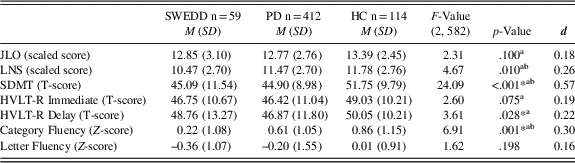
We tested the model assumptions for a MANOVA (normality, linearity, and homogeneity of variance and covariance) and deemed that this was an appropriate analysis for our data. Box’s Test of Equality of Covariance Matrices was significant (p<.001), therefore, Pillai’s Trace was used. The multivariate effect reflected significant differences in performances between the three groups, F(14,1155)=5.04; p≤.001; η2=0.058. Univariate analyses were conducted, which revealed significant group differences on category verbal fluency performances, F(2,583)=6.91; p=0.001; η2=0.023, HVLT delay (F(2,583)=3.61; p=.028; η2=0.009; and SDMT performances, F(2,583)=24.09; p<.001; η2=0.076 (Table 2).
Neuropsychological test performance

Notes: SWEDD=scans without evidence of dopaminergic deficiency; PD=Parkinson’s disease; HC=healthy controls; JLO=Judgment of Line Orientation; LNS=Letter Number Sequencing; SDMT=Symbol Digit Modalities Test; HVLT-R=Hopkins Verbal Learning Test-Revised.
*Statistically significant p-value=.05; JLO and LNS are noted in Scaled Scores (M=10, SD=3), SDMT and HVLT are noted in T-scores (M=50, SD=10), and Verbal Fluency are noted in Z-scores (M=0, SD=1).
a =HC group performed significantly better than the PD group.
b =HC group performed significantly better than the SWEDD group
Tukey’s studentized range procedure was used for pairwise comparisons. There were no significant differences between the SWEDD group and the dopamine deficient group on any neuropsychological test. Of the significant univariate models, the HC group performed better than the SWEDD group on category fluency (p≤.001) and SDMT (p≤.001). The HC group performed better than the dopamine deficient PD group on tests of category fluency (p=.03), SDMT (p≤.001), and HVLT delay (p=.10).
Motor symptom severity among participants with PD was negatively correlated with MoCA (r=−0.13; p=.007), JLO (r=−0.15; p=.003), SDMT (r=−0.20; p≤.001), HVLT immediate (r=−0.16; p=.001), and HVLT delay (r=−0.12; p=.012). Among the SWEDD group, motor symptom severity was negatively correlated with SDMT (r=−0.32; p=.036), category fluency (r=0.36; p=.005), and letter fluency (r=−0.30; p=.021).
Rates of MCI
Using established criteria to define MCI, 27.12% (n=16) of the participants with SWEDD and 26.94% (n=111) of the participants with dopamine deficient PD met criteria for MCI. There was not a significant difference between the proportions of participants with MCI between the two groups (p=.977).
DISCUSSION
In this study, the SWEDD group demonstrated similar cognitive performances when compared to the dopamine deficient PD group, but demonstrated statistically significant weaknesses in mental processing speed and category fluency when compared to the HC group. There were also significant correlations between greater severity of motor symptoms and weaker performance on cognitive testing in both PD and SWEDD groups. Of note, the mean cognitive performances in both the SWEDD and HC groups were within the average range of functioning. This is likely due to the fact that these comparisons were based on group comparisons, which attenuated some of the cognitive findings in the SWEDD group.
Indeed, when looking at cognitive performances on the individual case level, it can be seen that approximately one quarter of the participants with SWEDD met established criteria for MCI. The rate of MCI occurrence was similar to the rate found in the participants with dopamine deficient PD. Such findings, in particular, are of clinical significance because they indicate that a sizeable proportion of individuals with SWEDD, even in the initial years after symptom onset, demonstrate cognitive dysfunction that is of the same magnitude as that which is seen with dopamine deficient PD.
Because cognitive profiles and rates of MCI in these two parkinsonian groups were not significantly different from each other, one might wonder if cognitive dysfunction in individuals with PD and some individuals with SWEDD might be due to a common pathology that is outside of the nigrostriatal dopaminergic circuit.
Menéndez-González and colleagues (Reference Menendez-Gonzalez, Tavares, Zeidan, Salas-Pacheco and Arias-Carrion2014) have hypothesized that a sub-group of patients with SWEDD may be experiencing a neurodegenerative disease process, which differentially affects frontosubcortical circuits and leads to parkinsonian symptoms. While the current study is unable to document the exact etiology of the SWEDD patients, this study does demonstrate that individuals with SWEDD perform significantly worse than controls and similarly to individuals with PD. As such, some support for the hypothesis of Menéndez-González et al. might be inferred.
In conclusion, even though the exact etiology of symptoms of the PPMI SWEDD group is unknown at this time, this study provides evidence that SWEDD should not be considered “benign,” as has been previously suggested (Marshall et al., Reference Marshall, Patterson, Hadley, Grosset and Grosset2006). Clinicians need to be aware of the potential for underlying cognitive dysfunction among these individuals. Future studies should examine neuropsychological functioning in SWEDD groups longitudinally.
ACKNOWLEDGMENTS
None of the authors have any conflicts of interest to disclose, and the authors did not receive grant funding for this manuscript. The results of this study were previously presented at the 2017 International Neuropsychological Society (INS) meeting in New Orleans as a poster presentation. Kathryn Wyman-Chick thanks Carol A. Manning, PhD, and Scott A. Sperling, PsyD, for editing the contents of the poster for the INS meeting.
Data used in the preparation of this article were obtained from the Parkinson’s Progression Markers Initiative (PPMI) database (www.ppmi-info.org/data). For up-to-date information on the study, visit www.ppmi-info.org. PPMI- a public-private partnership- is funded by the Michael J. Fox Foundation (MJFF) for Parkinson’s Research and funding partners, including Abbvie, Avid Radiopharmaceuticals, Biogen, Britsol-Myers Squibb, Covance, GE Healthcare, Genetech, GlaxoSmithKline, Lilly, Lundbeck, Merck, Meso Scale Discovery, Pfizer, Piramal, Roche, Servier, and UCB. The MJFF was not involved in the data analysis for this article.