Despite the existence of a substantial literature on this topic, there are still conflicting arguments and evidence on the macroeconomic effects of decentralization.Footnote 1 In particular, cross-national comparative research has yielded mixed findings regarding how political decentralization affects inflation.Footnote 2 One reason for such empirical ambiguity is the imprecision in the use of ‘constitutional federalism’ to measure political decentralization. Conventional scholarship tends to privilege the constitutional provisions allocating powers between the central and sub-national governments. But such an approach can be too ‘blunt’, as Rodden has pointed out.Footnote 3 It lumps into one single category countries that differ substantially in the extent of political decentralization.Footnote 4
In this article, we propose to incorporate in thinking about political decentralization the broader political power aspects of intergovernmental relations centred upon ruling political parties. There are venerable precedents to this way of conceptualizing about political decentralization in political science. As early as 1964, Riker first identified two partisan dimensions of political decentralization: ‘(1) the degree to which one party controls both the national and sub-national levels of government; and (2) the degree to which each potential governing party at the national level controls its partisan associates at the level of constituent governments.’Footnote 5 In essence, a country’s degree of political decentralization could depend on the degree of decentralization for its governing political parties.
We draw on the Rikerian framework, focusing on the partisan rather than legalistic dimensions of intergovernmental power relations. In so doing, we also follow the leads of pioneering researchers who attribute cross-national variation in inflation in part to differences in the share of sub-national governments ruled by the national governing political party, Riker’s first partisan dimension of political decentralization above.Footnote 6 In this study, however, we focus on the extent of political control by the national governing political party over its co-partisans running the sub-national governments, Riker’s second partisan dimension of political decentralization. Specifically, we suggest that within a country under single-party rule where one political party rules all sub-national regions, variation could exist in the degree of political control exerted by the central government, through the sole governing political party, over the different regional governments. Sub-national governments under less stringent control by the central government enjoy a higher degree of de facto political decentralization.
Employing a sub-national research design, we study the relationship between political decentralization and provincial inflation in reform-era China under the rule of the sole governing Chinese Communist Party (CCP). By taking advantage of a rich dataset comprising detailed biographical histories of hundreds of Chinese provincial officials, we use a variant of Huang’s measure of ‘bureaucratic integration’ for the top-ranking provincial officials – provincial Communist party secretaries – to measure political decentralization for the Chinese provincial governments during this period.Footnote 7
Our main finding supports the view that greater political decentralization – less political control over the provincial governments by the central government – tends to be associated with higher provincial inflation, all else being equal. Controlling for a variety of provincial-level economic factors and province/year fixed effects, we show that one unit of increase in our measure of political decentralization translates into an increase of one-third of one percentage point in the provincial inflation rate during 1978–97. Given that China had relatively low inflation during this period, the effects are economically substantial as well as statistically significant. This finding remains robust to alternative specifications, expanded year coverage and Granger tests of reverse causality.
Political decentralization and inflation
Political Decentralization as Constitutional Federalism
Economic research tends to stress fiscal decentralization – i.e., whether or not provision of public goods and the incidence of its financing are at a national or lower level.Footnote 8 However, empirical economic studies on the link between divisions of fiscal revenue and spending and macroeconomic performance so far have not been conclusive.Footnote 9 Political economy scholarship has moved beyond this fiscal focus to study the macroeconomic effects of political arrangements because fiscal arrangements can be endogenous to particular institutional designs, one of which is a federalist constitution. A federalist constitution not only dictates specific fiscal arrangements but also constrains the central governments from arbitrarily changing them. Fiscal decentralization is only sustainable when a constitution imposes constraints on the national governments.Footnote 10
This insight is fundamental to the ‘credible commitment’Footnote 11 school in the research on how political decentralization measured in terms of constitutional federalism affects inflation. It assumes that high inflation is ultimately a problem of excessive money supply created by inflation-prone national-level politicians. Mechanisms that constrain the national governments are thus thought to suppress inflation.Footnote 12 The constitutionally prescribed sharing of monetary policy-making authority among different levels of government in federal countries could be one source of such credible constraints.Footnote 13 However, supportive systematic evidence has been largely wanting. Castles fails to detect any significant relationship between federalist constraints on the central government and inflation during 1960–93 among a cross-section of OECD (Organization for Economic Co-operation and Development) countries.Footnote 14 Similarly, Treisman does not find support for the theory in a panel of eighty-seven countries for the period 1970–89.Footnote 15
A second line of research treats inflation as a ‘collective action’ problem engendered by the sub-national governments.Footnote 16 Interested in shirking the costs of inflation control, for example, they may free-ride by adopting irresponsible regional spending policies through deficit financing and reliance on national government bailing them out. In this framework, low inflation is viewed as a public good in short supply. By politically empowering sub-national government through constitutional prescriptions, political decentralization might aggravate sub-national shirking and therefore exacerbate inflation. The empirical record again is mixed. There is indeed evidence of positive correlations between constitutional federalism and inflation from Wibbels’s sample of forty-six large developing countries in the period 1979–96.Footnote 17 But this result has not obtained among the OECD countries or in Treisman’s larger sample.Footnote 18
A third strand of arguments posits that political decentralization can be associated with either high or low inflation. Proposed by Treisman, this conjecture explicitly acknowledges the mixed evidence on the macroeconomic consequences of political decentralization measured in terms of constitutional federalism. In fact, a federalist constitution could have a ‘lock-in’ effect – it locks in whatever policies happen to be prevailing, inflation-prone or inflation-averse.Footnote 19 A federal system increases the switching costs because it creates more agents wielding veto power.Footnote 20 The prediction thus should be ambivalent with regard to the effects of political decentralization on inflation.
The research summarized here principally views political decentralization as a constitutional construct,Footnote 21 but the evidence, as pointed out above, is inconclusive regarding its effects on inflation. Theoretical differences aside, another major reason for these mixed empirical findings, as Rodden has insightfully noted, could be related to the limitations of the measure of political decentralization based on constitutional federalism in these studies.Footnote 22
Partisan Dimensions of Political Decentralization
One alternative way to conceptualize political decentralization, in contrast, focuses on the role of the governing political parties. For Riker, political decentralization promised by federalist constitutions dividing powers among different levels of government is only meaningful – it is more difficult for the national government to recentralize all political powers – in countries governed by decentralized political parties.Footnote 23 That is, more decentralized governing political parties make more decentralized political systems. In more concrete terms, we can operationalize a country as enjoying higher de facto political decentralization if the national governing political party: (1) rules a smaller share of the sub-national regions, such as by holding their governorships;Footnote 24 and (2) wields less political control, for instance, regarding personnel appointment or candidate nomination, over its sub-national co-partisans.Footnote 25 Cross-nationally, we could examine a country’s degree of political decentralization along these two partisan dimensions.
It is straightforward to calculate the share of the sub-national governments ruled by the political party of the national chief executive (the x-axis in Figure 1). For example, we can easily find out the share of the fifty states in the United States whose governors bear the president’s party label for any single year. The higher the share of governments that are ruled by the co-partisans of the national chief executive, the easier it might be to co-ordinate policy making across the two levels of government, other things being equal.Footnote 26 Riker’s first partisan dimension of political decentralization gauges the ease in intergovernmental policy co-ordination via the national governing political party.
Riker’s partisan dimensions of political decentralization

Meanwhile, the second partisan dimension of political decentralization – the degree of political control on the sub-national level (the y-axis) – captures the extent to which the central government, via the national office of the national chief executive’s political party, is able to secure policy compliance from regional government officials bearing the same party label. One mechanism for exercising such political control is authority regarding personnel appointment or candidate nomination at the sub-national level.Footnote 27 The National Committees for the two major political parties have little effective say over the candidacy for state governorships in the contemporary United States. However, national governing political parties in some Latin American countries often nominate regional candidates with a closed list or directly appoint people to lead the regional governments.Footnote 28 A national governing political party exercising such personnel authority over its sub-national co-partisans lends the central government more political control over and greater ability to extract policy compliance from the sub-national governments run by its co-partisans.Footnote 29
The executive branch of the government in the ideal-typically most centralized political system would be ruled, on both the national and sub-national level, by one single political party capable of exerting political control through holding substantial personnel power over its sub-national co-partisans. This refers to the top right corner of Figure 1, where the ability of the central government to engage in policy co-ordination with and to solicit policy compliance from the sub-national governments is the greatest. Either an authoritarian single-party state,Footnote 30 or a democracy if the national chief executive’s political party equipped with the requisite personnel power happens to govern all sub-national regions, via winning gubernatorial elections nationwide, could exemplify this type.Footnote 31 At the other extreme, in the bottom left corner, the political party of the national chief executive in the least centralized political system rules none of the sub-national governments and exercises little political control via personnel power over its sub-national co-partisans. Here central governmental ability to conduct intergovernmental policy co-ordination or ensure policy compliance from the sub-national governments via the national governing party is the weakest. One example, if only hypothetical, could be a United States under a Democratic president with fifty Republican governors.
Political control and the ability to extract policy compliance from below through personnel power wielded by the governing party is less meaningful if few of the sub-national regions are actually ruled by the party of the national chief executive, as in the top left corner of Figure 1. In Mexico the opposition started winning state governorships in 1989.Footnote 32 Even before the ruling Partido Revolucionario Institucional (PRI) relinquished its seventy-year hold on the Mexican presidency in 2000, effective political control by the Mexican central government was already declining, at least over certain states, although nomination power on the sub-national level remained with PRI’s national office.Footnote 33 For our purposes, greater de facto political decentralization was creeping into Mexico’s centralized political system under PRI single-party rule.
Similarly, intergovernmental policy co-ordination could be weakened if the national governing political party exercises little political control via personnel authority over its sub-national co-partisans even though politicians wearing the same party cap rule most of the regional governments, as in the bottom right corner. This could apply to a United States under a Republican president while most of the state governors are Republican. In both cases, the political system is moderately decentralized. Political control and ability to ensure policy compliance from below by the central government can at best be partial in one case, limited by the number of sub-national regions ruled by the national chief executive’s co-partisans. In the other case, intergovernmental policy co-ordination through the national governing party becomes more complicated absent the ability of national-level politicians to rein in sub-national co-partisans politically.
These discussions of Riker’s partisan dimensions of political decentralization are clearly preliminary and serve mainly illustrative purposes. But they suggest the elements of a more nuanced measure of political decentralization. To make an empirical study of how political decentralization affects inflation, ideally we should collect cross-national data that bear upon both of these partisan dimensions for all possible countries in all possible years. But this is too overwhelming a task for existing data collection endeavours.Footnote 34 Pioneering cross-national research on the macroeconomic consequences of political decentralization that capitalizes on Rikerian governing political party decentralization has mostly focused on one of the two dimensions among a select group of countries.
Indeed, Wibbels has constructed a measure of political party centralization based on the percentage share of sub-national governments ruled by the political party of the national chief executive. From a sample of nine developing countries – all nominally federal – during 1978–96, he finds that greater party decentralization is associated with higher inflation.Footnote 35 A key point here is that political decentralization and inflation vary among countries all classified as constitutionally federal. A promising sign of the robustness of this line of work is the replication of the finding by Rodden and Wibbels in an expanded dataset of fifteen nominal constitutional federations for the same period.Footnote 36
A Sub-National Approach
Findings from these cross-national studies drawing on Riker’s concept of governing party decentralization are consistent with a collective action thesis predicting higher inflation in politically decentralized countries. The more sub-national governments the national chief executive’s party rules, the easier it is to co-ordinate intergovernmental macroeconomic policies, and the more likely that the sub-national governments will be able to contribute to the national public good of low inflation. Still, such research says little about Riker’s other, more coercive partisan dimension of political decentralization – the ability of the central government to control the sub-national governments politically and extract their policy compliance through the governing political party. Taking into account such political leverage exercised by the central government is especially germane to studying the macroeconomic consequences of intergovernmental power relations inherent in any notion of political decentralization.
Again, future data collection efforts bearing on both of Riker’s partisan dimensions are needed before truly cross-country analysis can be undertaken and cross-nationally generalizable conclusions be drawn. We argue, however, that a within-country, sub-national research strategy studying a most centralized political system governed by one single political party, as in the top right corner of Figure 1, promises one big step forward.Footnote 37 Indeed, if one single political party rules both the central government and all the sub-national governments, we in effect hold constant Riker’s first partisan dimension of political decentralization. It then allows us to isolate the macroeconomic effects of political control by the central government over the sub-national governments through the ruling single political party. Two crucial conditions, however, have to be met first for us to formulate clear predictions under a sub-national research design.
First, the central government exercises varying political control over the different sub-national governments. But is it true that in a centralized one-party system, a high degree of political control by the central government is, by definition, uniformly distributed across all sub-national governments? Huang’s work on reform-era China under single-party rule suggests that this is not the case. To be sure, the central government via the ruling CCP monopolizes the personnel power to appoint top officials for all Chinese provincial governments. But for Huang, the extent of political control the central government exerts over the different provincial governments varies with the types of provincial leaders predisposed to varying compliance with the central government policy directives.Footnote 38
In other words, within a most centralized political system under the Rikerian typologies, the central government, via the single ruling party, wields varying effective political control by appointing different types of officials to lead the different provincial governments.Footnote 39 Because greater political control enhances the ability of the central government to secure policy compliance from below, a sub-national government is effectively under less stringent political control by the central government and enjoys a higher degree of de facto political decentralization if the co-partisans of the national chief executive assigned to lead the regional government are less likely to comply with the policy directives from above, other things being equal.
Secondly, we need to know the macroeconomic policy preferences of the central government regarding inflation. If the central government is inflation-prone, as assumed under a ‘credible commitment’ thesis,Footnote 40 sub-national governments under tighter political control by the central government and enjoying a lower degree of political decentralization might be more vulnerable to forced sharing of the national fiscal burdens and absorption of the negative consequences of central government spending excesses. This might in turn aggravate macroeconomic instability in these regions. If the central government is inflation-averse, as assumed under a ‘collective action’ thesis,Footnote 41 we expect sub-national governments enjoying a lower degree of political decentralization to witness lower inflation in their jurisdictions. They could be more sympathetic to efforts to provide the national-level public good of low inflation or simply more receptive to the imposition of the policy preferences of the central government.
In the case of reform-era China, there is solid evidence that the Chinese central government is inflation averse and that there is considerable variation in the extent to which the Chinese central government exerts political control over the different provincial governments.Footnote 42 Moreover, Huang finds that provincial governments under tighter central control tended to pursue lower rates of fixed-asset investment growth in their jurisdictions, as desired by the Chinese central government.Footnote 43 But Huang does not study provincial inflation per se, although there may be theoretical grounds to link growth in fixed-asset investments with inflation.Footnote 44 Here we extend Huang’s work to examine whether within-country variation in political decentralization affects provincial-level inflation in reform-era China.
Political decentralization and sub-national inflation in China
Inflation in Reform-Era China
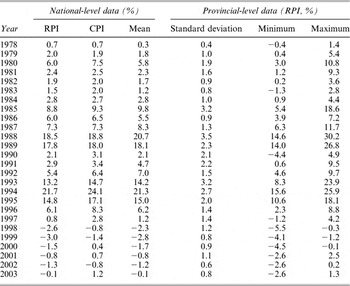
During the post-1978 period, China did not experience the kind of rampant inflation characteristic of other transitional economies. Columns 2 and 3 in Table 1 present national-level data on two measures of inflation for this period. The two measures, annual percentage changes in the retail price index (RPI) and the consumer price index (CPI), show substantial inflationary spikes (in the double-digit range) during two periods, in 1988 and 1989 and then in the mid-1990s.Footnote 45 In other years inflation remained subdued.
Inflation in China, 1978–2003

Note: China had 29 provincial units in 1978–87; Hainan became a province in 1988 and Chongqing obtained provincial status in 1997. Provincial-level inflation data for Tibet are missing for 1978–89.
Not surprisingly, many scholars have been interested in explaining the cyclical nature of and the changes over time in national-level inflation. For example, Brandt and Zhu suggest that the central government juggled between supporting state-owned enterprises with loans and the imperative to contain inflation.Footnote 46 Alternations between these two opposing policy commitments explain China’s macroeconomic cycles. Other researchers attribute the inflationary cycles to the changing political fortunes of policy factions. The reformist faction, headed by Deng Xiaoping, was more tolerant of inflation and its rise was associated with higher inflation. The conservative faction, headed by Chen Yun, pursued exactly the opposite policy preferences during its ascendancy.Footnote 47
We argue that assigning all the analytical weight to the actions of the central policy makers is at best incomplete. The substantial variation in provincial inflation is at least as interesting as the cross-year variation in national inflation.Footnote 48 For instance, at the height of the latest round of economic overheating in 1994 when China’s national inflation – measured by the RPI – was 21.7 per cent, Shaanxi experienced an inflation rate of 25.9 per cent, while that in Tianjin was only 15.6 per cent.Footnote 49 Similarly, in 1990, a year of austerity, Guangdong registered an inflation rate of only −4.4 per cent, while that in Heilongjiang was 4.9 per cent. Table 1 also provides data on the annual maximum, minimum and the standard deviation of Chinese provincial inflation; the huge cross-provincial as well as cross-year variation is quite evident. These substantial differences at the sub-national level further justify the use of China as our empirical setting.
Divergence in Inflation Preferences
Central policy makers and sub-national governments in China, during most of the reform era, appear to differ systematically in their attitudes towards inflation.Footnote 50 National political leaders seem more concerned about the country’s overall macroeconomic stability than do the provincial officials. An official survey conducted in 1991 shows that 61.6 per cent of surveyed central officials rated the economic situation in 1991 – a year with low inflation – as favourable, whereas only 41.2 per cent of the local officials in the sample did so. On the issue of credit expansion, 32.4 per cent of the local officials expressed concerns, vis-à-vis 52.8 per cent of the central officials. On the question of unemployment, the central and local officials held opposite views. For 1991, a year when unemployment rose in conjunction with falling price levels, 8.3 per cent of central officials viewed unemployment as a problem, compared with 29.4 per cent of local officials.Footnote 51
These systematic differences in inflation preferences are consistent with expectations under a collective action thesis. The central government bears the ultimate cost of rampant inflation, not only in economic terms but more importantly in political terms. Inflation reduces the living standards of those people on fixed incomes – typically civil servants, intellectuals, students and urban workers with a strong political voice. The student protests in 1989, after all, directly followed the inflationary bout of 1988.Footnote 52 Therefore, the central government harbours more ‘encompassing interests’Footnote 53 in macroeconomic stability. The central government might even have an incentive to share the cost of containing inflation with the provincial governments.
For the provincial governments, low inflation is a public good that benefits each locality regardless of whether it pays for its provision. Moreover, provincial governments could have much to lose if they helped to contribute to macroeconomic stability and low inflation on the national level. They might have to cut their favourite investment projects or withhold licences to break ground for new factories. All this would otherwise increase local government revenue and perhaps offer huge private payoffs for the officials. Thus, the incentive to shirk and free-ride could be high on the provincial level.
Indeed, with the devolution of the power to make economic policy since 1978, the increased role of China’s provincial governments in the local economies has been a major factor behind the periodic economic overheating abhorred by the national leaders. They can overstep their authority to approve public investment projects,Footnote 54 or exert political pressure on state banks located within their jurisdictions to make unwarranted loans to local enterprises.Footnote 55 In short, the central government seems to prefer macroeconomic stability; provincial governments often pursue policies conducive to high inflation in China. How has the Chinese central government been able to enforce its policy preferences over the objections of the provincial governments, apparently with varying success in the various provinces?
Data and Hypothesis
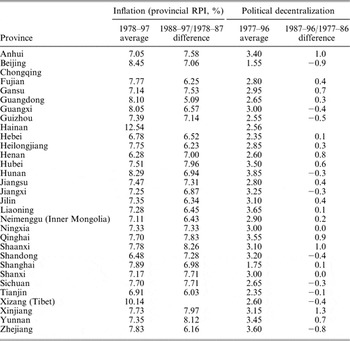
Our dependent variable is inflation in a province for a certain year. Our basic unit of observation is thus province/year. We use annual percentage change in the provincial retail price index (RPI) as our main measure of inflation because there is more data available about this, as noted earlier. We only use the CPI data as a check of robustness. We focus on the period between 1978, the beginning of the economic reforms, and 1997, in order to exclude the possible confounding influence of the region-wide deflation in the aftermath of the Asian financial crisis. Nevertheless, when checking for robustness, we extend our analysis up to 2003, the last year for which provincial economic data were available when we started the study. Table 2 presents the average inflation rates for all provinces during the years 1978–97 and the differences between the two sub-periods.
Inflation and Political Decentralization in Chinese Provinces, 1978–97

Note: Hainan was part of Guangdong province until 1988 when it attained provincial status and Chongqing was part of Sichuan province until it attained provincial status in 1997. Thus, data for Guangdong (1978–87) include those for Hainan and data for Sichuan (1978–96) include those for Chongqing. The same rule applies to all other economic variables used in this study. Inflation data for Tibet are missing for 1978–89.
As noted earlier, China under the single-party rule of the CCP in this era has a most centralized political system in the Rikerian sense. The Politburo of the sole governing political party together with its Department of Organization on the central level, is charged with appointing all the senior officials at the provincial level, i.e., the party secretaries and the provincial governors. As in all other Communist states, the party secretaries heading the provincial party committees outrank the governors in the power hierarchy.Footnote 56 They are ultimately responsible for implementing central policies or formulating their own policies in their provincial jurisdictions.Footnote 57 Thus, we focus on the provincial party secretaries, the yibashou (‘number one’ officials) leading the provincial governments. Although the bureaucratic appointment processes are identical, the relationships between the top provincial officials, once they are appointed, and the central government differ substantially.
This is a phenomenon first noted by Huang, who then uses information on these differences to construct his ‘bureaucratic integration’ variable that denotes the extent of central political control over the provincial governments led by these officials.Footnote 58 For Huang, there are four types of provincial party secretaries in China. One is what he calls the ‘concurrent centralists’. These are officials who, while occupying provincial positions, also hold central positions. For example, some of them are also members of the Politburo. In essence, they are national and provincial policy makers simultaneously. At the other extreme are what he calls the ‘localists’, people who have spent their entire careers in the provinces where they are still currently appointed. Between these two ends are two other types of provincial officials. One would be the ‘centralists’, who occupied central positions before being appointed to their current provincial positions. The category between the ‘localists’ and ‘centralists’, who worked in other provinces before their current provincial appointments, are dubbed ‘outsiders’.
Huang postulates that political control by the central government is strongest over the provincial governments led by concurrent centralists who have the greatest incentives to comply with the policy preferences of the central government. It is weakest over those overseen by localists least predisposed to such policy compliance. The amount of central control over the provincial governments led by centralists and outsiders falls somewhere in between. Provincial governments led by the ‘centralists’ are more tightly controlled; these officials would be more sympathetic with the policy preferences of the central government, possibly because of a pro-centre policy outlook they might have imbibed while working in the national capital. This is certainly consistent with our earlier discussion of Riker’s second partisan dimension of political decentralization – the extent of political control through the governing political party, in essence gauging the ability of the central government to exact policy compliance from sub-national governments.
We have collected similar data for China’s top provincial officials, but made one modification to Huang’s coding – our measure of political decentralization is the inverse of Huang’s bureaucratic integration measure. That is, we assigned a value of 1 to those province/years whose governments are led by the concurrent centralists, 2 to those by the centralists, 3 to those by the outsiders, and 4 to those by the localists. This measure indicates a gradation of political decentralization enjoyed by the different provincial governments in the Chinese political system, with the value of 4 denoting the highest level of political decentralization and 1 the lowest. We call our independent variable Political Decentralization. To remedy the potential problems of mutual causality, we lag our political independent variable by one year. All the political data are from biographical information in Chinese official sources.Footnote 59 The average Political Decentralization scores for all provinces across the years 1977 to 1996 and the differences between the two sub-periods are reported in Table 2.
We have noted above the aversion of the Chinese central government to macroeconomic instability. We expect that provincial governments less sympathetic to or compliant with the policy stance of the central government (i.e., those run by localist or outsider party secretaries) to be less likely to overcome the collective action curse in helping to provide a national-level public good such as low inflation. They should be more likely to engage in policy opportunism and pursue economic policies in their jurisdictions conducive to higher provincial inflation (by squeezing commercially unviable loans from state banks, launching unauthorized public investment projects, etc.). Therefore, we hypothesize that, all else being equal, the degree of political decentralization should be positively correlated with inflation in the Chinese provinces in this period. Those province/years with higher scores on our Political Decentralization variable should witness higher inflation than those with lower scores, ceteris paribus.
Cross-section time-series evidence
Model Specification and Estimation Issues
Our cross-section time-series dataset is composed of annual observations for thirty provincial units over about twenty years. Pooled time-series cross-section analysis, increasingly popular in political science research, allows us to examine both diachronic and spatial variation in the dependent variable with a larger number of observations.Footnote 60 Our empirical model on provincial inflation is thus as follows:

In Equation 1, Inflation i,t is our dependent variable, annual inflation rate for province i in year t. αi is a province-specific intercept included to capture unobservable effects ‘fixed’ to each province, equivalent to adding a dummy variable for each province. Similarly, λt is an annual year dummy variable to account for year-specific effects (such as centrally imposed austerity programmes).Footnote 61Political Decentralizationi ,t −1 is the degree of political decentralization for province i in year t−1, lagged by one year. β 1 is a vector of coefficients for our independent variable.
Economic i,t is a matrix of economic control variables for province i in year t. Specifically, we include the following. GDP Growth is the annual growth rate of the real Gross Domestic Product (constant at 1977 RMB) for each province/year.Footnote 62 We expect lower inflation when the economy is performing well.Footnote 63Per Capita GDP (natural log of its 1977 constant value) measures provincial income, often included in empirical studies on inflation to control for the role of level of economic development.Footnote 64 A measure of trade openness also appears in cross-national analysis. Openness can help commit a country to less inflationary monetary policies.Footnote 65 For our purposes, such a rationale is less applicable as the provinces do not directly make monetary policies, although the central government could respond to provincial economic performance with monetary policies. We include it here because of the possibility that trade openness might affect the type of provincial officials appointed in the first place.Footnote 66 Thus, we add Export, the percentage share of total provincial exports in provincial GDP.Footnote 67
Political decentralization is our central analytical concern, but we also control for the role of fiscal decentralization. Cross-country studies measure fiscal decentralization as the share of sub-national spending in total government outlays,Footnote 68 but this is not appropriate for a sub-national research design. We follow Zhang and Zou to operationalize Fiscal Decentralization as the ratio of real per capita provincial budgetary spending over real per capita budgetary expenditure by the central government (at constant 1977 RMB).Footnote 69 Fiscal decentralization may have ambiguous effects on inflation. Provincial governments can engage in unproductive investment projects, thus fuelling inflationary pressures.Footnote 70 They may also invest in productive projects that can increase supply capacity in the long run.Footnote 71 The effects of fiscal decentralization largely depend on the productivity of local investment projects, for which we do not have strong prior conjectures.
The existing literature also suggests that the size of the state sector also matters for inflation outcomes.Footnote 72 The reasoning is that provincial governments may divert funds to promote the more profitable non-state sector, forcing the injection of credit to maintain a given level of support to the state sector. If so, the effects of State Investment, the percentage share of state-sector fixed-asset investment in provincial total fixed-asset investment, should be negative because high provincial state-sector investments reduce the need for the injection of credit and the pressures for inflation. Finally, Bates argues that policies in developing countries are biased in favour of the more geographically concentrated urban sectors. These urban centres matter more for political stability, and lavishing resources on urban centres facilitates political pacification.Footnote 73 We thus include Urban Employment, the percentage share of urban employment in total provincial employment. If more urbanized provinces are more powerful politically and thus more likely to get away with high inflation, it should take on a positive sign. We do not lag these economic variables because we believe that their effects are instantaneous.Footnote 74
β 2 is a matrix of coefficients for the economic control variables, and εi,t is the disturbance term, assumed to be normally distributed with an expected mean of 0 and a variance of σi 2. Our data are slightly skewed because Hainan only became a province in 1988 and inflation data are missing for Tibet prior to 1990. Ordinary Least Squares (OLS) regressions with panel corrected standard errors have become the standard estimation technique for such data in political science and are also adopted here.Footnote 75 Proper use of this estimation technique requires that there is no autocorrelation in the residuals. Lags of dependent variables are often included to correct for serial correlation. In our case, simple tests recommended by Beck show that two levels of lag for our dependent variable are needed to clear serial correlation in the errors.Footnote 76
Empirical Results
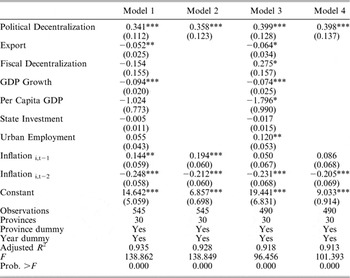
The results are reported in Table 3. Model 1 is our baseline estimation. In Model 2, we drop all economic control variables. Models 1 and 2 use the RPI-based inflation measure; Models 3 and 4 use the CPI-based inflation measure. Overall, our measure of political decentralization is positively related to provincial inflation. More politically decentralized province/years have higher inflation, all else being equal. The results are highly significant across all four models (at 0.01).
OLS Estimation of the Effects of Political Decentralization on Provincial Inflation, 1978–97: Panel Analysis

Note: The dependent variable is the annual inflation rate for each province during 1978–97. In Models 1 and 2, the dependent variable uses provincial retail price indices; in Models 3 and 4 it uses provincial consumer price indices. Panel-corrected standard errors are in parentheses. Results for province and year dummies are omitted to economize on space.
***p < 0.01; **p < 0.05; *p < 0.1 (two-tailed tests).
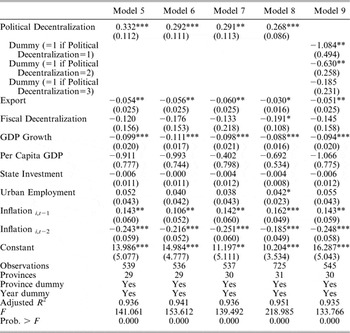
According to Model 1, an increase in Political Decentralization by one unit, say, from a province/year ruled by an ‘outsider’ to a province/year ruled by a ‘localist’, is on average associated with an increase in provincial inflation by about 0.34 per cent, all else being equal. In other words, inflation in a province/year whose government was presided over by a localist secretary is expected to be higher by approximately 1.02 per cent than in a province/year ruled by a concurrent centralist. This is an economically meaningful difference given that the average provincial inflation rate during this period was about 7.57 per cent. The significant and positive effects remain largely unchanged in either magnitude or statistical significance if we drop all economic control variables (Model 2), or use provincial CPI-based inflation data (Models 3 and 4). As shown in Table 4, moreover, similar results were generated in additional tests dropping the observations from Tibet (Model 5) or Hainan (Model 6), the two provinces that are often omitted in other studies on China employing provincial data.
OLS Estimation of the Effects of Political Decentralization on Provincial Inflation: Panel Robustness Analysis

Note: The dependent variable is the annual inflation rate (using provincial retail price indices) for each province/year. Model 5 drops observations from Tibet; Model 6 drops those from Hainan; Model 7 drops those from Shanghai after 1989. Model 8 extends analysis to the entire period of 1978–2003. In Model 9 we replace the original Political Decentralization with four dummy variables. The dummy variable equalling 1 if Political Decentralization equals 4 (and 0 otherwise) is omitted. Panel-corrected standard errors are in parentheses. Results for province and year dummies are omitted to economize on space.
***p < 0.01; **p < 0.05; *p < 0.1 (two-tailed tests).
Meanwhile, a recent theme in the Western media and academic circles is the putative rise of the ‘Shanghai gang’ in Chinese politics, associated with the move of Jiang Zemin, former Party Secretary of Shanghai, to the national capital to assume the top post of the ruling CCP in 1989.Footnote 77 Officials in Shanghai, especially those sitting together with Jiang in the Politburo (yielding lower values for the independent variable), might easily get away with pursuing pro-inflationary policies in their jurisdiction, generating higher values for our dependent variable and perhaps a negative relationship between political decentralization and provincial inflation for Shanghai during the post-1989 years.Footnote 78 If so, including observations from post-1989 Shanghai might have attenuated the hypothesized positive link between our independent and dependent variables.
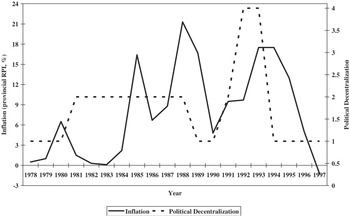
This does not seem to be the case, however. As we can see in Model 7, dropping observations from Shanghai for the post-1989 period,Footnote 79 the coefficient for Political Decentralization is still positive and highly significant (at 0.05), but its magnitude has slightly declined to about 0.29. If political decentralization and provincial inflation were negatively related for Shanghai in this period, excluding them would have enhanced the magnitude and perhaps statistical significance of the positive coefficient of our independent variable. In Figure 2, we also plot the values of our independent and dependent variables for Shanghai. In sum, there is little evidence that our empirical results have been confounded by data from Shanghai operating under an alternative logic.
Political decentralization and inflation in Shanghai, 1978–97 Note: Political Decentralization is lagged by one year.

Broadly similar results have obtained in a sequential series of regressions which drop observations from one single province at a time, suggesting that the results are not driven by any specific province. The magnitude of these results appears to shrink about 0.27 if we extend the analysis up to 2003 (Model 8). But the expanded coverage includes the post-1997 deflationary period when central-provincial preference divergence over inflation became less salient in the Chinese political economy, if only temporarily. Still, the coefficient remains significant (at 0.01).
Another concern is the use of Political Decentralization as a cardinal variable. As noted earlier, this variable takes on the four integer values from 1 to 4. Since a larger number implies a greater degree of political decentralization, these values make sense on an ordinal scale. But we are not sure whether this is also the case on a cardinal scale. That is, even if provincial inflation and a cardinal measure of political decentralization have a linear relationship, the same might not be true for an ordinal measure. We test linearity with dummy variables.Footnote 80 Four dummy variables are created, equalling 1 if the original value of our Political Decentralization variable equals 1, 2, 3 and 4, respectively, and 0 otherwise. We then replace our Political Decentralization variable with these dummy variables. The dummy variable equalling 1 when the original Political Decentralization variable equals 4 is excluded from the model as the benchmark.
The coefficients for the remaining three dummy variables in Model 9 are −1.084, −0.63 and −0.185, respectively.Footnote 81 This suggests that province/years whose governments enjoyed the lowest degree of political decentralization (led by concurrent centralist party secretaries) had the lowest inflation, and those with more politically decentralized governments (led by centralists) came second, followed by those with governments presided over by the outsiders. The omitted comparison group – province/years with governments overseen by localist party secretaries and enjoying the greatest political decentralization – had the highest inflation. Under linearity, furthermore, we expect the negative coefficient on the first dummy variable (equalling 1 if the value of original Political Decentralization variable equals 1) to be about twice that of the second dummy variable, and about three times that of the third dummy variable. A test of these restrictions cannot reject the null hypothesis that such expectations hold at the conventional levels (p = 0.618). This exercise thus justifies our direct use of our Political Decentralization variable in the regressions.
Meanwhile, export to the international market is negatively related to provincial inflation (mostly significant at 0.05, except in Model 3 when using consumer price indices to obtain our inflation data, and in Model 8 covering 1978–2003). In cross-national studies, economic openness is a proxy for the monetary policy commitment to low inflation.Footnote 82 But we include this variable mainly to control for the possible effects of provincial economic openness on political decentralization enjoyed by the provincial governments.Footnote 83 Echoing cross-national findings that better economic performance is linked with lower inflation,Footnote 84 provincial economic growth is a negative predictor of provincial inflation (highly significant at 0.01 in all our models).
The level of economic development as measured by per capita GDP also appears to be negatively related to provincial inflation, but its coefficient is only marginally significant (at 0.1) in Model 3. Likewise, provinces with higher urbanization seem to have witnessed higher inflation. This seems consistent with Bates’s suggestion that more urbanized provinces may wield more political clout and can better afford to behave in ways at variance with central policy preferences.Footnote 85 However, the positive effects of provincial urbanization are only significant in Model 3 (at 0.05) and Model 8 (at 0.1).
The results for our fiscal decentralization variable are mixed, as its coefficient switches signs when the dependent variable alternates between measures using the RPI and the CPI. While its effects are positive in Model 3, they are negative in Model 8 (both slightly significant at 0.1). But it is not statistically significant at conventional levels in the other models. Finally, the coefficient for the state-sector fixed-asset investment variable is negative in all models. This is consistent with the idea that credit diversion into the non-state sector might have been accompanied by credit expansion, possibly to maintain a given level of resource commitments to the state sector, thus contributing to higher inflation.Footnote 86 But in none of the models are the effects statistically significant.
Granger Causality Analysis
So far, we have found statistically and economically significant effects of political decentralization on sub-national inflation in China during the reform era. Specifically, the more politically decentralized provincial governments witnessed higher inflation in their jurisdictions compared with their less politically decentralized counterparts, all else being equal. Our hypothesis is that the causal direction runs from politics to economics. We can, however, postulate a rival ‘political reward’ hypothesis under which the direction of causality runs from economics to politics: the current appointment patterns and our measure of political decentralization are a function of past macroeconomic performance.
There are two possibilities. For one thing, being a concurrent centralist via a Politburo slot is considered a promotion in the Chinese political system and this position might be given to a provincial official overseeing a better record of macroeconomic management. Alternatively, provincial leaders with concurrent office holding or prior work experiences in the national capital might just be ‘better connected’ to the supreme national leaders in charge of provincial personnel assignments. They could have been assigned to plum jobs in those provinces with better macroeconomic performance in the first place by virtue of such connections. Thus, political decentralization for the provincial governments as measured here might be endogenous to provincial inflation performance.
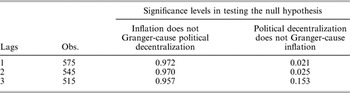
To assuage such concerns, we conduct Granger tests for our dependent variable and our political independent variable.Footnote 87 The Granger tests on whether x Granger-causes y examines how much of the current y can be explained by lagged values of x as well as by past values of y, as in Equation 2:

Here y is said to be Granger-caused by x if the coefficients on the lagged x’s are statistically significant. This is equivalent to a joint Wald test (β 1=β 2=β 3=…=βk=0) under the null hypothesis that x does not Granger-cause y. We can also run the regression the other way around, using x as the dependent variable to see whether y Granger-causes x. Accordingly, we run these Granger tests for our Inflation and Political Decentralization variables for 1978–97, with up to three levels of lag.
As we can see from Table 5, there is little evidence suggesting that provincial inflation affects the degree of political decentralization. Indeed, we cannot reject at the conventional levels of significance the null hypothesis that inflation does not Granger-cause political decentralization regardless of the levels of lag included for Inflation. We can, however, easily reject (at 0.05) the null hypothesis that political decentralization does not Granger-cause inflation (for up to two levels of lag). These tests lend support to our inference from the earlier analysis that greater political decentralization enjoyed by the provincial governments is a contributing factor to inflation in the Chinese provinces.
Pairwise Granger Tests for Mutual Causality between Political Decentralization and Provincial Inflation, 1978–97

Conclusion
‘Inflation’, Milton Friedman is famously quoted as saying, ‘is everywhere and anywhere a monetary phenomenon.’ But a monetary phenomenon itself can be deeply political. One political channel that political economists have explored at great length is decentralization, but research that views political decentralization as a constitutional construct has produced mixed evidence regarding its effects on inflation. This state of research has led Treisman to lament the lack of conclusive knowledge about the macroeconomic effects of political decentralization.Footnote 88
We concur with Rodden that part of the problem has to do with its measurement. Political decentralization measured in terms of constitutional federalism is too ‘blunt’,Footnote 89 so we follow Riker in thinking about political decentralization in terms of governing political party decentralization.Footnote 90 Given the limited existing cross-national data on political decentralization measured as governing political party decentralization, we suggest that a sub-national research design utilizing data from one country under single-party rule is especially useful for studying its effects on inflation. In addition to the usual advantages of analysing more homogeneous data from one country,Footnote 91 it also allows us to isolate the effects on inflation of the regionally differential exercise of political control by the central government through the governing political party. In post-1978 China, we have found that a greater extent of political decentralization is associated with higher inflation on the provincial level and the association is both statistically significant and economically substantial. The finding has been quite robust. The Granger tests have also ruled out at least the most egregious possibility of reverse causality.
To the best of our knowledge, our study constitutes the first empirical effort in this direction that employs data at the sub-national level. We believe our sub-national research design could be applicable to other centralized political systems, provided the requisite economic and political data on the sub-national level are available and that the policy preferences of the central government are known. Still, while our single-country focus may have improved the precision with which political decentralization is measured, we should be cautious in drawing generalizable inferences. Cross-national analysis will be indispensable with future collection of data bearing on both of Riker’s partisan dimensions of political decentralization. In this regard, it is encouraging that our findings are both consistent with prior research on the Chinese political economy – i.e., investment controls by HuangFootnote 92 – and with the cross-country evidence that political decentralization complicates macroeconomic management.Footnote 93 Such empirical consistency in turn provides more confidence in our findings.