Introduction
The widespread use of strategic planning (SP) in organizations may be threatened by the criticism of its lack of flexibility (Wolf & Floyd, Reference Wolf and Floyd2017) and the discouragement of innovation (Arend, Zhao, Song, & Im, Reference Arend, Zhao, Song and Im2017). SP involves ensuring efficient implementation but sometimes fails in the incorporation of opportunities for adapting plans that could result in even greater gains. In response to the criticism, researchers have discussed the idea of dynamic SP (Hughes & Hodgkinson, Reference Hughes and Hodgkinson2020; Ojha, Patel, & Sridharan, Reference Ojha, Patel and Sridharan2020), associating SP with dynamic capabilities (DCs).
SP is the process of formalizing, routining and controlling the strategic direction of organizations (Globocnik, Faullant, & Parastuty, Reference Globocnik, Faullant and Parastuty2020; Wolf & Floyd, Reference Wolf and Floyd2017). Hence, SP drives investment and resource use and strategic decision-making (Arend et al., Reference Arend, Zhao, Song and Im2017). DCs, in turn, are the capabilities ‘to continuously sense and seize opportunities and to periodically transform aspects of the organization and culture so as to be able to proactively reposition to address yet newer threats and opportunities as they arise’ (Teece, Reference Teece2018: 43).
The two constructs have differences and similarities that make the intersection between them worthy of attention. A more dynamic nature is attributed to DCs (Teece, Reference Teece2007; Teece, Pisano, & Shuen, Reference Teece, Pisano and Shuen1997), while SP is often related to more stable and predictable environments (Dibrell, Craig, & Neubaum, Reference Dibrell, Craig and Neubaum2014). Beyond that, SP is defined as a process and DCs as capabilities, putting them at different levels of conceptualization (Dosi, Nelson, & Winter, Reference Dosi, Nelson and Winter2000). Nevertheless, DCs and SP are logical and intentional and are predicated on routines (Helfat et al., Reference Helfat, Finkelstein, Mitchell, Peteraf, Singh, Teece and Winter2010; Zollo & Winter, Reference Zollo and Winter2002). Both are used to reconfigure internal resources aimed at improving performance and achieving competitive advantage (Enkel & Sagmeister, Reference Enkel and Sagmeister2020; Globocnik, Faullant, & Parastuty, Reference Globocnik, Faullant and Parastuty2020; Mousavi, Bossink, & van Vliet, Reference Mousavi, Bossink and van Vliet2018).
Previous studies have indicated different comprehensions of the relationship between SP and DCs. Researchers have considered SP to be a DC (Ojha, Patel, & Sridharan, Reference Ojha, Patel and Sridharan2020; Wibbens, Reference Wibbens2019; Wolf & Floyd, Reference Wolf and Floyd2017) or as an aspect of DCs (Biesenthal, Gudergan, & Ambrosini, Reference Biesenthal, Gudergan and Ambrosini2019; De Guimarães, Odelius, Medeiros, & Vargas Santana, Reference De Guimarães, Odelius, Medeiros and Vargas Santana2011). In contrasting perspectives, SP has been investigated as a mediator between DCs and performance (Andersen & Nielsen, Reference Andersen and Nielsen2009), and DCs have been examined as a mediator between SP and performance (Ouakouak, Reference Ouakouak2018).
An ambiguous understanding of how SP and DCs interact leads to different sets of research and contradictory findings. From this perspective, the literature lacks a comprehensive discussion of how these two constructs are related, especially how they impact organizational performance. Previous research portrays a fragile and inconclusive link between the constructs and their impacts on performance and competitiveness, even though these are the expected results that justify their uses in organizations (Ferreira, Coelho, & Moutinho, Reference Ferreira, Coelho and Moutinho2020; Rau, Flores, & Simha, Reference Rau, Flores and Simha2021). Some researchers believe that the difficulty in establishing this link is the cause of the decline in SP studies (Jarzabkowski & Balogun, Reference Jarzabkowski and Balogun2009).
Beyond performance, other complexities of the constructs have not yet been properly explored since they are at different levels of theoretical and practical maturity. While SP is considered one of the most explored concepts in the strategy literature (Posch & Garaus, Reference Posch and Garaus2020), the DC construct is still considered to be emerging – where its nature, antecedents and consequences are considered poorly defined and inconsistent (Bitencourt, de Oliveira Santini, Ladeira, Santos, & Teixeira, Reference Bitencourt, de Oliveira Santini, Ladeira, Santos and Teixeira2020; Haarhaus & Liening, Reference Haarhaus and Liening2020). Additionally, DCs have been criticized as vague and tautological and with low practical relevance (Ferreira, Coelho, & Moutinho, Reference Ferreira, Coelho and Moutinho2020; Froehlich, Bitencourt, & Bossle, Reference Froehlich, Bitencourt and Bossle2017; Sunder, Ganesh, & Marathe, Reference Sunder, Ganesh and Marathe2019), while SP is considered one of the most widely used management tools in organizations' day-to-day operations (George, Walker, & Monster, Reference George, Walker and Monster2019).
This theoretical effort provides a brief review of the studies that have jointly discussed the two themes and argues that SP is one of the microfoundations of DCs because it supports the seizing and continuous alignment of assets and resources (Teece, Reference Teece2007). Three propositions are presented for further empirical testing: (i) SP and other microfoundations of DCs can act in a complementary way to improve the perception of the external environment; (ii) SP operationalizes the demands of other microfoundations, reflecting them in the reconfiguration of ordinary capabilities and impacting performance; and (iii) performance and SP play a role in the development of DCs as a whole.
This paper is the first to discuss SP as one of the microfoundations of DCs, considering the complementarities between them, and argues that the interaction between SP, other microfoundations and performance over time can create a virtuous and mutually reinforcing cycle, resulting in improvements in DCs, SP and performance. No previous studies that directly address these complementary relationships or encompass the themes more broadly as in this discussion were found.
This study contributes to the literature by discussing the role of SP in the creation and development of DCs, considering aspects such as learning (Pulsiri & Vatananan-Thesenvitz, Reference Pulsiri, Vatananan-Thesenvitz, Kocaoglu, Anderson, Kozanoglu, Niwa, Steenhuis and Perman2018; Sirén & Kohtamäki, Reference Sirén and Kohtamäki2016), perception of the external environment (Hughes & Hodgkinson, Reference Hughes and Hodgkinson2020) and performance (Ferreira, Coelho, & Moutinho, Reference Ferreira, Coelho and Moutinho2020; Pezeshkan, Fainshmidt, Nair, Lance Frazier, & Markowski, Reference Pezeshkan, Fainshmidt, Nair, Lance Frazier and Markowski2016; Rau, Flores, & Simha, Reference Rau, Flores and Simha2021; Wibbens, Reference Wibbens2019). This paper sheds light on how SP and DCs interact and how this link can be considered in DC research to strengthen its empirical basis (Ferreira, Coelho, & Moutinho, Reference Ferreira, Coelho and Moutinho2020; Froehlich, Bitencourt, & Bossle, Reference Froehlich, Bitencourt and Bossle2017; Sunder, Ganesh, & Marathe, Reference Sunder, Ganesh and Marathe2019). Finally, this article clarifies the impact of SP and performance on DCs over time (Dixon, Meyer, & Day, Reference Dixon, Meyer and Day2014), arguing how this can help to measure and support the effectiveness of DCs (Ojha, Patel, & Sridharan, Reference Ojha, Patel and Sridharan2020).
This paper contributes to practitioners by updating the importance of SP and highlighting its role in adapting an organization to the market and seizing opportunities. This article clarifies the integration required between knowledge acquisition and external environment assessment routines with SP, aiming to make it more flexible and supportive towards innovation. Finally, this study details how previous information from SP and performance measurements can be used to generate better strategies.
This article is structured in five sections. It begins with the introduction, presenting the themes considered, and the relevance of this discussion for academia and practitioners. The concepts of SP and DCs are briefly explained in the following section, standardizing definitions for the discussions that follow. In the third section, the procedures employed for the search of the papers that support this theoretical effort are detailed. The central argument of this paper is presented in the penultimate section, discussing SP as one of the microfoundations of DCs in terms of strategy formulation, performance measurement and the use of performance information over time, along with the theoretical and practical implications of these argumentations. The final considerations are described in the last section, highlighting the main aspects of this study.
Literature review
SP
Made popular among organizations in the 1950s and 1960s, SP is the periodic process in which strategic investment priorities and the use of resources are systematized and formalized (Grant, Reference Grant2003). SP starts from a rational vision of the threats and opportunities of an organization, formalizing it to standardize information and strategies and concretizing the way to achieve objectives (Arend et al., Reference Arend, Zhao, Song and Im2017; Globocnik, Faullant, & Parastuty, Reference Globocnik, Faullant and Parastuty2020). In practice, SP includes the organization's mission, the analysis of the internal and external environment perception, the strategies to be adopted, the objectives in the period and the action plans (George, Walker, & Monster, Reference George, Walker and Monster2019; Wolf & Floyd, Reference Wolf and Floyd2017).
SP routinizes processes of the formulation, implementation and control of strategy, signalling to the operational environments the activities and resources needed to fulfil an organization's mission and achieve the planned objectives (Globocnik, Faullant, & Parastuty, Reference Globocnik, Faullant and Parastuty2020). Accordingly, SP acts as a coordinator and integrator of resources and processes with the aim of generating better performance (Wolf & Floyd, Reference Wolf and Floyd2017).
However, the positive impacts of SP on performance found in some studies have been criticized for the loss of innovation in the name of efficiency. From this perspective, the processes and routines implemented become a rigid structure that stifles new strategic thinking and makes them difficult to adapt (Arend et al., Reference Arend, Zhao, Song and Im2017; George, Walker, & Monster, Reference George, Walker and Monster2019). Strategy innovation and adaptation are essential in uncertain and rapidly changing environments, in which organizations are currently. SP advocates argue there can be planned flexibility; some level of innovation and adaptation can be achieved without abandoning efficiency and formalization (Dibrell, Craig, & Neubaum, Reference Dibrell, Craig and Neubaum2014; Grant, Reference Grant2003). Both the relationship of SP to performance and the development of this dynamic SP are signalled as relevant research gaps (Hughes & Hodgkinson, Reference Hughes and Hodgkinson2020; Rau, Flores, & Simha, Reference Rau, Flores and Simha2021).
DCs
Identified In 1997, DCs are defined as ‘the potential to systematically solve problems, enabled by its propensity to sense opportunities and threats, to make timely decisions, and to implement strategic decisions and changes efficiently, thereby ensuring the right direction’ (Ferreira, Coelho, & Moutinho, Reference Ferreira, Coelho and Moutinho2020: 1). DC studies come from at least two different epistemological roots, generating different understandings of the concept and different expectations about their contribution to organizations (Arndt & Bach, Reference Arndt and Bach2015).
From the perspective of the evolutionary school, DCs are positioned at the level of competitive strategy, seeking to challenge competitors through innovation to achieve better performance and a better position in the market. From the perspective of the behavioural school, DCs are positioned as best practices and simple rules that operationalize broader and general objectives (e.g., growth or learning), seeking to adapt an organization to the market (Arndt & Pierce, Reference Arndt and Pierce2018; Di Stefano, Peteraf, & Verona, Reference Di Stefano, Peteraf and Verona2014).
The evolutionary school of DCs is linked to the work of Teece, Pisano, and Shuen (Reference Teece, Pisano and Shuen1997), while the behavioural school is linked to the work of Eisenhardt and Martin (Reference Eisenhardt and Martin2000) as one of the most influential. This theoretical effort concurs with Di Stefano, Peteraf, and Verona (Reference Di Stefano, Peteraf and Verona2014) and considers that the two schools represent different but complementary levels of action. However, by discussing the consequences of DCs on performance and competitive strategy, considering the heterogeneity of resources and problemistic search, this study is more in line with the evolutionary school of DCs (Arndt & Pierce, Reference Arndt and Pierce2018).
From this literature stream, DCs rest in the processes of sensing, seizing and transforming, which are translated into routines of integration and coordination of activities and technologies (Teece, Reference Teece2007; Teece, Pisano, & Shuen, Reference Teece, Pisano and Shuen1997). Recognizing changes in the environment and detecting new opportunities and threats make up sensing, which includes routines for acquiring new knowledge about customers, competitors, suppliers and new market scenarios. Once an opportunity or threat is identified, the seizing process changes ordinary capabilities, products, processes and business models, mobilizing resources to exploit the opportunity or protect an organization from the threat. Finally, transformation means reconfiguring resources and capabilities continuously to support the adaptation between the external environment and the enterprise; it concerns strategic decision-making, learning and the model of governance of results (Enkel & Sagmeister, Reference Enkel and Sagmeister2020; Mousavi, Bossink, & van Vliet, Reference Mousavi, Bossink and van Vliet2018; Teece, Reference Teece2007). The several routines and processes that make up sensing, seizing and transforming are called microfoundations (Teece, Reference Teece2007).
Because they are considered higher-order capabilities, DCs adjust ordinary capabilities, processes and internal routines to meet market demands, generating an indirect impact on performance (Biesenthal, Gudergan, & Ambrosini, Reference Biesenthal, Gudergan and Ambrosini2019; Qaiyum & Wang, Reference Qaiyum and Wang2018; Ringov, Reference Ringov2017; Schriber & Löwstedt, Reference Schriber and Löwstedt2020). Ordinary capabilities, also called substantive or operational capabilities, are the capabilities used to carry out day-to-day operational and routine activities of organizations (Biesenthal, Gudergan, & Ambrosini, Reference Biesenthal, Gudergan and Ambrosini2019; Schriber & Löwstedt, Reference Schriber and Löwstedt2020; Zahra, Sapienza, & Davidsson, Reference Zahra, Sapienza and Davidsson2006).
From the moment they are created, DCs begin a life cycle and mature over time, being impacted by resource orchestration, knowledge acquisition and learning (Bitencourt et al., Reference Bitencourt, de Oliveira Santini, Ladeira, Santos and Teixeira2020; Tran, Zahra, & Hughes, Reference Tran, Zahra and Hughes2019; Wilden, Gudergan, & Lings, Reference Wilden, Gudergan and Lings2019). These factors, together with perceptions of the external environment and decisions made in the past, form the knowledge base necessary for DCs to evolve, impact ordinary capabilities and transform themselves (Biesenthal, Gudergan, & Ambrosini, Reference Biesenthal, Gudergan and Ambrosini2019; Dixon, Meyer, & Day, Reference Dixon, Meyer and Day2014; Haarhaus & Liening, Reference Haarhaus and Liening2020).
The literature has gaps in the nature, antecedents and consequences of DCs (Haarhaus & Liening, Reference Haarhaus and Liening2020). There is a lack of understanding of how DCs are developed (Dixon, Meyer, & Day, Reference Dixon, Meyer and Day2014; Haarhaus & Liening, Reference Haarhaus and Liening2020; Tran, Zahra, & Hughes, Reference Tran, Zahra and Hughes2019), as well as of their impacts on innovation (Froehlich, Bitencourt, & Bossle, Reference Froehlich, Bitencourt and Bossle2017) and performance (Ferreira, Coelho, & Moutinho, Reference Ferreira, Coelho and Moutinho2020; Wibbens, Reference Wibbens2019). Little is known about how performance interacts with DCs over time (Dixon, Meyer, & Day, Reference Dixon, Meyer and Day2014).
Methods
This theoretical effort aims to discuss the complementarities between SP and DCs, arguing that SP is one of the microfoundations of DCs. The discussion emerged from reading a review of SP literature carried out by Wolf and Floyd (Reference Wolf and Floyd2017). In the review, the authors argue that SP is a DC and, as such, is capable of generating other DCs, albeit as a distal outcome.
To investigate and deepen these arguments, a new literature review was performed but now considering studies that have simultaneously investigated SP and DCs. A reliable and replicable process of searching and organizing information was adopted to understand how researchers have been studying the two concepts (Treinta, Farias Filho, Sant'Anna, & Rabelo, Reference Treinta, Farias Filho, Sant'Anna and Rabelo2013; Webster & Watson, Reference Webster and Watson2002).
The search engines chosen were Web of Science (WOS) and Scopus so as to cover a large number of management journals, including those considered the most relevant in business strategy. Having a large number of papers indexed increases the chances of finding relevant articles. In addition, WOS has been widely used in articles reviewing topics related to management (Milian, de Spinola, & de Carvalho, Reference Milian, de Spinola and de Carvalho2019; Sassetti, Marzi, Cavaliere, & Ciappei, Reference Sassetti, Marzi, Cavaliere and Ciappei2018).
The searched terms were ‘strategic plan*’ and ‘dynamic capa*’, simultaneously using the Boolean operator ‘and’. SP searches covered papers indexed with ‘strategic plan(s)’ and ‘strategic planning’ and articles on DCs with ‘dynamic capability (ies)’ or ‘dynamic capacity (ies)’. Keywords were searched in the titles, abstracts and keywords of the papers indexed in the two search engines.
The initial search returned 53 articles on WOS and 121 in Scopus. To ensure the papers discuss DCs and SP from an organizational point of view, the results were limited by categories correlated to management: Management, Business, Business Finance and Public Administration on WOS and Business, Management and Accounting in Scopus, resulting in 31 papers on WOS and 73 in Scopus.
A new refinement was made regarding the type of document, filtering the works so only articles and conference papers were included. Adding up the refined searches, 98 papers remained, seven of which were duplicated and were excluded. Abstracts and titles were read to check adherence to the discussion, and 31 papers mentioned SP and DCs or other issues related to both constructs. These papers were downloaded and read. Nine of them mention one of the concepts in a ceremonial way, emphasizing the other. Three even discuss the two themes more comprehensively but do not explicitly relate SP with DCs. Four mention the themes to introduce other concepts. Thus, only 15 studies were directly connected to this discussion. A summary of the process of searching and refining the articles is presented in Figure 1.
Search and refinement of articles discussing both dynamic capabilities and strategic planning.

As the main objective was not an exhaustive review but rather the provision of a landscape for the arguments discussed here, the articles found in the review were supplemented with other papers deemed pertinent. These studies, although not jointly discussing DCs and SP, were indispensable to the argumentation in this theoretical effort and are referenced to the extent to which the ideas are exposed. Having briefly presented the review stage, the next section discusses the relations between DCs and SP.
SP and DCs: overlapping or complementary concepts?
The studies found in the literature review are presented in Table 1, which details how researchers have investigated the relationships between SP and DCs. Some papers considered SP a DC (Ojha, Patel, & Sridharan, Reference Ojha, Patel and Sridharan2020; Wibbens, Reference Wibbens2019; Wolf & Floyd, Reference Wolf and Floyd2017), while others considered it an aspect of DCs (Biesenthal, Gudergan, & Ambrosini, Reference Biesenthal, Gudergan and Ambrosini2019; De Guimarães et al., Reference De Guimarães, Odelius, Medeiros and Vargas Santana2011).
Summary of the literature review

SP, strategic planning; DCs, dynamic capabilities; SMEs, small and medium-sized enterprises.
Some researchers considered SP to be a process that integrates the efforts of DCs to impact performance (Andersen & Nielsen, Reference Andersen and Nielsen2009). Others changed the direction of the relationship between the two concepts and examined DCs as mediators in the impact of SP on performance (Ouakouak, Reference Ouakouak2018). Moreover, Tometich, Fracasso, Zen, and Engelman (Reference Tometich, Fracasso, Zen and Engelman2019) investigated the reconfiguration of ordinary capabilities from DCs to implement SP. This role of DCs and SP in strategy implementation was also studied by Gagné (Reference Gagné2018). Learning (Pulsiri & Vatananan-Thesenvitz, Reference Pulsiri, Vatananan-Thesenvitz, Kocaoglu, Anderson, Kozanoglu, Niwa, Steenhuis and Perman2018; Sirén & Kohtamäki, Reference Sirén and Kohtamäki2016) and foresight (Pulsiri & Vatananan-Thesenvitz, Reference Pulsiri, Vatananan-Thesenvitz, Kocaoglu, Anderson, Kozanoglu, Niwa, Steenhuis and Perman2018; Vecchiato, Reference Vecchiato2015) also appeared in the intersection between SP and DC studies.
SP and DCs share some similarities: both are periodical, systematic and intentional; are predicated on routines; and need to deal with an uncertain and challenging competitive environment (Haarhaus & Liening, Reference Haarhaus and Liening2020). Given the nature of SP, it could be assumed that its performance would be limited to organizations operating in predictable and stable environments, with low effectiveness in more volatile environments (Dibrell, Craig, & Neubaum, Reference Dibrell, Craig and Neubaum2014). However, some researchers have argued the opposite. Pasha and Poister (Reference Pasha and Poister2017), for example, believe that in turbulent environments, organizations need to pay more attention to their structures, goals and mission in order not to lose their raison d'etre, with SP being fundamental in these cases. Moreover, Batra, Sharma, Dixit, and Vohra (Reference Batra, Sharma, Dixit and Vohra2018) stated, ‘Strategic planning not only helps organizations in responding effectively to an uncertain environment but also in reducing uncertainty’ (p. 496).
Some authors observed a clear overlap between the two concepts, arguing that SP itself is one of an organization's DCs (Hughes & Hodgkinson, Reference Hughes and Hodgkinson2020; Wibbens, Reference Wibbens2019; Wolf & Floyd, Reference Wolf and Floyd2017). Dynamic SP is defined as ‘the strategic planning process that aligns a firm's vision and resources to accommodate changes in the external environment for capturing emerging opportunities’ (Ojha, Patel, & Sridharan, Reference Ojha, Patel and Sridharan2020: 1).
SP becomes a DC precisely to enable responding to changes in the external environment, being more aligned with the demands of stakeholders and being able to learn from the process (Wolf & Floyd, Reference Wolf and Floyd2017). The dynamic SP literature emphasizes the role of SP in reconfiguring resources to adapt an organization to the environment, which is coherent with the concept of DCs (Hughes & Hodgkinson, Reference Hughes and Hodgkinson2020). However, the literature mentions little about how dynamic SP performs sensing.
This paper argues that SP is one of the microfoundations of DCs rather than being a DC (Li, Easterby-Smith, & Hong, Reference Li, Easterby-Smith and Hong2019; Teece, Reference Teece2007). Regarding this perspective, the role of SP transcends being a DC specifically and impacts the realization of other DCs, as well as their development, maturation and even retirement.
SP as one of the microfoundations of DCs
Some studies have already considered SP as a part of DCs. De Guimarães et al. (Reference De Guimarães, Odelius, Medeiros and Vargas Santana2011) positioned SP as part of search routines – those that seek external changes to reconfigure resources internally. Biesenthal, Gudergan, and Ambrosini (Reference Biesenthal, Gudergan and Ambrosini2019), in turn, discussed the role of routines that influence behaviours and courses of organizational actions in the reconfiguration of ordinary capabilities by DCs. SP could be considered one of these routines because it integrates resources and outlines action plans to achieve strategic goals (George, Walker, & Monster, Reference George, Walker and Monster2019; Wolf & Floyd, Reference Wolf and Floyd2017). Finally, Andersen and Nielsen (Reference Andersen and Nielsen2009) outlined that SP integrates DCs' efforts to make a performance impact.
Teece (Reference Teece2007), one of the seminal and most influential authors on DCs, mentioned organizational processes that support the seizing of opportunities and the continuous alignment and realignment of assets as the microfoundations of DCs. This paper argues that one of these processes, perhaps the most important of them for its diffusion in the corporate world, is SP.
Organizational strategy has an interpretative and subjective component, and the processes and capabilities involved can range from clearly defined issues to broader, ambiguous and fluid issues (Dutton & Duncan, Reference Dutton and Duncan1987). From this perspective, there is one part that can be easily translated into processes and routines, but there is also another that demands intuition, art, creativity and flexibility to think beyond the box. As Mintzberg (Reference Mintzberg1994: 112) wrote, ‘Sometimes strategies must be left as broad visions, not precisely articulated, to adapt to a changing environment’.
The DC approach seems to embrace this ambiguity. Teece, Peteraf, and Leih (Reference Teece, Peteraf and Leih2016) mentioned that processes and routines are an essential aspect of DCs but that strong DCs are not based entirely on them. There is a mixture of art and intuition, science and analysis in the detection and diagnosis of organizational environments and strategy formulation (Dutton & Duncan, Reference Dutton and Duncan1987; Teece, Reference Teece2018). Due to its rationality and control characteristics, SP – as one of the microfoundations of DCs – acts not only in the science and analysis of strategy results but also in the execution and feedback (Pasha & Poister, Reference Pasha and Poister2017).
As a simplification of more complex thinking, SP is indispensable for good implementation (Gagné, Reference Gagné2018), even under strong environmental uncertainties (Batra et al., Reference Batra, Sharma, Dixit and Vohra2018; Pasha & Poister, Reference Pasha and Poister2017). SP synthesizes and clarifies the critical information that needs to be considered. SP standardizes understandings and directs the objectives that guide performance (Dutton & Duncan, Reference Dutton and Duncan1987) and decision-making (Posch & Garaus, Reference Posch and Garaus2020). Conversely, because it is procedural and based on clearly articulated and delimited information, SP per se is insufficient to perceive and diagnose the external environment and choose the best opportunity to be explored (Teece, Reference Teece2018). SP indicates what will be done and how an opportunity should be seized (Ojha, Patel, & Sridharan, Reference Ojha, Patel and Sridharan2020); the other microfoundations of DCs come first, working on the search, diagnosis and characterization of which opportunities are among the possible alternatives and which should be pursued.
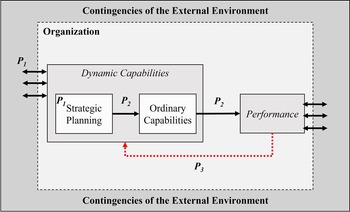
As part of DCs, SP and DCs complement each other – impacting performance and generating learning and new DCs over time in a virtuous and mutually reinforcing cycle, as shown in Figure 2.
A virtuous and mutually reinforcing cycle between dynamic capabilities and strategic planning.

The framework consists of three propositions and considers the theme from the main components of performance: formulation of the strategy, measurement of performance and the use of performance information to make decisions (Pasha & Poister, Reference Pasha and Poister2017). Each proposition is further discussed in the other sections.
Formulating the strategy
The complementary relationship between SP and DCs begins with the other microfoundations performing what some authors call problemistic search (Posen, Keil, Kim, & Meissner, Reference Posen, Keil, Kim and Meissner2018). It is a scanning of the external environment to find opportunities that, when exploited by the organization, would result in improvements of performance and competitiveness. The problemistic search, within the DC approach, considers the Schumpeterian idea of innovation, using the heterogeneity of resources to exploit opportunities that other competitors have not yet explored or recognized (Arndt & Pierce, Reference Arndt and Pierce2018).
The literature highlights that since the first studies on competitive advantage, environmental analysis tools have been used to substantiate decisions routinized by SP, such as the analysis of the Porter's five forces (Sunder, Ganesh, & Marathe, Reference Sunder, Ganesh and Marathe2019). What is argued here is that this information now comes from other DC routines since SP, by its own more formal and procedural nature, creates rigidities and inflexibilities for the entry of new knowledge (Arend et al., Reference Arend, Zhao, Song and Im2017; Dibrell, Craig, & Neubaum, Reference Dibrell, Craig and Neubaum2014). With an obstacle to the absorption of new knowledge, the adaptation or innovation required to exploit an opportunity becomes more difficult (Posch & Garaus, Reference Posch and Garaus2020). In more stable sectors, the lack of new knowledge does not seem to pose substantial problems, but in the face of rapid change, the absorption and integration of new knowledge becomes imperative (Li & Liu, Reference Li and Liu2014).
Faced with uncertainty and rapid changes in the environment, organizations plan more (Brews & Purohit, Reference Brews and Purohit2007), but the effectiveness and perceived value of the plan decreases (Dibrell, Craig, & Neubaum, Reference Dibrell, Craig and Neubaum2014). One reason for this may be the knowledge itself – which, once received and used, also becomes rigid if not constantly updated (Nieves & Haller, Reference Nieves and Haller2014).
Analysing SP as one of the microfoundations of DCs and not a DC specifically could give a little more autonomy for other microfoundations to perform the periodic search for new knowledge, especially because new and valuable knowledge increasingly seems to be outside organizational boundaries (Enkel & Sagmeister, Reference Enkel and Sagmeister2020; Haim Faridian & Neubaum, Reference Haim Faridian and Neubaum2020). The process of learning and integrating knowledge into the enterprise occurs through a series of conflicts and social and cognitive interactions (Tran, Zahra, & Hughes, Reference Tran, Zahra and Hughes2019) that is difficult to be completely controlled by planning. Moreover, the knowledge learned alone, although indispensable, is insufficient to adapt to the environment or exploit opportunities (Dixon, Meyer, & Day, Reference Dixon, Meyer and Day2014); it is important to perform the problematic search.
Going beyond the periodic absorption of new knowledge, DCs could direct SP towards innovation. On the one hand, critics believe that SP restricts creativity by making insufficiently adaptable plans for innovations that have not yet been tried based on the limited recognition of the external environment (Posch & Garaus, Reference Posch and Garaus2020). On the other hand, defenders see SP as a framework for innovation (Batra et al., Reference Batra, Sharma, Dixit and Vohra2018). From both angles, other microfoundations of DCs could support SP in the search and implementation of innovations, especially by improving sensing routines (Froehlich, Bitencourt, & Bossle, Reference Froehlich, Bitencourt and Bossle2017).
Whereas DCs need a process to support seizing opportunities and continually reconfiguring resources to implement innovation or other strategic intents (Teece, Reference Teece2007), SP can be this process by which the reconfiguration takes place. Other microfoundations of DCs contribute to SP with a problemistic search and absorption of new knowledge.
An active search for new opportunities in the external environment and a periodic absorption of new knowledge can result in better detection and interpretation of the external environment. With a better perception of the environment as a starting point, SP can be used more efficiently to achieve strategic demands (Ojha, Patel, & Sridharan, Reference Ojha, Patel and Sridharan2020; Rudd, Greenley, Beatson, & Lings, Reference Rudd, Greenley, Beatson and Lings2008). With a more aligned SP, an organization can become more competitive by orchestrating its assets and coordinating its activities in a way to better adapt to the external environment or explore new opportunities (Teece, Reference Teece2018).
The following proposition is outlined for future research:
P1: Other microfoundations of DCs support SP with a periodic search and absorption of new knowledge – which can result in a better interpretation of the external environment, enabling a better adaptation and exploration of new opportunities by an organization.
Measuring performance
Researchers argue that performance improvements substantially depend on the ability to adapt and exploit new opportunities in an increasingly uncertain and complex market (Arndt & Pierce, Reference Arndt and Pierce2018). From this perspective, both DCs and SP play an essential role that requires further clarification (Arend et al., Reference Arend, Zhao, Song and Im2017; Jantunen, Tarkiainen, Chari, & Oghazi, Reference Jantunen, Tarkiainen, Chari and Oghazi2018; Rau, Flores, & Simha, Reference Rau, Flores and Simha2021; Ringov, Reference Ringov2017; Rudd et al., Reference Rudd, Greenley, Beatson and Lings2008). This paper argues that SP can reflect other microfoundations of DCs (especially sensing) in the reconfiguration of capabilities, processes, resources and assets. In doing so, SP cooperates with other microfoundations to jointly impact performance. SP becomes a process that formalizes the demands of the external environment that have been perceived and interpreted through other microfoundations of DCs. SP creates conditions for ordinary capabilities to develop and impact performance.
Ouakouak (Reference Ouakouak2018) argued that SP that considers more rational elements together with more adaptive ones can provide opportunities for the learning, environmental adaptation, flexibility and efficiency necessary to develop organizational capabilities (both ordinary and dynamic). In this line, Andersen and Nielsen (Reference Andersen and Nielsen2009) argued that SP creates integrative capabilities that benefit an organization and promote its growth. By signalling to operational environments the activities and resources necessary to implement a strategy, SP is able to orchestrate resources and processes to ensure the development of capabilities (Globocnik, Faullant, & Parastuty, Reference Globocnik, Faullant and Parastuty2020; Wolf & Floyd, Reference Wolf and Floyd2017).
Beyond that, ordinary capabilities would be adapted and supported by DCs as a whole (including SP) because they are endogenously reconfigured by DCs (Biesenthal, Gudergan, & Ambrosini, Reference Biesenthal, Gudergan and Ambrosini2019; Schriber & Löwstedt, Reference Schriber and Löwstedt2020). This alignment between the microfoundations of DCs impacts performance (Ojha, Patel, & Sridharan, Reference Ojha, Patel and Sridharan2020; Ouakouak, Reference Ouakouak2018; Wibbens, Reference Wibbens2019). Here, ordinary capabilities are also considered one of the microfoundations of DCs because they are essential for the sensing, seizing and transformation processes to occur (Teece, Reference Teece2007).
A study argued that DC demands need to be simplified and routinized before they are put into practice (Li, Easterby-Smith, & Hong, Reference Li, Easterby-Smith and Hong2019). The researchers argued that the process of interpreting the external environment is complex and integrates various types of knowledge. Hence, the process requires a translation to be performed, orchestrating resources and capabilities to reflect the DC guidelines. Thus, SP would be responsible for translating the DC demands and formally assigning responsibilities and resources for the respective activities (Arend et al., Reference Arend, Zhao, Song and Im2017). SP would be the link between the formulation of the strategy and its implementation, maintaining the search for its characteristic efficiency (Gagné, Reference Gagné2018). However, it would also search for flexibility to accommodate emerging changes and support the exploitation of unanticipated opportunities (Ojha, Patel, & Sridharan, Reference Ojha, Patel and Sridharan2020). SP signals how resources can be employed most efficiently (Schriber & Löwstedt, Reference Schriber and Löwstedt2020), monitors results in uncertain times and makes functional predictions, generating valuable insights to be used by other microfoundations of DCs (Haarhaus & Liening, Reference Haarhaus and Liening2020; Pulsiri & Vatananan-Thesenvitz, Reference Pulsiri, Vatananan-Thesenvitz, Kocaoglu, Anderson, Kozanoglu, Niwa, Steenhuis and Perman2018). From the flexibility side, knowledge and learning, here coming from other microfoundations, can ensure SP dynamism in the face of emerging demands (Hughes & Hodgkinson, Reference Hughes and Hodgkinson2020).
The alignment between the microfoundations of DCs (including SP) can support the results of DCs regarding performance as well as boost those results by reconfiguring ordinary capabilities (Andersen & Nielsen, Reference Andersen and Nielsen2009; Ouakouak, Reference Ouakouak2018), providing competitive advantages in the short and long term (Dixon, Meyer, & Day, Reference Dixon, Meyer and Day2014). This is explicit in the proposition below.
P2: SP formalizes and operationalizes the demands of other microfoundations of DCs, reflecting them in the reconfiguration of ordinary capabilities and aiming to generate a positive impact on organizational performance.
Using performance and SP information: a virtuous and mutually reinforcing cycle
In the last two sections, it was argued that other microfoundations of DCs and SP act in an aligned way to periodically absorb new knowledge and actively search for new opportunities in the external environment, improving the perception of the environment. SP, in turn, formalizes and operationalizes the demands of the other microfoundations – reflecting them in the reconfiguration of ordinary capabilities, which can generate an impact on organizational performance. In this section, it is argued that SP and performance play a role in the development of DCs as a whole – forming a virtuous and mutually reinforcing cycle.
The starting point of the framework presented (Figure 2) is the other microfoundations of DCs performing the acquisition of new knowledge and the problemistic search for new opportunities that could be explored. The problemistic search assumes learning from the results of the strategies regarding performance (Posen et al., Reference Posen, Keil, Kim and Meissner2018). If performance is below expectations, new interventions are required to improve the outcome. From this perspective, performance is able to measure the effectiveness and performance of DCs as a whole and SP over a period, as it does with the business model of organizations (Teece, Reference Teece2018).
The DC literature not only highlights the need to measure the impacts of DCs (Ferreira, Coelho, & Moutinho, Reference Ferreira, Coelho and Moutinho2020; Pezeshkan et al., Reference Pezeshkan, Fainshmidt, Nair, Lance Frazier and Markowski2016; Wibbens, Reference Wibbens2019) but also emphasizes the difficulty in separating these impacts from those of ordinary capabilities and other resources (Qaiyum & Wang, Reference Qaiyum and Wang2018). The challenge of measuring the impact of DCs on performance becomes even greater because several factors can interfere in this relationship. Previous studies have found variations in the relationship between DCs and performance, depending on the type and pervasiveness of strategic change (Girod & Whittington, Reference Girod and Whittington2017), the internal characteristics of the organization (e.g., size, age, managerial positions and geographical location; Bitencourt et al., Reference Bitencourt, de Oliveira Santini, Ladeira, Santos and Teixeira2020; Jantunen et al., Reference Jantunen, Tarkiainen, Chari and Oghazi2018; Qaiyum & Wang, Reference Qaiyum and Wang2018), the methods used to measure performance (Pezeshkan et al., Reference Pezeshkan, Fainshmidt, Nair, Lance Frazier and Markowski2016), the exposure to environmental dynamics and the complexity of the resource base (Ringov, Reference Ringov2017).
SP could form an analysis framework – where low performance results could signal, for example, that a DC is not yet suitable for an organization's context, that conditions are lacking for ordinary capabilities to develop (Ouakouak, Reference Ouakouak2018) or even that the microfoundations of DCs used to adapt and reconfigure ordinary capabilities do not reflect DC demands (Biesenthal, Gudergan, & Ambrosini, Reference Biesenthal, Gudergan and Ambrosini2019; Schriber & Löwstedt, Reference Schriber and Löwstedt2020). Each of these findings can generate a set of corrective actions, aiming to improve performance in the next period.
Over time, SP can refine itself and improve DCs as a whole based on the performance measurement information. SP itself can be improved due to its past performance and other aspects of organizational memory (Hughes & Hodgkinson, Reference Hughes and Hodgkinson2020). The results of the previous strategies are part of the path dependence envisaged in the first definition of DCs in 1997 (Teece, Pisano, & Shuen, Reference Teece, Pisano and Shuen1997). Suddaby, Coraiola, Harvey, and Foster (Reference Suddaby, Coraiola, Harvey and Foster2020) updated the importance of the path: ‘The capacity to manage the interpretation of the past, in the present for the future, is a critical ability that informs a firm's ability to successfully enact changes needed to adapt to disruptive technology’ (p. 530).
The historical knowledge gained from DCs as a whole and SP evolutions themselves, together with their results obtained in performance, are part of the knowledge base where new capabilities, both dynamic and ordinary, emerge (Enkel & Sagmeister, Reference Enkel and Sagmeister2020; Zollo & Winter, Reference Zollo and Winter2002). From this perspective, SP is influenced by established knowledge routines as well as influences how new knowledge is achieved or acquired and transformed into products, processes or even capability innovations (Arend et al., Reference Arend, Zhao, Song and Im2017). To Ojha, Patel, and Sridharan (Reference Ojha, Patel and Sridharan2020), an overly misaligned or rigid SP becomes a bottleneck for the application of DCs, making them less effective. Thus, SP is contained in the interactive learning factors that lead to a new capability (Tran, Zahra, & Hughes, Reference Tran, Zahra and Hughes2019), considerably delimiting the creation and development of DCs. From this viewpoint, DCs can also be a result of SP, as argued by Wolf and Floyd (Reference Wolf and Floyd2017). However, considering SP as one of the microfoundations of DCs, the contribution of SP is not limited to the creation and development of some DCs but permeates them all.
SP can anticipate and secure investments to ensure the effectiveness and dynamism of DCs (Schreyögg & Kliesch-Eberl, Reference Schreyögg and Kliesch-Eberl2007; Zahra, Sapienza, & Davidsson, Reference Zahra, Sapienza and Davidsson2006) – especially research and development, which constitute a relevant source of new capability (Enkel & Sagmeister, Reference Enkel and Sagmeister2020). When aligned with other microfoundations of DCs, SP can also help in the reflexive monitoring that must accompany the evolution of DCs, suggested by Schreyögg and Kliesch-Eberl (Reference Schreyögg and Kliesch-Eberl2007), so that the development flow of DCs does not dissolve the strategic intent or stiffen an organization, keeping DCs up to date and flexible. SP, together with performance information over time, can signal when capability needs to be created, better developed or inactivated (Helfat & Peteraf, Reference Helfat and Peteraf2003).
The reconfiguring influences new sensing and seizing processes, and so on (Mousavi, Bossink, & van Vliet, Reference Mousavi, Bossink and van Vliet2018). Therefore, when SP executes seizing and reconfiguring, it influences the generation of learning for new DCs in a cycle that mutually reinforces itself (Dixon, Meyer, & Day, Reference Dixon, Meyer and Day2014). The realization of seizing and reconfiguring through SP feeds back into the new DCs. Within this cycle is also the feedback of performance information as a way of evaluating the feasibility of some strategies (Teece, Reference Teece2018) and reviewing capabilities, objectives, processes and activities (Pasha & Poister, Reference Pasha and Poister2017). As it aims to adapt and improve the competitiveness of organizations, this cycle can be considered virtuous, in line with Dixon, Meyer, and Day (Reference Dixon, Meyer and Day2014) study about building DCs.
Considering the arguments presented, the final proposition of this study is detailed below.
P3: There is a virtuous and mutually reinforcing cycle between DCs (with SP as one of the microfoundations) and performance, thereby the alignment between SP and other microfoundations retro-fed by previous performance information generates useful learning capable of improving DCs' base and SP itself and consequently produces subsequent higher performance.
Theoretical implications
This study has three main theoretical implications of how considering SP as one of the microfoundations of DCs can impact future research. First, this new perspective expands the contributions of SP to DCs as a whole and to performance. While SP was treated only as a specific DC, its contributions were limited to self-development to achieve better performance (Ojha, Patel, & Sridharan, Reference Ojha, Patel and Sridharan2020; Wibbens, Reference Wibbens2019), eventually generating new DCs as a distal result (Wolf & Floyd, Reference Wolf and Floyd2017). Instead, SP has an active and participative role in the creation, development and implementation of all DCs. SP formalizes resource demands, organizes activities, and provides conditions for ordinary capabilities to develop (Globocnik, Faullant, & Parastuty, Reference Globocnik, Faullant and Parastuty2020; Ouakouak, Reference Ouakouak2018), execute the strategy and generate higher performance.
Second, SP is now considered the bridge between strategy formulation and implementation (Gagné, Reference Gagné2018), becoming the mechanism by which DCs endogenously reconfigure ordinary capabilities (Biesenthal, Gudergan, & Ambrosini, Reference Biesenthal, Gudergan and Ambrosini2019; Schriber & Löwstedt, Reference Schriber and Löwstedt2020), and only then to obtain a result in performance. Thus, SP becomes one possible evidence to be analysed by researchers, having the potential to facilitate the empirical identification of DCs and strengthen its practical relevance – an aspect for which it has been strongly criticized (Ferreira, Coelho, & Moutinho, Reference Ferreira, Coelho and Moutinho2020). In SP research, the alignment of the two bodies of literature can revive researchers' interest, highlighting how SP incorporates environmental changes and then results in performance. The impact of environmental changes on SP has been considered a fruitful avenue for future studies (Wolf & Floyd, Reference Wolf and Floyd2017), and the still inconclusive link between SP and performance has been considered responsible for the dramatic drop in the academic discussions of the theme (Jarzabkowski & Balogun, Reference Jarzabkowski and Balogun2009).
Finally, previous information on SP and performance measurement has become more prominent because it is considered an input for the improvement of DCs as a whole and of SP in particular (Hughes & Hodgkinson, Reference Hughes and Hodgkinson2020), as well as the performance itself in a subsequent period. By implementing seizing and transforming and having performance measured, SP generates information that influences new sensing (Mousavi, Bossink, & van Vliet, Reference Mousavi, Bossink and van Vliet2018) and can create or develop new capabilities – both ordinary and dynamic (Dixon, Meyer, & Day, Reference Dixon, Meyer and Day2014; Enkel & Sagmeister, Reference Enkel and Sagmeister2020; Zollo & Winter, Reference Zollo and Winter2002). This information can measure the effectiveness of DCs as a whole and an organization's previous trajectory, giving insights into strategies that may be more assertive in the future. Under this perspective, SP, over time, can reconstruct the trajectory of the organization, becoming useful in empirical investigations examining path dependence inside of the DC approach.
Practical implications
For practitioners, the discussions of this paper reinforce the importance of the processes that create SP and accompany its implementation. There are three main practical implications of this study. First, it reaffirms the importance of establishing and consolidating the routines of acquiring new knowledge (even from outside the organization), evaluating the external environment, and seeking new opportunities, creating conditions for DCs to be created and updated (Haarhaus & Liening, Reference Haarhaus and Liening2020; Tran, Zahra, & Hughes, Reference Tran, Zahra and Hughes2019). DCs can enable a more comprehensive view of the market, and through SP, they can more effectively guide decision-making in the organization, avoiding a blind search for efficiency in the present that can compromise profits in the long run.
Second, the study highlights the need for SP to be aligned with the routines of absorption of new knowledge and market perception in order to become more flexible and responsive. As argued by Ojha, Patel, and Sridharan (Reference Ojha, Patel and Sridharan2020), misaligned SP can make DCs less effective and decrease their performance. In this sense, practitioners need to assess whether SP supports and ensures the resources (e.g., financial and knowledge) necessary for capabilities – both dynamic and ordinary – to develop and generate a satisfactory result. SP can no longer be an obstacle to innovation (Arend et al., Reference Arend, Zhao, Song and Im2017); it has to be a means by which innovation happens more assertively (Batra et al., Reference Batra, Sharma, Dixit and Vohra2018; Gagné, Reference Gagné2018), enabling the identification and capture of opportunities.
Finally, the existence of a virtuous and mutually reinforcing cycle, which was argued in this study, denotes the need to use previous information – both from SP and performance measurement – to improve strategies and SP and, hence, increase subsequent performance (Dixon, Meyer, & Day, Reference Dixon, Meyer and Day2014; Posen et al., Reference Posen, Keil, Kim and Meissner2018; Teece, Reference Teece2018). By looking attentively and consciously at the past, it is possible to differentiate successful and unsuccessful strategies and contextualize their results, generating a pool of information that can be useful for a better interpretation of the market and the effectiveness of new strategies (Suddaby et al., Reference Suddaby, Coraiola, Harvey and Foster2020). Keeping this cycle in mind can help practitioners think about their results as part of a continuous flow, where understanding the reasons a strategy was unsuccessful can generate the learning needed for further success.
Conclusions
SP development has recently been identified as a relevant research gap (Hughes & Hodgkinson, Reference Hughes and Hodgkinson2020), and the role of environmental and organizational contingencies has been indicated as one of the areas that require the greatest efforts from SP researchers (Wolf & Floyd, Reference Wolf and Floyd2017). This study discussed the contributions of other microfoundations of DCs to SP regarding the search for the flexibility to better adapt organizations to uncertain and rapidly changing environments (Haarhaus & Liening, Reference Haarhaus and Liening2020). There is a recent movement to align these two bodies of literatures – aligning concepts of adaptation and strategic flexibility, which has been called dynamic SP. This paper extends these efforts (Hughes & Hodgkinson, Reference Hughes and Hodgkinson2020; Ojha, Patel, & Sridharan, Reference Ojha, Patel and Sridharan2020) but argues that SP is one of the microfoundations of DCs, instead of a DC specifically.
Far from having exhausted the literature concerning the two individual constructs and presenting an exhaustive review, this theoretical effort is able to exemplify some possible, as yet unstudied, relationships between DCs and SP. The main arguments are that SP is one of the microfoundations of DCs and that other microfoundations are complementary to SP. The complementarity occurs especially in the connection with the external environment since other microfoundations identify opportunities and point out ways to explore them, giving dynamism, agility and responsiveness to SP. In line, SP – as one of the microfoundations of DCs – is the formal mechanism by which the reconfiguration or restructuring of resources and capabilities discussed in the literature on DCs is executed and, thus, operationalizes the impact of DCs on performance.
The alignment between SP and the other microfoundations of DCs can result in not only innovation and performance but also the creation and development of new DCs. In this way, DCs not only complement SP but also are a result of it and performance in a virtuous and mutually reinforcing cycle. From a longitudinal perspective, the possibility of SP and performance acting to encourage or inhibit the development of new DCs and the evolution of existing ones was discussed.
The creation of DCs, from the point of view of evolutionary theory, extrapolates formal processes and is contained in the learning obtained through crises, trial and error, and emerging situations (Tran, Zahra, & Hughes, Reference Tran, Zahra and Hughes2019). However, a better understanding of the processes of creation, development and maturation of DCs remains being encouraged by researchers (Arndt & Pierce, Reference Arndt and Pierce2018; Tran, Zahra, & Hughes, Reference Tran, Zahra and Hughes2019; Wilden, Gudergan, & Lings, Reference Wilden, Gudergan and Lings2019).
The main theoretical implication of this study is that the contributions of SP and measurement of performance need to be considered in the creation and development of DCs. Therefore, this paper expands the contributions of SP, which was previously limited to being a specific DC, to all DCs and performance. Here, SP was characterized as the mechanism that implements the seizing and transforming processes and contributes to the creation and development of DCs over time in a virtuous and mutually reinforcing cycle. Three propositions were presented that could serve as a starting point for further research, including longitudinal ones. New research is strongly encouraged, aiming to contribute to the elucidation of fundamental gaps in both the study of DCs and SP.
For practitioners, this study implies not only recognizing the importance of SP but also supporting the periodic absorption of new knowledge and the active search for new opportunities. This paper argues that practitioners should assess if SP is providing conditions for an organization's capabilities to evolve and, therefore, result in better performance. Moreover, this paper presents some insight into how SP and performance feedback can generate the improvement of DCs, SP and performance over time.
Acknowledgements
This study was financed in part by the Coordenação de Aperfeiçoamento de Pessoal de Nível Superior – Brasil (CAPES) – Finance Code 001. The authors would like to thank the valuable comments received during the presentation of an earlier version of this paper at ENANPAD 2020.
Conflict of interest
None.
Gleycianne Rodrigues Araújo. PhD candidate at Pontifícia Universidade Católica do Paraná in Brazil. Her research interests include dynamic capability, strategic orientations and competitiveness.
Heitor Takashi Kato. PhD in Business Administration from EAESP, Fundação Getulio Vargas. He is Full Professor at Pontifícia Universidade Católica do Paraná. His research interests include dynamic capability, strategic process and competitiveness.
Jansen Maia Del Corso. PhD in Management Science from ESADE, Universitat Ramón Llull. He is Full Professor at Pontifícia Universidade Católica do Paraná. His research interests include strategic planning and organizational modelling.