In January 1935, the leading weekly farming magazine in England, Farmer and Stockbreeder, began publication of a new series showcasing the work of “Successful Women Farmers.” The opening page claimed that “it is generally not realised how many women are engaged in farming on their own account and making a success of it.”Footnote 1 The series ran for eighteen months and was the culmination of a process that had seen farming promoted as a suitable career for women in England over the previous four decades. This was succinctly summed up by the farmer featured in March 1935, Miss Dillon. Asked for her view on farming as a profession for women, she remarked, “It’s the finest life in the world.”Footnote 2 Miss Dillon personified a new type of woman farmer in the 1930s. Educated and articulate, she ran an Oxfordshire farm with her friend Miss Corbett, producing milk for the wholesale trade. Farmer and Stockbreeder did not doubt that farmers such as Misses Dillon and Corbett encapsulated “the valuable work which women are doing throughout the country for the advancement of agriculture.”Footnote 3 Historians have been more reticent. Women’s work has emerged as a central research theme in the new English rural historiography in recent years, but female farmers—those who owned or rented land for cultivation—remain conspicuous by their absence. Nor has farming been considered in relation to the opening up of professions for women in the nineteenth and early twentieth centuries. This article shows that debates about gender, class, and professionalization intersected in a unique way around farming. It will explore why farming came to be seen as a viable occupation for middle-class women in England and how the discourse was framed in such a way to assuage unease over gender roles and class position in the period before the First World War. The development of the primary paths to the professionalization of farming—agricultural education and training—will then be analyzed. How far these advances benefited women who moved into practical farming in the interwar period forms the focus of the final section. Utilizing personal accounts from women who farmed, this section explores whether farming was a profession that enabled middle-class women to lead economically, socially, and intellectually independent lives in the years before the Second World War.
Women have always been involved in English farming. Once a subject that elicited little attention, the participation of women as paid workers in agriculture, as both day laborers and hired servants, now commands considerable debate among historians of rural England. The place of women in the agricultural workforce during the classic industrial revolution period, whether women were paid a market or a customary wage, and how far they remained an important component of farm work in the late nineteenth and early twentieth centuries have all been scrutinized.Footnote 4 Regional studies have constructed a complex and nuanced portrait of female farm labor, which waxed and waned according to local market conditions and laboring families’ needs.Footnote 5 Recent research has shifted the focus onto the multifarious roles performed by the farmer’s wife.Footnote 6 Within this upsurge of interest in English rural women workers in the modern period, however, the figure of the female farmer has been neglected. Leonore Davidoff’s 1986 account of the gradual marginalization of women in farming between 1780 and 1850 remains the most detailed investigation. She argues that the institutions that underpinned farming—the agricultural societies and farmers’ clubs, the market halls and Corn Exchanges, the public houses, sporting pursuits, and village administrative offices—all restricted the involvement of women and made it increasingly challenging for a woman actively to run a farm. This, combined with the transformation of women’s domestic, familial, and religious roles within the increasingly status-conscious farming class, meant that “the exclusion of women with ambitions for gentility from active participation in the running of the farm was complete by the mid-century ‘golden age’ of high agriculture.”Footnote 7 This claim for the gender segregation of farming life by 1850 dovetailed with a general theme in the historiography of the social history of the first industrial revolution: the separation of male and female spheres in the middle-class world.Footnote 8
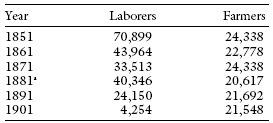
Contemporary accounts substantiate women’s problematic status in the Victorian farming world. During the boom midcentury decades of “High Farming,” English agriculture, transformed by scientific thinking and technological innovation, was portrayed in public discourse as an overwhelmingly male pursuit. It was certainly deemed no place for a woman to work as a laborer. In the late 1860s, the Reverend James Fraser warned that work on the land was liable to “unsex a woman in dress, gait, manners, character, making her rough, coarse, clumsy, masculine.”Footnote 9 His views were far from untypical. Similar arguments were used in the parliamentary debates on women and children who worked in agricultural gangs, and, in 1867, the Gangs Act outlawed public gangs, regulated distances workers could travel, and set a minimum age for the employment of children.Footnote 10 This condemnation and regulation of women’s paid work on the land were comparable to earlier and ongoing efforts to legislate working-class female labor in mines and factories.Footnote 11 Commentators therefore breathed a sigh of relief that paid working-class female labor on the land was decreasing precipitously in the last decades of the nineteenth century (table 1). As Charles Whitehead forecast in 1870, “the gradual influence of public opinion, and an average higher rate of wages to agricultural labourers throughout the country will be able in time to keep women in their proper sphere.”Footnote 12
At the same time that paid female labor in agriculture was declining, the number of female farmers remained remarkably stable (table 1). In the second half of the nineteenth century, just fewer than one in ten farms was managed or run by a woman. The majority of these were widows, living in households with their children and, as the 1901 census noted, “carrying on the farms formerly held by their husbands” until a son or other male relative could take the reins.Footnote 13 Where farms
Number of Women Engaged in Agriculture (England and Wales), 1851–1901
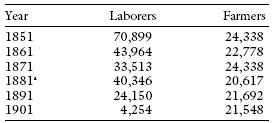
Source Census reports of England and Wales, 1851–1901.
a From 1881, this figure includes laborers and farm servants.
were tenanted, as was the usual practice in England in the nineteenth century, this was seen as a convenient measure by estate owners to ensure continuity of family occupancy. Others, though, were women farming not through their late husbands’ tenancy but in their own right. Many of these were the daughters of farmers, carrying on the family business. Around the turn of the twentieth century, however, another type of woman farmer began to emerge. She was the unmarried, middle-class, educated townswoman, drawn to farming as a profession in which she could potentially secure health, happiness, and an independent income. By the interwar period, when the census reports began to publish data on marital status, the absolute numbers of female farmers were in decline while the proportion of those who were single women farming in their own right was increasing. In 1921 and 1931, never-married single women formed 27 and 29 percent of all women farmers (table 2).
When did farming come to be viewed as a viable occupation for middle-class women? Early feminist campaigners in England placed the expansion of employment opportunities for middle-class women at the center of their crusade, and efforts to open up professions such as medicine and teaching after the mid-nineteenth century have been effectively documented by historians.Footnote 14 Farming, while not central to these debates, gradually began to emerge as a possible, if unusual, career option for country-loving urban women in the pages of the Langham Group publication Englishwoman’s Review in the 1870s.Footnote 15 It was not until the last decade of the nineteenth century, however, that a more diverse range of periodicals and magazines aimed at upper- and middle-class women began actively to showcase farming as a suitable career choice for well-to-do women frustrated by the constraints of her urban surroundings
Female Farmers (England and Wales) in 1921 and 1931

Source Census reports of England and Wales, 1921 and 1931.
and narrow employment prospects. The female magazine market was burgeoning in the last quarter of the nineteenth century and was a site where the vexed question of employment for women was increasingly articulated and debated.Footnote 16 The way that one important example, Queen (“the foremost periodical for ladies of rank and breeding”), underwent a process of reformulation from “conservative to progressive attitudes” toward women’s work has been recently analyzed by Arlene Young.Footnote 17 Her emphasis is on the three fields of work that employed most middle-class women and that “most effectively united femininity and professionalism in the cultural imagination”: teaching, nursing, and typewriting. Beyond these, though, Young acknowledges that “other less promising fields of endeavour,” including poultry farming, “drew a surprising amount of interest.”Footnote 18
Queen was not alone in this growing enthusiasm for a career well outside the usual parameters of the English metropolitan middle classes. Women’s Employment, published from 1900 by the Central Bureau for the Employment of Women in London, was a periodical covering the “Professions and Employments of Educated Women.” One of its key objectives was to advertise new openings for educated women, and it regularly included articles featuring agriculture and horticulture. Magazines aimed more directly at a rural readership also extended a welcome to female newcomers. Country Life, a magazine that epitomized upper-class rural living, recognized that as working-class rural women were retreating from the land, middle-class townswomen were increasingly grasping its potential: “it may be taken as the tendency all over England for the woman of the soil to quit field labour as quickly as she can,” it argued in 1899, but this was “counterbalanced by another equally significant. Exit the woman, enter the lady.”Footnote 19Ladies Field, the feminine supplement to “the country gentleman’s newspaper” Field, began publication in 1898 with a regular feature, “Fair Farmeresses.” By 1903, it had adopted the more egalitarian moniker “Fair Farmers.”
The promotion of farming as a career for middle-class townswomen intersected with the development of formal agricultural education and training in England. With funding from a number of disparate sources, including central government, county councils, and agricultural societies, a tripartite hierarchy of agricultural education providers began to develop before the First World War. At the top were universities, which provided three- or four-year degree courses; then came national agricultural colleges, where two-year diploma courses were taught; and finally farm institutes, where a range of certificate courses could be taken.Footnote 20 With a few notable exceptions, attendance was open to both sexes.Footnote 21 Alongside them, a number of specialist women’s colleges emerged, with Swanley Horticultural College and Studley College leading the way. Swanley began admitting women students in 1891 and became a women-only college in 1902, under the direction of Miss Frances Wilkinson. Studley was opened by Lady (later Countess) Warwick in 1903 at some personal expense. It was the successor to the Lady Warwick Hostel, which had been attached to Reading College (later the University of Reading) between 1898 and 1902. Lady Warwick’s vision was to train middle-class women in agriculture and horticulture and encourage them to live in the countryside. In the wake of these pioneering women’s colleges, a number of private schools providing horticultural education were also established.Footnote 22 The women’s colleges were aimed specifically at the daughters of wealthy metropolitan men, those who wished “to enter the profession, not those born to it.”Footnote 23 The fees levied effectively ensured that training courses were restricted to the most affluent groups in English society. Swanley, for example, charged £70 a year between 1891 and 1914.Footnote 24 These initiatives in education were supported by the foundation of organizations that aimed to assist women into farming careers. The Agricultural Association for Women was formed in 1899 as an appendage to Lady Warwick’s College. It published the instructive but short-lived periodical Woman’s Agricultural Times and ran an employment registry and marketing department, among its other activities.Footnote 25 In the same year, the Women’s Agricultural and Horticultural International Union was founded. By the time it had changed its name to the Women’s Farm and Garden Association (WFGA) in 1921, it was the foremost organization advising educated women on training opportunities and employment vacancies in farming.Footnote 26
Those who advocated farming as a suitable profession for middle-class women in late Victorian England drew upon a number of varied but overlapping “state of the nation” anxieties as justification for their cause. Farming was seen as a possible solution to the problem of surplus women: those who were unlikely to marry and needed remunerative employment in order to support themselves.Footnote 27 An article in Land Magazine in 1898 understood that frustration and resolve had compelled a new generation of women into “bestirring themselves in a way that was not thought of twenty years back, striving by one means and another to hold their own in the fierce struggle of life, to earn an independent living by their own industry and without involving the necessity of marriage.”Footnote 28 Within this shifting environment, farming began to be seen as a potential release from the confines of traditional feminized occupations. Lady Warwick noted the overcrowding of female professions in English towns in 1899 and questioned whether anything could be done to rescue women from what she termed “this wearing, joyless, unnatural existence.”Footnote 29 Her solution, for women to train in agriculture and move into the countryside, was seized upon by others. Readers of Ladies Field were told, “It is, I know, a bold thing to suggest that women of cultivated tastes should go ‘back to the land,’ though in these practical days I see no reason why we should be regarded as capable of merely earning money by needlework or by other essentially feminine occupations.”Footnote 30 Margaret Bateson, the editor of the “Employment” section of Queen, explained in 1903 that farming embodied features “absent from any other kinds of work which women are driven to undertake” and suggested that women who had been brought up to run a household “could be exercised equally well in carrying on a farm.”Footnote 31
Farming also began to be sanctioned as a beneficial occupation due to its underlying health-giving properties. Mid-nineteenth-century debates over the physical incapacities of women had been eclipsed by growing appreciation of the benefits of moderate exertion. Young townswomen, arrested by the controls imposed upon them by the urban world and the surveillance of middle-class parents, could bloom physically in a natural, outdoor workspace. She would become “head of her own world … constantly stirring, seeing after human beings and living creatures … in pure air … the quiet of the country around her.”Footnote 32 Although it was conceded that the work involved in farming could be arduous and constant, the health rewards were seen to outweigh the costs. Ladies Field reported in 1911 that “neurasthenia, the scourge of modern times, has never been known to attack the woman who, in the open air, works hard and keeps herself fit.”Footnote 33 This was endorsed by Lady Warwick, who noted that “greater freedom of dress and work and play” made “new creatures” of girls who had once been the “easy victims” of anaemia.Footnote 34 Mental fitness went along with physical health as “all the faculties of the mind are taking part in the health-giving and absorbing work of the body.”Footnote 35
Concern over women’s well-being was connected to wider unease about the state of the nation’s health in the last quarter of the nineteenth century. Falling birth rates, persistently high infant mortality, and the large number of male recruits declared unfit for military service during the Boer War all fueled eugenic fears of national racial degeneration.Footnote 36 General anxiety about the nature of urban, industrial life was exacerbated by increased economic competition from global rivals. At the same time, there was growing realization that rural areas had suffered decades of depopulation, which not only added to the economic and structural problems of towns and cities, but also had a devastating effect on many areas of the English countryside.Footnote 37 The first absolute declines in rural areas were enumerated in 1851. By the 1870s, nine English counties recorded reduced populations, with Cornwall and Rutland experiencing the worst losses.Footnote 38 The census also revealed that the number of farm laborers and servants in England and Wales fell by nearly a third between 1881 and 1901.Footnote 39 Once an activity that lay at the very heart of the English occupational structure, agriculture was hemorrhaging workers. H. Rider Haggard, on his tour of English farming at the turn of the twentieth century, was alarmed that “some part of England are becoming almost as lonesome as the veld of Africa.”Footnote 40 Migration was stimulated by the “pull” of the social and economic attractions of town. For Haggard, the agricultural laborer and his wife eschewed the charms of the natural world (which truly only appealed to the “educated”) for “the excitement of the streets.”Footnote 41 Social observers popularized the view that “urban degeneration from healthy countryman to unhealthy cockney” occurred within three generations of migration from country to town.Footnote 42 The “push” of English agriculture was equally significant, however. From the early 1870s, agriculture was hit by protracted depression, deriving from, among other things, the penetration of cheap foreign grain and foodstuffs into the English market.Footnote 43 Depopulation fueled fears that domestic agricultural production would become unsustainable in a deserted countryside and the nation would become reliant on overseas imports.
The movement of educated middle-class townswomen into farming was seen as one potential solution to rural depopulation and agricultural depression, called the “the Land question and the Labour question” by Lady Warwick.Footnote 44 It was claimed that women farmers could offer a fillip to desolate rural areas by invigorating village life, stimulating interest in local industry, and helping “in some measure to stay the depopulation.”Footnote 45 As Lady Warwick put it, training “women of education” in agriculture and horticulture could “do something towards the development of agriculture in England” by raising “the country districts from their dead level of depression” and “infusing new life and spirit into our villages.”Footnote 46 Women were seen as particularly suited to cultivate a range of “alternative” agricultural products such as butter, cheese, fruit, vegetables, flowers, bees, and poultry.Footnote 47 These were showing greater resilience to agricultural depression than traditional arable crops such as wheat, barley, and oats through increasing consumer demand from the urban population in the late nineteenth century. Having women produce these “necessities of life” would, it was argued, “add to the revenue.”Footnote 48 Edith Bradley, first warden of Lady Warwick Hall, urged, “get the women on the land to rear the necessary poultry and eggs, and so let them have the benefit of some at least of the money now enjoyed by the foreigner.”Footnote 49
In the years before the First World War, farming for middle-class women was therefore advanced in three distinct but often overlapping forums: women’s magazines and periodicals, agricultural colleges, and newly founded women’s agricultural organizations. Their endeavors have been rather dismissed by historians. Pamela Horn concludes that any “attempts to train professional women for careers as commercial farmers” at the turn of the twentieth century “were doomed to failure.”Footnote 50 At the time, however, all were greeted with enthusiasm from sections of the national and periodical press. Land Magazine believed wealthy country-bound women would “derive enormous advantage” from a program of education, with the “whole prosperity of a neighbourhood … easily changed … by a lady whose heart was in her work.”Footnote 51The Times went further, describing Lady Warwick’s hostel as “an interesting experiment, and one that is likely, if it meets with success, to have an appreciable effect upon agriculture in England.”Footnote 52 This may be seen as hyperbole, but we should not dismiss these developments as trivial. They were closely bound to the zeitgeist and bridged national concerns over the direction of English social and economic life at the turn of the twentieth century: the place of women, the “Land Question,” and the health and efficiency of the racial “stock.”
Proponents of farming for middle-class women saw no incongruity in their support for what had traditionally been a male stronghold. They warned it was “idle” to suggest that women were “not sufficiently practical to become agriculturalists, or that agriculture as a calling is too disagreeable for the feminine hand or brain.”Footnote 53 However, they had to tread a careful line between promoting an unusual career for middle-class women and maintaining a sense of social refinement and feminine respectability. After all, for decades, women had been told that work connected to the land was improper and unwomanly. They overcame this by focusing on what were labeled the “lighter branches of agriculture”: dairying, poultry, and horticulture. The mid-nineteenth-century framework of separate spheres lingered in the gendered imagery and language of expert advice fifty years later, and turn-of-the-century perspectives constructed a division between the masculine (proper farming) and the feminine (subsidiary farming).
For most prewar male agriculturists, large-scale arable production, with cereal growing at its core, represented the apex of English farming. This was farming that bestowed social, economic, and, in some cases, political status. Dairying (particularly, cheese and butter making), poultry, and other smallholding ventures, however, had traditionally been “pin-money” activities associated with the farmers’ wife.Footnote 54 For male agriculturalists, they were low-status areas of farm production. While offering a cautious welcome to female farmers, male experts therefore cautioned women not to stray from those areas of production appropriate to their gender and abilities. In 1899, Professor James Long, writing in Woman’s Agricultural Times, did not counsel women to “occupy broad acres, to manage flocks and herds and studs, and to undertake the multifarious and anxious duties of the agriculturist,” but to concentrate on “those forms of culture … which come within their sphere.”Footnote 55 Sir James Blythe believed that it was because women possessed “habits of neatness,” “deftness,” and “greater contentment with rural pursuits” that their temperament and physique fitted them for the “lighter occupations of the dairy, poultry, egg production, the greenhouse and the garden.”Footnote 56 This separation of the farming spheres was not simply used as a straitjacket to contain women, however. It was also a mantle assumed by women at the forefront of agricultural education and training as a means of appropriating a space for middle-class women in a male-dominated world. Lady Warwick noted that the term “Lighter Branches of Agriculture” was a “convenient expression” that effectively summed up “the field of labour in agriculture which is more specially the province of women than men … the dairy, work in the garden and green house, supervision of market gardens, culture of fruits, management of poultry and bees.”Footnote 57 Mrs. Roland Wilkins (Louisa Jebb), an indefatigable campaigner and organizer for the WFGA, argued that these “subsidiary” branches of agriculture that were chiefly taken up by women were “not technically actual farming.”Footnote 58
By focusing their endeavors on the lighter branches of agriculture, champions of the farming life for women were able to uphold middle-class notions of decorum and respectability. The lighter branches were depicted as creative outlets, “the natural ground on which the practical and the poetical elements in women’s work meet and blend.”Footnote 59 Although, as we have seen, a certain amount of outdoor labor was viewed as invigorating, commentators warned middle-class women of the dangers of performing too much of the manual labor of the farm. Country Life argued that the new breed of woman farmer should “not aspire to handle the fork and the hoe, to be brye-women and drudges, or to undertake the heavy labour of husbandry” lest they should develop the traits characteristic of a northern field worker “strong of limb, ruddy of hue … plain clothed and still more plain of speech.” But if women chose their department of tillage carefully, they would discover “careers on which they can enter without forfeiting anything that belongs to their sex.”Footnote 60Land Magazine advised the farming woman not “to become so absorbed in her farming operations as in any way to unsex herself” and to devote some time to other “feminine accomplishments,” such as literature, music, painting, needlework, or wood carving.Footnote 61 Distancing women from heavy manual labor not only maintained femininity but also upheld the educated woman’s social position. A clear demarcation between the rural working-class man, who performed the paid work on the land, and the middle-class woman, whose education and training fitted her for more subtle and cerebral tasks, was drawn. Dairying, poultry, and marketing gardening demanded “skill rather than mere physical strength,” and women’s physical resources need not be wasted on “work which can be perfectly well done by a labourer.”Footnote 62 This argument was promoted by Edith Bradley and Bertha La Mothe in their 1903 book The Lighter Branches of Agriculture. Posing the question “Are women physically fitted for manual labour?” they responded that, “women of course can, and do, do this well enough, but experience shows that it is undesirable for them to take so much out of themselves physically, when their object is to make sure of their training and education in order to bring their intellects to bear upon the work in hand instead of doing it by mere rule of thumb.”Footnote 63
The ascendancy of the lighter branches of agriculture should not detract from the fact that women did farm on a large scale and successfully ran their farms along strictly commercial lines. These women were most likely to be from prosperous farming backgrounds, however. Miss Katherine Courtauld, of the famous Essex textile family, was one of the best-known examples. She gained her training by managing one of her father’s farms before taking over management of the 243-acre Knight’s Farm at Colne Engaine in the mid-1890s. She did not hold with the proponents of the “lighter branches of agriculture” for women, advocating the advantages of “putting her eggs into many baskets” and farming on a large scale. Her holdings consisted of wheatland, pastureland for sheep, bullocks, a dairy herd, and extensive orchards and gardens.Footnote 64 The “business side” of farming was firmly under her control—the supervision of labor, the buying and selling of stock, the keeping of accounts—and she also enjoyed the “pleasure side” of farming that her position sanctioned, “a day’s hunting when she can get it, and shooting too … [and] all the duties and responsibilities of the educated countrywoman.”Footnote 65 Courtauld’s family lineage, wealth, and local authority permitted her participation in farming associations and processes that normally excluded outsiders. The type of farming that was promoted as suitable for middle-class townswomen was rather different. It was selective and carefully bound by the binaries of separate spheres. However, the language of separate spheres was used pragmatically to enable potentially transgressive behavior to be deemed acceptable: women were permitted to engage in work that was physical and public while middle-class gendered notions of respectability and refinement were maintained.
Although the model of the lighter branches of agriculture was in many ways a restrictive one, it was used quite deliberately to promote appropriate and fulfilling work for middle-class women in the farming world of late Victorian and Edwardian England. Although this movement was cautiously welcomed in some quarters, a large body of the male farming class remained skeptical. As the great Warwickshire landowner and politician Lord Willoughby de Broke scoffed, “Is it not a little galling to agriculturists, to be told that a parcel of soft-handed delicate women from town are to succeed where we have failed?”Footnote 66 The First World War went a long way to quash such concerns over the capabilities of middle-class women on the land. Between March 1917 and July 1919, 23,000 women passed through Women’s Land Army (WLA) training centers.Footnote 67 Susan Grayzel has argued that the significance of the WLA’s recruitment of unmarried, educated townswomen “lies less in the labour that they performed … than in how they affected the perception of women’s participation in the life and economy of the countryside.”Footnote 68 Government investigators in 1919 reported that the “great prejudice” that had existed among farmers toward women on the land had “now practically vanished,” with “imported” women described as “very plucky,” “very keen,” and “very patriotic.”Footnote 69 The war provided most middle-class women with their first practical experience of agricultural work and fueled a desire in some to remain on the land as farmers in their own right. In 1918, Sir Daniel Hall, permanent secretary to the Board of Agriculture, recognized that some women who had begun their association with farming during the war were “now determined to remain upon the land and take up farming as a career.”Footnote 70 Whereas opportunities for them to achieve this goal before 1914 had been “few and far between,” after the war, “the possibility of continuing the work learnt under the necessities of war on farms of their own” was increasingly being realized.Footnote 71 Margaretta Hicks, a leading socialist organizer who had moved out of London to take up farming during the war, was one such example. Writing in 1921, she recalled her conversion from town to country living:
I had lived a town life till I went to work on the land, to help provide food for our country in 1915. I expected to find it awfully hard, and thought it might shorten my life, or kill me; but I went. I did have a rough time at first till I learnt to wear strong clothing and boots that were suitable. The work tired me, but I slept and woke with the joy of the morning, and could feel the ‘call’ of the fields and sky, sun, trees, and all the growing things. I grew strong and loved them; and now I could not go back and live within four walls—unless I was absolutely starved into it.Footnote 72
Farming emerged from the war as a skilled and specialized career path for middle-class women, and an emphasis on the necessity of a thorough training program became more prominent after it. The WFGA pointed out in 1919 that “recognition of the wisdom of undergoing a systematic preparation for land work, just as one undergoes such preparation for any other skilled employment, is due partly no doubt to the general experience of women … during the war.”Footnote 73Women’s Employment admonished readers in 1921 for categorizing poultry farming as an area where “one can ‘pick up’ a little knowledge here and there, and expect from that to become an expert.” “It is,” the article stressed, “as serious a branch of agriculture as any other form of farming, and though the training is usually somewhat shorter, it is just as essential and should be just as thorough.”Footnote 74 This caution was reiterated frequently in the pages of career-advice manuals aimed at middle-class girls in the interwar period.Footnote 75
From modest beginnings in the late 1890s, women became enthusiastic consumers of agricultural and horticultural education after the First World War. Dairying was the branch most systematically provided for. By the 1930s, women could study for a three-year BSc in dairying, a two-year National Diploma in Dairying (NDD), and a one-year certificate course. The first two were largely aimed at middle-class women who expected to take up work with County Councils and agricultural colleges as instructresses and research assistants, or start up farms of their own, while the latter was largely aimed at young women who planned to go into paid dairy work.Footnote 76 Degrees in horticulture were first offered by the University of London during the war and by the University of Reading beginning in 1928. The majority of female horticultural students, however, took either the Royal Horticultural Society General Examination or, beginning in 1915, the National Diploma in Horticulture.Footnote 77 A similar framework for poultry training was slower to evolve, with a national diploma not introduced until 1920. In all three branches, women started to dominate the roll call of successful candidates. Over 60 percent of students awarded the degree in dairying at the University of Reading during its first decade were female, as were graduates of the horticulture program from London and Reading Universities between 1918 and 1939. Between 1896 and 1939, 638 women and 419 men gained the NDD, with women forming the vast majority of those who were awarded the qualification after 1915. Three times as many women as men gained the National Diploma in Poultry between 1920 and 1939.Footnote 78
Educational providers placed an emphasis on a “sound practical and scientific training for women.”Footnote 79 Practical training was seen as particularly crucial for middle-class townswomen because they had no access to traditional avenues of informal familial instruction on the farm. By the 1930s, women studying at the University of Reading received their practical training on a 400-acre farm at Sonning and a 50-acre horticulture station at Shinfield, which also housed the National Institute for Dairy Research.Footnote 80 Studley College similarly boasted 430 acres of land, including 40 acres dedicated to gardens and orchards and 236 acres to the dairy stock. It was committed to providing “a wide practical experience” to equip women “to go out and run either her own or somebody else’s farm or garden.”Footnote 81 A 1938 report for Farmers Weekly on Swanley stressed that the college was not a “schoolgirls’ paradise” but an institution where women of all ages were “training seriously for a career.”Footnote 82
The emphasis upon agricultural training as an entry prerequisite was a conscious attempt to elevate the status of farming as a profession for middle-class women. Harold Perkin characterizes professional society as being one dominated by specialized occupations that “claim expertise beyond the common sense of the layman,” where entry selection is by merit and based upon training, where the disqualified are excluded, and where status and rewards, monetary and personal, follow.Footnote 83 Paul Brassley has recently argued that twentieth-century farming per se demonstrates some, but not all, of the features of a profession according to the Perkins model.Footnote 84 Can middle-class townswomen who trained in agriculture in the first half of the twentieth century also lay claim to this “professional stratum” within English farming? They were self-selecting in that they had the resources and enthusiasm to follow a specialized career path. They obtained skills, expertise, and knowledge after a regulated course of instruction that went “beyond the common sense.” However, the status and rewards that middle-class women gained from farming were more equivocal. For those women who entered farming in the years after the First World War, the specter of economic depression and the ingrained attitudes of the farming community made their financial and social position precarious at best: college training was often inadequate to prepare women for the vagaries and vicissitudes of the farming world at large.
New entrants to farming were faced with several predicaments. What was the best size and type of farm? Should they buy or rent land? Should they set up on their own or in combination with others? Farming demanded start-up capital, and it was not a monthly salaried occupation in the same way that other middle-class women’s professions were. It could take several years for a farm to become profitable, with any surplus income used for structural reinvestment rather than personal earnings. For women who wanted to set up on their own, financial security was therefore crucial. In her popular book Farming for Ladies, first published in 1907, Edith Park, who had been brought up in Madeira and earned her living as a music teacher before deciding to invest her inheritance in a farm in Sussex, recommended at least £200 worth of initial funds to purchase livestock, deadstock, and feedstuffs. In addition, she suggested that £50 per annum of “assured income” was essential to stave off insolvency in the difficult and unpredictable first few years.Footnote 85 By the interwar period, the real costs, including the purchase or mortgaging of land, had escalated appreciably. Despite being produced on small acreages, soft fruits, orchards, poultry, and dairy all required significant capital investment if begun from scratch. In 1933, R. Collett bought a small twelve-acre holding in Cornwall, paying £900 for the farm, £100 on improvements to the attached cottage, £22 on solicitors fees, £20 on a packing shed, and £170 on bulbs, soft fruits, and flowers.Footnote 86 Specialization reduced the economic risk of farming because even when they were small in scale, mixed farms still needed a full set of implements, livestock, and at least one horse and cart. Mary Bridson’s forty-four mixed-acre Somerset farm was stocked with new implements and animals only “very gradually,” owing to the “enormous” postwar prices.Footnote 87 T. F. Barton, who began with ten acres and a cow in milk in Hampshire in 1924, similarly advised new entrants to farming “to consider starting in a small way and let the farm increase on its own merits.”Footnote 88
However carefully the process was planned, financial recompense from farming was insecure in the interwar years. Although branches of “alternative husbandry” continued to fare well during the postwar depression, cheese markets came under increasing pressure from cheap standardized imports, and market-oriented specialities such as fruit and vegetables were notoriously unreliable and highly vulnerable to poor seasons.Footnote 89 Many commentators, like Park, were very careful not to “colour too highly farming for women as a means of livelihood.”Footnote 90 Mrs. Wilkins was even more pessimistic, claiming in 1915 that “there do exist a few women, who … have taken to farming for the sake of an outdoor life, and who manage to supplement small incomes; no case, however, has been found where an entire living is being earned.”Footnote 91 Despite the backdrop of agricultural depression, a measure of good luck, combined with productive land and a secure market, did amount to “a comfortable livelihood” being realized by some women.Footnote 92 With the advantage of a guaranteed commission in Covent Garden, Collett needed no further capital investment in her farm, which was “entirely self-sustaining from the start.”Footnote 93 Christal Henderson, who “sunk nearly all” her legacy into a poultry farm in Cornwall and also sold to the London market, recognized her fortune in commencing her business during a period of good hatching and rearing seasons with high prices for eggs and table birds. “I very much doubt had I started a year or two later,” she wrote, “whether I should have been as fortunate, for the poultry industry touched rock-bottom for a period not long afterwards.”Footnote 94
Why did women who commanded the capital risk financial ruin by buying or mortgaging rather than renting land? There were two main reasons. Gaining a farm tenancy as a newcomer could be extremely difficult. The majority of tenancies were passed down through families, and where farms did become free to let, landlords and their agents looked for age, experience, and no doubt gender, as primary requisites. Middle-class women were also attracted by a more romantic notion of custodianship that went with land ownership. Dorothy Kenyon understood that a tenancy under a good landlord offered some protection for women farmers but argued “the thrill of owning even a very few acres of England, is worth a lot.”Footnote 95 Bridson knew that “with Agriculture only just scraping along” in the late 1930s, her small farm would not make a “sensational profit,” but she was comforted by the contribution she made to “a few acres of England’s soil … being gradually improved.”Footnote 96 Women’s desire for a stake in the soil reflected a strong impulse in English middle-class culture and thought in the first half of the twentieth century. But it was a stake in a particular type of soil, represented by the rolling hills and romantic landscapes of the “South Country.” This was an ideal of rural England developed through the prism of urban, middle-class sensibilities. It excluded the vast, even panoramas of East Anglia or the forbidding, wild terrains of the North.Footnote 97 Middle-class townswomen therefore tended to look for land in regions that conformed to their idyllic, benign vision of rural Englishness. Kenyon put location above all else, arguing that, being a woman, she found “it more satisfactory to farm where I live and not to live where I farm. In other words it makes for happiness if one is settled in a county one loves, and not just living there because the land is good or the markets are favourable.”Footnote 98
If the economic status of middle-class women who farmed in the interwar years was uncertain, their social standing was also in jeopardy. Farming was unremitting, and women had to relinquish the usual round of social activities typical of the urban middle classes. Despite being advised not to undertake too much of the manual work of farms, in reality, this is exactly what many women had to do. One woman farmer warned others not to “entertain the idea unless … you are prepared to labour twice as hard as any trade union would ever permit.”Footnote 99 Unable to afford additional labor, Christal Henderson undertook all the work of the farm herself in its first few years, with the result that “I hardly ever left the farm and often had to forgo some dance, party, or invitation to stay away, because I could neither afford the time or money to do so.”Footnote 100 Commitment to the farm distanced women, both practically and psychologically, from family circles and old acquaintances, and could result, as Henderson warned, in “friends sheering off.”Footnote 101 Moreover, the place of middle-class women on the farming social scale was ambiguous. In terms of upbringing, education, and demeanor, women may have looked to the gentry and large-scale farmers as their social equals. In reality, however, their holdings, housing, and income identified them more closely to smallholders, barely scratching a living from the land and socializing with the local land workers. This experience is captured by Evelyn Salter, who farmed in Oxfordshire in the 1930s: “Here, the small working farmers are very friendly and Hail-fellow-well-met, and are always ready to do one a good turn. The large farmers merely look down their noses at you at sales and markets, as if you were the proverbial ‘something nasty on the shovel,’ but they are far too high and mighty to be actively unpleasant.”Footnote 102
Despite the reassurance of the periodical press, entry into farming could mean downward social mobility for middle-class women. Margaret Leigh, who farmed in Cornwall in the late 1930s, recognized that it was “difficult” for a woman to “keep up relations with her own class”: “More and more are we forced to seek our company among people of the same income and habits: and those of us who work on a farm have our hours and ways of living regulated by a system, which admits of no elegant amenities and hardly any leisure, so that it is difficult for us to meet our social equals on easy terms.”Footnote 103 While income level effectively barred new female entrants to farming from participation in the usual round of leisure and community activities that were part of the daily round of the affluent male farmer, her class background precluded her from social intercourse with local laboring families. The middle-class woman farmer could therefore find herself in limbo economically and socially. This could lead to a questioning of professional identity, as Mary Bridson found: “I sometimes doubt whether one who spent more than half her life among streets and chimneys can claim to be a farmer. Ought I, when signing a legal document, to describe myself as ‘farmer,’ or would that marvellous old title ‘spinster’ be more appropriate? When the weather is fine for haymaking, or a cow does a record in milking I decide on ‘farmer,’ hoping that the eighteen years I have spent on the practical work and problems of a small farm justify me.”Footnote 104
Gender also presented considerable impediments for women. Despite the reconstruction of farming as a desirable profession for women in the periodical press, many strands of Victorian custom and culture still persisted well into the twentieth century. Farming, even on a small scale, necessitated the engagement and supervision of labor and the buying and selling of produce in the open market. Both could present considerable difficulties for women. Hired labor was predominately male, and corn and livestock exchanges were male dominated, as were public houses, local agricultural societies, and clubs where the business of the market was deliberated and sanctioned. Even in the interwar years, women presented an unusual spectacle at market and could receive inequitable treatment as a result. In the mid-1920s, Women’s Employment warned that a woman “cannot buy and sell in the open market with the same ease as men can, for often the dealers look on her as fair game, and try to squeeze her out.”Footnote 105 How the marketplace operated was not on the curriculum of training schools. Dorothy Kenyon found herself, even after several years of education and practical work on farms during the Great War, “with very little actual knowledge of all the important art (for art it is) of buying and selling, and my experience had to be bought dearly.”Footnote 106 For Mary Bridson, the selling of produce, “with its inevitable bargaining and the necessary knowledge of current prices” was “the least congenial side of farming.”Footnote 107 While farmers’ wives and daughters who took over the running of a family farm often had local connections, instinctive judgment, and male relatives to help them “in the marketing problem,” women from outside the community “still afforded an interesting topic of conversation” and were often labeled as “strong-minded women aping men, or regarded merely as cranks.”Footnote 108 Margaret Leigh argued that all strangers were viewed with suspicion by the farming community, but it was much easier for “alien” men to be accepted than women, by virtue of their sex. Thus, given time, a man would be “admitted to the freemasonry of his neighbours” whereas a woman, especially a young single woman, never would. Leigh believed “there is something different, inexplicable, but powerful, keeping her apart, as a beast of another colour walks lonely among its fellows.”Footnote 109 To overcome this, women were urged to follow the custom of their neighbourhoods, to “ask the advice of an old hand at the game, someone that is a successful example, and never feel you know better” in order to acculturate.Footnote 110 But it was difficult to surmount deep-seated suspicion. Women farmers had to carry out their work in a public arena and were subject to communal scrutiny. Individual successes and failures could determine collective worth, counting “not only for or against themselves, but against the whole body of women farmers.”Footnote 111
The issue of labor was especially problematic for the single woman farmer. Smallholders usually depended upon family members to provide (unpaid) extra labor. The educated woman farmer did not have the assistance of family members at her command.Footnote 112 Where labor needed to be contracted, and even the smallest of holdings necessitated the use of extra hands at peak seasons of the farming calendar, a middle-class woman issuing orders to a working-class man transgressed gender and class norms. “London” farmers, as A. G. Street noted, were regarded by the “older type of agricultural labourer … with suspicion,” resenting “any interference in his customary habits by these interlopers, even though it might have been of great benefit to him.”Footnote 113 Women were therefore advised that although it was essential that they should understand all the strands of farm work in order “to see that the manual labour under her is being properly carried out,” she should employ a male foreman or bailiff as her representative “who, by preference, should be of the rank of his fellow workers, but capable of taking the lead with the work of the farm.”Footnote 114 Another way to overcome the labor problem was to take in female pupils and provide on-farm training and accommodation in return for unpaid work. Being surrounded by small family farmers in a sparsely populated Cornish hamlet, R. Collett turned to the WFGA to “find girls who come for a time with the object of later taking a similar place themselves.”Footnote 115 Rachel Elliott adopted the same resolution but for different reasons. In her district of Kent, local labor was prohibitively expensive and was difficult to procure in the summer when demand outstripped supply. Taking in pupils from February to October provided a satisfactory alternative.Footnote 116
Labor also encompassed domestic work. On top of outdoor work, the woman farmer also had to run her own household. Farming on a small scale was “hard enough for a man … who can do most of the work himself while his wife keeps the house,” but women did not have such the luxury of a housekeeper.Footnote 117 Many struggled to adapt to conditions without basic amenities “taken as a matter of course in the town, but which in a small cottage in the country are often unobtainable.”Footnote 118 By the late 1930s, a quarter of English parishes still had no piped water, and only around one in ten farms were wired up to main electricity.Footnote 119 Leigh reminded her readers that “house-work and cooking are, as everywhere else, unremitting in their demands” and that “simplicity of life will not altogether compensate for lack of convenience.”Footnote 120
Another way to overcome the uncertainties and loneliness of the farming life was for women to join in cooperation. Women were seen as being especially “fitted” for cooperation, “as every true woman does her best to avoid waste of time, of material, of labour.”Footnote 121 This could mean simply two friends setting up a farm in partnership, where they were able to pool resources, allocate specialisms, and provide companionship. The Misses Dillon and Corbett we met at the beginning of the article were typical. There were other examples. Miss Andrews and Miss Spencer ran a seventy-eight-acre grass farm in Chalvington, Sussex, selling wholesale milk and poultry to the London market. They had begun not “in a spirit of adventure” but after “lengthy training” at the University of Reading and the Midland Agricultural College, “and afterwards engaged in work on other farms to gain thorough practical knowledge and experience.”Footnote 122 Miss Darbyshire and Miss Lovell, who together farmed 120 acres at Newdigate, Surrey, took female pupils and Diploma students, and with their assistance undertook “every job on the farm,” with the exception of plowing, which they deemed “not suitable work for women.”Footnote 123 Cooperation also encompassed more ambitious projects to form women’s agricultural colonies or settlements. Lady Warwick was a keen advocate and put women’s agricultural settlements at the heart of her agenda in the late 1890s. Envisaged as holdings of six to ten acres, each worked by two women in partnership, they were seen as a means of providing women “inducements and possibilities of a useful life.”Footnote 124 This idea came into fruition in 1920 when the WFGA purchased a ninety-one-acre estate at Lingfield in Surrey. This was subdivided into smallholdings and let to tenants who had agricultural experience and possessed a small private income. The colony was beset with financial difficulties and housing problems, and as a consequence was wound down in the 1930s. Its temporary and discordant nature illustrates how difficult it was for women to successfully farm cooperatively during a period of economic depression. Despite this, as Anne Meredith argues, it should be seen as an example of a “mutually supportive rural community where single women were able to lead satisfying and secure lives.”Footnote 125
The single status of many of the women who farmed corresponds to other professions in which women were making headway in the interwar period, although, unlike teaching and nursing, there was no formal marriage bar in operation. While singleness as a category was coming under increasing attack from sexology and psychology in the early twentieth century, resulting in bitter attacks on some female professionals, same-sex female partnerships seem to have aroused little explicit comment or hostility in the farming world.Footnote 126 As well as making sense practically and financially, such relationships could also provide emotional and social support to women. Katherine Courtauld continued to share Knight’s Farm with her companion Mary Gladstone until her death in 1935.Footnote 127 The organic pioneer Eve Balfour, who ran the 157-acre New Bells Farm in Suffolk with her elder sister Mary since 1919, was joined in 1926 by her lifelong companion Kathleen Carnley.Footnote 128 Whether such relationships were also physical is not something discussed openly by the women themselves. As Katherine Holden, Amy Froide, and June Hannam have recently argued, rather than speculating whether these were romantic or lesbian relationships, historians should recognize that, where women carved out meaningful lives for themselves with other women, “whether they were having sex with these women is just another instance, but not necessarily the primary or only instance, of the emotional significance of single women to one another.”Footnote 129
Although many middle-class women entered farming along business lines, they did so with the security of a private income and the understanding that the farming life accorded advantages above and beyond financial gain. The long hours, unremitting annual schedule, loss of social life, and basic amenities were compensated for by the “joys of an outdoor life,” as Florence Low reported in 1934: “Those who have won modest success assert that they would not change their way of life for any other. To rise early on a spring or summer morning and breathe the clear, untainted air, to watch Nature’s changes day by day, to listen to the lark’s divine rapture and to feel that one is working with Mother Earth, and to enjoy good health and the hope and happiness that spring from it—all this is surely compensation for the lack of a big income and a large bank balance.”Footnote 130 For many middle-class women, farming therefore satisfied a range of personal, rather than economic, needs. They were their own bosses, communing with the natural world, and participating in work that was varying and gratifying. These were advantages that did not necessarily translate readily into monetary value but accorded “health, happiness, contentment and peace, in this mad rushing, tearing, world of to-day.”Footnote 131 For many middle-class women, it was these pleasures that offset the volatility of the business side of farming in the years before the Second World War.
The majority of women farmers in England were so by accident of birth, but between the last decade of the nineteenth century and the beginning of the Second World War, a growing number of middle-class women from outside the rural community found farming an attractive proposition. They were assisted by the growth of formal agricultural and horticultural training and the formation of national women’s agricultural organizations. Both of these characterized the increasingly professional character of farming in the early twentieth century. Professionalization, training, and the achievements of women who joined the Land Army during the First World War all facilitated a shift in public consciousness. Farming, once designated a masculine occupation, came to be seen as befitting middle-class women. But for farming to be endorsed as an appropriate career for middle-class women, it had to combine professionalism with femininity. This was achieved by perpetuating a separation of farming into male and female spheres. Middle-class women were identified with the “lighter branches of agriculture,” while men continued to be linked with large-scale cereal and livestock farming. Women’s spheres of production—dairying, poultry, and horticulture—were designated as ancillary. This compartmentalization served two purposes. It pacified the agricultural establishment, which scoffed at the prospect of middle-class townswomen entering farming. It also enabled such women to maintain their reputation and dignity while pursuing a demanding and unusual career. Whereas, in the early 1800s, any woman with pretensions to gentility, as Davidoff argues, had to distance herself from farm production, by the early 1900s, genteel women were able to participate in certain spheres of farming seen as appropriate to their class and gender. Despite this, cultural suspicion about the competence of college-trained ladies lingered. Nor did farming necessarily bring women a level of financial reward that maintained a customary middle-class standard of living, and the social standing of unmarried female farmers could be ambiguous. We should not dismiss their work as doomed to failure, however. For many women who farmed, success was not predicated exclusively on economic criteria or social status but on more intangible bases. Farming demanded a wide range of skills, cultivated an independence of body and mind, and fulfilled a range of middle-class women’s personal ambitions that had previously been stymied.
The language of “supplementary” or “subsidiary” farming could be used to denigrate the efforts of women farmers. The fact that most new female entrants to farming concentrated on smallholding and were cushioned by the expediency of a private income led to accusations of “hobby” or “fancy” farming. Smaller holdings were often belittled by the agricultural establishment as a poor medium for commercial food production. Rider Haggard blamed this, among other things, for changing the character of English farming “for the worse” and decreasing the volume of agricultural output.Footnote 132 A. D. Hall thought they were useful as an “adjunct” to other work or as a “stepping stone” for the laborer but little else.Footnote 133 But while many agriculturalists clung to the ideal of large-scale cereal farming, by the early 1930s, the chill wind of falling prices and profits was increasingly being felt. Much arable land went out of cultivation, and the size of the farm workforce was reduced. Commentators noted that some traditionally feminized areas of production, particularly poultry, milk, fruit, and vegetables, had retained their market value and were generating profits above and beyond “pin-money.” In 1932, A. G. Street recognized the increasing profitability of English meat, dairy, and eggs and exhorted farmers to abandon the “old cry of wheat-growing.”Footnote 134 In the years immediately preceding the outbreak of war in 1939, this new interest in the commercial possibility of some of the lighter branches of agriculture began to change the nature of production irrevocably. Many farmers diversified, and large intensive poultry farms and milk production units emerged. Some women farmers, those with the land and capital to invest, were able to capitalize on this shift. For women who cultivated on a smaller scale however, farming became even more precarious. Whereas the buoyancy of “alternative” agriculture had enabled middle-class women to carve out a niche for themselves at the turn of the twentieth century, by the Second World War, changes in production were increasingly squeezing women out of the market.