INTRODUCTION
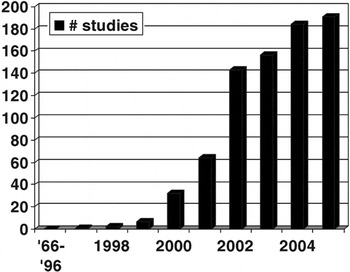
The past decade has seen a proliferation of interest across disciplines in spirituality within the context of health care (see Fig. 1). The spiritual needs and concerns of individuals with life-threatening illness and those receiving palliative and hospice care have garnered the most attention in the health care literature (Astrow et al., 2001). Much of this research has been hermeneutic, investigating phenomena such as patient–clinician communication about spiritual concerns (Reed, 1991; Ehman et al., 1999; Hart et al., 2003) and nurses' preparation and interest in dealing with patients' spiritual concerns (Ross, 1997; Yang & Mcilfatrick, 2001).

Number of published studies per year with spirituality as focus (Medline).
To date several major research initiatives have been directed at end-of-life care in an attempt to improve quality of life for individuals and families during this difficult time (SUPPORT Principal Investigators, 1995). Although valuable information about medical, social, and emotional needs of patients was derived from this research, spiritual care has remained comparatively underdeveloped. Several descriptive and qualitative studies have investigated the question of quality end of life care from the differing viewpoints of health care professionals, patients with life-threatening illness, and family members. Consistently, across samples, spirituality has been identified as important alongside physical, functional, and psychosocial well-being (Institute of Medicine, 1997; Singer et al., 1999; Steinhauser et al., 2000).
From the preliminary work just described, as well as the hospice care concept of Total Pain asserted by Saunders et al. (1995), the Conceptual Framework for a Good Death was developed. Emphasizing the multifaceted nature of the experience of dying, the framework considers fixed characteristics of the patient (sociodemographics, clinical status), modifiable dimensions (physical, psychological and cognitive symptoms, social relationships and support, economic demands, caregiver needs, hopes and expectations, and spiritual and existential beliefs), care-system interventions, and the outcome—the overall experience of the dying process. The framework was created to provide clinicians and researchers a systematic approach to evaluating and optimizing care given to dying patients and their families and to communicate the complex interdependence of the dimensions (Emanuel & Emanuel, 1998). By highlighting the interdependence, one is allowed to consider, for example, the influence of a patient's existential despair on depression and/or perceived physical pain.
Nolan and Mock's (2004) Conceptual Framework for End of Life Care corroborates the importance of spirituality to overall care. In this framework the spiritual domain is at the center of the physical, functional, and psychological domains. Outcomes in the framework include quality of life, patient decision-making methods, and achievement of life goals, indicating the potential influence of spirituality on cognitive and functional outcomes in the end of life population. In both frameworks, spirituality has been pivotally positioned as an important component to end of life care and a good death (Emanuel & Emanuel, 1998; Nolan & Mock, 2004).
The present state of the science investigating spirituality at the end of life is dominated by qualitative studies. Taken individually, qualitative studies have the inherent limitations of nonexperimental design restricting generalizability. When qualitative studies in a topic area are taken in aggregate, as in a meta-summary, the nonexperimental design limitations still exist; however, the collective data allow for a more substantive representation of universal themes (Paterson et al., 2001). A meta-summary of qualitative literature reporting spiritual perspectives of adults at the end of life was undertaken to analyze the research to date and better understand the relationship of spirituality with physical, functional, and psychosocial outcomes in the health care setting. The research question was: What perspectives do adults at the end of life have on spirituality and the dying process? The intent of the study was to synthesize data from the extant literature so as to receive direction for future research from the target audience and form a basis for future intervention studies.
METHODS
Sample
A comprehensive literature review was conducted using the MEDLINE, PubMed, Cumulative index of Nursing and Allied Health Literature (CINAHL), and PsycINFO databases. Keywords for searching the databases were: “spirituality,” “spiritual health,” and “spiritual well-being,” which were linked with “end of life,” “terminal care,” “terminally ill patients,” “hospice,” and “palliative care.”
Included in the sample were all English language reports from 1966 (inception of the earliest database) to the present identifiable as qualitative research investigations in which investigators explored the spiritual perspectives of adults at the end of life, with author-generated themes and/or participant quotations documented. Studies were included without consideration of the qualitative research method employed in an attempt to capture the widest range of data (Paterson et al., 2001). Dissertation research was excluded because of retrieval difficulties. All articles were published in peer-reviewed journals; no further assessment for scientific merit was conducted, thereby allowing a broadly inclusive data set (see Procedure).
To confirm the retrieved sample comprehensively represented the published qualitative studies reporting patients' perspectives of spirituality at end of life, bibliographies from seven concept analyses of spirituality (Burkhardt, 1989; Emblen, 1992; Meraviglia, 1999; Newlin et al., 2002; Tanyi, 2002; Smith & McSherry, 2004; Delgado, 2005) and one integrative review (Lin & Bauer-Wu, 2003) were inspected. No new articles were identified.
Procedure
Each research article was assigned a unique study number and systematically assessed for the following: research question or statement of purpose, qualitative research method, sample size, participant characteristics (e.g., age, diagnoses), setting (e.g., home, hospice, hospital), and country in which the research took place. The techniques used for creating the meta-summary followed the published recommendations of Sandelowski and Barroso (2003) and included: “(a) extraction of relevant statements of findings from each report; (b) reduction of these statements into abstracted findings; and (c) calculation of effect sizes” (Sandelowski & Barroso, 2003, p. 228).
Effect size is a term used in quantitative research to indicate the magnitude of an intervention effect. In qualitative literature it is a means by which the frequency of occurrence of themes is calculated, thereby confirming the presence of a pattern (Sandelowski & Barroso, 2003). In calculating the effect size for the present study, the decision was made to treat each report as one unit of analysis, independent of page length or sample size. Subsequently, each theme was weighted equally. The frequency of the theme appeared in the numerator and the total number of themes in the denominator.
For the purpose of this study, and consistent with other published meta-summaries (Sandelowski et al., 2004), during the extraction phase, “findings” were considered any integrated discoveries (e.g., themes) documented in the articles. When authors explicitly reported themes, they were recorded verbatim. If no themes were generated by the authors, then implicit themes were created, reported, and noted as such.
RESULTS
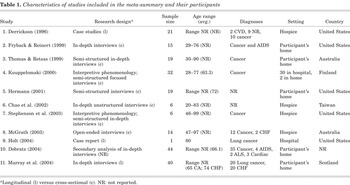
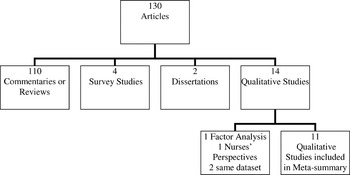
The initial search using key search terms (see Sample) and limited to qualitative studies, identified 130 articles. Abstract reviews revealed 110 of the 130 articles were commentaries or review articles, 4 were survey studies, 2 were dissertations, and 14 were qualitative studies (Fig. 2). On closer inspection of the full articles, it was found that of the qualitative studies, 1 was a factor analysis and 1 focused on nurses' perceptions rather than patients'. Also among the qualitative studies were 2 articles reporting on the same data set; the first article reported perceptions of spiritual pain among a hospice population; the second article extracted from the spiritual pain data set whether or not the illness experience promoted or hindered religiosity. The original spiritual pain analysis was retained; the religiosity analysis was excluded. The final sample, therefore, included 11 articles meeting criteria for the meta-summary (Table 1; Derrickson, 1996; Fryback & Reinert, 1999; Thomas & Retsas, 1999; Kuuppelomaki, 2000; Hermann, 2001; Chao et al., 2002; McGrath, 2003; Stephenson et al., 2003; Dobratz, 2004; Holt, 2004; Murray et al., 2004).
Characteristics of studies included in the meta-summary and their participants


Flow chart of article selection process for inclusion in meta-summary.
Of the 11 articles in the sample, all but 1 reported a research question and/or statement of purpose (Table 2). Rather than reporting a specific research methodology (e.g., grounded theory, ethnography), most authors reported generic research designs (e.g., in-depth interviews). Three of the studies collected participants' data longitudinally, 10 of the studies used cross-sectional data collection, and 1 study failed to report temporality of data collection. The sample sizes for the individual studies ranged from 1 to 44; the collective sample size represented input from 217 adults at the end of life. Although the preponderance of participants had a diagnosis of cancer, those with HIV/AIDS, cardiovascular disease, and ALS were also represented. Five of the studies took place in participants' homes, 4 at hospice, and 2 in the hospital. Approximately half of the studies were conducted in the United States; the others were performed in Australia, Finland, Scotland, and Taiwan (Table 1).
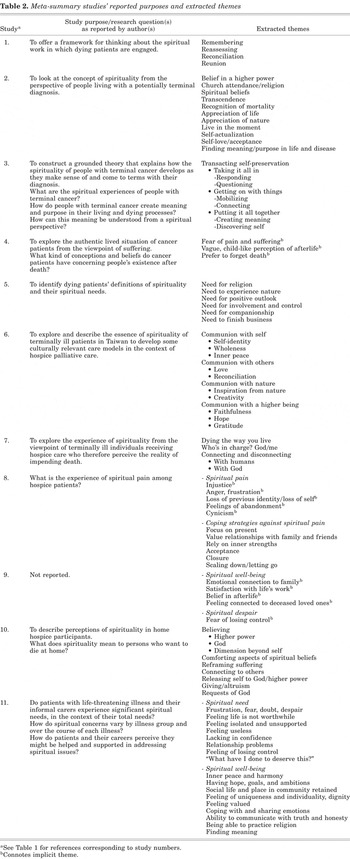
Meta-summary studies' reported purposes and extracted themes

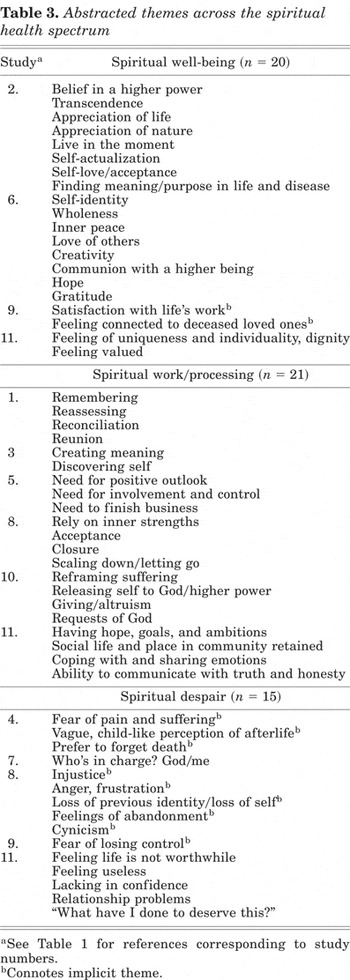
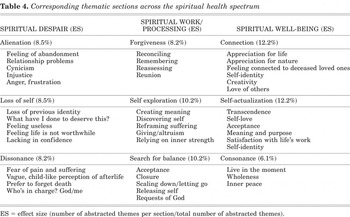
The extraction phase yielded 89 thematic statements, 76 explicit and 13 implicit (Table 2). During the abstraction phase, redundancies were eliminated and themes were merged to most accurately capture the content of the findings. The abstraction process allowed for reduction to 56 thematic statements (Table 3). Abstracted themes were then separated into categories representing the spectrum of spiritual health (O'Brien, 2003) from spiritual despair/spiritual pain (n = 15) to spiritual work/processing (n = 21) to spiritual well-being (n = 20). The abstracted thematic statements were further organized into nine thematic sections: three corresponding sections in each of the three spiritual health spectrums. For example, the spiritual despair section “alienation” corresponds to the spiritual work/processing section “forgiveness” and the spiritual well-being section “connection.” In other words, if one is in despair and feeling alienated, one must do the work of forgiveness to attain connection and spiritual well-being. The second set of corresponding sections include: “loss of self,” “exploring self,” and “self-actualization.” The third set of corresponding sections includes “dissonance,” “finding balance,” and “consonance.”
Abstracted themes across the spiritual health spectrum

Effect sizes were calculated and reported for each thematic section (Table 4). Within spiritual work/processing, 7 of the 21 themes were noted to relate to conditions necessary to do the spiritual work, rather then an actual activity or process. As such, these 7 themes were not included in the corresponding thematic sections across the spiritual health spectrum, and the denominator for calculating the effect size was reduced from 56 (total number of abstracted themes) to 49 (number of abstracted themes minus the 7 conditions). The 7 conditions necessary to do spiritual work are: need for a positive outlook; need for involvement and control; need to finish business; need for hope, goals, and ambitions; need to retain social life and place in community; need to cope with and share emotions; and ability to communicate truthfully and honestly.
Corresponding thematic sections across the spiritual health spectrum

Once the themes were sorted to the thematic sections, I revisited the original articles to discern patterns in the distribution of the sample to spiritual despair, spiritual work, or spiritual well-being. No patterns were identified by study research design, population diagnosis, or setting. The age range reported in each study was too large to discern patterns by age group. Studies from four of the five countries represented contributed themes to the spiritual despair section.
DISCUSSION
The meta-summary presented here provides a comprehensive analysis of the qualitative literature of the perspectives on spirituality of adults at the end of life. By cataloging the themes across the spectrum of spiritual health from despair to well-being, and including the work necessary to move along the continuum, a fuller appreciation of end-of-life spirituality was achieved than was available from the individual studies. The nine thematic sections, composed of three “layers,” each with three sections corresponding to despair, work, or well-being, provide nuance to the concept that only became available once the individual studies were examined in aggregate. For example, drawing from the thematic sections presented in Table 4, one can see that in the first corresponding section the spiritual despair of alienation occurs when an individual feels abandoned and cynical. The spiritual work is forgiveness through remembering, reassessing, and reuniting with those from whom one feels alienated. If the work is successful, spiritual well-being of connection is manifest as appreciation for life, love of others, and feeling connected to deceased loved ones. In the second corresponding section, loss of self can appear when illness usurps one's previous identity, perhaps forcing the individual to relinquish his occupation, hobbies, or role in the family. The despair comes when the individual feels useless and believes life no longer has value. The spiritual work for the individual is self-exploration, during which he reframes his suffering, creating meaning for his circumstance and discovering a new self. Spiritual well-being is possible if the individual succeeds at his work, achieving self-actualization via transcendence of his disease and circumstance, self-love, and acceptance. The third set of corresponding sections demonstrates how the spiritual despair of dissonance occurs when one prefers to forget that death is imminent and/or one wrestles with a higher power for control of the situation. The spiritual work is the search for balance through acceptance, closure, and letting go of the need for control. Spiritual well-being in the form of consonance arises when one can live in the moment with a sense of wholeness and inner peace.
The activities identified in this meta-summary as spiritual work of the dying are consistent with the existing literature. Dame Cicely Saunders, over decades of writing about the dying (Saunders et al., 1995; Clark, 2002), repeatedly recognizes spiritual work among the end-of-life population. Saunders describes the effort among the dying to surmount feelings of failure, regret, guilt, and worthlessness, all of which can contribute to intense anguish. The antidotes Saunders prescribes include acceptance, forgiveness, and connection to a larger truth, which can lead to belief that there is meaning and purpose in one's past and peace in the present (Saunders et al., 1995). Although the dying process may spontaneously precipitate questions about the meaning and value of one's life, the quality and nature of relationships, and the purpose of suffering and death, these questions cannot receive a patient's full attention unless physical and psychological symptoms such as pain, dyspnea, anxiety, and depression have been relieved (Saunders et al., 1995; Sulmasy, 2001a, 2001b).
From the germinal hospice literature of the 1950s to the present, there have been consistent assertions that the end of life is a unique and complex time that offers the opportunity to address spiritual queries (Saunders et al., 1995; Sulmasy, 2001a, 2001b). As one's physical and functional attributes deteriorate during the terminal phase of life, psychosocial and spiritual needs can be prioritized in a way not typically seen during other phases of life (Saunders et al., 1995; Sulmasy, 2002). Implied then is an evolutionary and transitory nature to spirituality (Sulmasy, 2002). If spirituality evolves throughout the life cycle and illness trajectory, and is brought into focus most keenly during times of transition in life (Fiori et al., 2004), then it can be inferred that perceptions of spirituality will be influenced by circumstance, stressors, and health status and will likely change over time. Longitudinal studies assessing changes in perceptions over time would be the most valuable means of exploring the premise of spirituality's evolutionary and transitory nature. Unfortunately most of the studies included in the meta-summary were cross-sectional in design. The three longitudinal studies (Derrickson, 1996; Holt, 2004; Murray et al., 2004) failed to report changes over time but instead accumulated responses. Future investigations, both qualitative and quantitative, will benefit from attention to a time variable.
The findings from this meta-summary confirm the fundamental importance of spirituality at the end of life and highlight the shifts in spiritual health that are possible when a person at the end of life is able to do the necessary spiritual work. Whether spirituality is absent, nascent, or fulminate, the qualitative literature speaks to the influence the spiritual domain has on the dying process. The Framework for a Good Death (Emanuel & Emanuel, 1998) and The Conceptual Framework for End of Life Care (Nolan & Mock, 2004) address the integrity of the total person and the interdependence of factors affecting that integrity, both positively and negatively. Both frameworks position spirituality prominently; however, neither framework specifically addresses the work necessary to move along the spiritual health spectrum. It is likely the area of spiritual work is fertile ground for interventions to improve spiritual and overall quality of life among the dying. The results of this meta-summary indicate that by neglecting spiritual work, the frameworks may be deficient in guiding end-of-life research and clinical care.
The seven themes describing the conditions necessary to do spiritual work encompass modifiable personal characteristics and perceptions. These conditions, if not sufficiently addressed, could pose formidable barriers to the success of interventions designed to enhance spirituality at the end of life.
Promising interventions to promote spiritual work and spiritual health among those with life-threatening illness include metta meditation (Williams et al., 2005) and meaning-centered psychotherapy (Breitbart, 2003; Breitbart et al., 2004). Other interventions such as music therapy (Halstead & Roscoe, 2002), mindfulness meditation (Luskin, 2004), storytelling (Roche, 1994), and reminiscence (Trueman & Parker, 2004) appear ready for more systematic investigation, particularly in the end-of-life population.
Limitations of this study include the inability to retrieve unpublished literature (two dissertations identified) and having a single investigator conduct the extraction, abstraction, and analysis. Other limitations stem from the constraints inherent in meta-summary methodology, namely, synthesis of themes rather than raw data and the inability to explore disease-specific and demographic-specific experiences. For example, it was not possible to compare perspectives of adults at the end of life experiencing a premature death versus those facing death at the time of or exceeding their predicted life expectancy.
Strengths of the study include the comprehensive sample capturing 89 themes from 217 terminally ill adults in five countries. The geographic heterogeneity of the sample, as well as the broad age range and varied diagnoses of the studies' participants, indicates the thematic patterns that emerged likely have universal resonance to the dying. The study employed a detailed audit trail, thereby lending itself to confirmation and replication of the findings.
CONCLUSION
This meta-summary aggregates the discernment of adults who are at the end of life. Each of the qualitative studies has in effect become an archive of the testimonies of people who chose to share their perspectives on spirituality in their final days and months of life. Despite enduring the sanitizing procedures of scholarly publication, the emotion, sentiment, and wisdom of the participants' comments remained apparent and evocative.
The thematic analysis of these perspectives demonstrates that there is a spectrum of spiritual health and that it is possible to move along that spectrum with work.
The existential questions about the human condition can be ignored during many phases of life, but are brought into acuity at the end of life. For those who can find answers to the questions via ritual and/or belief, life can resonate with joy until death. For individuals who have achieved spiritual well-being, the end of life can be recognized as an active, beautiful time of accelerated growth requiring courage, passion, and grace and offering the opportunity to be transformed. However, for those for whom the existential questions remain unanswered, the end of life can reverberate discordantly with despair and anguish. To advance end-of-life care, researchers need to find effective interventions that help the terminally ill complete the work necessary for spiritual well-being.
ACKNOWLEDGMENTS
The contributions of Drs. Ruth McCorkle, Robin Whittemore, and Dena Schulman-Green are gratefully acknowledged.