Introduction
Nearly all temperate and arctic species of Fabaceae produce seeds with a water-impermeable seed coat that causes physical dormancy. This dormancy can be broken artificially by scarification, by fire or by passage through the digestive tract of animals (reviewed by Baskin and Baskin, Reference Baskin and Baskin1998).
Germination of the seeds of the Mediterranean species Trifolium subterraneum is enhanced by a pretreatment at daily fluctuating temperatures between 30°C and 60°C (e.g. Ballard, Reference Ballard1958; Taylor, Reference Taylor1981). However, it is not known how germination is regulated for most species in ecosystems with a temperate climate where fires occur very rarely. In previous work, we showed that seeds of some Fabaceae germinated in spring after a defined temperature treatment of chilling followed by relatively low daily alternating temperatures (Van Assche et al., Reference Van Assche, Debucquoy and Rommens2003).
Seeds of most Fabaceae remain impermeable during dry storage, but Morrison et al. (Reference Morrison, Auld, Rish, Porter and McClay1992) showed that some Australian species lose physical dormancy during dry storage. Dry storage acts as an environmental cue for germination in several Geraniaceae (Van Assche and Vandelook, Reference Van Assche and Vandelook2006). This phenomenon might be more common, but it is poorly documented. Timing of germination may be regulated by the presence of a dormant embryo, so that germination does not start immediately after softening or scarification. The presence of both systems is called combinational dormancy (Baskin and Baskin, Reference Baskin and Baskin2004). Ballard (Reference Ballard1958) studied in detail embryo dormancy in T. subterraneum, and Thomson (Reference Thomson1965) showed its presence in other Trifolium species. Expression of embryo dormancy is transitory and temperature dependent. Scarified seeds of T. subterraneum do not germinate at 30°C, but they do so readily at 15°C (Katznelson and Carpenter, Reference Katznelson and Carpenter1972). Swollen seeds of Trifolium sp. germinate to a higher percentage at lower temperature (Thomson, Reference Thomson1965).
The combination of a hard seed coat and a dormant embryo is interpreted as a double safety mechanism to prevent early germination after out-of-season rains in arid regions and Mediterranean climates (Kigel, Reference Kigel, Kigel and Galili1995; Norman et al., Reference Norman, Cocks, Smith and Nutt1998). However, it is not known whether combinational dormancy occurs frequently in Fabaceae growing in a temperate climate. Furthermore, it has not been demonstrated whether seeds that are swollen after summer rains can survive subsequent drought and delay germination until autumn. As far as we know, only one study deals with this problem: Jansen and Ison (Reference Jansen and Ison1994) showed that seed viability of Trifolium sp. decreased during storage after imbibition and dehydration.
The first aim of this study was to determine if combinational dormancy is frequent in herbaceous Fabaceae growing in a temperate climate and if it affects germination time. We compared the germination rate of scarified seeds of 14 species and characterized embryo dormancy by a delay in germination of scarified seeds. As embryo dormancy is described as a transitory phenomenon, we compared fresh seeds and seeds stored for 3 months. The second aim was to analyse temperature effects on softening of the seed coat and on growth of the embryo of Medicago arabica, the two distinct processes in germination of hard seeds. The third aim was to determine if swollen seeds of M. arabica tolerate desiccation. Finally, we tested the hypothesis that drying might be a possible environmental cue for breaking of dormancy in Fabaceae.
Materials and methods
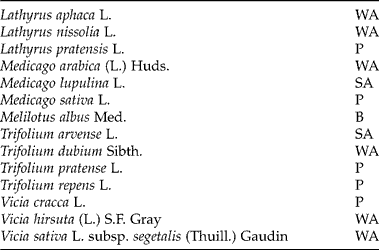
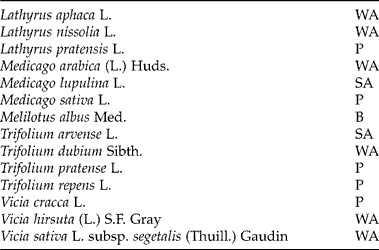
Fourteen species of herbaceous Fabaceae were used in this study; six species were winter annuals and eight species had another kind of life cycle (Table 1). Most seeds were collected from one population growing along roadsides near Leuven (Belgium). The following species were grown in a garden: Lathyrus aphaca and M. arabica were collected in Ambleteuse (northern France) and Lathyrus nissolia in Halle (Brabant).
A list of the 14 studied species and their life-form: B, biennial; P, perennial; SA, summer annual; WA, winter annual
Pods were collected as soon as they were ripe. Seeds were separated by drying the pods in laboratory conditions [c. 40% relative humidity (RH)], by rubbing on a sieve or breaking them manually. Fresh seeds were used within 1 week after harvest. Other samples were stored for 3 months at room temperature (18–22°C and c. 40% RH) or for a longer time as mentioned in the results.
Scarification and germination rate at different temperatures
Seeds were scarified by cutting a small part of the seed coat at the concave side of the seed with a surgical knife. Three replicates of 50 seeds each were placed in Petri dishes (diameter 10 cm) on moist filter paper (MN400, Macherey Nagel, Düren, Germany) and incubated at 23°C, 10°C and 5°C. Seeds were exposed to diffuse daylight in the laboratory (PAR between 2.6 and 6.5 μmol m− 2 s− 1), but numerous unmentioned experiments showed no difference in germination in light and darkness. Germinated seeds were counted daily until germination was complete, or for a maximal period of 60 d. From the cumulative germination curve, we derived T50, the number of days to attain 50% germination of the total seed population. For M. arabica, we determined germination rate, expressed as 1/T50, at 5°C intervals between 5°C and 35°C. At the optimal temperature, germinated seeds also were counted after 12, 16 and 20 h imbibition.
Softening rate of seeds
For each temperature treatment, three lots of 100 seeds of M. arabica were placed in Petri dishes on filter paper (MN 400) moistened with distilled water. Seeds were incubated for 3 years at 5°C, 10°C, 20°C and 30°C. They were exposed to diffuse daylight (see above). Water was added if necessary to keep the filter paper moist. Swollen seeds were counted weekly and removed. Three Petri dishes were placed at 40°C. Here, swollen seeds were counted three times a week, and the experiment was terminated after 20 weeks. From the cumulative curve, we derived T50, the number of weeks to attain 50% swelling, and the rate of softening was expressed as 1/T50.
Drying of naturally softened seeds
About 2000 fresh seeds of M. arabica were placed on moist filter papers at 23°C and 30°C. During 1 month, naturally swollen seeds were selected every 2 d to start the treatment. One series was dried immediately; others were incubated further at 23°C and 30°C for 1, 2, 3 and 4 weeks. Germinated seeds were counted and removed. At the end of the incubation period, non-germinated seeds were dried. Drying was started by placing seeds on dry filter paper in open Petri dishes. After 1 d under laboratory conditions (c. 40% RH), the open Petri dishes were placed in a desiccator over silica gel for 1 week at room temperature (c. 20°C). Germination was tested at 10°C on wet filter paper. In each treatment, three replicates were used with at least 50 seeds. The desiccation treatment was repeated up to five times in another series of experiments. After drying, filter papers were wetted and placed at 23°C. Seeds swelled in 24 h and desiccation was repeated as described above.
Effect of dry storage
Germination of intact seeds was tested immediately after harvesting and after 3 months of dry storage, or up to 1 year for Vicia sativa. Three replicates of 100 seeds were placed at 23°C on MN400 filter paper. Germinated seeds were counted after 14 d.
Statistical analysis
For winter annuals, the interactive effect of dry storage at room temperature and incubation temperature on T50 was analysed statistically for each species separately using a two-way analysis of variance (ANOVA) (SPSS, version 16.0; SPSS Inc., Chicago, Illinois, USA). In case of species with a life cycle other than winter annual, the effect of dry storage on the germination rate at 23°C was analysed for individual species using a t-test.
Results
Germination rate of fresh and stored seeds after scarification
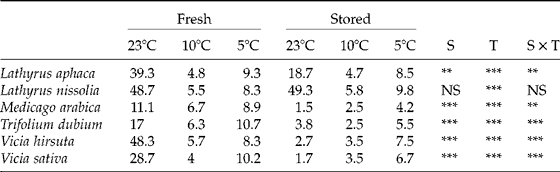
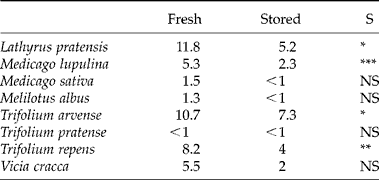
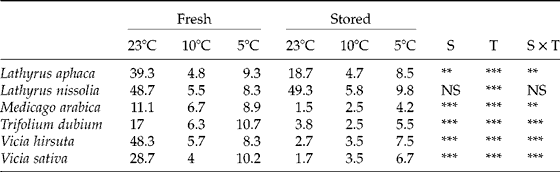
There was a large difference in germination rate between the 14 species (Tables 2 and 3). At 23°C, some species germinated very rapidly with a T50 of 1 d or even less, while other species remained in a swollen state for a long time, and germination was delayed, with a T50 up to 48 d, indicating the presence of a dormant embryo.
Mean germination rate of winter annuals at different temperatures. Seeds were either fresh or stored for 3 months and scarified. Germination rate is expressed as time in days to attain 50% germination. For individual species the interactive effect of storage (S) and incubation temperature (T) was analysed statistically using a two-way ANOVA, where *** indicates P<0.001; **, P<0.01 and NS, P>0.05
Mean germination rate of species with a life cycle other than winter annual at 23°C. Seeds were either fresh or stored for 3 months and scarified. Germination rate is expressed as time in days to attain 50% germination. For individual species the effect of storage (S) was analysed statistically using a t-test, where *** indicates P<0.001; **, P<0.01; *, P<0.05 and NS, P>0.05
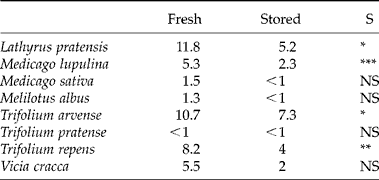
A delay in germination was observed in all winter annuals, but was less obvious in species with a different life cycle, so we classified two groups of species (Tables 2 and 3). Storing seeds dry at room temperature for 3 months significantly affected T50 for most species. After storage, T50 for winter annuals was greatly reduced (except for L. nissolia), and some species germinated without delay (Vicia spp. and M. arabica). In species with a different life cycle, germination was in general more rapid after storage, but the effect of storage on germination rate was smaller than in winter annuals.
Incubation temperature had a significant effect on germination rate, as fresh seeds of winter annuals germinated much faster at 10°C than at 23°C, and even at 5°C germination rate was only slightly reduced compared to 10°C. The germination rate of stored seeds at lower temperatures was similar or slightly higher than that of fresh seeds, resulting in a significant interaction effect between storage and incubation temperature for all species except L. nissolia (Table 2).
Rate of softening and germination at different temperatures
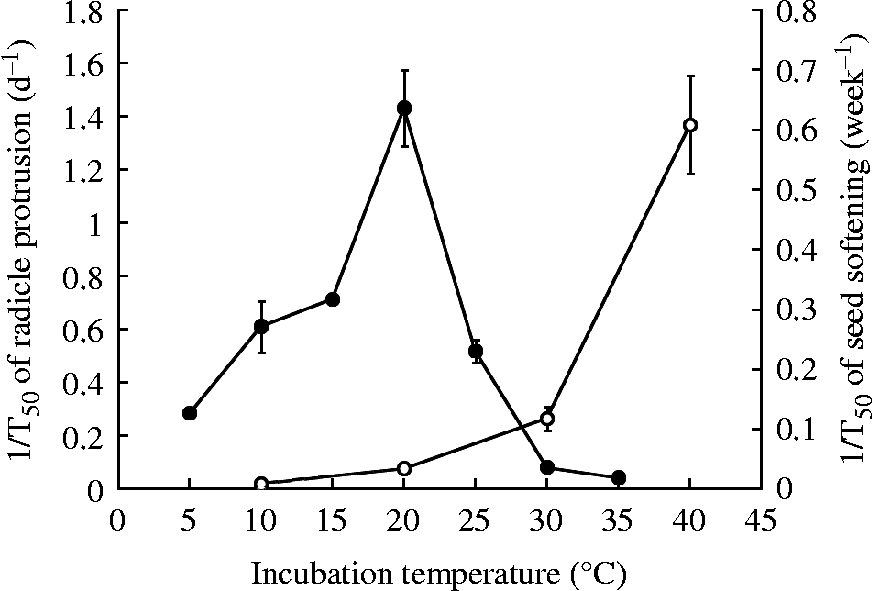
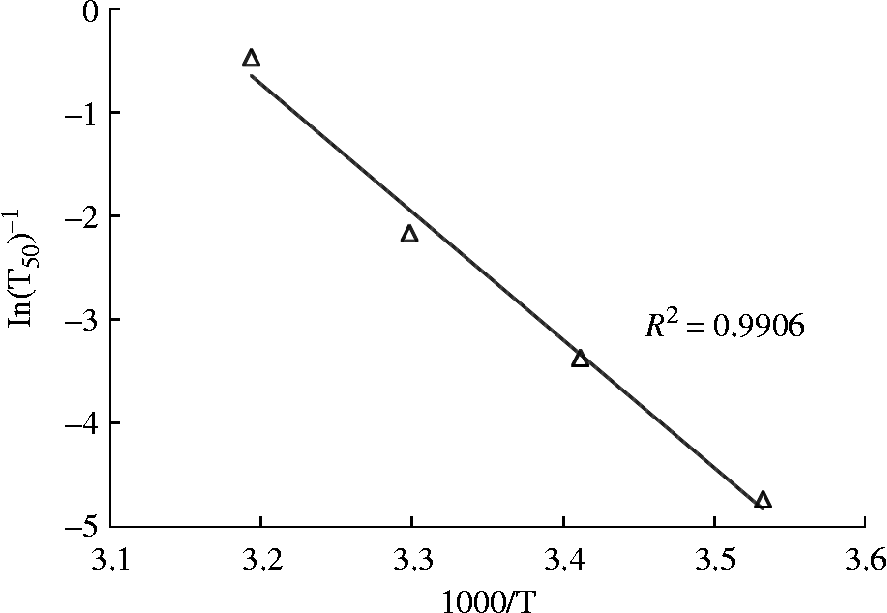
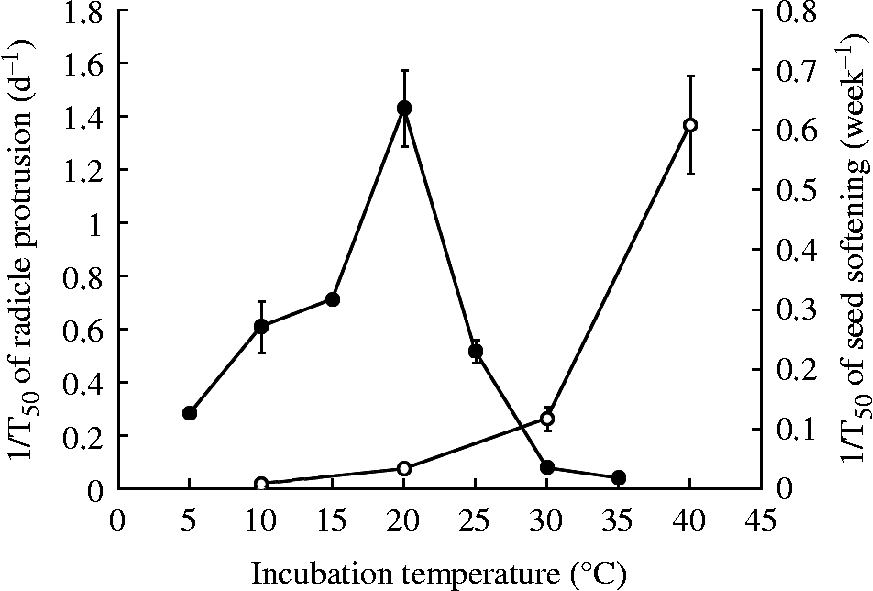
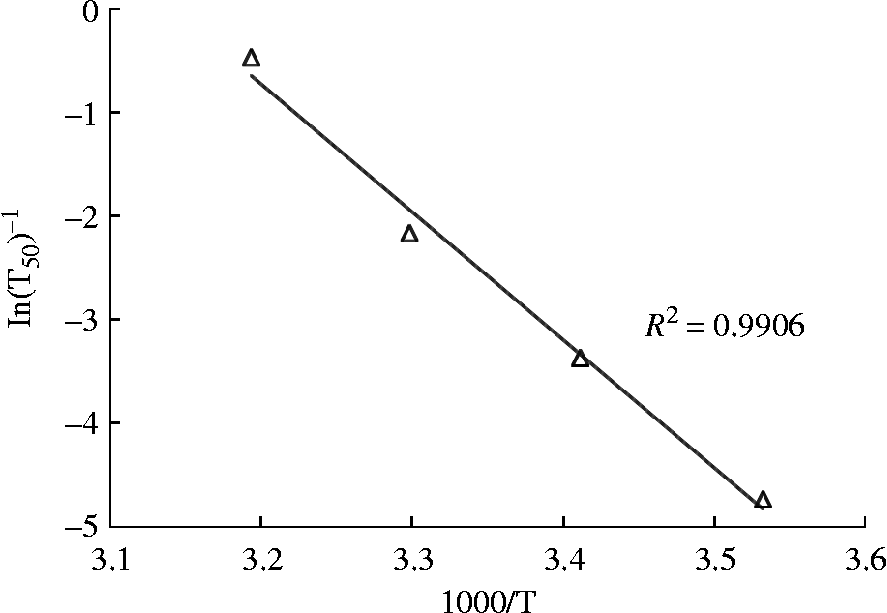
We compared the effects of temperature on softening of the seed coat and on radicle protrusion, the two distinct processes of germination of hard seeds. Embryo growth and radicle protrusion of 3-month-old scarified seeds of M. arabica occurred very rapidly at 20°C (Fig. 1). After 24 h, 80% of the seeds had germinated, and T50 was attained in 17 h. Compared to 20°C, germination rate decreased slightly at 5–15°C, whereas it decreased sharply at 30°C and 35°C. In contrast, softening, measured by counting swollen seeds that were not scarified, is very slow at lower temperatures. At 5°C, only 41.4% swelled after 3 years. Rate of softening increased exponentially at higher temperatures with a Q10 between 3.4 and 5.1 (Fig. 1). Incubation at 40°C for 20 weeks led to swelling of 93% of seeds. A linear correlation of ln(1/T50) versus 1000/T indicates that the softening rate obeys the Arrhenius equation (Fig. 2).
Effect of temperature on the rate of softening (open circles) and on the rate of germination (closed circles) of seeds of Medicago arabica. Vertical bars denote SD.
Arrhenius plot of ln of softening rate [ln(T50)− 1] of seeds of Medicago arabica versus 1000/T. (T50 is expressed in weeks).
Survival of Medicago arabica seeds after drying
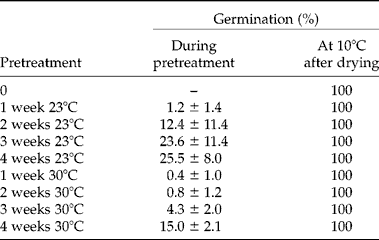
Fresh seeds that swelled naturally were selected and further incubated for up to 4 weeks at 23°C and 30°C. At 23°C, few seeds germinated in the first weeks due to embryo dormancy, whereas in the third and fourth weeks about 25% germinated. The ungerminated swollen seeds were dried and they all germinated within 7 d after rewetting (Table 4). At 30°C, still fewer seeds germinated, due to the combination of embryo dormancy and supra-optimal temperature. Again, all ungerminated swollen seeds survived the desiccation treatment.
Mean germination percentage (±SD) of swollen seeds of Medicago arabica after different pretreatments followed by drying. Germination after drying was determined after 7 d of imbibition
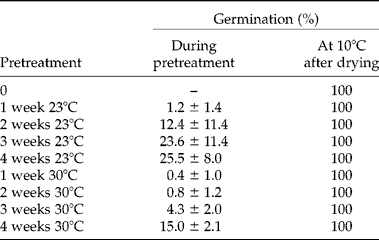
This experiment was repeated with 3-month-old seeds. Swollen seeds that were immediately dried survived this treatment. During a longer period of incubation at 23°C, however, swollen seeds germinated and could not survive after dehydration. Up to five hydration re-drying cycles had little effect on seed viability, with germination remaining between 98.5 and 100%.
Effect of dry storage on physical dormancy
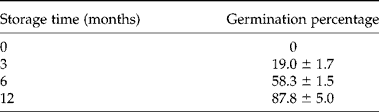
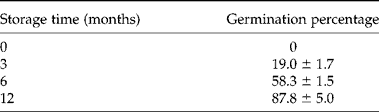
Germination at 23°C of all species was tested after dry storage. In only one species, V. sativa, seeds became gradually water permeable in 1 year, and then germinated promptly in 14 d (Table 5). All other 13 species were tested after 3 months of dry storage. Germination percentages were lower than 5% and nearly identical to that of fresh seeds, indicating that all seeds remained impermeable (results are not shown).
Germination percentage of seeds of Vicia sativa after different periods of dry storage. Germination percentage was determined after 14 d of imbibition
Discussion
Scarified seeds of nearly all studied species germinated faster after 3 months of dry storage than immediately after harvest. We concluded that the embryos of nearly all species have, to a greater or lesser degree, some form of non-deep physiological dormancy that is lost within 3 months. However, embryo dormancy was much more marked in winter annuals than in species with another life history. The difference between fresh and stored seeds was very striking in some species, such as V. hirsuta, V. sativa and M. arabica. Only one species, Lathyrus nissolia, did not change in germination response during 3 months of storage.
Expression of physiological dormancy was evident only at the relatively high temperature of 23°C. Dormancy of fresh seeds was not observed at the lower temperatures of 10°C and 5°C. Also, L. nissolia seeds did not change during storage at 23°C, but fresh and stored seeds germinated much faster at lower temperatures. This relative dormancy at higher temperature is typical of winter annuals that have permeable seeds, e.g. Agrostemma githago and cereals like wheat and barley. Fresh seeds of these species germinate immediately at temperatures lower than 15°C, while storage is needed to enable germination at higher temperatures (Borris, Reference Borris1940; Bewley and Black, Reference Bewley and Black1994).
Physiological dormancy of the embryo might be quite common in herbaceous Fabaceae and presumably more frequent in Mediterranean than in other climates (Thomson, Reference Thomson1965; Kigel, Reference Kigel, Kigel and Galili1995). Grant Lipp and Ballard (Reference Grant Lipp and Ballard1959) showed that seeds of several legume species germinated very slowly after scarification. Germination was stimulated in an atmosphere enriched in carbon dioxide and increased for some species after dry storage. Combinational dormancy also occurs in other families, such as Geraniaceae (Baskin and Baskin, Reference Baskin and Baskin1974; Van Assche and Vandelook, Reference Van Assche and Vandelook2006), Convolvulaceae (Meulebrouck et al., Reference Meulebrouck, Ameloot, Van Assche, Verheyen, Hermy and Baskin2008), Anacardiaceae (Baskin et al., Reference Baskin, Baskin and Li2000) and in Cercis canadensis (Caesalpiniaceae) (Geneve, Reference Geneve1991). Profumo and Gastaldo (Reference Profumo and Gastaldo1977) showed that the endosperm imposes dormancy in Cercis siliquastrum.
Natural softening of seeds of Fabaceae species presumably occurs by opening of the lens (Baskin, Reference Baskin2003), but the exact mechanism and its regulation remain unknown. As for most Fabaceae, softening of hard seeds of M. arabica is a very slow process at relatively low temperatures, ensuring that seeds can survive in the soil for many years. The rate of softening increases exponentially at higher temperatures, with a Q10 between 3.4 and 5.1. A Q10 of 2–3 or higher is typical for chemical reactions, whereas a Q10 of 1.0 or slightly above indicates a physical process (reviewed by Berry and Raison, Reference Berry, Raison, Lange, Nobel, Osmond and Ziegler1981). Furthermore there is a mathematical relation between logarithm of rate and 1/T, identical to the Arrhenius equation that is used generally to describe kinetics of chemical reactions. It is possible that softening of the seed coat is the consequence of an unknown chemical reaction, a chemical breakdown of the seed coat or a reaction in the lens. This supposed reaction might occur in hydrated parts of the seed coat. We found that the softening rates of Geranium pratense and G. robertianum also obeyed the Arrhenius equation (unpublished experiments).
Winter annuals of Fabaceae show many ecological adaptations that are commonly found in winter annuals with permeable seeds (Grime et al., Reference Grime, Mason, Curtis, Rodman, Band, Mowforth, Neal and Shaw1981). Germination during summer is prevented by a double safety mechanism: an impermeable seed coat and physiological dormancy that is expressed at higher summer temperatures. Embryo dormancy disappears during dry storage (afterripening), and a fraction of the seed population that has become permeable germinates at the optimal lower autumn temperatures. The remaining impermeable seeds survive in the soil and germination is spread over several years. Combinational dormancy might have evolved in Mediterranean climates, where cool and wet winters are safe seasons for survival of the germlings. It is possible that winter annuals in temperate climates originated in Mediterranean climates and retained this life history after migration to regions with a temperate climate.
Our experiments show that some seeds of M. arabica will swell but do not germinate at the higher temperatures after summer rains. Afterwards the soil dries during summer, seeds may dehydrate, but they tolerate desiccation and even several cycles of hydration and dehydration. Seeds of M. arabica can remain in a swollen state for up to 4 weeks and still be tolerant to desiccation. This is in contrast to seeds of Lotus corniculatus that became sensitive to desiccation afters 24 h of hydration (McKersie and Stinson, Reference McKersie and Stinson1980). Imbibed seeds of several species maintain viability if dehydrated prior to radicle emergence. However, if seedlings are dehydrated after radical emergence, seedlings are damaged and germination reduced (Berrie and Drennan, Reference Berrie and Drennan1971; Hegarty, Reference Hegarty1978).
According to the current view, seeds of most Fabaceae remain impermeable during dry storage (Baskin and Baskin, Reference Baskin and Baskin1998). We found that seeds of only one species, V. sativa, become permeable during dry storage. Drying during summer, resulting in breaking of physical dormancy, may be a supplementary cue for germination in autumn, as shown in several Geraniaceae (Van Assche and Vandelook, Reference Van Assche and Vandelook2006). We conclude that seeds of Fabaceae regulate germination via a great diversity of mechanisms (or combination thereof) and by convergent evolution show ecological adaptations similar to those of other plant families.