Introduction
Although the lifetime prevalence of eating disorders (EDs) in the general population is relatively low (average prevalence rate 0.3% (0–1.0%) for anorexia nervosa (AN), 1.0% (0–2.0%) for bulimia nervosa (BN) (Garfinkel et al. Reference Garfinkel, Lin, Goering, Spegg, Goldbloom, Kennedy, Kaplan and Woodside1995; Bijl et al. Reference Bijl, Ravelli and van Zessen1998; Hoek & van Hoeken, Reference Hoek and van Hoeken2003; Hudson et al. Reference Hudson, Hiripi, Pope and Kessler2007; Preti et al. Reference Preti, Girolamo, Vilagut, Alonso, Graaf, Bruffaerts, Demyttenaere, Pinto-Meza, Haro, Morosini and Investigators2009; Smink et al. Reference Smink, van Hoeken and Hoek2012; Kessler et al. Reference Kessler, Berglund, Chiu, Deitz, Hudson, Shahly, Aguilar-Gaxiola, Alonso, Angermeyer, Benjet, Bruffaerts, de Girolamo, de Graaf, Maria Haro, Kovess-Masfety, O'Neill, Posada-Villa, Sasu, Scott, Viana and Xavier2013), and 1.4% (0.2–2.6%) for binge eating disorder (BED) (Hudson et al. Reference Hudson, Hiripi, Pope and Kessler2007; Preti et al. Reference Preti, Girolamo, Vilagut, Alonso, Graaf, Bruffaerts, Demyttenaere, Pinto-Meza, Haro, Morosini and Investigators2009; Smink et al. Reference Smink, van Hoeken and Hoek2012; Kessler et al. Reference Kessler, Berglund, Chiu, Deitz, Hudson, Shahly, Aguilar-Gaxiola, Alonso, Angermeyer, Benjet, Bruffaerts, de Girolamo, de Graaf, Maria Haro, Kovess-Masfety, O'Neill, Posada-Villa, Sasu, Scott, Viana and Xavier2013), these disorders have profound physical, psychological and social consequences, especially in youth (Lewinsohn et al. Reference Lewinsohn, Striegel-Moore and Seeley2000; Crow et al. Reference Crow, Peterson, Swanson, Raymond, Specker, Eckert and Mitchell2009; Steinhausen & Weber, Reference Steinhausen and Weber2009; Smink et al. Reference Smink, van Hoeken and Hoek2013). The Diagnostic and Statistical Manual of Mental Disorders, Fourth Edition (DSM-IV) categorizes EDs as AN, BN, and ‘eating disorders not otherwise specified’, which includes sub-threshold AN, BN, other atypical EDs, and BED (APA, 1994). To reduce the number of cases classified as ‘eating disorders not otherwise specified’, and recognizing the growing importance of BEDs, the recently published Fifth Edition of the DSM (DSM-5) included BED as a separate diagnosis. Moreover, the criterion amenorrhoea, required for AN in DSM-IV, is removed in DSM-5, mainly because it excluded females taking contraceptives, and males. Furthermore, the frequency of binge eating and compensatory behaviours that people with BN must exhibit is reduced to once weekly from twice weekly, as specified in DSM-IV (APA, 2013; Attia et al. Reference Attia, Becker, Bryant-Waugh, Hoek, Kreipe, Marcus, Mitchell, Striegel, Walsh, Wilson, Wolfe and Wonderlich2013).
It is important to assess trends in occurrence rates in different countries, because culture has consistently been recognized to exert an important influence on EDs (Pike et al. Reference Pike, Hoek and Dunne2014). However, there are but a limited number of population-based studies and the validity of previous epidemiological studies has been questioned due to certain methodological issues (Hoek & van Hoeken, Reference Hoek and van Hoeken2003; Smink et al. Reference Smink, van Hoeken and Hoek2012). Population-based studies are often expensive and ineffective, due to the low prevalence of EDs in the general population. Research conducted with medical records or hospital registers often has represented only a small demographic region, with rates subject to underestimation because patients tend to deny and hide their illness to avoid professional help (Hoek & van Hoeken, Reference Hoek and van Hoeken2003; Smink et al. Reference Smink, van Hoeken and Hoek2012). Furthermore, the samples were often non-representative due to the utilization of special populations (e.g. schoolgirls, young females, or twins), or samples that were small or concentrated in small local areas (Fairburn & Beglin, Reference Fairburn and Beglin1990; Hoek & van Hoeken, Reference Hoek and van Hoeken2003; Preti et al. Reference Preti, Girolamo, Vilagut, Alonso, Graaf, Bruffaerts, Demyttenaere, Pinto-Meza, Haro, Morosini and Investigators2009). In addition, differences in data collection methods and screening instruments make international comparisons very difficult. For all these reasons, a large representative sample from the general population has been required to obtain sufficient cases for reliable information on trends, risk factors, and healthcare utilization.
Aims of the study
This study was conducted to generate updated lifetime and 12-month prevalence estimates for EDs, taking into consideration the three main diagnoses (AN, BN, BED) and two sub-threshold categories (sub-threshold BED and any binge eating), using a large national representative sample in Switzerland. Obesity has become one of the most important public health problems worldwide (WHO, 2009). Moreover, BED was included as a new diagnostic entity in DSM-5. There has been growing interest in examining the relationship between binge-eating episodes (not just BEDs), overeating, and ‘loss of control eating’, as well their relationship with being overweight or obese (Agras & Telch, Reference Agras and Telch1998; Goldschmidt et al. Reference Goldschmidt, Engel, Wonderlich, Crosby, Peterson, Le Grange, Tanofsky-Kraff, Cao and Mitchell2012; Berg et al. Reference Berg, Peterson, Crosby, Cao, Crow, Engel and Wonderlich2014). Therefore, it is important to examine different diagnostic entities of binge eating. Studies assessing the association between binge eating and obesity can especially benefit from our data at the population level in the European context. Although we used the DSM-IV based WHO Composite International Diagnostic Interview (CIDI; Kessler & Ustun, Reference Kessler and Ustun2004) to assess EDs, we also compared the prevalence of AN according to DSM-IV v. DSM-5 criteria. However, due to the structure of the original questions administered in the CIDI, we were unable to use the DSM-5 criteria to estimate the prevalence of BN or BED. In addition, we sought to identify concurrent mental health problems, correlates of EDs, their association with other mental health outcomes, and patients’ professional help-seeking behaviours.
Materials and method
Participants
The present study was a cross-sectional household survey with computer-assisted telephone interviews that included a nationally representative sample of Swiss residents aged 15–60 years across all three language regions of Switzerland. The protocol was approved by the Ethics Committee of Canton Zurich. In 2010, roughly 93% of Swiss households had at least one landline telephone, with either listed (78%) or unlisted (15%) telephone numbers. To minimize sampling bias, we also included households with mobile telephones only (5%). Only about 2% of the households in Switzerland have neither a landline nor mobile telephone and were therefore excluded from our survey. The survey was administered from April to October 2010 by trained interviewers. An information letter was sent on behalf of the Swiss Department of Public Health and University of Zurich to those addresses with listed telephone numbers, approximately 2 weeks before the interviewers called to invite household residents to participate in a general health survey. The telephone survey was voluntary and anonymous. The survey took about 15 min and included questions about sociodemographic characteristics, EDs, quality of life, and other mental health-related questions. All of the study investigators, study coordinator and the two project leader of the research centre that conducted the telephone interview completed the 2-day CIDI training course and received certification. A similar procedure was applied to training of the telephone interviewers. We also did the pre-test with patients provided by the study investigator. The supervisors of the telephone interview, study coordinators and investigators visited the calling centre to train the interviewers and listened to the telephone interviews.
We aimed to draw a representative national sample, and the sampling design took into consideration: age, gender, language region (German, French, Italian), household size, and type of telephone line (listed landline, unlisted landline, or mobile number only). Two-stage sampling was used. First, 13 734 valid addresses were successfully contacted and 10 533 households agreed to a short interview about household structure (response rate 76.7%). In the second stage, every second person in the household who met the criteria of targeted age and gender, according to the sampling design for each region, was selected to participate in a personal telephone interview. A total of 12 418 eligible persons were identified from household interviews, of whom 10 038 participated in the survey (response rate 80.8%). Among them, 8542 (85%) were from households with a listed landline number, 1025 (10%) from households with an unlisted landline number, and 471 (5%) from households with a mobile telephone only. (For a detailed recruitment chart see Supplementary Fig. S1.) Individuals in the 15–26 years age group, males, and those living in a household with an unlisted telephone number were all slightly underrepresented in the final sample. Therefore, prevalence estimates were weighted to reflect sampling design and reduce selection bias caused by non-participation, accounting for subject's age, gender, language region, household size and type of telephone line.
Measures
EDs
Diagnoses of an ED were based upon version 3.0 of the WHO Composite International Diagnostic Interview (CIDI; Kessler & Ustun, Reference Kessler and Ustun2004), a fully structured lay-administered diagnostic interview that generates diagnoses in accordance with DSM-IV and ICD-10 criteria. For the present study, the ED module from CIDI was used to establish diagnoses of AN, BN and BED based on DSM-IV criteria. We also diagnosed AN using the newly-released DSM-5 criteria, using the below-minimum normal weights and omitting the amenorrhoea criterion. As described in previous studies using the CIDI (Hudson et al. Reference Hudson, Hiripi, Pope and Kessler2007; Preti et al. Reference Preti, Girolamo, Vilagut, Alonso, Graaf, Bruffaerts, Demyttenaere, Pinto-Meza, Haro, Morosini and Investigators2009), most of the CIDI questions closely paralleled the DSM-IV criteria; however, to meet criteria for BN and BED, the DSM-IV requires a minimum of 3 months of regular binge eating for BN and 6 months for BED, whereas the CIDI only asks whether someone has experienced 3 months of symptoms (i.e. the same criterion as DSM-5).
In addition to the three EDs, we included two provisional entities defined in previous studies (Hudson et al. Reference Hudson, Hiripi, Pope and Kessler2007; Preti et al. Reference Preti, Girolamo, Vilagut, Alonso, Graaf, Bruffaerts, Demyttenaere, Pinto-Meza, Haro, Morosini and Investigators2009). The first was ‘subthreshold binge eating disorder’ defined as (a) binge eating episodes, (b) occurring at least twice a week for at least 3 months, and (c) not occurring solely during the course of AN, BN or BED. Thus, sub-threshold BED did not require DSM-IV criteria B (three out of five features associated with binge eating) or C (marked distress regarding binge eating for BED). The second provisional entity was ‘any binge eating’, also defined as binge eating episodes (not requiring DSM-IV criteria B or C), that (b) occurs twice a week for at least 3 months, but (c) lacks hierarchical exclusion. In other words, any binge eating was diagnosed regardless of whether or not the individual simultaneously met other ED criteria. Finally, we also calculated the prevalence of any ED, defined as meeting any one of the three sets of DSM-IV criteria (AN, BN, or BED). Finally, we calculated prevalence estimates for the following seven conditions: each of the three DSM-IV diagnoses (AN, BN, BED), any one of the above three conditions (combined prevalence), a DSM-5-based diagnosis of AN, and either of the two provisional entities (subthreshold binge eating and ‘any binge eating’).
For those individuals who met criteria for any of the above-mentioned seven conditions, the CIDI assessed the age of onset, recent occurrence, years with the disorder, and professional help-seeking. The full diagnostic CIDI algorithms for all three EDs are available online at http://www.hcp.med.harvard.edu/ncs/diagnosis.php, while the corresponding questions used to operationalize the criteria are available at http://www.hcp.med.harvard.edu.ncs.
Other mental health outcomes
We used the K6 screening scale for serious mental illness (SMI). The K6 is a six-item scale of non-specific psychological distress that screens for the presence of SMI. The respondent is asked to rate how they feel about each of the six symptoms in five categories (on a scale from none of the time to all of the time) over the last 30 days. The K6 has been widely used and validated in community epidemiological surveys in many countries (Kessler et al. Reference Kessler, Green, Gruber, Sampson, Bromet, Cuitan, Furukawa, Gureje, Hinkov, Hu, Lara, Lee, Mneimneh, Myer, Oakley-Browne, Posada-Villa, Sagar, Viana and Zaslavsky2010), including the WHO World Mental Health Survey Initiative. Social phobia symptoms were measured using the five-item social phobia scale of Symptom Checklist-27-plus (SCL-27-plus; Hardt, Reference Hardt2008). Quality of life was measured using the World Health Organization Quality of Life (WHOQOL-BREF) scale (Skevington et al. Reference Skevington, Lotfy and O'Connell2004). Due to the time constraints of the survey, we used only the physical health (seven items) and social relationship domains (three items). Each item included five categories and the raw scores for both domains were calculated by summing the items. Following the instructions of the scoring programme, a transformed score (0–100) was then calculated for each subject from the raw score.
Statistical analysis
All analyses were weighted using the Stata survey estimation procedure (http://www.stata.com/manuals13/svy.pdf) to reflect sampling design. We used contingency tables to present lifetime and 12-month prevalence rates for the seven ED conditions, as well as for professional help-seeking and SMI stratified by gender. The actuarial method was used to estimate age-of-onset curves (Richards, Reference Richards2010). Logistic regression applying discrete-time survival analysis (Singer & Willett, Reference Singer and Willett1993) was used to examine differences in cohort effects on ED, with person-years as the unit of analysis. Logistic regression also was performed to examine the association between EDs and SMI, adjusting for age and sex. Mean scores with 95% confidence intervals for social phobia and quality of life (physical health and social relationships) also were calculated for those without an ED and those with each of the seven different ED conditions.
Results
Prevalence
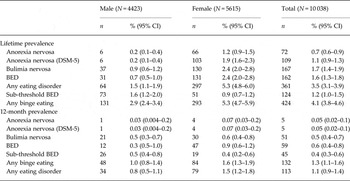
Among 10 038 participants, 81.6% were Swiss, 52% were female, and 87.4% were employed (values are weighted %). Table 1 shows the lifetime and 12-month prevalence of EDs. The lifetime prevalence rate for any ED was 3.5%. Lifetime prevalence estimates for AN, BN, BED, any ED, sub-threshold BED and any binge eating were 1.2, 2.4, 2.4, 5.3, 0.9 and 5.3%, respectively, among women and 0.2, 0.9, 0.7, 1.5, 1.6 and 2.9%, respectively, among men. Rates were roughly 3–6 times higher among women than men, the only exception being sub-threshold BED. The prevalence of AN in women increased by 58.3% from 1.2% to 1.9% when DSM-5 criteria were applied. Accordingly, the prevalence of DSM-5 AN was approximately 10 times higher in women than in men. The 12-month prevalence estimates for these disorders were much lower.
Lifetime and 12-month prevalence estimates of DSM-IV eating disorder

CI, Confidence interval; BED, binge eating disorder.
Age of onset and cohort effects
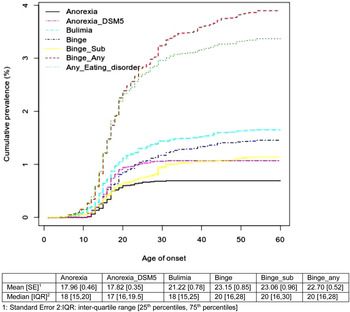
The median and mean ages of onset ranged from 17 to 23 years (Fig. 1) for the six disorders, with the majority of cases beginning between the ages of 10 and 20 years. About three-quarters of AN cases started before age 20, and only one case after age 30, compared to 13% and 20% for BN and BED, respectively. Survival analysis of life-time risk and cohort (age at interview) revealed a consistent inverse association for all EDs (Table 2). Compared to those aged 50–60 years, all younger cohorts had significantly higher odds of fulfilling the criteria of an ED.
Cumulative lifetime prevalence of eating disorders by age of onset.

Inter-cohort differences in lifetime risk of eating disorder

aOR, Adjusted odds ratio (adjusted for sex); CI, confidence interval.
Professional help-seeking
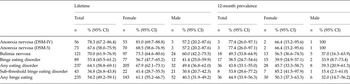
Between 41% and 81% of females and 30% and 60% of males fulfilling criteria for EDs reported ever having sought professional help for their eating or weight problems, with the highest percentages for AN and the lowest for sub-threshold BED (Table 3). In general, more females than males who met the criteria for an ED reported ever having sought professional help for their eating or weight problems. However, differences between females and males were significant only for ‘any binge eating’ and for ‘any eating disorder’, mainly due to lack of statistical power given the low case counts in males.
Professional help-seeking in subjects suffering from eating disorders

CI, Confidence interval.
n=subjects who have sought professional help.
Mental health outcomes and EDs
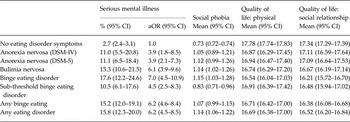
Table 4 summarizes the association between EDs and three other mental health outcomes: SMI, social phobia, and quality of life. Co-morbidity with SMI ranged from 2.7% in those without any ED to 17.6% in those meeting the criteria for BED. The odds of reporting SMI were significantly higher among those with an ED than those without ED symptoms. The mean symptom scores for social phobia were also significantly higher among those with an ED than those without, except among those with sub-threshold BED. Subjects without any ED also reported significantly higher quality of life in both the physical health and social relationships domains than those with an ED, the one exception being the social relationships domain in AN cases.
Eating disorders and other mental health-related outcomes

aOR Adjusted odds ratio (adjusted for age and sex); CI, confidence interval.
Discussion
With a large population-based sample of 10 038 respondents, the present study provides updated estimates of the prevalence of EDs in a developed country in Europe. Considering three EDs (AN, BN and/or BED) together, we identified a substantial lifetime prevalence of 3.5%. Although any comparisons with other studies are difficult, due to the limited number of population-based studies and methodological problems with prior study designs (Hoek & van Hoeken, Reference Hoek and van Hoeken2003; Smink et al. Reference Smink, van Hoeken and Hoek2012; Kessler et al. Reference Kessler, Berglund, Chiu, Deitz, Hudson, Shahly, Aguilar-Gaxiola, Alonso, Angermeyer, Benjet, Bruffaerts, de Girolamo, de Graaf, Maria Haro, Kovess-Masfety, O'Neill, Posada-Villa, Sasu, Scott, Viana and Xavier2013), we found that our relatively high lifetime prevalence of BN (0.9% in males and 2.4% in females) contradicted recent reviews (Smink et al. Reference Smink, van Hoeken and Hoek2012; Pike et al. Reference Pike, Hoek and Dunne2014), suggesting that the occurrence of BN may be decreasing in North America and Northern Europe. Previous population-based studies conducted in the 1990s in Canada (Garfinkel et al. Reference Garfinkel, Lin, Goering, Spegg, Goldbloom, Kennedy, Kaplan and Woodside1995) and The Netherlands (Bijl et al. Reference Bijl, Ravelli and van Zessen1998), as well as an earlier review on BN estimated life-time prevalence as 1.0% in females and 0.1% in males (Hoek & van Hoeken, Reference Hoek and van Hoeken2003). Furthermore, a recently published World Mental Health (WMH) Survey encompassing 14 countries utilizing the CIDI detected an average BN prevalence of 1.0% (ranging from 0% to 2.0%; Kessler et al. Reference Kessler, Berglund, Chiu, Deitz, Hudson, Shahly, Aguilar-Gaxiola, Alonso, Angermeyer, Benjet, Bruffaerts, de Girolamo, de Graaf, Maria Haro, Kovess-Masfety, O'Neill, Posada-Villa, Sasu, Scott, Viana and Xavier2013). Two similar studies, one conducted in the United States (Hudson et al. Reference Hudson, Hiripi, Pope and Kessler2007) and the other across six European countries (Preti et al. Reference Preti, Girolamo, Vilagut, Alonso, Graaf, Bruffaerts, Demyttenaere, Pinto-Meza, Haro, Morosini and Investigators2009), estimated lifetime BN prevalence as 1.5% and 0.88%, respectively, in females and 0.26% and 0.5%, respectively, in males. Our BN prevalence estimates of 2.4% in females and 0.9% in males are clearly higher.
The high rates of BN we identified could be explained by the following factors. The lower prevalence detected in previous studies could be because of their much smaller sample sizes. Due to the relatively lower occurrences of these conditions and subjects’ tendency to conceal this type of illness, it is necessary to study large numbers of subjects from the general population to achieve satisfactory differential power (Hoek & van Hoeken, Reference Hoek and van Hoeken2003). Furthermore, our higher prevalence rate could also be partly explained by differences in data collection methods. Although we used the CIDI, like some previous studies, we used telephone v. face-to-face interviews. Keel et al. (Reference Keel, Crow, Davis and Mitchell2002) compared agreement between questionnaire and interviews in assessing EDs and concluded that the greater agreement observed between questionnaires and telephone interviews could be due to a higher level of perceived anonymity with these methods. Relative to face-to-face interviews, respondents might be more willing to disclose potentially embarrassing behaviours like binge eating and vomiting when not directly facing the interviewer. Finally, the authors of a previous review concluded that BN is a culture-bound syndrome, and that the specific combination of binge eating and purging are relatively constrained to Western culture (Keel & Klump, Reference Keel and Klump2003). Swiss culture is traditionally considered one that emphasizes diligence and perfection. Consequently, there could be considerable pressure in Swiss society to appear trim and fit, thereby rendering residents more likely to adopt inappropriate compensatory behaviours, like BN. Of interest, in this context, is that Switzerland has the lowest obesity rate among industrialized countries (OECD, 2013).
The prevalence of AN found in our study is quite comparable to other population-based studies using the CIDI. Our lifetime prevalence in females was 1.2% v. 0.9% in the United States (Hudson et al. Reference Hudson, Hiripi, Pope and Kessler2007) and six European countries (Preti et al. Reference Preti, Girolamo, Vilagut, Alonso, Graaf, Bruffaerts, Demyttenaere, Pinto-Meza, Haro, Morosini and Investigators2009), and the prevalence in males was 0.2% v. 0.3% in the US study (Hudson et al. Reference Hudson, Hiripi, Pope and Kessler2007) and 0% in the same six European countries (Preti et al. Reference Preti, Girolamo, Vilagut, Alonso, Graaf, Bruffaerts, Demyttenaere, Pinto-Meza, Haro, Morosini and Investigators2009). Recent reviews on the incidence of AN have concluded that its overall incidence has remained stable, albeit increased in the high-risk group of girls aged 15–19 years (Smink et al. Reference Smink, van Hoeken and Hoek2012; Pike et al. Reference Pike, Hoek and Dunne2014).
When DSM-5 criteria were applied, thereby removing the requirement for amenorrhoea, the prevalence of AN in women increased more than half, from 1.2% to 1.9%, with 66 women fulfilling DSM-IV criteria, and an additional 37 women (total n = 103) fulfilling DSM-5 criteria. Comparing the characteristics of the 66 women meeting the formal criteria v. the 37 meeting the latter only (data not shown), we detected no significant differences in age of onset, body mass index, association with SMI (7/66 = 10.3% v. 5/37 = 11.3%), or quality of life (mean = 17 for both groups). These findings are consistent with previous studies comparing AN and atypical AN patients that identified no significant differences in either clinical or demographic variables, or with respect to associations with other mental illnesses between these two patient groups (Dalle Grave et al. Reference Dalle Grave, Calugi and Marchesini2008; Santonastaso et al. Reference Santonastaso, Bosello, Schiavone, Tenconi, Degortes and Favaro2009). In previous studies, 25% of underweight eating-disorder patients did not have amenorrhoea (Dalle Grave, Reference Dalle Grave, Calugi and Marchesini2008; Roberto et al. Reference Roberto, Steinglass, Mayer, Attia and Walsh2008). Consistently applying DSM-5 criteria, roughly 36% of female AN patients did not have amenorrhoea, thereby also supporting the revised diagnostic criteria for AN.
Surprisingly, we found a sizable difference in professional help-seeking, with 81% of women meeting the DSM-IV criteria v. only 47.7% of those meeting the DSM-5 criteria only reporting having sought professional help for eating or weight problems. This has important clinical implications, in that women with AN appear to consider amenorrhoea an important indication to seek treatment or professional help. Although we were unable to locate other studies with similar results, those of two previously published studies indirectly support our findings. Santonastaso et al. (Reference Santonastaso, Bosello, Schiavone, Tenconi, Degortes and Favaro2009) compared typical and atypical AN patients without amenorrhoea in an outpatient setting and concluded that the prevalence of atypical AN in community samples was similar to or higher than that of typical AN, probably due to lower rates of referral. They also referred to another study that observed that atypical AN patients had a longer duration of illness (Dalle Grave, Reference Dalle Grave, Calugi and Marchesini2008). Altogether, the lower referral rates and longer duration of illness among AN patients without amenorrhoea could be due to reduced awareness of the problem, supporting the conjecture that the absence of amenorrhoea can delay treatment seeking (Santonastaso et al. Reference Santonastaso, Bosello, Schiavone, Tenconi, Degortes and Favaro2009). It is interesting to note that the individuals in our study who met AN criteria reported a similar quality of life in social relationships as those without ED. This result is contrary to those of recent studies in which interpersonal difficulties were identified among individuals with AN (Schmidt & Treasure, Reference Schmidt and Treasure2006; Ambwani et al. Reference Ambwani, Berenson, Simms, Li, Corfield and Treasure2016).
In DSM-5, BED has been included as an additional diagnostic category of ED. It has been the most prevalent ED identified in previous studies (Hudson et al. Reference Hudson, Hiripi, Pope and Kessler2007; Preti et al. Reference Preti, Girolamo, Vilagut, Alonso, Graaf, Bruffaerts, Demyttenaere, Pinto-Meza, Haro, Morosini and Investigators2009). The prevalence of BED in our sample was 1.6%, which is quite comparable to the average of 1.9% detected across 14 countries in the WMH (Kessler et al. Reference Kessler, Berglund, Chiu, Deitz, Hudson, Shahly, Aguilar-Gaxiola, Alonso, Angermeyer, Benjet, Bruffaerts, de Girolamo, de Graaf, Maria Haro, Kovess-Masfety, O'Neill, Posada-Villa, Sasu, Scott, Viana and Xavier2013) study. It is interesting to note that 124 (1.2%) subjects met the criteria for sub-threshold BED, and that the condition was over-represented in male (59%) v. female (41%) subjects. This is in contrast to the male:female ratio typically observed in BED (1:3). On the other hand, our results are consistent with those of the National Comorbidity Survey, conducted by Hudson et al. (Reference Hudson, Hiripi, Pope and Kessler2007). Whereas sub-threshold BED required neither ‘marked distress’ nor ‘three of the five features associated with binge eating’, further research is needed to examine gender differences in binge eating. It is possible that males with BED did not show the marked stress or other features typically seen in females.
Although BEDs generally have a lower rate of mortality than AN or BN, they are closely connected to someone being overweight or obese (Reichborn-Kjennerud et al. Reference Reichborn-Kjennerud, Bulik, Sullivan, Tambs and Harris2004; Hudson et al. Reference Hudson, Hiripi, Pope and Kessler2007). In addition, we found that those with BED exhibited the highest rate of co-morbidity with SMI, the highest score for social phobia, and the lowest quality of life in both the physical and social relationships domains, underlining the high psychological and social distress that persons with BED have. These results should be interpreted with caution, however, for several reasons. First, we used a community sample rather than a clinical sample and the interview was conducted retrospectively. We also estimated the lifetime occurrence of ED, even though subjects were only asked to report mental health symptoms they had experienced over the last 30 days. It is possible that the poorer mental health outcomes reported by BED subjects were due to their later age of onset, relative to those with AN or BN.
As concluded in a recent systematic review (Agh et al. Reference Agh, Kovacs, Pawaskar, Supina, Inotai and Voko2015), BED is a serious ED that significantly impairs quality of life in both the physical and mental domains and is associated with increases in both healthcare utilization and costs. Furthermore, it is alarming that only 41% of the males and 57% of the females with BED in our sample had ever sought any kind of professional help. These rates are much less than for either BN or AN. Since both pharmacological and behavioural treatments for BED have been shown to produce positive effects (Treasure et al. Reference Treasure, Claudino and Zucker2010), general practitioners, school teachers/psychologists, and family members should be alerted to BED symptoms so they can help those affected with this disorder to receive appropriate treatment.
It is worth noting that only 30–60% of men with an ED sought any kind of professional help. Therefore, previous studies using clinical samples or case registries could have underestimated the prevalence of EDs in men. Similar to two other population-based studies, the female:male ratios of BN and BED were approximately 3:1, which is much less than the 10:1 (Bushnell et al. Reference Bushnell, Wells, Hornblow, Oakley-Browne and Joyce1990; Garfinkel et al. Reference Garfinkel, Lin, Goering, Spegg, Goldbloom, Kennedy, Kaplan and Woodside1995) ratio identified in previous clinic-based studies. Conversely, the sex ratio of AN in our sample was 6:1 (and 9.5:1 using DSM-5 criteria), which is higher than the 3:1 reported in the United States (Hudson et al. Reference Hudson, Hiripi, Pope and Kessler2007). Results from a recent qualitative study suggest that widely held perceptions that EDs are a female problem lead to men failing to recognize their problem and seek help (Raisanen & Hunt, Reference Raisanen and Hunt2014). Given that more than half of those affected have never consulted any professionals about their problems with eating or weight, routine inquiries about eating and weight by clinicians, school teachers/psychologists and family members may help those who are at risk of developing an ED, both young women and young men, to be diagnosed and treated.
Several limitations of our study should be considered. First, some CIDI questions did not exactly mirror DSM-IV criteria, so we were unable to assess for differences between DSM-IV and DSM-5 in terms of estimating the prevalence of BN and BED, due to fixed diagnostic algorithms. However, some previous studies have shown that using one set of criteria v. another exerts a greater effect on anorexia, while changes in the prevalence of BN and BED are quite minimal. For example, Fairburn & Copper (Reference Fairburn and Cooper2011) studied 167 patients and found that the prevalence of anorexia increased from 8.4% with DSM-IV criteria to 28.7% with DSM-5 criteria, whereas no change in prevalence was observed for BN (38.9%). A recent review article (Call et al. Reference Call, Walsh and Attia2013) also concluded that less stringent criteria of binge eating episodes did not greatly increase the prevalence of BN or BED (De Young et al. Reference De Young, Lavender, Wilson and Wonderlich2012; Hudson et al. Reference Hudson, Coit, Lalonde and Pope2012; Trace et al. Reference Trace, Thornton, Root, Mazzeo, Lichtenstein, Pedersen and Bulik2012). Furthermore, the medical history for EDs and mental disorders was not assessed due to time and cost constrains. Third, since the recall of earlier experiences may decrease with age, retrospective assessment might have overestimated the cohort effect (Giuffra & Risch, Reference Giuffra and Risch1994), or underestimated the prevalence in older age groups.
Conclusions
These limitations considered, we nonetheless conclude that, within our large population-based sample, EDs were not rare. We detected an especially high rate of BN, arguing against recent reviews suggesting that its prevalence is decreasing. Our results also support using the new DSM-5 criteria for AN, and the inclusion of BED as an official diagnosis due to its large impact on both physical and mental health. Future studies are clearly necessary to identify trends in ED prevalence, and to better understand the impact of different cultural factors on the onset and development of these complex illnesses.
Supplementary material
For supplementary material accompanying this paper visit http://dx.doi.org/10.1017/S0033291716001136.
Acknowledgements
We thank all the respondents who participated in the study. Data collection for the present study was supported by the Swiss Federal Office of Public Health no. 09. 006 170/204.0001/-675 and 10.005736/204.0001/-782.
Declaration of Interest
None.