I. INTRODUCTION
ZnO is a wide band gap semiconductor material with a direct band gap of 3.37 eV at room temperature and a free exciton binding energy of 60 meV, which makes ZnO material hopefully suitable for the fabrication of light emitting diodes or even laser diodes at short wave length. Since 1996, when scientists in Japan and Hong Kong achieved the UV lasing of ZnO films at room temperature for the first time, the research on the ZnO material has become a hot topic in the field of photonics.Reference Zhu, Tang and Wong1,Reference Bagnall, Chen, Zhu, Yao, Koyama, Shen and Goto2 Molecular beam epitaxy, pulsed laser deposition, and metal organic chemical vapor deposition (MOCVD) have been used to prepare high-quality ZnO films. Among them, the MOCVD technique has received much attention due to its possibility to achieve multi-piece uniform film growth in a large scale with an excellent crystalline quality, a smooth surface, and an abrupt heterointerface.
In the MOCVD growth of ZnO, different zinc metal organic (MO) precursors and oxygen sources have been used and studied by many research groups. Dimethyl zinc (DMZn) and diethyl zinc (DEZn) are the mostly used zinc precursors. Our previous work showed that ZnO thin films grown by the DMZn precursor have a high content of carbon impurities, while the samples grown by the DEZn precursor have superior structural and optical properties with a low concentration of carbon impurities. Also, the kind of zinc MO precursors has shown a significant influence on the surface morphology of ZnO thin films.Reference Ye, Gu, Zhu, Liu, Liu, Zhou, Hu, Zhang, Shi and Zheng3 In the study of Oleynik and Adam, they have made a comparison among different oxygen sources in the ZnO MOCVD growth, such as isopropyl alcohol, acetone, and nitrous oxide (N2O).Reference Oleynik, Adam, Krtschil, Blasing, Dadgar, Bertram, Forster, Diez, Greiling, Seip, Christen and Krost4 Lamb has studied the properties of ZnO films using butanol as the oxygen source.Reference Lamb and Irvine5 Further studies by Lau and Oda have pointed out that when DMZn and DEZn were used as zinc precursors and H2O and O2 were used as oxygen sources, they would have violent reactions. But while ethanol, ketones, and nitrous oxide were used as oxygen sources, the reactions would be relatively mild.Reference Lau, Tiku and Lakin6,Reference Oda, Tokunaga, Kitajima, Hanna, Shimuzu and Kodado7
Compared with the molecular beam epitaxy (MBE) or pulsed laser deposition (PLD) method, the MOCVD method has a big drawback for semiconductor material growth. During the process, various kinds of impurities will be unintentionally incorporated into the growing films due to the hydrocarbon radicals contained in the MO precursors, especially for the case of ZnO growth, which is usually implemented at low temperature. Carbon and hydrogen are thus two common unintentionally doped atoms in the MOCVD-grown films. A H2 addition has been found to play a key role to effectively eliminate hydrocarbon radicals from the MO precursors, and to suppress carbon clusters' incorporation during the growth of compound semiconductor thin films, especially for the epigrowth of III–V compound semiconductors.Reference Roy, Djurisic, Chan, Gao, Lui and Surya8,Reference Leung, Djurišić, Leung, Ding, Yang and Ge9 In the study of Marzouki, and Sayarietc, it has been found that the carbon atoms were easily incorporated into ZnO films. When the H2 was used as the carrier gas, a significant improvement in the quality of the ZnO material could be attained with carbon impurities suppressed, revealed by the disappearance of the sp 2 carbon cluster related vibrational modes in Raman scattering.Reference Marzouki, Sayari, Jomard, Sallet, Lusson and Oueslati10 When DEZn was used as the zinc precursor and oxygen is used as the oxygen source, the increase of the H2 content has been found to play an important role in the carrier concentration of the ZnO samples.Reference Park, Byun, Jeon and Lee11 Besides the effects on the structure and properties of ZnO thin films, researchers also found that the H atoms had an important influence on the growth of ZnO samples. It has been found that the H2 addition has caused an improvement in the crystalline quality and a larger grain size, but the surface morphology has become rougher.Reference Baik, Jang, Lee, Cho and Lim12–Reference Myong and Lim14
Although researchers have made great progress in the research of ZnO material and devices, the key technology of realizing ZnO-based optoelectronic devices, which is the preparation of high-quality p-type ZnO films, remains difficult. The low incorporation rate of p-type dopants and p-type doping induced high concentration of residual impurities or defects are the most important adverse factors. In a previous study, we have found that an appropriate amount of H2 addition will benefit the growth of ZnO thin films with the film quality improved and the carbon impurities suppressed. But there is still no clear understanding about the mechanism of H2 addition on the ZnO films, which is most important for the optimization of the growth process to attain high-quality ZnO films with low concentration of impurities.
In the study, we have investigated the effect of H2 addition on the ZnO growth by using DMZn or DEZn as the zinc precursor and N2O or O2 as the oxygen source during the MOCVD growth process. The effect of H2 addition on the structure and properties of ZnO films will be presented in detail. The interactions of H2 with different oxygen sources and zinc MO precursors will be discussed to explain the effects from the view of the chemical reactions occurring during the growth process.
II. EXPERIMENT DETAILS
The ZnO thin films were grown in a MOCVD system, which is designed and developed in our laboratory. The details of the system have been described previously.Reference Zhu, Gu, Zhu, Huang, Gu, Ye and Zheng15C-plane sapphire (Al2O3) and quartz (SiO2) were used as the growth substrates, which were degreased with acetone and ethanol, followed by a deionized water rinse, and then dried under a high-purity N2 flow. After that the substrates were put into the growth chamber. High-purity N2 passed through the bubblers containing DMZn or DEZn precursor to carry out the MO vapor into the reactor. N2O or O2 was used as the oxygen source. The substrate temperature was set to 450 °C. In the case, there was no obvious difference observed for quartz or sapphire in terms of the growth and properties of the as-grown ZnO films, possibly due to the low growth temperature. Since N2O is extremely difficult to decompose at such a low temperature, for the N2O case, a low-temperature plasma generator was used to realize the ionization of oxygen atoms for the ZnO growth. To study the effect of H2 addition during the growth, 100 sccm of highly purified H2 has been added into the gas line of oxygen source. The ZnO growth lasted for 30 min for both cases with or without H2 addition. To compare the mechanisms and effects of H2 on the film growth directly, the as-grown films had not undergone the in situ high-temperature annealing process since the annealing has been found to significantly improve the structure and the quality of ZnO films grown at low temperatures and the effects of annealing might be mixed with the ones of the H2 addition.
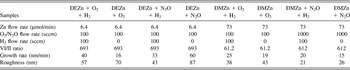
Table I summarizes the growth parameters. The temperature of the bubblers was set to 10 and −15 °C for DEZn and DMZn, respectively. The flow rates of the carrier gas were 16 and 20 sccm, respectively. According to the ideal gas equation of state, the flow rates of DEZn and DMZn have been calculated as 6.4 and 73 μmol/min, respectively. The much higher (∼10 times) rate for DMZn is due to the higher saturated vapor pressure of DMZn. For the growth using DEZn, the flow rates of O2 and N2O were set to 100 sccm, leading to a VI/II ratio of 693. To maintain similar VI/II ratio, for the growth using DMZn, the flow rate of N2O had been increased to 1000 sccm, resulting in a VI/II ratio of 612. However, the flow rate of O2 is still 100 sccm to prevent severe gas-phase reaction between DMZn and O2. The growth rate and the surface roughness are also shown in Table I and will be discussed later.
Summary of the growth parameters.

To compare and characterize the structure and the quality of the ZnO thin films, we used high-resolution x-ray diffraction (Philips X'pert Pro diffractometer, Netherlands) to measure the structural properties of ZnO thin films. Its ray source is Cu-target Kα2 ray at the wave length of 0.15405 nm; we used a Nanoscope IIIa atomic force microscope (AFM) produced by digital instrument to measure the surface morphology of the films at the scanning range of 10 μm × 10 μm. The optical properties of the samples were measured by room-temperature photoluminescence (PL), whose excitation light source is a 325 nm He–Cd laser, and the wave length resolution is 0.2 nm. The Raman scattering spectra (JOBIN YVON HR800 UV Raman system, Finland) were carried out in a backscattering geometry using an Ar+ laser (514.5 nm) as the excited source at room temperature. The scattered light was analyzed with a multichannel detector worked at the temperature of 202 K with accuracy better than 0.65 cm−1. Hall measurement was carried out at room temperature in a van der Pauw's geometry using indium as the ohmic contact metal, and the magnetic field used was about 0.2T.
III. RESULTS AND DISCUSSION
A. DEZn used as the zinc precursor
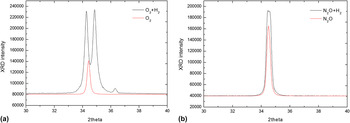
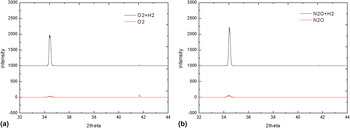
First, we used DEZn as the zinc MO precursor and O2 or N2O as the oxygen source to study the effect of H2 addition on ZnO growth. The θ–2θ XRD spectra of the samples are shown in Fig. 1. For the case using O2 as oxidant, it is found that the H2 addition has caused the splitting of the ZnO (0002) diffraction peak, indicative of the appearance of a crystal twinning that have a small deviation from C-plane orientation. An additional peak at 36.4° can be ascribed to (101) plane of ZnO films, which shows its internal polycrystalline structure. For the N2O case, similar two diffraction peaks but with a much smaller splitting can be observed in Fig. 1(b). No additional diffraction peaks can be found anymore. The appearance of the crystal twinning shows that the addition of H2 degrades the structural quality of ZnO samples grown by the DEZn precursor, regardless of the oxygen source used.
XRD patterns of the samples grown by DEZn and (a) O2 or (b) N2O as oxygen source.

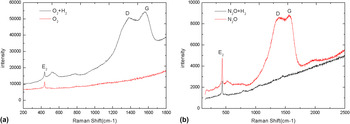
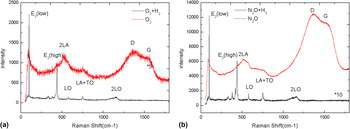
To study the effect of H2 addition on the lattice vibration and the carbon contamination of the ZnO films, we use laser Raman spectroscopy for characterization and the results are shown in Fig. 2. In a film grown by MOCVD, it is common to see carbon contaminations in the grown films due to the hydrocarbon species in the MO precursors.Reference Tang, Gu, Zhu, Liu, Chen, Ye, Zhang and Zheng16 Furthermore, contaminated carbon impurities in a semiconductor are likely to be aggregated to form graphite clusters, and Raman scattering is proved to be highly sensitive to the carbon impurities even at a concentration of 1016/cm3 in a semiconductor. In fact, the Raman spectra measured on GaN with implanted carbon ions also have the sp 2-hybridized graphite-like amorphous carbon peaks. Zhang et al. further confirmed that the C-implanted GaN has carbon clusters via high-resolution transmission microscope.Reference Sun, Wang, Zhang, Chen, Qin, Tong, Yang, Zhang, Pu, Zhang, Li, Lin and Jiang17 The Raman spectra of GaN epitaxial films using trimethylgallium (TMGa) as gallium source via hydride-organometallic vapor phase epitaxy have the characteristics of sp 2 hybridized carbon. Meanwhile, the Raman peak near 514 cm−1 is considered as Zn–C bond's characteristic peaks. For ZnO, many studies have also reported the observation of carbon clusters related D and G peaks by Raman scattering in the undoped or doped ZnO samples using DMZn as the zinc precursor via MOCVD.Reference Marzouki, Sayari, Jomard, Sallet, Lusson and Oueslati10,Reference Marzouki, Lusson, Jomard, Sayari, Galtier, Oueslati and Sallet18
Raman scattering spectra of the samples grown by DEZn and (a) O2 or (b) N2O as oxygen source.

In Raman spectra of ZnO, the peak at 438 cm−1 is known as E2 (High) mode for wurtzite ZnO and is closely correlated with the crystalline quality and mostly related to oxygen atoms. The obvious E2 (High) mode has been obviously observed for both the N2O and O2 cases, indicative of acceptable qualities of the as-grown ZnO films. For the case of N2O without H2, strong vibration modes located at 1300–1600 cm−1, which are assigned as D and G peaks and related to the carbon clusters, are observed. A full suppression of carbon impurity incorporation has been found with H2 addition, revealed by the disappearance of the D and G peaks. This shows that the addition of H2 does reduce carbon incorporation in the film and has a positive effect on inhibiting the carbon contamination. For the O2 case, however, totally opposite effect of H2 addition has been observed. It has been noted that no D and G peaks are observed for O2 without H2 due to its high VI/II ratio, which is reported to be powerful to eliminate the carbon impurity incorporation in ZnO.Reference Liu, Gu, Zhu, Tang, Liu, Chen and Zheng19 However, strong D and G peaks have been observed in the ZnO for O2 with H2, indicative of high carbon incorporation.
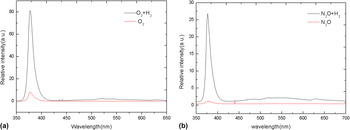
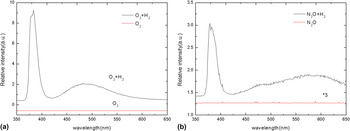
We use room temperature PL spectra to study the optical properties of the samples using DEZn as the zinc precursor with different oxygen sources, and the results are shown in Fig. 3. The H2 addition shows almost the same effect to the samples using O2 and N2O as oxygen sources, with much stronger intensity of the band-edge emission observed for the case with H2 addition. Avella et al. have found in their study that H2 addition is beneficial to the passivation of dangling bonds in nanocrystals, and thus reducing the amount of nonradiative recombination centers.Reference Avella, Prieto, Jimenez, Rodriguez, Sangrador, Rodriguez, Ortiz and Ballesteros20 Therefore, the enhancement of PL has been ascribed to the inhibition of nonradiative recombination centers by the H2 addition.
PL spectra of the samples grown by DEZn and (a) O2 or (b) N2O as oxygen source.

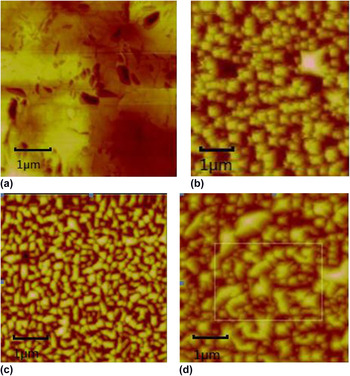
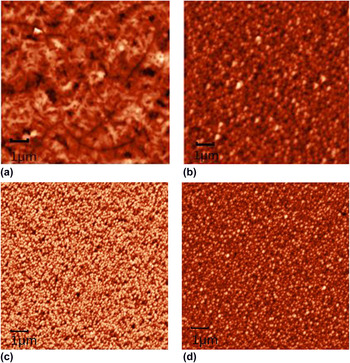
Figure 4 shows the AFM surface topography images of the ZnO thin films using DEZn as the zinc precursor with different oxygen sources. For the O2 case, the addition of H2 has caused the merge of the nearby grains as shown in Fig. 4(a), indicative of obvious coalescence process. For the N2O case, however, an opposite effect of H2 addition has been observed in Fig. 4(c), with the smaller grains covered on the surface. As carbon clusters are usually formed in the grain boundaries,Reference Tang, Gu, Zhu, Liu, Ye, Zhu, Zhang, Zheng and Sun21 the merge of the nearby grains (also faster growth rate) will bury the carbon clusters and thus lead to high carbon incorporation, just like the case of O2 + H2 [Fig. 4(a)] and N2O [Fig. 4(d)]. However, for the surfaces consisting of smaller grains, like the case of O2 [Fig. 4(b)] and N2O + H2 [Fig. 4(c)], carbon clusters formed in the grain boundaries will have a long time to expose to the oxygen atoms. Therefore, the reaction of the carbon clusters with O atoms will desorb carbon impurities from the growing surface, with low carbon incorporation obtained in the film.
AFM images of the samples grown by DEZn with (a) O2 as oxygen source and H2 addition; (b) O2 as oxygen source and no H2 addition; (c) N2O as oxygen source and H2 addition; (d) N2O as oxygen source and no H2 addition.

B. DMZn used as the zinc precursor
Next, we used DMZn as the zinc MO precursor, and O2 or N2O as the oxygen source, respectively, to study the effect of H2 addition on ZnO growth.
To study the effect of H2 on the structure of the ZnO films, we use XRD θ–2θ scanning to measure the samples, and the results are shown in Fig. 5. It is found that the addition of H2 has significantly improved the structural quality of the ZnO films revealed by much higher intensity and smaller full width at half maximum (FWHM) of (0002) diffraction peaks for either O2 or N2O case. This shows that the addition of H2 has the same effect on the structure of ZnO thin films with two different oxygen sources in the growth.
XRD patterns of the samples grown by DMZn and (a) O2 or (b) N2O as oxygen source.

To study the effect of H2 addition on the lattice vibration and the carbon contamination of the ZnO films, we use laser Raman spectroscopy to measure the samples, and the results are shown in Fig. 6, where strong D and G peaks related to carbon clusters can be observed in the Raman spectra. The samples using DMZn as the zinc precursor are mostly mirror smooth but with brown or even black color for both the O2 and N2O cases without H2 addition, indicative of serious carbon contaminations in the samples. In Fig. 5, much stronger D and G peaks have been observed for the N2O case. Although the actual VI/II ratio for the N2O case is 10 times higher than the O2 case as shown in Table I, the observation of stronger carbon related modes is indicative of a lower effective VI/II ratio for the N2O case. It has also been noted that the samples for the O2 case without H2 addition also show obvious D and G peaks, implying the formation of graphite-like amorphous carbon clusters. But for the cases with H2 addition, the D and G peaks have been vanished in the Raman spectra. It shows that adding H2 does help to decrease the carbon incorporation in the film and to inhibit the carbon contamination in the growth of the ZnO thin films for the DMZn case. The vibration modes of E2 (High), which are not observed in the samples for cases without H2 addition, indicative of deteriorated quality of the ZnO films. The significant enhancement of E2 (High) shows the structural quality of the ZnO thin films, which has been greatly improved with H2 addition.
Raman scattering spectra of the samples grown by DMZn and (a) O2 or (b) N2O as oxygen source.

Furthermore, we use room temperature PL spectra to study the optical properties of the samples above and the results are shown in Fig. 7. No obvious emission can be observed for cases without H2 addition, indicative of degraded optical quality of the samples. High carbon impurity or some other defects or impurities has caused a high content of nonradiative recombination centers. The addition of H2 shows the same effect on the samples using two different oxygen sources. Band-edge emissions have been significantly enhanced. This shows that the addition of H2 has improved the lattice quality, eliminated nonradiative recombination centers, and improved the optical properties of the ZnO samples.Reference Avella, Prieto, Jimenez, Rodriguez, Sangrador, Rodriguez, Ortiz and Ballesteros20
PL spectra of the samples grown by DMZn and (a) O2 or (b) N2O as oxygen source.

Figure 8 shows AFM surface morphology images of ZnO thin films using two different oxygen sources. From the image, it can be found that to the samples using N2O as the oxygen source, there is no obvious difference in the surface morphology. However, for the O2 case, the addition of H2 has resulted in the merge of the nearby grains, with its surface morphology changed a lot. This may have some correlation with weak gas phase reaction between the zinc and oxygen precursors with H2 addition and will be discussed in the next section.
AFM images of the samples grown by DMZn with (a) O2 as oxygen source and H2 addition; (b) O2 as oxygen source and no H2 addition; (c) N2O as oxygen source and H2 addition; (d) N2O as oxygen source and no H2 addition.

C. Discussions
The above results show that the H2 addition has different effects on the grown ZnO films, which depends on the kind of chosen zinc precursors, DMZn or DEZn. Both zinc precursors are liquid at room temperature, with the boiling points of 46 and 118 °C, respectively, and they are easy to react violently with oxygen or water. The decomposition of DMZn starts at 470 K with a complete decomposition attained at 720 K. Meanwhile, the decomposition of DEZn starts at 573 K with a complete decomposition attained at 673 K. In this study, the growth temperature of ZnO is chosen at 450 °C (723 K) to ensure that both zinc MO precursors should completely decompose during the growing process, so a direct comparative study of the different influences of both zinc precursors on ZnO growth can be made.
The difference between the thermal cracking reaction temperatures of the MO precursors is related to the different sizes and configurations of the organic free radicals in the metal–carbon bonds. It has been reported that the methyl and ethyl groups have different thermal decomposition mechanisms. In the MOCVD growth of GaAs or GaN, compared with triethyl gallium (TEGa), the use of TMGa as Ga precursor was found to lead to high content of carbon impurity and thus affects the background carrier concentration and optical properties of the as-grown films.Reference Kobayashi and Makimoto22 Also to the ZnO materials, similar results have been found for the use of DMZn as zinc source by comparing with the DEZn source. Vohs and Klivenyiuse have used temperature-programmed desorption spectra, high-resolution electron energy loss spectroscopy, and photoelectron spectroscopy to study the thermal cracking of DMZn and DEZn's on GaAs and Si substrate.Reference Rueter and Vohs23,Reference Klivényi, Kovács and Solymosi24 It is found that DMZn thermally decomposed to form Zn and methyl radical group through α fission, i.e.,
 $${\rm{Zn}}{\left( {{\rm{C}}{{\rm{H}}_3}} \right)_2} \to {\rm{Zn}}\left( {{\rm{C}}{{\rm{H}}_3}} \right) + {\rm{C}}{{\rm{H}}_3} \to {\rm{Zn}} + 2{\rm{C}}{{\rm{H}}_3},\;{\rm{C}}{{\rm{H}}_3} + {\rm{C}}{{\rm{H}}_3} \to {\rm{C}} + {{\rm{H}}_2} + {\rm{C}}{{\rm{H}}_4}\quad .$$
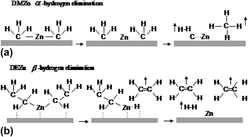
Methyl radical and ZnCH3 adsorbed on the surface can easily lead to carbon contamination in the grown films with H2 and CH4 escaping from the growing surface as by-products and the specific decomposition methods is shown in Fig. 9(a), while DEZn gains ethylene molecule via β dehydrogenation, i.e.,
 $${\rm{Zn}}{\left( {{{\rm{C}}_2}{{\rm{H}}_5}} \right)_2} \to {\rm{ZnH}}\left( {{{\rm{C}}_2}{{\rm{H}}_5}} \right) + {{\rm{C}}_2}{{\rm{H}}_4} \to {\rm{Zn}} + {{\rm{H}}_2} + 2{{\rm{C}}_2}{{\rm{H}}_4}\quad .$$
Dehydrogenation schematic diagram of (a) DMZn and (b) DEZn.

C2H4 produced by β dehydrogenation and the intermediate compound of the Zn–H bond produced at the same time are both beneficial to inhibit carbon contamination from the MO sources, and the specific cleavage method is shown in Fig. 9(b).
From the above reaction process, it can be seen that the hydrogen atoms and molecules are the by-products of the zinc MO sources' decomposition reaction. So the addition of hydrogen (atoms or molecules) should have effect on the above thermal decomposition. Particularly to DMZn, the dehydrogenation process may be changed due to the addition of hydrogen and the process which is similar to DEZn dehydrogenation will occur. One that can be expected is that the H atoms or molecules will react with two methyl groups to make the carbon groups desorb completely. Therefore, when DMZn is the zinc source, the addition of H2 has the positive effect on the growth of ZnO films. For the DEZn case, C2H4 and the intermediate compounds of Zn–H bond produced by β dehydrogenation are beneficial to decrease the carbon contamination from MO sources. As H2 is a by-product of β-dehydrogenation reaction, hydrogen addition may then enhance the barriers for carbon-related species to desorb from the growing surface. Therefore, the addition of H2 decreases the quality of ZnO thin films and has a negative effect on the growth.
It is also reported that oxygen will have influences on the decomposition of Zn MO sources. The desorption rate of carbon species from the growing surface can be enhanced via the reaction of oxygen with the adsorbed carbon species. In the case, the high VI/II ratio will be greatly helpful to suppress the carbon incorporation in the ZnO films, as reported in our early work and some other studies.Reference Liu, Gu, Zhu, Tang, Liu, Chen and Zheng19 In the case, if the H2 addition can affect the decomposition of oxygen precursor, a change of zinc precursor decomposition or even carbon impurity incorporation can then be anticipated.
Next, let's move to the effect of H2 addition on oxygen source. In our previous study, the effect of H2 on ZnO has been introduced and discussed when N2O is used as the oxygen source. H2 addition has been found to enhance the decomposition of N2O, and so possibly to form H2O. H2O is believed to decompose much easily compared with N2O, which is very difficult to decompose to produce oxygen at a low growth temperature.Reference Liu, Gu, Zhu, Tang, Liu, Chen and Zheng19 This reaction is shown in Eq. (3).
 $${{\rm{H}}_2} + {{\rm{N}}_2}{\rm{O}} \to {{\rm{N}}_2} + {{\rm{H}}_2}{\rm{O}}\quad .$$
Therefore, when N2O is used as the oxygen source, the addition of H2 should be beneficial for the growth of ZnO thin films. For the O2 case, however, the high VI/II ratio in the growth reactor can be attained and thus carbon incorporation can be fully suppressed. When H2 is added into O2, it is reported that the formation of H2O will occur, too, as shown in Eq. (4).
 $${{\rm{H}}_2} + {{\rm{O}}_2} \to {{\rm{H}}_2}{\rm{O}} + {\rm{H}}\quad .$$
The transition from O2 to H2O will certainly decrease the amount of effective oxygen on the growing surface, and then the VI/II ratio will be decreased. This may possibly cause the increase of carbon incorporation in the ZnO films to some extent.
The growth rate of the samples shown in Table I can be understood by the above reaction mechanism. For the samples grown by O2, the growth rates increase when adding H2, regardless of the MO precursor used. It could be due to the transfer of O2 to H2O by additional H2, which reduces the activity of the oxygen source, and thus suppresses strong gas-phase reactions. Since the suppression would reduce the consumption of the Zn MO precursors, more MO molecules could reach the growing surface and results in a faster growth rate. However, for the samples grown by N2O, the growth rates seem to depend on the kind of MO precursors. As discussed above, the additional H2 would suppress the β dehydrogenation reaction of DEZn while enhancing the α fission reaction of DMZn. Therefore, the H2 addition would prevent the dissociation of DEZn, leading to less Zn atoms on the growing surface. Despite that H2 addition would change N2O to more active H2O, the amount of Zn precursors would determine the growth rate. As a result, the growth rate with H2 addition for the DEZn + N2O combination case is lower. Accordingly, the H2 addition would enhance the dissociation of DMZn, leading to more Zn atoms on the growing surface, and a higher growth rate has been thus observed for the DMZn + N2O combination case.
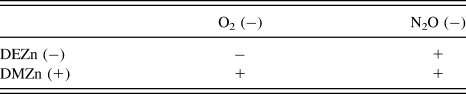
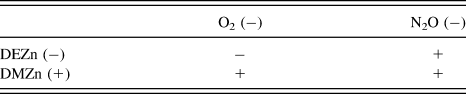
The above descriptions of the influence of the H2 addition on zinc and oxygen sources indicate complicated effects of H2 addition on the grown ZnO films, which should strongly depend on the choice of zinc and oxygen precursors for ZnO MOCVD growth. The carbon impurities incorporation, and then the structural quality and properties of the ZnO films will also change accordingly. According to the above description and results, we can make a summary on the effect of H2 addition on ZnO film in a systematic manner, as shown in Table II. First, when DMZn is used as the zinc precursor, and N2O is used as the oxygen source, H2 has positive effects on both sources for ZnO growth. So the quality of the ZnO thin films has been significantly improved with carbon impurity suppressed, as shown in Figs. 5(b)–Figs. 7(b). Second, when DMZn is used as the zinc source and O2 is used as the oxygen source, H2 has the positive effect on the zinc precursor, but a negative effect on the oxygen source. From the experimental results as shown in Figs. 5(a)–Figs. 7(a), it shows that the quality of ZnO thin films has been significantly improved which indicates that the positive effect of H2 on the zinc precursor plays the decisive role. Third, when DEZn is used as the zinc precursor and N2O is used as the oxygen source, H2 has negative effect on the zinc precursor, but positive effect on the oxygen source in the growth of ZnO films. From Figs. 1(b)–Figs. 3(b), x-ray diffraction (XRD) shows that the addition of H2 has caused a small decrease in the structural quality of ZnO thin films, but Raman scattering shows that the addition of H2 has fully suppressed carbon impurity incorporation. Combined with the strongly enhanced intensity of the band edge emission in PL, it is also fair for us to suggest a positive effect of H2 addition on ZnO film here. Finally, when DEZn is used as the zinc source and oxygen is used as the oxygen source, H2 has negative effects on both sources. Thus, the quality of the ZnO thin films is significantly degraded together with high carbon impurity incorporation. In the case, even the band edge emission of PL has enhanced a lot in terms of intensity, the negative effect of H2 addition on ZnO film should be given for the case.
Summary of the effects of the H2 addition on properties of the as-grown ZnO films. The “+” denotes a positive (improvement) effect and the “−” denotes a negative (degradation) effect.
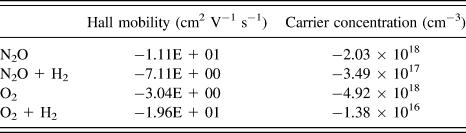
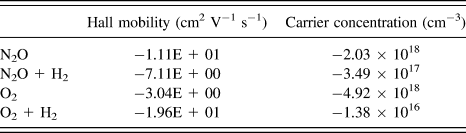
The positive effect of H2 addition on ZnO film has been obtained for most cases, however, researchers should be careful about the use of H2 for ZnO growth optimization because of the possibility of H impurity incorporation in ZnO. The H atom, which has the smallest radius in nature, can also be easily bonded to the defects or other impurities of the material, which can greatly affect the electrical, optical, and structural properties of many materials. In fact, the H atom has been considered as a strong candidate, which is responsible for the observed intrinsic carriers. As carbon clusters may have contribution to the carrier concentration of the ZnO film, the opposite effect on carbon impurity incorporation for DEZn with H2 addition may cause it difficult for us to determine the exact contribution of hydrogen incorporation to the carrier concentration. We then used room temperature Hall-effect measurement on the grown ZnO films for DMZn cases, and the results are shown in Table III. For the N2O case, the addition of H2 causes a little lower Hall mobility with the carrier concentration decreased a lot in the grown ZnO film. For the O2 case, the addition of H2 has increased the Hall mobility a lot with a much lower carrier concentration of the grown ZnO film. As H is considered as a shallow donor in ZnO, the above results do suggest that there is little H atom has been incorporated into the ZnO films during growth with H2 addition. The observed significant decrease in the carrier concentration should have a strong correlation with the suppression of carbon clusters. Actually, the intensity of the carbon-related signal drops significantly with the addition of H2 revealed by the auger electron spectra (AES). The depth profile derived from the AES shows that the carbon concentration in the bulk is around 3.0% for the film without H2 addition. However, no obvious peak related to carbon atoms could be detected for the film with H2 addition, indicating that the carbon concentration is below the detection limit of the AES. Therefore, the AES analysis supports the suppression mechanism of carbon impurities by the H2 addition. The carbon clusters have been found to have a strong contribution to the carrier concentration in ZnO, in fact, the specific resistance has been found to have a monotonous decrease dependence on carbon clusters in our previous study.Reference Zhu, Gu, Zhu, Huang, Gu, Ye and Zheng15
Room temperature Hall-effect measurement on the grown ZnO films for the DMZn case.
IV. CONCLUSIONS
In summary, the influence of H2 addition on the structure and properties of ZnO films with DMZn and DEZn as zinc precursors and N2O and O2 as oxygen precursors have been systematically studied. The H2 addition has significantly improved the crystal structural quality of ZnO thin films grown by DMZn for both the O2 and N2O cases with carbon impurity incorporation fully suppressed, but an opposite effect has been found to occur on the ZnO thin films grown by DEZn with H2 addition, the improvement in the quality of the ZnO film with full suppression of carbon impurity has been obtained for the N2O case, but the deterioration in the quality of the film with abnormal high carbon impurity incorporation was obtained for the O2 case. However, the H2 addition can significantly improve the optical properties of the ZnO films no matter what zinc MO precursors or oxygen sources are used. No evidence has been found on the observation of enhanced hydrogen incorporation in grown ZnO film with H2 addition. This study indicates that the H2 addition should be a powerful tool to optimize the structure and quality of ZnO film grown by MOCVD method.
ACKNOWLEDGMENTS
This research is supported by the State Key Program for Basic Research of China under Grant No. 2011CB302003 and National Natural Science Foundation of China (Nos. 61025020, 60990312, 61274058, and 61322403), Basic Research Program of Jiangsu Province (BK2011437 and BK20130013), and the Priority Academic Program Development of Jiangsu Higher Education Institutions.