Introduction
Special Care Units (SCUs) have been conceived as a way to provide specialized care for people with dementia in nursing homes. Purportedly, their environmental design, the training of their staff, and their intervention programs are specifically suited for the needs of people with dementia (Weiner and Reingold, Reference Weiner and Reingold1989; Berg et al., Reference Berg1991; US Congress, Office of Technology Assessment, 1992). Actually, in the 1980s and 1990s in the United States there was a proliferation of nursing homes claiming to have such SCUs: from 7.6% in 1987 to 14.1% in 1992 and 22% in 1996 (Leon et al., Reference Leon, Cheng and Alvarez1997). However, it was not clear which elements were different between a special unit and a standard one; and without uniform and agreed-upon criteria for defining the special units, these ran the risk of turning into mere marketing ploys for the nursing homes offering special units (US Congress, Office of Technology Assessment, 1992; Maslow and Ory, Reference Maslow and Ory2001).
In the early 1990s, two parallel studies (one sponsored by the US Congress, Office of Technology Assessment, and the other by the Alzheimer's Association) reached the conclusion that there was no empirical evidence in favor or against these units; likewise, there was no conclusion either about the characteristics of these units that could effectively be of help for residents with dementia (Maslow and Ory, Reference Maslow and Ory2001).
This lack of empirical data led the National Institute on Aging to fund a series of ten national level collaborative studies throughout the 1990s, which reached the following conclusions (Maslow and Ory, Reference Maslow and Ory2001): In comparison with residents in non-specialized beds, those in SCUs were more likely to be males, younger, diagnosed with Alzheimer's disease (AD), admitted directly from home, under private pay status, independently mobile, and with fewer physical impairments and behavioral discomfort (agitation/aggressiveness). In addition, other works found that, in comparison to those in non-specialized care, residents in SCUs had better physical health (Riter and Fries, Reference Riter and Fries1992; Buchanan et al., Reference Buchanan, Choi, Wang, Ju and Graber2005; Nobili et al., Reference Nobili2008). So Leon (Reference Leon1998) warns that attention to younger and healthier residents implies a higher economic cost, since they have a greater life expectancy. Furthermore, other differences at intake with respect to residents in standard care should not be overlooked when assessing the impact of special care.
Results of research on SCUs are critical with their purported benefits: in some cases no beneficial effect of being in an SCU has been found in activities of daily living (ADL), behavior problems, or functional capacity in general (Holmes et al., Reference Holmes1990; Phillips et al., Reference Phillips1997), while in other studies it is not clear whether the attention and care received by residents in SCUs is really special or different from the ones received in a standard unit (Gerdner and Beck, Reference Gerdner and Beck2001). Although it has also been found that residents in SCUs received a more comfortable attention in some respect (e.g. fewer use of feeding tubes, bed rails, or nappies in the absence of a toileting program; Gruneir et al., Reference Gruneir, Lapane, Miller and Mor2008), there would be no difference in other relevant variables (i.e. use of physical restraints); moreover, there would be an unexpected increase in the use of neuroleptic medication in these units (Phillips et al., Reference Phillips, Spry, Sloane and Hawes2000; Gruneir et al., Reference Gruneir, Lapane, Miller and Mor2008). On the other hand, when considering more recent works, Nobili et al. (Reference Nobili2008) do find a tendency to withdraw physical restraints and antipsychotic medication in SCUs, and the data from the National Nursing Homes Survey in 2004 show that residents in these units received better care, showing less pressure ulcers, hospitalization, and weight loss in comparison with residents in regular units (Luo et al., Reference Luo, Fang, Liao, Elliott and Zhang2010).
The concept of SCU in Spain has not received as much attention as in the United States. In January 2010 in Spain there were 5,177 nursing homes, amounting to a total of 335,380 beds, of which 23,923 (7.13%) are defined as psychogeriatric beds (IMSERSO, 2010); the number of beds in SCUs, or their features, is not specified. Unlike in the United States, in Spain there is no official qualification for SCUs; thus, any nursing home offering some specific feature for the attention of people with dementia can make the claim of having an SCU. This makes SCUs very heterogeneous in their size and other features, although they usually consist of a separate area in the nursing home with an adapted environment where dementia patients can take part in a number of activities suited to their needs. Besides this, in recent years some centers have been created specifically for residents with AD. Furthermore, no data about residents and care features in SCUs in Spanish nursing homes have been reported to date.
Consequently, the present paper reports the first data about the features of SCUs in Spain. Specifically, it aims to compare nursing home residents with dementia in SCUs with other residents with dementia taking into account (1) socio-demographic and clinical characteristics; (2) services and care provided; and (3) quality of life (QoL). This study is a part of a broad research project promoted by Alzheimer's Association of Spain (AFALcontigo), aimed at improving residents’ living conditions in dementia long-term facilities and focused on the analysis of their QoL and unmet needs. Further results of the project have been published previously (Crespo et al., Reference Crespo, Bernaldo de Quirós, Gómez and Hornillos2012; Reference Crespo, Hornillos and Bernaldo de Quirós2013a; Reference Crespo, Hornillos and Gómez2013b).
Based on the data from previous studies in other countries, we propose the following hypothesis: (1) Residents with dementia in SCUs will be younger and will show higher cognitive and functional impairment and more disruptive behaviors than residents with dementia in standard beds; (2) availability of individual bedrooms and bathrooms will be higher in SCUs; (3) use of nappies and feeding devices will be lower in SCUs; and (4) due to differences in care, outcome measures, such as QoL, will be better for patients in SCUs. Since data about the use of restraint systems in previous studies are contradictory, there are no specific hypotheses about this issue.
Methods
Participants and sampling
The present paper describes a multicenter study in 11 nursing homes in five Spanish provinces (Córdoba, León, Madrid, Murcia, and Soria). Altogether, these facilities offered 1,316 beds (Mean (M) = 119; SD = 57); when the assessment was carried out, they had 1,203 residents, which implies an occupation rate of 92%; 488 residents (48.88%) had been diagnosed of having dementia. Six centers had dementia SCUs, with a total of 300 beds in these units (M = 50; SD = 52.73), and an occupation rate of 91% (i.e. in the assessment period there were 282 residents in SCUs). Consequently, 57.79% of the residents with dementia in the assessed nursing homes were in SCUs.
For every province a fixed number of residents (50) was set (i.e. total residents = 250, about 50% of the residents with dementia in 11 nursing homes during the assessment period). Then for every province, each nursing home was surveyed for a proportional number of residents, depending on its size and the proportion of residents with dementia.
In each center residents were randomly selected among those who (a) were aged 60 years and more; (b) lived permanently in the center and had been living there for at least three months; (c) met criteria of the American Psychiatric Association (DSM-IV-TR) for “probable” or “possible” dementia; and (d) had a Mini-Mental State Examination (MMSE) score of less than 27.
For every selected resident, a staff member was also chosen to obtain data about the residents’ clinical status and the care provided. Following Hoe et al. (Reference Hoe, Hancock, Livingston and Orrell2006), who recommend taking the report from the “key” person in the resident's care, we focused on the worker who provided direct attention and care to the selected residents. Consequently, one member of the staff could assess several residents.
Design and measures
A multicenter cross-sectional study was designed comparing patients with dementia in nursing home placed in SCUs and patients placed in standard beds.
The following instruments were applied to the residents and the staff member to assess residents’ care features:
Residents’ battery: (a) Socio-demographic data (age, gender, educational level, marital status, months in nursing home); (b) MMSE (Folstein et al., Reference Folstein, Folstein and McHugh1975) to verify the inclusion criteria and also to obtain an overall level of current cognitive profile (scores range 0–30; higher scores indicate less cognitive impairment); (c) The Cornell Scale for Depression in Dementia (CSDD, patient version; Alexopoulos et al., Reference Alexopoulos, Abrams, Young and Shamoian1988), which assesses frequency of signs and symptoms of major depression (range 0–38; scores greater than 12 indicate probable depression; scores greater than 18 indicate certainty of depression); and (d) the Quality of Life in Alzheimer's Disease Scale (QoL-AD, patient version; Logsdon et al., Reference Logsdon, Gibbons, McCurry and Teri2002) in the adaptation by Edelman et al. (Reference Edelman, Fulton, Kuhn and Chang2005) for assessing QoL in patients with dementia in residential settings (range 15–60; higher scores indicating higher QoL).
Staff members’ battery: It focused on care features and resident-related variables as assessed by the staff member, including (a) ad hoc record of the residents’ needs and the kind of care provided to them in the last month, including presence of urinary and faecal incontinence, use of day and night nappies, use of feeding devices, use of physical and pharmacological (i.e. psychotropic medication) restraint, and bedroom and bathroom features (i.e. individual vs. shared); (b) the Barthel Index of ADL (Mahoney and Barthel, Reference Mahoney and Barthel1965) to measure residents’ functional abilities, ranging from 0 – completely dependent– to 100 – completely independent; (c) the Global Deterioration Scale (GDS; Reisberg et al., Reference Reisberg, Ferris, de Leon and Crook1982) to measure the level of cognitive impairment and severity of dementia, ranging from 1 – no cognitive impairment – to 7 – severe cognitive impairment; (d) Cohen-Mansfield Agitation Inventory (CMAI; Cohen-Mansfield, Reference Cohen-Mansfield1986) to assess agitation and other disturbing behaviors in elderly people, including aggressive behavior, physically non-aggressive behavior, and verbally agitated behavior – higher scores indicate higher frequency of these behaviors; (e) CSDD (informant version; Alexopoulos et al., Reference Alexopoulos, Abrams, Young and Shamoian1988) that assesses frequency of signs and symptoms of major depression (range 0–38; scores greater than 12 indicate probable depression; and scores greater than 18 indicate certainty of depression); and (f) QoL-AD (proxy version; Logsdon et al., Reference Logsdon, Gibbons, McCurry and Teri2002) in the adaptation by Edelman et al. (Reference Edelman, Fulton, Kuhn and Chang2005) for residential settings (range 15–60; higher scores indicating higher QoL).
Procedure
Approval for the study was obtained from the center's Research Ethics Board. Consent was directly obtained from residents. For those who were too cognitively impaired to give consent, a guardian or a responsible party was approached for consent. Then the residents were interviewed individually in a quiet room. Once the residents had been selected and interviewed, the manager was asked to identify the key worker. Subsequently, the resident's key worker completed the assessment staff members’ battery.
Data analysis
Descriptive analysis of clinical and socio-demographic characteristics of residents was carried out using absolute and relative frequencies for qualitative variables, measures of central trend, and dispersion for quantitative variables.
Student's t-tests and χ 2 tests were used to compare residents’ profile between SCUs and standard beds. Moreover, multivariate analysis (binary logistic regression) was also performed with resident's location as a dependent variable and residents’ socio-demographic and clinical features that reached statistical significance in univariate analyses as independent variables, using the forward stepwise (Wald) method and the Hosmer and Lemeshow goodness-of-fit test for the adjustment of the model.
Comparisons of care features between residents in SCUs and standard beds were carried out by means of χ 2 tests. Odds ratio and 95% confidence interval (CI) values were considered. In addition, in order to control the effect of the state of the residents, further analyses were performed controlling for the effect of functional status (Barthel scores) and dementia stage (GDS) with the Mantel–Haenszel test. Finally, comparisons of residents’ QoL were performed using t-tests.
For all χ 2 analyses, when the expected frequency was less than 5 in any cell, Fisher's test or Kendall's Tau-b correlation was applied.
Results
Characteristics of participants
A total of 217 residents were examined; however, 20 provided incomplete information. Consequently, the final sample consisted of 197 residents: 102 (51.8%) in SCUs, and 95 (48.2%) in standard beds; the percentage of residents in SCUs was slightly lower in the sample than in the whole group of residents in the centers, but this difference did not reach statistical significance (χ 2(1) = 3.13, p = 0.077).
The participants were mostly women (82.2%) and their mean age was 86.08 years (SD = 6.40); 44.6% of the residents showed severe cognitive impairment (MMSE scores ≤10); 66.5% were severely or totally dependent for ADL (Barthel scores <40); and 68% were rated in the severe or very severe impairment dementia stages (GDS scores 6–7).
Additional information was obtained through 92 staff members with a mean age of 39.8 years (SD = 9.96). They were mainly females (96.7%) and worked as care or nursing assistants (88.1%). Most of them had received specific training on elderly care (92.4%) and dementias (76.1%). Training on elderly care was more frequent among staff members that provided information about residents in SCUs than those that informed about residents in standard beds (96% vs. 83.7%; χ 2(1) = 8.14, p = 0.041); nevertheless, there were no significant differences in specific training on dementia. The mean duration of working in the nursing home was 47.34 months (SD = 49.52); there were no differences here between workers completing the battery regarding residents with dementia in SCUs and those completing the battery regarding residents with dementia in standard beds (t(184) = 1.38, p = 0.17).
SCU residents’ profile
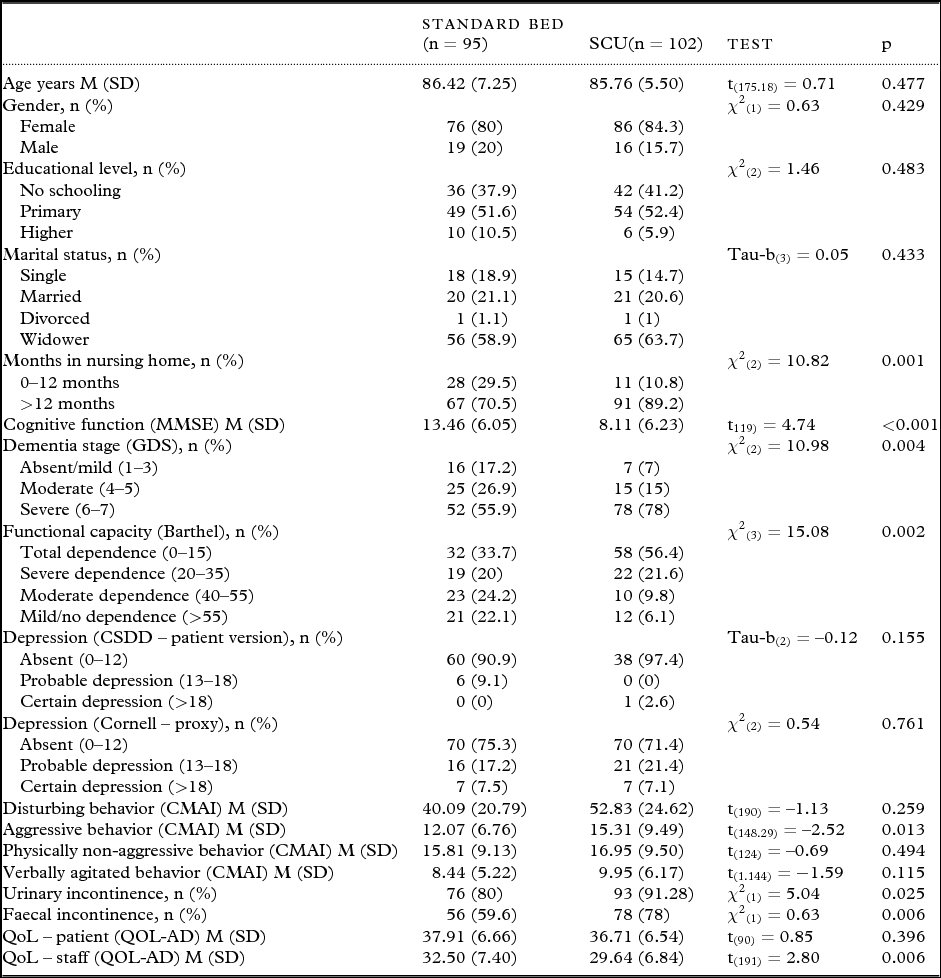
As shown in Table 1, the residents in dementia SCUs mostly had lived in the nursing home for more than a year, showed severe cognitive impairment, and a severe dementia stage as well as total or severe dependence for ADL; moreover, both urinary (91%) and faecal (78%) incontinence were very common. On the contrary, depression symptoms were quite infrequent, and the presence of disruptive behaviors could be considered low.
Residents’ socio-demographic and clinical features by placement

Univariate analyses showed that the residents with dementia placed in SCUs had higher cognitive impairment, were in a more advanced dementia stage, were more functionally impaired for ADL, and showed more aggressive behaviors when compared with the residents with dementia placed in standard beds. Furthermore, among the residents in SCUs, the percentage of those who had been residing in the center for a year or longer was significantly higher than the residents in standard beds, as also were the percentage of the residents with urinary and faecal incontinency.
In the multivariate logistic regression model, the variables significantly associated with the residents’ placement in SCUs were the presence of severe cognitive and functional impairment, and a higher frequency of aggressive behaviors; these three variables allowed for a correct classification of placement for 76% of the residents (see Table 2). General goodness-of-fit for the model was good, with Nagelkerke R2 = 0.291, χ 2(8) = 9.77, and p = 0.282 in the Hosmer–Lemeshow test.
Multiple logistic regression model with residents’ placement (standard bed vs. SCU) as dependent variable

Note: OR = odds ratio; 95% CI = 95% confidence interval.
SCU care features
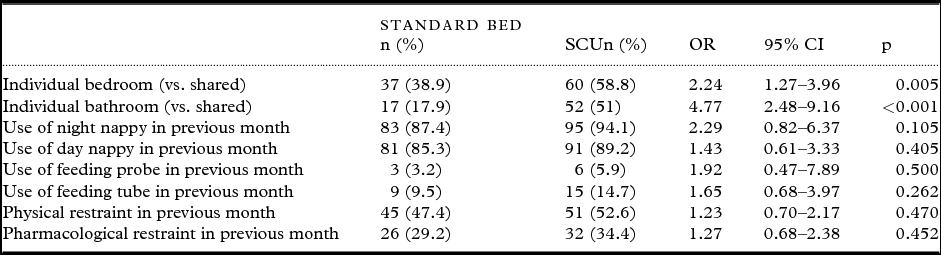
As can be seen in Table 3, about half of the residents in SCUs had individual bedrooms and bathrooms. The majority of residents in SCUs used both day and night nappies; however, the use of feeding probes and tubes was only occasional. Regarding the use of restraint systems, physical restraints were applied to about half of the residents in SCUs, while pharmacological restraints were applied to about one-third of them.
Features of care to residents with dementia by placement
Note: OR = odds ratio; 95% CI = 95% confidence interval.
There were no significant differences by type of unit in none of the care variables assessed. Only the features of the placement reached statistical significance; specifically, more residents in SCUs have at their disposal individual bedroom and bathroom.
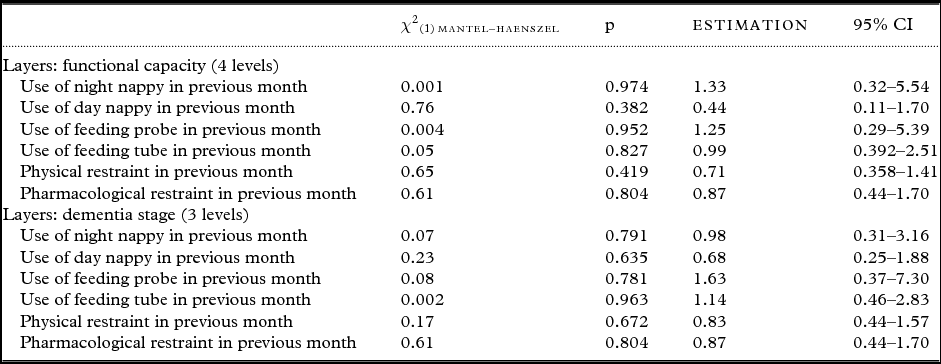
Since it could be expected that the use of some measures of care (e.g. use of nappies or feeding devices) would increase with rise in functional impairment, and since data had shown that residents in SCUs had higher overall impairment, further analyses were performed controlling for both functional impairment level and stage of dementia. As can be seen in Table 4, no significant effects were found when controlling for these variables.
Features of care to residents with dementia by placement controlling for functional level (Barthel) and dementia stage (GDS)
Note: 95% CI = 95% confidence interval.
Specifically, since the percentage of residents with urinary and faecal incontinence was higher in SCUs, a higher use of day and night nappies in this group could be expected; nevertheless, data do not show so. Consequently, further analyses were performed on the use of nappies considering the presence of urinary incontinence. χ 2 tests showed significant differences by placement in the percentage of residents that had used nappies in the last month without having urinary incontinence: 9.9% and 1.1% for day nappies among residents in standard bed and SCUs, respectively (χ 2(1) = 6.66, p = 0.014); and 10.8% and 3.2% for night nappies among residents in standard bed and SCUs, respectively (χ 2(1) = 4.16, p = 0.041).
QoL in SCU residents
Data about QoL in both groups showed that residents in standard beds had higher QoL either when reported by the residents themselves or by the staff key member (see Table 1). Nevertheless, only the differences in QoL reported by staff reached statistical significance.
Discussion
The present study provides the first analysis of SCUs in Spain. Similar to results found in the United States, data show a different profile for residents in SCUs in comparison with those in standard settings; however, no differences were found regarding the kind of care and attention provided in different units (Holmes et al., Reference Holmes1990; Phillips et al., Reference Phillips1997; Gerdner and Beck, Reference Gerdner and Beck2001).
Residents in SCUs show higher cognitive and functional impairment, and more aggressive behaviors (though no other behavior problems) than residents in standard care. Nevertheless, they do not show differences in their emotional state. Lack of differences in behavioral and emotional variables could show the success of SCUs in the treatment of those issues. On the other hand, higher cognitive impairment as well as aggressive behaviors could precisely be the reasons for admission to SCUs (due to their admission criteria).
Residents in SCUs have been living in the nursing home for a longer time than residents in standard care; this might mean that those residents were first admitted in that nursing home in non-specialized beds, and as impairment and dependency increased they were later shifted to SCU. However, there is no difference in age between the residents in either setting. That is to say, not being older, residents in SCUs tend to have been living longer and show a greater impairment than residents in standard care, which could mean that the former had an earlier onset or a faster development of dementia.
According to these data, it could be expected that residents in SCUs require special care and attention. However, although residents in SCUs showed a higher availability of individual bedroom and bathroom, there were no significant differences in variables related to type of attention. This result is somewhat surprising in some aspects. Thus, for example, in spite of their higher functional impairment, residents in SCUs do not show a higher use of feeding devices. This data could mean better care in SCUs (i.e. less use of feeding tubes, probes, or syringes due to maintenance of feeding without external devices whenever possible) as Gruneir et al. (Reference Gruneir, Lapane, Miller and Mor2008) have pointed out. However, analyses where the effect of this variable was controlled do not support this interpretation.
Special mention deserves the use of nappies, where there were no significant differences, even though residents in SCUs suffered more frequently from incontinence. These data, which are again in line with the results found in the United States by Gruneir et al. (Reference Gruneir, Lapane, Miller and Mor2008), could mean a higher use of continence programs in these units. However, detailed analyses reveal that use of nappies in residents without incontinence is more frequent in standard beds than in SCUs, maybe because of the high incontinence rates in the latter. Nevertheless, data could also show a certain “premature” use of nappies in standard beds, although further research would be required in this respect.
It is also noteworthy that, contrary to expectations, data show better QoL among residents in standard care units, especially when some member of the staff assesses it. Thus, data would support findings about the higher influence of residents’ cognitive and functional status than environmental variables upon staff-rated QoL (González-Salvador et al., Reference González-Salvador2000; Sloane et al., Reference Sloane, Zimmerman and Walsh2001; Hoe et al., Reference Hoe, Hancock, Livingston and Orrell2006; Crespo et al., Reference Crespo, Hornillos and Bernaldo de Quirós2013a). Furthermore, taken into account that this is the only outcome variable measured in the study, data are not very encouraging about the beneficial impact of SCUs upon their users.
Staff members that reported about residents in SCUs showed better qualifications for working with elderly people but not specifically with people with dementia, which is somehow unexpected. Besides, their experience in their job was similar to the one reported by staff that assessed residents in standard care. Nevertheless, it has to be taken into account that available information does not refer to the whole staff, but only to those staff members who actually took part in the study gathering data from the residents. Nonetheless, results point to the need of further research about the characteristics of workers in both types of units.
These results contrast with those found in the United States, where recent data support the notion that residents in SCUs do receive a better care (Luo et al., Reference Luo, Fang, Liao, Elliott and Zhang2010), even though the first studies on this issue, carried out in the 1990s, did not found positive effects for these units and brought into question their true specialization (Holmes et al., Reference Holmes1990; Phillips et al., Reference Phillips1997). It could be that those first more critical studies had a positive effect by drawing attention to the need of regulating and/or establishing criteria about what special care in dementia implies, and of guaranteeing that units advertised as special care units are really special. In this line, it is noteworthy that when the State of Arkansas legally regulated the criteria for SCUs, the number of nursing homes offering this service decreased from 24 to 14 (Gerdner and Beck, Reference Gerdner and Beck2006).
Regarding the use of restraint systems, half of the residents had had mechanical restraints and one-third had had pharmacological restraints in the last month, independent of their placement. These data are at odds with those found in the United States, where the tendency is toward the increasing use of pharmacological restraints in SCUs (Leon and Ory, Reference Leon and Ory1999; Gruneir et al., Reference Gruneir, Lapane, Miller and Mor2008; Luo et al., Reference Luo, Fang, Liao, Elliott and Zhang2010), which could have to do with differences in legislation about the use of restraint systems.
All in all, results from the present study show that (1) residents in SCUs did not differ from those in standard beds in socio-demographic variables; (2) placement of residents with dementia in SCUs seemed to be related with the presence of severe cognitive and functional impairment and more aggressive behaviors; (3) being in an SCU conveyed a higher probability of having individual bedroom and bathroom; (4) there were no differences in provided care in SCUs, considering use of nappies and feeding and restraint systems; and (5) patients in SCUs showed lower QoL when reported by the staff.
Recent data by Luo et al. (Reference Luo, Fang, Liao, Elliott and Zhang2010) show that SCUs could be in fact of help, provided that attention is truly special; one should ask if an evolution like the one observed in the United States, where first reports were critical of SCUs but recent data point toward their potential usefulness, could happen in Spain as well. To that end, research on SCUs should continue, overcoming some of the limitations of the current study: cross-sectional design, which does not allow for the establishment of causal links; the size and representativity of the sample of residential centers; lack of relevant variables regarding staff characteristics, environmental design (besides individual bedroom and bathroom), the programs developed in SCUs, and the place of derivation of the resident before admission to an SCU (home, hospital, non-specialized bed?); or the need of more outcome variables.
Furthermore, given that there is yet no agreed-upon definition of SCU, and since under that term several units with heterogeneous characteristics can be found, it could be useful to establish a typology based on the process of SCUs (Park et al., Reference Park, Zimmerman, Sloane, Gruber-Baldini and Eckert2006), which would help in the study of the impact of specific care measures upon residents’ well-being. If research results effectively confirmed those of the present work, that is, the attention in SCUs is not truly specialized, then it would be up to the policy-makers to take effective action to (1) promote research about the care processes that are of help for people with dementia; (2) establish regulations to include these processes in SCUs as well as an official certification system; and (3) establish the required control and supervision mechanisms to guarantee compliance with these regulations. Suggestions about features that could make special care truly special could only come from empirical research. Nevertheless, it could be hypothesized that there should be a real match between residents’ needs and care practices. This means that SCUs should be staffed by workers with specific training about people with dementia; moreover, the worker-to-resident ratio should probably be higher than in standard care. Residents’ QoL should be a priority and the ultimate objective of any intervention. To that end, resident's autonomy should be fostered whenever possible regarding mobility, dressing, feeding, bathing, toileting, and self-care; staff should keep in mind that their role would sometimes imply merely to oversee that residents are able to perform these tasks, providing assistance only when necessary. Furthermore, environment should be suited for people with mobility issues, but other considerations should be also taken into account, such as the use of visible external cues to be of help for time-space orientation. Besides, staff should be prepared and properly equipped for implementing programs for memory training, self-esteem development (e.g. keeping residents involved in tasks and choices around the SCU, such as taking care of a plant or a small animal), or positive communication exchanges. Nonetheless, as stated previously, only empirical research could inform about the suitability and effectiveness of these measures, but taking into account the not-so-good results for SCUs in Spain found in this study, research on these issues seems worth the effort.
Conflict of interest
This research was supported by the Alzheimer's Association of Spain (AFALcontigo) and was funded by Foundation Centre for Research on Neurological Diseases (Fundación Centro Investigación Enfermedades Neurológicas – Fundación CIEN) in their program 2008–2010.
Description of authors’ role
M. Crespo led the research project, designed the present study, and carried out the redaction of the text and data analysis. C. Hornillos assisted with study design, database, data analysis, and the redaction of the text. M.M. Gómez supervised data collection.
Acknowledgments
The authors would like to kindly thank the following: Alzheimer's Associations in Spain for their help and support for this study: AFALcontigo, AFA Córdoba, AFA León, ALZHEIMUR Murcia, and AFA Soria. The authors also thank the participation and support of the following nursing homes: SANYRES (León), Artevida Rivas (Madrid), Alzheimer Centre Queen Sophia Fundation (Madrid), San Basilio (Murcia), Nuestra Señora de Fátima (Murcia), Los Royales (Soria), and five others that have preferred to remain anonymous.