


Introduction
Social anxiety disorder (SAD) is a debilitating psychological problem that is highly prevalent in adults. SAD is marked by a persistent fear of negative evaluation in social or performance situations and avoidance from these situations, which leads to impairment in life functioning (American Psychological Association, 2013). Among the most dysfunctional psychiatric conditions, SAD is the fourth most common disorder (Kessler et al., Reference Kessler, Berglund, Demler, Jin, Merikangas and Walters2005) and is associated with marked impairment in social, academic and occupational functioning (Acarturk et al., Reference Acarturk, de Graaf, Van Straten, Ten Have and Cuijpers2008). Furthermore, SAD is characterized by early onset (Otto et al., Reference Otto, Pollack, Maki, Gould, Worthington, Smoller and Rosenbaum2001), chronicity (Cairney et al., Reference Cairney, McCabe, Veldhuizen, Corna, Streiner and Herrmann2007), lack of treatment (Wang et al., Reference Wang, Lane, Olfson, Pincus, Wells and Kessler2005) and low rates of spontaneous remission (Keller, Reference Keller2003).
In spite of the effectiveness of traditional cognitive behaviour therapy (CBT) in SAD (Hofmann et al., 2014; Månsson et al., Reference Månsson, Frick, Boraxbekk, Marquand, Williams, Carlbring, Andersson and Furmark2015), the rate of drop-out from the treatment (Fernandez et al., Reference Fernandez, Salem, Swift and Ramtahal2015) and relapse rate (Scholten et al., Reference Scholten, Batelaan, van Balkom, Penninx, Smit and van Oppen2013) is high, and a third of treatment completers have been classified as non-respondent (Taylor et al., Reference Taylor, Abramowitz and McKay2012). Moreover, social anxiety is relatively highly co-morbid with other conditions (Fehm et al., Reference Fehm, Beesdo, Jacobi and Fiedler2008) and co-morbidity of anxiety and depression is associated with a higher proportion of disease burden (Gadermann et al., Reference Gadermann, Alonso, Vilagut, Zaslavsky and Kessler2012), worse treatment outcomes, and a poorer prognosis (Garber and Weersing, Reference Garber and Weersing2010). These results have led to considering the commonalities between anxiety and depression (i.e. emotional disorders), especially emotion regulation. Individuals with SAD have difficulties in emotion regulation across five specific families of emotion regulation processes – situation selection, situation modification, attentional deployment, cognitive change, and response modulation (Jazaieri et al., Reference Jazaieri, Morrison, Goldin and Gross2015). Considering these commonalities, interventions are designed to treat some underlying shared components. Among these interventions, contemporary psychological treatments like dialectical behaviour therapy (Linehan, Reference Linehan1993), mindfulness-based cognitive therapy (Segal et al., Reference Segal, Williams and Teasdale2002), acceptance and commitment therapy (Hayes et al., Reference Hayes, Strosahl and Wilson1999) and other recent CBT family therapies have emphasized commonalities in the process of emotional disorders in order to optimize treatment (Mennin et al., Reference Mennin, Ellard, Fresco and Gross2013).
Furthermore, the evidence for the efficacy of contemporary treatments on SAD is not consistently demonstrated. For example, a meta-analysis on the efficacy of transdiagnostic therapies on anxiety and depressive disorders showed a relatively large effect size on both anxiety and depression. However, there was a high inconsistency between studies (Newby et al., Reference Newby, McKinnon, Kuyken, Gilbody and Dalgleish2015). A systematic review of mindfulness and acceptance-based treatments (MABTs) on SAD showed that MABTs demonstrate a significant reduction in SAD symptoms (Norton et al., Reference Norton, Abbott, Norberg and Hunt2015). Another meta-analysis on the efficacy of cognitive bias modification on SAD showed a small effect size and a high degree of heterogeneity (Cristea et al., Reference Cristea, Kok and Cuijpers2015). The significant effect size was not found in the efficacy of mindfulness-based interventions on anxiety symptoms including SAD (Strauss et al., Reference Strauss, Cavanagh, Oliver and Pettman2014). However, other studies have shown a moderate effect of mindfulness-based therapy on improving anxiety symptoms (Hofmann et al., Reference Hofmann, Sawyer, Witt and Oh2010). Moreover, most of these treatments have not considered co-morbidity [including generalized anxiety disorder (GAD) and depression symptoms] as the main obstacle for improving SAD symptoms and increasing the likelihood of its occurrence (Bruce et al., Reference Bruce, Yonkers, Otto, Eisen, Weisberg, Pagano, Shea and Keller2005; Ezpeleta et al., Reference Ezpeleta, Domènech and Angold2006), but our study treated individuals with SAD co-morbid with depression and this study is novel and relevant for treatment.
In line with these efforts, emotion regulation therapy (ERT) is a preliminary treatment that incorporates components from traditional and recent CBTs with affective science to target emotional disorders, especially distress symptoms (Renna et al., Reference Renna, Quintero, Fresco and Mennin2017). ERT was developed to modify emotion dysregulation and negative self-referential processing (e.g. worry, rumination and self-criticism) which are highly characteristic of individuals with SAD symptoms (Kertz et al., Reference Kertz, Stevens and Klein2017; Klemanski et al., Reference Klemanski, Curtiss, McLaughlin and Nolen-Hoeksema2017; O’Toole et al., Reference O’Toole, Zachariae and Mennin2017). ERT postulates that motivational dysfunction, emotion regulation dysfunction (particularly negative self-referential processing) and inflexible contextual learning underlie individuals with anxiety and mood psychopathology and that awareness skills training, regulation skills training and experiential exposure can be used to target these disturbances (Mennin and Fresco, Reference Mennin and Fresco2014). ERT has been applied to treat individuals with GAD and GAD co-morbid with depression via open and randomized control trial treatment studies (Mennin et al., Reference Mennin, Fresco, Ritter and Heimberg2015; Mennin et al., Reference Mennin, Fresco, O’Toole and Heimberg2018; Renna et al., Reference Renna, Quintero, Soffer, Pino, Ader, Fresco and Mennin2018) and has been shown to reduce worry, rumination, anxiety, depression, and increase the quality of life. Furthermore, ERT has been well tolerated by clients, and the rate of attrition has been demonstrated to be low (Fresco et al., Reference Fresco, Mennin, Heimberg and Ritter2013; Mennin and Fresco, Reference Mennin and Fresco2014; Mennin et al., Reference Mennin, Fresco, Ritter and Heimberg2015; Mennin et al., Reference Mennin, Fresco, O’Toole and Heimberg2018; Renna et al., Reference Renna, Quintero, Soffer, Pino, Ader, Fresco and Mennin2018). Moreover, ERT has been adapted for caregivers of those with cancer to good effect (Applebaum et al., Reference Applebaum, Buda, O’Toole, Hoyt and Mennin2017).
Finally, co-morbidity is a common condition of emotional disorders (Craske et al., Reference Craske, Rauch, Ursano, Prenoveau, Pine and Zinbarg2009; Ohayon and Schatzberg, Reference Ohayon and Schatzberg2010) and Axis I co-morbidity is related to greater severity and longer duration of SAD (Erwin et al., Reference Erwin, Heimberg, Juster and Mindlin2002), decreased treatment outcomes (Olatunji et al., Reference Olatunji, Cisler and Tolin2010), and indeed, greater severity on avoidance, general anxiety, cognitive symptoms of anxiety, depressed mood, functional impairment, and overall psychopathology (Mennin et al., Reference Mennin, Heimberg and Jack2000). These findings suggest that ERT may be helpful in wider clinical groups such as those with primary SAD. Indeed, there has been a growing emphasis on shared aetiological and maintenance mechanisms across anxiety and mood conditions (McEvoy et al., Reference McEvoy, Watson, Watkins and Nathan2013; Watson, Reference Watson2005).
The main aim of the present study was to assess the efficacy of ERT via a single case series study in social anxiety disorder. The single case study is an acceptable design to preliminarily examine symptom–mechanism relations and change process in psychotherapy in order to further refine and develop efficacious treatments. In idiographic approaches like single case studies, by manipulating the independent variables, the dependent variables are carefully and repeatedly assessed. These designs require little time, money and participants and are also flexible and efficient (Barlow and Nock, Reference Barlow and Nock2009). This is the first study to investigate the efficacy of ERT on SAD, and it has twofold benefits. The first is providing initial support to develop ERT for SAD co-occurring with GAD and depression symptoms, and the second is assessing preliminary efficacy in the Iranian population.
Method
Design
A single case series using A-B design with follow-up (1, 2 and 3 months after the final treatment session) was used (Kazdin, Reference Kazdin1982). There were three weekly baseline points before the treatment phase. Participants completed self-reported questionnaires and were diagnostically assessed by an expert assessor at the baseline phase (weekly), at the treatment phase (every other week) and the follow-up phase. The assessor had an MSc in clinical psychology and was trained in ERT concepts. She assessed emotional symptoms by the Structured Clinical Interview for DSM-IV-TR (including SAD, GAD and depression symptoms), global functioning and participants’ feedback about the efficacy of ERT and its challenges. Baseline scores were considered as a baseline control against the treatment phase and the post-treatment scores were considered as a baseline control for the follow-up periods.
Participants
Participants were recruited from counselling and psychological service clinics and through local poster advertisements in Tehran, Iran. Of 20 referred individuals, four fulfilled the full criteria of the study. Inclusion criteria were: age greater than 18 years and meeting SAD (as the primary diagnosis and chief complaint) co-morbid with GAD and depression symptoms based on the Structured Clinical Interview for DSM-IV-TR (SCID-I, II). All participants were interviewed using Structured Clinical Interview for DSM-IV-TR, their primary diagnosis was SAD, and co-morbid GAD and depression symptoms were also determined. Diagnosis of SAD with GAD and depression symptom co-morbidity was assessed using Structured Clinical Interview for DSM-IV-TR before the intervention and after the termination of intervention. Co-morbidity assessment was based on Structured Clinical Interview for DSM-IV-TR interview and changes in the rumination scores as an indicator of depression and worry as an indicator of GAD [using the Rumination Response Scale (RRS) and Penn State Worry Questionnaire (PSWQ) for assessing rumination and worry, respectively, because a study on clinical GAD and major depressive disorder (MDD) individuals (Yang et al., Reference Yang, Kim, Lee, Lee, Yu, Jeon and Kim2014) showed that worry (assessed with PSWQ) was associated with greater odds of receiving a GAD diagnosis over and above the effect of rumination, and rumination (assessed with RRS) was associated with greater odds of receiving a MDD diagnosis above and beyond the effect of worry. In other words, although worry and rumination are related, they are distinct cognitive factors and play a differential role in the diagnosis of GAD and MDD (Yang et al., Reference Yang, Kim, Lee, Lee, Yu, Jeon and Kim2014). Exclusion criteria were: any evidence of problematic neurocognitive conditions; being diagnosed with a substance disorder or other Axis I and II disorders (as the main diagnosis); being the recipient of psychotherapy in the past 2 years before referral to the centre and not taking psychoactive medication or if so, being stabilized. Participants were three men and one woman. None was taking medications for his or her SAD. All participants gave written consent to report and submit the findings of case studies.
Clients’ demographic information
Common symptoms: symptoms of SAD (fear of negative evaluation, difficulty in an oral presentation, initiating and continuing conversation, and avoidance of social parties and interaction with other people), worry, rumination, self-criticism, guilt, sad mood, decreased self-esteem and self-confidence, and considerable impairment in almost all life aspects.
Client A: a 28-year-old man living in Tehran. At the time of assessment, he was studying for a university degree (MSc). SAD symptoms began in high school when he wanted to speak in front of a class. Worry, rumination and other symptoms were intensified in the second year of college.
Client B: a 27-year-old single woman living in Tehran. At the time of assessment, she was studying for a university degree (MSc). SAD symptoms began in the first year of college when she was obliged to communicate with new people and make new friends. She presented with economic and family problems.
Client C: a 29-year-old man living in Tehran. He specialized in an engineering profession and presented as struggling with conflicts in his relationship. Due to his SAD and the lack of assertiveness, he lost his job and was unemployed at the time of assessment and initial sessions of treatment. Symptoms of SAD began when he was in military service. He also had some issues with his family due to a lack of assertiveness skills.
Client D: a 45-year-old man living in Karaj, the capital of Alborz Province, Iran. He holds a diploma degree (humanities). He was married and has a 9-year-old daughter. He presented with conflicts with his wife due to disagreements on some crucial issues (different ideas about lifestyle and parenting). He did not have a stable job and had lost many prior positions due to his SAD symptoms and maladaptive perfectionism. SAD began when he lost his hair during adolescence, and since then, he was afraid of being evaluated negatively by others. However, negative evaluations were not limited to his appearance and they extended to other sources of negative evaluation like speaking in front of others, eating in front of others, and fear of being humiliated when doing something in front of others. Other symptoms were intensified in two recent years due to some stresses.
Assessments
Structured Clinical Interview for DSM-IV-TR (SCID-I, II; First et al., Reference First, Gibbon, Spitzer and Benjamin1997; Spitzer et al., Reference Spitzer, Williams, Gibbon and First1992): SCID is a semi-structured interview for assessing selected Axis I and II disorders according to DSM-IV-TR criteria. Original (First et al., Reference First, Gibbon, Spitzer and Benjamin1997; Spitzer et al., Reference Spitzer, Williams, Gibbon and First1992) and Iranian (Sharifi et al., Reference Sharifi, Assadi, Mohammadi, Amini, Kaviani, Semnani, Shabani, Shahrivar, Davari-Ashtiani and Shooshtari2009) versions have been demonstrated reliable (Yule’s Y=0.61, sensitivity, and specificity for an anxiety disorder is 0.68 and 0.75 and for MDD is 0.64 and 0.85, respectively).
Self-report symptom measures
Social Interaction Anxiety Scale (SIAS; Heimberg et al., Reference Heimberg, Mueller, Holt, Hope and Liebowitz1992): SIAS is a 20-item self-report scale which is rated on a 5-point Likert scale ranging from 0 (not at all characteristic or true of me) to 4 (extremely characteristic or true of me). It has acceptable internal consistency (Heimberg et al., Reference Heimberg, Mueller, Holt, Hope and Liebowitz1992). The Iranian version of SIAS is reliable (α=0.91, CFA of this scale is χ=190.99, d.f.=128, χ2/d.f.=1.49, p<0.001, CFI=0.98, GFI=0.96, RMSEA=0.03) (Abasi et al., Reference Abasi, Pourshahbaz, Mohammadkhani and Dolatshahi2017b).
Penn State Worry Questionnaire (PSWQ; Meyer et al., Reference Meyer, Miller, Metzger and Borkovec1990): PSWQ is a 16-item self-report questionnaire assessing worry and is rated on a 5-point response scale ranging from 1 (not at all typical of me) to 5 (very typical of me). Internal consistency and test–re-test reliability of PSWQ has been reported to be α=0.93 and r=0.74–0.93, respectively (Meyer et al., Reference Meyer, Miller, Metzger and Borkovec1990). Psychometric properties of the Iranian version of the scale have been demonstrated to be acceptable (α =0.86, CFA of this scale is χ=132.66, d.f.=80, χ2/d.f.=1.65, p<0.001, CFI=0.98, GFI=0.97, RMSEA=0.03) (Abasi et al., Reference Abasi, Pourshahbaz, Mohammadkhani and Dolatshahi2017b).
Ruminative Response Scale (RRS; Nolen-Hoeksema and Morrow, Reference Nolen-Hoeksema and Morrow1991): the RRS is a 22-item self-report scale assessing rumination and is rated on a 4-point Likert-type scale ranging from 1 (almost never) to 4 (almost always). Psychometric properties of the original version (Nolen-Hoeksema et al., Reference Nolen-Hoeksema, Parker and Larson1994) and Iranian versions (Abasi et al., Reference Abasi, Pourshahbaz, Mohammadkhani and Dolatshahi2017b) have been acceptable (α=0.91, CFA of this scale is χ=253.69, d.f.=159, χ2/df=1.59, p<0.001, CFI=0.97, GFI=0.95, RMSEA=0.03).
Self-report emotion regulation model – related measures
Affect Intensity Measure (AIM; Larsen et al., Reference Larsen, Diener and Emmons1986): the AIM is a self-report 40-item measure rated on a 6-point Likert scale (never=1 to always=6). AIM assesses individual differences in affective reactions to typical life situations. Original (Larsen et al., Reference Larsen, Diener and Emmons1986) and Iranian (Abasi et al., Reference Abasi, Pourshahbaz, Mohammadkhani and Dolatshahi2017b) versions of AIM have good reliability and validity (α=0.88, CFA is χ=535.94, d.f.=270, χ2/d.f.=1.98, p<0.001, CFI=0.95, GFI=0.93, RMSEA=0.04). Negative emotional subscale of AIM has been used in the present study.
Sensitivity to Punishment and Sensitivity to Reward Questionnaire (SPORQ; Torrubia et al., Reference Torrubia, Avila, Moltó and Caseras2001): SPORQ is a self-report 48-item questionnaire with two subscales in a Yes and No response format: sensitivity to punishment (SP) and sensitivity to reward (SR). The SP subscale has been used in the present study and original (Franken and Muris, Reference Franken and Muris2006) and Iranian (Abasi et al., Reference Abasi, Pourshahbaz, Mohammadkhani and Dolatshahi2017b) versions of it have satisfactory reliability (α=0.84, CFA of punishment subscale is χ=402.86, d.f.=245, χ2/d.f.=1.64, p<0.001, CFI=0.92, GFI=0.93, RMSEA=0.03).
Attentional Control Scale (ACS; Derryberry and Reed, Reference Derryberry and Reed2002): the ACS is a self-report 20-item questionnaire rated on a 4-point Likert scale (1=almost never to 4=always) and assesses attentional control and attentional shifting. Psychometric properties of the original (Derryberry and Reed, Reference Derryberry and Reed2002) and Iranian (Abasi et al., Reference Abasi, Mohammadkhani, Pourshahbaz and Dolatshahi2017a) versions of ACS are acceptable (α=0.77, test–re-test=0.82).
Difficulties in Emotion Regulation Scale (DERS; Gratz and Roemer, Reference Gratz and Roemer2004): DERS is a self-report 36-item scale rated on a 5-point Likert scale ranging from 1 (almost never) to 5 (almost always). It has six facets. Acceptance subscale of DERS has been used in the present study. This subscale has demonstrated acceptable reliability in original (Gratz and Roemer, Reference Gratz and Roemer2004) and Iranian (Abasi et al., Reference Abasi, Pourshahbaz, Mohammadkhani and Dolatshahi2017b) versions (χ=9.15, d.f.=4, χ2/d.f.=2.29, p<0.05, CFI=0.99, GFI=0.99, RMSEA=0.05).
Experiences Questionnaire (EQ; Fresco et al., Reference Fresco, Moore, van Dulmen, Segal, Ma, Teasdale and Williams2007): the EQ is a self-report 20-item questionnaire that is rated on a 7-point Likert scale ranging from 1 (never) to 7 (all the time). The Decentering subscale with 11 items was used in the study. Internal consistency and test–re-test reliability of decentering in original (Fresco et al., Reference Fresco, Moore, van Dulmen, Segal, Ma, Teasdale and Williams2007) and Iranian (Abasi et al., Reference Abasi, Pourshahbaz, Mohammadkhani and Dolatshahi2017b) versions have been reported satisfactory (α=0.84, CFA of this scale is χ=68.30, d.f.=34, χ2/d.f.=2.00, p<0.001, CFI=0.97, GFI=0.97, RMSEA=0.04).
Emotion Regulation Questionnaire (ERQ; Gross and John, Reference Gross and John2003): the ERQ is a 10-item self-report questionnaire rated on a 7-point scale. ERQ consists of two subscales: reappraisal and suppression. Reappraisal was used in the present study. Psychometric properties of original (Gross and John, Reference Gross and John2003) and Iranian (Abasi et al., Reference Abasi, Pourshahbaz, Mohammadkhani and Dolatshahi2017b) versions of reappraisal have been demonstrated to be acceptable (α=0.81, CFA of this subscale is χ=13.86, d.f.=5, χ2/d.f.=2.77, p<0.01, CFI=0.99, GFI=0.99, RMSEA=0.05).
Self-report quality of life, social and work adjustment measures
World Health Organization - Quality of Life - Brief Questionnaire (WHO-QOL-BRIEF; WHOQOL Group, 1998): the WHO-QOL-BRIEF is a 26-item self-report questionnaire rated on a 4-point Likert scale and consists of four domains of physical health, psychological health, social relationship and environmental health. Original (WHOQOL Group, 1998) and Iranian (Nedjat et al., Reference Nedjat, Montazeri, Holakouie, Mohammad and Majdzadeh2008) psychometric properties of WHO-QOL-BRIEF are acceptable (α=0.77, test–re-test=0.78).
Work and Social Adaptation Scale (WSAS; Mundt et al., Reference Mundt, Marks, Shear and Greist2002): the WSAS is a 5-item Likert scale from 0 (not at all) to 8 (very severely), assessing functional impairment. WSAS has promising reliability (Mundt et al., Reference Mundt, Marks, Shear and Greist2002). The Iranian version of WSAS is acceptable (test–re-test=0.69) (Mohammadi et al., Reference Mohammadi, Birashk and Gharaie2013).
Assessments
A semi-structured interview was conducted by the assessor for assessing the SAD, worry, rumination and global functioning of participants and also their satisfaction with the effectiveness of ERT. Participants were asked to rate their severity symptoms on a semantic differential scale from 1 to 10. For assessing the global functioning after interviewing and asking some questions about their quality of life in different domains, their willingness and, the degree of following their value-related goals, assessor rated the global functioning of participants according to GAF (global assessment of functioning) rating scale (1–10 to 91–100).
Procedure and treatment phases
Eligible individuals were informed about the study’s purpose and were told that participating in the study was voluntary and that they could leave the study whenever they wanted. Clients were also assured about the confidentiality of the study, and informed consent was obtained from all patients. ERT is a manualized intervention with 16 weekly sessions. The length of all sessions (except sessions 9 to 13, which were about 1 hour and 30 minutes) was about 1 hour. Treatment was conducted from March 2018 to February 2019. ERT consists of four phases (Mennin, Reference Mennin and Fresco2013). The study was approved by the ethical committee of the University of Social Welfare and Rehabilitation Sciences, IR.USWR.REC.1394.291. All treatment sessions were free of charge for the participants.
Phase I (sessions 1 to 3): awareness skills training – the goal of phase I was to increase understanding of emotions, motivational pulls, contextual events and reactive responses through psychoeducation, self-monitoring and mindful awareness. Emotion related ‘snowball’ (explaining the temporal cascade of reactivity) and ‘orchestra’ (explaining the experience of multiple and conflicting emotions) metaphors, and ‘Catch Yourself Reacting’ (CYR) monitoring and cue detection forms are techniques used in this phase (Table 1 defines some ERT-specific words).
Definitions of some ERT-specific words

Phase II (sessions 4 to 8): emotion regulation skills training – the main theme of this phase is to learn how to regulate attentional and metacognitive skills better. Orienting to emotions, allowing emotions, cognitive distancing (decentring), and cognitive change (reframing/reappraisal) are the main emotion regulation skills in this phase. Each skill has offline (refers to an exercise that you practise regularly at certain times regardless of how you feel) and online (refers to an exercise that can be practised closer to when you are feeling emotional) forms. The offline form is practised via a step-by-step, prescribed recorded voice (therapist’s voice).
Phase III (sessions 9 to 13): experiential exposure to promote the new contextual learning – the main goal of this phase is to become more proactive and broaden behavioural repertoire by exploring and clarifying values, value-related goals, and actions in different aspects of life. In addition to identifying and solving perceived internal and external obstacles that prevent individuals from taking valued-based behaviours, imagined action, experiential dialogue task, and planned between-sessions exercises were used.
Phase IV (sessions 14 to 16): consolidating gains and relapse prevention; clients were informed about the normal variation of different emotions, up and down moments of life, how to prevent later reactive responding, keeping up with learned skills and proactive activities. Building self-confidence in utilizing the earned skills and overcoming problems in life is another theme of phase IV.
Training and supervision
All the participants were treated by the first author, who was a PhD candidate in clinical psychology that used the ERT manual step by step. The treatment was directed and supervised by co-authors whenever needed. The therapist was supervised about the process and ERT skills, and difficulties with ERT implementation whenever she needed.
Statistical analysis
In line with the single case analysis method, visual analysis, effect size (Cohen’s d) and percentage improvement (PI) were used for analysing the data in this study.
Results
Self-report symptom measures
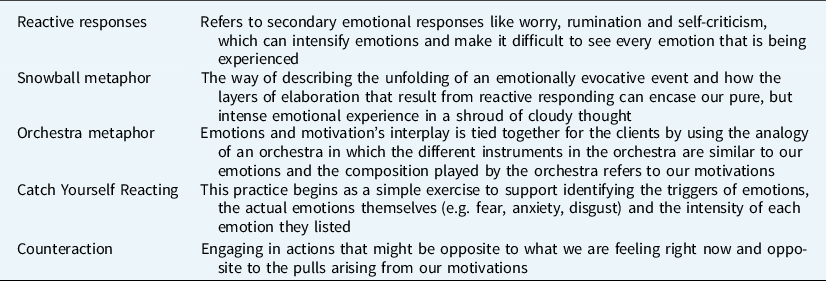
Visual analysis of clients A to D in symptoms severity (SAD symptoms, worry and rumination), are displayed in Figure 1. Furthermore, mean, standard deviation, effect size, and percent of participants’ improvements in intensity measures are presented in Table S1 in the Supplementary material (note: participant D could not continue the follow-up sessions thus, for this participant follow-up results were not reported). All participants showed a reduction in SAD symptoms, worry, and rumination. Participant D and then C showed the most improvement in all symptom severity indexes.
Symptoms (SAD, worry, rumination) severity period.

Self-report emotion regulation model- related measures
Emotion regulation strategies
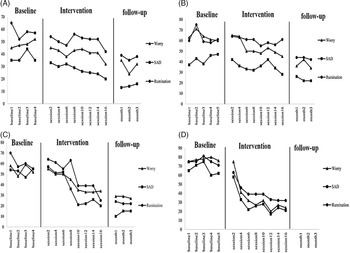
Visual analysis of participants A to D in emotion regulation strategies (attentional control/ACT, acceptance, decentring and reframing) are displayed in Figure 2. Furthermore, mean, standard deviation, effect size and percentage improvements of participant’s emotion regulation strategies are presented in Table S2 in the Supplementary material. All participants showed increases in the use of adaptive emotion regulation strategies and the most improvement was observed in the use of decentring.
Emotion regulation strategies periods.

Safety motivation and negative emotionality
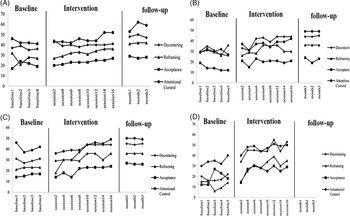
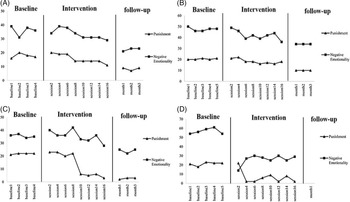
Visual analysis of clients A to D in safety motivation and negative emotionality are displayed in Figure 3. Furthermore, mean, standard deviation, effect size and percentage improvements of participants in safety motivation and negative emotionality are presented in Table S3 in the Supplementary material. All participants showed a decrease in the severity of safety motivation and negative emotionality and all showed improvement more in safety motivation than negative emotionality.
Safety motivation and negative emotionality periods.

Self-report quality of life, social and work adjustment measures
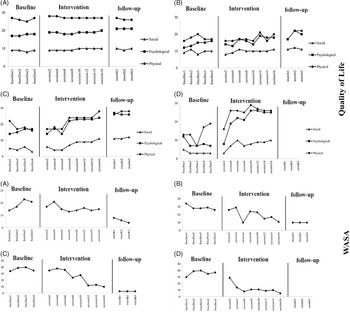
Visual analysis of clients A to D in quality of life aspects, work and social adjustment is displayed in Figure 4. Furthermore, mean, standard deviation, effect size and percentage improvements of participants in quality of life aspects, work and social adjustment are presented in Table S4 in the Supplementary material. All participants improved in almost all aspects of quality of life and adjustment except for participant B, who reported no improvement in the social aspect of quality of life.
Quality of life and aspects and work and social adjustment (WSAS) periods.

Follow-up
Follow-up findings indicated more improvement in almost all study indices in relation to the treatment period. In fact, for all participants (especially A and B), there was not only maintenance of gains after 3 months of acute treatment but also continued improvements in at least some measures in the subsequent follow-up periods.
Clinical significance changes
All participants’ final scores on SIAS (measurement for SAD) were below the cut-off point (34) considered for psychopathology (Heimberg et al., Reference Heimberg, Mueller, Holt, Hope and Liebowitz1992) as participants’ A to D final treatment session scores on SIAS were 20, 28, 20 and 21, respectively. This shows clinically reliable changes and remission in SAD symptoms. Furthermore, reducing worry and rumination indicates clinically significant reduction of GAD and depression symptoms because worry and rumination are recognized as distinct processes related to diagnosis of GAD and depression despite their relatedness (Yang et al., Reference Yang, Kim, Lee, Lee, Yu, Jeon and Kim2014). The assessor reported significant changes in SAD, worry and rumination of participants. Furthermore, findings showed that participants D, C, B and A had the highest improvement in global functioning (Table S5 in the Supplementary material). Analysis of participants’ satisfaction about the ERT efficacy and the therapist observation during sessions showed that participant A could benefit more from some traditional CBT techniques such as challenging and testing negative thoughts (explained more in the Discussion section). Feedback from clients on the techniques suggested that counteraction was the most helpful technique in reducing SAD symptoms and mindful emotion regulation techniques helped participant decrease worry and rumination.
The assessor interviewed all participants using Structured Clinical Interview for DSM-IV-TR and reported that no-one met diagnostic criteria for SAD, GAD and depression symptoms after treatment.
Generally, participant D was the most improved in all assessed variables. He was very active in the session and did homework consistently. Moreover, he showed the greatest tendency to participate in sessions. However, because he did not have the follow-up, the results cannot be generalized to this particular participant’s long-term change.
Discussion
The current study presents the first test of emotion regulation therapy in a clinical sample of individuals with the original diagnosis of social anxiety disorder with symptoms of GAD and depression. The study’s findings indicate that ERT can modify SAD, GAD and depression symptoms, along with rumination and worry negative emotionality, and safety motivation. Furthermore, ERT could enhance emotion regulation strategies use, quality of life, work and social adjustment in individuals with SAD. The 3-month follow-up results showed that treatment gains were maintained and, in some cases, increased. SAD patients also achieved clinically significant improvement on SAD, worry and rumination symptoms according to the interview. In addition, their final scores were considerably below the clinical cut-off point and these results were largely maintained for the 3-month follow-up. Our findings are in line with studies demonstrating the efficacy of ERT (Mennin et al., Reference Mennin, Fresco, Ritter and Heimberg2015; Mennin et al., Reference Mennin, Fresco, O’Toole and Heimberg2018) and efficacy findings from other recent cognitive behaviour therapies like ACT, MBCT and transdiagnostic treatment which consider emotion regulation strategies to play a mediating role in ameliorating SAD (Laposa et al., Reference Laposa, Mancuso, Abraham and Loli-Dano2016; Norton, Reference Norton2012; Norton et al., Reference Norton, Abbott, Norberg and Hunt2015; Swain et al., Reference Swain, Hancock, Hainsworth and Bowman2013).
The degrees of efficacy of ERT on participants were not the same, and some were more improved (participants C and D) than the others. Specifically, participants A and B showed little improvement in several study variables like quality of life aspects, work and social adjustment, negative emotionality, and reframing. Participants A and B did not complete homework regularly, and they had socio-economic problems; low income and social supports have been found to be associated with decreased effectiveness of treatment (Kazantzis et al., Reference Kazantzis, Whittington and Dattilio2010; Patel et al., Reference Patel, Weiss and Mann2010). Another possible explanation is that these cases might have benefited from some traditional CBT techniques. For example, using Socratic and cooperative dialogue along with reframing could increase the effectiveness of the reframing technique, especially for those who respond to cognitive challenges. Moreover, some individuals could benefit more when reappraisal and restructuring techniques are used simultaneously, depending on some unknown interactional patient characteristics (Moscovitch et al., Reference Moscovitch, Gavric, Senn, Santesso, Miskovic, Schmidt, McCabe and Antony2012). Furthermore, when addressing internal obstacles to some pursued goals and values, some participants may express emotional and cognitive conflicts reflecting deep unresolved issues that could be responsive to treatment like schema therapy (Young et al., Reference Young, Klosko and Weishaar2003), which may be a useful adjunctive approach after the conclusion of ERT sessions. Moreover, participants’ feedback about the treatment process showed that experiential exposures in phase III were an unexpected transition in treatment that often exposed them to unwanted experiences, and for one participant (D), it was expressed that the number of sessions for this phase was not enough. Furthermore, some participants noted that they preferred CBT challenging techniques as they reported if reappraisal was based on Socratic dialogue, it might have been more appealing to them. In other words, it may be that this component of the treatment needs to be tailored to the individual’s needs, and future intervention studies should examine individualized/personalized treatment designs.
Concerning the efficacy of CBT on SAD, which has been reported to be in a range of small to medium (Carpenter et al., Reference Carpenter, Andrews, Witcraft, Powers, Smits and Hofmann2018), the present effect size seems promising, especially when co-morbidity may be present. The present findings on improving worry and rumination as a reliable indicator of GAD and MDD, respectively, are promising and support ERT’s strength in ameliorating distress symptoms in individuals with SAD beyond previous treatments that could not effectively alleviate co-morbidity conditions in SAD individuals (Mululo et al., Reference Mululo, Menezes, Vigne and Fontenelle2012). One more exciting and encouraging finding was the very low attrition (all participants participated in all sessions including follow-up assessment except for participant D that could not take part in the follow-up sessions), meaning ERT was well tolerated by SAD individuals, which is in agreement with previous findings on ERT effectiveness (Mennin et al., Reference Mennin, Fresco, O’Toole and Heimberg2018).
Findings should be interpreted with caution considering some limitations. First, while single case series provide valid inferences about treatment efficacy, due to a small amount of data, generalization is a problem. Second, due to the lack of a comparison control condition, non-specific factors could not be ruled out. Third, despite using an independent assessor for diagnosis, the lack of multiple psychotherapists may confound the results. Fourth, because worry and rumination are highly present in individuals with SAD, considering them as indicators of GAD and depression and assessing the GAD and depression symptoms changes according to interview and changes in worry and rumination is not enough, and more reliable measures are needed in the future study. Finally, as most of the participants in the present study were in college and, further, were majoring in engineering, the results of the study should be interpreted cautiously in terms of application beyond those in school and studying engineering.
Conclusion
The present study’s findings support the preliminary efficacy of ERT for SAD and co-occurring mild depressive and GAD symptoms (both statistical and clinically significant changes) and require replication and extension with more varied clinical samples of SAD. Furthermore, individual differences in response to ERT elucidate the individualizing ERT techniques based on the nexus of biological-psychological-environmental-socio-economic factors. To achieve this goal, it is important that research continues to clarify the contextual entity of emotion regulation strategies and conduct mediating studies, which demonstrate when, why, and for whom different emotion regulation and other developed techniques are helpful. Factors associated with the outcome of ERT for SAD patients should be investigated. The optimal duration of ERT, especially considering experiential exposure exercises, also needs further consideration for heightening ERT’s efficacy for certain patients.
Acknowledgements
The authors gratefully acknowledge their colleagues and clients for their support and contributions to the study.
Funding
The authors received no funding from an external source.
Conflicts of interest
The authors declare no conflicts of interest.
Author contributions
I.A., A.P., P.M., B.D. and D.S.M assisted with the design and conceptualization of the study. I.A. and A.P. did the study research. I.A. and A.P. analysed the data. I.A. drafted the manuscript. A.P., D.S.M. and L.M. provided advice on the drafted manuscript. All authors read and revised the whole report.
Data availability
The authors confirm that the data supporting the findings of this study are available, and in case of inquiries, we can provide the data to this Journal.
Supplementary material
To view supplementary material for this article, please visit: https://doi.org/10.1017/S1352465821000175




Comments
No Comments have been published for this article.