INTRODUCTION
The use of durable container technologies in prehistory has often been connected to increasingly sedentary lifestyles, generally linked to agriculture. However, it was not only the introduction of farming that led people to stay in one place. Seasonal abundance of aquatic resources in specific parts of the landscape can also facilitate increasing sedentism (Jordan and Zvelebil, Reference Jordan and Zvelebil2009). The subarctic Aleutian Islands are an ecological hot spot where early sedentism occurred based on the year-round abundance of marine resources. Through exploiting marine mammals and fish, the Aleutian tradition grew out to become “one of the world’s most highly specialized and successful maritime hunter-gatherer adaptations” (Corbett and Yarborough, Reference Corbett and Yarborough2016, p. 607). Terrestrial resources were scarce with only a limited range of plant and terrestrial animals available. However, birds such as ptarmigan and waterfowl were abundant. Nevertheless, people focused their main efforts on the sea.
Heavy stone vessels such as bowls and flat cooking stones known as griddle stones were a technology central to this subsistence economy. The procurement, manufacture, and maintenance of these tools required investment of time and effort (Jeanotte et al., Reference Jeanotte, Nicolaysen, Dowell, Johnson and West2012). However, despite their apparent importance, the function of these artefacts remains unclear. Carbonised deposits on griddle stone surfaces, bowl rims, and exteriors hint at the use of these artefacts as food processing tools using direct heating methods. Knecht et al. (Reference Knecht, Davis and Carver2001, p. 49) and Knecht and Davis (Reference Knecht and Davis2008, p. 73) suggested that stone bowls were used for the hot rendering of sea mammal oil, one of the most important commodities in the life of northern peoples. However, this has never been tested. Little is known regarding the use of griddle stones, although it has been suggested that they were used for cooking sea food (Jeanotte et al., Reference Jeanotte, Nicolaysen, Dowell, Johnson and West2012).
In this article, we aim to identify the function of stone bowls and griddle stones. The organic residues preserved on these artefacts offer the opportunity to identify different cooking and storage practices. Through organic residue analysis, we test the hypotheses that (1) these artefacts were used for the processing of aquatic resources, and (2) stone bowls and griddle stones may have been used for different purposes. Building on our finds, our second aim is to explore why stone bowl frequencies peak so suddenly and to explore the role of climate change in the emergence and abundance of this artefact type.
Culture historical phasing
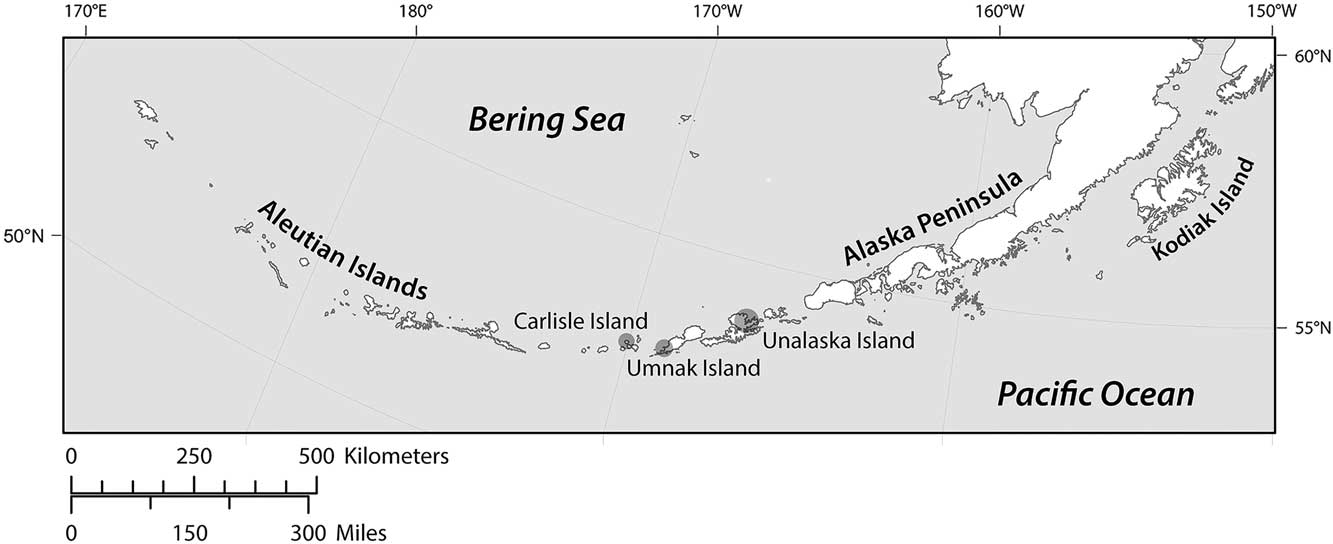
Humans first arrived in the Aleutian Islands around 9000 cal yr BP. Their subsistence practice is considered to have been focused on maritime resources despite the terrestrial character of their tool kit. Possibly these people were late Palaeoarctic terrestrial game hunters that came to the Aleutian Islands using a route across landfast sea ice (Davis et al., Reference Davis, Knecht and Rogers2016, p. 293). Knecht and Davis (Reference Knecht and Davis2001) divided the Anangula tradition into an early stage (9000–7000 cal yr BP) and a late stage (7000–4000 cal yr BP). It has been argued that an influx of Ocean Bay I people from Kodiak Island (Fig. 1) around 7000 cal yr BP further added to the foundation of the specialized maritime adaptation for which the Unangax̂ people (better known as the Aleut) are known (Dumond, Reference Dumond1977; Dumond and Bland, Reference Dumond and Bland1995). People were attracted to the region because of an abundance of fish (cod [Gadus macrocephalus] and halibut [Hippoglossus stenolepis]) and sea mammals, such as harbour seals (Phoca vitulina), whales (Cetaceans), porpoises (Phocoenidae), sea lions (Otariinae), and sea otters (Enhydra lutris), but also a variety of bird species. The earliest stone bowls (n=2) and griddle stones (n=1) are found in low numbers at a few sites dating to the Early Anangula phase. They become more numerous during later phases.
Map of the Aleutian Islands, Alaska Peninsula, and Kodiak Island with emphasis on site locations mentioned in the text at Unalaska Island (Amaknak Bridge, Margaret Bay, Oiled Blade, Tanaxtaxak), Umnak Island (Anangula Blade), and Carlisle Island (Ulyagan).

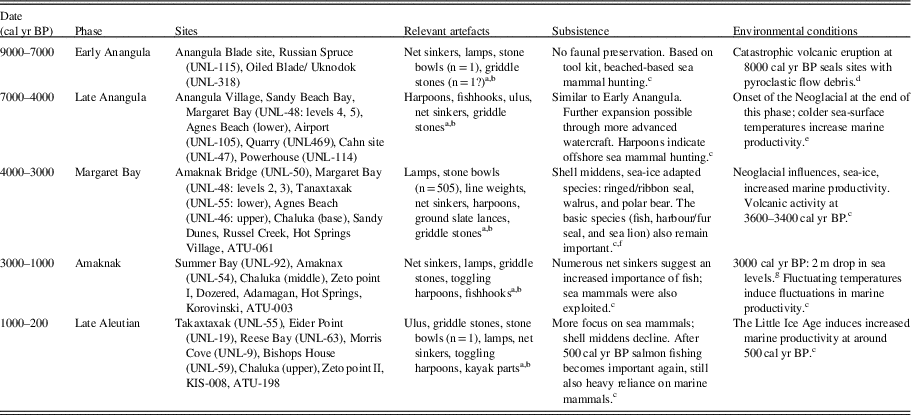
The Margaret Bay phase (4000–3000 cal yr BP) is a period of both climatic and cultural change. Based on the faunal assemblages of the Margaret Bay (3800–3000 cal yr BP) and Amaknak Bridge (3500–2500 cal yr BP) sites, Davis (Reference Davis2001) and Crockford and Frederick (Reference Crockford and Frederick2007) argue for the presence of sea ice in the region generated by the onset of the colder sea-surface temperatures of the Neoglacial. This induced marine productivity, and new species appeared in the region such as walrus (Odobenus rosmarus), ringed seal (Pusa hispida), and polar bear (Ursus maritimus). The new situation presented challenges and opportunities for the Unangax̂. Subsistence practices were adapted to the new circumstances and focused more on ice-bound marine mammal hunting (Knecht and Davis, Reference Knecht and Davis2008). Stone bowls peak during this phase (Table 1) with high occurrences at the Margaret Bay (n=434) and Amaknak Bridge (n=71) sites, which suggests the substantial importance of these artefacts in Aleutian daily life at these sites.
Prehistory of the eastern Aleutian Islands: dates, site characteristics, subsistence trends, and climatic influences. Based on the following references: Davis et al. (Reference Davis, Knecht and Rogers2016), Hatfield (2010), Maschner (Reference Maschner2016), Mason (2001), Magny and Haas (2004), Knecht and Davis (Reference Knecht and Davis2008), and Corbett and Yarborough (Reference Corbett and Yarborough2016).

a Davis et al. (Reference Davis, Knecht and Rogers2016).
b Hatfield (2010).
c Maschner (Reference Maschner2016).
d Mason (2001).
e Magny and Haas (2004).
f Knecht and Davis (Reference Knecht and Davis2008).
g Corbett and Yarborough (Reference Corbett and Yarborough2016).
The Amaknak phase of 3000–1000 cal yr BP can be considered the start of the florescence of the Aleutian tradition (Davis et al., Reference Davis, Knecht and Rogers2016, p. 286) with a complex and varied tool kit representing the continuous further development of the long-established maritime adaptation. Stone bowls seem to go out of use during this period (Davis et al., Reference Davis, Knecht and Rogers2016, p. 286), whereas the occurrence of griddle stones increases from this time onwards (Knecht and Davis, Reference Knecht and Davis2003; Jeanotte et al., Reference Jeanotte, Nicolaysen, Dowell, Johnson and West2012). These two technologies are hardly ever found together. Temperatures fluctuated and possibly influenced the human populations in the area. Colder temperatures led to increased marine productivity, which could have induced cultural expansion as suggested by Maschner (Reference Maschner2016, p. 340). During the Late Aleutian phase of 1000 to 2000 cal yr BP, tensions rose along the Pacific coast of southwestern Alaska. Fortified sea stacks and refuge sites indicate warfare, possibly with the newly established Koniag tradition of Kodiak Island, but also among neighbouring Unangax̂ groups (Davis et al., Reference Davis, Knecht and Rogers2016, p. 286).
MATERIALS AND METHODS
Stone bowls
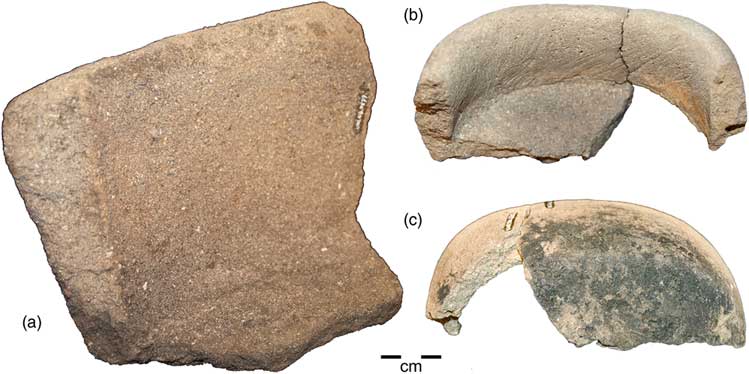
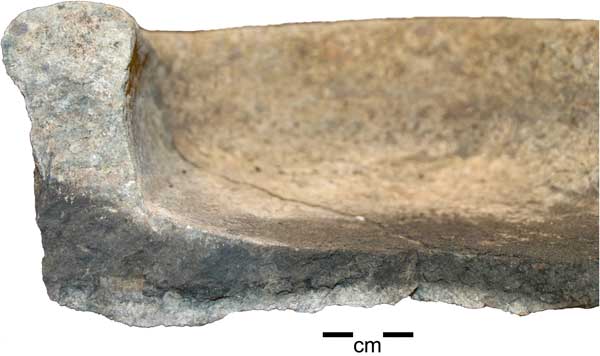
These heavy, nonportable artefacts are made of ground volcanic tuff and come in different textures and colours. Although no complete specimens have been recovered to date, (partial) reconstructions show that shapes varied from oval to rectangular, and sizes range from 12 to 45 cm in diameter and 3 to 12 cm in depth (Figs. 2 and 3). Bowls are distinguished from lamps mainly by their relative depth and base thickness. Where lamps are often shallow with a thick base, bowls have higher walls with a base that is always thinner than the walls and which allows for cooking using a direct heating source. Another distinction is the absence of a wick in bowls, whereas some lamps have a raised platform for the wick. Stone bowls occur in large numbers during the colder Margaret Bay phase (4000–3000 cal yr BP). At the Margaret Bay site, a total of 434 fragments were recovered, 75% of which dated to around 3300–3100 cal yr BP, the final phase of occupation. At the Amaknak Bridge site, 71 fragments were found dating towards the very end of the phase around 2780 cal yr BP. Six fragments were reported from the base of the Chaluka mound dated 3700 cal yr BP (Denniston, Reference Denniston1966, p. 108). A few fragments (n=6) were found at the lower levels of the Tanaxtaxak site, also ascribed to the Margaret Bay phase based on artefact assemblage (Knecht and Davis, Reference Knecht and Davis2003, p. 45). Stone bowls are scarce outside this period, though a few older fragments were found at the earlier levels of Margaret Bay (Knecht et al., Reference Knecht, Davis and Carver2001) and at the Anangula Blade site (n=1) (McCartney and Veltre, Reference McCartney and Veltre1996) and the Oiled Blade site (n=1) on Hog Island at 9000 cal yr BP (Knecht and Davis, Reference Knecht and Davis2001, p. 273). With the abandonment of the Margaret Bay and Amaknak Bridge sites, stone bowls also seem to disappear from the Aleutian Islands archaeological record (Knecht et al., Reference Knecht, Davis and Carver2001, p. 49).
(colour online) Example of two different types of stone bowls fashioned out of differing textured volcanic tuff and varying in size and shape: (a) UNL48-57: red, more crude textured tuff, thick rim, thin base. (b) UNL50-51: sand coloured fine tuff, finely ground both inside and out. (c) UNL50-51: base with carbonized encrustations. (Photographs by M. Admiraal, courtesy of the Museum of the Aleutians.)

(colour online) Stone bowl with encrustation on the interior. Surface find from Eider Point site (UNL-19) probably dating to the Late Aleutian phase (1000–2000 cal yr BP). (Photograph by M. Admiraal, courtesy of the Museum of the Aleutians.)

Griddle stones
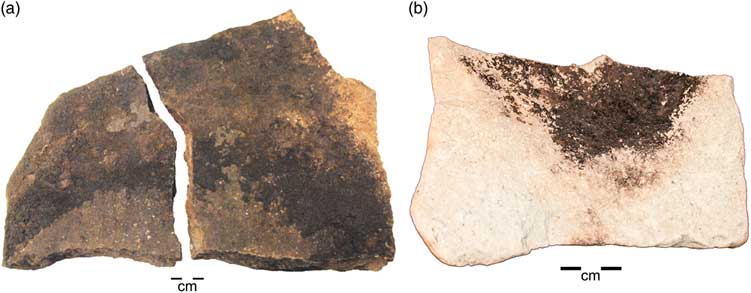
Referred to as “stone frying-pans” by (Jochelson, Reference Jochelson1925, p. 109), the presence of these grease-covered stone slabs goes back 9000 yr in the Aleutians (Fig. 4b). No complete specimens of griddle stones are known. Like the stone bowls, they are all fragmented, perhaps fractured during use or purposefully broken after their use-life was completed. Jeanotte et al. (Reference Jeanotte, Nicolaysen, Dowell, Johnson and West2012) showed that at the ADK-011 site on Adak Island the majority of griddle stone raw material was carefully selected from a source some 5 km away from the site, while a lesser quality source was also available much closer to site. This indicates that these artefacts were not just flat stones selected randomly. Acquiring them would have been costly both in time and effort.
(colour online) (a) UNL55-39 griddle stone with clean centre, Late Aleutian phase. (b) UNL318-47 griddle stone with encrustations in the centre, Early Anangula phase. (Photographs by M. Admiraal, courtesy of the Museum of the Aleutians.)

Despite the importance of these food processing techniques in the Aleutian subsistence economy, the subject has received little attention in current archaeological literature. Jeanotte et al. (Reference Jeanotte, Nicolaysen, Dowell, Johnson and West2012) were the first to perform analysis on the residues associated with the griddle stones by using bulk carbon isotope analysis and visible/near-infrared spectrometry but were not able to offer any specific identifications. Here we aim to investigate the function of stone bowls and griddle stones through the structural and isotopic analysis of lipids that are preserved in the greasy crusts on the artefact surfaces. This approach has been shown to be highly effective in distinguishing marine and terrestrial products formed during the use of archaeological artefacts (Craig et al., Reference Craig, Saul, Lucquin, Nishida, Tache, Clarke and Thompson2013; Farrell et al., Reference Farrell, Jordan, Taché, Lucquin, Gibbs, Jorge, Britton, Craig and Knecht2014; Colonese et al., Reference Colonese, Lucquin, Guedes, Thomas, Best, Fothergill and Sykes2017; Shoda et al., Reference Shoda, Lucquin, Ahn, Hwang and Craig2017).
Lipid extraction of archaeological food crusts
Twenty charred surface residue samples of approximately 100 mg were collected of stone bowls from the Margaret Bay (n=11), Amaknak Bridge (n=8), and Tanaxtaxak (n=1) sites. Where available multiple samples were taken to compare interior with exterior residues or base with rim residues. Most of the bowls, however, only had encrustations on the exterior. Charred surface deposits were also collected from eight griddle stones (~100 mg). One sample dates to the Early Anangula phase (9000–8000 cal yr BP) Oiled Blade site, whereas the other sampled griddle stones were much younger with two specimens from the Tanaxtaxak site on Unalaska (around 500 cal yr BP) and five samples from the Ulyagan site on Carlisle Island, part of the Islands of the Four Mountains (around 400 cal yr BP). The Tanaxtaxak griddle stones were sampled on both sides for comparative reasons. Samples were acquired by scraping off surface residues using a sterile scalpel and homogenized by grinding the samples to a fine powder using a mortar and pestle.
Approximately 20 mg of the sample was weighed out for lipid extraction using acidified methanol and following established protocols (Papakosta et al., Reference Papakosta, Smittenberg, Gibbs, Jordan and Isaksson2015; Colonese et al., Reference Colonese, Lucquin, Guedes, Thomas, Best, Fothergill and Sykes2017). This approach has been extremely efficient in extracting lipids from carbonised deposits, especially where intact and partially degraded acyl lipids are unlikely to survive (Craig et al., Reference Craig, Forster, Andersen, Koch, Crombé, Milner, Stern, Bailey and Heron2007; Lucquin et al., Reference Lucquin, Gibbs, Uchiyama, Saul, Ajimoto, Eley and Radini2016b).
One millilitre of methanol was added to the sample, which was subsequently ultrasonicated for 15 min. Then 200 µL of sulphuric acid (H2SO4) was added, after which the samples were heated for 4 hours at 70°C. The samples were then centrifuged at 3000 rpm for 5 min. The supernatant was transferred to a sterile vial and then extracted three times by adding 2 mL of hexane, mixing, separating, and removing the supernatant. The sample was neutralized by passing through a pipette with glass wool and potassium carbonate (K2CO3). Eventually, the extracts were dried under a gentle stream of nitrogen (N2), and an internal standard (10 µL of C36 alkane) was added to all samples (lipid quantities ranging from 40 to 8600 µg/g) before further analysis by gas chromatography (GC), gas chromatography–mass spectrometry (GC-MS), and gas chromatography–combustion–isotope ratio mass spectrometry (GC-c-IRMS). The majority of acid extracts were also silylated after acid extraction by adding 100 µL of BSTFA [N,O-bis(trimethylsilyl)trifluoroacetamide] and heating the sample at 70°C for 60 min in order to determine the presence of dihydroxy acids (Hansel and Evershed, Reference Hansel and Evershed2009).
Collagen extraction of archaeological bones
A selection of archaeological bone material from the Tanaxtaxak, Margaret Bay, and Summer Bay sites, as well as the Brooks River area on the Alaska Peninsula, was collected to serve as collagen reference material for bulk isotope analysis. Species were as follows: fin whale (Balaenoptera physalus; n=2), porpoise (n=2), right whale (Eubalaena; n=2), and narwhal/beluga whale (Monodon monoceros/Delphinapterus leucas; n=3) (all determined using ZooMS, courtesy of the University of York); and sea lion (n=2), seal (n=4), sea otter (n=2), eagle (Haliaeetus leucocephalus; n=1), bear (Ursus; n=2), caribou (Rangifer tarandus; n=5), anadromous fish (n=2), and marine fish (n=5). Sampling was done by removing a small section of mechanically cleaned bone using a sterile Dremel saw.
Collagen of 32 bone samples was extracted using a modified Longin method (Brown et al., Reference Brown, Nelson, Vogel and Southon1988). Samples (200–300 mg) were demineralized using 0.6 M hydrochloric acid (HCl) at 4°C for several days depending on the sample. Samples were rinsed with distilled water after demineralization. Then they were gelatinised with 0.001 M HCl at 80°C for 48 hours after which the samples were first filtered using polyethylene Ezee Filters (9 mL, pore size 60–90 µm; Elkay Laboratories Ltd.). Subsequently, the samples were ultrafiltered (30 kDa, Amicon Ultra-4 centrifugal filter units; Millipore, Burlington, MA, USA). Finally, the samples were frozen and lyophilised.
GC-MS
The equipment used for GC-MS analysis was an Agilent 7890A series chromatograph attached to an Agilent 5975C Inert XL mass-selective detector with a quadrupole mass analyser (Agilent Technologies, Cheadle, Cheshire, UK). A splitless injector was used and kept at 300°C. The GC column was inserted into the ion source of the mass spectrometer directly. The carrier gas used was helium with a constant flow rate of 3 mL/min. The ionisation energy of the MS was 70 eV, and spectra were obtained by scanning between m/z 50 and 800. A DB-5ms (5%-phenyl)-methylpolysiloxane column (30 m×0.250 mm×0.25 mm; J&W Scientific, Folsom, CA, USA) was used for scanning. The temperature was set at 50°C for 2 min, then raised by 10°C/min until it reached 325°C where it was held for 15 min.
All extracts were also analysed on a DB-23 (50%-cyanopropyl)-methylpolysiloxane column (60 m×0.250 mm×0.25 mm; J&W Scientific) in simulation (SIM) mode to identify isoprenoid fatty acids and ω-(o-alkylphenyl) alkanoic acids as aquatic biomarkers (Cramp and Evershed, Reference Cramp and Evershed2014) and to resolve the mixture of phytanic acid diastereomers (Lucquin et al., Reference Lucquin, Colonese, Farrell and Craig2016a). The temperature was set at 50°C for 2 min and then raised by 10°C/min until it reached 100°C, then raised by 4°C/min to 140°C, then by 0.5°C/min to 160°C, then by 20°C/min to 250°C where it was maintained for 10 min. The first group of ions (m/z 74, 87, 213, 270) corresponding to 4,8,12-trimethyltridecanoic acid (TMTD) fragmentation, the second group of ions (m/z 74, 88, 101, 312) corresponding to pristanic acid, the third group of ions (m/z 74, 101, 171, 326) corresponding to phytanic acid, and the fourth group of ions (m/z 74, 105, 262, 290, 318, 346) corresponding to ω-(o-alkylphenyl) alkanoic acids of carbon length C16 to C22 were monitored, respectively. Helium was used as the carrier gas with a flow rate of 2.4 mL/min. The relative abundance of two diastereomers of phytanic acids was obtained by the integration of the ion m/z 101.
Bulk isotope analysis: carbon/nitrogen
Thirty-one surface residue samples of which 21 stone bowls, seven griddle stones, and three lamps, as well as 32 bone collagen samples, were analysed by elemental analysis–isotope ratio mass spectrometry. The residue samples were ground into a homogenised powder. The residue and collagen samples were weighed out in duplicate into tin capsules (~0.9 mg). The bulk stable nitrogen (δ15N) and carbon (δ13C) isotope values were measured based on previously described methods (Craig et al., Reference Craig, Forster, Andersen, Koch, Crombé, Milner, Stern, Bailey and Heron2007). Precision of instrument on repeated measurement was ±0.2‰ (standard error of the mean), δ13C, δ15N=[(R sample/R standard − 1)]×1000, where R=13C/12C and 15N/14N. Accuracy was determined by measurements of international standard reference materials within each analytical run. These were IAEA 600 δ13Craw=−27.69±0.02, δ13Ctrue=−27.77±0.04, δ15Nraw=1.49±0.38, δ15Ntrue=1.0±0.2; IAEA N2 δ15Nraw=20.9±0.33, δ15Ntrue=20.3±0.2; IA Cane, δ13Craw=−11.76±0.10, δ13Ctrue=−11.64±0.03. Data were normalised to these international standards. All samples with % N values below 1% and % C below 10% were excluded.
GC-c-IRMS
Eleven stone bowl and seven griddle stone samples were measured in duplicate for stable carbon isotope values of methyl palmitate (C16:0) and methyl stearate (C18:0) derived from precursor fatty acids by GC-c-IRMS, following the existing procedure (Craig et al., Reference Craig, Allen, Thompson, Stevens, Steele and Heron2012). The instrument used for the analysis was a Delta V Advantage isotope ratio mass spectrometer (Thermo Fisher, Bremen, Germany) linked to a Trace Ultra gas chromatograph (Thermo Fisher) with a GC Isolink II interface (Cu/Ni combustion reactor held at 1000°C; Thermo Fisher) to oxidise all the carbon species to CO2. The carrier gas used was ultrahigh-purity-grade helium with a flow rate of 2 mL/min, and parallel acquisition of the molecular data was realised by deriving a small part of the flow to an ISQ mass spectrometer (Thermo Fisher). Samples were diluted in hexane, and 1 μL of each sample was injected into a DB-5MS ultrainert fused-silica column (60 m× 0.25 mm× 0.25 µm; J&W Scientific). The temperature was set at 50°C for 0.5 min and raised by 25°C/min to 175°C, then raised by 8°C/min to 325°C where it was held for 20 min. A clear resolution and a baseline separation of the analysed peaks were achieved. Eluted products were ionized in the mass spectrometer by electron impact, and ion intensities of m/z 44, 45, and 46 were recorded for automatic computing of the 13C/12C ratio of each peak in the extracts. Computation was made with Isodat software (version 3.0; Thermo Fisher) and was based on comparisons with standard reference gas (CO2) of known isotopic composition that was repeatedly measured. The results of the analysis were expressed in per mille (‰) relative to an international standard, Vienna Pee Dee belemnite (VPDB).
The accuracy of the instrument was determined on n-alkanoic acid ester standards of known isotopic composition (Indiana standard F8-3). The mean±standard deviation (SD) values of these were −29.60±0.21‰ and −23.02±0.29‰ for the methyl ester of C16:0 (reported mean value vs. VPDB −29.90±0.03‰) and C18:0 (reported mean value vs. VPDB −23.24± 0.01‰), respectively. Precision was determined on a laboratory standard mixture injected regularly between samples (28 measurements). The mean±SD values of n-alkanoic acid esters were −31.65±0.27‰ for the methyl ester of C16:0 and −26.01±0.26‰ for the methyl ester of C18:0. Each sample was measured in replicate (average SD is 0.07‰ for C16:0 and 0.13‰ for C18:0). Values were also corrected subsequent to analysis to account for the methylation of the carboxyl group that occurs during acid extraction. Corrections were based on comparisons with a standard mixture of C16:0 and C18:0 fatty acids of known isotopic composition processed in each batch under identical conditions.
RESULTS
Lipid preservation
The preservation of organic residues on the artefacts is very good in general. Both griddle stones and stone bowls provided high quantities of lipids per sample. Thirty of 33 samples ranged from 400 to 8600 µg/g, indicative of exceptional preservation. The griddle stones (n=8, mean=4200 µg/g) were richer in lipids than stone bowls (n=22, mean=2477 µg/g). However, the majority of stone bowls sampled here are about 1500 years older than the griddle stones, so this may be the result of degradation. Both of these artefact types contained a much greater amount of lipids than commonly found on charred deposits associated with ceramic cooking pots. For example, the mean lipid concentration from 14 charred deposits on pottery from the subarctic Sakhalin Islands extracted under identical conditions was 298 µg/g (Gibbs et al., Reference Gibbs, Isaksson, Craig, Lucquin, Grishchenko, Farrell, Thompson, Kato, Vasilevski and Jordan2017). Only two stone bowl samples showed lower lipid preservation with lipid quantities ranging from 40 to 130 µg/g (Supplementary Table 1). The oldest stone bowl sample in the Aleutian Islands from the Anangula Blade site (Quimby, Reference Quimby1945; McCartney and Veltre, Reference McCartney and Veltre1996) yielded no lipid biomarker results, and based on the associated % N value of 0.71, we discarded this sample.
GC-MS analysis
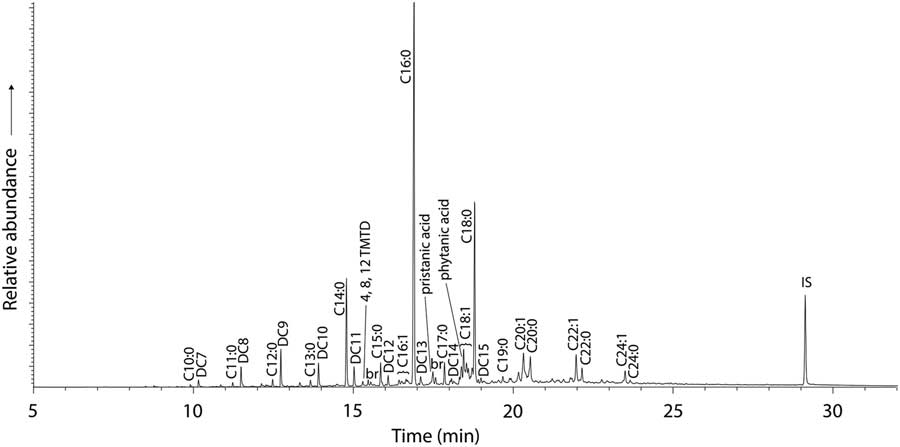
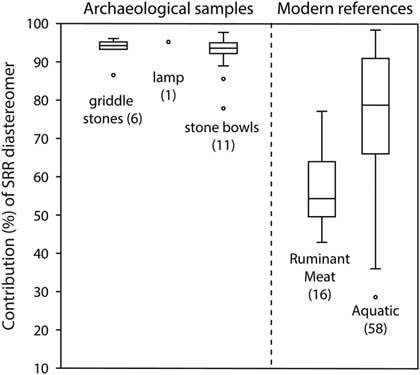
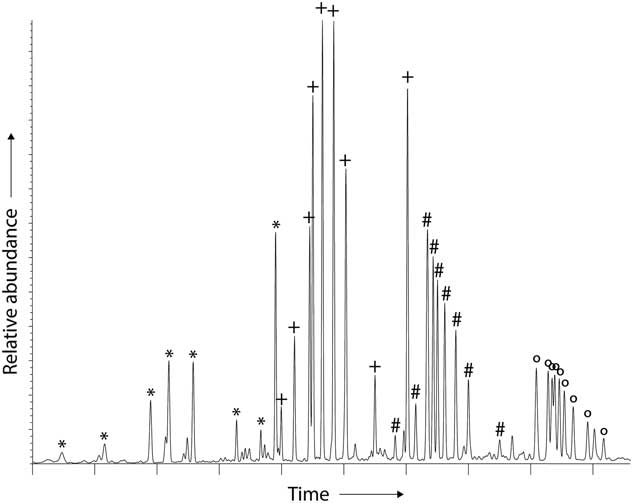
Thirty of 33 samples of both the stone bowls (20 of 23) and the griddle stones (10 of 10) contained isoprenoid acids: TMTD, pristanic acid (2,6,10,14-tetramethylpentadecanoic acid), and phytanic acid (3,7,11,15-tetramethylhexadecanoic acid) (Figs. 5 and 6), as well as ω-(o-alkylphenyl) alkanoic acids (APAAs) of carbon length 16 to 22 (Fig. 7). These meet the established criteria for the identification of aquatic resources in archaeology (Hansel et al., Reference Hansel, Copley, Madureira and Evershed2004; Evershed et al., Reference Evershed, Copley, Dickson and Hansel2008; Hansel and Evershed, Reference Hansel and Evershed2009; Lucquin et al., Reference Lucquin, Colonese, Farrell and Craig2016a). Interestingly, APAAs are only formed during the prolonged heating of tri-unsaturated fatty acids at a temperature of at least 270°C, and therefore, the aquatic oils must have been heated on these artefacts presumably during their processing. These data rule out the contamination of degraded aquatic oils that may be present in the soils as these are unlikely to have been heated. Additionally, the presence of APAAs on these stone artefacts suggests that formation of these compounds is not necessarily dependent on the presence of a ceramic matrix as stated by Evershed et al. (Reference Evershed, Copley, Dickson and Hansel2008, p. 111). To date, no evidence of pottery has been found in the Aleutian Islands. Isoprenoid acids are degradation products of phytol, a constituent of chlorophyll, and occur widely in marine organisms. Phytanic acid also occurs in the tissues of ruminant animals. The contribution of SSR:SRR diastereomers of phytanic acid (SSR %) provides a means to discriminate these sources (Lucquin et al., Reference Lucquin, Colonese, Farrell and Craig2016a). As expected, because of the lack of ruminants in the area, the data obtained confirm the aquatic origin of phytanic acid in all the Aleutian samples as compared with modern references (Fig. 6).
A typical total ion current of an acid/methanol extract of a stone bowl from the Margaret Bay site (UNL48-61b) showing saturated fatty acids, diacids (DC), branched (br), isoprenoid acids (4,8,12-trimethyltridecanoic acid [TMTD], pristanic, and phytanic acid), and long-chain unsaturated fatty acids.

Percentage of SSR diastereomer in total phytanic acid in Aleutian artefacts compared with modern ruminant and aquatic resources (Lucquin et al., Reference Lucquin, Colonese, Farrell and Craig2016a, Reference Lucquin, Gibbs, Uchiyama, Saul, Ajimoto, Eley and Radini2016b).

Saturated fatty acids range from C8 to C32 and unsaturated fatty acids, even numbered from C16:1 to C24:1, with some extending up to C26:1. All samples contain longer-chain fatty acids and unsaturated fatty acids with the exception of the three badly preserved samples. Dicarboxylic acids (or diacids), most likely degradation products of unsaturated fatty acids, are also widely present in all samples ranging mostly from 7 to 15 carbon length (Fig. 5). Experimental work by Evershed et al. (Reference Evershed, Copley, Dickson and Hansel2008) showed that diacids of carbon length 8 to 11 form during the heating of aquatic oils. Following derivatization of the acid extract with BSTFA, trace amounts of long-chain n-alkanols (C22–C32) were also present in many of the samples with an even number of carbon atoms. Because these were found in trace amounts, there is a possibility they are derived from the burial environment, as they are a common lipid component of soils (Van Bergen et al., Reference Van Bergen, Nott, Bull, Poulton and Evershed1998), derived from wax compounds in higher plants. However, these compounds were much more abundant in the charred deposits from several of the griddle stones from the Ulyagan site, along with the matching distribution of long-chain fatty acids (C22–C32). In this case, it is conceivable that plant products were directly processed on these artefacts.
Partial summed mass chromatogram (m/z 105) showing ω-(o-alkylphenyl) alkanoic acid distribution in griddle stone sample AMK3-1030 run on DB-23 using the AQUASIM method. *, C16; +, C18; #, C20; °, C22.

Stable isotope analysis of individual fatty acids
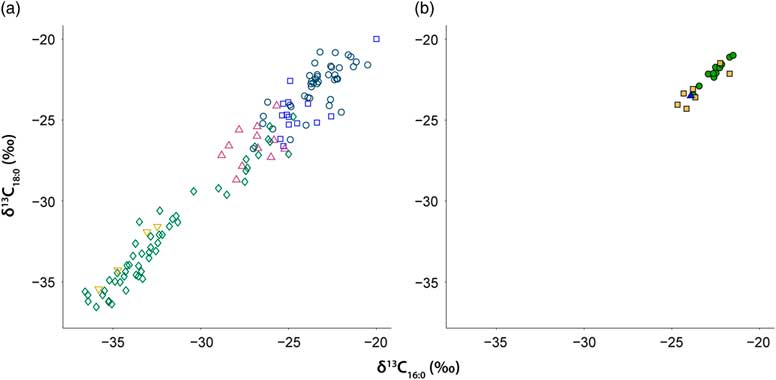
Based on the lipid residue analysis results, integrated with contextual archaeological information of the materials, it seems very likely that the tested artefacts were used for the processing of aquatic resources. But what kind of aquatic resources were processed? Were the different artefacts used for different purposes? To further differentiate within the aquatic spectrum, we analysed stable isotopes of individual fatty acids C16 and C18 using GC-c-IRMS. This approach serves as a means to discriminate aquatic animals based on their habitat (marine, anadromous, and freshwater), with the marine species relatively enriched in 13C compared with the others (Fig. 8).
(a) Modern reference samples of anadromous fish (pink triangles), freshwater fish (green diamonds), marine fish (blue circles), marine mammals (blue squares), and aquatic birds (yellow downward triangles) (Bell et al., Reference Bell, Preston, Henderson, Strachan, Bron, Cooper and Morrison2007; Outram et al., Reference Outram, Stear, Bendrey, Olsen, Kasparov, Zaibert, Thorpe and Evershed2009; Craig et al., Reference Craig, Steele, Fischer, Hartz, Andersen, Donohoe and Glykou2011, Reference Craig, Saul, Lucquin, Nishida, Tache, Clarke and Thompson2013; Debono Spiteri, Reference Debono Spiteri2012; Cramp et al., Reference Cramp, Jones, Sheridan, Smyth, Whelton, Mulville, Sharples and Evershed2014; Colonese et al., Reference Colonese, Farrell, Lucquin, Firth, Charlton, Robson, Alexander and Craig2015; Horiuchi et al., Reference Horiuchi, Miyata, Kamijo, Cramp and Evershed2015; Taché and Craig, Reference Taché and Craig2015; Choy et al., Reference Choy, Potter, McKinney, Reuther, Wang and Wooller2016). (b) Gas chromatography–combustion–isotope ratio mass spectrometry results showing isotopic values of C16:0 and C18:0 fatty acids of stone bowls (green circles), griddle stones (yellow squares), and one lamp (blue triangle). (For interpretation of the references to colour in this figure legend, the reader is referred to the web version of this article.)

The carbon isotope values show some differences between the two technological groups (Fig. 8). In general, griddle stones are more depleted in both δ13C16 and δ13C18 than stone bowls. Two stone bowls are more depleted than the others. Of the seven tested griddle stones, five are separated from the stone bowls, and two have similar fatty acid isotope values to the stone bowls. One of these is the only exceptionally old specimen from the Early Anangula phase (9000–8000 cal yr BP) site of Oiled Blade (UNL-318). It is unlikely that the isotopic approach deployed here can be used to distinguish between marine mammal and marine fish oil in this case. Although no authentic lipid carbon isotopes values have been measured from the Aleutian Islands, the δ13C values of collagen extracted from 17 marine mammals (mean δ13Ccoll=−14.47±0.04) and five marine fish (mean δ13Ccoll=−11.96±0.03) from southwestern Alaska (Supplementary Table 2) are similar. More depleted lipid sources could include salmon (Salmonidae; δ13Ccoll=−15.44±0.05) or potentially terrestrial resources including plants. The latter would be consistent with degraded wax esters found on the griddle stones. However, we stress that overall both the stone bowls and griddle stones have strong marine isotope signatures and aquatic lipid profiles, so any other products are only a minor component in these residues.
Bulk δ13C and δ15N isotopes
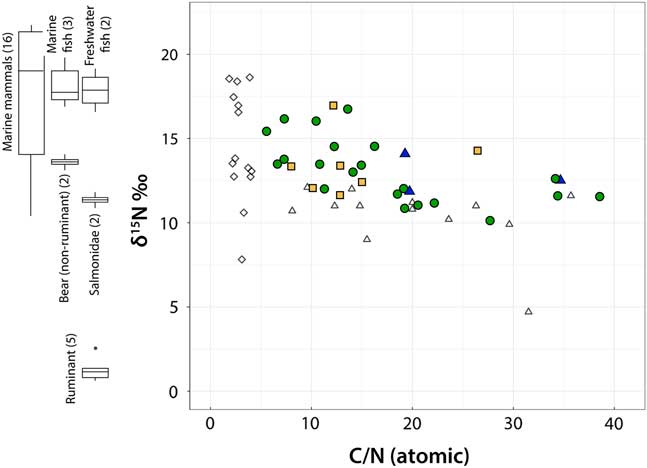
The δ15N ratios of the carbonised deposits associated with the stone bowls and griddle stones are generally within the range expected for marine tissues (i.e., >10‰; Fig. 9). These values can be tentatively compared with δ15N values of collagen from associated fauna (fish, marine mammals, and terrestrial fauna) by assuming that any of the δ15N in the surface residues are derived from animal tissue protein and the Δ15Ntissue--collagen =~ +2‰ (Fernandes et al., Reference Fernandes, Grootes, Nadeau and Nehlich2015). Interestingly, the range of δ15N values observed in the carbonised deposits is at the lower end of the marine mammal and fish range (Supplementary Table 1).
Bulk isotope results of stone bowls (green circles), griddle stones (yellow squares), and lamps (blue triangles) compared with Sakhalin pottery (open diamonds) (Gibbs et al., Reference Gibbs, Isaksson, Craig, Lucquin, Grishchenko, Farrell, Thompson, Kato, Vasilevski and Jordan2017) and European oil lamps (open triangles) (Heron et al., Reference Heron, Andersen, Fischer, Glykou, Hartz, Saul, Steele and Craig2013; Heron and Craig, Reference Heron and Craig2015; Piezonka et al., Reference Piezonka, Meadows, Hartz, Kostyleva, Nedomolkina, Ivanishcheva, Kosorukova and Terberger2016; Oras et al., Reference Oras, Higham, Cramp and Bull2017) against archaeological bone collagen data from the Aleutian Islands and the Alaska Peninsula. The collagen δ15N values were adjusted by +2‰ to correct for the collagen to tissue offset in order to make these values more comparable with the food crusts (Fernandes et al., Reference Fernandes, Grootes, Nadeau and Nehlich2015). (For interpretation of the references to colour in this figure legend, the reader is referred to the web version of this article.)

Compared with pottery vessels from the Sakhalin Islands, which are assumed to have been used for cooking a range of marine tissues (Gibbs et al., Reference Gibbs, Isaksson, Craig, Lucquin, Grishchenko, Farrell, Thompson, Kato, Vasilevski and Jordan2017), all the Aleutian artefacts have higher C:N ratios, indicative of a relatively higher lipid content. These data are more comparable to the so-called blubber lamps of the European Mesolithic where it is thought that marine mammal oil was burned for illumination (Heron et al., Reference Heron, Andersen, Fischer, Glykou, Hartz, Saul, Steele and Craig2013). One caveat to this interpretation is that extensive microbial degradation or percolation with groundwater might lead to a preferential loss of protein, effectively increasing the C:N ratio (Heron and Craig, Reference Heron and Craig2015), although this would seem less likely given the environment is so conducive to molecular preservation. The δ13C values in all but one case are less than −25‰ (Supplementary Table 1), which are consistent with values reported from pottery from coastal sites with clear marine lipid signatures (Craig et al., Reference Craig, Steele, Fischer, Hartz, Andersen, Donohoe and Glykou2011, Reference Craig, Saul, Lucquin, Nishida, Tache, Clarke and Thompson2013).
DISCUSSION
Our main question centred on the specific function of griddle stones and stone bowls within the Aleutian subsistence economy. We hypothesized that these artefacts were used to process aquatic resources but were used in different ways. The results of this research cautiously support our hypotheses. All artefacts with sufficient preservation (n=30) show strong evidence for the processing of aquatic resources. Minor isotopic differences between stone bowls and griddle stones may indicate a more variable use of the latter. However, the lipid concentrations and C:N ratios from both artefacts are consistent with their use for processing aquatic oils and fats. By integrating the organic residue results with information of archaeological contexts, ethnography, and climate, we discuss the possible function and role of these artefacts placed in a framework of the wider subsistence strategies of the ancient Unangax̂.
Griddle stone function
Griddle stone charred residues show a clear aquatic signal. This is visible in the presence of all aquatic biomarkers as well as in compound specific and bulk isotope results. We hypothesized that griddle stones had a more general use for cooking foodstuffs. The residue results are cautiously supportive of this notion. Interpretation is based on comparisons with stone bowls that we assume were used for a very specific purpose—namely, the rendering of marine oil. The residues on griddle stones seem to be derived from a wider diversity of resources. Despite this, aquatic oils still make up the majority of the sample. Depleted δ13C values may indicate the contribution of salmon and plant products to the sample. Furthermore, the presence of n-alkanols on the Ulyagan griddle stones supports the possibility that plant products contributed to the otherwise predominantly aquatic sample. The lower C:N ratio values attest to a higher presence of proteins possibly caused by the cooking of flesh as opposed to fats.
Not all griddle stones show the same consistent residue results. We analysed the earliest griddle stone in the Aleutian Islands, a partial specimen from the Oiled Blade (UNL-318) site, dating to the Early Anangula phase at 9000–8000 cal yr BP. The compound specific δ13C isotope data and C:N ratio value of this particular griddle stone are closer to stone bowl values. This possibly indicates a less diverse use on this ancient griddle stone as opposed to griddle stones from later periods.
Ethnographic resources are of great value when considering function because griddle stones were still widely in use by the Unangax̂ during early contact times. A report by C.I. Shade describes the traditional Unangan way to prepare cod soup using a griddle stone: “The traditional method of making soup was to dig a fire pit and place over it a stone, flush with the ground. Then a very thin beach stone was placed on the fire stone and clay walls built on this base. The liquid was cooked in this. A bluish clay called qudii u was used for the walls of this vessel which turned white when heated. This kind of fire pit was called unaalu. The same vessel was used more than once. One way of preparing the cod soup was with seaweed and seal oil” (as quoted in Johnson, Reference Johnson2004, p. 52).
This is an interesting notion suggesting griddle stones were actually also used as containers. It also attests to the use of marine mammal oil in cooking practices, agreeable with our findings. No evidence for the use of clay has ever been detected in the archaeological record of the Aleutians. However, some griddle stones are clean in the centre and have a thick edge of greasy and carbonized material around this clean area (Fig. 4a). This use-wear pattern could represent the process described previously. Not all griddle stones show this residue distribution though—some show residues in the centre (Fig. 4b). This may suggest different methods of cooking with the use of griddle stones.
Use patterns possibly changed through time with the earlier griddle stone used for the processing of a single commodity, whereas griddle stones of the Late Aleutian phase were probably used to cook dishes of a more diverse character, although still predominantly aquatic.
Stone bowl function
The charred residues distributed mainly along the rims on both interior and exterior, but also on the bases of the bowls, seem to be solely aquatic in origin. The stone bowls have comparable lipid distribution, C:N ratios, and bulk isotope characteristics to prehistoric oil lamps from Europe that were unequivocally used to burn aquatic oils for fuel (Heron et al., Reference Heron, Andersen, Fischer, Glykou, Hartz, Saul, Steele and Craig2013; Heron and Craig, Reference Heron and Craig2015; Piezonka et al., Reference Piezonka, Meadows, Hartz, Kostyleva, Nedomolkina, Ivanishcheva, Kosorukova and Terberger2016; Oras et al., Reference Oras, Higham, Cramp and Bull2017).
Aquatic oil played an important role in the lives of prehistoric and historic peoples of the (sub)Arctic. Not only was the substance used as a fuel to burn in oil lamps, but it is also known to be an important part of the Unangax̂ diet (Unger, Reference Unger2014) and critical for the storage of various foodstuffs (Frink and Giordano, Reference Frink and Giordano2015). Knecht and Davis (Reference Knecht and Davis2001, Reference Knecht and Davis2008) have suggested multiple times that stone bowls were used for the purpose of rendering aquatic oils. Despite the absence of stone bowls in archaeological sites dating to later phases, one ethnographic source refers to an artefact used during contact times whose description sounds remarkably like that of a stone bowl: “The stone of which these lamps are made is very soft, and may be hollowed out with others of greater hardness, not merely for this purpose, but also for deep pots, in which they boil their fish. They use them however, but seldom, preferring mostly the iron and copper kettles, which they procure from the Russians” (Sarychev, Reference Sarychev1806, p. 73).
Another argument supporting the use of stone bowls for the rendering of aquatic oils is the residue distribution on the rims but not on the bottom (Fig. 2). Oil may have been rendered by placing cuts of fat in boiling water. The rendered oil could be scooped off the surface leaving the bottom of the bowl clean but the rims stained. It seems probable that the oil came from marine mammals because they yield much more fat than fish do and were readily available as is evident from archaeological faunal material.
Explaining the peak in stone bowl frequencies
The high stone bowl occurrence during the Margaret Bay phase at the Margaret Bay and Amaknak Bridge sites is remarkable. What were the driving forces behind the sudden spike in the occurrence of such a specialist artefact type? It is possible that this change in stone bowl frequency is the product of a sampling error. After all, the Margaret Bay (13,500 artefacts, 434 stone bowls) and Amaknak Bridge (3000 artefacts, 71 stone bowls) sites were extensively excavated in comparison with sites of earlier phases (e.g., Oiled Blade: 800 artefacts, 1 stone bowl). However, other sites have also seen extensive investigation and yielded no evidence of stone bowls—for example, the Summer Bay site where 564 m2 was excavated, yielding 3300 artefacts but no stone bowls, and the upper levels of Tanaxtaxak, with 3500 artefacts total but no stone bowls after the Margaret Bay phase (Knecht and Davis, Reference Knecht and Davis2001, p. 270; Table 1). The only exception of stone bowl occurrence after the Margaret Bay phase is a surface find that may or may not belong to the Late Aleutian Eider Point site (Fig. 3).
Here we explore the notion that stone bowl frequencies spike during the Margaret Bay phase and go out of use after this period ends. Why did frequencies peak at this specific time? What changed? Furthermore, if aquatic oil was rendered using stone bowls, then why does this artefact only occur at this frequency during the Margaret Bay phase (4000–3000 cal yr BP)? Assuming oil rendering was important throughout the entire prehistoric and historic sequence of the Aleutian Islands, one would expect to see high frequencies of stone bowls throughout the whole sequence. Were they replaced by another tool type; was the method for rendering oil changed?
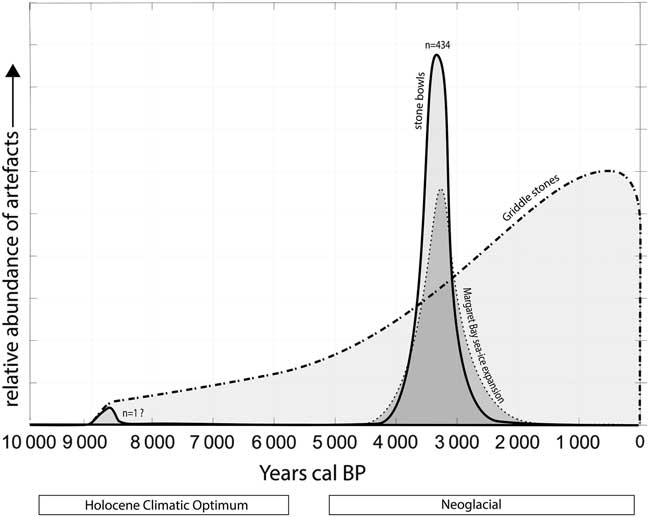
At around 3500 cal yr BP, a cold spell ascribed to the Neoglacial brought colder temperatures to the Aleutian Islands (Fig. 10). Marine mammals became more abundant as lower sea surface temperatures increased marine productivity. This induced cultural expansion and increased marine mammal hunting practices. Archaeological bone material is preserved for the first time in the Aleutian sequence, and it shows the presence of sea ice–dependent species such as polar bear, ringed seal, and walrus that are not present in later phases when there is no sea ice (Davis, Reference Davis2001; Crockford and Frederick, Reference Crockford and Frederick2007; Knecht and Davis, Reference Knecht and Davis2008).
Schematic diagram of stone bowl and griddle stone relative abundance against the Margaret Bay phase sea-ice presence in the Aleutian Islands as inferred by Crockford and Frederick (Reference Crockford and Frederick2007) on the basis of archaeological faunal assemblages.

The increased presence of marine mammals rich in fats during this period of high marine productivity may have increased the rendering of marine oil. On the other hand, the unpredictability of climate change could have posed problems for the rendering of oil using a cold method where pieces of fat were stored in a cleaned seal skin, referred to as a seal poke, and left to slowly self-render into oil (Frink and Giordano, Reference Frink and Giordano2015). Temperature was of the utmost importance to this process. Under no circumstances was the substance allowed to freeze, nor should it become too warm. Therefore it was stored in a cool and dark place, often a submerged pit, to prevent the oil from becoming rancid (Frink and Giordano, Reference Frink and Giordano2015). Semi-subterranean houses in the Aleutians dating to before 3000 cal yr BP often had subfloor storage pits lined with stone slabs (Knecht and Davis, Reference Knecht and Davis2008). It is possible that these pits were used for this purpose.
We contend that decreasing temperatures in the Aleutians as demonstrated by faunal remains of the Margaret Bay and Amaknak Bridge sites (Davis, Reference Davis2001; Crockford and Frederick, Reference Crockford and Frederick2007) may have induced a change in the method for rendering oil. The hot rendering of oil is not only more controlled but also quicker. Although stone containers could be used for cold rendering as well, for hot rendering the use of a durable container such as a stone bowl was a necessity. Fat was cut up and boiled in water using a container, either by means of stone boiling or by heating the container directly over a fire. The latter seems to have been the case for the examined specimens as evidenced by thick carbonated encrustations stuck to the bases of the bowls.
The adoption of durable cooking technologies in the circumpolar north
Aleutian stone bowls and griddle stones are among the earliest durable, nonportable cooking technologies in the circumpolar north. We argue here that stone bowls were used for the rendering of marine fats, whereas griddle stones were probably used for cooking food with high contributions of marine oils. But why were they adopted in the first place? Were stone bowls unique in light of their function? Were they replaceable? How does the adoption of stone bowls relate to the wider debate of early durable container technologies in the circumpolar north?
Stone bowls were a means to an end, to render marine oil. Alternative methods could be used to reach that same end. The seal poke system allowed for the rendering of fat into oil using a cold method that could have been employed before and after the period when bowls became abundant. Climate change may have made this system to render oil more prone to failure and induced the introduction of the stone bowl. However, sedentism also plays an important role here. It was sedentism that allowed for the manufacture and maintenance of this expensive container technology. The fact that a lot of early pottery is associated with the processing of aquatic resources (Jordan and Zvelebil, Reference Jordan and Zvelebil2009; Craig et al., Reference Craig, Saul, Lucquin, Nishida, Tache, Clarke and Thompson2013) may be closely linked to the notion that a stable abundance of aquatic resources induced sedentism, instead of the idea that aquatic resource processing demanded the use of durable containers such as stone bowls and pottery.
That said, climatic circumstances could very well have encouraged the local invention of the stone bowl in the Aleutian Islands. The hot rendering of aquatic oil would have been difficult or even impossible with different, less durable technologies such as basketry or seal pokes. Therefore, we ascribe the sudden peak in stone bowl frequencies to a change in oil rendering methods brought on by the Neoglacial cold spell. The introduction and use of griddle stones as a cooking technology is more gradual and consistent. The demand for a container or grill plate to cook on would have easily led to the utilization of these flat stones that are abundant in the Aleutian Islands.
CONCLUSIONS
In this article, our aim was to identify the function of stone bowls and griddle stones. We argue that stone bowls were used for the rendering of marine oil using direct heating. We ascribe the sudden peak in stone bowl occurrence to a shift in temperature caused by the Neoglacial cold spell that subsequently induced a change in oil rendering methods and brought an abundance of sea ice–dependent species, rich in fats, to the area. Our results also suggest that griddle stones were used for the processing of a slightly more diverse set of resources, although still predominantly marine. We ascribe this diversity to cooking practices as opposed to oil rendering in stone bowls.
This is the first systematic research into the function of Aleutian cooking technologies employing molecular and chemical analyses of carbonised residues. Future work could test the hypotheses raised in this article by analysing a larger set of samples, especially regarding griddle stones to more firmly establish trends. The differences between the two technological groups are minor but apparent. Differentiation within the aquatic spectrum is still poorly understood, and advances in experimental techniques involving APAA isomer ratios and phytanic acid ratios (Fig. 6), but also an expansion of archaeological reference data from, for example, bone lipids, are necessary to further understand the origin of varying signals.
ACKNOWLEDGMENTS
This research is a part of MA’s PhD research project, hosted by the University of Groningen Arctic Centre as well as the BioArCh laboratory of the University of York and cosupervised by coauthors PDJ and OEC. The PhD is funded by the University of Groningen, Faculty of Arts. Additional support for residue analysis came from the Arts and Humanities Research Council (AH/L0069X/1). We would like to thank the Museum of the Aleutians and the Ounalashka Corporation for supporting this research and granting access to the artefacts. We also thank the Oregon Museum of Natural and Cultural History and the Katmai National Park Service for allowing the sampling of archaeological bone material. Thank you to Virginia Hatfield for providing the AMK3 griddle stone samples, to Frits Steenhuisen for his help with Figure 1, and to Krista McGrath and Dr. Camilla Speller for the identification of archaeological bone using ZooMS. MA would like to thank Dr. Shinya Shoda and Dr. Laura Llorente-Rodriguez for their valuable contribution to her lab training. Special thanks go out to the guest editors Bre MacInnes, Ben Fitzhugh, Kirsten Nicolaysen, and Virginia Hatfield for their efforts in bringing this special issue of Quaternary Research together.
SUPPLEMENTARY MATERIAL
To view supplementary material for this article, please visit https://doi.org/10.1017/qua.2018.31