In the process of cataloguing holdings of the Reid Music Library at the University of Edinburgh, I identified two collections of minimally documented manuscript parts that were apparently gathered in the middle years of the eighteenth century. These collections are now held by and accessible through the Centre for Research Collections in the Main Library of the university. The first of these consists of twenty-five sinfonias and overtures, apparently collected by Charles Hope-Weir, together with an aria ascribed to J. C. Bach. The second is a collection of about forty trios featuring one or two flutes, believed to have been owned by General John Reid, the founder of the Music School. Most of the works in both collections are in three movements, with title and composer most fully given on the cover of the basso part.
The collections give rise to several questions, the answers to which could shed more light on life and music in Europe, and more specifically Scotland and Edinburgh, at the time. There seems to be little information on Charles Hope-Weir's involvement with music, but he must have had some purpose in collecting such a substantial and focused repertory. Does the presence of the collection in the Reid Library indicate a relationship between General Reid (1721–1807) and Charles Hope-Weir (1710–1791)? The latter was Muster General (Scotland) (responsible for military record-keeping) from 1744 to 1759, and both he and Reid were Hanoverians. One of Hope-Weir's motives in making the Grand Tour was to visit his son William, then finishing his education in Pisa and Göttingen. William joined the first regiment of Dragoon Guards in 1756. The Reid collection appears to have been assembled in much the same way as the Hope-Weir collection, but there is little indication of how or when.
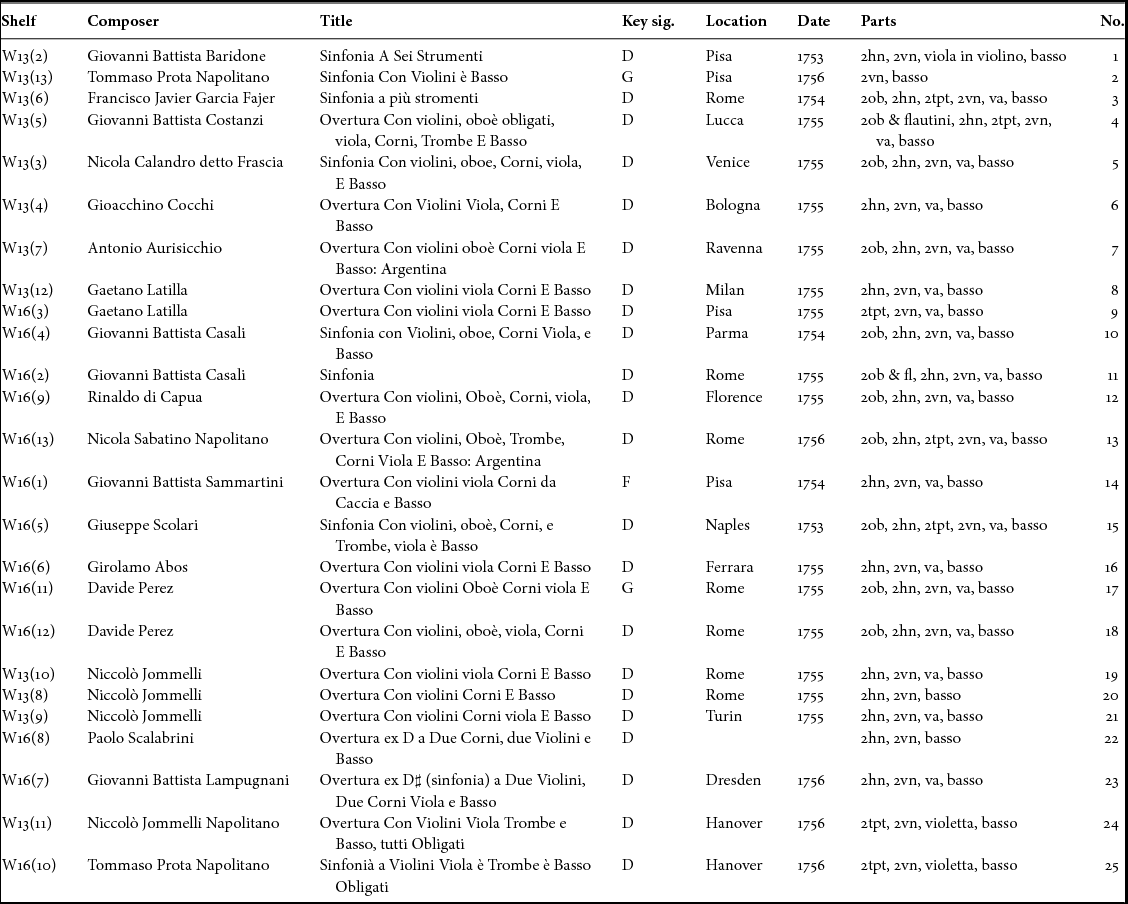
The Hope-Weir Collection consists of parts dated between 1753 and 1756, each set marked with a location, presumably indicating where it was collected. The music is mostly for an ensemble of two horns, two violins, viola and basso, with the addition of pairs of oboes (twice alternating with flutes) and trumpets in some cases. The composers are largely associated with the opera of that time, and little of their instrumental music seems to have survived. The name Hope-Weir is written on the title-page of each set together with a number in the same hand, along with other numbers. Most of the music is in the key of D major, and in three movements (typically Allegro – Andantino – Allegro, the latter often in triple time), with the winds tacet in the middle movement. The exceptions are the two pieces (Hope-Weir Nos 4 and 11) where the oboists take up piccolo or flute in the middle movements. In addition, in the overture by Davide Perez (No. 17), the three movements follow each other without a break, with the oboes and horns playing in every movement. Another point of interest in the collection are the expression marks, apparently in vernacular Italian: in the work by Rinaldo di Capua (No. 12) the first-horn part features a marking posta di voce sforzata. The marking sforzata by itself also appears in the violin parts in the Perez (No. 17). The dynamic markings include sections indicating a gradual increase in volume: po assai, poco fe, più fe, rinf, fe, fmo. The marking ten p exists in contexts where we might now expect sempre p.
In addition to the twenty-five overtures or sinfonias there is in one box an aria by J. C. Bach (known in Italy as Don Giovanni Bach). It does not carry the name ‘Hope-Weir’ but was found in the same box as the first set of overtures. This is a manuscript score of Non temer bell’ idol mio, for soprano with oboe, two violins and basso. There is a staff labelled viola, but it is blank until the final bar, when it has the bass note at the octave. As J. C. Bach is known to have been in Italy, indeed in Milan and Bologna, at the same time as the collection is dated (see, for example, Karl Geiringer, The Bach Family (London: George Allen & Unwin, 1954), 406, quoting C. P. E. Bach), it seems reasonable to assume that the aria was copied and brought back to Scotland in the same collection in which it is now found.
Charles Hope-Weir was the second son of Charles Hope, First Earl of Hopetoun; he embarked on a Grand Tour during 1754–1756, when as a Member of Parliament he was given leave to be abroad. In 1754 he was joined in Brussels by the young Robert Adam with his brother James, the celebrated architects and designers. The brothers had been working on Hopetoun House for Charles's brother John, the second Earl of Hopetoun. James returned via Antwerp that year while Charles and Robert continued to Italy. Robert stayed on in Italy until 1757 but Charles left Robert in Rome in September 1755, travelling to Viterbo and Florence. He later returned to Britain via Germany, which might account for Dresden and Hanover appearing in the list of cities (dated 1756) after the Italian cities which form the bulk of the places cited on the parts. This was a Grand Tour significant for the development of British architecture and style, and has been relatively well documented (see, for instance, Roderick Graham, Arbiter of Elegance: A Biography of Robert Adam (Edinburgh: Birlinn, 2009)). J. C. Bach's aria Non temer bell’ idol mio may in fact have been sent back by Robert Adam, as he indicates in a letter to his mother that he had attended the opera and heard ‘some very pretty music’, and that he had arranged to have it copied for his sister Helen (see Graham, Arbiter of Elegance, 92).
Appendix 1 gives the list of compositions in the Hope-Weir Collection, with modern spellings of the composers’ names. The collection is complemented in Edinburgh University Library by a substantial part of the Periodical Overtures published by Bremner from 1763, together with publications for similar forces by Thompson, Longman, Walsh and others. These are in the form of parts, with generally two copies of the basso part and one of each of the others, almost all for an ensemble of pairs of oboes and horns with four strings.
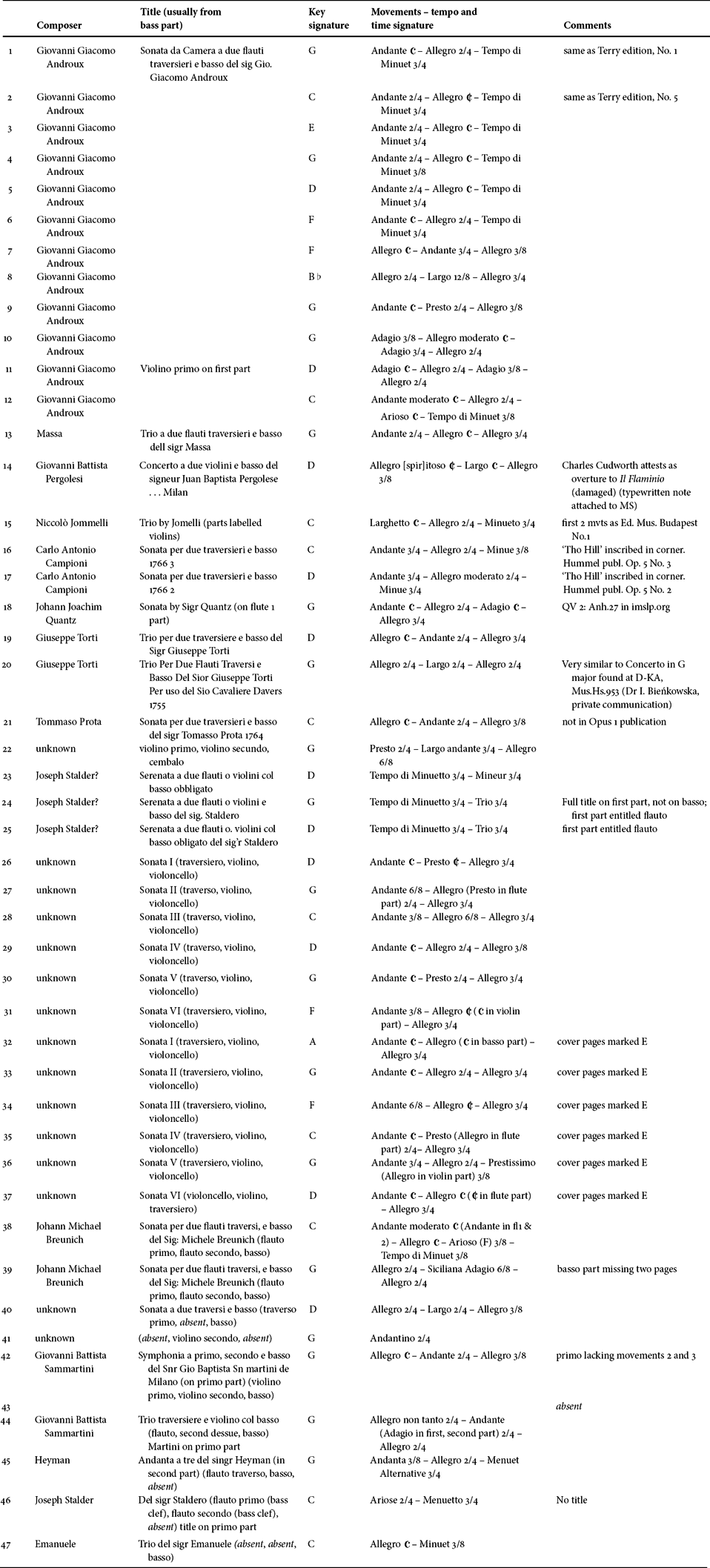
The Reid Collection of trios consists of music suitable for flutes, with evidence that it was intended for two flutes and basso. There is little identification of where or when these parts were collected. Two significant sets of six trios identify no composer, with parts explicitly headed ‘traversiero’, ‘violino’ and ‘violoncello’. Some of the music can be found in published or other manuscript collections, but much seems to be unknown. The predominant three-movement structure is similar to the works in the Hope-Weir collection, but the keys are more varied. A summary table of the collection is given in Appendix 2, and a thematic index is available as a pdf file from the author.
General John Reid had a distinguished military career, and he was also a flute player and composer. Some of his marches and flute works were published during his lifetime, one of which is a Highland March for two flutes or violins and basso, with the composer given as Captain Reid. It was published around 1765 by Bremner in a collection of Airs and Marches, copies of which exist in Edinburgh University Library and in the British Library. It was matched with words and is still in frequent use by Scottish regiments as Garb of Old Gaul, arranged for military band from the earliest version for two pairs of oboes or violins and horns with basso (again published by Bremner in 1781). Reid endowed the professorship of music in Edinburgh, and his collection of books and music started what has become a very significant resource.
In both collections the handwriting is quite clear, although there are numerous copyists’ errors, including wrong notes and displaced bars. Some of these works, minimally edited and typeset, are available from the author: to date the trios by Massa (Reid 13), Pergolesi (Reid 14), Torti (Reid 19, 20) and anonymous (Reid 26 – 31), and the entire Hope-Weir collection. The Bach aria has also been typeset.
I would like to thank Dr Jenny Nex and Elizabeth Quarmby Lawrence for making it possible for me to explore the music in the Centre for Research Collections of Edinburgh University Library, and all the staff there for their cheerful assistance. It is hoped that scans of both manuscript collections will soon be made available through the Edinburgh University website.
Hope-Weir Collection of manuscripts in the Centre for Research Collections of Edinburgh University Library

Trios of the Reid Collection at cupboard shelfmarks D 52–54 in the Centre for Research Collections of Edinburgh University Library