Adolescent externalizing behaviors are typically thought of as inner-city phenomena, but research has now shown that these can occur as much, if not more so, at the upper economic extreme (Beyers, Loeber, Wikstrom, & Stouthamer-Loeber, Reference Beyers, Loeber, Wikstrom and Stouthamer-Loeber2001; Luthar & Ansary, Reference Luthar and Ansary2005; Luthar & Latendresse, Reference Luthar and Latendresse2005a). In this study of affluent high school 17-year-olds, we sought to explore the nature and antecedents of substance use and other externalizing behaviors in relation to perceived parenting behaviors, with special attention to perceived “containment”: beliefs that particular deviant behaviors would elicit stringent disciplinary repercussions from parents.
Externalizing Behaviors in Affluent Suburbs: Substance Use and Delinquency
Past research with affluent suburban youth has suggested that rates of substance use are considerably higher than national norms. Based on data collected in the mid-1990s, Luthar and D'Avanzo (Reference Luthar and D'Avanzo1999) reported elevated substance use among children of well-educated, relatively affluent parents, particularly among the girls. National data from the Monitoring the Future study show that use levels tend to change with time, with 10th graders, for example, having shown modest declines in illicit drug use between the mid-1990s and 2004 (Johnston, O'Malley, Bachman, & Schulenberg, Reference Johnston, O'Malley, Bachman and Schulenberg2004). It is unclear that any such decreases have occurred in wealthy suburbs where youngsters have ample financial means to acquire different substances.
The Luthar and D'Avanzo (Reference Luthar and D'Avanzo1999) sample also showed rates of overall delinquency that were commensurate with those of inner-city teenagers of the same age (Luthar & Ansary, Reference Luthar and Ansary2005), with the type of behaviors varying to some degree. Inner-city high school sophomores endorsed some behaviors (e.g., physical fights or carrying weapons) that could conceivably be invoked in self-defense within high crime neighborhoods (Beyers, Loeber, Wikstrom, & Stouthamer-Loeber, Reference Beyers, Loeber, Wikstrom and Stouthamer-Loeber2001; Luthar, Reference Luthar1999; Richters & Cicchetti, Reference Richters and Cicchetti1993; Swanson et al., Reference Swanson, Spencer, Harpalani, Dupree, Noll and Ginzburg2003). Their suburban counterparts, by contrast, endorsed higher levels of petty theft, unlikely to be because of financial exigencies, suggesting that there, in fact, could be a draw toward some rule breaking even among these ostensibly privileged youth.
The current investigation builds upon and extends this prior work in three major ways. First, we examine deviant behaviors more contemporaneously, presenting data on late adolescents assessed almost a decade later than had Luthar and D'Avanzo (Reference Luthar and D'Avanzo1999) and in a different community in the Northeast. Second, in addition to assessing substance use and delinquency (as in the previous study), we also report on externalizing behaviors using well-normed instruments, the Youth Self-Report (YSR) and the Teacher Report Form (TRF; Achenbach & Rescorla, Reference Achenbach and Rescorla2001). Self-reports were used to gauge rule-breaking levels because adolescent behaviors such as stealing, lying, and cheating are, by definition, concealed from adults. Analogously, academic disengagement, also potentially a problem among suburban teens (Luthar & Ansary, Reference Luthar and Ansary2005), was ascertained via teachers' observations of attention problems and academic carelessness, as well as school grades. The third innovation lies in the attention to reasons for behavioral deviance among affluent late adolescents. Whereas prior studies have documented that substance use is elevated (Luthar & Ansary, Reference Luthar and Ansary2005; Luthar & D'Avanzo, Reference Luthar and D'Avanzo1999), we explore socializing factors potentially implicated in this and related problems, with central attention to perceived parental reactions to different externalizing behaviors.
Parameters of the Study
This report is based on data from the New England Study of Suburban Youth (NESSY; Luthar & Latendresse, Reference Luthar and Latendresse2005b), involving a cohort of high-income, suburban students who were first studied when they were in the sixth grade in 1999, and followed annually ever since (further details are provided in the Methods section). Questions addressed here were based on data obtained when the cohort was in the 11th grade, 17-years-old on average, a developmental period connoting high risk for substance use and associated externalizing problems. As demonstrated in longitudinal research (Moffitt, Caspi, Rutter, & Silva, Reference Moffitt, Caspi, Rutter and Silva2002), the period between the ages of 15 and 18 years reflects sharp increases in alcohol and illegal drug use as well as rule-breaking, delinquent behaviors.
While exploring vulnerability and protective factors salient in high-income communities, our work with the NESSY cohort thus far has followed several major tenets of developmental psychopathology research, the first being concerted attention to developmentally stage-salient risk modifiers. Our overarching goal has been to track rates of youth problems that might be particularly elevated in affluent settings, and accordingly, assessments of various maladjustment domains have remained constant across annual assessments. However, as the cohort has progressed through middle and high school, we have altered our measurement battery to consider predictors of maladjustment salient at new developmental phases (cf. Campbell, Shaw, & Gilliom, Reference Campbell, Shaw and Gilliom2000), as is common in programmatic long-term studies (see, e.g., Sameroff, Reference Sameroff2000; Shaw, Criss, Schonberg, & Beck, Reference Shaw, Criss, Schonberg and Beck2004).
Also following developmental psychopathology tenets, our work has focused on (a) “modifiable modifiers” and (b) context-specific forces. As is recommended in risk and resilience research (Luthar, Reference Luthar, Cicchetti and Cohen2006), we have been particularly attentive to vulnerability and protective forces, which are themselves amenable to change via external interventions. Parents' management of teens' recalcitrant behaviors could be changed more readily, for example, than adolescents' negative temperaments. Second, from the start of this study, we have used a strategy commonly employed in qualitative, ethnographic research (LeCompte & Preissle, Reference LeCompte and Preissle1993), interviewing “key informants”: members of the community likely to have a good understanding of influences significant in this environment at the different developmental stages. With the lack of prior empirical research on high-income youth, these qualitative data have been critical in focusing our work on contextually relevant forces.
With regard to externalizing behaviors during the high school years, key informants converged in citing parents' lack of knowledge regarding their teenage children's whereabouts and activities, and the likely significance of this is supported by research on teens in diverse settings (Dishion, French, & Patterson, Reference Dishion, French, Patterson, Cicchetti and Cohen1995; Dishion & McMahon, Reference Dishion and McMahon1998; Fletcher, Steinberg, & Williams-Wheeler, Reference Fletcher, Steinberg and Williams-Wheeler2004; Kerr & Stattin, Reference Kerr and Stattin2000; Smith & Stern, Reference Smith and Stern1997). Also noted was parents' efforts to track and know of their children's activities, again, a construct of established significance and distinct from actual knowledge (which requires parents' interest as well as the child's willingness to share information; cf. Crouter, Bumpus, Davis, & McHale, Reference Crouter, Bumpus, Davis and McHale2005; Sameroff, Reference Sameroff2000; Sameroff, Peck, & Eccles, Reference Sameroff, Peck and Eccles2004).
In addition to parents' knowledge and monitoring, key informants pointed to another salient construct, lack of consequences for deviance, noting that at least for some suburban youth, parents were well aware of their children's alcohol and marijuana use but were not particularly troubled by it. These perspectives are consistent with recent clinical evidence (e.g., Kindlon, Reference Kindlon2001; Levine, Reference Levine2006) as well as media reports of parties for groups of suburban high school students, some even hosted by parents, where alcohol was freely available (see Associated Press, 2003; National Center on Addiction and Substance Abuse, 2002; Ritter, Reference Ritter2005).
To empirically examine the basis for these views, we drew upon research on a relatively new construct in developmental psychopathology, called containment. As defined by Schneider, Cavell, and Hughes (Reference Schneider, Cavell and Hughes2003, p. 97) containment represents “… a child's beliefs that adults have the capacity to impose firm limits and to prevail if there is a conflict in goals.” These investigators examined perceived containment among younger children with items such as, “My mom can make me obey her even if I really don't want to.” In the present study involving 17-year-olds, we developed a parallel measure to tap into parental containment in relation to adolescent nonconformity. Students were asked about the seriousness of likely consequences, from their parents, if they discovered incidents related to substance use (e.g., “were smoking marijuana”) or delinquency (e.g., “took something from a store without paying for it, such as a DVD or CD”).
We also explored containment around two other behavioral “infractions”: academic disengagement and rudeness to others. In high-income communities strongly valuing academic success (Luthar, Reference Luthar2003; Luthar & Sexton, Reference Luthar, Sexton and Kail2004), it is plausible that parents react strongly on discovering academic indolence among their high school children. Conversely, a single-minded focus on personal success can come, sometimes, at the cost of considerateness to other people (see Luthar, Reference Luthar2003, for a review), perhaps explaining why high socioeconomic status (SES) people are stereotyped as being “not nice” (Christopher, Westerhof, & Marek, Reference Christopher, Westerhof and Marek2005). Accordingly, we also examined teenagers' perceptions of how strongly their parents might react on discovering academic disengagement and rudeness or hostility, along with substance use and delinquent acts, to determine whether each had any bearing on the youngsters' behavioral conformity.
Attachment to Parents
Of course, adolescent deviance can occur even with the strictest, most vigilant parents; another reason that teenagers act out is because of inadequate nurturance (see Locke & Prinz, Reference Locke and Prinz2002, for a review), with closeness to mothers and to fathers each explaining unique variance in adolescent outcomes (e.g., Grych, Raynor, & Fosco, Reference Grych, Raynor and Fosco2004). Aside from closeness dimensions, again, we considered a novel but related aspect of parenting: perceived parent “commitment.” Put forth by Dozier, Lindhiem, and Ackerman (2005), this construct represents the extent to which the caregiver is committed to her particular child, ensuring the child's welfare even at cost to herself. Developed originally for use with children in foster care, the original measure tapped into dimensions such as beliefs in parents' acceptance, commitment, and influence (Bates & Dozier, Reference Bates and Dozier2002).
In this study, we examined teenagers' perceptions of their parents' commitment, considering conceptually analogous dimensions potentially important for suburban youth. Rooted in knowledge of white collar professional parents' multiple time demands, we considered students' beliefs that parents prioritized their children's welfare above their careers and other pursuits; that they would help their child despite other commitments; and would protect the child from life's injustices. Again, we sought to determine the potential significance of parental commitment over and above more conventional measures of closeness to both parents. Apart from examining main effects of these various indices, we also considered interactions between the four containment dimensions and perceived parent commitment, as effects of parent discipline depend somewhat on levels of closeness in the relationship (Kerr & Stattin, Reference Kerr and Stattin2000).
In sum, our goals in this study were to better understand the nature and potential parenting correlates of substance use and externalizing behaviors among high school juniors in a high income, suburban community. Adjustment dimensions considered included self-reported substance use, delinquency, and rule-breaking behaviors, and teacher-rated inattentiveness as well as school grades. These behaviors were examined in relation to 11th grade students' reports on the following parent dimensions: knowledge of the child's activities and whereabouts; efforts to know about these; parental containment in four domains: substance use, delinquency, rudeness, and academic disengagement; perceived parent commitment and closeness to both mothers and fathers. All analyses were conducted separately for females and males, given known gender differences in both levels of different forms of psychopathology as well as their different correlates (Cicchetti & Sroufe, Reference Cicchetti and Sroufe2000; Davies & Lindsay, Reference Davies, Lindsay, Grych and Fincham2001; Grych et al., Reference Grych, Raynor and Fosco2004; Zahn-Waxler, Crick, Shirtcliff, & Woods, Reference Zahn-Waxler, Crick, Shirtcliff, Woods, Cicchetti and Cohen2006).
Method
Sample
As noted earlier, this report is based on NESSY, involving a cohort of high-income, suburban students first studied when they were in the sixth grade (Luthar & Latendresse, Reference Luthar and Latendresse2005b) and followed annually ever since. When the study was initiated, participants were 335 students (161 females, 174 males) from the high school in one affluent town. Ninety-three percent were Caucasian, less than 2% each were African American and Hispanic, 3% were Asian, and the remainder were of other ethnic backgrounds. Based on census data, the median annual family income in this township was $125,381, and 32.8% of adults had a graduate degree (Luthar & Sexton, Reference Luthar, Sexton and Kail2004); only 3% of the students in the school sample were eligible for free or reduced lunches.
Students' inclusion in the sample was based on passive consent procedures, as data collection was done as part of school-based initiatives on positive youth development. To ensure that parents and participants were well informed, administrators sent letters to parents of all students via US mail before each wave of data collection, describing the project, indicating that survey results would be presented only in aggregate form, and requesting notification from parents who did not want their children to participate. A second notice was mailed a few days before data collection, again offering the option to refuse consent. On days of data collection, students were informed that their participation was voluntary, and on completion of data collection, questionnaires were stored with subject numbers as identifiers.
This manuscript is the first report of NESSY students in the high school years (for reports during middle school, see Luthar & Latendresse, Reference Luthar and Latendresse2005a, Reference Luthar and Latendresse2005b; Luthar, Shoum, & Brown, Reference Luthar, Shoum and Brown2006). In this wave of data collection, when students were in the 11th grade, a total of 258 students participated, representing 80.6% of those who had completed the original sixth grade assessments (and 77.0% of all 11th graders, including those who had joined the school district postinitiation of the longitudinal study). Of the 50 11th graders who did not participate, 20 parents disallowed participation, 4 were excused from participation by the principal, and 26 were absent on the day of data collection as well as makeup days. A multivariate analysis comparing the 258 participants with the 77 nonparticipants on constructs assessed in the sixth grade showed that the nonparticipants were similar to participants on earlier substance use, delinquency, attachment to mothers and attachment to fathers, but they fared more poorly on academic grades and teacher ratings. Thus, a subset of students at greatest academic risk may well be missing in the longitudinal sample.
Procedure
During the 2003–2004 academic year, measures were group administered to the students in this cohort during one 90-min session in the school cafeteria. To guard against biases because of variability in reading proficiencies, the principal investigator (S.S.L.) read each questionnaire aloud, and students marked their responses accordingly. Two members of the research team supervised each student table and were available to clarify questions. Questionnaires were administered with relatively structured, nonthreatening measures administered at the beginning and end of each session. On completion of data collection, all participating students received a $20 gift certificate to either a sporting goods or local music store; teachers were given $5 for each student rated.
Measures: Parenting dimensions
Parent knowledge and monitoring
Paralleling measures used by Fletcher et al. (Reference Fletcher, Steinberg and Williams-Wheeler2004), students were asked about how much their parents really know and how much they try to know about (a) where they go at night, (b) what they do with their free time, and (c) where they are most afternoons after school, with responses rated on a 3-point scale (1 = not at all, 2 = a little, and 3 = a lot). Reliability coefficients for really know and try to know respectively were .83 and .71 for females and .83 and .81 for males in this sample.
Perceived parent containment
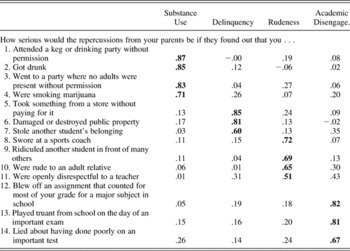
Anticipated parental repercussions on discovering different errant behaviors were measured by a 14-item scale with the following instructions: “Parents differ in how seriously they react when they discover types of rule-breaking behaviors among their teenage children. Reactions can range from simply talking about the incident or giving warnings for the future, to revoking privileges that are very important to the person. For each of the following items, please indicate how serious the consequences from your parents would be, if they found out you'd done the behavior in question.” The items on this scale are shown in Table 1: substance use (four items), delinquency (four items), rudeness (three items), and academic disengagement (three items). Items were rated on a 5-point Likert scale (1 = not at all serious, 3 = moderately serious, 5 = extremely serious).
The Perceived Containment Questionnaire with factor loadings

Items on the perceived parent containment measure were subject to factor analyses with varimax rotation, and results showed that a four-factor solution was, in fact, optimal as indicated by the scree plot and eigenvalues > 1 (see Table 1). Together, the four factors accounted for 71.2% of total variance. Separate factor analyses for females and males yielded the same factor structure. Accordingly we derived four containment subscale scores by adding the relevant items. Reliability coefficients for the containment subscales, among females and males, respectively, were as follows: containment-substance use (Cont-Subst), .89 and .87; containment-delinquency (Cont-Delinq), .83 and .74; containment-rudeness (Cont-Rude), .88 and .80; containment-academic disengagement (Cont-Acad), .70 and .77.
Parental commitment
Students indicated on a 5-point Likert-type scale how true for them were three statements regarding different aspects of parental commitment: “I know that I am my parent(s)' first priority—over their careers and other pursuits”; “If I were upset about something, my parent(s) would drop their other commitments to help me”; and “If there was an injustice done to me, my parent(s) would stick up for me.” Parental commitment αs were .74 for females and .69 for males.
Closeness to parents
Closeness to parents was assessed via a widely used measure, the Inventory of Parent and Peer Attachment (Armsden & Greenberg, Reference Armsden and Greenberg1987), which contains 50 items (25 pertaining to each parent) rated on a 5-point Likert-type scale. Scores are obtained for the degree of trust, communication, and alienation in relationships with each parent, as well as an overall attachment score obtained by combining the subscales. Cronbach alpha coefficients for trust, communication, and alienation, for mother versus father, respectively, were .92 versus .90, .91 versus .92, and .77 versus .76 among girls, and .91 versus .91, .83 versus .87, and .69 versus .77 among boys.
Measures: Externalizing behavior
Substance use
Levels of cigarette, alcohol, and marijuana use, the three substances most commonly used by suburban adolescents (Luthar & D'Avanzo, Reference Luthar and D'Avanzo1999), were assessed via the frequency of drug use grid used in the Monitoring the Future Study Survey (Johnston, O'Malley, & Bachman, Reference Johnston, O'Malley and Bachman1984), an instrument that queries about frequency of use of different substances over the preceding year, with ratings obtained on a 7-point scale (1 = never, 2 = 1–2 times, 3 = 3–5 times, 4 = 6–9 times, 5 = 10–19 times, 6 = 20–39 times, and 7 = 40+ times). The reliability and validity of this type of self-report have been amply documented (see www.monitoringthefuture.org). Following the approach in previous studies (Luthar & Becker, Reference Luthar and Becker2002; Luthar & D'Avanzo, Reference Luthar and D'Avanzo1999), a composite substance use variable was created by adding scores for cigarettes, alcohol, and marijuana. Alpha coefficients were .85 and .79 for females and males, respectively.
Delinquency
The Self-Report Delinquency Checklist (SRD; Elliot, Dunford, & Huizinga, Reference Elliot, Dunford, Huizinga and Burchard1987) asks about the frequency of delinquent acts at home, at school, and in the community, with 37 items rated on a 4-point scale anchored by never and very often: five or more times per year. Footnote 1 To minimize redundancy with our measure of substance use, we omitted 6 of the 37 items that pertained to drug-related behaviors in computing the overall delinquency score (e.g., used alcohol, been drunk in a public place, sold marijuana). Acceptable reliability and validity have been reported for the SRD (Huizinga & Elliot, Reference Huizinga and Elliot1986), and in this study coefficients were α = .87 for both females and males.
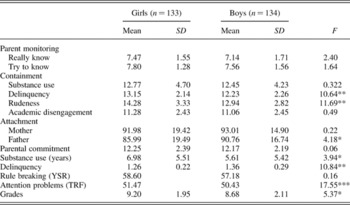
Descriptive data on all variables presented by gender

Note: Means shown for rule-breaking and attention problems were first computed from raw data and then converted to T scores using normative sample charts (Achenbach & Rescorla, Reference Achenbach and Rescorla2001). Accordingly, standard deviations are not displayed.
*p ≤ .05. **p ≤ .01. ***p ≤ .001.
Self-reported rule breaking
The YSR (Achenbach & Rescorla, Reference Achenbach and Rescorla2001) contains 112 items encompassing internalizing and externalizing domains prevalent among 12- to 18-year-olds (Achenbach & Rescorla, Reference Achenbach and Rescorla2001). The externalizing subscale central to our analyses, rule-breaking, had values of α = .75 and .77 for females and males, respectively, in this study. (Alpha coefficients for other internalizing and externalizing scales ranged from .65 to .82, median value .77.)
Teacher-reported attention problems
Toward the end of the academic year, English teachers of all students completed the TRF (Achenbach & Rescorla, Reference Achenbach and Rescorla2001), a measure parallel to the YSR. In this study, we used the attention problems subscale, as the 25 component items are analogous to the 12 items previously assessed by Luthar and Ansary (Reference Luthar and Ansary2005) in reporting discernible academic disengagement in a substantial proportion of 10th graders in that sample, from a different suburban community. Examples of TRF subscale items, with parallel examples in parentheses from the Teacher Child Rating Scale (a nonnormed measure) used in the earlier study, are as follows: has trouble concentrating or paying attention (has poor concentration), apathetic or unmotivated (is poorly motivated to achieve), inattentive or easily distracted (has a limited attention span), fails to carry out assigned tasks (has poor work habits), showing off or clowning (is disruptive in class), has trouble concentrating or paying attention (has poor concentration), apathetic or unmotivated (is poorly motivated to achieve), talks too much (constantly seeks attention), underachieving, not working up to potential (is underachieving), and has trouble sitting still (has difficulty sitting still). To enable comparisons with national normative data in this study, we administered the entire set of YSR subscales rather than just those that corresponded exactly to those in the shorter Teacher Child Rating Scale.
Alpha reliability coefficients for the TRF subscale in this study were .90 and .96 for females and males, respectively. As a further cross-check for reliability because ratings were made by only one teacher, we computed correlations of attention problems provided by English teachers in the preceding and current years (i.e., the 10th and 11th grades). Despite the different teachers and the 1-year interval, a large, significant correlation was found, r = .58, p < .001.
Grades
Cumulative grade point averages (i.e., mean across social studies, science, math, and English) were computed from data in students' records from the prior two quarters of the school year. Letter grades were coded such that an A+ was assigned a score of 13 and an F a score of 1.
Results
Descriptive statistics
Means and standard deviations for all predictor and outcome variables are presented separately by gender in Table 2. A one-way multivariate analysis of variance (MANOVA) revealed significant gender differences: Wilks' Λ = .77, F (14, 173) = 3.78, p < .001. Follow-up univariate analysis of variance (ANOVA) showed that girls reported higher perceived parent containment for delinquency and rudeness but lower attachment to fathers (see Table 2). On externalizing indices, females reported higher substance use and teacher-reported inattentiveness than males, yet fared better than males on delinquency and school grades. In terms of externalizing behaviors relative to norms, average scores in this sample approximated national averages for teacher-rated attention problems, but were almost 1 standard deviation above national means on self-reported rule breaking (t scores of 59 and 57 for females and males, respectively).
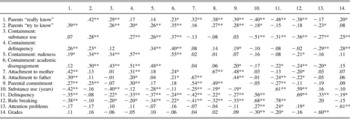
Simple correlations among all variables are displayed in Table 3, with values for males in the top right half of the table and those for females shown in the bottom left. Values suggest several hypothesized links between predictors and outcomes, but to avoid Type I errors, all inferences about salient patterns are reserved for the more stringent multivariate analyses that follow. With regard to links among the predictors, the patterns of correlations attest to the validity of measures as coefficients were generally the strongest within groups of conceptually linked variables (e.g., correlations between parental commitment and attachment to mother and father, respectively, were .54 and .49 for boys, and .48 and .44 for girls).
Intercorrelations among parental relationship predictors and adolescent externalizing outcomes

Note: Correlations for girls are listed in the bottom left half of the diagonal and correlations for boys are listed in the top right half of the diagonal.
*p < .05. **p < .01.
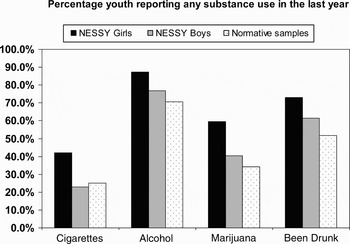
Parallel to strategies in prior studies of affluent youth, both in the NESSY cohort when they were middle school students (Luthar et al., Reference Luthar, Shoum and Brown2006; Luthar & Latendresse, Reference Luthar and Latendresse2005b) and with the other high school cohort assessed a decade ago (Luthar & D'Avanzo, Reference Luthar and D'Avanzo1999), we examined functioning of this sample on measures for which normative data were available. Figure 1 displays substance use frequencies in the past year separately for cigarettes, alcohol, and marijuana. We also display, in this figure, frequencies of drinking to intoxication as a gauge of dangerous levels of substance use in this cohort. Substance use rates were higher than norms in the NESSY cohort, particularly among girls. Rates of any cigarette use (past year) were 25% in normative samples, and rates for females and males in this cohort were 42 and 23%, respectively. Parallel values for alcohol use, in normative samples, versus NESSY females and males, respectively, were 71 versus 88% (females) and 77% (males); and 34 versus 60% (females) and 40% (males) for marijuana use; and 52 versus 73% (females) and 62% (males) for having been drunk. As in the Luthar and D'Avanzo (Reference Luthar and D'Avanzo1999) study, suburban girls were particularly at risk for substance use, with frequencies at least one and a half times higher than norms on most indices.
Different types of substance use taking place in the last year (compared to national norms). National normative data are not available for girls and boys separately.

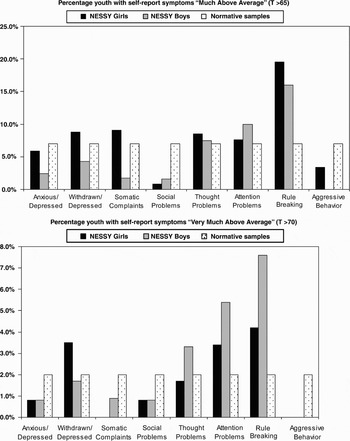
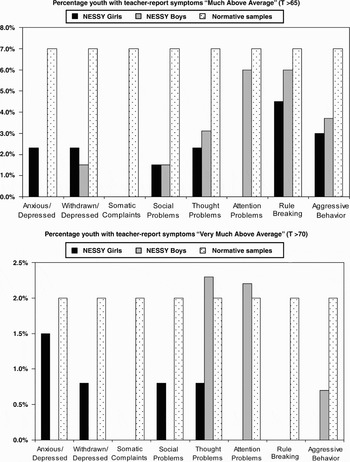
For self-reported rule breaking on the YSR, the proportion of NESSY youth with clinically significant symptoms was also high relative to norms (Figure 2a and b). Whereas 7% of normative samples have t scores “much above average” (above 65), rates here were about three times as high: 20 and 26% among females and males, respectively. Scores “very much above average” (t > 70) are found in only 2% of normative samples; rates in the NESSY cohort were twice and four times as high (4 and 8%) among females and males, respectively. Teachers' reports did not indicate that an unusually large proportion of NESSY youth had clinically significant symptoms (Figure 3a and b). On attention problems, “much above average” scores were not reported for females, but frequencies for males approximated those in normative samples: 7% (norms) and 6% (males).
The incidence of clinically significant self-reported symptoms (compared to national norms). The 7 and 2% incidence rates apply to both girls and boys, respectively, in normative samples.

The incidence of clinically significant teacher-reported symptoms (compared to national norms). The 7 and 2% incidence rates apply to both girls and boys, respectively, in normative samples.

Perceived containment across different behavioral infractions
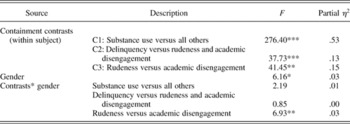
Using the entire sample, average scores on the four containment subscales were compared to determine whether students anticipated varying degrees of parental repercussions for infractions in different domains. Subscale scores were considered as four levels of the same overall factor in a repeated-measures MANOVA with Helmert contrast codes. Results from the tests of the Helmert contrasts and gender, as well as the Contrast × Gender interactions, are shown in Table 4.
Comparisons of perceived parent containment scores across four domains

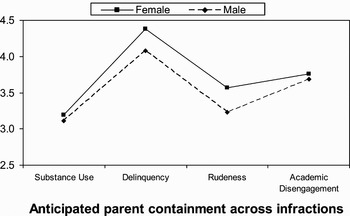
Results showed a significant effect for all three containment contrasts with a very large effect size, of .53, in the contrast between containment for substance use (the lowest of the four) versus all the other dimensions. Judd and McClelland (Reference Judd and McClelland2001) note that eta-squared values (η2) of .03, .10, and .30 reflect small, medium, and large effect sizes, respectively. Significant differences were also found for Cont-Delinq compared to Cont-Acad and Cont-Rude, with the latter two being lower in terms of anticipated consequences. For gender as a main effect, as noted earlier (in discussing Table 1), girls reported higher containment scores than boys. A significant interaction in this MANOVA indicated that girls generally anticipated much stronger parental reactions than boys upon discovering rudeness, whereas gender differences were negligible in perceived parental reactions to academic disengagement (see Figure 4).
Estimated marginal means for repeated measures analysis of perceived containment.

Multiple regression analyses: Parental predictors in relation to adolescent outcomes
For both females and males, multivariate regressions were conducted with the various parenting dimensions predicting to the different outcomes, namely: substance use (the composite of cigarettes, alcohol, and marijuana),Footnote 2 delinquency, self-reported rule-breaking, teacher-reported attention problems, 3and school grades. Age and ethnicity have little variation in this cohort and cause problems of multicollinearity in regressions (Luthar & Latendresse, Reference Luthar and Latendresse2005b); accordingly, they were not entered in the equations. To maximize stringency of our analyses as all predictors were based in self-report, simultaneous regressions were conducted with all predictors considered together such that results indicate the unique variance contributed by each predictor, having considered the variance shared with all others in the equation (see Cohen, Cohen, West, & Aiken, Reference Cohen, Cohen, West and Aiken2003).
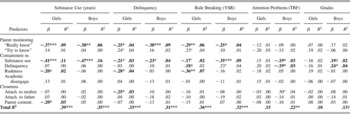
Results of the regression analyses are presented in Table 5. The strongest unique associations across outcomes were for parental knowledge about child activities (“really know”) and for Cont-Subst; each was linked with low substance use, delinquency, and rule breaking among both girls and boys. Aside from these two variables, Cont-Rude also was inversely related to girls' self-reported externalizing behaviors, as Cont-Delinq was associated with boys' low teacher-rated inattentiveness and high grades.
Simultaneous regressions predicting to adjustment outcomes

Note: The R 2 change for individual predictors is based on squared semipartial correlations (the sum of R 2 change for each predictor is usually smaller than the total R 2 because of shared variance).
aAlthough these effects were statistically significant, they are not interpreted because they are likely due to a suppressor variable as suggested by the opposite valence of the parallel zero-order correlations.
†p < .10. *p ≤ .05. **p ≤ .01. ***p ≤ .001.
Collectively, the three closeness indices, as expected, had weaker links with the externalizing behavior outcomes than did the previously discussed discipline indices. Attachment to mothers was linked with low delinquency among girls and parents' commitment showed a significant inverse link with girls' substance use (see Table 5).
Interaction effects
As noted earlier, we hypothesized that felt closeness to parents might moderate the effects of containment, and this was explored via a set of four interaction terms predicting to each outcome: Parent Commitment × Cont-Subst, Cont-Delinq, Cont-Acad, and Cont-Rude. We chose to examine interactive effects for containment and commitment because (a) examining all pairs of combinations of six discipline × three attachment variables considered in this study was logistically unfeasible and (b) containment and commitment are both relatively new constructs in the developmental literature, and we sought to ascertain their explanatory potential.
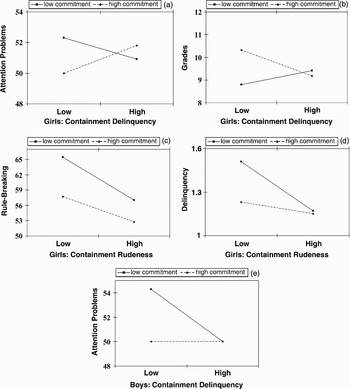
Results indicated four interaction effects for girls, involving Cont-Delinq in relation to academic disengagement (unstandardized B = .30, R 2 change [ΔR 2] = .04, p = .05) and grades (B = − .12, ΔR 2 = .04, p = .04) and Cont-Rude in relation to delinquency (B = .01, ΔR 2 = .02, p = .06), and rule breaking (B = .11, ΔR 2 = .02, p = .09). Among males, a single interaction effect was found, Cont-Delinq in relation to academic disengagement (B = .80, ΔR 2 = .14, p < .001). The pattern of results in these interactions is depicted in Figure 5. As shown there, findings were generally in expected directions with the combination of low perceived parent commitment, and low perceived containment, connoting the poorest adjustment in all cases. For the two effects involving girls' academic outcomes, however, high parent commitment was linked with better performance at low rather than high levels of perceived containment for delinquency. Conversely, for girls' academics, the optimal combination was high parent commitment in combination with relatively low repercussions for delinquency (Figure 5a and b).
Interactions between parental commitment and containment dimensions in predicting adolescents' behaviors.

Additional analyses on use of individual substances
Given (a) the growing evidence of elevated substance use among affluent youth and (b) the potentially serious health risks associated with these, (c) the varying correlates of cigarette, alcohol, and marijuana use (Luthar & Ansary, Reference Luthar and Ansary2005), and (d) the significant regression results with the “omnibus” version considering the substance use composite, we conducted additional regressions predicting to levels of cigarette, alcohol use, and marijuana separately; we also considered frequency of being drunk (drinking to intoxication). Results paralleled those for the composite substance use variable; again, “really know” and Cont-Subst significantly linked with all four substance use outcomes, but contributions to explained variance were considerably stronger for the latter among boys. Specifically, the following pairs of R 2Δ values were seen for “really know” versus Cont-Subst among females: cigarettes, .05 versus .05; alcohol .12 versus .12; marijuana, .06 versus .13; been drunk, .11 versus .09. Parallel values among males were as follows: cigarettes, .03 versus .06; alcohol, .03 versus .19; marijuana, .06 versus .11; been drunk, .04 versus .16.
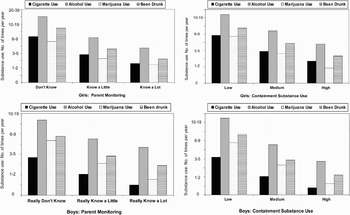
To understand in real-life terms what these associations meant, for each of the substance use variables, we computed residual scores in regression analyses, reflecting levels of use after having considered all other predictor variables in the equation, and these were plotted at high, medium, and low levels of the two most salient predictor variables (“really know” and Cont-Subst). Results are displayed in Figure 6. As shown there, comparable, independent effects were found for “really know” and Cont-Subst. To illustrate, girls in the lowest tertiles of the two predictors reported smoking every two months on average, and being drunk every 6 weeks (nine times a year) on average.
The frequency of cigarette, alcohol, and marijuana use: standardized predicted values by parent “really know” and Cont-Subst use tertiles.

Discussion
Mirroring findings from a decade ago, affluent high school students reported high substance use relative to national norms with the risks particularly pronounced for girls. Suburban 17-year-old females reported using cigarettes and marijuana at nearly twice the normative rate (42 vs. 25%, and 60 vs. 24%, respectively). Although also seen to some degree in substance use, problems among boys in this sample were more apparent in rule-breaking behaviors. One quarter of suburban boys reported rule breaking much above clinically significant levels, and almost 1 in 10 had scores very much above significant levels; these rates are three to four times higher than those in national normative samples.
In multivariate analyses including diverse parenting dimensions, all self-reported externalizing outcomes were significantly related to (a) parents' knowledge of their children's activities and whereabouts, and (b) a new dimension explored in this study of perceived parental containment, or consequences on discovering different types of nonconformity. The strongest links were for parents' containment in reaction to discovered substance use in relation to teens' actual levels of use. In addition, girls' perceived parent containment for rudeness to others was linked with low rule breaking, and boys' parent containment for delinquency with low self-reported delinquent behaviors, good school grades, and positive teacher ratings.
On average, perceived parent containment scores differed substantially across domains. Students anticipated considerably less stringent parental repercussions on discoveries of their substance use compared to rudeness to others, academically disengaged behaviors, or delinquent acts. Girls' containment scores were higher than boys', but the differences were particularly strong in parents' expected reactions to their interpersonal rudeness.
Finally, our findings suggest the potential value of another relatively new construct in the parenting literature: commitment, reflecting adolescents' beliefs that they were a high priority in their parents' lives. Among girls in particular, the implications of high parent containment varied depending on whether they saw their parents as being highly committed to their well-being.
Externalizing behaviors of suburban youth: Implications of perceived parent containment
Substance use is clearly a problem among affluent, suburban teens, and the present findings implicate the role of several parenting dimensions. Based on data obtained almost a decade ago, Luthar and D'Avanzo (Reference Luthar and D'Avanzo1999) reported that suburban tenth graders reported more substance use compared to national norms with girls' use being particularly pronounced; the present findings are replicative in a different suburban school district a decade later. The persistently high substance use among wealthy youth may, in part, reflect simply ease of acquisition given the combination of ample disposable income, cell phones, and cars to congregate quickly at impromptu parties (Smith, Reference Smith2002). In contract, anecdotal evidence suggests that parents' attitudes might also play a role. In 2002, for example, the United Press International reported several stories on excessive underage drinking among affluent youth, often with their parents' knowledge, for example, “a high school football team in Chappaqua celebrated the start of the season with heavy drinking and a professional strip show at the home of one of the players” (Fitzgerald, Reference Fitzgerald2002). Students interviewed for the story suggested parents' unwillingness to intervene. Similarly, clinicians working with affluent teens indicate that parents are not necessarily perturbed by their adolescents' substance use (Kindlon, Reference Kindlon2001; Levine, Reference Levine2006).
In this quantitative study, various findings point to the significance of perceived parental attitudes around substance use. To begin with, students unambiguously reported that parents would have far more tolerance for their substance use than for other illegal behaviors such as stealing or academic problems as well as for their interpersonal rudeness. The magnitude of the difference was profound. In the psychological literature, η2 values of .30 are considered to reflect large effect sizes (with .10 and .03 reflecting moderate and small effect sizes, respectively), and we found a value almost twice as high, .53, in comparing perceived parent containment for substance use, compared to containment for rudeness, academic disengagement, and delinquency.
The significance of this finding is further accentuated by the apparently strong preventive potential of this dimension. Anticipated parent containment for substance use retained significant associations with self-reported use of cigarettes, alcohol, and marijuana, and effect sizes, again, were nontrivial. Even after partialling out variance shared with many other commonly examined dimensions such as parents' efforts to know of their activities, actual awareness of these, and multiple indices of closeness, by itself, containment for substance use accounted for as much 12% of the variance in females' overall substance use, and 16% of males'. (By contrast, the only other significant predictor, “really know” about children's whereabouts, explained 9 and 6% of variance, respectively, among females and males.)
Undoubtedly, some parents see substance use as an adolescent-normative phenomenon, but for some of the youth in this study, levels were clearly above occasional experimentation. For those 17-year-olds who felt that their parents would be unperturbed on discovering their substance use (Cont-Subst use scores in the bottom third of the sample), students reported smoking marijuana as often as once a month and getting drunk as often as once every 6–9 weeks. Conversely, those in the top third of Cont-Subst use scores reported marijuana use at one to two times a year or less on average, and drinking to intoxication at two to three times a year or less. Whereas experimentation with drugs and alcohol can be largely limited to adolescence, there could be serious long-term consequences for at least some teens given the neurodevelopmental features of this period, such as propensities to sensation seeking, poor impulse control, and brain plasticity (Chambers, Taylor, & Potenza, Reference Chambers, Taylor and Potenza2003; Evans et al., Reference Evans, Foa, Gur, Hendin, O'Brien and Seligman2005).
In terms of prevention implications, the present findings suggest the value of conveying two core results to upper middle class parents: (a) as a group, the adolescents saw their parents as quite lackadaisical about under-age substance use and (b) this perception was strongly predictive of their actual use levels, even after considering many other parent dimensions. It is also worth underscoring that community-based talks on adolescent substance use, as well as authoritative internet Web sites (e.g., National Institute on Alcohol Abuse and Alcoholism, 2006; National Institute on Drug Abuse, 2006a, 2006b; Office of National Drug Control Policy, 2006), typically point to relatively generic aspects of parents' monitoring and discipline, advising parents, for example, to know where their children are and with whom, and to ensure clarity and consistency in conveying the family's rules. Our findings suggest that beyond the clearly important broader aspects of parental support and consistent limit setting, significant prevention potential could lie in adolescents' beliefs that substance use will actually lead parents to revoke privileges cherished by them (obviously, in proportion to the seriousness of the infraction), rather than actions seen as merely minor inconveniences or annoyances.
Gender differences in perceived parent containment
Overall, girls reported higher anticipated consequences from parents for misbehavior across all four domains, but the gender differences were particularly pronounced for rudeness and delinquency. These findings suggest that daughters of upper middle class parents are subject to a set of competing demands in which they are expected to succeed in both traditionally female and traditionally male spheres. Unlike the general population, where parents have higher academic and career aspirations for sons (Furnham, Reeves, & Budhani, Reference Furnham, Reeves and Budhani2002), well-educated parents have equally high academic standards for their daughters (Luthar & Becker, Reference Luthar and Becker2002). These young women, therefore, grow up with competing sets of demands: (a) to succeed in the male-dominated worlds of academics and career and (b) to fulfill the traditional, other-centered, feminine roles of caring friend and daughter (Zahn-Waxler, Klimes-Dougan, & Slattery, Reference Zahn-Waxler, Klimes-Dougan and Slattery2000). Multiple sets of high perceived expectations might, in part, underlie suburban girls' elevated rebelliousness (as reflected in high substance use, a typically “male” behavior,” seen in this cohort and others).
An alternative interpretation of the gender differences we found is that rather than reflecting parents' greater stringency with daughters than sons, they reflect girls' greater sensitivity to parental wishes surrounding delinquency and rudeness. In contrast, it is plausible that girls are more concerned about upsetting their parents with delinquent, unkind behaviors, than are boys. Regardless of the directionality of this relationship, the fact remains that across the four domains, girls did, in fact, experience stronger parental reactions than did their male counterparts.
To some degree, our findings on containment also are informative on stereotypes about parents' values in relatively affluent communities. Highly educated, wealthy parents are commonly seen as highly prioritizing academic success and not caring as much about interpersonal kindness or decency (e.g., Christopher et al., Reference Christopher, Westerhof and Marek2005), and at least for boys, our results provide modest support for this. The interaction term between gender and the contrast between Cont-Acad and Cont-Rude was statistically significant, and it was boys who reported much more serious parent consequences for academic indolence than for unkindness to others. Again, whether their reports actually mirror what parents themselves actually value or do, is another matter. For now, many parents may benefit simply from knowing that this is how their sons see their value systems, as overlooking their children's unkindness much more than they would excuse academic disengagement.
In terms of gender-specific links with outcomes, Cont-Delinq, and to some degree, Cont.-Subst use, were related, in multivariate regressions, to boys' academic grades across four major subjects, as well as teacher-rated inattentiveness at school. These findings are consistent with prior evidence. When the NESSY cohort students were in middle school, high parental expectations (e.g., “My parents have very high standards for me”) were critical in relation to the boys' academic performance much more so than for girls' (Luthar et al., Reference Luthar, Shoum and Brown2006). The present results add to this work in showing that anticipated parental behaviors curtailing conduct problems are particularly beneficial for academic outcomes among boys, who in general, tend to be relatively uninvested in doing well at school (Kowaleski-Jones & Duncan, Reference Kowaleski-Jones and Duncan1999; Posner & Vandell, Reference Posner and Vandell1999). In addition, among girls, containment for rudeness was related to all three self-reported outcomes, suggesting that when parents' have few repercussions regarding interpersonal hostility, relatively atypical in gender-role socialization patterns (Zahn-Waxler et al., Reference Zahn-Waxler, Klimes-Dougan and Slattery2000), girls are more likely to act out.
Parent commitment
Aside from containment, another parenting construct that emerged as significant in this study was perceived parental commitment. As with containment, this construct was explored given its relevance to white collar professional communities in particular. With busy lifestyles involving demanding careers, parents are often pulled in competing directions, and our findings suggest that there could be protective potential to children's feelings that in times of need, they are unquestionably their parents' first priority. In univariate correlations with the various outcomes, links for perceived commitment were comparable in strength to those involving the commonly examined indices of attachment to mother and father, and in multivariate analyses, as would be expected, commitment and attachment variables were overshadowed by the discipline and containment indices in predicting to adolescents' rebellious behavior outcomes.
Interactions between commitment and the containment dimensions generally showed that the most deleterious combination, as expected, was low commitment and low containment. The poorest outcomes were seen for low perceived commitment in combination with low Cont-Delinq vis-à-vis girls' rule breaking and with Cont-Rude in relation to their delinquency, and among boys, with low Cont-Delinq in relation to their attention problems as perceived by teachers.
Findings also showed, surprisingly, that among girls, those who felt that their parents were highly committed to them fared better academically at low levels of containment for delinquency. This result is unlikely to be entirely spurious, as it was replicated with two outcomes: one involving classroom behaviors as rated by English teachers, and the other composite of academic grades across all major subjects. Thus, parents seen as loving, committed, and somewhat “laid-back,” not stringent about relatively minor misdemeanors, had the most highly achieving, academically motivated daughters. This pattern of findings suggests that when there is a feeling of security in the parent–daughter relationship in upper middle class families, there could be some benefits to parents' relaxing their standards to some degree.
Limitations, implications, and future directions
The measurement of all parenting dimensions by adolescents' self-report could be considered a limitation of this study, but our interest was in youths' own perceptions of their parents' values and norms. As Lindahl, Malik, Kocynski, and Simons (Reference Lindahl, Malik, Kaczynski and Simons2004) have noted, self-report measures are the method of choice when one is interested in family members' perceptions of each others' functioning (see also Kerig, Reference Kerig1995). Researchers have validated the use of self-reports to determine the quality of parent–adolescent interactions (De Ross, Marrinan, Schattner, & Gullone, Reference De Ross, Marrinan, Schattner and Gullone1999; Dozier et al., Reference Dozier, Lindhiem, Ackerman, Berlin, Amaya-Jackson, Greenberg and Zaiv2005) and have also shown that parents typically perceive their own behaviors more positively than do their children (Gaylord, Kitzmann, & Coleman, Reference Gaylord, Kitzmann and Coleman2003; Tein, Roosa, & Michaels, Reference Tein, Roosa and Michaels1994). All this said, in future research, it would be helpful to reexamine the associations reported here with family relations assessed by parents reports.
Regarding our use of self-reports to measure parenting dimensions as predictors as well as critical outcomes, substance use and rule-breaking behaviors, two points warrant emphasis. First, associations reported are unlikely to reflect artificially inflated links because we used stringent simultaneous regressions: results indicate the unique significance of each dimension of parenting, as perceived by teens, having partialled out shared variance across eight other dimensions of perceived parenting behaviors. Second, in theory, teacher reports could also have been used to operationalize teens' delinquency (on the YSR). However, adolescent self-reports are most commonly used in assessing illegal behaviors (see www.monitoringthefuture.org; Loeber et al., Reference Loeber, Wung, Keenan, Giroux, Stouthamer-Loeber and Van Kammen1993). Youth in general try and hide their illegal activities from adults, a tendency probably heightened in this cohort of academically ambitious high school juniors and their teachers of major academic subjects.
The cross-sectional nature of this work precludes any firm conclusions regarding directionality of links. It is plausible, for example, that parents' become discouraged about discipline if adolescents continue to display high externalizing behaviors. Furthermore, associations between parent containment and adolescents' problem behaviors could partly be driven by preexisting child problems. In future research, it would be useful to determine if perceived containment in late childhood has any prognostic significance for substance use and related problems several years later.
Studies examining developmental changes in parent containment and replicating central findings using alternative measures and in different geographic locations would also be useful. It is possible, for example, that given the pressures of the junior year of high school in competitive communities, with intensive exploration of college possibilities, parents might lower their stringency in containing teens' behavioral infractions. Tracking average levels across time could illuminate this. In considering containment relative to “competing” explanatory constructs of monitoring and discipline, the latter should be operationalized via alternate measures employed in contemporary research such as parents' tracking or surveillance, structuring of children's time, and adolescents' spontaneous disclosure of information (see Capaldi & Patterson, Reference Capaldi and Patterson1989; Dishion & McMahon, Reference Dishion and McMahon1998; Kerr & Stattin, Reference Kerr and Stattin2000; Stattin & Kerr, Reference Stattin and Kerr2000). In terms of teacher-rated academic disengagement, similarly, the measure we used is well normed (the YSR attention scale) and corresponds to previous assessments of suburban teens (cf. Luthar & Ansary, Reference Luthar and Ansary2005), but items encompass poor motivation as well as potentially real attention deficits. To the degree possible, it would be helpful to employ “clean” measures of academic indifference in future research on these issues. Finally, the significance of parents' containment of substance use versus other rule breaking should be considered among relatively affluent youth in cities as opposed to the suburbs, and in parts of the country other than the Northeast.
Notwithstanding these various caveats and limitations, we believe that results of this study carry significant implications for prevention. It is important that well-educated, relatively affluent parents be aware of findings indicating that as a group, their teens engage in much more alcohol and marijuana use than the average American youth, that they see their parents as reacting far more benignly to substance use than to other misbehaviors (including rudeness to others or academic indolence), and that when youngsters anticipate few parent repercussions, their substance use levels are markedly elevated (with drinking to intoxication, e.g., occurring almost every 6 weeks on average).
Aside from practical implications, this study yields contributions to research on critical family processes. Commenting on important directions for developmental psychopathology research, Rutter (Reference Rutter2000, p. 380) stressed the importance of studies attempting to “pull apart” variables that usually coexist, allowing researchers to test competing explanatory hypotheses. This study shows that effect sizes for a new family dimension, perceived parent containment, can be as large as, or greater than, those for the more commonly considered dimension of parental knowledge and monitoring. Furthermore, perceived parent commitment, or adolescents' beliefs that they are a high priority in their parents' lives, can modify the effects of parents' disciplinary strategies. With regard to gender differences, girls report high parental standards spanning multiple domains; and coexisting pressures to be accomplished and high achieving on the one hand and accommodating and compliant on the other hand might exacerbate distress. Conversely, boys' relatively low anticipated consequences for rudeness to others raises questions about the value systems that these boys are internalizing. Extending prior programmatic research findings, results of this study further underscore the importance of continued attention to challenges, as well as advantages, for youth and families in “privileged,” upwardly mobile communities.