Implications
Piglets prefer to sleep in the dark and therefore choose to sleep in the sow area when light is present in the heated creep area; a situation that might increase the number of crushing incidents. It is therefore recommended turning the light off in the creep area during darkness, which can be accomplished using radiant heat sources, such as eHeat, in contrast to the normally used light-emitting infrared heat lamp.
Introduction
Hypothermia, experienced by piglets, has been related to piglet deaths both directly and by being an underlying factor to crushing, starvation and disease (Tuchscherer et al., Reference Tuchscherer, Puppe, Tuchscherer and Tiemann2000; Edwards, Reference Edwards2002; Pedersen et al., Reference Pedersen, Berg, Jorgensen and Andersen2011). Most piglet deaths happens within the first 3 days after birth (English and Morrison, Reference English and Morrison1984; Pedersen et al., Reference Pedersen, Berg, Jorgensen and Andersen2011; KilBride et al., Reference Larsen, Pedersen and Thodberg2012), where the piglet is highly susceptible to hypothermia due to low amounts of subcutaneous fat, a lack of brown fat and that the piglet only has few hairs on its skin; right after birth, the piglet is also wet from birth fluids (Herpin et al., Reference Herpin, Damon and Le Dividich2002). Prevention of hypothermia right after birth is therefore considered important for piglet survival.
Under semi-natural conditions, the domesticated sow will build a nest (Jensen, Reference Jensen1986; Jensen et al., Reference Jensen, Floren and Hobroh1987; Stangel and Jensen, Reference Stangel and Jensen1991), which creates a thermal microclimate for the piglets independent of ambient temperature and weather conditions (Algers and Jensen, Reference Algers and Jensen1990) providing them with an appropriate environment to recover from hypothermia. In conventional pig production, the sow is often housed in crates where nest building is not possible. A two-climate strategy has instead been developed, to comply with both the thermal demands of the sow and piglets, in which piglets are offered a heated creep area. Unfortunately, it seems to be a battle against biology to attract piglets to the creep area (Vasdal et al., Reference Vasdal, Glaerum, Melisova, Boe, Broom and Andersen2010b) due to a high motivation of neonates to stay near the sow and littermates (Vasdal et al., Reference Vasdal, Wheeler and Boe2009b), and the use of the creep area is, therefore, low the first days after farrowing (Hrupka et al., Reference Hrupka, Leibbrandt, Crenshaw and Benevenga1998; Zhang and Xin, Reference Zhang and Xin2001; Berg et al., Reference Berg, Andersen, Tajet, Haukvik, Kongsrud and Boe2006). To ensure a higher and earlier use of the creep area, it might be worthwhile to improve the heat source. The current light-emitting standard infrared heat lamp has been shown to supply a concentrated amount of heat right under the bulb, making the centre too hot and the periphery too cold. Consequently, most piglets within a litter will not receive the right temperature when lying in the creep area (Zhang and Xin, Reference Zhang and Xin2001) and might therefore choose the natural thermal solution and stay close to the sow. A new heat source, called eHeat (Animal Care ApS, 2013), has recently been developed. The heat source is based on radiant heat that provides a more even and widespread heat surface and decreases draft in the creep area. eHeat also regulates the temperature within the creep area both according to the ambient temperature and the age of the piglets, by turning off the heat source when the set-point temperature is obtained and by downregulating the set-point temperature with days postpartum. eHeat is therefore expected to attract piglets earlier to and increase the use of the creep area. Radiant heat, in contrast to the normally used light-emitting infrared heat, is independent of light, and it is therefore worthwhile to investigate whether light in itself is an attractant to piglets. Contradictory results have earlier been obtained to whether light is attracting to piglets. Parfet and Gonyou (Reference Parfet and Gonyou1991) tested new-born piglets’ preference for illumination levels by applying a choice-test with bright, dim and dark as possible choices. They found that piglets preferred dim and dark areas over a bright area and that many piglets avoided the bright area. Tanida et al. (Reference Tanida, Miura, Tanaka and Yoshimoto1996) tested 1-week-old piglets and concluded that piglets feared staying in darkness and would rather not move into a new area unless light is present. Both studies were performed outside the farrowing environment and to our knowledge, whether piglets are attracted to light when it is present in the creep area, have yet to be investigated. A study by Houbak et al. (Reference Houbak, Thodberg, Malmkvist and Pedersen2006) investigated whether piglets use of the creep area was affected by under-floor heating around farrowing. The piglets experienced either 48 h of under-floor heating or no floor heating. The study showed that piglets that experienced under-floor heating used the creep area less from day 3 postpartum than piglets that experienced no floor heating (Houbak et al., Reference Houbak, Thodberg, Malmkvist and Pedersen2006) and this effect lasted throughout the observation period until day 5 postpartum (B. Houbak, personal communication). These results indicate that early experience with under-floor heating can affect piglets’ behaviour even after the under-floor heating has been turned off. This might also be true for other types of additional heat for piglets, and it could therefore be worthwhile to investigate piglets’ use of the creep area further into the lactation than seen earlier.
The aims of the present study were to investigate (1) how radiant heat is affecting piglets’ use of the creep area and (2) if light in the creep area is attractive to piglets.
Material and methods
Animals, housing and management
The experimental units were 39 litters with a total of 528 piglets, crossbred from dams of Danish Yorkshire×Danish Landrace, all inseminated with Duroc semen. The 39 litters were assigned to one of two batches with 20 litters in batch 1 and 19 litters in batch 2, running throughout August and September 2013, respectively.
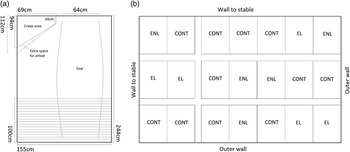
The experiment was conducted at a private farm in Hammershøj near Research Centre Foulum, Aarhus University, Denmark. The sows were housed in a farrowing house with 21 farrowing crates from 1 week before expected farrowing until weaning of piglets 4 weeks after farrowing. Only 20 (batch 1) or 19 (batch 2) of the farrowing crates were used in the experiment, while the rest contained foster nursing sows with a standard infrared heat lamp as a heat source in the creep area. From day 14 after farrowing, two sows in batch 1 and one sow in batch 2 were converted to nursing sows and data collected before day 14 were used for analysis. The sows farrowed in identical farrowing crates of 3.8 m2 in size with 1.6 m2 of slatted floor and a creep area of 0.43 m2 when using a standard infrared heat lamp and 0.49 m2 when using eHeat (Animal Care ApS, 2013) as heat source (see Figure 1a). The creep areas were placed in the front corner of the pen, and they all had a cover and a heat source turned on until day 10 after farrowing. The standard infrared heat lamp emitted a constant amount of heat during the 10 days while eHeat turned down the set-point temperature with 0.8°C per day from 28°C to 20°C within the 10 days. The standard infrared heat lamp had a 150 W incandescent bulb (130 lx) while eHeat was a radiant heat source based on a 150 W ceramic heater and had a light-emitting diode as light source (130 lx); all measures of light intensity (lx) was made with a light meter (Elma 1335) at a height of 16 cm from the floor, directly under the light source. Under-floor heating in the creep area was turned on during batch 2, independent of treatment, and was emitted with a constant level with an inlet temperature of 50°C; this gave an average surface temperature measured by an infrared camera (Model SC660, Flir Systems, Wilsonville, OR, USA) of ∼32°C with both types of heat sources, but with a larger variation in temperature when using the standard infrared heat lamp (ranging from minimum 26°C to maximum 41°C) compared with using eHeat (ranging from minimum 29°C to maximum 35°C). The room temperature was intended to be kept at around 20°C, but this was not always the case due to hot weather in the summer period where the experiment took place. The room temperature was not measured systematically, but ranged from 22°C to 29°C during batch 1 and from 18°C to 25°C during batch 2. Sows were fed three times a day outside of the observation periods at 0730, 1230 and 1630 h with a standard lactating sow diet. They received 4.0 kg until the day before farrowing, 3.3 kg the day before to the day after farrowing and thereafter, the ration was increased with about 150 g/day until day 10 after farrowing. After day 10, the sows received feed ad libitum and the piglets got a standard feed. The sow was also given 200 g of straw each morning on the floor and wood shavings were provided in the creep area. Artificial light was on from 0600 to 1800 h (300 lx). Four small windows brought in natural daylight and were placed on two of the house facades turning towards east and south; this made sure that it was dark in the farrowing house during the evening observation period and made it necessary to wear a headlight.
(a) Schematic drawing of the pen design; (b) overview of the random assignment of heat source treatments to the 21 pens in the farrowing house; CONT=standard infrared heat lamp; EL=eHeat with light and ENL=eHeat without light. Some CONT pens also represent nursing foster sows but with different pens in the two batches.

Handling outside the experimental protocol
After farrowing and before the first recordings, the litters were standardised according to size of piglets and number of functioning teats of the sow (13.5±2.3 piglets per litter). Piglets were numbered with earmarks and with a pen marker on the back and thereafter no further piglets were added to the litter. Piglets’ teeth were ground on the day of farrowing and on day 4, they received an iron injection, their tails were docked and the males were castrated with preceding pain relief. The observers of the experiment were not allowed to make any interference with the sow or litter during the experimental period, but piglets were treated against diseases according to normal procedure. If considered necessary for a piglet’s survival, it was moved to a foster nursing sow and removed from the experiment; this concerned on average 13% of piglets per litter.
Experimental protocol and sampling
Within each batch, the litters were randomly assigned to one of three heat source treatments (see Figure 1b): (1) standard infrared heat lamp (CONT, n=9 (batch 1) and n=8 (batch 2)); (2) eHeat with light (EL, n=5 for both batches) and (3) eHeat without light (ENL, n=5 for both batches). All measurements and observations were done on day 1, 2, 3, 7, 14 and 21 after farrowing. In the morning on each observation day, the piglets were counted, weighed, marked on the back with a pen, and their rectal temperature was measured. To do this, the piglets were shortly lifted from the pen and returned as quickly as possible. For two 3-h periods each day, the number of piglets in the creep area was recorded by scan sampling every 10 min; one period during the day in daylight (0900 to 1200 h) and one period during evening in darkness (2100 to 2400 h). Piglets were counted as being in the creep area if more than half of their body was in that position. If the sow farrowed between 2100 and 1200 h, the first observation was done in the evening on the current day, and if the sow farrowed between 1200 and 2100 h, the first observation was done the following morning; this resulted in some sows having two observations on day 1, while others only had one.
Statistical analysis
All statistical processes were performed in SAS (SAS Institute Inc., Cary, NC, USA) using Proc Mixed (Littell et al., Reference Littell, Milliken, Stroup and Wolfinger1996) accounting for repeated measurements on litters by including litter as a random effect. When analysing the effect of treatment on piglets’ use of the creep area, the measurements were averaged to one value per litter per day and percentage use of the creep area was calculated. In the linear mixed model, batch, treatment, day postpartum, and all two- and three-way interactions were included as fixed effects and litter nested within batch and treatment and litter nested within day postpartum as random effects. Litters’ average birth weight as a covariate and an interaction between litters’ average birth weight and batch was included in the model. A similar model was used to analyse the effect of treatment on piglets’ daily rectal temperature and piglets’ average daily weight gain from day 1 to 21 postpartum. For rectal temperature, the individual piglet nested within litter was included as a random effect, and piglets’ weight measured daily as a covariate and the interaction between weight and day postpartum was also included in the model. The effect of piglets’ birth weight on piglets’ daily rectal temperature was analysed using a similar model with birth weight as a covariate and the interaction between birth weight and day postpartum included in the model. When analysing the effect of treatment on piglets’ average daily weight gain, birth weight as a covariate was also included in the model.
A significance level of 5% (P⩽0.05) was chosen. Every model was reduced by first excluding non-significant interactions and thereafter covariates; main effects were never excluded from the model. For models with significant interactions, post hoc analysis was performed by looking at differences in least square means. Results are presented as least square means of piglets’ percentage use of the creep area or piglets’ rectal temperatures and daily weight gains.
Results
Use of the creep area
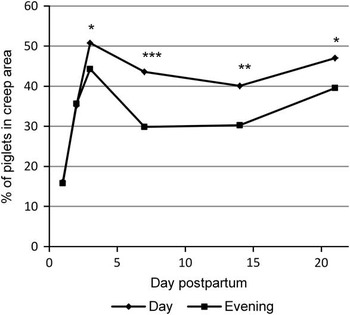
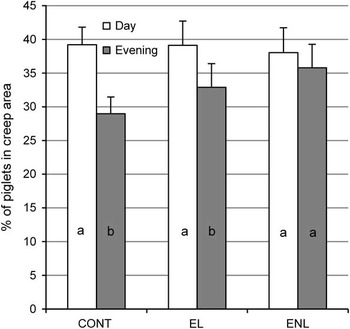
Piglets’ use of the creep area increased until day 3 (Figure 2) and was affected by batch and whether the observations were done during the day or evening observation period. An effect of batch on piglets’ use of the creep area was seen (F 1,34=7.83, P<0.01), with a lower use during batch 1 than batch 2 (32.4% and 38.9%, respectively). No effect of heat source was seen on the single days but a two-way interaction between day and observation period (F 5,191=2.85, P<0.05) and between treatment and observation period (F 2,192=3.19, P<0.05) was found. The former showed that piglets used the creep area more during the day than the evening period on day 3, 7, 14 and 21 (Figure 2). This was only applicable to CONT and EL litters with no difference found between the day and evening observation periods for ENL litters (Figure 3).
Piglets’ percentage use of the creep area during the day (0900 to 1200 h) and evening (2100 to 2400 h) observation periods on day 1, 2, 3, 7, 14 and 21 postpartum. Significance level: *P<0.05, **P<0.01, ***P<0.001.

Piglets’ percentage use of the creep area for three heat source treatments (CONT=standard infrared heat lamp, n=19; EL=eHeat with light, n=10; ENL=eHeat without light, n=10) on day 1 to 21 postpartum, divided between the day (0900 to 1200 h) and evening (2100 to 2400 h) observation periods. a, b indicates a significant difference within treatment.

Effect on piglets’ rectal temperature and weight
Piglets’ rectal temperature was not affected by either batch or treatment but was affected by piglets’ daily weight and birth weight. A two-way interaction between piglets’ weight and day postpartum was seen (F 5,2017=20.75, P<0.0001) and showed that piglets with higher daily weights also had higher rectal temperatures. An effect of birth weight was seen by a two-way interaction between birth weight and day postpartum (F 5,2018=7.00, P<0.0001) and showed that piglets with higher birth weights also had higher rectal temperatures. The effects of both daily weight and birth weight on piglets’ rectal temperature were more pronounced the first 2 days after farrowing, and thereafter the size of the effect decreased until day 21.
Piglets’ weight increased linearly with days postpartum for all treatments. Piglets’ average daily weight gain was not affected by treatment, but was affected by batch (F 1,35=5.26, P<0.05) and piglets’ birth weight (F 1,467=18.82, P<0.0001). Piglets born in batch 1 had lower average daily weight gains than piglets born in batch 2 (0.149 and 0.182 kg/day, respectively), and piglets with higher birth weights also had higher average daily weight gains.
Discussion
In the present study, neither eHeat nor light worked as an attractant on piglets, as none of them decreased piglets’ latency to reach the creep area or increased the overall use of the creep area.
The effect of batch
A higher use of the creep area was seen in the second batch compared with the first batch, independent of treatment. The batches were conducted in Denmark during August and September 2013, respectively, with warm weather characterising both months that year, although warmest during August. In addition, an overall lower use of the creep area was seen in this study compared with earlier conducted studies (Hrupka et al., Reference Hrupka, Leibbrandt, Crenshaw and Benevenga1998; Toscano and Lay, Reference Toscano and Lay2005; Vasdal et al., Reference Vasdal, Andersen and Pedersen2009a) with the average use on the single days never exceeding 50% of the observation periods. Vasdal et al. (Reference Vasdal, Mogedal, Boe, Kirkden and Andersen2010a) showed that piglets were able to choose location based on the thermal environment, but only with differences in temperature not lower than 8°C to 16°C; the difference in temperature between the creep area and the sow area might be too small at higher environmental temperatures for piglets to choose location based on the thermal environment. Piglets have also been shown to use a heated area less with room temperatures of 25°C (Pedersen et al., Reference Pedersen, Malmkvist, Kammersgaard and Jorgensen2013) and 26°C (Schormann and Hoy, Reference Schormann and Hoy2006) compared with 20°C and 18°C, respectively. At higher environmental temperatures, the piglets might be less motivated to move to a warmer area, away from the sow, because they already have a thermo comfortable location. Piglets have also been shown to choose another littermate rather than a thermo comfortable area, even when this littermate was anaesthetised (Hrupka et al., Reference Hrupka, Leibbrandt, Crenshaw and Benevenga2000), and their motivation to stay near other individuals is therefore higher than their motivation to find a thermo comfortable area. It, therefore, seems reasonable that piglets’ use of areas away from the sow will decrease at higher environmental temperatures. During batch 2, under-floor heating was used in the creep area and not in the rest of the farrowing pen. This might make the creep area more attractive to the piglets and explain the higher use of the creep area seen during batch 2 compared with batch 1; although a lower use of the creep area was seen when incorporating a heat mat in the creep area compared with a standard infrared heat lamp (Zhang and Xin, Reference Zhang and Xin2001). Under-floor heating will also increase the temperature in the creep area even further and support the factors explained earlier concerning the effect of higher environmental temperatures on piglets’ use of the creep area. Therefore, it is a more likely explanation that the attractiveness of the sow, rather than the characteristics of the creep area, decrease piglets’ use of the creep area. In conclusion, piglets’ use of the creep area is highly affected by the environmental temperature, which was not controllable in the present study. This might explain why a difference between treatments in piglets’ use of the creep area was not seen, and it would be interesting to investigate the effect of eHeat in temperature controlled facilities, which has recently been done (Larsen et al., Reference Larsen, Pedersen and Thodberg2015).
The effect of observation period
A higher use of the creep area was seen during the day compared with the evening observation period on day 3, 7, 14 and 21. Pigs are considered diurnal animals with a resting period from early evening to next morning (Gundlach, Reference Gundlach1968; Wood-Gush et al., Reference Wood-Gush, Jensen and Algers1990). This resting period may be a safer period to stay near the sow because the sow is primarily in lateral recumbency (Gundlach, Reference Gundlach1968) and it can therefore be seen as an adaptable behaviour for a piglet to stay near the udder during the resting period to secure feed intake, instead of lying in the creep area. The resting period is, however, the period where the farmer cannot help the piglets from getting crushed, and it would therefore be worth investigating how to attract piglets to the creep area during the resting period. The piglet is highly motivated to stay near the sow and littermates the first days after farrowing to receive protection, warmth and colostrum/milk (Vasdal et al., Reference Vasdal, Wheeler and Boe2009b); this might explain why no difference is seen between observation periods on day 1 and 2.
The effect of light during the resting period
During the evening observation period, a lower use of the creep area was seen when the heat source was accompanied by light. The nest, built by the domesticated sow under semi-natural conditions, often has a shelter or roof (Jensen, Reference Jensen1986; Jensen et al., Reference Jensen, Floren and Hobroh1987) creating a dark or dimly lit environment in the nest. Piglets might, therefore, innately be attracted to dark areas, which in the stable during night time will be in the sow area if light is present in the creep area. Jensen and Redbo (Reference Jensen and Redbo1987) described piglets as intermediates between a hider and a follower species; hiding from predators for the first few days after farrowing and then following the mother as she leaves the nest, but still return to the nest at various intervals. Even though this behaviour may not be necessary under commercial conditions, the instincts may as well have been retained. Choosing the dark area in the farrowing crate can then be considered as an adaptable behaviour to avoid being noticed by predators. It seems reasonable to think that light in the creep might help piglets to discover the creep area and thereafter increase the use of it, but from results presented here, the opposite is shown with light in the creep area working as a repellent instead of an attractant to piglets; this might also explain why a difference is seen between the day and evening observation period in general. These results are in accordance with the findings of Parfet and Gonyou (Reference Parfet and Gonyou1991) where piglets preferred dark and dim areas and avoided the bright areas. The results are in discrepancy to the findings by Tanida et al. (Reference Tanida, Miura, Tanaka and Yoshimoto1996), where it was concluded that piglets feared staying in darkness and preferred to seek out an unfamiliar area if light was present. This study was performed on 1-week-old piglets instead of new born piglets as in the study of Parfet and Gonyou (Reference Parfet and Gonyou1991) and the present study, which might explain the differences in the findings. Under semi-natural conditions, the domesticated sow and her piglets will leave the nest around 1 week after farrowing (Jensen, Reference Jensen1986; Stangel and Jensen, Reference Stangel and Jensen1991) and piglets might therefore no longer use darkness as a stimulus at that age. The negative effect of light in the creep area on piglets’ use of the creep area during darkness was found for all days of the observation period (day 1 to 21 after farrowing), which means that this effect was seen even after the light and heat was turned off in the creep area on day 10 after farrowing. This result indicate that piglets’ early experiences can affect their use of the creep area even after removing the source of the experience, and that this is seen as late as day 21 after farrowing; similar results have earlier been seen when piglets were experiencing under-floor heating (Houbak et al., Reference Houbak, Thodberg, Malmkvist and Pedersen2006).
In conclusion, piglets preferred to sleep in the dark and it could be recommended to turn off the light in the creep area during darkness. Heating up the creep area without light can be accomplished by using a radiant heat source such as eHeat in contrast to using the light-emitting standard infrared heat lamp. Piglets’ use of the creep area was also highly affected by random fluctuations in the environmental temperature and this may have overruled a potential effect of the heat source. It would be necessary to investigate the effect of eHeat under more temperature controlled conditions before the results can be considered conclusive.
Acknowledgements
This study was financed by the Green Development and Demonstration Programme under the Ministry of Food, Agriculture and Fisheries, Denmark. The authors thank the farmer, Pernille Jensen and her husband, for letting them use both their facilities and animals, and the authors also thank the technicians, Betty Skou and Carsten K. Christensen, for doing the observations.