1. Introduction
The Altaids (Şengör, Natal'in & Burtman, Reference Şengör, Natal'in and Burtman1993; Şengör & Natal'in, Reference Şengör, Natal'in, Yin and Harrison1996; Xiao et al. Reference Xiao, Windley, Badarch, Sun, Li, Qin and Wang2004a, Reference Xiao, Zhang, Qin, Sun and Lib) or the Central Asian Orogenic Belt (CAOB) (Carroll et al. Reference Carroll, Yunhai, Graham, Xuchang, Hendrix, Jinchi and McKnight1990; Carroll et al. Reference Carroll, Graham, Hendrix, Ying and Zhou1995; Jahn, Wu & Chen, Reference Jahn, Wu and Chen2000a, Reference Jahn, Wu and Chenb; Dobretsov, Buslov & Vernikovsky, Reference Dobretsov, Buslov and Vernikovsky2003), one of the world's largest accretionary orogens, is a collage of continental fragments, island arcs, oceanic plateaux, arc-related volcanic and granitic rocks, accretionary complexes and dismembered ophiolites (Şengör, Natal'in & Burtman, Reference Şengör, Natal'in and Burtman1993; Şengör & Natal'in Reference Şengör, Natal'in, Yin and Harrison1996; Jahn et al. Reference Jahn, Windley, Natal'in and Dobretsov2004; Xiao et al. Reference Xiao, Windley, Badarch, Sun, Li, Qin and Wang2004a, Reference Xiao, Zhang, Qin, Sun and Lib, Reference Xiao, Huang, Han, Sun and Li2010a; Cawood et al. Reference Cawood, Kröner, Collins, Kusky, Mooney and Windley2009). However, the architecture of the Altaids is hotly debated. Some researchers have proposed one long-lived, single subduction system (Şengör, Natal'in & Burtman, Reference Şengör, Natal'in and Burtman1993; Şengör & Natal'in, Reference Şengör, Natal'in, Yin and Harrison1996; Bazhenov et al. Reference Bazhenov, Collins, Degtyarev, Levashova, Mikolaichuk, Pavlov and Van der Voo2003; Collins et al. Reference Collins, Degtyarev, Levashova, Bazhenov and Van der Voo2003; Abrajevitch et al. Reference Abrajevitch, Van der Voo, Levashova and Bazhenov2007; Levashova et al. Reference Levashova, Mikolaichuk, McCausland, Bazhenov and Van der Voo2007), whereas others envisage punctuated accretion and closure of multiple ocean basins now marked by ophiolitic sutures (Coleman, Reference Coleman1989; Buchan et al. Reference Buchan, Cunningham, Windley and Tomurhuu2001). To resolve this architectural controversy, it is crucial to find a means of deciding whether there were multiple subduction zones in the Palaeo-Asian Ocean or just one continuous subduction zone that generally migrated southwards (present coordinates).
Although it is generally accepted that the accretionary process of the Altaids migrated southwards (Şengör, Natal'in & Burtman, Reference Şengör, Natal'in and Burtman1993; Şengör & Natal'in, Reference Şengör, Natal'in, Yin and Harrison1996; Windley et al. Reference Windley, Alexeiev, Xiao, Kroner and Badarch2007), only the earliest subduction event in the northern Altaids has been constrained by a c. 1.0 Ga supra-subduction-zone (SSZ) type ophiolite (Khain et al. Reference Khain, Bibikova, Kröner, Zhuravlev, Sklyarov, Fedotova and Kravchenko-Berezhnoy2002), but it is not well understood when subduction started in the southern Altaids. In order to resolve this problem, it is necessary to constrain the age of the earliest subduction in the southern Altaids, and thus better understand the processes of continental growth. Accordingly, the age and tectonic relationships of key ophiolites in the southern Altaids provide the most viable key for resolving the major controversy regarding the architecture of the Altaids.
The Beishan collage in northwestern China contains some of the best ophiolites of possible early Palaeozoic age in the southern Altaids (Fig. 1). In a companion paper, Mao et al. (Reference Mao, Xiao, Windley, Han, Qu, Ao, Zhang and Guo2011) describe the implications of the Liuyan Complex ophiolite in the evolution of the Altaids. In this paper we present the results of a detailed structural, geochemical and geochronological study of the Yueyashan–Xichangjing ophiolite, one of the best exposed and preserved Beishan ophiolites. We put the tectonic setting of this dated ophiolite and associated accretionary complex into a regional tectonic framework in order to demonstrate the accretionary tectonics between a micro-continental block and an island arc.
(a) Shows the location of the Beishan area in the Altaids. (b) Schematic geological map of the Beishan collage (modified after Xiao et al. Reference Xiao, Mao, Windley, Han, Qu, Zhang, Ao, Guo, Cleven, Lin, Shan and Li2010b). Box shows location of the larger scale map of Figure 2.

2. Regional geology and tectonic framework
2.a. Regional geology
The Beishan is an E–W-trending mountain chain in Xinjiang and Gansu provinces of NW China, situated between the Badain Jaran desert to the east and Lop Nor Lake to the west, and between Mongolia to the north and the Dunhuang to the south (Fig. 1). Across the Mongolian–Chinese border, the Beishan can be tectonically correlated with southern Mongolia, which is part of the southern Mongolian accretionary collage (Fig. 1). The southernmost unit of the Beishan collage is the Dunhuang Block. Rocks in the Beishan area were originally mapped as Precambrian to late Palaeozoic, occurring in supposedly fault-bound blocks (Zuo et al. Reference Zuo, Zhang, He and Zhang1991; Hsu et al. Reference Hsu, Yao, Li and Wang1992; Liu & Wang, Reference Liu and Wang1995). The Beishan area is not only characterized by many mafic-ultramafic complexes, which host magmatic Cu–Ni sulphide deposits that crop out along regional large-scale faults or sutures (Mao et al. Reference Mao, Pirajno, Zhang, Chai, Wu, Chen, Cheng, Yang and Zhang2008; Pirajno et al. Reference Pirajno, Mao, Zhang, Zhang and Chai2008; Zhang et al. Reference Zhang, Mao, Du, Pirajno, Wang, Chai, Zhang and Yang2008; Ao et al. Reference Ao, Xiao, Han, Mao and Zhang2010), but also by four different ophiolite belts that from north to south are: Hongshishan, Shanbanjing–Xiaohuangshan, Yueyashan–Xichangjing and Liuyuan (Huang & Jin, Reference Huang and Jin2006; Song et al. Reference Song, Wang, Lin, Yang, Zhang and An2008; Xiao et al. Reference Xiao, Mao, Windley, Han, Qu, Zhang, Ao, Guo, Cleven, Lin, Shan and Li2010b; Zhang & Guo, Reference Zhang and Guo2008; Zhou, Zhao & Li, Reference Zhou, Zhao and Li2000).
The Yueyashan–Xichangjing ophiolite belt, situated in the middle of the Beishan area (Fig. 2), strikes NW–SE and is approximately 50 km long and up to 10 km wide (Fig. 2). Previous lithological mapping defined a complete ophiolite stratigraphy (Anonymous, 1977; Moores, Reference Moores1982): i.e. ultramafic cumulates, gabbros, sheeted dykes, pillow lava and local chert and limestone (Zhou, Zhao & Li, Reference Zhou, Zhao and Li2000; Zuo et al. Reference Zuo, Zhang, He and Zhang1990a). Although the geochemistry and tectonic setting of many ophiolites are well understood (Dilek & Furnes, Reference Dilek and Furnes2011), important questions remain regarding the inter-relationships between their internal structure, age, mechanism of emplacement and overall tectonic significance.

2.b. Tectonic framework
The rocks of the Beishan are divisible into five major lithotectonic units (Fig. 2), which from south to north are: the Huaniushan block (Unit I), a sedimented passive margin (Unit II), the incoherent Yueyashan–Xichangjing ophiolite (Unit III), a coherent sedimentary complex (Unit IV) and the Mazongshan island arc with granitic rocks (Unit V). All the lithotectonic units are juxtaposed along WNW–ESE-striking, SW-vergent thrusts (Fig. 2).
The southernmost Huaniushan block (Unit I) comprises the middle Proterozoic Dahuoluoshan Formation, the lower part of which is mainly composed of quartzite and metasandstone with a thickness of more than 1000 m. The 4000 m thick upper Dahuoluoshan Formation consists of clastic limestone, and stromatolite-bearing limestone intercalated with beddded chert and marble. There is no precise isotopic age for this unit, and the stromatolites (Stratifera sp.) in the carbonates are not standard fossils with a definable lifespan (Anonymous, 1977). Based on the palaeostratigraphic assemblages this unit may be the northern limb of an anticlinorium (Figs 2, 4c), which occurs on the northern margin of a Precambrian micro-continental block.
To the north of the Huaniushan block, Unit II contains conglomerates, interbedded metasandstones, siltstones, black cherts and trilobite-bearing limestones. The well-bedded succession is dominated by sandstones and siltstones with beds about 150 m thick. The discontinuous limestone and chert beds are about 25 m thick. Palaeontological data and correlation with similar units elsewhere in Northwest China indicate these sediments have a Cambrian to early Ordovician age (Anonymous, 1977). Bedding in Unit II dips 45–65° NNE (Figs 2, 4d), but the deformation is not well developed, and consequently sedimentary graded beds are well preserved; bed-tops point NE. In most localities, Unit II lies in thrust contact with Unit I, but locally it is unconformable on Unit I. The sediments of Unit II are similar to those in a modern passive continental margin.
The Yueyashan–Xichangjing ophiolite (Unit III; Fig. 2) comprises a complete ophiolite stratigraphy: i.e. ultramafic cumulate gabbros, sheeted mafic dykes, plagiogranite dykes, pillow lavas and local cherts and limestones (Zhou, Zhao & Li, Reference Zhou, Zhao and Li2000; Zuo et al. Reference Zuo, Zhang, He and Zhang1990a). However, the ophiolite is dismembered into blocks, which have variable internal stratigraphy (Figs 3, 4, 5), and are enclosed in a matrix of sheared serpentinite.
Geological map and Yueyashan cross-section of the Yueyashan–Xichangjing ophiolite (see Fig. 2 for location) (modified after Zuo et al. Reference Zuo, Zhang, Wang, Jin, He, Zhang, Li and Bai1990b).

(a, b) Geological map and the Jiuquan–Ejinaqi road cross-section of the Yueyashan–Xichangjing ophiolite (see Fig. 2 for location). (c) Bedding measurements in Unit I along the dirt road section. Equal-area projection of the lower hemisphere. (d) Bedding measurements in Unit II along the dirt road section. Equal-area projection of the lower hemisphere.


Unit IV contains sediments (1300 m thick) that mainly comprise metasandstone interbedded with limestone and chert. Locally, contact metamorphism by intrusive granites has created quartzites and mica schists. The limestones contain brachiopods, corals and trilobites, which suggests sedimentation in late Ordovician time (Anonymous 1977, 1979). The rocks are tightly folded and cleaved, and strike WNW–ESE parallel to the regional structural trend (Figs 2, 6). The contact between these sediments and the Mazongshan island arc to the north is poorly exposed owing to low topography and Quaternary sedimentary cover, thus the contact relationship with Unit V is unclear.
(a, c) The map and cross-section of the coherent sedimentary complex. Bedding orientations indicated on Figure 2 (Anonymous, 1977, 1979) are plotted in (b). Our own observations measured in Unit IV (a, f) are in line with published measurements, and indicate a NE–SW contraction direction that gave rise to the folding. (e) Bedded metasandstones and phyllites are folded with amplitudes of tens of metres. Car for scale; looking east. (d) Outcrop of the coherent sedimentary complex. Red pen for scale; looking south.

Unit V, located in the northernmost part of the area, is mainly composed of andesitic to basaltic lava, together with minor dacite and metasandstone, and lenses of chert, limestone and marble. The mafic lavas belong to the Gongpoquan Formation, which consists of amygdaloidal andesite, basalt and basaltic andesite. The limestones contain abundant crinoids, bryozoans, corals and brachiopods. These corals have been identified as Halysites cf. vulgaris kasachstanica Polotavzeva of middle Silurian age (Anonymous, 1977). The lithological assemblages of Unit V suggest that it formed in an island arc setting (Liu & Wang, Reference Liu and Wang1995; Zuo, Liu & Liu, Reference Zuo, Liu and Liu2003). Unit V was intruded by granitic bodies, which are mainly tonalite with minor biotite granite; a calc-alkaline signature indicates that they possibly formed in an arc-related setting (Zuo et al. Reference Zuo, Zhang, He and Zhang1990a, Reference Zuo, Zhang, Wang, Jin, He, Zhang, Li and Baib; Liu & Wang Reference Liu and Wang1995; Zuo, Liu & Liu, Reference Zuo, Liu and Liu2003).
The ophiolite and associated rocks in Units III and IV are the main focus of the current study, which includes a structural analyses of the two units.
3. Structural analysis
Three cross-sections of the incoherent ophiolite complex are presented (Unit III, Fig. 2) and one outcrop-scale mapping of the coherent sedimentary complex (Unit IV). These sections are mainly based on our own field work combined with previous work (Hsu et al. Reference Hsu, Yao, Li and Wang1992; Zuo et al. Reference Zuo, Zhang, Wang, Jin, He, Zhang, Li and Bai1990b). In the following paragraphs, we describe the major structural and geological features along these sections that can be considered representatives of the study region because of their location.
3.a. Ophiolitic melange
3.a.1. Yueyashan section
The Yueyashan section located in the west of the Yueyashan–Xichangjing ophiolite belt contains all the stratigraphic components of a typical ophiolite, including peridotite, gabbro, diorite, serpentinite, sheeted mafic dykes and submarine pillow lava (Fig. 3). In stratigraphic contact above the pillow lavas are Ordovician phyllites, slates, radiolarian cherts and limestones (Zuo et al. Reference Zuo, Zhang, He and Zhang1990a; Hsu et al. Reference Hsu, Yao, Li and Wang1992). The ophiolitic rocks, metamorphosed in part, occur as isolated blocks or fragments in a pelitic matrix (Fig. 3a). The boundaries between the different blocks are thrusts according to Zuo et al. (Reference Zuo, Zhang, He and Zhang1990a), as shown in Figure 3b.
3.a.2. Jiuquan–Ejinaqi road section
All the Units I, II, III and IV crop out along a dirt road in this section (Fig. 4). Bedding in Units I and II dips 45–65° N–NE (Fig. 4c, d). Unit I occurs in the northern limb of an anticlinorium that occurs on the northern margin of a Precambrian micro-continental block (Anonymous, 1977). The deformation in Unit II is not well developed, and consequently sedimentary graded beds are well preserved; bed-tops point NE. Unit II lies in thrust contact with Unit I, but locally it is unconformable on Unit I (Fig. 4b).
The Yueyashan–Xichangjing ophiolite (Unit III; Fig. 4) contains many large blocks and some almost complete sections of ophiolite stratigraphy. The blocks include ultramafic cumulates, gabbros, sheeted mafic dykes, plagiogranite dykes, pillow lavas and locally chert and limestone, which are situated in a matrix of sheared serpentinite (Fig. 4a, b). Most of the large blocks are composed of cumulate-layered gabbro, but the variable dip directions of the layering suggest they are isolated and separate blocks within the serpentinite melange (Fig. 7). The southern part of Unit III is dominated by basalt and gabbro in contrast to the northern part. The boundaries between the four units are NE-dipping thrusts, which demonstrate a top-to-the-SW sense of movement (Fig. 4b).
Photographs illustrating typical lithologies and structure of the Yueyashan–Xichangjing ophiolite (see Figs 4 and 5 for locations). (a) Cumulate gabbro. Pencil is 18 cm for scale. (b) Pillow basalt. Hammer for scale. (c) Red chert block in the incoherent ophiolite complex. Man for scale; looking NW. (d) Photo of the ophiolite melange in the Yueyashan area. The bush is 0.5 m high for scale; looking SW. (e) Pyroxenite block in serpentinite matrix. Hammer for scale; looking NW. (f) Gabbro blocks in serpentinite matrix. Man for scale; looking NW. (g, h) Imbricate structures in the Xichangjing area. Man for scale; looking NW.

The northernmost part of this section exposes an imbricate thrust stack belonging to Unit IV (Fig. 4a, b). The bedded sandstones and siltstones dip moderately to the SW. The rocks are stacked by imbricate faults that dip to the NE–N and demonstrate a top-to-the-SW–S movement. The contact between Unit IV and Unit III to the south is probably a transpressional fault. Thin-sections of mylonitized gabbro close to this fault demonstrate sinistral shear or a top-to-the-E movement (Fig. 8).
Micrographs of mylonitized gabbro showing sinistral shear sense or top-to-the-E movement. (a) The appearance of S–C fabrics under cross-polarized light. (b) Mylonitic mica-fish fabrics under cross-polarized light.

3.a.3. Xichangjing section
In the east of the Yueyashan–Xichangjing ophiolite belt is the Xichangjing section (Fig. 2); isolated blocks occur in a pelitic or serpentinite matrix along a N–S-striking dry creek (Figs 5, 7e, f). Lithologically the blocks consist of carbonatized peridotite, pyroxenite, gabbro, basalt and red chert. The boundaries between blocks are mostly ENE-dipping thrusts that demonstrate a top-to-the-SSW sense of movement. This imbricated thrust stack includes gabbro, serpentinite, chert and pyroxenite (Fig. 7g, h).
3.b. Coherent sedimentary rocks
The thrust rocks of Unit IV are dominated by metasandstone and mica schist (Fig. 6), which are different from those of Unit II, suggesting that the two units formed in different environments. The rocks of Unit IV are folded into a near E–W-trending, W-plunging anticline, and they are more strongly deformed than those of Unit II.
The geological map (Fig. 2) of Unit IV (Anonymous, 1977) shows the attitude of bedding data, which when plotted give an average fold axis that plunges 22° to 295° (Fig. 6b). Even though on a large scale Unit IV has the form of an anticline, its internal structure is dominated by thrusts, as indicated on the map (Fig. 6a, c). In the northern part of the map, bedded metasandstone and phyllite are deformed into folds with amplitudes of tens of metres (Fig. 6e); a plot of their bedding planes indicates a fold axis that plunges 17° to 296° (Fig. 6f), which is close to that constructed from bedding data on the geological map. The fold axial planes strike NW–SE and dip almost vertically.
4. Geochemistry and geochronology
Whole-rock major and trace element analysis and SIMS (secondary ion mass spectrometry) U–Pb dating of zircon grains were conducted using a Cameca IMS-1280 SIMS at the Institute of Geology and Geophysics, Chinese Academy of Sciences in Beijing. The analytical procedures are described in detail in the Appendix. The geochemical and isotopic data of zircons from a plagiogranite are listed in Tables 1 and 2, respectively.
Major oxide and trace element composition of the Yueyashan–Xichangjing ophiolite samples

U–Pb zircon SIMS data for plagiogranite from the Yueyashan–Xichangjing ophiolite

f206* is the percentage of common 206Pb in total 206Pb
4.a. Whole-rock major and trace element analysis
Most of the analysed rocks were variably altered as indicated by the high loss on ignition (LOI) values (up to 6.15 wt% for basalt), shown in Table 1. Consequently, many major and trace elements (e.g. Si, Na, K, Ca and Cs) may have been mobilized to some extent. However, the high-field-strength elements (HFSEs), rare earth elements (REEs), some transitional elements and Th are generally immobile during hydrothermal ocean floor alteration and metamorphism and accretion-related metamorphism (Pearce, Reference Pearce, Hawkesworth and Norry1983). Therefore, the following discussion on petrogenesis and tectonic setting is mostly based on the HFSEs and REEs together with some transitional elements.
In order to constrain the origin and tectonic environment of the Yueyashan–Xichangjing ophiolite, refractory element contents and ratios of basalt, mafic dykes, gabbro and andesite are plotted in several chemical discrimination diagrams (Shervais, Reference Shervais1982; Pearce, Reference Pearce2008).
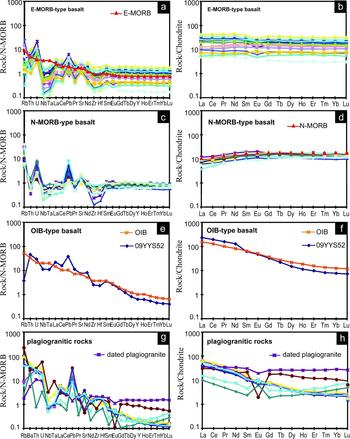
Basalts, gabbros and mafic dykes display a narrow range of variation for SiO2 (38.83–54.51 wt%), MgO (3.1–8.9 wt%), low TiO2 (0.30–1.78 wt%, Table 1) and low K2O (0.07–1.43 wt5%). Most of these rocks belong to the sub-alkalic series (Fig. 9a), and plot in the tholeiitic area (Fig. 9b) in a TFeO–MgO diagram (Pearce & Robinson, Reference Pearce and Robinson2010). Overall, the basaltic rocks share low total REE (ΣREE = 12–67 ppm, Table 1), except sample 09YYS52 (ΣREE = 280.9 ppm). They display normal mid-ocean ridge basalt (N-MORB) type (LaN/YbN = 0.5–1.0), enriched mid-ocean ridge basalt (E-MORB) type (LaN/YbN = 1.0–1.3) and ocean island basalt (OIB) type (LaN/YbN = 28.7) REE patterns (Fig. 10b, d, f). All samples show spikes in large-ion lithophile fluid-mobile elements and negative anomalies in HFSEs (i.e. Zr, Hf, Nb, Ta; Fig. 10a, c, e). Most of them plot as N-MORB in petrogenetic-based discrimination diagrams (Pearce, Reference Pearce2008; Fig. 9d). Notably in Figure 9c, some data points lie above the N-MORB–OIB line and plot along a line towards the volcanic arc array. These geochemical features are indicative of an N-MORB mantle source and SSZ signature, and therefore suggest an SSZ-type ophiolite (Pearce, Reference Pearce2008; Pearce, Harris & Tindle, Reference Pearce, Harris and Tindle1984; Stern & Bloomer, Reference Stern and Bloomer1992; Stern, Reference Stern2002; Pearce & Robinson, Reference Pearce and Robinson2010).
(a) K2O + Na2O versus SiO2 diagram (Le Maitre et al. Reference Le Maitre, Bateman, Dudek, Keller, Lameyre Le Bas, Sabine, Schmid, Sorensen, Streckeisen, Woolley and Zanettin1989); the dashed line is the boundary between alkaline (above) and sub-alkaline (below) fields. (b) TFeO versus MgO diagram (Pearce & Robinson Reference Pearce and Robinson2010); this diagram divides lavas into high, medium and low iron, where high- and medium-Fe can be treated as tholeiitic (Th) and low-Fe as calc-alkalic (CA). (c) Th/Yb versus Nb/Yb diagram (Pirajno et al. Reference Pirajno, Mao, Zhang, Zhang and Chai2008). MORB – mid-ocean ridge basalt; OIB – ocean island basalt. (d) TiO2/Yb versus Nb/Yb diagram (Pirajno et al. Reference Pirajno, Mao, Zhang, Zhang and Chai2008). Th – tholeiitic series; Alk – alkalic series.

Chondrite-normalized REE patterns (b, d, f, h) and N-MORB normalized trace element spidergrams (a, c, e, g) of the Yueyashan–Xichangjing ophiolite (Sun & McDonough, Reference Sun, McDonough, Saunders and Norry1989).

The dated plagiogranite (Table 2) and the tonalities exhibit insignificant LREE-enriched patterns (Fig. 10h). The dated plagiogranite resembles N-MORB (Fig. 10g), but it has minor negative Nb and Ta anomalies, interpreted to be the result of residual phases in the mantle source (Brenan et al. Reference Brenan, Shaw, Phinney and Ryerson1994). Similar REE patterns suggest that the plagiogranite and tonalite originated from the same melt that generated the Yueyashan–Xichangjing ophiolite.
4.b. Geochronology of the Yueyashan–Xichangjing ophiolite
Zircon crystals separated from a plagiogranite of the Yueyashan–Xichangjing ophiolite were typically euhedral and colourless with lengths of 80–160 μm, and length/width ratios of 2:1 to 3:1. In cathodoluminescence (CL) images (Fig. 11), no inherited cores and oscillatory zones were observed. Twenty analyses, conducted on 20 zircons from the plagiogranite, show low U (64 to 342 ppm) and Th (1 to 117 ppm) concentrations as well as low Th/U ratios (0.01 to 0.34; Table 2). For geochronology, the 20 analyses form a tight cluster on a Concordia diagram and yield a weighted mean 206Pb–238U age of 533 ± 1.7 Ma (95% confidence level, MSWD = 6.7, n = 20; Fig. 12), which we consider to be the crystallization age of the plagiogranite. As an ophiolite component, plagiogranite is thought to have intruded at a late stage of magma crystallization (e.g. Floyd, Yaliniz & Goncuoglu, Reference Floyd, Yaliniz and Goncuoglu1998). The above data suggest that the Yueyashan–Xichangjing ophiolitic ocean floor formed in early Cambrian time.
Representative cathodoluminescence images of zircons from the Yueyashan–Xichangjing ophiolite plagiogranite.

U–Pb Concordia diagram for zircons from a plagiogranite in the Yueyashan–Xichangjing ophiolite. Data-point error ellipses are 2σ. The weighted average plots of 206Pb–238U apparent ages are shown in the upper left corner box.

5. Discussion
5.a. Tectonic setting and age of the Yueyashan–Xichangjing ophiolite
In the past, the Yueyashan–Xichangjing ophiolite was considered to be derived from a typical N-MORB-type oceanic crust and mantle (Zuo et al. Reference Zuo, Zhang, He and Zhang1990a, Reference Zuo, Zhang, Wang, Jin, He, Zhang, Li and Baib, Reference Zuo, Zhang, He and Zhang1991; Hsu et al. Reference Hsu, Yao, Li and Wang1992; Liu & Wang, Reference Liu and Wang1995; Zhou, Zhao & Li, Reference Zhou, Zhao and Li2000; Gong et al. Reference Gong, Liu, Liang and Li2003). However, new geochemical data of all the basaltic samples presented in this paper show spikes in large-ion lithophile fluid-mobile elements and negative anomalies in HFSEs (i.e. Zr, Hf, Nb, Ta; Fig. 10a, c, e), which are commonly attributed to an aqueous fluid component in the source region (Ellam & Hawkesworth, Reference Ellam and Hawkesworth1988; Brenan et al. Reference Brenan, Shaw, Ryerson and Phinney1995; Dhuime et al. Reference Dhuime, Bosch, Bodinier, Garrido, Bruguier, Hussain and Dawood2007). Most rocks plot as N-MORB in petrogenetic-based discrimination diagrams (Pearce, Reference Pearce2008) (Fig. 9d). Notably in Figure 9c, some data points lie above the N-MORB–OIB line (Fig. 9c) and plot along a line towards the volcanic arc array, indicating an N-MORB mantle source and SSZ signature, and therefore suggest an SSZ-type ophiolite (Pearce et al. Reference Pearce, Harris and Tindle1984; Stern & Bloomer, Reference Stern and Bloomer1992; Pearce, Reference Pearce2008; Pearce & Robinson, Reference Pearce and Robinson2010). We therefore interpret this ophiolite to reflect subduction of a main ocean, which was originally opened in Precambrian time by rifting and separation of the Huaniushan micro-continent from the Siberian margin (Fig. 13a, b).
Schematic diagram showing the early Palaeozoic tectonic evolution of the Yueyashan–Xichangjing ophiolite in the Beishan area. (a) Precambrian; (b) early Cambrian; (c) early to middle Ordovician; (d) late Ordovician to early Silurian. See text for discussion.

The mafic and ultramafic rocks of the Yueyashan–Xichangjing ophiolite were originally considered to be intruded in middle Ordovician time (Anonymous, 1977). Later, Sm–Nd isotopic analyses of plagiogranites and mafic dykes yielded an isochron age of 468 ± 58 Ma (Zhou, Zhao & Li, Reference Zhou, Zhao and Li2000). In this study, we present a new weighted mean 206Pb–238U age of 533 ± 1.7 Ma (95% confidence level, MSWD = 6.7, n = 20, Fig. 12) for a plagiogranite from the ophiolite, which we consider reflects the crystallization age; accordingly this suggests that the Yueyashan–Xichangjing ophiolite formed in early Cambrian time (Fig. 13b).
5.b. Emplacement of the Yueyashan–Xichangjing ophiolite
The tectonic polarity of Yueyashan–Xichangjing ophiolite is controversial. Some authors think that emplacement was caused by oceanic crust subduction beneath the Huaniushan micro-continental block to the south (Zuo et al. Reference Zuo, Zhang, He and Zhang1990a, Reference Zuo, Zhang, He and Zhang1991; Zuo, Liu & Liu, Reference Zuo, Liu and Liu2003). Others infer that the Yueyashan–Xichangjing ophiolite was emplaced onto the northern margin of the Huaniushan block owing to subduction beneath the Mazongshan arc to the north (Liu & Wang, Reference Liu and Wang1995; He et al. Reference He, Ren, Yao and Fu2002, Reference He, Zhou, Ren, Yao and Fu2005). If the first idea were correct, the accretionary complex and arc-related intrusions should be to the south of the ophiolite. However, the second model is more likely, because as shown in Figure 2, the lithotectonic units from south to north are: the Huaniushan block (Unit I), a passive margin (Unit II), the incoherent Yueyashan–Xichangjing ophiolite (Unit III), the coherent sedimentary complex (Unit IV) and the Mazongshan island arc with arc-related intrusions (Unit V). Furthermore, the structural analysis of Unit IV shows that this sedimentary complex is dominantly characterized by folding and thrusting. Most thrusts dip NE and indicate top-to-the-SW translation (Figs 4, 6). Thus, the present data are more consistent with the idea that the emplacement of the Yueyashan–Xichangjing ophiolite was caused by oceanic crust subduction beneath the Mazongshan island arc to the north (Fig. 13c), followed by obduction of the ophiolite onto the northern margin of the Huaniushan block to the south.
Our data suggest that this event led to the main deformation phase in the Yueyashan–Xichangjing ophiolite belt, which is characterized by folding and thrusting with shortening in a NE–SW direction, perpendicular to the plate boundary (Figs 4, 5, 6). The emplacement of the Yueyashan–Xichangjing ophiolite was associated with a component of right-lateral, E–W, strike-slip faulting (Fig. 8); strain partitioning between strike-slip and compressional motion is a well-known phenomenon in a transpressional setting (Cunningham, Reference Cunningham2005, Reference Cunningham2007).
The final emplacement of the Yueyashan–Xichangjing ophiolite can be considered to represent the end of subduction and the finalization of arc and micro-continent collision. The timing of this event is constrained by the youngest late Ordovician to early Silurian (Fig. 13d) age of Unit IV. Abundant gastropods, brachiopods, corals and trilobites in the lower part of Unit IV have been identified as middle to late Ordovician in age: Maclurites sp., Lesueurilla sp., Heliolites sp., Cyclospira bilobaria, Sphaerexochus sp. and Cerauninus sp. (Anonymous, 1977, 1979). We consider that these fossil ages indicate that the Yueyashan–Xichangjing ophiolite was emplaced in late Ordovician to early Silurian time (Fig. 13d).
5.c. Tectonic evolution modal of the Yueyashan–Xichangjing ophiolite
Based on the above analysis of the structure, geochemistry and geochronology of the Yueyashan–Xichangjing ophiolite, we present a new tectonic history of the ophiolite illustrated in Figure 13.
5.c.1. Precambrian
At some time in the Precambrian the Gondwana supercontinent broke into the Siberia, Tarim–Dunhuang and some micro-continental blocks (e.g. Huaniushan) within the Palaeo-Asian Ocean, the subduction of which joined the Siberian block to the north with the Tarim–Dunhuang block to the south (Fig. 13a).
5.c.2. Early Cambrian
The northern margin of the Huaniushan micro-continental block has probably been a passive continental margin since Precambrian time. Sediments derived from the micro-continental block were deposited on the passive margin after early Cambrian time. N-dipping subduction of intra-oceanic lithosphere generated the Yueyashan–Xichangjing ophiolite at 533 ± 1.7 Ma, which was characterized by a SSZ geochemical signature (Zhou, Zhao & Li, Reference Zhou, Zhao and Li2000) (Fig. 13b). Oceanic sediments were scraped off the intra-oceanic subduction zone to form the accretionary complex at the same time.
5.c.3. Early to middle Ordovician
Sediments derived from the Huaniushan micro-continental block were deposited on the northern passive margin in early to middle Ordovician time. As subduction continued, an intra-oceanic arc (Mazongshan arc) was constructed above the subduction zone in early Ordovician time (Fig. 13c).
5.c.4. Late Ordovician to early Silurian
The Palaeo-Asian Ocean between the Huaniushan micro-continental block and the Mazongshan oceanic arc was probably consumed in late Ordovician to early Silurian time, and oceanic crust subduction continued beneath the Mazongshan arc to the north (Fig. 13d). This subduction and accretion caused the Yueyashan–Xichangjing ophiolite to be emplaced on the northern margin of the Huaniushan micro-continental block. Also, the Huaniushan micro-continental block and the Mazongshan arc were welded together as a composite block, which later took part in accretionary processes of the Altaids (see fig. 20 in Xiao et al. Reference Xiao, Mao, Windley, Han, Qu, Zhang, Ao, Guo, Cleven, Lin, Shan and Li2010b).
5.d. Significance
In the southern Altaids, early Palaeozoic orogenesis in the Beishan was characterized by Cambrian to early Silurian accretionary processes marked by the Yueyashan–Xichangjing ophiolite and associated rocks, which made up an early Palaeozoic accretionary complex (Zuo et al. Reference Zuo, Zhang, He and Zhang1990a, Reference Zuo, Zhang, Wang, Jin, He, Zhang, Li and Baib, Reference Zuo, Zhang, He and Zhang1991; Zuo, Liu & Liu, Reference Zuo, Liu and Liu2003; Xiao et al. Reference Xiao, Huang, Han, Sun and Li2010a, Reference Xiao, Mao, Windley, Han, Qu, Zhang, Ao, Guo, Cleven, Lin, Shan and Lib). The earliest subduction event was at 533 ± 1.7 Ma as recorded in the Yueyashan–Xichangjing ophiolite with its SSZ-type geochemistry. Combined with previously published Cambrian SSZ-type ophiolites (sphene Pb–Pb age of 523.2 ± 7.2 Ma (Kwon et al. Reference Kwon, Tilton, Coleman and Feng1989); SHRIMP zircon age 503 ± 7 Ma (Xiao et al. Reference Xiao, Windley, Yuan, Sun, Han, Lin, Chen, Yan, Liu, Qin, Li and Sun2009)) in the southern Altaids, our data suggest that the Yueyashan–Xichangjing ophiolite records the earliest subduction event in the southern Altaids.
The Dunzhugur SSZ-type ophiolite in Eastern Sayan in the northern Altaids was dated at c. 1.0 Ga, which documents the earliest subduction event in the whole Central Asian Orogenic Belt (Khain et al. Reference Khain, Bibikova, Kröner, Zhuravlev, Sklyarov, Fedotova and Kravchenko-Berezhnoy2002, Reference Khain, Bibikova, Salnikova, Kröner, Gibsher, Didenko, Degtyarev and Fedotova2003). Younger subduction events in the Palaeozoic are recorded in surrounding areas (Cambrian: Dobretsov, Buslov & Vernikovsky, Reference Dobretsov2003; Dobretsov & Buslov, Reference Dobretsov and Buslov2007; Rojas-Agramonte et al. Reference Rojas-Agramonte, Kroner, Demoux, Xia, Wang, Donskaya, Liu and Sun2011; Ordovician to late Carboniferous: Dobretsov, Reference Dobretsov2003; Rippington, Cunningham & England, Reference Rippington, Cunningham and England2008; Batkhishig, Noriyoshi & Greg, Reference Batkhishig, Noriyoshi and Greg2010). Therefore, the accretionary events in the northern Altaids lasted from c. 1.0 Ga to late Palaeozoic time. Our data together with published literature indicate that subduction events in the southern Altaids lasted from early Cambrian to Carboniferous–Permian time (Xiao et al. Reference Xiao, Zhang, Qin, Sun and Li2004b, Reference Xiao, Han, Yuan, Sun, Lin, Chen, Li, Li and Sun2008; Windley et al. Reference Windley, Alexeiev, Xiao, Kroner and Badarch2007; Ao et al. Reference Ao, Xiao, Han, Mao and Zhang2010).
Clearly, some periods of accretion overlapped both in the northern and southern Palaeo-Asian Ocean. Therefore, the general southward, (present coordinates) single-subduction zone model for the whole Altaids (Şengör, Natal'in & Burtman, Reference Şengör, Natal'in and Burtman1993; Şengör & Natal'in, Reference Şengör, Natal'in, Yin and Harrison1996; Bazhenov et al. Reference Bazhenov, Collins, Degtyarev, Levashova, Mikolaichuk, Pavlov and Van der Voo2003; Collins et al. Reference Collins, Degtyarev, Levashova, Bazhenov and Van der Voo2003; Abrajevitch et al. Reference Abrajevitch, Van der Voo, Levashova and Bazhenov2007; Levashova et al. Reference Levashova, Mikolaichuk, McCausland, Bazhenov and Van der Voo2007) can no longer explain the currently available data, and certainly requires considerable modification and update to account for the present well-documented evidence of multiple, subduction and accretion. In contrast, punctuated accretion and closure of multiple ocean basins provides a more viable and robust model for the accretionary processes of the Altaids. Yet, future work is required to further confirm the complicated multiple accretionary features of the Altaids.
Acknowledgements
We thank Q. L. Li, H. Li, X. D. Jin and X. Yan for their laboratory assistance, and Q. G. Mao for fruitful discussions. We appreciate the editor Phil Leat and Timothy Kusky, Brian Windley and Sanzhong Li for their constructive reviews. We gratefully acknowledge funds from the Chinese State 973 Programme (2007CB411307), the National 305 project (2011BAB06B04-1), the Innovative Programme of the Chinese Academy of Science (KZCX2-YW-Q04-08) and the National Natural Science Foundation of China (40725009, 40523003 and 40973036).
Appendix 1. Analytical procedures
SIMS U–Pb dating of zircon
Samples for U–Pb analysis were processed by conventional magnetic and density techniques to concentrate non-magnetic, heavy fractions. Zircon grains together with zircon standard 91500 were mounted in epoxy mounts, which were then polished in order to cut the crystals in half for analysis. All zircon grains were documented with transmitted and reflected light micrographs as well as cathodoluminescence images to reveal their internal structures, and the mount was vacuum-coated with high-purity gold prior to SIMS analysis. Measurements of U, Th and Pb were conducted using the Cameca IMS-1280 SIMS at the Institute of Geology and Geophysics, Chinese Academy of Sciences in Beijing. U–Th–Pb ratios and absolute abundances were determined relative to the zircon standard 91500 (Wiedenbeck et al. Reference Wiedenbeck, Allé, Corfu, Griffin, Meier, Oberli, Quadt, Roddick and Spiegel1995), analyses of which were interspersed with those of unknown grains, using operating and data processing procedures similar to those described by Li et al. (Reference Li, Liu, Li, Guo and Chamberlain2009). The mass resolution used to measure Pb/Pb and Pb/U isotopic ratios was 5400 during the analyses. A long-term uncertainty of 1.5% (1 RSD) for 206Pb/238U measurements of the standard zircons was propagated by the unknowns (Li et al. Reference Li, Li, Liu, Tang, Yang and Zhu2010), despite the fact that the measured 206Pb/238U error in a specific session was generally around 1% (1 RSD) or less. Measured compositions were corrected for common Pb using non-radiogenic 204Pb. Corrections were sufficiently small to be insensitive to the choice of common Pb composition, and an average of present-day crustal composition (Stacey & Kramers, Reference Stacey and Kramers1975) was used for the common Pb assuming that the common Pb is largely surface contamination introduced during sample preparation. Uncertainties of individual analyses in the data tables are reported at a 1σ level; mean ages for pooled U/Pb (and Pb/Pb) analyses are quoted with 95% confidence intervals. Data reduction was carried out using the Isoplot/Ex v. 2.49 programs (Ludwig, Reference Ludwig2001).
Whole-rock major and trace elements
All sample analyses were carried out at the Institute of Geology and Geophysics, Chinese Academy of Sciences in Beijing. Rock samples for whole-rock analyses were crushed and then pulverized in an agate mill. Whole-rock major elements were analysed by X-ray fluorescence (XRF) on fused glass beads, following the analytical procedures of Li et al. (Reference Li, Li, Wingate, Chung, Liu, Lin and Li2006). Analytical precision was between 1% and 5%. Trace elements were analysed using a PQ2 Turbo ICP-MS, following the technique of Li (Reference Li1997). About 50 mg of powder from each sample was dissolved in high-pressure Teflon bombs using a HF + HNO3 mixture. An internal standard solution containing single element Rh was used for monitoring signal drift during ion counting. Within-run analytical precision for most elements was generally better than 2–5%.