Introduction
The row type of the barley (Hordeum vulgare) spike is controlled by the vrs1 locus located on chromosome 2H. The vrs1 locus encodes a HD-ZIP I type transcription factor specific to barley (Komatsuda et al., Reference Komatsuda, Pourkheirandish, He, Azhaguvel, Kanamori, Perovic, Stein, Graner, Wicker, Tagiri, Lundqvist, Fujimura, Matsuoka, Matsumoto and Yano2007), which may interact with the other HD-ZIP I transcription factor encoded by HvHox2, which is a gene highly conserved in cereal species (Sakuma et al., Reference Sakuma, Pourkheirandish, Matsumoto, Koba and Komatsuda2010). The six-rowed spike is restricted to cultivated barley (subsp. vulgare), and is believed to have evolved from the two-rowed type (Komatsuda et al., Reference Komatsuda, Pourkheirandish, He, Azhaguvel, Kanamori, Perovic, Stein, Graner, Wicker, Tagiri, Lundqvist, Fujimura, Matsuoka, Matsumoto and Yano2007) around the time of the crop's domestication (c. 6500 BCE) (Harlan, Reference Harlan, Smartt and Simmonds1995). The cDNA sequence cMWG699 (Graner et al., Reference Graner, Jahoor, Schondelmaier, Siedler, Pillen, Fischbeck, Wenzel and Herrmann1991), which is a fragment of an elongation factor gene EF-G, maps within 0.1 cM of the vrs1 locus (Komatsuda et al., Reference Komatsuda, Li, Takaiwa and Oka1999a), and has been applied for phylogenetic studies in the Hordeum and related species (Komatsuda et al., Reference Komatsuda, Tanno, Salomon, Bryngelsson and Bothmer1999b, Reference Komatsuda, Salomon and Bothmer2009; Blattner, Reference Blattner2009). The two co-dominant EF-G alleles (A and K, defined by a TaqI Cleaved Amplified Polymorphic Sequences (CAPS) assay) are generally correlated with, respectively, the six- and two-rowed type, although some recombinant genotypes existed (Komatsuda et al., Reference Komatsuda, Li, Takaiwa and Oka1999a). When the assay was applied to a collection of 65 cultivated barley accessions, Tanno et al. (Reference Tanno, Takaiwa, Oka and Komatsuda1999) uncovered a third allele D of EF-G, which was restricted to six-rowed types. A wider survey of 464 accessions showed that the A allele is distributed worldwide, whereas the D allele only occurs in southern Europe (Tanno et al., Reference Tanno, Taketa, Takeda and Komatsuda2002). The D allele has, however, also been identified in one two-rowed cultivated barley (cv. Palmella Blue) from an unidentified north African country and all the seven Moroccan wild barley applied (subsp. spontaneum) from Morocco. Molina-Cano et al. (Reference Molina-Cano, Fra-Mon, Salcedo, Aragoncillo, Roca de Togores and Gracia-Olmedo1987) have suggested that Moroccan wild barley was a possible progenitor of southern European cultivated barleys, and given the probability that the six-rowed spike evolved from the two-rowed one, it is likely that the D allele originated in Moroccan subsp. spontaneun. If this supposition is correct, then the expectation is that the allele should still be represented among Moroccan six-rowed barleys. Thus, here we set out to screen a collection of six-rowed Moroccan barleys for their allelic constitution at the EF-G CAPS marker.
Materials and methods
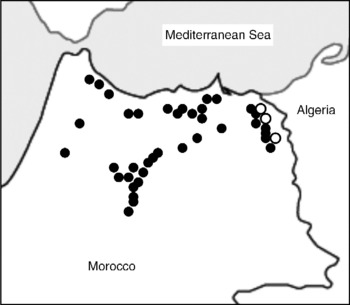
A germplasm panel of 52 six-rowed landraces collected from northern Morocco (Kuwabara et al., Reference Kuwabara, Furusho and Miyagawa1988) was assembled (Supplementary Table S1, available online only at http://journals.cambridge.org). Their collection sites ranged from sea level to an altitude of >2000 m (Fig. 1). Four seeds from each accession were grown to isolate a single pure line to provide a source of DNA, which was extracted from leaves of 9-d-old seedlings following the protocol described by Komatsuda et al. (Reference Komatsuda, Nakamura, Takaiwa and Oka1998). This DNA provided the template for PCR amplification of the EF-G fragment, based on the primer pair T7-3 and T3-3 (Tanno et al., Reference Tanno, Takaiwa, Oka and Komatsuda1999). The resulting amplicons were TaqI restricted as described by Komatsuda et al. (Reference Komatsuda, Nakamura, Takaiwa and Oka1998). A further Derived Cleaved Amplified Polymorphic Sequences (dCAPS) assay was based on the primer pair T7-3 and T3-4 (5’-AACTCTGAGAATAAAATGGCTAGCG), using HhaI restriction to recognize the additional nucleotide polymorphism between the A and the D allele (Tanno et al., Reference Tanno, Takaiwa, Oka and Komatsuda1999).
Geographical distribution of the EF-G/TaqI polymorphism across northern Morocco. Closed circle, A allele; open circle, D allele.

Results
The EF-G amplicon resolved as a single fragment of size ~490 bp in all 52 accessions. Its digestion with TaqI produced two restriction patterns, corresponding to the A and D alleles (Tanno et al., Reference Tanno, Takaiwa, Oka and Komatsuda1999). Forty-nine of these accessions carried allele A, and the other three carried allele D (Supplementary Table S1, available online only at http://journals.cambridge.org). The A allele carriers were distributed across the whole collection region, whereas the D allele ones originated from a narrow area around the city of Ojuda (Fig. 1), which lies close to the border with Algeria, at an altitude of 1250–1560 m (Supplementary Table S1, available online only at http://journals.cambridge.org). The second dCAPS analysis did not reveal any polymorphism among the A allele accessions, so no A–D intermediate (as found in a Chinese cultivar by Komatsuda et al., Reference Komatsuda, Tanno, Salomon, Bryngelsson and Bothmer1999b) was present.
Discussion
The EF-G fragment has offered a means of exploring the evolution of the six-rowed ear. The distribution of alleles within this sequence has suggested that the A and D alleles arose prior to the appearance of the six-rowed ear, thus implying that a two-rowed barley carrying the A allele was the ancestor of the six-rowed barleys carrying the A allele, and likewise a D allele two-rowed type was the ancestor the current D allele six-rowed types (Tanno et al., Reference Tanno, Takaiwa, Oka and Komatsuda1999, Reference Tanno, Taketa, Takeda and Komatsuda2002). The hypothesis that the six-rowed D allele carriers evolved from a Moroccan two-rowed D allele individual, before spreading toward southern Europe, requires that six-rowed D allele carriers can be located in Morocco.
In that event, we found three such accessions among a collection of 52 six-rowed northern Moroccan landraces. The result confirms the plausibility that the progenitor of six-rowed D allele carriers is a wild barley from Morocco. D allele wild barleys are distributed throughout Algeria, Tunisia, Egypt and Spain (T. Komatsuda, unpublished data). The result also supports the suggestion made by Molina-Cano et al. (Reference Molina-Cano, Fra-Mon, Salcedo, Aragoncillo, Roca de Togores and Gracia-Olmedo1987) that, on the basis of some isozyme and morphological data, a number of Spanish six-rowed barleys were descended from Moroccan subsp. spontaneum types.
Tanno et al. (Reference Tanno, Takaiwa, Oka and Komatsuda1999) have shown that the EF-G fragment A and D alleles reflect four nucleotide substitutions, and that the age of the divergence between these alleles is in the range 138,000–830,000 years. The evolution of the six-rowed spike appears to have occurred independently in an A allele and a D allele carrier (Komatsuda et al., Reference Komatsuda, Pourkheirandish, He, Azhaguvel, Kanamori, Perovic, Stein, Graner, Wicker, Tagiri, Lundqvist, Fujimura, Matsuoka, Matsumoto and Yano2007; Saisho et al., Reference Saisho, Pourkheirandish, Kanamori, Matsumoto and Komatsuda2009). Here, we have reported that the D allele is present in the Moroccan population of six-rowed (cultivated) barley, while Tanno et al. (Reference Tanno, Taketa, Takeda and Komatsuda2002) showed that it is also present in Moroccan subsp. spontaneum. Thus, the likelihood is that the lineage of six-rowed barley D allele carriers involved a Moroccan subsp. spontaneum followed by a Moroccan two-rowed vulgare.