


Introduction
Democracy is challenged from within: In recent years, elected incumbents have violated democratic rules and norms often without losing support among citizens (e.g., Levitsky and Ziblatt Reference Levitsky and Ziblatt2018; Svolik Reference Svolik2019). Convincingly and consistent with classical political science work (e.g., Lipset Reference Lipset1983), a recent stream of research explains the successful trails of political leaders such as Viktor Orbán in Hungary, Hugo Chávez in Venezuela, and Recep Tayyip Erdoğan in Turkey by the powerful forces of partisanship, policy interests, and polarization of society (Ahlquist et al. Reference Ahlquist, Ichino, Wittenberg and Ziblatt2018; Bartels Reference Bartels2020; Carey et al. Reference Carey, Clayton, Helmke, Nyhan, Sanders and Stokes2022; Graham and Svolik Reference Graham and Svolik2020; Touchton, Klofstad, and Uscinski Reference Touchton, Klofstad and Uscinski2020).
But there is an equally powerful explanation. The aforementioned political leaders have wielded strong economies while in office and portrayed themselves as cleaning up ineffective political structures (Albertus and Grossman Reference Albertus and Grossman2021, 121; Carey et al. Reference Carey, Clayton, Helmke, Nyhan, Sanders and Stokes2022, 4; Luo and Przeworski Reference Luo and Przeworski2019, 10). That is, they have appeared to be competent to many citizens and, perhaps more importantly, more competent than their competitors and predecessors. Recent assaults on democracy have in this sense mainly come from populists claiming to fight corruption and resolve economic matters, but future threats could also come from competent leaders proposing technocratic, expertise-based government at the expense of democracy (Bertsou and Caramani Reference Bertsou and Caramani2022; Caramani Reference Caramani2017; Dahl Reference Dahl1985, 52). This poses the question of whether citizens simply tolerate undemocratic behavior by competent political leaders. We already know that voters are more forgiving of wrongdoings such as corruption if economic growth or other favorable outcomes are provided in return (e.g., Breitenstein Reference Breitenstein2019; De Vries and Solaz Reference De Vries and Solaz2017; Klašnja, Lupu, and Tucker Reference Klašnja, Lupu and Tucker2021), which increases our suspicion that similar mechanisms are at play when it comes to undemocratic behavior.
In this paper, I provide novel survey-experimental evidence from five democracies to test the argument that citizens forgive undemocratic behavior as long as they get competent political leaders—that is, leaders with positive reputations on handling important issues—in return. Specifically, I conducted well-powered and preregistered conjoint experiments in the United States, the United Kingdom, Mexico, South Korea, and the Czech Republic, yielding a sample with more than 14,000 respondents and more than 260,000 candidate observations. These experiments allow me to examine the effects of undemocratic behavior and competence, provide scenarios resembling real-world decision-making situations for voters, and mitigate social desirability bias in candidate assessments (Hainmueller, Hopkins, and Yamamoto Reference Hainmueller, Hopkins and Yamamoto2014). Moreover, the diverse case selection—representing one of the most comprehensive data collections on citizens’ responses to undemocratic behavior to this date—allows me to generalize the results across space. Contrary to expectations, I find that competence does not suppress the negative effect of incremental violations of democratic principles. Competence and undemocratic behavior both influence voter support, but they do so as additive factors. This also means that the support for undemocratic candidates increases with their competence. And in the context of these experiments, voters prefer undemocratic, competent candidates to democratically compliant, incompetent candidates. These findings hold across all five countries.
Therefore, this study adds valuable insights to the existing literature. Because competence does not diminish sanctioning of undemocratic behavior, we can expect support for even the most competent political leaders to erode over time if they repeatedly violate democratic rules and norms. But the findings also reveal that undemocratic political leaders—beyond exploiting polarization and partisan identities (Ahlquist et al. Reference Ahlquist, Ichino, Wittenberg and Ziblatt2018; Bartels Reference Bartels2020; Carey et al. Reference Carey, Clayton, Helmke, Nyhan, Sanders and Stokes2022; Graham and Svolik Reference Graham and Svolik2020; Touchton, Klofstad, and Uscinski Reference Touchton, Klofstad and Uscinski2020)—can gain support by appearing to be competent. Therefore, the relationship between competence and sanctioning of undemocratic behavior leaves us with good as well as bad news for democracy.
Competence and Undemocratic Behavior
I focus on competence as positive reputations on handling issues that are particularly important to the public (Green and Jennings Reference Green and Jennings2017, 2; Petrocik Reference Petrocik1996). I define undemocratic behavior as violations of the democratic cornerstones of free and fair elections, civil liberties, and/or the rule of law (Møller and Skaaning Reference Møller and Skaaning2013). These democratic principles are endorsed and valued by citizens worldwide (Pew Research Center 2020).
Although work on the link between competence and sanctioning of undemocratic behavior is scarce, studies on a related wrongdoing, corruption, have in fact examined the consequences of competence. Typically, these studies argue and show that voters are more forgiving of corruption as long as the corrupt actor provides good economic performance or other favorable outcomes (e.g., Breitenstein Reference Breitenstein2019; De Vries and Solaz Reference De Vries and Solaz2017; Klašnja, Lupu, and Tucker Reference Klašnja, Lupu and Tucker2021). As corruption and undemocratic behavior share the similarity that both are transgressions in democratic contexts, it seems intuitive that we can expect voters to be more forgiving of undemocratic behavior in case the undemocratic actor is competent.
However, undemocratic behavior is also different from corruption. Political leaders that violate democratic principles often portray themselves as anticorrupt and competent in fighting corruption (Albertus and Grossman Reference Albertus and Grossman2021, 121; Carey et al. Reference Carey, Clayton, Helmke, Nyhan, Sanders and Stokes2022, 4). Citizens are therefore unlikely to have similar impressions of corrupt and undemocratic actors. In addition, according to Luo and Przeworski (Reference Luo and Przeworski2019) citizens’ preferences for competence and democracy are more intertwined. These authors assume that citizens value democracy because it provides the ability to select competent politicians. Thus, when voters face an undemocratic but competent political leader, they face a trade-off between getting competence in the short run and the ability to select competent political leaders through democratic procedures in the future. Therefore, undemocratic behavior threatens the political rights of citizens to choose their own leaders, which corruption in itself does not.
Nevertheless, when competent political leaders violate democratic principles, the expected mechanism is much the same as on corruption. If an undemocratic actor has positive reputations on handling important issues, voters tolerate undemocratic behavior because they value competence (Luo and Przeworski Reference Luo and Przeworski2019, 27). Meanwhile, we can expect citizens to strongly disregard incompetent political leaders regardless of other features, which leaves little to no room for an effect of undemocratic behavior among such leaders. It is, therefore, for political leaders of average competence—those who are neither competent nor incompetent—that I expect the largest negative effect of undemocratic behavior, whereas I expect the effect to be smaller for incompetent and highly competent political leaders.Footnote 1
Research Design and Data
I employ preregistered conjoint experiments to test this theoretical expectation (Frederiksen Reference Frederiksen2022). By manipulating candidate competence along with incremental violations of democratic rules and norms, these experiments enable me to causally identify the respective effects of and interactions between these factors (Hainmueller, Hopkins, and Yamamoto Reference Hainmueller, Hopkins and Yamamoto2014). I fielded the experiments via Lucid in September and October 2020 in five countries: the United States, the United Kingdom, Mexico, South Korea, and the Czech Republic, yielding nationally representative samples on age and gender (N = 2,481–3,159 respondents in each country).Footnote 2 Deviations from the preregistration are described in the supplementary materials.
I diversified the selection of countries to maximize external validity across national settings and contexts (Egami and Hartman Reference Egami and Hartman2020, 12; Findley, Kikuta, and Denly Reference Findley, Kikuta and Denly2021, 372; Shadish, Cook, and Campbell Reference Shadish, Cook and Campbell2002, 18). Most prominently, democratic and autocratic legacies vary. The UK and the US represent old democracies, whereas South Korea (prior military dictatorship) and the Czech Republic (prior Communist dictatorship under Soviet influence) are intermediately mature democracies and Mexico (prior hegemonic one-party rule), finally, is a fairly young democracy. This variation yields differences in prior experiences with compliance to democratic rules and norms as well as government performance related to competence-heavy domains such as the economy. Moreover, the degree of political polarization and importance of partisanship also vary between these countries (e.g., Hajek Reference Hajek2017; Hobolt, Leeper, and Tilley Reference Hobolt, Leeper and Tilley2021; Langston Reference Langston2017; Lee Reference Lee2016), yielding different prospects of competence to matter (Green and Jennings Reference Green and Jennings2017, 22). Thus, potential similarities in the results across countries have good prospects of being generalized beyond those included here.
Experimental Candidate Profiles
Each respondent faced 10 pairs of hypothetical future candidates for the presidency (prime minister in the UK) and was asked to state the likelihood of voting for each of the candidates on a five-point scale from Very unlikely (1) to Very likely (5).Footnote 3 I rely on this rating outcome because several of the included countries have more than two major parties such that forcing the respondents to choose between two candidates would not imitate real-world politics well in these countries. The rating outcome allows me to capture fine-grained nuances in the effects of competence and undemocratic behavior, also for candidates that each respondent would not normally vote for (Hainmueller, Hopkins, and Yamamoto Reference Hainmueller, Hopkins and Yamamoto2014, 6).
I constructed candidate profiles by randomizing gender, age, profession, party, policy positions, undemocratic behaviors, and competence reputations. Assigning these other attributes beyond undemocratic behavior and competence is important because they provide the experiments with realism and ensure that candidate attributes associated with competence and undemocratic behavior in the real world do not contaminate the results (Hainmueller, Hopkins, and Yamamoto Reference Hainmueller, Hopkins and Yamamoto2014, 2). I assigned gender, age, and profession using real-world, country-specific distributions of current and former either local or national incumbents to further enhance external validity (de la Cuesta, Egami, and Imai Reference de la Cuesta, Egami and Imai2022). The remaining attributes were assigned using uniform distributions. All candidate attributes, a conjoint scenario, and ethical considerations are included in the supplementary materials.
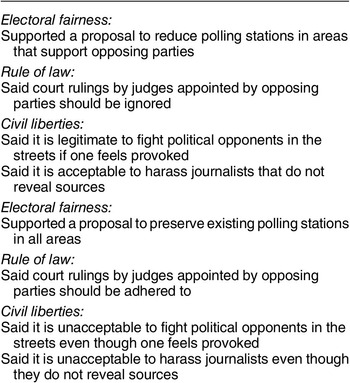
I assigned violations of the democratic cornerstones of free and fair elections, civil liberties, and the rule of law as shown in Table 1.Footnote 4 Each candidate was assigned either a democratically compliant or an undemocratic behavior. Consistent with prior studies (Carey et al. Reference Carey, Clayton, Helmke, Nyhan, Sanders and Stokes2022; Graham and Svolik Reference Graham and Svolik2020), the wordings of undemocratic behaviors are neutral rather than presented in a leading, negative language. Moreover, the violations are largely incremental and piecemeal to reflect how they play out in contemporary democracies (e.g., Graham and Svolik Reference Graham and Svolik2020; Levitsky and Ziblatt Reference Levitsky and Ziblatt2018). Although we could theoretically imagine more severe undemocratic behavior such as threatening to abolish elections or to deploy military forces against public protests, assigning such behaviors would be unrealistic.
Undemocratic (Top) and Democratic (Bottom) Behaviors

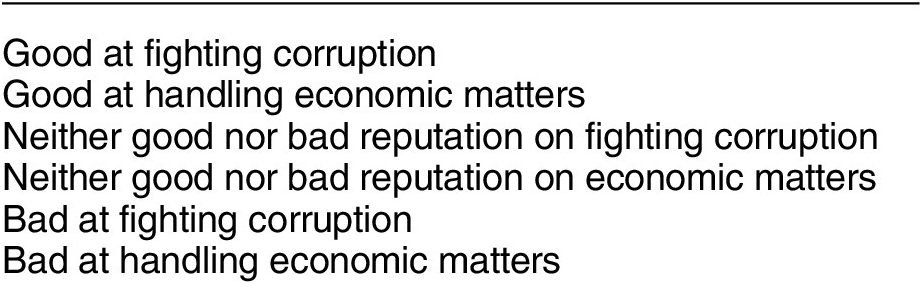
I assigned competence reputations on economic matters and fighting corruption with three levels in each dimension as shown in Table 2. Acknowledging that competence transcends many different issues (Green and Jennings Reference Green and Jennings2017), I selected these particular competencies due to their clear virtues: Economic competence and competence in fighting corruption seem more unambiguously virtuous to all citizens than, say, competence in fighting crime or handling immigration, which may not be endorsed by everyone. As economic competence may still reflect partisan priorities, competence in fighting corruption is especially neat to employ here. Competence in fighting corruption also makes the candidate profiles more realistic because undemocratic political leaders often portray themselves as competent in this particular domain (Albertus and Grossman Reference Albertus and Grossman2021, 121; Carey et al. Reference Carey, Clayton, Helmke, Nyhan, Sanders and Stokes2022, 4).
Competent (Top), Neutral (Middle), and Incompetent (Bottom) Reputations

For the purpose of analysis, I collapse the undemocratic/democratic behaviors to two categories and sum the competence reputations to a five-point scale with the categories Very incompetent (1), Incompetent (2), Average competence (3), Competent (4), and Very competent (5). For example, 5 means that the candidate is competent in both domains, whereas 3 implies that the candidate either is competent in one domain and incompetent in the other or is neither incompetent nor competent in both domains. Therefore, a unit change on the scale corresponds to moving a level up or down on one of the individual measures shown in Table 2.
Does Competence Suppress Sanctioning of Undemocratic Behavior?
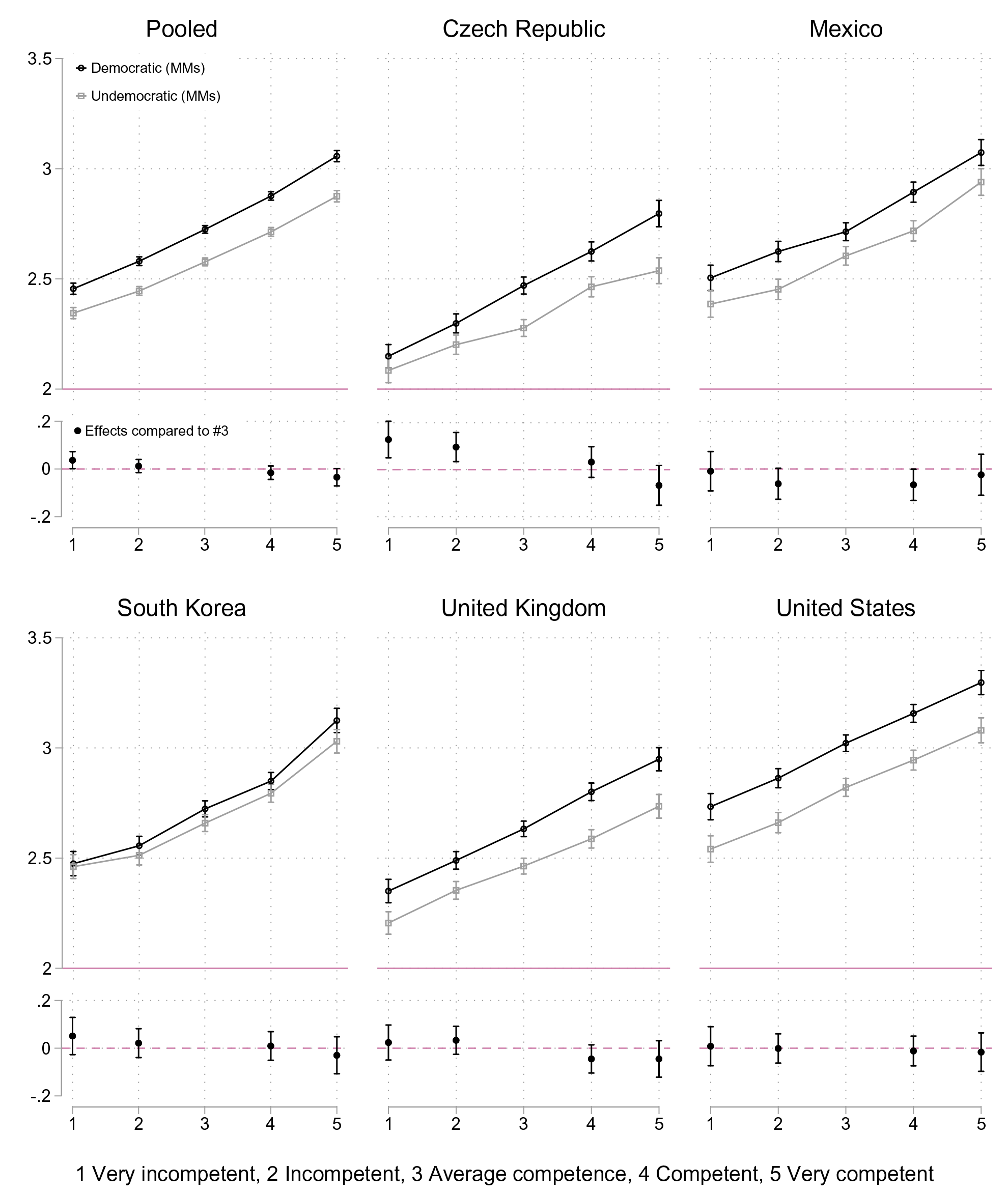
The theoretical expectation predicts that the negative effects of undemocratic behavior are lower among incompetent and very competent candidates than among average competence candidates. To test this, Figure 1 illustrates the marginal means of support for undemocratic and democratic candidates across the five competence levels (upper panels) as well as the effects of undemocratic behavior among competent and incompetent candidates compared with candidates of average competence (lower panels).Footnote 5 Thus, the lower panels provide the direct test of the expectation and the upper panels provide a transparent overview of the effects of competence and undemocratic behavior (Leeper, Hobolt, and Tilley Reference Leeper, Hobolt and Tilley2020).
Primary Results
Note: There were 2,481–3,159 respondents and 47,221–60,106 candidates in each country (14,058 and 267,795 in the pooled sample). The upper panels show the marginal means of support for undemocratic and democratic candidates across competence. The lower panels show whether the effects of undemocratic behavior for incompetent and competent candidates differ from those among Average competence (3) candidates (positive values signal smaller effects).

The upper panels show that undemocratic behavior decreases voter support, whereas competence increases support. The average effects of undemocratic behavior and competence, which are shown in the Dataverse appendix (Frederiksen Reference Frederiksen2022), are both statistically significant at the 0.001 level in all five countries. The effects of undemocratic behavior range from -0.06 in South Korea to -0.20 in the United States, and a unit change in competence approximately yields an effect between 0.14 and 0.15 on the five-point outcome variable in each country. Importantly, the upper panels also provide evidence against the theoretical expectation because the marginal means of support for undemocratic and democratic candidates largely run in parallel across competence. This suggests that undemocratic behavior and competence influence voter support as additive factors rather than interact.
The lower panels provide more evidence against the expectation. The differences in effects between Average competence (3) and Very competent (5) candidates are insignificant in all five countries. Comparing the effects among Very incompetent (1) with those among Average competence (3) candidates yields insignificant differences in all countries except the Czech Republic where the former group is sanctioned 0.13 scale point less (CI: 0.05, 0.21; p: 0.001). The theoretical expectation can partly explain the latter finding: Voters generally dislike incompetent political leaders, which leaves less room for an effect of undemocratic behavior among these candidates. This exception aside, competence does not alter the effect of undemocratic behavior, and the expectation is rejected.
Therefore, both competence and undemocratic behavior matter, but they do not fundamentally change each other’s influence. This implies that voters value and reward competence, even if the particular candidate violates democratic principles. The upper panels in fact show that citizens prefer Very competent (5) or Competent (4) undemocratic candidates to Very incompetent (1) or Incompetent (2) democratic candidates in all five countries (the Dataverse appendix also documents this statistically). We should interpret this ordering of preferences with some caution because it reflects the effect sizes of competence and undemocratic behavior that are produced by the particular treatments used in this study. Specifically, the assigned undemocratic behaviors are incremental, neutrally phrased, and more complex, whereas the assigned competence reputations are clear, diagnostic, and concern issues that citizens encounter often in politics.
In summary, competence does not suppress the influence of undemocratic behavior, but undemocratic candidates can gain support by appearing to be competent. Judging from the results of these experiments, citizens also prefer competent but undemocratic candidates over incompetent but democratically compliant candidates. Theoretically, these results make sense: Voters value both competence and democratically compliant behavior, but these two dimensions affect support for political leaders as additive factors rather than interact.
Robustness Checks and Auxiliary Analyses
In the Dataverse appendix, I provide marginal means for all candidate attributes within each country and benchmark the effects of competence and undemocratic behavior against other attributes. I also provide demographic characteristics of the Lucid samples, show that the samples are quite balanced on partisan lines, provide balance tests, provide power calculations, and show the average effects of and interaction between undemocratic behavior and competence in table format.
Showing that the results travel across different treatments, I split the analyses by the two competence domains and by the different undemocratic behaviors. Moreover, I show that including all candidate attributes or employing competence in its squared form does not change the results. I also show that the results are robust to excluding candidates from parties that citizens plausibly do not believe to be competent regardless of the assigned reputations. Finally, I show that the results hold regardless of whether the respondent is an in-partisan to the candidate, an out-partisan to the candidate, or holds neutral attitudes toward the candidate’s party.
Discussion and Conclusion
Do citizens turn the blind eye when competent political leaders violate democratic principles? I have employed experiments in five democracies to find an answer to this question. Contrary to expectations, competence does not interfere with the sanctioning of undemocratic behavior. Competence and undemocratic behavior instead affect the support of political leaders as additive factors. This also means that support for undemocratic political leaders increases with their competence. Consequently, the results suggest that voters prefer undemocratic, competent political leaders to democratically compliant but incompetent leaders.
This ordering of preferences may be a fruitful venue for future research to explore further. In this study, violations of democratic principles were incremental while competence reputations were clear. Would citizens still prioritize competence if undemocratic behaviors were more severe or competence features were more ambiguous? Another theme to explore further is explaining cross-country differences in how voters sanction undemocratic behavior. The findings did largely replicate across countries, suggesting that the tendencies are quite general, but the degree to which the findings were evident varied. For example, incompetent candidates were sanctioned less than average competence candidates for behaving undemocratically only in the Czech Republic, whereas democratic compliance mattered markedly more in the United States than in South Korea.
The insights of this paper have important implications for democratic sustainability looking forward. Besides the option of exploiting political polarization and partisan identities, undemocratic political leaders can gain support by appearing to be competent. However, because competence in itself does not suppress the effect of undemocratic behavior, we can expect support for even the most competent leaders to erode over time if they continuously violate democratic rules and norms. As the behaviors of undemocratic political leaders often seek to backslide democracy to a point where elections are no longer free or fair, the question then becomes whether this erosion of support unfolds fast enough for democracy to survive.
SUPPLEMENTARY MATERIALS
To view supplementary material for this article, please visit http://doi.org/10.1017/S0003055422000119.
DATA AVAILABILITY STATEMENT
Research documentation and data that support the findings of this study are openly available at the American Political Science Review Dataverse: https://doi.org/10.7910/DVN/NGFLRO.
ACKNOWLEDGMENTS
I thank members of the Political Behavior and Institutions section and participants at the Political Regime Online Workshop at the Department of Political Science, Aarhus University for excellent comments on earlier drafts of this paper. I would also like to thank participants at the panel Behavior and Authoritarian Politics at the MPSA Conference, 2021, and three anonymous reviewers for valuable comments and feedback. I am especially grateful to Laurits Aarslew, Matias Engdal Christensen, Liv Frank, Nicholas Haas, Andreas Videbæk Jensen, Lars Johannsen, Martin Vinæs Larsen, Mathias Osmundsen, Jesper Rasmussen, Svend-Erik Skaaning, Kim Mannemar Sønderskov, and Anders Wieland for their helpful comments.
FUNDING STATEMENT
This research was funded by Aarhus University.
CONFLICT OF INTEREST
The author declares no ethical issues or conflicts of interest in this research.
ETHICAL STANDARDS
The author affirms that this article adheres to APSA’s Principles and Guidance on Human Subject Research.




Comments
No Comments have been published for this article.