Introduction
The cognitive profile of schizophrenia is characterized by impairments in several domains. Among these, deficits in episodic memory (EM) function are some of the most salient (Cirillo & Seidman, Reference Cirillo and Seidman2003; Hazlett et al., Reference Hazlett, Buchsbaum, Jeu, Nenadic, Fleischman, Shihabuddin and Harvey2000; Nohara et al., Reference Nohara, Suzuki, Kurachi, Yamashita, Matsui, Seto and Saitoh2000) and may be partially related to memory strategy deficits. For example, individuals with schizophrenia often fail to encode stimuli as deeply as control participants and are less likely to generate effective strategies to learn new information (Brebion, Amador, Smith, & Gorman, Reference Brebion, Amador, Smith and Gorman1997; Iddon, McKenna, Sahakian, Robbins, Reference Iddon, McKenna, Sahakian and Robbins1998). Functional neuroimaging studies in schizophrenia consistently identify activation impairments during verbal encoding in regions of prefrontal cortex hypothesized to be associated with the generation and application of memory strategies, such as left inferior frontal gyrus (Hofer et al., Reference Hofer, Weiss, Golaszewski, Siedentopf, Brinkhoff, Kremser and Fleischhacker2003; Kubicki et al., Reference Kubicki, McCarley, Nestor, Huh, Kikinis, Shenton and Wible2003; Ragland et al., Reference Ragland, Gur, Raz, Schroeder, Kohler, Smith and Gur2001).
Notably, EM deficits in individuals with schizophrenia can be somewhat alleviated through interventions that facilitate the use of advantageous encoding strategies, including levels-of-processing manipulations (Bonner-Jackson, Haut, Csernansky, & Barch, Reference Bonner-Jackson, Haut, Csernansky and Barch2005; Kubicki et al., Reference Kubicki, McCarley, Nestor, Huh, Kikinis, Shenton and Wible2003; Paul, Elvevag, Bokat, Weinberger, & Goldberg, Reference Paul, Elvevag, Bokat, Weinberger and Goldberg2005; Ragland et al., Reference Ragland, Moelter, McGrath, Hill, Gur, Bilker and Gur2003, Reference Ragland, Gur, Valdez, Loughead, Elliott, Kohler and Gur2005), in which participants typically show better memory for items processed “deeply” relative to those processed in a “shallow” manner. Cues provided during retrieval can also improve EM in schizophrenia (Culver, Kunen, & Zinkgraf, Reference Culver, Kunen and Zinkgraf1986; McClain, Reference McClain1983; Sengel & Lovallo, Reference Sengel and Lovallo1983; Tompkins, Goldman, & Axelrod, Reference Tompkins, Goldman and Axelrod1995). In some cases, improvements in EM function have been accompanied by enhancements in task-related brain activity relative to activity under non-supportive conditions (Bonner-Jackson et al., Reference Bonner-Jackson, Haut, Csernansky and Barch2005; Ragland et al., Reference Ragland, Gur, Valdez, Loughead, Elliott, Kohler and Gur2005), such that schizophrenia participants demonstrate patterns of activity that are more similar to those seen in controls.
However, gaps exist in the research in this area. First, improvements in EM function among individuals with schizophrenia following orientation to memory strategies have largely been demonstrated using recognition memory paradigms, whereas few studies of this type have used recall paradigms, which represent a more stringent measure of EM function. Additionally, little is known regarding the effect of strategy use on associative memory performance and brain activity. Lastly, few studies have investigated the combined effects of encoding and retrieval strategies on EM in schizophrenia, despite initial indications that individuals with schizophrenia demonstrate memory performance equivalent to that of controls when both are used (McClain, Reference McClain1983).
Although the use of mnemonic strategies improves memory in schizophrenia, individual differences in cognitive skills may constrain the effectiveness of such interventions (Ragland et al., Reference Ragland, Moelter, McGrath, Hill, Gur, Bilker and Gur2003). Research from our lab and others (Bonner-Jackson et al., Reference Bonner-Jackson, Haut, Csernansky and Barch2005; Ragland et al., Reference Ragland, Moelter, McGrath, Hill, Gur, Bilker and Gur2003, Reference Ragland, Gur, Valdez, Loughead, Elliott, Kohler and Gur2005) has used encoding tasks that orient participants to process the semantic attributes of items (e.g., abstract/concrete judgments, living/non-living judgments, etc.), putatively to improve encoding effectiveness and memory. Such semantic elaboration techniques may represent one manner in which individuals process and remember information in real-life situations. However, the effectiveness of the encoding manipulations is dependent on the degree to which the individual can successfully use the semantic information to improve memory. It is conceivable, therefore, that individual variations in verbal processing ability could constrain the impact of memory strategies in schizophrenia.
In the current study, we investigated the effect of encoding and retrieval strategies on associative memory and encoding-related brain activity in individuals with schizophrenia and health comparison participants. Additionally, we assessed the impact of individual differences in verbal processing ability on memory and brain activation. We predicted that participants with schizophrenia would show better memory performance when provided with cues at either encoding or retrieval, and the best performance would be found when both encoding and retrieval cues were present. Additionally, we predicted that encoding-related brain activity would be most similar between groups when advantageous encoding cues were provided. Lastly, we predicted that participants with better verbal processing abilities would show greater subsequent memory benefits and greater brain activation enhancements when oriented to beneficial encoding strategies.
Methods
Participants
Participants were 23 individuals with DSM-IV diagnosed schizophrenia and 24 comparison participants.Footnote 1 All participants were required to be without a lifetime history of concussion or head injury, any neurological disorder, and without DSM-IV diagnosis of substance abuse or dependence within the past 6 months. Additionally, all potential participants were required to be 18–50 years of age; able to give informed consent to participate in research; could not be pregnant, claustrophobic, or have any non-removable metallic objects in their body; and could not meet criteria for mental retardation. Participants with schizophrenia were required to meet DSM-IV criteria for schizophrenia or schizoaffective disorder. Comparison participants could not have any lifetime history or family history of psychotic disorders. All participants with schizophrenia were medicated at the time of study. Detailed records of current medications and dosage levels were kept for each participant with schizophrenia. Written informed consent was obtained from all participants before participation in any aspect of the research. All experimental procedures were approved by the Institutional Review Board of Washington University in St. Louis and complied with these regulations.
Diagnosis and clinical assessment
To determine each participant's diagnosis, a structured clinical interview was administered by a trained interviewer, using the Structured Clinical Interview for DSM-IV (SCID-IV).
Measures
Associative memory task
The associative memory task was modeled after the paradigm described by Naveh-Benjamin and colleagues (Naveh-Benjamin, Craik, & Ben-Shaul, Reference Naveh-Benjamin, Craik and Ben-Shaul2002). During encoding, participants were shown a scene and a word simultaneously on the screen and were instructed to study each word-scene pair. During half of the scanning runs (“Verbal Orientation” condition), participants were instructed to indicate whether the current word-scene pair was strongly or weakly associated by pressing one of two buttons. During the other half of the scanning runs (“Location” condition), participants were asked to indicate whether the word in the word-scene pair was above or below the scene by pressing one of two buttons. Additionally, half of the to-be-encoded words were “strongly” related to their associated scene and half were “weakly” related to the scene, as determined by normative data collected from pilot subjectsFootnote 2. All participants were instructed to learn the relationship between scenes and words for a memory test to be administered later. The encoding phase was accomplished over six functional imaging runs (three for Verbal encoding, three for Location encoding). Task order was counterbalanced across participants within each group.
Over the course of the encoding scans, each of the 120 word-scene pairs was shown four times (two times with the word above the scene, two times with the word below the scene). Each stimulus was encoded in only one condition (i.e., Verbal, Location) across all four presentations. Stimuli were presented every 2.5 s in a rapid event-related design, with fixation trials intermixed pseudo-randomly. During the retrieval phase, participants were presented with each of the 120 previously viewed scenes once, as well as 30 new (not previously viewed) scenes. Scenes were presented one at a time, and participants were instructed to recall and say the word that was originally paired with the scene, or to say “New” if the scene was never previously presented. Additionally, half of the to-be-retrieved words were cued with a first letter followed by a blank line below the scene, while the other half only had a blank line. One-letter retrieval cues were counterbalanced across participants within each group, such that half of the participants received cues for half of the pictures, while the other half of the participants were cued for the other half of the pictures. The retrieval phase occurred simultaneously with scanning. However, imaging results focused only on imaging data from the encoding scans.
Neuropsychological measures
Participants underwent a brief neuropsychological assessment, including the Vocabulary, Similarities, and Matrix Reasoning subtests from the Wechsler Adult Intelligence Scale (WAIS-III; Wechsler, Reference Wechsler1997). The Vocabulary and Similarities subtests were double-checked for scoring errors to verify correct classification of participant responses, as there is a somewhat subjective element to scoring these measures. Participants were also administered the Pyramids and Palm Trees Test (Howard & Patterson, Reference Howard and Patterson1992), which measures the ability to retrieve semantic information about words and pictures. Stimuli are black and white line drawings. Participants are shown a picture in the top half of the page and two pictures in the bottom half, and they are instructed to select the picture in the bottom half that is semantically related to the picture in the top half. The measure consists of 52 picture triads, and the maximum score is 52 points. A composite verbal processing variable was created for use as a variable of interest in behavioral and neuroimaging analyses. The aim was to create a metric representing verbal reasoning ability, ability to understand word meanings, and ability to express relationships between concepts. Thus, we included tests that all putatively measure these constructs. To do this, scores for each participant on the WAIS-Vocabulary, WAIS-Similarities, and the Pyramids and Palm Trees Test were converted to Z-scores (based on performance in the entire sample) and summed. However, we acknowledge that this does not necessarily represent a “pure” measure of verbal processing ability.
Symptom measures
Participants were administered the Scale for the Assessment of Positive Symptoms [SAPS; (Andreasen, Reference Andreasen1983b)] and the Scale for the Assessment of Negative Symptoms [SANS; (Andreasen, Reference Andreasen1983a)] during the clinical interview. Symptom summary scores were created for three symptom clusters summing the following global rating scores: (1) positive (hallucinations and delusions); (2) negative (affective flattening, alogia, apathy, and anhedonia); and (3) disorganized (bizarre behavior, positive formal thought disorder, and attention).
fMRI scanning methods
All neuroimaging data collection was performed on the 3 Tesla Siemens Trio at the Mallinckrodt Institute of Radiology at the Washington University School of Medicine. The functional images were acquired using an asymmetric spin-echo echo-planar sequence sensitive to blood oxygen level-dependent (BOLD) contrast (T2*; repetition time [TR] = 2500 ms; echo time [TE] = 27 ms; field of view [FOV] = 256 mm, slice thickness = 4 mm). Encoding runs consisted of 168 whole brain volume acquisitions. Functional neuroimaging data was collected during retrieval but are not included here. A high-resolution structural image was acquired using a coronal MPRAGE three-dimensional (3D) T1-weighted sequence (TR = 2400 ms; TE = 3.13 ms; FOV = 256 mm; voxel size = 1 × 1 × 1.2 mm), used for between subject registration and anatomic localization.
Preprocessing of functional magnetic resonance imaging (fMRI) data included: (1) compensation for slice-dependent time shifts; (2) elimination of odd/even slice intensity differences due to interpolated acquisition; (3) realignment of all data acquired in each subject within and across runs to compensate for rigid body motion; (4) intensity normalization to a whole brain mode value of 1000; and (5) spatial smoothing with an 8-mm full-width half-maximum Gaussian kernel. The functional neuroimaging data was transformed into the stereotaxic atlas space of Talairach and Tournoux (Reference Talairach and Tournoux1988) by computing a sequence of affine transformations (first frame EPI to T2-weighted TSE to MPRAGE to atlas representative target) composed by matrix multiplication. Following the standard pre-processing stream, all functional neuroimaging data was inspected for quality and integrity. Signal-to-noise ratios (SNR) were calculated for each scanning run for each participant, and participants with low average SNR values across all six scanning runs (mean SNR < 150) were excluded from the neuroimaging analyses. Three participants were excluded from neuroimaging analyses for this reason. Participants with head movement that exceeded 4 mm in any direction (X, Y, or Z) were also discarded and were not included in subsequent analyses. Based on mean head movement, the same three participants were identified for exclusion as had been identified based on mean SNR values. No additional participants were excluded from analyses based on these parameters.
The fMRI data were analyzed with an in-house neuroimaging data analysis package (FIDL). Estimate of encoding-related activity in each voxel for the Verbal and Location encoding conditions were created for each participant separately, using a general linear model (GLM) convolved with a canonical Boynton hemodynamic response function, which was estimated over 7 scanning frames (17.5 s). These estimates were used in the analyses of variance (ANOVAs) and t tests. All analyses were appropriately corrected for multiple comparisons using cluster size algorithms to ensure whole-brain false positive rates of p < .05.
Results
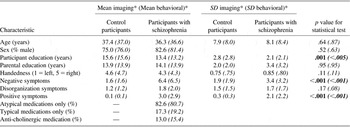
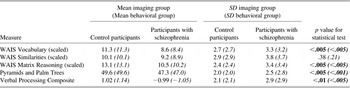
Demographic and clinical data for participants from both neuroimaging and behavioral analyses are presented in Table 1. Neuropsychological data are in Table 2.
Demographic and clinical data

Note. Data regarding participant education, parental education, handedness, symptom ratings, and medication information not available for 2 participants in behavioral group (1 control, 1 schizophrenia).
*Data are presented separately for participants with usable behavioral data and participants with both usable behavioral and neuroimaging data.
Neuropsychological data

Note. Neuropsychological data are not available for two participants in the behavioral group (1 control, 1 schizophrenia).
Controls had significantly more years of education than schizophrenia participants (p < .005). The groups did not differ on any other demographic variables. Control participants performed significantly better than schizophrenia participants on the Vocabulary (p < .005), Matrix Reasoning (p < .005), and Pyramids and Palm Trees (p < .005) measures. The groups did not differ in their performance on the Similarities subtest.
Behavioral Data
Encoding
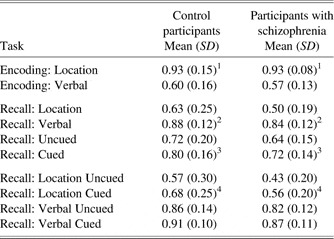
Performance on the encoding tasks themselves (Table 3) was examined using repeated measures ANOVAs, with Encoding Task as a within-subject factor and Group as a between-subject factor. The accuracy ANOVA revealed a significant main effect of Encoding Task [F(1,48) = 420.37; p < .001] but no significant main effect of Group (p > .49) or Group × Encoding Task interaction (p > .67).
Behavioral data: encoding & recall task performance

*Encoding task performance data are not available for six participants (three control, three schizophrenia).
1Main effect of Encoding Task (p < .001).
2Main effect of Encoding Task (p < .001).
3Main effect of Cueing (p < .001).
4Encoding Task × Cueing interaction (p < .005).
Recall
We conducted a repeated measures ANOVA with Group (Control, Schizophrenia) as the between subjects variable, and Encoding Task (Verbal, Location) and Cueing (Cued or Uncued at retrieval) as the within subjects variables. Results of the analysis revealed main effects of Encoding Task [F(1,50) = 148.70; p < .001] and Cueing [F(1,50) = 87.56; p < .001]. Post hoc comparisons revealed better subsequent recall for words encoded in the Verbal relative to Location condition, as well as better recall of words that were Cued relative to Uncued. We also found a significant Encoding Task × Cueing interaction [F(1,50) = 9.05; p < .005], such that the recall benefit conferred by Cueing was greater for words encoded in the Location condition relative to words encoded in the Verbal condition (Table 3). Consistent with predictions, the between-group effect size (Control > Schizophrenia) for Verbal recall (Cohen's d = 0.34) was smaller than that for Location recall (d = 0.61), although the Encoding Task × Group interaction reached only trend-level significance (p = .08). The Group × Cueing (p > .60) and Group × Encoding Task × Cueing (p > .66) interactions were non-significant. Calculation of between-group effect sizes suggest that the groups performed most similarly for recall of Verbal Uncued words (d = 0.29), whereas the largest difference between groups was observed for Location Uncued words (d = 0.55).
Functional Neuroimaging Data
Encoding related brain activity
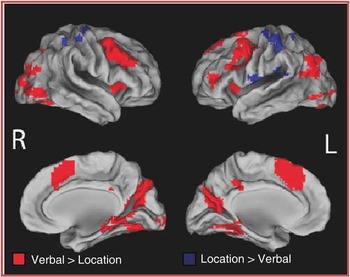
We examined effects of encoding task on brain activity, irrespective of group, using voxel-wise repeated measures ANOVAs with Encoding Task as a within-subject factor. We found a significant main effect of Encoding Condition (Verbal > Location) on task-related brain activity in a network of regions often implicated in EM encoding (see Figure 1). These included left inferior frontal gyrus (BA 44, 47), bilateral middle frontal gyrus (BA 6), and bilateral parahippocampal gyrus (BA 36).
Brain regions showing a main effect of encoding condition: regions representing Verbal > Location encoding activity are displayed in red. Regions representing Location > Verbal encoding activity are displayed in blue.

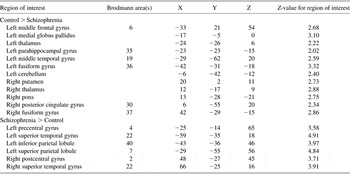
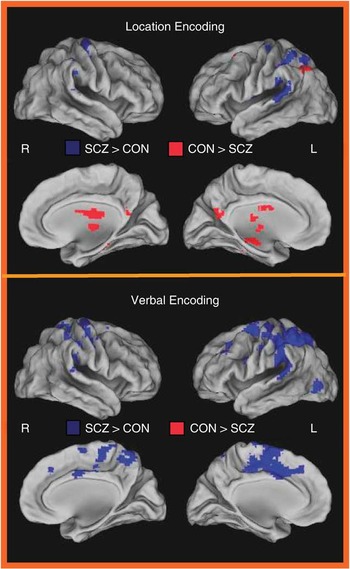
Next, we compared task-related brain activity of controls and schizophrenia participants during each of the encoding several number of regions of significant activity (see Table 4 and Figure 2), including left middle frontal gyrus (BA 6) and left parahippocampal gyrus (BA 35). The Schizophrenia > Control contrast revealed that schizophrenia participants activated some regions to a significantly greater degree than controls, including bilateral superior temporal gyrus (BA 22), left inferior (BA 40) and superior (BA 7) parietal lobule, and left precentral gyrus (BA 4).
Regions of significant between-group differences: Location Encoding

Group differences in brain activity during each encoding condition. Upper panel: Task-related brain activation during Location encoding. Regions representing control greater than schizophrenia are shown in red. Regions representing schizophrenia greater than control are shown in blue. Lower panel: Task-related brain activation during Verbal encoding. Regions representing control greater than schizophrenia are shown in red. Regions representing schizophrenia greater than control are shown in blue.

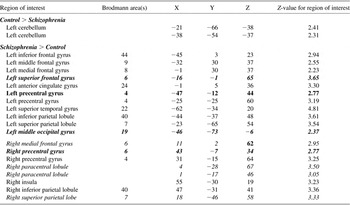
Groups were then compared on encoding-related brain activity during Verbal encoding. Between-group differences (Control > Schizophrenia) were dramatically reduced during the Verbal encoding condition (see Table 5, Figure 2) as compared to the Location condition. Only 2 regions showed greater activity in controls than patients, both in the cerebellum. As such, nearly all regions of between-group differences during Verbal encoding demonstrated greater activity in schizophrenia participants than controls. Regions showing this pattern included left inferior frontal gyrus (BA 44), left superior frontal gyrus (BA 6), bilateral inferior parietal lobule (BA 40), bilateral superior parietal lobule (BA 7), and anterior cingulate gyrus (BA 24).
Regions of significant between-group differences: Verbal Encoding

Note. Activity in bolded regions was significantly predicted by verbal processing ability. Activity in italicized regions showed a group by verbal processing ability interaction.
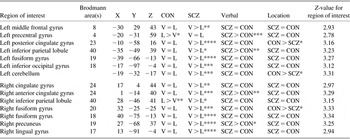
Lastly, we assessed for Group × Encoding Condition interactions using voxel-wise repeated measures ANOVAs, with Group (Control, Schizophrenia) as the between subjects variable and Encoding Task (Verbal, Location) as the within subjects variable. We found significant Group × Encoding Condition interactions (see Table 6) in bilateral prefrontal and parietal lobe regions, including left middle frontal gyrus (BA 8) and bilateral inferior parietal lobule (BA 40). Notably, post hoc comparisons revealed that task-related activation differences between Verbal and Location encoding were greater for schizophrenia participants than controls in a variety of regions, including left middle frontal gyrus (BA 8) and left inferior parietal lobule (BA 40). Furthermore, the nature of the interaction in nearly all regions was such that schizophrenia participants showed greater activity during Verbal (relative to Location) encoding, whereas controls showed either no difference between Verbal and Location encoding or greater activity during Location encoding (relative to Verbal encoding).
Regions demonstrating a significant Group × Encoding Condition interaction

Note. CON = Control; SCZ = Schizophrenia; V = Verbal encoding; L = Location encoding.
*p < .05.
**p < .01.
***p < .005.
****p < .001.
The enhanced pattern of activation observed in the participants with schizophrenia relative to the control group in the Verbal encoding condition could be attributable to one of at least two possible mechanisms. First, if the additional activation served a compensatory role, schizophrenia participants who performed the best would be expected to show the most enhanced encoding activity. Alternatively, overactivation could be interpreted as a sign of underlying pathology and inefficient cognitive processing, which would be associated with worse subsequent recall performance. Thus, we would expect those schizophrenia participants with poorer memory performance to show the most enhanced encoding-related brain activity. To address this issue, we divided schizophrenia participants into two groups based on subsequent recall of Verbally encoded items: a high-performing group (N = 12; recall = 94%) and a low-performing group (N = 11; recall = 77%). Groups were compared on encoding-related activity in regions that previously showed significant between-group differences (schizophrenia > control). We found that low-performing schizophrenia participants activated several regions, including areas of bilateral prefrontal cortex, during Verbal encoding to a greater degree than high performers. In contrast, the high-performing group activated few regions more than the low-performing group. We next conducted a similar analysis in the control group, comparing high-performing (N = 15; recall = 94%) and low-performing (N = 9; recall = 78%) participants. The groups only differed in one area of left occipital cortex (−46, −73, −6), such that high performers showed more activity in this region than low performers. These results suggest that the pattern of overactivation observed in the participants with schizophrenia relative to controls was associated with poorer subsequent memory performance, whereas schizophrenia participants with better memory accuracy demonstrated encoding-related brain activity that was more like that of controls. Furthermore, the pattern of overactivation demonstrated by the low-performing schizophrenia participants appears to be absent among lower-performing controls, further supporting the notion that overactivation during memory processing in the schizophrenia group was associated with underlying pathology.
Individual Differences: Behavioral Data
We conducted Pearson's r correlations between the verbal processing composite variable and recall performance. Among controls, verbal processing ability was significantly positively correlated with recall accuracy in the Location condition (r = 0.49; p < .05), but not the Verbal condition (r = 0.35; p > .10). Among schizophrenia participants, verbal processing ability was positively correlated with recall accuracy in both the Verbal (r = 0.55; p < .01) and Location (r = 0.41; p < .05) conditions. To evaluate the specificity these relationships, we also performed correlations between a measure of abstract reasoning ability (Matrix Reasoning) and memory performance. Neither the schizophrenia participants nor the controls showed significant associations between performance on the Matrix Reasoning subtest and recall accuracy in the Verbal condition (Controls: r = 0.05; p = .81; Schizophrenia: r = 0.21; p = .30), Location condition (Controls: r = 0.28; p = .19; Schizophrenia: r = 0.16; p = .45), Cued condition (Controls: r = 0.22; p = .31; Schizophrenia: r = 0.14; p = .48), or Uncued condition (Controls: r = 0.26; p = .22; Schizophrenia: r = 0.17; p = .41).
Individual Differences: Functional Neuroimaging Data
We conducted two separate analyses: a regions-of-interest (ROI) analysis and a whole-brain analysis. For the ROI analysis, we correlated verbal processing ability with average brain activity in each of the ROIs that previously showed main effects of Encoding Orientation (Verbal > Location). The schizophrenia participants showed significant negative correlations in three regions: two areas of left middle frontal gyrus (BA 6; −45, 2, 49 and −28, 15, 57) and one in left inferior frontal gyrus (BA 9; −41, 3, 29). Thus, enhanced verbal processing abilities were associated with reduced activation in these regions. No significant correlations were found in controls. To assess the specificity of these relationships, we conducted similar correlational analyses with Matrix Reasoning performance. Participants with schizophrenia demonstrated a significant relationship between Matrix Reasoning performance and brain activity (r = −0.44; p = .037) in one region [left middle frontal gyrus (−45, 2, 49)], while control participants did not show any significant correlations.
We also conducted whole-brain correlations between brain activity during Verbal encoding and the verbal processing composite variable. To protect against false-positives, we used a cluster size (n = 29) and activation threshold (p < .0005) that provided a whole brain false-positive rate of .05. Participants with schizophrenia demonstrated a significant negative correlation in left middle frontal gyrus (BA 6; −27, 5, 55), whereas controls did not demonstrate any significant correlations.
Lastly, we were interested in whether diagnostic group (control vs. schizophrenia) continued to predict encoding-related brain activity when verbal processing ability was taken into account, and whether there was a significant interaction between group and verbal processing ability in predicting brain activity. To address these questions, we conducted hierarchical regressions in each of the regions showing significant between-group differences in encoding activity, with the average magnitude of brain activity in each group in each region as dependent variables. For each regression, the verbal processing composite variable and group were entered in step 1, followed by the interaction between verbal processing and group in step 2. As evidenced by significant (p < .05) beta values for group in step 2 for every region of interest, diagnostic group remained significantly predictive of brain activity during both Verbal and Location encoding even when verbal processing ability was included in the regression. In addition, verbal processing ability was significantly predictive (p < .05) of encoding-related brain activity during Verbal encoding in four regions (bolded regions in Table 5), but was not predictive of brain activity during Location encoding. Additionally, there were significant Group × Verbal Processing Ability interactions in seven regions (italicized regions in Table 5), suggesting that the relationship between intrinsic verbal processing ability and encoding-related brain activity differed between groups.
Discussion
The present study investigated the effects of encoding and retrieval strategies on EM performance and encoding-related brain activity in individuals with schizophrenia and healthy controls. Similar to controls, schizophrenia participants demonstrated significantly better recall for items that were encoded in the Verbal condition (relative to items encoded in the Location condition). Thus, orientation to the verbal relatedness of the word-scene pairs significantly improved subsequent recall of the words in both groups. This finding is in line with previous studies of EM in schizophrenia that have reported memory improvement following orientation to beneficial encoding conditions (Bonner-Jackson et al., Reference Bonner-Jackson, Haut, Csernansky and Barch2005; Chan et al., Reference Chan, Kwok, Chiu, Lam, Pang and Chow2000; Gold, Randolph, Carpenter, Goldberg, & Weinberger, Reference Gold, Randolph, Carpenter, Goldberg and Weinberger1992; Koh & Peterson, Reference Koh and Peterson1978; McClain, Reference McClain1983; Paul et al., Reference Paul, Elvevag, Bokat, Weinberger and Goldberg2005; Ragland et al., Reference Ragland, Moelter, McGrath, Hill, Gur, Bilker and Gur2003, Reference Ragland, McCarthy, Bilker, Brensinger, Valdez, Kohler and Gur2006). Such findings have been attributed to an enhancement of strategic memory processes through the manipulation of encoding conditions, as individuals with schizophrenia typically show deficits in generating and applying effective encoding and organizational strategies (Brebion et al., Reference Brebion, Amador, Smith and Gorman1997; Brebion, David, Jones, Pilowsky, Reference Brebion, David, Jones and Pilowsky2004; Hutton et al., Reference Hutton, Puri, Duncan, Robbins, Barnes and Joyce1998; Iddon et al., Reference Iddon, McKenna, Sahakian and Robbins1998; Koh, Reference Koh1978; Russell, Bannatyne, & Smith, Reference Russell, Bannatyne and Smith1975; Russell & Beekhuis, Reference Russell and Beekhuis1976; Traupmann, Reference Traupmann1980). Additionally, the magnitudes of the group comparisons across conditions and the trend level Group × Encoding Condition interaction for recall accuracy indicated that between-group differences in recall were reduced following Verbal Encoding, relative to Location encoding, suggesting that individuals with schizophrenia may have benefited from the Verbal Encoding condition to a somewhat greater degree than control participants, potentially because they had more room to improve.
Most studies in this area have reported improvements in recognition memory following orientation to beneficial encoding conditions. Although such findings are promising, it has been argued that recognition memory tasks can be completed on the basis of familiarity, rather than recollection (Yonelinas & Jacoby, Reference Yonelinas and Jacoby1994). Furthermore, some authors assert that conscious recollection is impaired and underlies memory deficits in schizophrenia, whereas familiarity processes are relatively intact (Danion, Rizzo, & Bruant, Reference Danion, Rizzo and Bruant1999; Huron et al., Reference Huron, Danion, Giacomoni, Grange, Robert and Rizzo1995). Thus, the memory benefits described by previous studies following encoding manipulations could be partially attributable to enhancements in familiarity, without increased rates of recollection. We extend previous findings by demonstrating significant enhancements in recall performance among individuals with schizophrenia following an encoding manipulation, suggesting that conscious recollection was improved.
Retrieval cues also improved memory in both groups. Schizophrenia participants, like controls, recalled significantly more items that were Cued at recall, which supports previous literature demonstrating memory benefits conferred by retrieval cues to individuals with schizophrenia (Culver et al., Reference Culver, Kunen and Zinkgraf1986; McClain, Reference McClain1983; Sengel & Lovallo, Reference Sengel and Lovallo1983; Tompkins et al., Reference Tompkins, Goldman and Axelrod1995). The presence of retrieval cues conferred approximately the same memory benefits to both groups. Taken together with the results from the encoding orientation analysis, our findings demonstrate that individuals with schizophrenia are receptive to strategic memory manipulations during both the encoding and retrieval stages. Furthermore, individuals with schizophrenia (like controls) demonstrated the highest rate of recall for Verbally encoded items that were cued at retrieval and did not significantly differ from controls in this condition. This result is consistent with prior work showing that free recall in schizophrenia participants is equivalent to that of controls only when retrieval cues are provided as well (Culver et al., Reference Culver, Kunen and Zinkgraf1986; McClain, Reference McClain1983).
Analysis of the functional neuroimaging data revealed several between-group differences during Location encoding (mostly control > schizophrenia), which partially replicate previous reports of underactivation in frontotemporal cortex regions among individuals with schizophrenia during standard EM paradigms (Barch, Csernansky, Conturo, Snyder, Ollinger, Reference Barch, Csernansky, Conturo, Snyder and Ollinger2002; Hofer et al., Reference Hofer, Weiss, Golaszewski, Siedentopf, Brinkhoff, Kremser and Fleischhacker2003; Ragland et al., Reference Ragland, Gur, Raz, Schroeder, Kohler, Smith and Gur2001). In contrast, during Verbal encoding schizophrenia participants activated a large network of frontal, temporal, and parietal cortex regions to a significantly greater degree than control participants. These findings support previous work demonstrating enhancements in brain activity in schizophrenia relative to controls under supportive encoding conditions (Bonner-Jackson et al., Reference Bonner-Jackson, Haut, Csernansky and Barch2005; Ragland et al., Reference Ragland, Gur, Valdez, Loughead, Elliott, Kohler and Gur2005), as well as reports of normal modulation of brain activity during encoding of related associate pairs (Achim et al., Reference Achim, Bertrand, Sutton, Montoya, Czechowska, Malla and Lepage2007).
The precise mechanisms that lead patients with schizophrenia to show greater activity than controls under supportive encoding conditions are unclear. As described above, regression analyses suggested that the between-group differences in encoding-related brain activity did not simply reflect differences in verbal processing ability. Post hoc analyses indicated that low-performing participants with schizophrenia showed the most enhanced brain activity during Verbal encoding, relative to higher-performing schizophrenia participants or controls. This finding may suggest that the pattern of overactivation is a function of an underlying pathological process or cognitive inefficiency, rather than a compensatory mechanism. Individuals with schizophrenia may need to engage certain brain regions to a much greater degree to achieve the same degree of task performance as controls. Further research should attempt to more fully understand the nature of activation enhancements seen in schizophrenia under supportive memory conditions.
These data also have important implications for understanding the mutability of altered brain activity in schizophrenia. One potential explanation for findings of reduced activation in individuals with schizophrenia is that they cannot activate a particular brain region for some specific biological reason. However, our data suggest that individuals with schizophrenia sometimes do not activate a brain region because they fail to engage the process that normally activates this region (i.e., verbal memory processing). However, when supported in the use of that process, they are able to activate that brain region (such as left inferior frontal cortex), although potentially in a way that is still altered (e.g., hyperactivity). Results such as these suggest that an important question is why individuals with schizophrenia do not engage the same memory strategies as controls, which may implicate the cognitive control processing or neural systems that normally allow individuals to detect the conditions that would require the use of particular strategies and to attempt to apply them.
Regarding the individual differences data, both groups demonstrated significant positive correlations between verbal processing ability and recall in the Location condition. A significant correlation was also found between verbal processing ability and recall of Verbally encoded words in the schizophrenia group, whereas the correlation among controls was not of the same magnitude and did not reach statistical significance. This finding potentially may be due to less variance in the control group and, therefore, less opportunity to identify significant correlations. Additionally, the relationship between verbal processing ability and memory performance was somewhat specific, as we found no evidence of a significant association between abstract reasoning ability and memory performance.
Furthermore, our ROI-based approach identified significant negative correlations with verbal processing ability for schizophrenia participants in three brain areas—two areas in left BA 6 and one area in left BA 9. The whole-brain analysis identified one significant negative correlation among individuals with schizophrenia in left BA 6. Of interest, there is evidence that this area of prefrontal cortex (BA 6) plays a role in various processes that may contribute to verbal processing in healthy individuals, such as word retrieval, phonological processing, working memory, and effortful memory retrieval (Kubicki et al., Reference Kubicki, McCarley, Nestor, Huh, Kikinis, Shenton and Wible2003; Naghavi & Nyberg, Reference Naghavi and Nyberg2005; Smith & Jonides, Reference Smith and Jonides1999; Thompson-Schill, D'Esposito, Aguire, & Farah, Reference Thompson-Schill, D'Esposito, Aguire and Farah1997). Since all of the correlations were negative, our findings may suggest that schizophrenia participants with less intrinsic verbal processing ability recruit regions of left prefrontal cortex to a greater degree than those with more verbal processing ability while engaged in a verbal encoding task.
There were several limitations to the current study. First, all of the patients were on anti-psychotic medications, which could in theory alter memory functions. However, both medicated and unmedicated individuals with schizophrenia show similar patterns of cognitive dysfunction (Barch et al., Reference Barch, Mathews, Buckner, Maccotta, Csernansky and Snyder2003; Saykin et al., Reference Saykin, Shtasel, Gur, Kester, Mozley, Stafiniak and Gur1994), and it is clear that antipsychotic medications do not cause the core episodic memory deficits that are present in schizophrenia. Memory deficits are also present in individuals with first-episode schizophrenia before administration of anti-psychotic medications and in individuals at risk for the illness (i.e., first-degree relatives). Furthermore, a comparison of memory performance between patients who were taking atypical Versus typical anti-psychotics revealed no differences for any of the memory variables. However, it is possible that unmedicated patients with schizophrenia might fail to show as much benefit from the provision of effective encoding strategies, a hypothesis that remains to be tested. In addition, we were not able to examine brain activity during the retrieval phase, due to the high degree of noise introduced by vocal responses. In future studies, it would be important to try to examine activity related to retrieval with and without the support of effective strategies using approaches that do not involve vocal responses. Lastly, with regard to the verbal processing variable, the goal was to create a composite measure of verbal comprehension and verbal reasoning ability, and we included in this variable neuropsychological tests that all putatively measure these constructs. However, the composite measure was not previously validated as a measure of verbal processing ability, nor does it necessarily represent a “pure” measure of verbal processing. Thus, findings related to this variable should be interpreted with this caveat in mind.
In summary, individuals with schizophrenia showed significant memory benefits from cues provided at both encoding and retrieval. Such memory improvements were accompanied by significant enhancements in encoding-related brain activity during Verbal encoding, relative to controls. Similar to controls, schizophrenia participants showed significant associations between verbal processing ability and memory performance that was specific to verbal ability. Schizophrenia participants also demonstrated significant relationships between verbal processing ability and encoding-related brain activity, some of which were not found in controls, potentially related to decreased variability in the control group. Additional research is necessary to clarify the differential relationship between verbal processing ability and task-related brain activity in healthy controls and individuals with schizophrenia.
Acknowledgments
We thank the staff of the Administrative/Assessment and Biostatistical Cores of the CCNMD at Washington University School of Medicine for help in the collection of the clinical and imaging data. This research was supported by NIH grants P50 MH071616 and R01 MH56584. The authors have no financial conflicts of interest to report.