More than three decades ago, decollectivization altered the dependent status of Chinese peasants as state-employed agricultural labourers and gave them greater autonomy over their economic lives. While cadres still retained much power following decollectivization,Footnote 1 the foundation upon which that power was based continued to be eroded by an array of subsequent rural reforms, including commercialized grain purchase, the privatization of village-owned enterprises (VOE), more free and fair village elections, and the tax-for-fee reform (TFR) (2002–2004).
Even so, village cadres still held sway to varying degrees, depending on the economic type of the village. They were authorized to collect agricultural taxes and the related surtaxes and surcharges. Their authority over land reallocation also remained.Footnote 2 Village governments with plenty of assets and a robust collective economy were able to hold on to a considerable amount of redistributive power. In these villages, aside from an ability to engage fellow villagers in economic terms, cadres derived their authority and prestige from their strong fiscal capacity to provide public goods, such as irrigation projects.
The abolition of agricultural taxes (AAT) (2005–2006) was a landmark development in rural China as it brought to an end the levy of “royal grain” (huang liang 皇粮) – a tax Chinese peasants had traditionally been obligated to pay. The AAT seemed to have been motivated by the reform regime's modest desire to relieve peasant burdens once for all and thereby ensure the political stability of rural society.Footnote 3 The AAT's ripple effects, however, went far beyond the appeasement of grieving peasants. Whilst on the one hand the AAT relieved village governments of their most critical and painstaking task and did indeed alleviate tensions between cadres and peasants, it also eliminated a key source of village revenue, and, in those villages with no collective economy and where little transfer payment was obtainable, drove village finances into near bankruptcy. The AAT also narrowed the scope of village governments' legitimate authority over village affairs. In a nutshell, the AAT cost village cadres most of the redistributive and administrative powers which they required to govern villages effectively and also which underlay their incentives as regime agents.
Needless to say, China's communist regime depends heavily on village cadres to maintain its rule in the countryside. The change in responsibilities, workload, finances and power of a village government also brought about a change in its functions. The empirical findings presented in this article illustrate how the AAT transformed village governments in China's agricultural regions from Party-state tools for rural governance to self-serving commercial bodies whose main function has not only become detached from peasant life but has also deviated from the long-standing pattern of village governance.
Following a short post-AAT transitional period during which village governance was left adrift, village governments had to reset their routine agenda and make the search for new sources of village revenue through “attracting investment” (zhaoshang yinzi 招商引资) their top priority. Rather than being the result of the village cadres' initiative, this new agenda was formed in response to the pressures exerted by township governments which rated revenue-generating ability as the highest criterion when evaluating village cadres' performance. The AAT had also hit the finances of township governments and they tried desperately to share in whatever revenue village governments could raise. The AAT altered the way in which village cadres were paid, and compelled them to be more obedient to township leaders.
Where local conditions allowed, the overriding priority for village governments was the generation of as much revenue as possible, for both the township and the village. The shared personal stake of township and village leaders in increasing revenue through zhaoshang yinzi led to the formation of a financial symbiosis that increased the disengagement between cadres and peasants. This scenario contradicts the observation that economic achievements or benefits for peasant incomes are critical to cadre authority and that village elections greatly boost cadres' legitimacy.Footnote 4 In the villages where I conducted my fieldwork, village elections might have increased cadre accountability, but were of a lesser concern for villagers. Given the AAT-transformed township–village financial relations, townships receiving adequate fiscal “contributions” from villages would no longer depend on county governments for revenue and would thus gain autonomy, as Kennedy found before the AAT.Footnote 5
In March 2004, Premier Wen Jiabao 温家宝 announced that agricultural taxes would be phased out within five years. By mid-2005, agricultural taxes had been abolished in 22 provinces. By the end of 2005, agricultural taxes ceased to be levied in 28 provinces and 210 counties in Hebei, Shandong and Yunnan. Starting from 1 January 2006, agricultural taxes were officially abolished nationwide – three years ahead of schedule. The consequences of the AAT for townships and villages varied immensely, depending on the importance of agricultural taxes to their finances and administrative functions.
This study focuses on the agricultural regions which constitute most of the Chinese countryside and where village governance has undergone the greatest transformation since the AAT. For this project, I conducted fieldwork in one village in Chongqing (December 2005); four villages in Anhui (December 2005–January 2006); four villages in Shandong (June 2006);Footnote 6 one village in Fujian (December 2008); and four villages in Jiangsu (2008–2012). My empirical study lasted seven years, which was long enough for me to witness how the AAT impacted on village governance. In this article, unless otherwise indicated, my interviewees in the villages included both cadres and ordinary villagers.
Village Governance Adrift in the Wake of the AAT
Following the consolidation of its political control over the peasantry in the mid-1950s, the communist state's goal for rural governance turned to the extraction of agricultural surpluses in order to serve industrialization. Accordingly, the role, function and agenda of village governments were reformulated to revolve around and best serve this goal. After compulsory grain-oil purchase, corvée labour and excessive peasant burdens were phased out in the reform process, agricultural taxes represented the last, but not the least, “contribution” the regime demanded of the peasantry. As such, the AAT in effect altered the goal and nature of the Party-state rule in the countryside.
In my research sites, agricultural taxes and surtaxes were critical to township and village finances, and the tax and surtax levy dominated the agendas of village governments. At L village (Chongqing), after the fees and taxes were scrapped, formerly neglected issues and responsibilities took their place. As some cadres recounted, they felt like the AAT had suddenly removed a heavy “stone” from their backs. Even though the collection of taxes, in contrast to the pre-TFR fee collection that frequently sparked violent resistance, was generally peaceful, it remained a “displeasing” or “offensive” task, particularly if cadres had to deal with lower-income, recalcitrant villagers. Cadres had neither the tools for enforcement nor the ability to help villagers, and for most of the time they were reliant on the goodwill and cooperation of the villagers to fulfil this duty. The AAT brought an abrupt end to what had been habitually treated as the village government's “central work” and thus created a large vacuum in village administration. One year after the AAT, village cadres apparently had not yet recovered from this pleasant “shock” and were still struggling to adapt. Without instructions from the township, cadres were confused about what their new priority should be. They allegedly remained “busy” with other (old) tasks, which they described as “trifling” but “important.” Their list of tasks included, among other things, the enforcement of birth control, taking care of disabled elders, issuing certificates to applicants for state subsidies, providing connections and information to urban job seekers, conflict mediation between villagers, making improvements to irrigation systems and infrastructure, offering advice on which crops had the greatest market potential, helping “big specialized households” and those who aspired to develop family businesses to obtain credit services, building workshops, selling products, and wooing investors (albeit with little success). Shortly before the AAT, village cadres were also assigned a few new responsibilities, such as bird flu prevention and advertising state-sponsored medical insurance, known as the New Rural Cooperative Medical System (NRCMS).Footnote 7
X village (Anhui) had neither a collective economy nor collective assets. Like L village, its land was not requisitioned by the government, nor was it leased to investors. X village's post-AAT revenue consisted solely of transfer payments (annually 30,000 yuan), which were barely sufficient to cover cadres' salaries, basic office expenses and subsidies for retired cadres. Cadres and villagers disagreed over the extent to which the AAT had reduced the village authorities' workload. Cadres alleged that the AAT had cut back their workload by 20 per cent. They were now occupied with four responsibilities: enforcing birth control, mediating intra-village conflicts, constructing bridges and roads, and levying water fees.
The villagers told a different story, however. One change was most visible, namely that after the AAT cadres seemed to have disappeared. Villagers rarely saw or had any interactions with them in everyday life and thus had no idea what these cadres were exactly doing all day long. What villagers knew for certain was that the cadres were no longer relevant to them, except for the periodic collection of water fees. As some villagers observed, most probably because the township did not need the village cadres to assist in tax collection anymore, the once close and amicable working relationship between township and village leaders seemed to have suddenly cooled down. Cadres stopped conveying instructions or taking on new assignments from the township.
Birth control remained a thorny issue. Since the enforcement of birth control was often met with emotional defiance, which village cadres were keen to avoid, they deliberately left the potentially confrontational part of the job to the township's “birth-control office,” confining their own role to paperwork such as compiling statistics and storing archives. The fees for building bridges and roads were raised at the villagers' assembly through “one-issue-one-discussion” (yi shi yi yi 一事一议). However, although each villager was required to pay less than 15 yuan per year, many refused to pay. Thus, public goods provision was hypothetical rather than real work.Footnote 8
In June 2006, only six months after the AAT, I conducted fieldwork in W township (Shandong) and some of its villages. Township officials seemed to be more demoralized, if not panicked, than village cadres, and not only because the AAT had dealt a devastating blow to the township's finances. At the time of my visit, the “rumour” was spreading that as the AAT rendered the township “redundant,” most of its personnel would be either laid-off or transferred to lower-salary posts in the ongoing bureaucratic streamlining (fenliu 分流) reform. In contrast, those village cadres who had survived the AAT were more concerned about the loss of their “responsibilities” and administrative power, which threatened to “marginalize” them from community life. The psychological impact of the AAT on village cadres could be discerned from their reactions, which were characterized by a mixture of relief, joy, loss, bewilderment and uncertainty. When they celebrated the eventual end of their long-lasting “torment,” they also perceived themselves as being relegated to the status of ordinary villagers.
The AAT allowed village cadres more leisure time to sit at the mahjong or poker table and to spend more time taking care of their family businesses. However, probably driven by the force of “inertia” or a hidden superiority complex, they did not intend to relinquish their “leadership roles.” Cadres in J village allegedly “served” fellow villagers by offering endorsements for those applying for bank loans, providing technical services for those using pesticides and chemical fertilizer, formulating a blueprint for house-building land, delivering farming subsidies door-to-door, and “planning” to set up a shareholding cattle-feeding factory. Since most households owned a small fish pond, cadres organized a “fish-breeding association” to help improve fish-breeding skills. A cadre explained to me that they had not received any new assignments or instructions from above and so just performed their duties out of “conscience” or “habit.”Footnote 9
My empirical findings suggest a number of significant changes to village governance and cadres effected by the AAT. With regard to its immediate effects, the AAT did not appear to alter anything except that cadres no longer levied taxes. However, soon after the AAT, another “benefit” was brought to village governments. As most villages were thrown into a quagmire of debt after the mid-1990s, tackling debt repayment was a highly distressing but unavoidable undertaking for village authorities. Since the AAT took away a large portion of village revenue, village governments no longer had to wrestle with their debt problems and instead simply waited for a “final” solution to come from the centre.
The reform regime did not immediately fill the void left by the AAT by giving cadres new responsibilities, and instead let village governments go adrift. In nearly all the villages I visited, there was a pervasive feeling of disorientation among cadres who were apparently in the dark about their new priorities and the new criteria for their performance evaluation. Meanwhile, on top of the continued emphasis on birth control, some previously lower-ranked tasks emerged as more pressing, such as the allocation of farming subsidies and NRCMS programmes.Footnote 10 A comparison of what village cadres did before and after the AAT reveals how the AAT, coupled with the rural market process, has made village cadres not only less useful to peasants but also to the Party-state. Compelling evidence of the regime's decreasing dependence on village cadres for policy implementation and rural governance is provided by the drastic downsizing of village leaderships and the large cut in the number of salaried cadres, which were achieved in some regions through the merging of villages.Footnote 11
In the past decade, village finance has suffered two devastating blows, namely the TFR and the AAT. The TFR cancelled out most fees and turned others into taxes which villages were not able to take or share in. As compensation, village governments were entitled to the agricultural surtax, which amounted to 20 per cent of agricultural taxes, and the special (agricultural) product surtax. However, post-TFR surveys in agricultural regions show that the two surtaxes amount to far less than pre-TFR fees.Footnote 12
Aside from the two surtaxes, villages were entitled to share the transfer payments allocated to rural areas. How much each village could acquire was left to the discretion of the township. Where township finances deteriorated in the aftermath of the TFR, townships tended to withhold transfer payments for their own coffers, so very little trickled down to the village level.Footnote 13 The abolition of two surtaxes along with the AAT meant that some village governments were left dependent on transfer payments as their only source of income. According to a survey conducted in 100 villages in five provinces, the combined average of transfer payments and the two surtaxes amounted to just 58.6 per cent of pre-TFR village revenue. Even though post-AAT transfer payments for townships and villages were greatly increased to compensate for their fiscal losses, the total amount for villages was still only 60.1 per cent of pre-TFR revenues.Footnote 14 On paper, village revenues did not decrease with the AAT and even increased slightly; in reality, the AAT diminished village finances still further.
Before the AAT, the two surtaxes contributed exclusively to village revenues and could not be touched by the township. Despite the massive increase in post-AAT transfer payments for rural areas, the method of distribution has remained unchanged. Transfer payments are given only to townships to be distributed among their villages in proportion to their financial conditions and needs. However, in agricultural regions where township funds relied heavily on agricultural taxes, the fiscal crisis arising from the AAT often prompted township governments to withhold even more transfer payments from villages, except for the mandatory outlay for village cadres' salaries.Footnote 15 In all the villages I visited, the post-AAT transfer payments allocated by the township either remained unchanged or decreased. For instance, Y village received a transfer payment of only 3,000 yuan after the AAT, which included the mandatory payment for cadre salaries. This was less than half of the village's annual per capita income (7,200 yuan).Footnote 16 M village received a mere 460 yuan from the revenue-starved township government in 2011.Footnote 17
Although village cadres' salaries and remunerations have always been decided and paid for by the township, funds used to be extracted from the village's own coffers to contribute towards these costs. Where the AAT eliminated most of the village revenue, cadres' salaries were delinked from village finance and instead paid by the township out of transfer payments, so village cadres did not have to “use the money grabbed from peasants to pay themselves,” as some peasants claimed.Footnote 18 Apart from further alienating cadres from villagers, this new method of payment produced a paradoxical consequence.
Tax collection was one of the key indicators of performance for village cadres and township officials alike. The AAT relieved township officials of their tax-related burdens and so they no longer needed village cadres to assist in tax collection. As “maintaining stability” (wei wen 维稳) replaced tax collection as the townships' top priority, the alliance between township officials and village cadres against peasants tended to break up.Footnote 19 Many cadres complained that in order to avert peasant riots, the township government no longer stood by village cadres in the latter's confrontations with villagers.Footnote 20 In addition, as the AAT meant that village cadres had lost much of their usefulness, township officials were less tolerant of village cadres' corruption and abuses of power. Meanwhile, the township's tighter control over their salaries obliged village cadres to be more obedient.Footnote 21 Since the AAT bound township and village finances together more tightly, township governments were inclined to reduce the functions of village governments, where possible, to generating cash.
The Commercialization of Village Government
However cost-ineffective it made village cadres to the Party-state, the AAT did not result in the abolition of village government, but instead transformed its incentive structure, function and agenda. By eliminating the hardest target responsibility for township officials as well, the AAT allowed them to take the reins and set and proceed with self-serving agendas, which the village authorities were urged to follow.Footnote 22 Subsequently, three new priorities dominated the timetables of both township and village leaders, namely developing the (local) economy, increasing peasant income and maintaining stability.Footnote 23
When I visited N and B villages in Jiangsu during the winter of 2008–2009, cadres in both villages seemed to have settled on their new agendas which, as they informed me, had changed considerably since the initial AAT years. In the meantime, the state had increased its farming subsidies (to 85 yuan per mu) and set up an account (yi zhe tong 一折通) for every rural household. Thus, the government no longer needed cadres to deliver the subsidies to each household and instead remitted the money directly into individual households' accounts each June.
At N village, enforcing birth control was a fairly easy task and did not bother cadres much. The township still demanded that cadres persuade fellow villagers to pay the 30 yuan membership fee to join the NRCMS, but the job had become less arduous as the reputation of the NRCMS improved and its membership grew. The township also assigned a variety of minor or hardly tangible duties to the village government, such as filling in statistical tables, unifying house-building standards, environmental protection and forestation.
The most remarkable change was the obsession village cadres had with zhaoshang yinzi. In fact, this was not a new task but had been one of their responsibilities since the early 1990s. The rise in the importance of zhaoshang yinzi was the result of a combination of pressure from the township and the cadres' own initiative.Footnote 24 In practice, village cadres were merely township officials' assistants and played a subsidiary role in this undertaking. N village had an industrial park for private enterprises, which was set up and regulated by the township but jointly managed by the village and township authorities. The township was responsible for wooing interested investors, whereas the village leased its land. Since most of the land was requisitioned from peasants, village cadres had to persuade them to give up their land-use contracts and also haggle with the investors for a “reasonable” rent.Footnote 25 In interviews, the cadres likened themselves to a ‘bridge” or “brokers” both between the township and the investors, and between the investors and the villagers. It appeared that the role of “broker” was an arduous one and took up all their office hours.
N village's industrial park had existed for a number of years but its expansion gained momentum shortly after the AAT. By 2008, it had attracted around 34 private enterprises, with the total output value exceeding 120 million yuan. The revenue it generated became critical to both the township and village finances. The peasants whose land was requisitioned usually received the lion's share, if not the whole, of the rent paid by the enterprises.Footnote 26 However, the rent for the village-owned land, which was mostly unusable wasteland, went entirely to the village authorities. The enterprises also paid taxes, which could not be legitimately shared with the village and mostly (those falling in the local-tax category) entered the township coffers. Thus, zhaoshang yinzi was well justified as it allegedly conformed with the reform regime's goals of boosting the local economy and helping peasants to get rich.
Until the TFR and the AAT, farming was an unprofitable business. The AAT did enhance the value of land to peasants, but not much. In N village, those busy growing crops in their fields were nearly all elderly people and women. For most households, having their land requisitioned was a better prospect as rental income was much higher than the net income they received from farming. The benefits for these households were not confined to the rent alone. Cadres negotiated with the enterprise owners to persuade them to hire landless villagers and to “protect” the welfare, wage and working conditions of the enterprise employees from the village. The main driving force behind zhaoshang yinzi lay in the deep personal interests held by both township and village leaders. The thriving industrial park offered them abundant income opportunities and enhanced their performance evaluations.Footnote 27
The change in functions of the village government in B village was much the same. It was marked most noticeably by the cadres' preoccupation with zhaoshang yinzi, a task which they prioritized above all others. The ranking of priorities among all the villages under the jurisdiction of township Z was determined by the township government, and the de facto sole criterion for evaluating village cadres' performance was how successful they were in attracting investment. Success was measured by the number, capital assets, employment and output value of private enterprises and, above all, how much tax revenue they generated for the government.
On the eve of the AAT, B village had just four private enterprises. Five years later, the number had leapt to 26. Its location on the edge of the township meant that the village's efforts to attract investors were handicapped by its poor infrastructure and geographical inconvenience. Except for one outsider from Sichuan, all of the private entrepreneurs were native villagers who had grown up in the village but who had left during the early years of market reform in search of business opportunities. After they had established themselves in business, village cadres lured them back with “preferential” terms. Beyond that, it was difficult for cadres to do more. Since the investors had extensive family ties and social networks in the village, they did not need to bother the cadres much. Unlike their counterparts in N village, enterprise owners in B village preferred to hire fellow villagers who, aside from being relatives or friends, could take care of their own board and lodging and hence spared the enterprises extra outlay.Footnote 28
In N and B villages, although the initial process of zhaoshang yinzi involved ordinary villagers, the transformation of the village governments' routine functions created an even bigger distance between cadres and villagers than I had witnessed in my earlier fieldwork. On the positive side, the AAT had dispensed with one of the cadres' most onerous responsibilities which had often required the use of coercive power against peasants and thus constantly provoked tension. After the AAT, however, contention was replaced not by harmony but by disengagement. The AAT failed to boost the status of village cadres, did not improve cadre–villager relations or raise the villagers' respect for cadres; instead it just drove them farther apart. A cadre in N village complained to me that village cadres did not count as “cadres” at all and that their status was even lower than ordinary villagers who often “hurl all kinds of abuse” at them. The AAT stopped the reversal of power relations between cadres and peasants in tax collection, but did not reinstate cadre authority.
The cadres' growing detachment from the villagers gave them greater autonomy and allowed them to turn the village government into a corporation-style interest group. The cadres' dwindling authority and growing autonomy were also a function of the rural market process. What happened at the two villages illustrates how market forces advanced at the cost of cadres' leverage. B village was well known for its strawberry and pig-feed production. For many years, cadres' authority or “prestige” was built upon their fellow villagers' reliance on them to provide technological assistance, market information, and outlets for their produce. Now, the villagers could obtain all these directly from the market.Footnote 29 For instance, previously, the strawberries the villagers grew were purchased by the city's canned food company, via the village government, for export to Japan. After the AAT, the company bypassed cadres and signed contracts directly with each household. At N village, rice and pork traders periodically entered the village and bought directly from the villagers according to the market price. If any product was unsaleable or if the market price plummeted, cadres could not help at all. On the other hand, cadres failed to upgrade their services to meet the needs of either market-driven or government-endorsed “structural adjustments” to agricultural production. Thus, the peasants had no alternative but to resort to the market or other channels for the services they needed. While marketization weakened peasants' dependence on cadres, the AAT reduced the cadres' need to engage with villagers.Footnote 30
Comparing Post-AAT Village Governments
The success of zhaoshang yinzi efforts could not be guaranteed and varied according to local conditions such as proximity to the regional commercial hub or main communication routes.Footnote 31 To explore how and to what extent the success or failure of zhaoshang yinzi impacted on the patterns of village governance and the function of village governments, I selected two sharply contrasting villages, namely M village (R township) and H village (C township) in Jiangsu, as my research sites. The agendas of both village governments were set to conform with each respective township's criteria for performance evaluation.
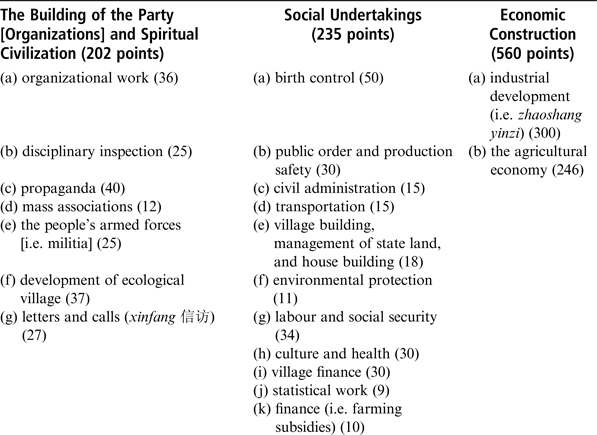
In R township, village cadres were evaluated according to their execution of 94 tasks, which were quantified as a total of 997 points.Footnote 32 The final allocation of points, as Schubert and Ahlers observe elsewhere, would “produce a strict hierarchy” and put heavy pressure on those whose score was low.Footnote 33 As Table 1 shows, all the tasks were divided into three categories. The first category contained seven sub-categories which comprised 38 tasks. After deleting the hollow or “formalistic” ones, only one task was real, namely preventing villagers from lodging complaints to higher authorities (shangfang 上访). If any villager took his/her grievances to Beijing, all cadres in that village would fail to pass the evaluation – a rule known as “one-vote veto.”
Categories and Sub-Categories of Cadre Evaluation Tasks in R Township (Total 997 Points)

Source:
Based on information obtained from R township on 25 December 2011.
Note:
It is obvious that the totals in columns 2 and 3 do not add up to the respective totals. It is unclear whether this is a calculation error, such as double counting for column 2, or whether there were hidden “tasks” for column 3 in the document from R township. Such statistical errors are not rare in government documents at the township level.
The second category had 11 sub-categories and 49 tasks. Except for two hard-target responsibilities (birth control and the levy of NRCMS fees), this category, too, included a “one-vote veto” task: to avoid any criminal case that was grave enough to cause a sensation throughout the region. Public goods provision (mainly infrastructure) belonged to “transportation” and deserved a mere seven points (out of 997). By contrast, zhaoshang yinzi alone accounted for 300 points. A cadre at M village admitted in private that at least 70 per cent of the tasks on the performance evaluation list were senseless and should be scrapped.Footnote 34 Many tasks sounded important but were abstract or intangible and therefore technically hard to execute or evaluate. The cadres felt pressurized by the township to focus on two top priorities, namely zhaoshang yinzi and maintaining a veneer of stability.Footnote 35
These criteria applied not only to the village cadres in R township but also to those in the entire county, regardless of the differences between villages. Given its overwhelming importance, cadres were supposed to be fully engaged in zhaoshang yinzi. This begs the questions: what would happen to those villages whose insurmountable disadvantages made all its efforts to attract investors futile? If village cadres could do nothing about zhaoshang yinzi, what did they do?
M village was such a case. For all its endeavours, the village had only five or six small private enterprises. Although the taxes they paid went to the government, enterprise owners paid rent (800–1,000 yuan per mu) to the households from whom they leased land. Owing to the small scale of the business enterprises, they brought few benefits to the village authorities. Village finances were dependent on fees and taxes and were severely depleted by the AAT as the village had no other ways to raise revenues. Many villages in this township suffered from the same disadvantages when it came to attracting investment. As a result, zhaoshang yinzi at the village level contributed very little to township finances.
Presumably because of its growing deficits, the township was reluctant to share transfer payments with the villages. M village's portion of transfer payment was not allocated to the village government but instead distributed among individual cadres. Each year, in addition to their salaries, the Party secretary was given 120 yuan (for basic administration expenses); the village head and accountant were each given 100 yuan; and three other cadres received 80 yuan each.Footnote 36 Apart from these meagre funds, village revenue was zero. The township's finances only afforded a pension, social security, and medical insurance for the village Party secretary. The village Party branch recruited a private company owner to the Party and appointed him as the deputy Party secretary. The village government was so poor that most expenditures, including the bill for my lunch, were paid for from his own private pocket.
Handicapped in their efforts to woo investment, cadres allegedly shifted their priorities to “serving peasants,” which fit with the loosely interpreted evaluation criteria. On the wall of the village government office, I saw a complete list of the services cadres were obligated to offer. They were referred to as “entrusted services” (daili fuwu 代理服务) in the sense that cadres would work as agents or perform services for fellow villagers who applied to the government for: (1) private company registration; (2) a house-building licence; (3) the registration, change, or cancellation of house ownership; (4) a licence to sell salt; (5) permission to sell medicine; (6) a birth certificate; (7) a subsidy for purchasing modern farm machinery; (8) farming subsidies; (9) land circulation; (10) small or “help-poor” (fu pin 扶贫) loans; (11) the use of electricity; (12) a certificate of temporary (urban) residency; (13) a house lease; (14) the payment of fees for irrigation projects, drinking water, electricity, cable TV, and mobile phones; (15) a death certificate; (16) an identity card; (17) insurance for pension and subsistence; (18) compassionate (cishan 慈善) assistance; (19) a disability certificate; (20) consultancy on laws concerning marriage, family, and labour; and (21) legal assistance.
These services, however, to a large extent were offered only on paper. In reality, villagers seldom asked cadres for help. Although some applications needed to go through the village government and required the rubber stamp of the village head, applicants usually preferred to file applications on their own as enlisting the help of cadres could make the process even longer and perhaps more complicated. Also, since they no longer paid (taxes or fees), villagers did not want to owe cadres personal “favours” (renqing 人情) which they would then be morally obligated to repay. In cases when an application was turned down, village cadres were usually powerless to help anyway as they held little influence with government officials.
Of course, cadres' work was not limited to “entrusted services” but also encompassed other responsibilities such as filling in statistical tables, collecting payments for pensions (nong bao 农保), cable TV, NRCMS and “one-issue-one-discussion” sessions, ordering rice and wheat seeds and delivering them door-to-door, enforcing the ban on stem burning (to avoid air pollution), managing the state subsidies for ex-servicemen, the elderly and households below the poverty line, providing labour for the region's irrigation projects, forestation, providing mediation between villagers, coordinating enterprise–villager relations and enforcing birth control.
While these seemingly trivial or hypothetical tasks could indeed keep cadres “busy,” how did ordinary villagers assess what cadres did? In my interviews, the villagers agreed on one point: their everyday lives had almost nothing to do with cadres. To the extent that the village government did function, it was irrelevant to villagers. Villagers received farming and other state subsidies directly from the government and relied on the market or social networks for all they needed. They were free to sell their produce at a price they desired in a free market without any state intervention. If villagers did need the village government's stamp or signature for any certificates and applications, they were not at all dependent on the “mercy” of the cadres: if cadres were reluctant or slow to respond and thereby caused confrontation, they would most likely be punished for failing in their duties and for upsetting “stability.”
The cadres did not seem to treat their responsibilities to “serve the villagers” seriously, either. For all the rhetoric, these tasks counted for little in their performance evaluations.Footnote 37 In many villages, the redistribution of collective assets was a divisive issue. However, M village had no collective economy and no collective funds, so the village government's redistributive power was zero. After the AAT, cadres and fellow villagers did not need each other anymore, nor did they see each other often. In rural China, abuses of power by village cadres often triggers protests. In M village, as the power held by cadres dwindled, “stability” prevailed as fewer villagers lodged grievances with higher authorities. In short, cadres in M village had to do very little for zhaoshang yinzi and to maintain “stability,” the two top priorities imposed from above.Footnote 38
H village was in stark contrast to M village. This village is located in C township, where industry and finance are far stronger than in R township. Some villages under C township's jurisdiction boasted many advantages when it came to attracting investors, the most critical of which was their proximity to three main highways, a railway and Taizhou 泰州 city, the regional hub. Aside from its developed infrastructure, H village enjoyed an additional advantage – a history and reputation for the production of spare parts for cars, motorcycles and bicycles.Footnote 39 In C township, H village was rated as one of the most successful villages at zhaoshang yinzi.
C township's criteria for evaluating the performance of village cadres resembled those of R township, but cadres in M and H villages pursued different agendas and did different things. H village had more than 100 private enterprises, two of which had output values exceeding 100 million yuan, and ten had output values of more than 10 million yuan each. How did the township government, the village authorities and ordinary villagers benefit from this village's astonishing achievements in zhaoshang yinzi? The total taxes these enterprises paid annually reached approximately 40 million yuan and were divided into joint and local categories to be shared between five levels of government, from the centre to the township. Under China's post-1994 tax system, the township was only entitled to a portion of local taxes. For C township, this amounted to 10 million yuan, a huge boost to the township's finances. Obviously, H village was not solely responsible for raising this revenue; the taxes paid by private enterprises in all the villages in C township accounted for 30 per cent of the township's total revenue.
In addition, zhaoshang yinzi generated two benefits for the villagers. First, the land rental paid by the enterprises went exclusively to the land-leasing household. The rent, 1,300 yuan per mu per annum, was higher than that charged in M village (800–1,000 yuan) where the land was of less commercial value. Second, the landless villagers were employed by these enterprises on a monthly salary of 3,000 yuan, which was roughly equal to, if not higher than, the wage earned by urban blue-collar workers at that time. Moreover, these villagers retained a small plot of land on which to produce food for their own consumption. How zhaoshang yinzi impacted on the villagers' livelihoods can be seen from a snapshot comparison: M village had 1,300 villagers, 600 of whom left the village to look for employment in urban areas; H village had a population of 1,718 but fewer than ten joined the floating population. Most of the H villagers were hired by the village's private enterprises.
H village's finances benefited as well. The village government had a well-filled purse with annual revenue soaring to 2.41 million yuan. Of this total revenue, 30 per cent came from the profit of its collective economy, which was based on the production of crab food. The private enterprises in H village contributed 70 per cent (1.70 million yuan) through three channels: 1) the rent they paid for the use of collective land (0.30 million yuan); 2) “management fees” charged by the village government for services which ranged from land requisitioning, paving roads, installing electricity, applying to the government for licences on behalf of the enterprises, rubbish clearance, mediating between capital and labour, etc. (0.40 million yuan); and 3) the “gratitude fee,” which the enterprises paid to “thank” village cadres for assisting their “technological upgrading” (jishu gaizao 技术改造) (one million yuan). What the “upgrading” meant exactly was not specified or clarified. So, the largest portion of village revenue appeared to be “grey income,” which was vague and opaque.
H village received transfer payments of 100,000 yuan from the township – 178 times that received by M village – thanks in large part to its contribution to township finances. H village's cadre salaries were paid out of both the transfer payments and village funds. The large fiscal surplus allowed the village authorities to launch some ambitious programmes such as developing the village into an industrial and business district.
To examine how the enormous success of zhaoshang yinzi in H village transformed cadre–villager relations, it is again interesting to make a comparison with M village. In M village, cadres lacked the ability to attract investment or to offer fellow villagers much help. In H village, except for the first phase of zhaoshang yinzi, which involved negotiating with villagers for land requisition, cadres were almost entirely preoccupied with the village's dealings with enterprise owners and the township authorities. Although cadres in both villages were obligated to provide villagers with a long list of services, most of which were rhetorical rather than substantial, the daily work of the busy cadres in H village was mostly not in connection with their fellow villagers. Thus, the increasing disengagement of cadres from peasants after the AAT is not significantly correlated with either the success or failure of zhaoshang yinzi.
Nuanced differences could be discerned, however. H village's importance to the finances of the township accounted for the more intensive interactions between the village and township leaders, which seemed to have made the former's “entrusted services” more effective.Footnote 40 In respect of the village government's “leadership,” during my interviews villagers in H village highlighted the leadership's willingness to offer financial assistance. H villagers were relatively affluent and their annual per capita income was as high as 16,300 yuan. If they needed funding to start a private business, for instance, the village government would help them to obtain credit or loans. Private irrigation and land cultivation fees, although not much, were paid for by village funds, too.
However, whatever the cadres did for fellow villagers, it did not seem to have made the village a harmonious community. Ironically, although M village was poor, “stability” was not a problem; in contrast, conflicts in H village were sharper – not only between cadres and villagers but also between enterprises and villagers. In the eyes of some villagers, they were entitled to a greater share of the collective funds. Although the cadres asserted that the majority of village funds went towards collective development projects, these projects obviously had not generated immediate and tangible benefits for fellow villagers.
Prior to the AAT, as H village's finances relied to some extent on the agricultural surtaxes collected from villagers, redistribution and expenditures were often explosive issues. After the AAT, how much revenue the village obtained, or for what purposes it was used, did not appear to be serious concerns for the villagers. This apathetic attitude should not be construed as a manifestation of villager contentment with their decent incomes or their trust in the village cadres, but rather by the change in the structure of village revenues. Since villagers no longer paid taxes/fees and thus did not contribute to village funds, the credit for the abundance of village revenue went exclusively to the village cadres, who arguably did a good job in zhaoshang yinzi. Cadres' greater responsibility for finding new revenues provided them with greater leeway and also rendered them less accountable and controllable.Footnote 41
Conclusion
In terms of its political and economic consequences, the importance of the AAT is matched perhaps only by decollectivization. If decollectivization eroded the economic foundation of its political authority, the AAT transformed the function of the village government and thereby changed the way the countryside was governed. Although the AAT was a reform of China's tax system, its political impact far overweighed its economic or financial impact. When agricultural taxes were abolished, it altered the nature, goal and trajectory of the Communist Party's rule in rural China. In most of China's agricultural regions where the village's collective economy was weak or lacking, the AAT, coupled with the socioeconomic ramifications of marketization, made the authority of village government unsustainable and its traditional functions obsolete. The AAT has undermined village cadres' redistributive and administrative powers to an extent that expedites the rollback of the Party-state from China's rural communities.
The empirical findings illustrate how the AAT has shifted village governance onto a different track. Initially, village cadres struggled to adapt to the AAT's immediate effects. All of a sudden, they seemed to have no functions to perform, no authority to govern, no capacity to undertake tasks, and no incentive to work. The removal of tax collections hollowed out village administration, resulting in the trivialization of the responsibilities of village governments. The depletion of the village coffers cost cadres their personal income advantages and dismantled their incentive structure. The de-linking of their salary from village funds brought them under the tighter control of the township governments.
After the dust settled, village cadres found themselves in a significantly changed situation. Under the reform regime, they were not assigned much substantial work and received little state-allocated revenue. On the positive side, cadres were granted a considerable amount of autonomy to make up for the lack of village revenues for either collective or personal benefit. Before long, their desperate efforts to find new sources of revenue accorded fully with the demands of cash-strapped township governments who attempted to balance their budgets with fiscal “contributions” from villages. The shared financial plight and stake in increasing revenues led to the convergence or even “merging” of the functions of township and village governments, both of which collaborated in placing zhaoshang yinzi top on their agendas. Where villages had advantages for attracting investment and used them to the full, private enterprises did indeed generate enormous revenues for both the township and village.
The transformation of the village government's main function has restructured its relationships with fellow villagers. The AAT eliminated the last responsibility held by village governments that required regular engagement with villagers. On one hand, maturing market institutions have reduced the villagers' economic dependence on cadres to almost zero; on the other, as villagers no longer pay taxes, they are reliant on the goodwill of the cadres for assistance. As finding new revenues has replaced tax collection as the village cadres' “central work,” cadres now mostly deal with township officials and private entrepreneurs. As cadres and villagers are pulled farther apart, “villager autonomy” has metamorphosed into “cadre autonomy,” as the prime goal of the cadres has become the generating of revenue for both the village and township governments, but which is of little relevance to ordinary villagers.